You are currently viewing a new version of our website. To view the old version click .

Pharmaceutics, Volume 12, Issue 9

September 2020 - 122 articles

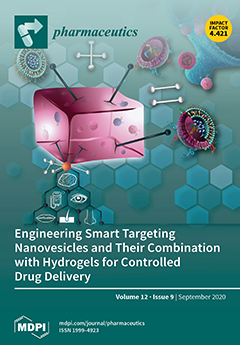
Cover Story: Exosomes are naturally derived nanovesicles that can target specific cells and tissues without particular modifications, whereas liposomes are well-established drug carriers that can deliver heavy loads. These types of nanovesicles present many advantages, but each has its own drawbacks. To overcome their shortcomings, a membrane fusion between exosomes and liposomes can generate superior hybrid nanovesicles. This novel hybrid delivery system can be armed with both the smart targeting behavior of exosomes and the high loading capacity of liposomes. Moreover, to enhance, control, and prolong drug release, these nanovesicles can be loaded in naturally derived hydrogels, which can then be administered in better routes, such as oral, nasal, parenteral, ocular, topical, and brain delivery routes. View this paper.
  • Issues are regarded as officially published after their release is announced to the table of contents alert mailing list .
  • You may sign up for email alerts to receive table of contents of newly released issues.
  • PDF is the official format for papers published in both, html and pdf forms. To view the papers in pdf format, click on the "PDF Full-text" link, and use the free Adobe Reader to open them.

Articles (122)

  • Article
  • Open Access
18 Citations
3,712 Views
37 Pages

Intra-parenchymal injection and delivery of therapeutic agents have been used in clinical trials for brain cancer and other neurodegenerative diseases. The complexity of transport pathways in tissue makes it difficult to envision therapeutic agent di...

  • Article
  • Open Access
104 Citations
8,493 Views
23 Pages

Development and Optimization of Naringenin-Loaded Chitosan-Coated Nanoemulsion for Topical Therapy in Wound Healing

  • Sabah H. Akrawi,
  • Bapi Gorain,
  • Anroop B. Nair,
  • Hira Choudhury,
  • Manisha Pandey,
  • Jigar N. Shah and
  • Katharigatta N. Venugopala

The potential role of naringenin (NAR), a natural flavonoid, in the treatment of chronic wound has prompted the present research to deliver the drug in nanoemulsion (NE) form, where synergistic role of chitosan was achieved through development of chi...

  • Article
  • Open Access
54 Citations
7,191 Views
15 Pages

Selection of Cryoprotectant in Lyophilization of Progesterone-Loaded Stearic Acid Solid Lipid Nanoparticles

  • Timothy M. Amis,
  • Jwala Renukuntla,
  • Pradeep Kumar Bolla and
  • Bradley A. Clark

Cryoprotectants are often required in lyophilization to reduce or eliminate agglomeration of solute or suspended materials. The aim of this study was to select a cryoprotecting agent and optimize its concentration in a solid lipid nanoparticle formul...

  • Article
  • Open Access
9 Citations
5,892 Views
14 Pages

This study tested 15 direct compaction grades to identify the contribution of different grades of mannitol to the storage stability of the resulting tablets. After preparing the model tablets with different values of hardness, they were stored at 25...

  • Communication
  • Open Access
40 Citations
9,071 Views
12 Pages

Franz Cell Diffusion Testing and Quantitative Confocal Raman Spectroscopy: In Vitro-In Vivo Correlation

  • Fotis Iliopoulos,
  • Peter J. Caspers,
  • Gerwin J. Puppels and
  • Majella E. Lane

Previously, we reported the use of Confocal Raman Spectroscopy (CRS) to investigate the topical delivery of actives and excipients. We have also correlated the results from CRS with findings from in vitro diffusion studies in human skin. However, unt...

  • Review
  • Open Access
16 Citations
5,167 Views
31 Pages

In nature, genomes have been optimized by the evolution of their nucleic acid sequences. The design of peptide-like carriers as synthetic sequences provides a strategy for optimizing multifunctional targeted nucleic acid delivery in an iterative proc...

  • Article
  • Open Access
5 Citations
4,528 Views
20 Pages

Imaging of the Effect of Alcohol-Containing Media on the Performance of Hypromellose Hydrophilic Matrix Tablets: Comparison of Direct Compression and Regular Grades of Polymer

  • Nihad Mawla,
  • Sarah Hanley,
  • Karl Walton,
  • Waseem Kaialy,
  • Tariq Hussain,
  • Adam Ward,
  • Jonathan Brown,
  • Barbara R. Conway,
  • Peter Timmins and
  • Kofi Asare-Addo

As the ingestion of drug products with alcohol could have adverse effects on the release of drugs from dosage forms, it is important to understand the mechanisms underpinning the influence on drug release by evaluating the effect of alcohol-containin...

  • Review
  • Open Access
31 Citations
5,793 Views
15 Pages

Porous nanomaterials can be used to load various anti-cancer drugs efficiently and deliver them to a particular location in the body with minimal toxicity. Biodegradable periodic mesoporous organosilica nanoparticles (BPMOs) have recently emerged as...

  • Article
  • Open Access
5 Citations
3,427 Views
20 Pages

Correlation between Elemental Composition/Mobility and Skin Cell Proliferation of Fibrous Nanoclay/Spring Water Hydrogels

  • Fátima García-Villén,
  • Rita Sánchez-Espejo,
  • Ana Borrego-Sánchez,
  • Pilar Cerezo,
  • Lucia Cucca,
  • Giuseppina Sandri and
  • César Viseras

Inorganic hydrogels formulated with spring waters and clay minerals are used to treat musculoskeletal disorders and skin affections. Their underlying mechanism of action for skin disorders is not clear, although it is usually ascribed to the chemical...

  • Review
  • Open Access
44 Citations
10,078 Views
18 Pages

Diabetic foot ulcer (DFU) is currently a global concern and it requires urgent attention, as the cost allocation by the government for DFU increases every year. This review was performed to provide scientific evidence on the advanced biomaterials tha...

of 13

Get Alerted

Add your email address to receive forthcoming issues of this journal.

XFacebookLinkedIn
Pharmaceutics - ISSN 1999-4923