


Abstract
The application of forestry waste as organic mulch on soil represents an increasingly recognized management practice. However, studies on how different mulching strategies regulate soil fertility and microbial community responses remain limited. In this study, a field experiment was conducted in plantation forest soil with four treatments: no mulching, fresh forestry waste mulching, composted mulching, and layered mulching. The results indicated that the layered mulching treatment significantly increased the soil comprehensive fertility index by 6.67% relative to the no mulching treatment. Both composted mulching and layered mulching treatments significantly reduced soil bulk density (2.26%–5.26%), increased pH (0.36%–0.48%) and organic matter content (21.90%–25.23%), and markedly enhanced urease (22.45%–26.41%) and protease activities (51.72%–62.68%). Under fresh forestry waste mulching, soil available phosphorus and available potassium increased by 23.21% and 27.07%, respectively, whereas improvements in the soil comprehensive fertility index, enzyme activities, and microbial communities were limited. Bacterial communities were highly responsive to mulching treatments, with composted mulching and layered mulching treatments significantly altering their structure, while fungal communities were comparatively stable across treatments. RDA and Mantel tests linked bacterial shifts mainly to total nitrogen, available potassium, and bulk density, and fungal variation mainly to total nitrogen (all p < 0.05). This study indicates that a layered mulching strategy simulating forest litter layers can enhance soil fertility and enzyme activity and provides an option for improving soil quality through the utilization of forestry waste.
1. Introduction
Forestry waste refers to woody plant residues generated during forest management. Globally, the scope of what is defined as forestry waste varies slightly among countries and regions, but it generally represents a substantial and increasing stream that warrants greater attention. In the United States, urban forestry waste from annual tree removals and mortality is estimated at 36.2–56.7 million tons per year [1]. In Canada, logging residues in managed forest areas can reach 21 million tons per year [2]. In the EU-28, about 52.9 million tons of wood waste were generated in 2018 [3]. With the rapid expansion of afforestation and greening areas, forestry waste production in China increased substantially from 10.71 million tons in 2003 to 60.97 million tons in 2022 [4]. Incineration and other previously common disposal methods, while posing environmental risks, also cause the loss of valuable forestry biomass resources [5]. In planted forest afforestation projects in urban and peri-urban areas, forestry waste is often collected during routine maintenance and fire prevention management rather than left to accumulate on the forest floor. This management reality makes it necessary to assess feasible pathways for handling forestry waste within planted forests [6]. Recycling forestry waste as surface organic mulch is a sustainable approach that couples biomass valorization with improvement in soil conditions and has been increasingly adopted as a soil conservation practice [7].
Surface organic mulches can improve soil conditions through interacting physical and biogeochemical processes. Their ecological benefits include regulating soil moisture, temperature, and structural properties to enhance water retention and aeration [5]; releasing organic carbon and nutrients during decomposition to promote soil organic matter formation and nutrient availability [8]; and providing substrates and microhabitats that shape microbial activity and community composition, thereby influencing organic matter degradation and nutrient transformation [9].
Different forms of forestry waste mulch may trigger distinct soil responses because compost maturity and nutrient release dynamics differ among materials. Fresh forestry waste mulches, often characterized by relatively high proportions of recalcitrant components and elevated C/N ratios, primarily regulate soil temperature and moisture via physical coverage in the short term but may show limited improvements in soil nutrient status and microbial activity and can promote microbial N immobilization during early decomposition [10]. In contrast, composted mulch, as a stabilized organic material, can directly supply plant-available nutrients, effectively improve soil structure and fertility, and rapidly stimulate microbial activity [11]. Bacteria and fungi exhibit markedly different responses to various types of mulching materials due to their distinct metabolic strategies. Bacterial communities typically respond rapidly to labile carbon inputs and shifts in soil physicochemical conditions. Their structure and potential functions can be reshaped by changes in moisture, aeration, temperature, nutrient availability, and enzyme activity [12]. Conversely, many fungi possess the enzymatic capacity to degrade cellulose and lignin, making them more adapted to large-sized, complex organic substrates; their community dynamics are relatively slow and more dependent on long-term organic matter accumulation [13]. Soil enzyme activities are sensitive functional indicators that link changes driven by mulching in substrate supply and soil conditions to microbial processes and nutrient cycling. Enzymes associated with carbon decomposition such as cellulase and amylase, together with enzymes associated with nitrogen cycling such as urease and protease, can help trace the functional pathways through which forestry waste mulching influences soil function [14].
Neither fresh nor composted mulching alone can effectively balance rapid nutrient release and sustained organic matter accumulation [8,15]. In natural forests, the litter layer typically develops a stratified structure, with fresher material in the upper layer and more decomposed matter beneath. This stratified structure simultaneously supplies stable carbon sources and readily available nutrients, supports both organic matter accumulation and nutrient provision, and regulates the spatial distribution and functional expression of bacterial and fungal communities [16,17]. Simulating the stratification of forest litter layers by applying fresh forestry waste and compost as a layered mulch on the soil surface may provide an effective strategy for improving soil quality [18]. In some agricultural systems, layered surface mulching that leverages the contrasting properties of different materials has also been explored. However, agricultural residues and forestry wastes differ substantially in chemical composition and decomposition dynamics [6]. Therefore, evidence from agricultural layered mulching may not be directly applicable to plantation forest soils. Studies evaluating layered mulching using forestry waste remain scarce, particularly those linking microbial community shifts with enzyme activities and key soil environmental factors [19,20].
Based on the above background, this study aimed to systematically evaluate the effects of different forestry waste mulching strategies on soil fertility, enzyme activity, and the structure and function of microbial communities, while further exploring how microbial communities respond to soil environmental factors. Overall, the layered mulching strategy produced more pronounced improvements in soil fertility, enzyme activities and microbial communities. This suggests that using forestry waste as surface mulch is a practical approach for improving forest soil quality.
2. Materials and Methods
2.1. Experimental Site
This study was conducted in August 2023 in Daxing District, Beijing, China (N39°34′16″, E116°20′42″). The site was a newly established plantation established using transplanted Populus tomentosa seedlings that were two years old. The site is located in southern Beijing on the North China Plain and is characterized by flat terrain with low relief. The region lies in the warm temperate zone and has a semi-humid continental monsoon climate. Air temperature ranged from an extreme minimum of −27.4 °C to an extreme maximum of 40.6 °C, with a mean annual temperature of 11.6 °C. Annual sunshine totaled about 2772 h, with a frost-free period of approximately 209 days and mean annual precipitation of 556 mm. The soil was classified as a Fluvisol with a sandy loam texture. Its physicochemical properties were as follows: pH 8.32, organic matter 8.96 g kg−1, available phosphorus 12.03 mg kg−1, available potassium 146.51 mg kg−1, alkali-hydrolyzable nitrogen 40.26 mg kg−1, and total nitrogen 0.63 g kg−1. All parameters were determined using the methods described in Section 2.4.
2.2. Experimental Design
The experiment used a single-factor experimental design comprising four surface mulching treatments:
- (1)
- CK, no mulching.
- (2)
- W, 6 cm of fresh forestry waste mulching.
- (3)
- G, 6 cm of composted mulching.
- (4)
- GW, layered mulching, consisting of 3 cm of composted mulch as the bottom layer and 3 cm of fresh forestry waste as the top layer.
The mulch thickness was set to 6 cm for all treatments. We selected this thickness because it is widely used in forestry residue mulching studies and it balances field feasibility, material cost, and expected benefits while maintaining consistent treatment comparability.
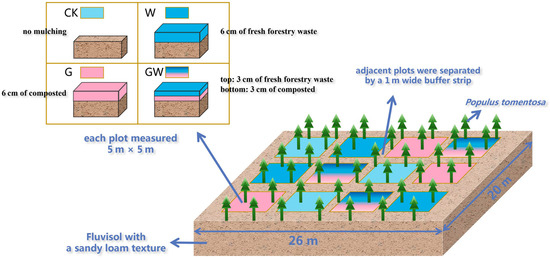
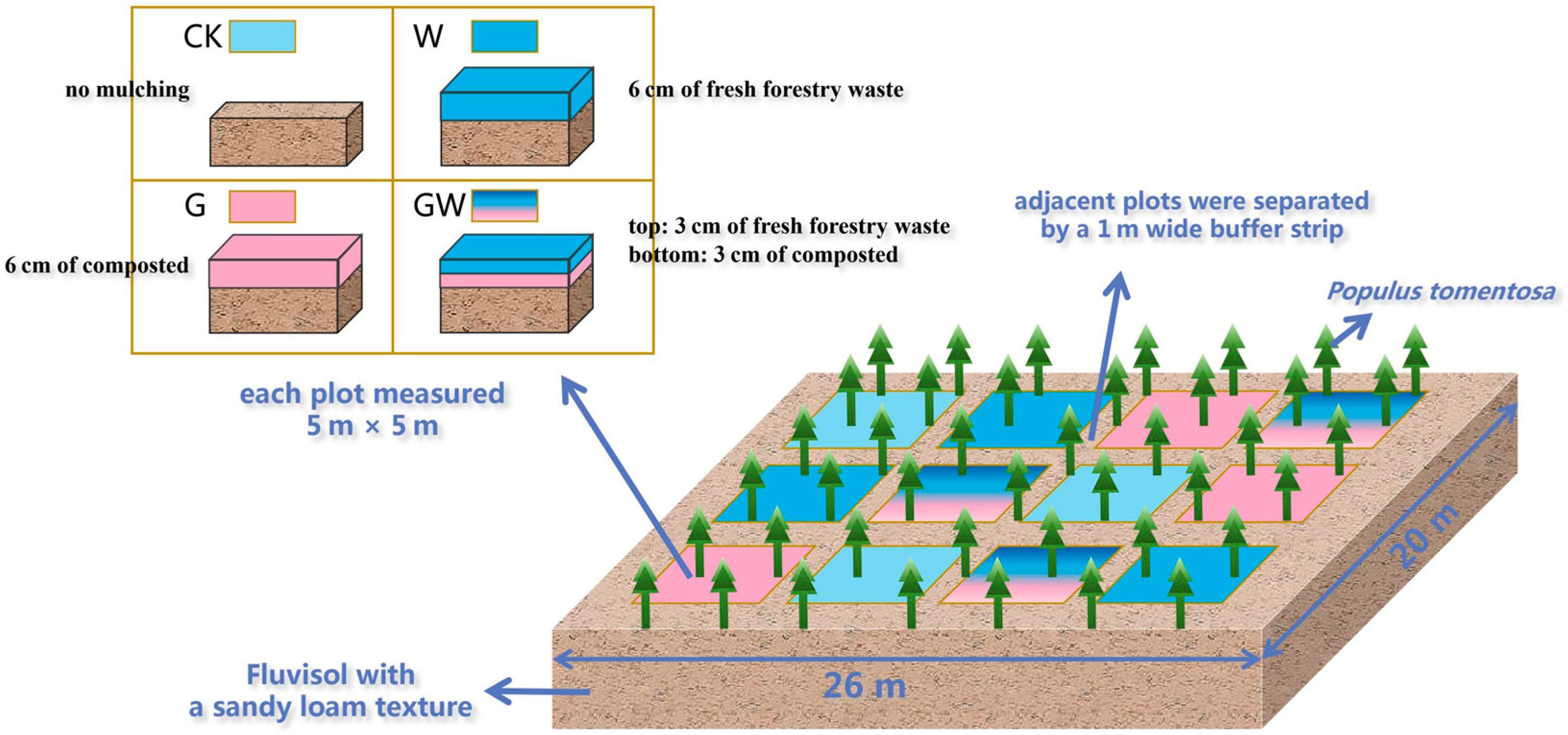
The experiment was arranged in a completely randomized block design (Figure 1), with three replicates for each treatment. The experimental field measured 20 m in width and 26 m in length, containing 12 plots arranged in three rows of four plots each. Each plot measured 5 by 5 m. A 1 m wide buffer strip was placed between adjacent plots, and the experimental field was enclosed by an additional 1.5 m wide buffer strip. These buffer strips were established to minimize boundary effects, and all soil sampling and measurements were conducted within the central area of each plot, excluding the buffer zones. The surface was cleaned uniformly across all plots before treatment application. During the experiment, routine forest farm management was followed and litter was removed regularly to prevent residue accumulation so that no additional litter input interfered with the treatments.
Figure 1.
Plot layout and schematic of four surface mulching treatments.
The fresh forestry waste was collected from routine pruning operations and naturally fallen litter within the managed stand, primarily derived from Populus tomentosa, Sophora japonica, and Ailanthus altissima. The composted mulch was produced through composting of the collected forestry waste. It underwent primary and secondary aerobic fermentation, and the compost was collected after the pile temperature had stabilized at ambient level for one week to ensure maturity before use. The particle size of the fresh forestry waste was approximately 3 cm and that of the composted mulch was 0.2 cm. Their organic matter contents were 429 and 358 g kg−1, and total nitrogen contents were 11.8 and 23.2 g kg−1, respectively. The mulching materials were applied only once at the beginning of the experiment. Throughout the trial, we did not apply any additional forestry waste or compost beyond the initial mulching setup.
2.3. Soil Sample Collection
The 0–10 cm soil layer that is most sensitive to surface mulching treatments was selected as the sampling layer. For each plot, five topsoil subsamples were randomly collected and combined into one sample for analysis. Samples were placed in sterile plastic bags and transported to the laboratory in insulated boxes packed with dry ice. After arrival, samples were split into two portions. One of the two was air-dried and sieved through a 2 mm mesh for physicochemical analyses, and the other was stored at −80 °C for enzyme activity assays and high-throughput DNA sequencing. Enzyme assays and DNA extraction were conducted within one week after sample collection [21].
2.4. Soil Physicochemical Properties
The core method [22] was used to quantify soil bulk density (BD). A pH meter (PHS-3S, INESA, Shanghai, China) was used to measure soil pH in a 1:5 soil-to-water suspension [23]. The potassium dichromate oxidation titration method [23] was used to quantify soil organic matter (SOM). The semi-micro Kjeldahl method [22] was used to quantify total nitrogen (TN). The alkali diffusion method [24] was used to quantify alkali-hydrolyzable nitrogen (AN). The molybdenum antimony colorimetric method [22] was used to quantify available phosphorus (AP). Flame photometry [25] was used to quantify available potassium (AK).
2.5. Soil Enzyme Activities
Urease activity (UR) was assayed by the phenol sodium hypochlorite colorimetric method [26]. Protease activity (PRO) was assayed by a modified casein-based colorimetric method [27]. Amylase activity (AMS) was determined using the iodine colorimetric method [28]. Cellulase activity (CEL) was measured using the 3,5-dinitrosalicylic acid (DNS) method [26].
2.6. Soil Microbial Community
Soil samples were processed for total genomic DNA extraction using the Mag-Bind® Soil DNA Kit (Omega Bio-tek, Norcross, GA, USA). Concentration and purity of extracted DNA were determined with TBS-380 and NanoDrop2000, respectively. DNA extract quality was checked on 1% agarose gel. The DNA extract was fragmented to an average size of about 400 bp using Covaris M220 (Gene Company Limited, Shanghai, China) for paired-end library construction. Paired-end library was constructed using NEXTFLEX Rapid DNA-Seq (Bioo Scientific, Austin, TX, USA). Adapters containing the full complement of sequencing primer hybridization sites were ligated to the blunt ends of fragments. Paired-end sequencing was performed on Illumina NovaSeq (Illumina Inc., San Diego, CA, USA) at Majorbio Bio-Pharm Technology Co., Ltd. (Shanghai, China) using NovaSeq 6000 S4 Reagent Kit v1.5 (300 cycles). Illumina paired-end reads were processed with fastp (v 0.20.0) [29] to remove adapter sequences and exclude low-quality reads, including reads shorter than 50 bp, reads with a quality value below 20, and reads containing N bases. Metagenomic reads were assembled with MEGAHIT (v 1.1.2) [30]. Contigs of 300 bp or longer were retained for downstream analyses. Open reading frames (ORFs) from each assembled contig were predicted using MetaGene [31]. The predicted ORFs with a length ≥ 100 bp were retrieved and translated into amino acid sequences using the NCBI translation table. A non-redundant gene catalog was constructed using CD-HIT [32] (v 4.6.1) with 90% sequence identity and 90% coverage. High-quality reads were aligned to the non-redundant gene catalogs to calculate gene abundance with 95% identity using SOAPaligner [33] (v 2.21). Representative sequences of non-redundant gene catalogs were aligned to the NR database with an e-value cutoff of 1 × 10⁻⁵ using Diamond [34] (v 0.8.35) for taxonomic annotations. The KEGG annotation was conducted using Diamond [34] (v 0.8.35) against the Kyoto Encyclopedia of Genes and Genomes database with an e-value cutoff of 1 × 10⁻⁵. All reagents, instruments, and software were used strictly in accordance with the manufacturers’ protocols. The BioProject accession number for the raw sequencing data is PRJNA1301234, and the data are available in the NCBI Sequence Read Archive, encompassing all 12 samples from this study (SRR34888899–SRR34888910), with the correspondence between accession numbers and treatment groups provided in the SRA metadata.
2.7. Evaluation of Soil Fertility
Soil fertility was comprehensively evaluated using a modified Nemerow composite index method [35,36], and the soil grading standards are shown in Table 1.
Table 1.
Soil fertility indicator grading criteria in a modified Nemerow composite index method.
The calculation formula is shown below:
In the formula (Equation (1)), F denotes the soil comprehensive fertility index, represents the average value of the sub-fertility indices (Table 1), Fimin corresponds to the lowest value across the sub-indices, and n refers to the total number of indicators evaluated. Each measured indicator value was converted to a sub-fertility index Fi by piecewise linear interpolation using the three threshold values xa, xc, and xp in Table 1, with Fi ranging from 0 to 3.
2.8. Soil Enzyme Activity Evaluation
Soil enzyme activity was comprehensively evaluated using the geometric mean of enzyme activities [37,38] (GMea).
The calculation formula is shown below:
In the formula (Equation (2)), UR, PRO, AMS, and CEL represent the activities of urease, protease, amylase, and cellulase, respectively.
2.9. Data Processing
All data were collated in Microsoft Excel 2024 and figures were prepared in Origin 2024b. Soil physicochemical properties, comprehensive fertility indices, enzyme activities and their geometric means, alpha diversity indices, and KEGG pathway abundances were compared among treatments by one-way ANOVA and LSD post hoc testing in IBM SPSS Statistics 25 (p < 0.05), without additional correction for multiple comparisons. The Shapiro–Wilk test and Levene’s test were applied to evaluate normality and homogeneity of variances, respectively, and both ANOVA assumptions were satisfied. Alpha diversity indices, including ACE, Chao1, Shannon, Simpson, and Pielou, were calculated in mothur (v.1.30.2). Pearson correlations (SPSS 25) were calculated to explore relationships between soil properties and enzyme activities and between environmental variables and microbial communities [39]; Spearman correlations (SPSS 25) assessed associations between environmental factors and individual taxa [40]. Microbial community dissimilarities (Bray–Curtis) were visualized by PCoA and group differences were tested with ANOSIM in R 4.2.3. We used R 4.2.3 to perform redundancy analysis (RDA) and Mantel tests to assess microbial community responses to environmental variables [14,18]. A linear regression was fitted in Python (v 2.7.0) to test the relationship between microbial functional diversity and taxonomic diversity indices.
3. Results
3.1. Effects of Forestry Waste Mulching on Soil Physicochemical Properties and Fertility
Forestry waste mulching treatments altered soil physicochemical properties and fertility. Both G and GW treatments significantly increased SOM and pH and reduced BD relative to CK (p < 0.05). The G treatment also significantly enhanced AK (Table 2). By contrast, the W treatment significantly affected the content of rapidly available nutrients, decreasing AN while increasing AP and AK (p < 0.05), but it showed no significant differences from CK in other soil properties.
Table 2.
Surface soil physicochemical properties under different forestry waste mulching treatments (means ± standard error, n = 3).
Evaluation of the soil comprehensive fertility index showed that the treatments ranked as GW (1.12) > G (1.11) > W (1.09) > CK (1.05), all falling within the medium fertility range (Table 3). Among them, both the GW and G treatments produced a significantly higher fertility index than CK (p < 0.05). Across treatments, SOM, TN, and AN showed comparatively low fertility coefficients of 0.64–1.09, which were significantly below those of the other fertility indicators (p < 0.05).
Table 3.
Comprehensive fertility index values for the surface soil under different forestry waste mulching treatments using the modified Nemerow composite index method.
3.2. Effects of Different Mulching Treatments on Soil Enzyme Activities
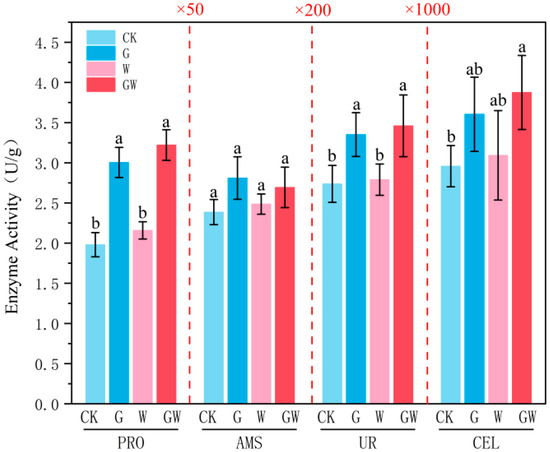
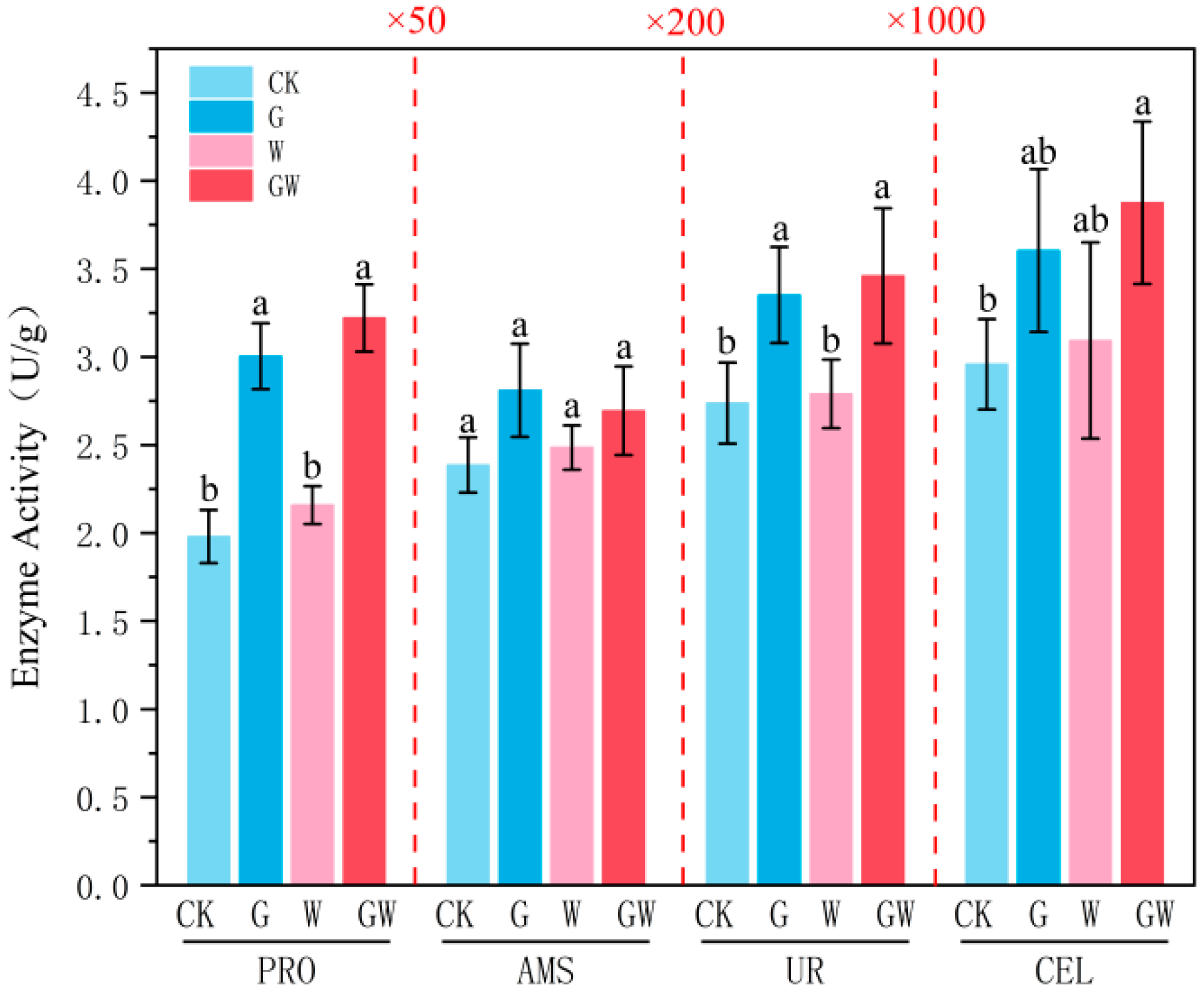
Mulching treatments involving compost application significantly enhanced soil enzyme activities. Both the G and GW treatments markedly increased the activities of UR and PRO. Compared with CK, UR increased by 22.45% and 26.41%, while PRO rose by 51.72% and 62.68% under the G and GW treatments, respectively (p < 0.05). In addition, the G treatment significantly increased AMS activity by 17.77% relative to CK, and the GW treatment significantly increased CEL activity by 31.34% relative to CK (p < 0.05). However, none of the four enzyme activities under the W treatment showed significant differences compared with CK (Figure 2).
Figure 2.
Effects of different forestry waste mulching treatments on surface soil enzyme activities. PRO: protease activity; AMS: α-amylase activity; UR: urease activity; CEL: cellulase activity. Error bars represent standard errors (SEs) based on three replicates (n = 3). For each enzyme, bars labeled with different lowercase letters differ significantly (LSD test; p < 0.05). Red dashed lines indicate the scaling factors applied to the vertical axis for enzyme activity values in the bar plots.
Soil enzyme activity was further assessed using the geometric mean of enzyme activities (GMea), with index values of 140, 145, 180, and 184 for CK, W, G, and GW, respectively. The GMea indices for G and GW were significantly higher than those of CK and W (p < 0.01).
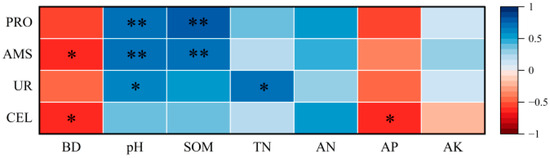
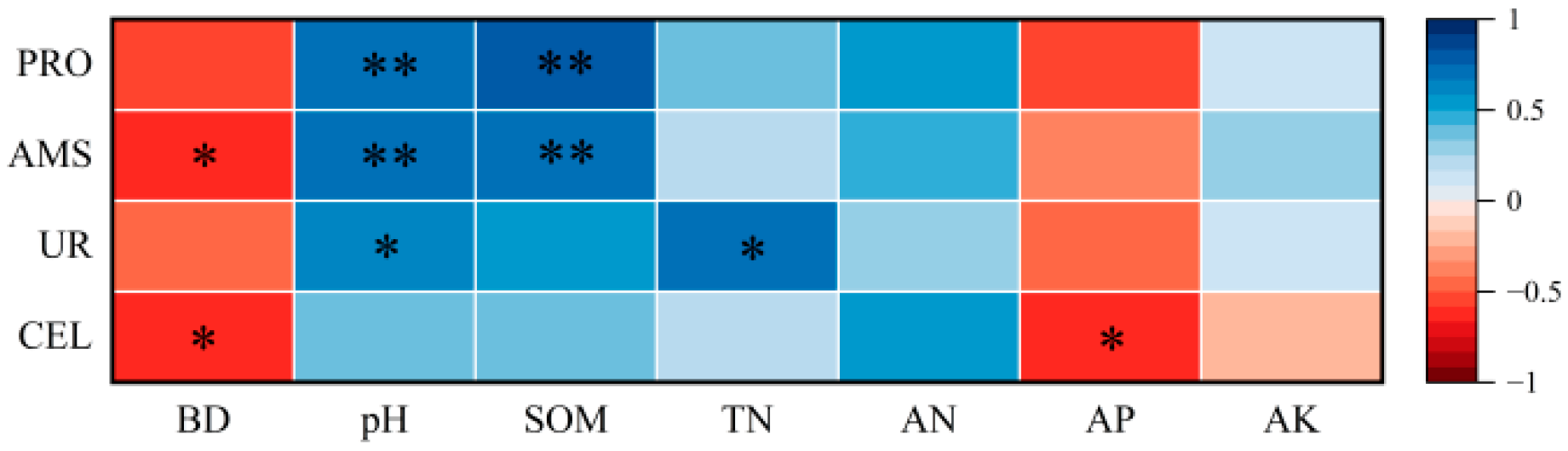
Pearson correlation analysis showed that PRO was highly positively correlated with pH and SOM (p < 0.01). AMS was significantly negatively correlated with BD (p < 0.05) and strongly positively correlated with pH and SOM (p < 0.01). UR showed significant positive correlations with pH and TN (p < 0.05). No significant correlations were observed between AN or AK and any of the four enzyme activities (Figure 3).
Figure 3.
Pearson correlation analysis between surface soil enzyme activities and environmental factors. Color intensity indicates the magnitude of Pearson’s correlation coefficient (r). Asterisks (*) and (**) denote significance at p < 0.05 and p < 0.01, respectively.
3.3. Effects of Different Mulching Treatments on Soil Microbial Diversity and Community Structure
Forestry waste mulching treatments had differential effects on the alpha diversity of soil microbial communities. For bacterial communities, the W, G, and GW treatments significantly reduced diversity indices (Shannon index decreased by 1.97%–2.39%; Simpson index increased by 33.83%–47.43%) and the evenness index (Pielou index decreased by 1.92%–2.33%; p < 0.05), while no significant effects were observed on richness indices (ACE, Chao1). For fungal communities, except the GW treatment, which significantly decreased the evenness index (Pielou index decreased by 0.09%–2.74%), none of the treatments caused significant changes in species richness or diversity indices. This indicates that the alpha diversity of the fungal communities was relatively insensitive to forestry waste mulching treatments (Table 4).
Table 4.
Surface soil bacterial and fungal community alpha diversity indices among forestry waste mulching treatments.
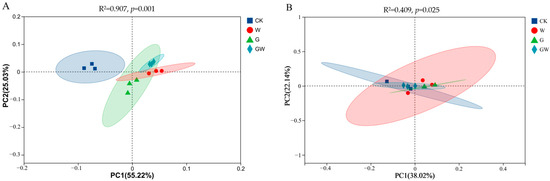
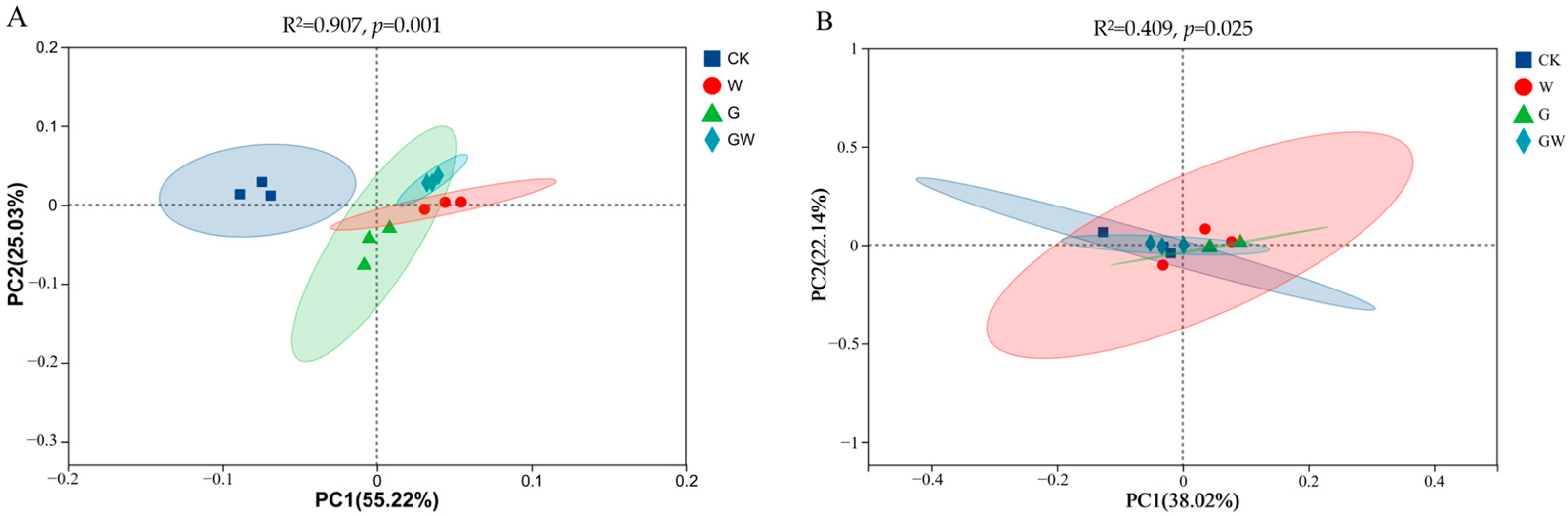
Treatment-related variation in soil microbial community composition was further characterized by PCoA and ANOSIM using the Bray–Curtis dissimilarity matrix (Figure 4). At the phylum level of bacterial communities, PC1 and PC2 together explained 80.25% of the variation, and differences among treatments were highly significant (p < 0.01). The bacterial community structures under CK and W treatments were clearly separated from those of G and GW, with minimal overlap between the two groups. In contrast, G and GW treatments showed substantial overlap, indicating high structural similarity. At the class level of fungal communities, PC1 and PC2 explained 60.16% of the total variation, and significant differences among groups were observed (p < 0.05). Unlike bacterial communities, fungal communities exhibited lower differentiation among treatments. Nonetheless, a certain degree of separation was still evident between CK and the mulched treatments, particularly for W, which showed large intra-group variation. Overall, bacterial communities responded more strongly to mulching treatments than fungal communities.
Figure 4.
Surface soil bacterial (A) and fungal (B) community structure across forestry waste mulching treatments shown by principal coordinates analysis (PCoA). Ellipses represent 95% confidence intervals.
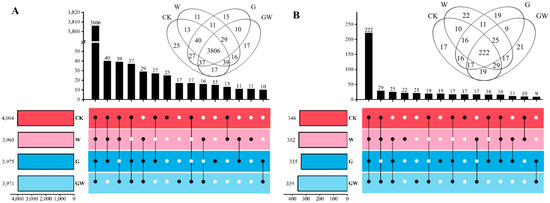
Mulching treatments altered the soil microbial community taxonomic composition. Genus level counts showed that the numbers of bacterial genera detected in CK, W, G, and GW were 4004, 3965, 3975, and 3971, respectively, while the corresponding numbers for fungal genera were 346, 352, 335, and 359. Across all treatments, 3806 bacterial genera were shared. The number of unique bacterial genera, ranked from highest to lowest, was CK > GW > G > W, with 25, 17, 15, and 11 genera uniquely detected in each treatment, respectively (Figure 5A). For fungi, 222 genera were common to all treatments. The number of unique fungal genera ranked as W > GW > G > CK, with 22, 21, 19, and 17 genera found exclusively in each treatment, respectively (Figure 4B).
Figure 5.
Shared and unique species analysis of surface soil bacterial (A) and fungal (B) communities among forestry waste mulching treatments. In the UpSet plot, bars represent the numbers of species in each combination of treatments and black dots and connecting lines indicate the corresponding treatment groups.
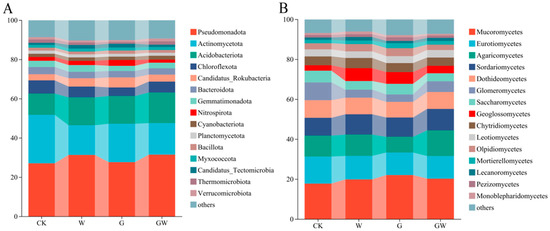
Forestry waste mulching treatments altered the abundance of dominant soil microbial taxa. Soil bacterial and fungal communities’ taxonomic classifications were used to identify the dominant bacterial phyla and fungal classes within the top 15 by relative abundance. At the phylum level, the dominant bacterial groups were Pseudomonadota (27.01%–31.44%), Actinomycetota (15.15%–24.71%), and Acidobacteriota (10.87%–15.61%). Compared with CK, all mulching treatments exhibited a consistent shift in dominant bacterial phyla, characterized by increases in Pseudomonadota and Acidobacteriota and a decrease in Actinomycetota (Figure 6A). At the class level, the dominant fungal groups were Mucoromycetes (17.72%–22.00%) and Eurotiomycetes (11.29%–13.55%). Compared with CK, all mulching treatments consistently increased the abundance of Mucoromycetes while reducing that of Eurotiomycetes (Figure 6B).
Figure 6.
Among forestry waste mulching treatments, the top-15 phyla of bacterial (A) and classes of fungal (B) groups in surface soil are ranked by relative abundance. Remaining low-abundance groups are combined as “others”.
3.4. Microbial Community Responses to Environmental Factors
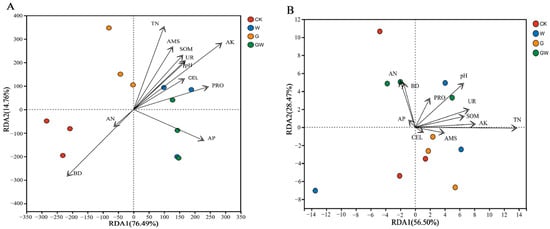
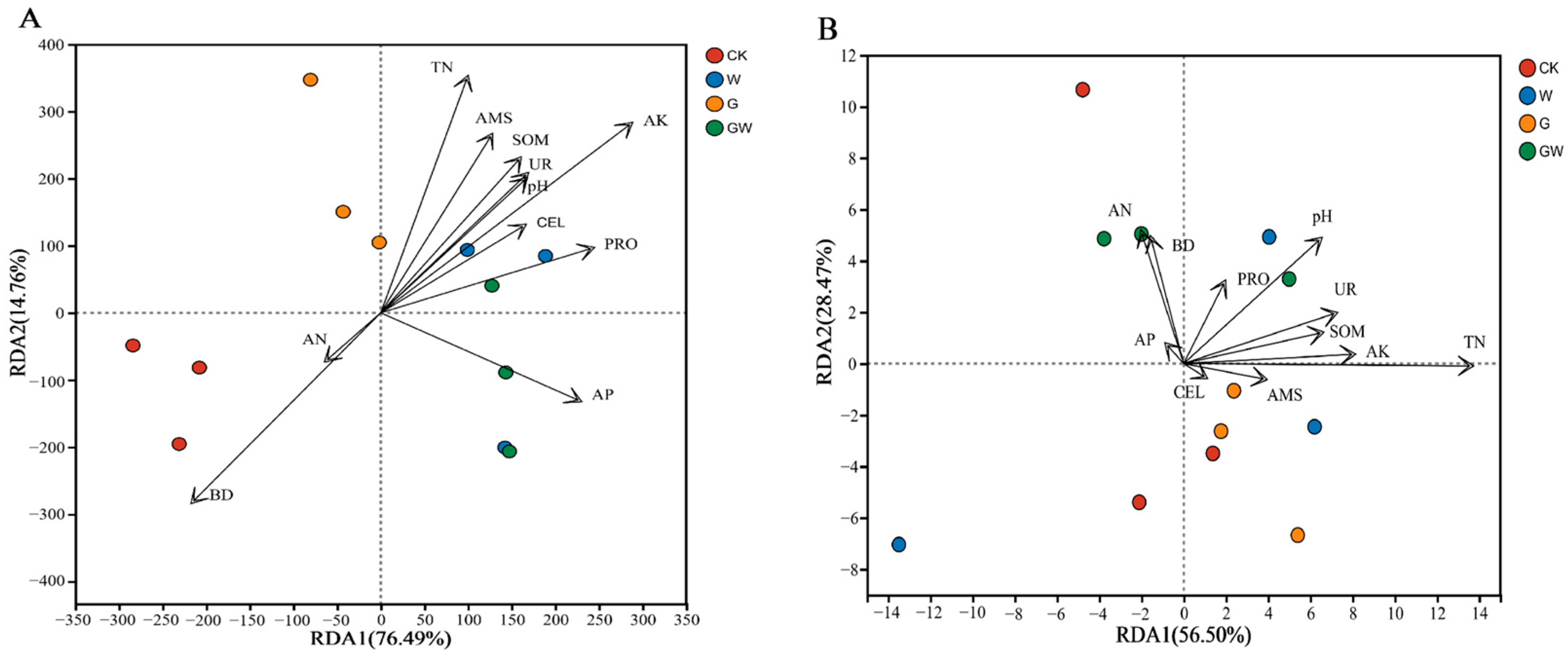
Different soil environmental factors had distinct effects on the structure of bacterial and fungal communities (Figure 7). Redundancy analysis (RDA) showed that bacterial community structure exhibited a strong response to environmental factors, with a total explained variance of 91.19%. Of the variation, 76.49% was explained by the RDA1 axis and 14.70% by the RDA2 axis. In the bacterial community, TN, AK, and BD were the main influencing factors (Figure 7A), with permutation tests indicating that AK was significant (p = 0.02), while TN (p = 0.057) and BD (p = 0.083) showed marginal effects. For the fungal community, the total explained variance was 84.97%, of which 56.50% was explained by the RDA1 axis and 28.47% by the RDA2 axis (Figure 7B). Unlike bacterial communities, fungal communities were significantly associated with TN (p = 0.002).
Figure 7.
(A) RDA of bacterial community structure; (B) RDA of fungal community structure. The length of the arrows represents the strength of environmental factor effects and the direction indicates their projection on the RDA axes. Points represent samples and are colored according to treatments.
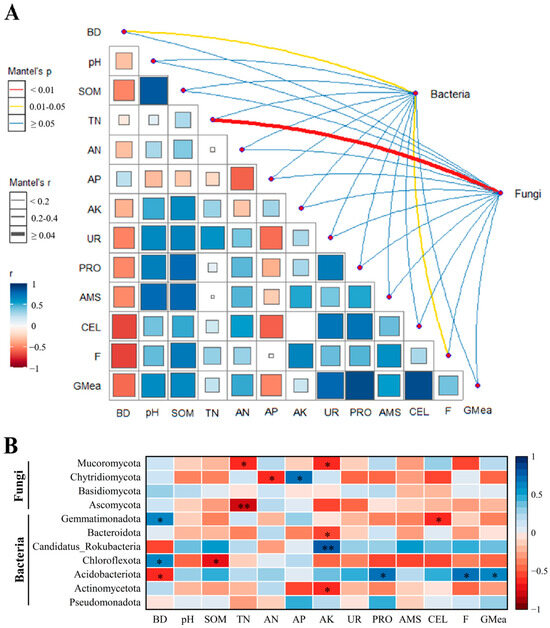
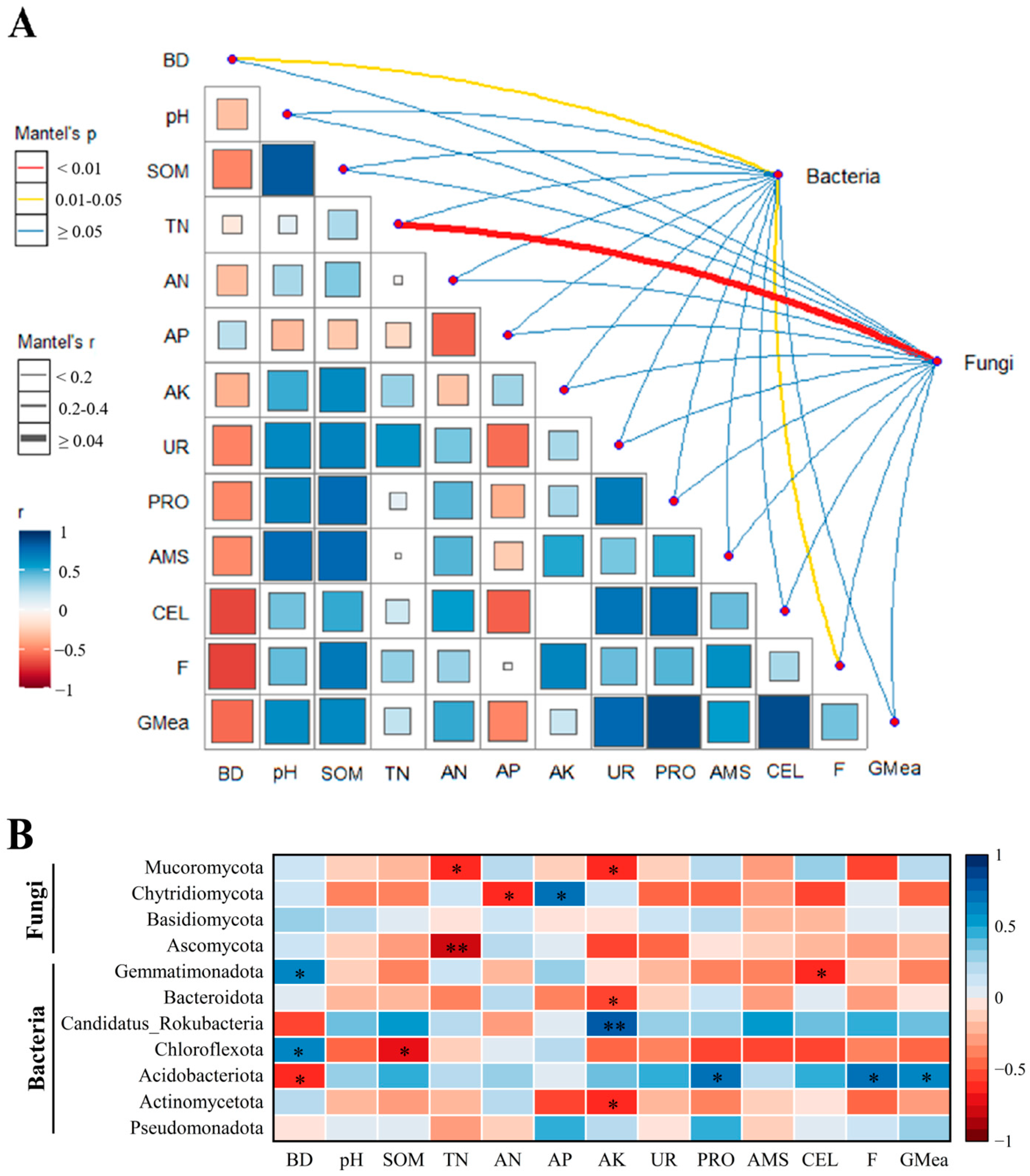
The Mantel test further confirmed that microbial communities were significantly associated with specific environmental factors (Figure 8A). Bacterial communities were significantly correlated with BD and F (p < 0.05), while fungal communities showed a highly significant correlation with TN (p < 0.01). In addition, Spearman correlation analysis revealed the response patterns of dominant microbial taxa to environmental factors (Figure 8B). The results showed that, except for pH, UR, and AMS, the remaining factors had significant effects on some dominant microbial taxa. For example, AK significantly suppressed Mucoromycota, Bacteroidota, and Actinomycetota (p < 0.05), but strongly promoted Candidatus Rokubacteria (p < 0.01).
Figure 8.
(A) Mantel test and correlation matrix between environmental factors, soil enzyme activities, and fertility indices. (B) Spearman correlation heatmap between dominant microbial taxa and environmental factors (* p < 0.05, ** p < 0.01).
3.5. Effects of Different Mulching Treatments on Soil Microbial Community Function Gene Abundance
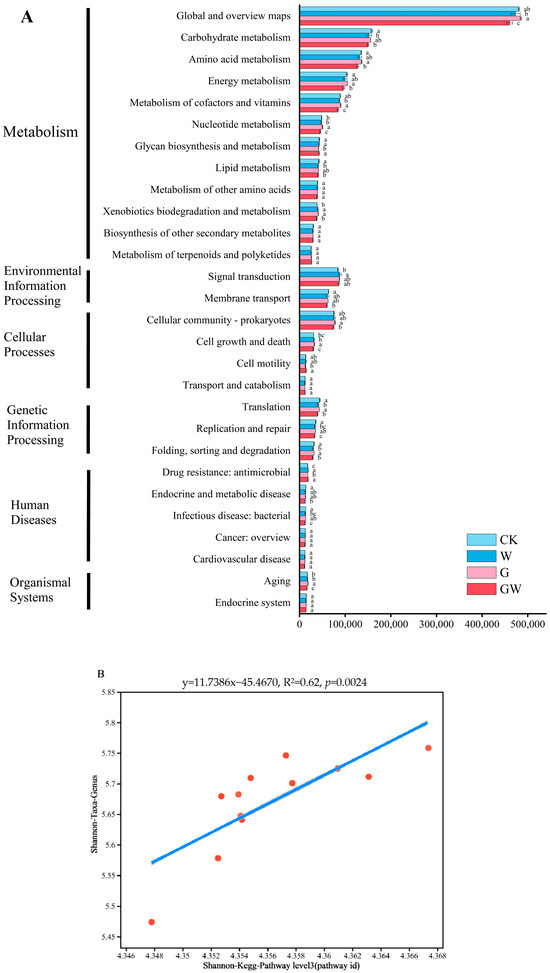
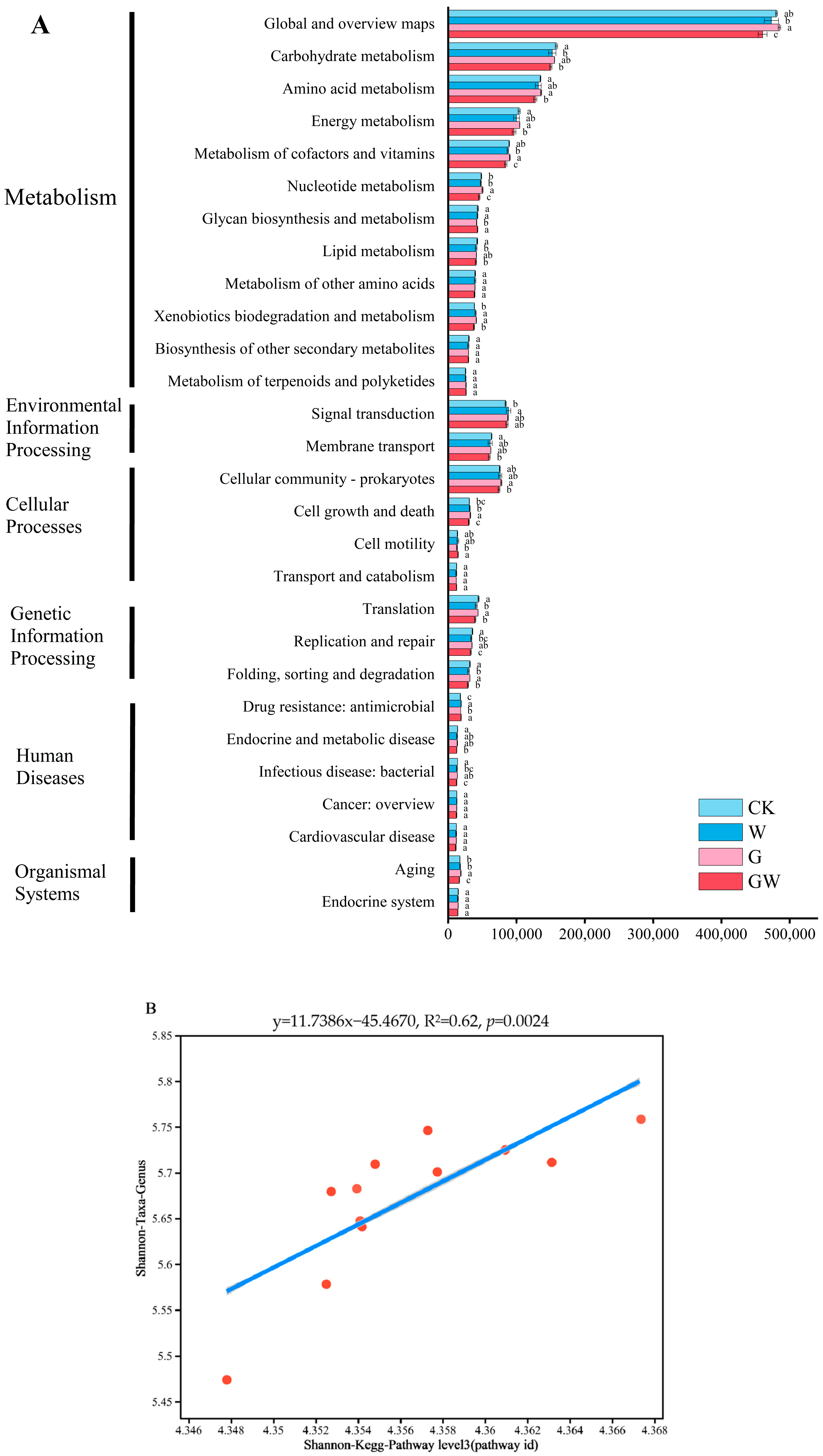
In the KEGG functional annotation results, metabolism-related pathways showed the highest functional gene abundance in soil microbial communities under forestry waste mulching treatments. The next most abundant functional categories were environmental information processing, cellular processes, and genetic information processing (Figure 9A). Several core metabolic pathways exhibited significant differences in gene abundance among forestry waste mulching treatments. The G treatment showed higher gene abundance in most metabolic pathways, particularly in carbon metabolism, amino acid metabolism, and energy metabolism, with a significantly higher gene abundance than the W and GW treatments (p < 0.05). The functional gene abundance of W in metabolic pathways was generally similar to CK, whereas GW exhibited a significantly lower gene abundance in most pathways compared to other treatments. Further regression analysis indicated a highly significant positive correlation between microbial functional diversity and species diversity indices (p < 0.01; Figure 9B).
Figure 9.
(A) Abundance diagram of KEGG functional pathway for surface soil microbial communities under forestry waste mulching treatments. (B) Linear regression analysis between species diversity and functional diversity indices of soil bacterial communities. Different lowercase letters indicate significant differences among treatments (p < 0.05; LSD test).
4. Discussion
4.1. Forestry Waste Mulching Improves Soil Physicochemical Properties and Enhances Fertility
Forestry waste mulching treatments generally improved soil physical properties. Among the treatments, G and GW had the most pronounced effects, both significantly reducing BD. This pattern is likely related to the fine particle size and higher organic matter content of the composted mulch, which can facilitate aggregate formation and increase soil porosity. These characteristics promote the formation of soil aggregates, increase porosity, and improve aeration and water retention capacity [11,41,42]. The W treatment, because of its loose structure and slow decomposition rate, had limited short-term effects on improving physical properties [43].
According to the comprehensive soil fertility evaluation, all treatments fell within the medium fertility range. This indicates that, under the conditions of this study, soil nitrogen content and organic matter accumulation remain the main limiting factors for improving the soil comprehensive fertility index. Moreover, significant differences among mulching treatments were observed in terms of soil nutrient supply. Among them, the GW and G treatments significantly improved the comprehensive soil fertility index, showing a more balanced nutrient regulation effect and greater application potential [11,24]. The G and GW treatments involving compost significantly improved the pH and organic matter content of surface soil. A likely explanation is that humified components in compost provided abundant organic matter that could sustain a relatively stable nutrient supply and was of great importance for long-term soil improvement [43]. The improvement effect of the W treatment was mainly reflected in the increase in available nutrients. It significantly enhanced AP and AK contents, which was mainly due to the rapid release of soluble organic matter and easily decomposable components, indicating a short-term nutrient supply advantage. However, it significantly reduced AN content, which may reflect microbes temporarily retaining available N while decomposing fresh forestry waste with a high C/N ratio in the initial stage [44].
4.2. Differences in Soil Enzyme Activities Under Forestry Waste Mulching Treatments May Be Driven by the Chemical Characteristics of the Mulching Materials
This study demonstrated that both compost-involved treatments significantly increased the activities of UR and PRO, indicating that the incorporation of mature organic matter enhanced nitrogen and protein turnover [45,46]. This pattern could result from compost having a lower C/N ratio and more soluble organic N which can provide readily available substrates and energy for the microbial synthesis of nitrogen-cycling enzymes [47]. Additionally, AMS increased in G, which may have been related to the more labile carbon substrates in compost that favor carbohydrate-hydrolyzing microbial activity. CEL activity was higher in GW, which may have been related to continuous cellulose inputs from the upper fresh forestry waste layer combined with the more stabilized compost layer, together creating a decomposition gradient that supported cellulolytic microbial activity [23,48]. However, the G treatment did not significantly enhance CEL activity, likely because most of the cellulose and hemicellulose had already been decomposed during composting, leaving fewer polymeric substrates to induce CEL enzyme production.
In contrast, although W increased the levels of available nutrients, it did not significantly enhance enzyme activities, which may have been closely related to the chemical characteristics of the mulching material [11]. Forestry waste typically has a high C/N ratio and is rich in lignin and cellulose, making it difficult to supply sufficient readily available substrates and energy sources for microbial enzyme synthesis in the short term [49]. High C/N organic materials can increase microbial demand for N during early decomposition, potentially constraining investment in extracellular enzyme production under short-term conditions. This results in a marked short-term mismatch between nutrient release and enzyme activity enhancement [40]. Such a mismatch may help explain why the W treatment showed limited stimulation of enzyme activities during the study period, despite increases in available nutrients.
The comprehensive evaluation based on the GMea also indicated that G and GW treatments were markedly more effective than the others in enhancing overall enzyme activity [39]. Pearson correlation analysis further identified pH and organic matter content of surface soil as the main drivers of enzyme activity. The activities of PRO, AMS, and UR were all highly positively correlated with both parameters, highlighting the key roles of organic matter accumulation and alkaline pH in enhancing enzyme activity [50]. In addition, BD showed a significant negative association with AMS and CEL activities, suggesting that improved physical properties also facilitate microbial metabolism and enzyme expression [23].
4.3. Forestry Waste Mulching Regulates Soil Microbial Diversity and Community Structure
Forestry waste mulching treatments exerted significant regulatory effects on bacterial diversity and community structure in soil. Although soil organic matter and nutrient contents increased under mulching treatments, bacterial diversity decreased. Combined with the changes in bacterial community composition, this suggests that resource enrichment promoted the dominance of specific fast-growing taxa, rather than enhancing the overall community diversity [51]. G and GW treatments introduced stable organic matter, supplied degradable substrates, and modulated soil pH, thereby creating favorable microhabitats for specific bacterial taxa and driving community restructuring [11].
In comparison, fungal communities exhibited greater structural stability, with limited changes in diversity and community composition in response to forestry waste mulching treatments [52]. This stability may have stemmed from the broader substrate adaptability and slower successional dynamics of fungi, which help maintain a relatively unchanged community structure under short-term mulching interventions. Moreover, the alkaline background of the study soil may have contributed to this pattern. The initial soil pH was 8.32 and the pH changed only slightly among treatments, which may have limited rapid fungal turnover [53]. By contrast, bacterial communities were more responsive to the mulching treatments, suggesting that bacteria are more sensitive to changes in soil environmental conditions [54].
The regulatory mechanisms of forestry waste mulching were further elucidated by changes in microbial community composition. In the bacterial community, the relative abundances of Pseudomonadota and Acidobacteriota generally increased, while Actinomycetota significantly declined, which was closely associated with organic carbon inputs and pH regulation [51]. Pseudomonadota and Acidobacteriota are r-strategists that rapidly exploit labile carbon sources and thrive in nutrient-rich, elevated-pH environments, leading to their rapid enrichment under mulching treatments [51]. In contrast, Actinomycetota, as typical K-strategists, are adapted to recalcitrant substrates and perform better in high C/N, nutrient-poor conditions, which explains their decline in the short term [55]. The fungal community, however, exhibited only minor structural changes, indicating greater substrate adaptability and slower community turnover [17].
4.4. Response of Soil Microbial Communities to Environmental Factors
Forestry waste mulching significantly altered the structure of the soil microbial communities by regulating soil physicochemical properties and enzyme activities. Bacterial communities exhibited greater sensitivity to environmental variables, with TN, AK, and BD identified as key drivers of community variation [8]. This suggests that bacterial communities possess strong adaptive capacity to changes in nutrient availability and physical soil conditions. In contrast, fungal community dynamics were primarily regulated by nitrogen levels, indicating a higher degree of nutrient dependence [54]. This divergence reflects the fundamental differences between bacteria and fungi in terms of carbon substrate utilization strategies, metabolic traits, and rates of community succession [56].
4.5. Changes in Soil Microbial Functional Gene Abundance Driven by Forestry Waste Mulching
Alterations in microbial functional pathway composition reflected how the mulching treatment methods altered the ecological functional potential of the soil system. KEGG functional annotation revealed that microbial gene abundance under all treatments was mainly concentrated in metabolism-related pathways, particularly carbon metabolism, amino acid metabolism, and energy metabolism, which are directly linked to organic matter decomposition, nitrogen transformation, and microbial energy supply, respectively, highlighting their central role in soil nutrient cycling [57]. The G treatment significantly enhanced the abundance of functional genes in various metabolic pathways, suggesting that stable organic input and substrate supply activated microbial metabolism and enhanced the soil’s nutrient cycling potential [58,59].
Notably, in most core metabolic pathways, gene abundance in the GW treatment remained at a relatively low level, which appears to contradict its enhancement of soil fertility and enzyme activities. However, a decline in metabolic gene abundance does not necessarily imply a reduction in the community’s metabolic capacity; rather, it can be consistent with reduced functional redundancy and a shift toward functional specialization within the microbial community [60]. Such structural reorganization could help improve metabolic efficiency, which may partly explain the enhanced soil fertility and enzyme activity observed under the GW treatment. This interpretation is consistent with the functional differentiation framework supported by previous studies [19,54,61]. The GW treatment, by simulating the structure of forest floor litter layers, established a vertical configuration of “fresh top layer–composted bottom layer”, potentially creating a spatial functional partitioning similar to “decomposition–nutrient separation” [45]. The upper layer of fresh forestry waste stimulates extracellular enzyme secretion and initiates organic matter decomposition, while the lower composted mulch primarily contributes to nutrient retention and organic carbon accumulation [11,18]. Within this vertically stratified system, distinct ecological partitioning may reduce functional redundancy and be associated with greater functional specificity, which could contribute to the lower abundance of genes related to central metabolic pathways in the surface soil [62,63]. Similar differentiation has been reported in stratified organic systems where microorganisms allocate functions along resource gradients [19,62]. Nevertheless, this explanation should still be regarded as a plausible hypothesis that is not directly supported by functional measurements, and further metatranscriptomic or enzyme kinetic evidence would be required to verify this mechanism.
In addition, this study found a significant positive correlation between microbial community diversity and functional gene abundance, indicating a strong coupling between structural shifts and functional potential in microbial communities [64]. Under the GW treatment, the microbial community structure was substantially restructured, along with undergoing differentiation in functional gene composition, which may have contributed to the formation of a more efficient and stable functional network [57]. This functional compartmentalization mechanism of the microbial community induced by layered mulching has been clearly documented in forest floor litter layers and is considered a key process contributing to carbon stabilization and ecological stability in soils [65]. Therefore, the layered mulching practice shows great promise for sustainable and science-based soil management [57]. In this study, it increased soil enzyme activity and short-term nutrient availability and may have also promoted short-term organic carbon accumulation in surface soil by simulating the functional coupling of forest litter layers [57]. Furthermore, long-term monitoring combined with metabolomic and co-occurrence network analysis may further clarify microbial contributions to ecosystem functioning under stratified mulching.
5. Conclusions
This study demonstrated that applying forestry waste mulches derived from forestry waste to the surface soils of artificial forests can improve the comprehensive soil fertility index and soil enzyme activities while also altering microbial community structure and functional potential. Bacterial communities responded more strongly than fungal communities to the mulching treatments, and their compositional variation was mainly associated with total nitrogen, available potassium, and bulk density. Among all treatments, the layered mulching showed the most pronounced effects in improving soil comprehensive fertility and enzyme activity and also elicited a distinct response from the microbial community. The “fresh-on-top, composted-on-bottom” vertical structure induced the microbial community to develop a functionally coupled mechanism of “decomposition–nutrient segregation”, which not only enhanced soil fertility but also may have promoted short-term soil organic carbon accumulation in the surface soil. Therefore, this composite mulching strategy that simulates forest litter layers shows good application potential under similar site conditions. It supports soil improvement and forestry residue recycling and it merits wider adoption and further investigation.
Author Contributions
Conceptualization, Z.F., Y.Z., S.L., and X.S.; methodology, Z.F., Y.Z., S.L., and X.S.; software, Z.F.; validation, Z.F.; formal analysis, Z.F. and Y.Z.; investigation, Z.F. and Y.Z.; resources, Z.F., Y.Z., J.C., S.L., and X.S.; data curation, Z.F. and Y.Z.; writing—original draft preparation, Z.F.; writing—review and editing, Z.F., Y.Z., J.C., S.L., and X.S.; visualization, Z.F.; supervision, J.C., S.L., and X.S.; project administration, Z.F., Y.Z., and J.C.; funding acquisition, Y.Z., S.L., and X.S. All authors have read and agreed to the published version of the manuscript.
Funding
This research was funded by the Forestry Science and Technology Extension Project of the State Forestry Administration ([2012] 39), and by the Beijing Municipal Forestry and Parks Bureau under the project Research and Demonstration of Key Technologies for the Application of Organic Mulch in Landscape Construction (2019-KJC-02-13).
Data Availability Statement
Due to issues related to data copyright, authors will make this material available upon request to interested researchers.
Conflicts of Interest
The authors declare no conflicts of interest.
References
- Nowak, D.J.; Greenfield, E.J.; Ash, R.M. Annual biomass loss and potential value of urban tree waste in the United States. Urban For. Urban Green. 2019, 46, 126469. [Google Scholar] [CrossRef] [Scilit]
- Barrette, J.; Paré, D.; Manka, F.; Guindon, L.; Bernier, P.; Titus, B. Forecasting the Spatial Distribution of Logging Residues across the Canadian Managed Forest. Can. J. For. Res. 2018, 48, 1470–1481. [Google Scholar] [CrossRef] [Scilit]
- Kiesnere, G.; Atstaja, D.; Cudecka-Purina, N.; Susniene, R. The Potential of Wood Construction Waste Circularity. Environments 2024, 11, 231. [Google Scholar] [CrossRef] [Scilit]
- Song, B.; Han, X.; Li, Y.; Huang, W.; Fang, Q.; Ren, X.; Li, H. Dynamic spatio-temporal patterns and driving factors of green waste generation based on provincial panel data in China. Front. Environ. Sci. 2025, 13, 1530769. [Google Scholar] [CrossRef] [Scilit]
- Malone, Z.; Berhe, A.A.; Ryals, R. Impacts of organic matter amendments on urban soil carbon and soil quality: A meta-analysis. J. Clean. Prod. 2023, 419, 138148. [Google Scholar] [CrossRef] [Scilit]
- Zheng, Y.; Cao, J.; Wang, Y.; Wei, Y.; Tian, Y.; Wang, Y. Response of Soil Properties, Bacterial Community Structure, and Function to Mulching Practices in Urban Tree Pits: A Case Study in Beijing. Forests 2025, 16, 1573. [Google Scholar] [CrossRef] [Scilit]
- Yao, X.; Wang, X.; Zheng, S.; Zhao, H.; Ju, J.; Wang, C. Research on composting of garden waste and its application in cultivation substrates. Sustainability 2024, 16, 8216. [Google Scholar] [CrossRef] [Scilit]
- Small, G.E.; Smedsrud, M.; Jimenez, I.; Chapman, E. Simulating the fate of compost-derived nutrients in an urban garden. Ecol. Model. 2023, 483, 110441. [Google Scholar] [CrossRef] [Scilit]
- Terrile, R.; Martinez, N.; Paz, N.; Brunotto, F.; Costa, M.; Budai, N.; Ruiz, C.; Rizzi, M.; Invernizzi, M.; Scarpeci, T.; et al. Urban food waste for soil amendment? Analysis and characterisation of waste-based compost for soil fertility management in agroecological horticultural production systems in the city of Rosario, Argentina. Front. Sustain. Food Syst. 2024, 8, 1338451. [Google Scholar] [CrossRef] [Scilit]
- Jia, P.; Huang, Y.; Chen, M.; Qi, X.; Hou, H. Comprehensive evaluation of spent mushroom substrate–chicken manure co-composting by garden waste improvement: Physicochemical properties, humification process, and the spectral characteristics of dissolved organic matter. Environ. Sci. Pollut. Res. 2022, 30, 8987–8997. [Google Scholar] [CrossRef] [Scilit]
- Wang, D.; Li, S.; Sun, X.; Hao, D.; Li, Y.; Wang, H. Effects of compost application of green waste on soil properties: A meta-analysis. Sustainability 2024, 16, 8877. [Google Scholar] [CrossRef] [Scilit]
- Siles, J.A.; García-Sánchez, M.; Gómez-Brandón, M. Studying microbial communities through co-occurrence network analyses during processes of waste treatment and in organically amended soils: A review. Microorganisms 2021, 9, 1165. [Google Scholar] [CrossRef] [Scilit]
- Cao, T.; Zhang, Q.; Chen, Y.; Li, Q.; Fang, Y.; Luo, Y.; Duan, C.; Chen, Q.; Song, X.; Tian, X. Enlarging interface reverses the dominance of fungi over bacteria in litter decomposition. Soil Biol. Biochem. 2024, 198, 109543. [Google Scholar] [CrossRef] [Scilit]
- Liu, B.; Dai, Y.; Cheng, X.; He, X.; Bei, Q.; Wang, Y.; Zhou, Y.; Zhu, B.; Zhang, K.; Tian, X.; et al. Straw mulch improves soil carbon and nitrogen cycle by mediating microbial community structure and function in the maize field. Front. Microbiol. 2023, 14, 1217966. [Google Scholar] [CrossRef] [Scilit]
- Liang, C.; Schimel, J.P.; Jastrow, J.D. The importance of anabolism in microbial control over soil carbon storage. Nat. Microbiol. 2017, 2, 17105. [Google Scholar] [CrossRef] [Scilit]
- Li, J.; Zhang, H.; Zheng, L. Influence of organic amendments based on garden waste for microbial community growth in coastal saline soil. Sustainability 2023, 15, 5038. [Google Scholar] [CrossRef] [Scilit]
- Wang, X.; He, X.; Liang, J. Succession of microbial community during the co-composting of food waste digestate and garden waste. Int. J. Environ. Res. Public Health 2022, 19, 9945. [Google Scholar] [CrossRef] [Scilit]
- Zhou, W.; Sun, X.; Li, S.; Qu, B.; Zhang, J. How organic mulching influences the soil bacterial community structure and function in urban forests. Microorganisms 2024, 12, 520. [Google Scholar] [CrossRef] [Scilit] [PubMed]
- Li, W.; Liu, X.; Xia, Q.; Gao, Z.; Zheng, W.; Zhai, B.; Yang, Z. Untargeted metabolomics to study changes in soil microbial community in response to tillage practices. Appl. Soil Ecol. 2024, 199, 105409. [Google Scholar] [CrossRef] [Scilit]
- Li, Y.; Chen, J.; Dong, Q.; Feng, H.; Siddique, K.H. Plastic mulching significantly improves soil enzyme and microbial activities without mitigating gaseous N emissions in winter wheat–summer maize rotations. Field Crops Res. 2022, 286, 108630. [Google Scholar] [CrossRef] [Scilit]
- Del Duca, S.; Aponte, C.; Trasar-Cepeda, C.; Vitali, F.; Esposito, A.; Pastorelli, R.; Bragato, G.; Fornasier, F.; Sagova-Mareckova, M.; Suhadolc, M.; et al. Effects of sample storage conditions on agricultural soil bacterial diversity and functionality. Appl. Soil Ecol. 2025, 212, 106218. [Google Scholar] [CrossRef] [Scilit]
- Yan, C.; An, D.; Zhao, B.; Ma, Z.; Ma, H.; Zhao, Q.; Kong, R.; Su, J. Intercropping herbage promoted the availability of soil phosphorus and improved the bacterial genus structure and the abundance of key bacterial taxa in the acidic soil of mango (Mangifera indica L.) orchards. Soil Use Manag. 2024, 40, e13046. [Google Scholar] [CrossRef] [Scilit]
- Bai, W.; Wang, G.; Shang, G.; Xu, L.; Wang, Z. Effects of experimental warming on soil enzyme activities in an alpine swamp meadow on the Qinghai-Tibetan Plateau. Pedobiologia 2023, 101, 150910. [Google Scholar] [CrossRef] [Scilit]
- Sun, X.; Wang, G.; Ye, Y.; Ma, Q.; Guan, Q.; Jones, D.L. Response of nitrogen fractions in the rhizosphere and bulk soil to organic mulching in an urban forest plantation. J. For. Res. 2021, 32, 2577–2588. [Google Scholar] [CrossRef] [Scilit]
- Wu, Z.; Ma, S.; Lu, J.; Ye, H.; Yang, D.; Hong, M. Vertical distribution and driving mechanisms of soil microarthropods in a Stipa baicalensis meadow steppe under long-term nitrogen addition. Ecol. Indic. 2024, 159, 111732. [Google Scholar] [CrossRef] [Scilit]
- Jat, H.; Datta, A.; Choudhary, M.; Sharma, P.; Dixit, B.; Jat, M.L. Soil enzymes activity: Effect of climate smart agriculture on rhizosphere and bulk soil under cereal based systems of north-west India. Eur. J. Soil Biol. 2021, 103, 103292. [Google Scholar] [CrossRef] [Scilit] [PubMed]
- Jesmin, T.; Margenot, A.J.; Mulvaney, R.L. A comprehensive method for casein-based assay of soil protease activity. Commun. Soil Sci. Plant Anal. 2021, 53, 507–520. [Google Scholar] [CrossRef] [Scilit]
- Malcheva, B.; Nustorova, M.; Zhiyanski, M.; Yaneva, R.; Abakumov, E. Microbial biomass carbon and enzymes-degraders of carbohydrates in polar soils from the area of Livingston Island, Antarctica. Soil Sci. Annu. 2022, 73, 156042. [Google Scholar] [CrossRef] [Scilit]
- Chen, S.; Zhou, Y.; Chen, Y.; Gu, J. fastp: An ultra-fast all-in-one FASTQ preprocessor. Bioinformatics 2018, 34, i884–i890. [Google Scholar] [CrossRef] [Scilit]
- Li, D.; Liu, C.M.; Luo, R.; Sadakane, K.; Lam, T.W. MEGAHIT: An ultra-fast single-node solution for large and complex metagenomics assembly via succinct de Bruijn graph. Bioinformatics 2015, 31, 1674–1676. [Google Scholar] [CrossRef] [Scilit]
- Noguchi, H.; Park, J.; Takagi, T. MetaGene: Prokaryotic gene finding from environmental genome shotgun sequences. Nucleic Acids Res. 2006, 34, 5623–5630. [Google Scholar] [CrossRef] [Scilit] [PubMed]
- Fu, L.; Niu, B.; Zhu, Z.; Wu, S.; Li, W. CD-HIT: Accelerated for clustering the next-generation sequencing data. Bioinformatics 2012, 28, 3150–3152. [Google Scholar] [CrossRef] [Scilit]
- Li, R.; Yu, C.; Li, Y.; Lam, T.W.; Yiu, S.M.; Kristiansen, K.; Wang, J. SOAP2: An improved ultrafast tool for short read alignment. Bioinformatics 2009, 25, 1966–1967. [Google Scholar] [CrossRef] [Scilit]
- Buchfink, B.; Xie, C.; Huson, D.H. Fast and sensitive protein alignment using DIAMOND. Nat. Methods 2015, 12, 59–60. [Google Scholar] [CrossRef] [Scilit]
- Li, Q.; Yang, J.; Guan, W.; Liu, Z.; He, G.; Zhang, D.; Liu, X. Soil fertility evaluation and spatial distribution of grasslands in Qilian Mountains Nature Reserve of eastern Qinghai-Tibetan Plateau. PeerJ 2021, 9, e10986. [Google Scholar] [CrossRef] [Scilit] [PubMed]
- Zhou, W.; Wang, W.J.; Zhang, B.; Xiao, L.; Lv, H.; He, X. Soil fertility evaluation for urban forests and green spaces in Changchun City. Acta Ecol. Sin. 2017, 37, 1211–1220. [Google Scholar] [CrossRef] [Scilit]
- Lemanowicz, J.; Haddad, S.A.; Bartkowiak, A.; Lamparski, R.; Wojewódzki, P. The role of an urban park’s tree stand in shaping the enzymatic activity, glomalin content and physicochemical properties of soil. Sci. Total Environ. 2020, 741, 140446. [Google Scholar] [CrossRef] [Scilit]
- Ghosh, A.; Singh, A.; Kumar, R.; Manna, M.C.; Bhattacharyya, R.; Rahman, M.M.; S.harma, P.; Rajput, P.S.; Misra, S. Soil enzymes and microbial elemental stoichiometry as bio-indicators of soil quality in diverse cropping systems and nutrient management practices of Indian Vertisols. Appl. Soil Ecol. 2020, 145, 103304. [Google Scholar] [CrossRef] [Scilit]
- Duanyuan, H.; Zhou, T.; He, Z.; Peng, Y.; Lei, J.; Dong, J.; Wu, X.; Wang, J.; Yan, W. Effects of straw mulching on soil properties and enzyme activities of Camellia oleifera–Cassia intercropping agroforestry systems. Plants 2023, 12, 3046. [Google Scholar] [CrossRef] [Scilit]
- Wild, B.; Li, J.; Pihlblad, J.; Bengtson, P.; Rütting, T. Decoupling of priming and microbial N mining during a short-term soil incubation. Soil Biol. Biochem. 2019, 129, 71–79. [Google Scholar] [CrossRef] [Scilit]
- Maselesele, D.; Ogola, J.B.; Murovhi, R.N. Macadamia husk compost improved physical and chemical properties of a sandy loam soil. Sustainability 2021, 13, 6997. [Google Scholar] [CrossRef] [Scilit]
- Fornes, F.; Lidón, A.; Belda, R.M.; Macan, G.P.F.; Cayuela, M.L.; Sánchez-García, M.; Sánchez-Monedero, M.A. Soil fertility and plant nutrition in an organic olive orchard after 5 years of amendment with compost, biochar or their blend. Sci. Rep. 2024, 14, 16606. [Google Scholar] [CrossRef] [Scilit] [PubMed]
- Rossi, G.; Beni, C.; Neri, U. Organic mulching: A sustainable technique to improve soil quality. Sustainability 2024, 16, 10261. [Google Scholar] [CrossRef] [Scilit]
- Li, J.; Hoang, K.T.K.; Hassan, N.; Marschner, P. Vermicompost influences soil P pools and available N—Effect of placement and combination with inorganic fertiliser. J. Soil Sci. Plant Nutr. 2019, 19, 900–905. [Google Scholar] [CrossRef] [Scilit]
- Sun, X.; Ye, Y.; Liao, J.; Soromotin, A.V.; Smirnov, P.V.; Kuzyakov, Y. Organic mulching increases microbial activity in urban forest soil. Forests 2022, 13, 1352. [Google Scholar] [CrossRef] [Scilit]
- Fan, Z.; Lu, S.; Liu, S.; Li, Z.; Hong, J.; Zhou, J.; Peng, X. The effects of vegetation restoration strategies and seasons on soil enzyme activities in the Karst landscapes of Yunnan, southwest China. J. For. Res. 2019, 31, 1949–1957. [Google Scholar] [CrossRef] [Scilit]
- Sun, X.; Ye, Y.; Ma, Q.; Guan, Q.; Jones, D.L. Variation in enzyme activities involved in carbon and nitrogen cycling in rhizosphere and bulk soil after organic mulching. Rhizosphere 2021, 19, 100376. [Google Scholar] [CrossRef] [Scilit]
- Ruch, B.; Hefner, M.; Sradnick, A. Excessive nitrate limits the sustainability of deep compost mulch in organic market gardening. Agriculture 2023, 13, 1080. [Google Scholar] [CrossRef] [Scilit]
- Xie, Y.; Zhou, L.-L.; Dai, J.; Chen, J.; Yang, X.; Wang, X.; Wang, Z.; Feng, L. Effects of the C/N ratio on the microbial community and lignocellulose degradation during branch waste composting. Bioprocess Biosyst. Eng. 2022, 45, 1163–1174. [Google Scholar] [CrossRef] [Scilit]
- Piotrowska-Długosz, A.; Kobierski, M.; Długosz, J. Enzymatic activity and physicochemical properties of soil profiles of Luvisols. Materials 2021, 14, 6364. [Google Scholar] [CrossRef] [Scilit]
- Sun, X.; Ye, Y.; Liao, J.; Tang, Y.; Wang, D.; Guan, Q. Organic mulching alters the composition, but not the diversity, of rhizosphere bacterial and fungal communities. Appl. Soil Ecol. 2021, 168, 104167. [Google Scholar] [CrossRef] [Scilit]
- Xu, D.; Ling, J.; Qiao, F.; Xi, P.; Zeng, Y.; Zhang, J.; Lan, C.; Jiang, Z.; Peng, A.; Li, P. Organic mulch can suppress litchi downy blight through modification of soil microbial community structure and functional potentials. BMC Microbiol. 2022, 22, 155. [Google Scholar] [CrossRef] [Scilit]
- Rousk, J.; Brookes, P.C.; Bååth, E. Investigating the mechanisms for the opposing pH relationships of fungal and bacterial growth in soil. Soil Biol. Biochem. 2010, 42, 926–934. [Google Scholar] [CrossRef] [Scilit]
- Wang, Y.; Liu, L.; Luo, Y.; Awasthi, M.K.; Yang, J.; Duan, Y.; Li, H.; Zhao, Z. Mulching practices alter the bacterial–fungal community and network in favor of soil quality in a semiarid orchard system. Sci. Total Environ. 2020, 725, 138527. [Google Scholar] [CrossRef] [Scilit] [PubMed]
- Shang, W.; Razavi, B.S.; Yao, S.; Hao, C.; Kuzyakov, Y.; Blagodatskaya, E.; Tian, J. Contrasting mechanisms of nutrient mobilization in rhizosphere hotspots driven by straw and biochar amendment. Soil Biol. Biochem. 2023, 187, 109212. [Google Scholar] [CrossRef] [Scilit]
- Kravchenko, I.; Tikhonova, E.; Semenov, V. Temperature sensitivity of litter and soil organic matter decomposition: Perspective of soil microbial community structure and function. In Microbes in Land Use Change Management; Kuzyakov, Y., Razavi, B.S., Eds.; Academic Press: London, UK, 2021; pp. 1–43. [Google Scholar] [CrossRef] [Scilit]
- Liu, Y.; Liu, R.; Feng, Z.; Hu, R.; Zhao, F.; Wang, J. Regulation of wheat growth by soil multifunctionality and metagenomic-based microbial functional profiles under mulching treatments. Sci. Total Environ. 2024, 920, 170881. [Google Scholar] [CrossRef] [Scilit] [PubMed]
- Guo, K.; Li, G.; Wu, P.; Yue, Y.; Liu, X.; Lv, Z.; Zhang, J. Compost-induced changes in microbial community reinforce the ecosystem functioning of sandy loam soil in China. Soil Use Manag. 2024, 40, e13145. [Google Scholar] [CrossRef] [Scilit]
- Wang, Y.; Huang, Q.; Liu, C.; Ding, Y.; Liu, L.; Tian, Y.; Wu, X.; Li, H.; Awasthi, M.K.; Zhao, Z. Mulching practices alter soil microbial functional diversity and benefit to soil quality in orchards on the Loess Plateau. J. Environ. Manag. 2020, 271, 110985. [Google Scholar] [CrossRef] [Scilit]
- Ramond, P.; Galand, P.E.; Logares, R. Microbial functional diversity and redundancy: Moving forward. FEMS Microbiol. Rev. 2025, 49, fuae031. [Google Scholar] [CrossRef] [Scilit]
- Cui, Y.; Zhang, Y.; Duan, C.; Wang, X.; Zhang, X.; Ju, W.; Chen, H.; Yue, S.; Wang, Y.; Li, S.; et al. Ecoenzymatic stoichiometry reveals microbial phosphorus limitation decreases the nitrogen cycling potential of soils in semi-arid agricultural ecosystems. Soil Tillage Res. 2020, 197, 104463. [Google Scholar] [CrossRef] [Scilit]
- Zhang, N.; Sainju, U.M.; Zhao, F.; Ghimire, R.; Ren, C.; Liang, Y.; Yang, C.-D.; Wang, J. Mulching decreased the abundance of microbial functional genes in phosphorus cycling under maize. Appl. Soil Ecol. 2023, 187, 104833. [Google Scholar] [CrossRef] [Scilit]
- Tian, L.; Zhang, F.; Zhang, L.; Gao, X.-L.; Feng, B. Use of metagenomics and metabolomics to quantify changes in rhizosphere soil microbial function in response to mulching regimes. Land Degrad. Dev. 2023, 34, 3033–3048. [Google Scholar] [CrossRef] [Scilit]
- Pan, J.; Li, Y.; Zhang, R.; Tian, D.; Wang, P.; Song, L.; Quan, Q.; Chen, C.; Niu, S.; Zhang, X.; et al. Soil microbial gene abundance rather than diversity and network complexity predominantly determines soil multifunctionality in Tibetan alpine grasslands along a precipitation gradient. Funct. Ecol. 2024, 38, 1210–1221. [Google Scholar] [CrossRef] [Scilit]
- Babur, E.; Dindaroğlu, T.; Riaz, M.; Uslu, O.S. Seasonal variations in litter layers’ characteristics control microbial respiration and microbial carbon utilization under mature pine, cedar, and beech forest stands in the eastern Mediterranean karstic ecosystems. Microb. Ecol. 2022, 84, 153–167. [Google Scholar] [CrossRef] [Scilit] [PubMed]

Disclaimer/Publisher’s Note: The statements, opinions and data contained in all publications are solely those of the individual author(s) and contributor(s) and not of MDPI and/or the editor(s). MDPI and/or the editor(s) disclaim responsibility for any injury to people or property resulting from any ideas, methods, instructions or products referred to in the content. |
© 2026 by the authors. Licensee MDPI, Basel, Switzerland. This article is an open access article distributed under the terms and conditions of the Creative Commons Attribution (CC BY) license.