
Skip to Content

Materials

Materials is an international peer-reviewed, open access journal on materials science and engineering published semimonthly online by MDPI.
The Spanish Materials Society (SOCIEMAT), Manufacturing Engineering Society (MES) and Chinese Society of Micro-Nano Technology (CSMNT) are affiliated with Materials and their members receive discounts on the article processing charges.
Indexed in PubMed | Quartile Ranking JCR - Q2 (Metallurgy and Metallurgical Engineering | Physics, Applied | Physics, Condensed Matter)

Get Alerted

Add your email address to receive forthcoming issues of this journal.

All Articles (56,073)

This study examined the foaming characteristics of asphalt and their effects on the performance of cold recycled mixtures. The expansion ratio and half-life were used to evaluate effects of asphalt type, foaming temperature, and water content. The influence of asphalt content, gradation, cement content, curing time, and mixing water on mechanical properties and water stability was analyzed. The results indicate that asphalt type is the key factor affecting foaming performance. CNOOA asphalt showed optimal foaming at 160 °C with 2% water, achieving an expansion ratio of 27 and a half-life over 30 s. Optimal asphalt contents for gradations A and B are 3.5% and 2.5%, respectively. A 1.5% cement content provides the best performance balance. Dry and wet indirect tensile strengths increased by 91.18% and 205.56% after 3-day curing. The optimal mixing water ranges are 60–90% and 70–80% of optimum moisture content for gradations A and B. Curing time has the most significant influence on performance, followed by cement and asphalt content. This study provides a theoretical basis for optimizing foamed asphalt cold recycling.

18 May 2026
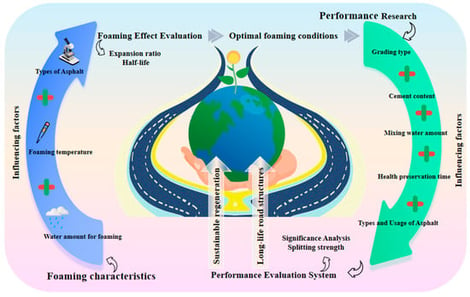
Technical Flow Chart.

Calcium leaching is a key degradation mechanism governing the long-term durability of cement-based materials, particularly in marine environments where multi-ionic interactions significantly alter dissolution behavior. In this study, the solid–liquid equilibrium of calcium in hardened Portland cement exposed to NaCl solution and artificial seawater was experimentally established. A wide range of equilibrium states was achieved by varying the liquid-to-solid ratio, and the corresponding aqueous chemistry and phase assemblage were characterized using ICP-AES, XRD, and SEM-EDS. The results show that both NaCl solution and seawater substantially increase the equilibrium calcium concentration compared to deionized water, with a much stronger effect observed in seawater. In NaCl solution, the equilibrium relationship follows a classical three-stage decalcification process. In contrast, seawater induces coupled dissolution–precipitation reactions due to the presence of Mg2+ and SO42−, leading to rapid and extensive decalcification within a narrow calcium concentration range. The findings provide important experimental evidence for improving thermodynamic models and predicting the long-term degradation of Portland cement concrete in marine environments.

18 May 2026

The thermodynamic equilibrium relationship between the calcium ions in solution ((a) deionized water [7], (b) 6 mol/L ammonium nitrate solution [13]) and the average Ca/Si molar ratio of solid products in hardened Portland cement paste. (For (a), different symbols denote experimental data from various literature sources, and the solid line represents the fitted curve.).

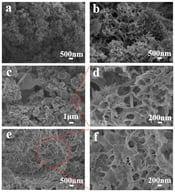
This study presents a hierarchical conductive-network strategy to overcome the performance trade-off in cement structural supercapacitors (CSSCs). By incorporating one-dimensional carbon nanotubes (CNTs) and two-dimensional graphene oxide (GO) into Portland cement, we simultaneously enhance its electrochemical and mechanical properties. The approach exploits the complementary roles of the two nanomaterials: CNTs establish a three-dimensional percolation network that facilitates electron transport, while GO promotes formation of a denser calcium silicate hydrate (C-S-H) gel and refines the pore structure by complexing with calcium ions, thereby improving ionic pathways. The k12gc sample attains a specific capacitance of 66.8 F g−1 at 0.1 mA cm−2, a 58.4% rise in conductivity and a 63% reduction in charge-transfer resistance. At the same time, the composite reduces harmful macropores by 27.9% and strengthens the material, with compressive and flexural strengths increasing by 4.8% and 8.3%, respectively. This work establishes a rational design principle based on functional division between CNTs and GO for developing high-performance, multifunctional CSSCs.

18 May 2026

SEM images of each sample: (a) k12, (b) k12c, (c) low-magnification and (d) high-resolution image of k12g, (e) low-magnification and (f) high-resolution image of k12gc.

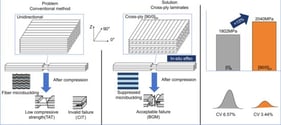
Compression testing of high-performance carbon fiber composites remains challenging due to premature failure modes in unidirectional laminates, which can underestimate true material strength. This study investigates the compressive behavior of T800-grade carbon fiber-reinforced polymer (CFRP) cross-ply ([90/0]2s) and unidirectional ([0]8) laminates using finite element simulation and experimental testing following the SACMA SRM-1R-94 standard, combined with macroscopic and microscopic failure analysis. The results show that cross-ply laminates consistently exhibit valid mid-gauge failure with lower data dispersion (coefficient of variation: 3.44%), whereas unidirectional laminates are prone to invalid root failures (crushing or shear). The compressive strength derived from cross-ply laminates using the back-out factor (2040 MPa) is 13% higher than that from direct unidirectional testing (1802 MPa), attributed to the in situ effect where adjacent 90-degree plies suppress fiber microbuckling. The cross-ply approach provides a more reliable and practical method for characterizing the true in situ compressive strength of high-performance CFRP composites.

18 May 2026

Longitudinal stress distribution in (a) unidirectional and (b) cross-ply laminates.

News & Conferences

Volumes

Latest Issues

Open for Submission

Editor's Choice

XFacebookLinkedIn
Materials - ISSN 1996-1944