


Abstract
Power management strategies for microgrids are typically designed around quantitative performance metrics such as cost, efficiency, and reliability. While effective in many settings, these approaches often do not fully account for qualitative, human-centric considerations, such as the relative importance or criticality of different loads. This limitation is especially relevant in remote or community-based energy systems, and becomes more pronounced in wind-powered microgrids, where variable generation and limited resources require flexible and context-aware operational decisions. In this work, a qualitative-driven power management framework is proposed that incorporates stakeholder-defined qualitative indices into microgrid energy allocation. A community–importance (CI) index is used to represent qualitative needs as normalized weighting factors, which are then used to guide power redistribution during supply–demand imbalances. The framework is demonstrated using a wind-powered microgrid with heterogeneous load types and is evaluated under different operating scenarios. The results show that the proposed approach supports prioritized and socially informed power allocation while preserving overall system feasibility. Rather than replacing conventional quantitative optimization, the framework acts as a complementary decision-support layer and is particularly well suited for microgrids serving remote or resource-constrained communities where qualitative priorities play an important role in operational planning.
1. Introduction
The growing use of renewable energy sources and the increasing complexity of energy systems have made power management more challenging, particularly in areas with limited or unreliable grid access. In these settings, energy must often be allocated under constrained and variable supply conditions. Most existing power management approaches rely on quantitative metrics such as load demand, efficiency, or cost [1,2]. While these methods are effective from a technical standpoint, they often do not reflect qualitative, human-centered considerations that influence how energy services are prioritized in real communities.
Recent work in socio-technical energy systems and community-based microgrid planning has shown that qualitative factors, such as the relative importance of services or stakeholder priorities, can play a meaningful role in energy decision-making [3,4]. This is especially relevant for wind-powered microgrids, where fluctuating generation requires trade-offs between technical performance and community needs. However, many existing approaches consider qualitative aspects only at a high planning level or lack a clear and structured way to incorporate them into operational power allocation.
This paper presents a qualitative-driven power management framework for microgrids that incorporates human-centered priorities directly into energy allocation decisions. Human needs are described using three dimensions—community importance, level of satisfaction, and power intensity—to support prioritized allocation of limited energy resources. Our study advances prior work and illustrates the practical use of the proposed framework through a wind-powered microgrid case study. The proposed framework is particularly relevant for wind-powered microgrids in remote or infrastructure-limited environments, where renewable generation and storage must be managed carefully to meet essential community needs. By integrating qualitative priorities into operational decision-making, the framework complements conventional quantitative approaches and supports more context-aware and socially informed power management. This work establishes a systematic foundation for integrating qualitative priorities into operational power management and provides a basis for future comparative and application-specific studies.
2. Related Works
As energy systems shift toward increasingly decentralized, renewable, and community-based models [5], understanding qualitative needs in energy management is becoming more important [6]. Traditional ways of optimizing energy systems are often purely quantitative (on numerical indicators such as cost, efficiency, and/or reliability), and do not include the social and contextual factors that influence how energy use supports individual and community well-being [7,8]. In real-world microgrids, particularly in remote or constrained resource settings, energy allocation is not just a technical decision; it is also a discussion about the wants and priorities of the community [9,10]. For example, whether to continue or cut off an electricity service, when allowed energy is limited, depends on priorities related to safety, education, or comfort—in other words, what cannot be defined as a numerical demand. In these contexts, understanding the qualitative dimensions of electricity users makes better decisions that enable operational control to align with social priorities, giving the limited energy supply a better chance at support- QoL and resilience, instead of purely optimized electrical performance. Early studies on rural electrification consistently show that the value of electricity extends beyond technical reliability to include quality-of-life improvements, economic activity, education, and social well-being [11,12]. These findings establish that energy access functions as a socio-technical enabler rather than a purely engineering outcome.
Building on this foundation, recent studies have turned to decentralized energy systems—specifically microgrids—where similar social and qualitative considerations are important for their success over the long term [13,14]. For instance, Raman et al. [15] show through community surveys, that perceptions of fairness and priority concerning energy distribution were critical to the community acceptability and effectiveness of a microgrid. Similarly, Tamasiga et al. [16] systematically review renewable microgrids and find that while technical feasibility is a requirement for microgrid development, socio-economic impacts such as enhanced well-being and energy poverty alleviation are essential for long-term viability. Additionally, El Gohary et al. [17] have conducted more empirical research on user engagement within a PV-microgrid and have discovered that successfully increasing self-consumption relies significantly on user understanding of the system and user perceptions of their roles within it. In [18], community identity and trust in rural Australian microgrid projects were highlighted as critical factors, with social cohesion, governance structures, and place-based dynamics identified as important for both the uptake and performance of community microgrids. More recently, in another study [19], efforts to engage communities and stakeholders were examined and investigated how community engagement practices impact feasibility studies of microgrids in multiple contexts, and reaffirm the need for communities to be engaged in developing tailored engagement strategies—not just engineering design—to instill sustainable communities as stakeholders, create ownership among project partners and stakeholders, and set the stage for successful projects. Taken together, this body of work reinforces the need to integrate technical constructs and social and context-based constructs, including community-based participation and human-centered design constructs to maximize the potential for the benefits of decentralized power systems.
A common way to bring social factors into microgrid planning is multi-criteria decision analysis (MCDA) or multi-objective optimization that treats social metrics alongside technical factors [20,21,22,23,24]. Recent work develops indicator systems that explicitly include social and community dimensions (e.g., equity, local acceptance, service coverage) and uses MCDA to score alternatives for island or remote systems; these methods let planners’ weight social criteria transparently during siting, sizing, and resource-mix selection. Beyond planning, multi-objective formulations remain useful in operation to trade off technical and social goals (e.g., minimizing unmet essential services while controlling cost), reinforcing that social indicators can be integrated mathematically—not just narratively—into the decision process [23].
A growing body of work applies human-in-the-loop (HITL) methods to integrate stakeholder preferences into energy system optimization [25,26,27]. These approaches typically incorporate human feedback into control or learning loops to improve safety, flexibility, or acceptability, particularly in reinforcement learning and adaptive control settings [28,29]. Studies in this area highlight the potential of integrating human reasoning and feedback into automated energy system optimization. This work builds on these ideas by focusing on community-based microgrids and examining how qualitative attributes such as importance and fulfillment can be structured for operational power allocation.
Qualitative parameter assessments in power-allocation scenarios typically start via participatory and survey methods where communities or decision makers assign relative weight (or priority) to different services [30,31,32]. Such approaches translate social perceptions—such as satisfaction, importance, or reliability—into numerical scales that can be incorporated into optimization models [33,34,35]. For instance, participatory MCDA and Analytic Hierarchy Process (AHP) have been used to capture stakeholder preferences in distributed-energy planning [36,37,38]. These participatory processes put a qualitative stakeholder input neatly alongside quantitative resource allocation models, and energy managers can consider social input through a formal decision-making process.
Another major class of methods relies on fuzzy logic or linguistic evaluation to model subjective judgments where data are uncertain or perception-based [39,40,41]. Fuzzy inference systems (FIS) allow qualitative attributes—such as perceived reliability, comfort, or social benefit—to be mapped into numerical ranges through membership functions and linguistic variables [42]. In microgrid operation, fuzzy multi-objective models have been used to integrate both technical indicators (voltage stability, loss minimization) and social indicators (service satisfaction, priority level) into dispatch and scheduling [43]. These methods approximate how communities derive value from power access, allowing qualitative perceptions to directly influence control parameters in optimization routines.
Recent research has utilized data-driven and hybrid frameworks to integrate qualitative information with operational data from sensors, smart meters, and social feedback systems [44,45,46,47,48]. Machine-learning models, including clustering and reinforcement learning algorithms, emerge to learn patterns of behavior that embody human satisfaction or discomfort with the availability of energy [49,50,51]. In some cases, sentiment analysis and social feedback mining are utilized to analyze perceived service quality in real time, integrating qualitative feedback from the human context into microgrid scheduling or demand response optimization [52,53,54].
Hybrid socio-technical frameworks combine these computational techniques with participatory weighting, allowing decision systems to adjust energy allocation dynamically according to evolving qualitative feedback. Emerging frameworks have extended beyond static weighting frameworks to become dynamic models, which advance existing communities’ experiences bent on how to improve system performance with the co-evolution of systems and their human context [55,56,57].
Table 1 summarizes previous research that has incorporated social and qualitative factors into microgrid analysis across a range of geographical and technological settings. These studies demonstrate that renewable microgrids can enhance not only energy access but also community development, equity, and participation.
Table 1.
Summary of Social Analysis of Microgrids and Qualitative Assessment.
Wind-powered microgrids provide a relevant setting for qualitative-driven power management due to the inherent variability of wind generation [73]. In these systems, available power can change rapidly, often requiring allocation decisions to be made under constrained and uncertain conditions. This challenge is particularly important in remote or infrastructure-limited environments, where wind resources may be available but alternative supply options are limited. In many such microgrids, electricity supports essential community services such as healthcare, education, communication, and basic living needs. When generation is insufficient to meet all demands, decisions about which services should be prioritized cannot rely solely on numerical load values or economic cost but instead depend on qualitative considerations such as service importance and community-defined priorities.
Although existing research on wind-based microgrids has focused extensively on technical performance, reliability, and integration with storage, less attention has been given to how limited energy should be distributed among competing services when social priorities are explicitly considered. This observation motivates the use of wind-powered microgrids in this work as an application context for examining qualitative-driven operational power management.
Collectively, prior work demonstrates that qualitative and human-centered factors play an important role in the planning and operation of decentralized energy systems. Existing approaches incorporate these factors through participatory weighting, multi-criteria decision analysis, fuzzy logic, or human-in-the-loop optimization. However, most methods either address qualitative considerations at a high-level planning stage, rely on application-specific models, or lack a general and transferable structure for defining qualitative priorities and embedding them directly into operational power allocation decisions. There remains a gap in frameworks that systematically define qualitative parameters and translate them into a unified mathematical representation suitable for microgrids operating under limited and variable renewable generation. This gap motivates the qualitative-driven power management framework proposed in this work.
3. Materials and Methods
This section outlines the general methodological framework used to integrate qualitative community needs into the power-allocation process. The approach is designed to remain adaptable to various microgrid configurations and resource contexts, though it is demonstrated later through a wind-powered case study. The methodology combines three key components: (1) qualitative assessment of community needs, (2) quantification of these qualitative indicators, and (3) mathematical optimization for resource allocation under power constraints.
3.1. Qualitative Parameter Quantification
Community well-being and service satisfaction are inherently subjective, yet they can be quantified through structured scoring and weighting systems. Each community need—such as water, education, safety, or leisure assigned:
- a condition value () ranging from 0 (unmet) to 5 (fully satisfied), representing its current level of fulfillment.
- an importance weight () derived from community or stakeholder ranking; and
- a power intensity coefficient () indicating the average energy required to maintain that service at an acceptable level.
These three dimensions form the basis of the Community Importance Index (CI), which expresses the relative priority of each service within the system. The general form can be written as [35]:
where denotes the QoL parameter, and represents the weight assigned to that parameter based on community preference—corresponding, respectively, to low, medium, and high importance levels. A value of indicates that the community places a particularly high priority on the parameter.
3.2. Optimization Model Structure
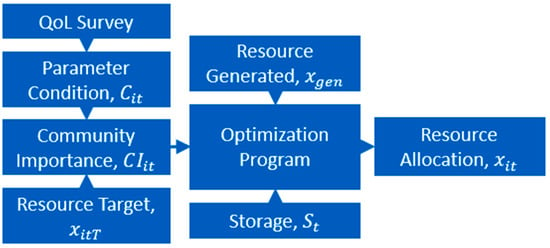
A mathematical program is formulated to maximize the overall QoL by optimally allocating available resources among competing community needs. The general flow of information used in this program is illustrated in Figure 1. Let represent distinct time blocks, where corresponds to daytime and to nighttime. The variable denotes the condition of parameter at time , and represents its community importance. To maintain generality, the framework is applicable to any resource—such as electrical power or monetary budget—and the variable is defined as the amount of resource allocated to parameter during time block .
Figure 1.
The flow of information into the mathematical program for a general framework.
While the baseline captures the static importance of each parameter, it is necessary to account for temporal variation and the diminishing marginal utility of additional allocation. Intuitively, allocating one kilowatt-hour (kWh) of energy to a service that currently receives none is more impactful than providing the same amount to one already sufficiently powered. To incorporate this relationship, a modified importance index is introduced as follows:
where denotes the importance weight assigned to parameter at time , and is the target allocation required for full satisfaction of that parameter. It is important to note that computing relies on accurate condition and weight data obtained through a community-based QoL survey. The design and administration of this survey are essential for ensuring the framework’s validity and human-centered accuracy but are considered beyond the scope of this study. Here, it is assumed that the survey is properly structured and broadly accepted by the community.
The mathematical symbols used in the general program are summarized in Table 2. The primary decision variables in the optimization are and . The variable represents the amount of resource allocated to QoL parameter during period after the optimization has been completed. The secondary variable denotes the amount of resource stored at time for subsequent use. Although is not of direct interest in evaluating QoL outcomes, it is essential for ensuring continuity and temporal balance in the allocation process. Energy storage is modeled at an abstract level to enable temporal coupling between allocation periods. Detailed battery dynamics such as efficiency losses, degradation, and state-dependent charging constraints are not explicitly represented. This simplification is intentional and allows the framework to focus on qualitative-driven allocation behavior rather than technology-specific storage modeling.
Table 2.
The variables being used in the general mathematical program.
Additional parameters are introduced to reflect the characteristics of each community and are incorporated as constraints within the model. The total available resource, , represents the total generation capacity—typically insufficient to satisfy all community needs simultaneously. Therefore, the cumulative allocation across all services must satisfy the constraint . Each parameter also has a target allocation , which denotes the required resource amount to achieve its optimal functionality or service level. When , no further allocation is necessary, as the service is fully satisfied. Furthermore, a minimum allocation must be guaranteed for essential services to ensure basic operability. This lower bound is defined as a proportion of the target value . Finally, represents the maximum storage capacity available, which is assumed to be sufficiently large to prevent energy loss or wastage.
Given the variable definitions in Table 2, the qualitative power-allocation problem is formulated as the following nonlinear program:
The objective maximizes the aggregate community benefit by weighing each allocation with the corresponding importance index . The first constraint enforces the storage balance between two blocks of time: energy remaining at the end of period 1 () equals initial storage () plus generation () minus total allocations in period 1. The second constraint ensures feasibility in period 2, i.e., storage must be sufficient to cover the total allocations in that period. The third constraint guarantees a minimum service level via the proportion of each target . The last bounds restrict allocations to be non-negative and not exceed targets, and confine storage within its physical capacity .
Based on the formulation above, the proposed nonlinear program can now be applied to representative case studies. The following section presents two composed scenarios that demonstrate the framework’s operation under different community conditions and resource constraints.
4. Case Study: Wind-Powered Microgrid for a Rural Community
4.1. Definition of Quality-of-Life Parameters
To demonstrate the proposed qualitative optimization framework, a hypothetical rural community powered by a wind-based microgrid is considered. The numerical values used in the following studies are hypothetical but selected to be consistent with ranges reported in prior microgrid and rural electrification studies. This approach allows the behavior of the proposed framework to be examined without reliance on site-specific data, which may not always be available in remote or underserved communities. The system operates under limited power availability, representing conditions typical of remote or islanded settings. Community services are divided into four categories—Education, Leisure, Safety, and Water—each reflecting a fundamental aspect of local QoL.
Each service is associated with a Condition Index () ranging from 0 to 5, where higher values represent better access or satisfaction levels. These condition levels quantify qualitative attributes that would typically be collected through community surveys or stakeholder input. Table 3 provides the descriptive scale for each parameter.
Table 3.
Quantification of condition (C) for select parameters [74].
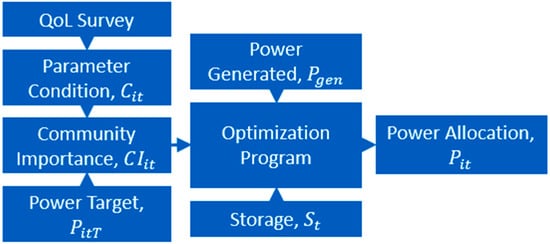
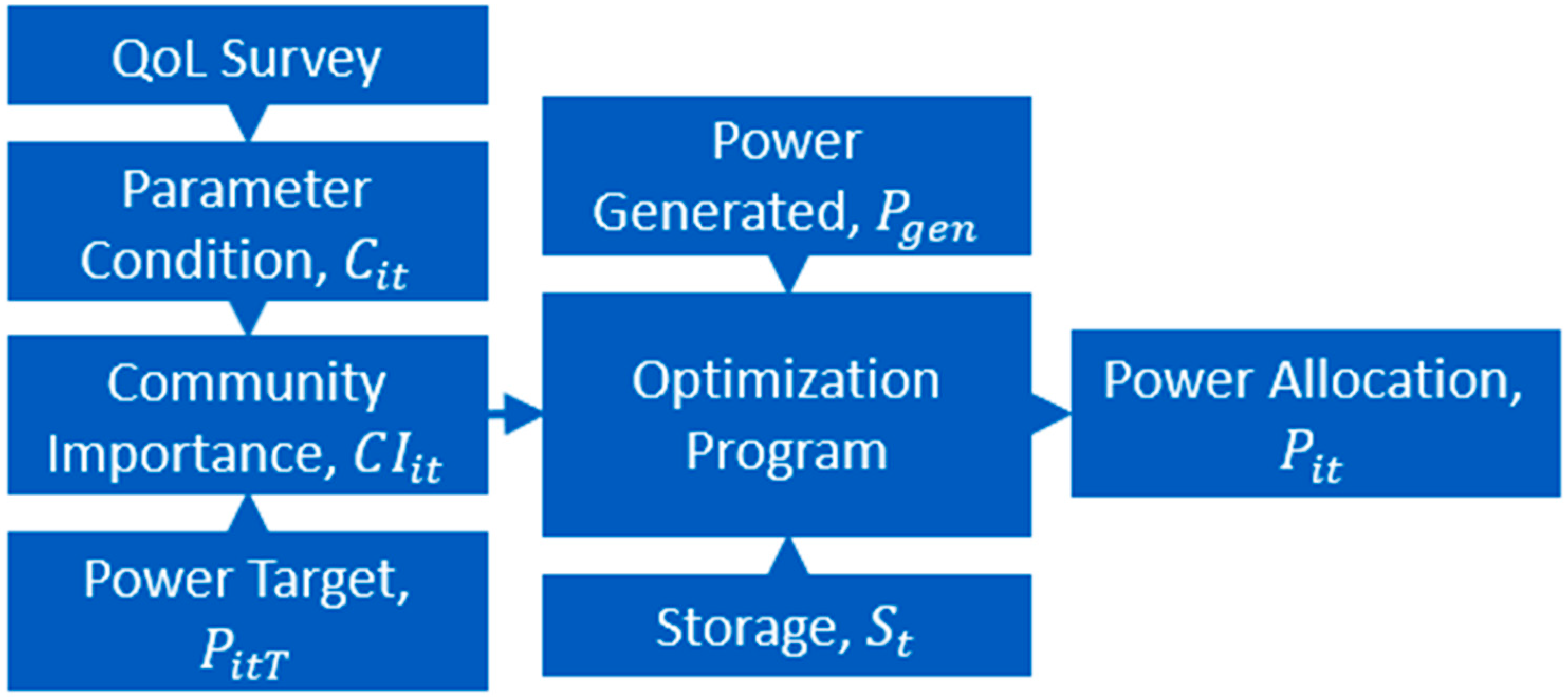
It is important to emphasize that the framework developed above is general and adaptable to a wide range of applications, including resource-allocation problems such as budget or material distribution. In this study, however, the framework is applied specifically to power allocation within a microgrid environment characterized by renewable generation and limited supply capacity. This focus allows for a clear demonstration of how qualitative needs can be integrated into energy management when available power is insufficient to meet all demands simultaneously. The overall program structure used for this analysis is illustrated in Figure 2.
Figure 2.
The flow of information into the mathematical program for a microgrid.
Then the microgrid program is as follows, using E for Energy as the resource being allocated:
4.2. Microgrid 1: Baseline Allocation Scenario
The first case study considers a hypothetical microgrid with a total renewable power generation capacity of 32 kWh per day. Energy storage is assumed to be sufficient to buffer short-term fluctuations, though it is acknowledged that this assumption may not hold for larger, macrogrid systems. The general configuration of the microgrid and its qualitative parameters is summarized in Table 4. To represent the variability in community needs, five minimum power requirements () are selected based on ranges consistent with previous studies [75]. The associated importance weights and condition indices ( and ) are generated using Python (version 3.13.2) random number functions to emulate realistic community diversity.
Table 4.
The variable allocations for the first village microgrid; empty columns are unused (like lights in the daytime, or water at night).
Each service category corresponds to a distinct aspect of community life: represents leisure, corresponds to education, to water supply, and to safety. Power allocation is time-dependent, divided into two periods—daytime () and nighttime ()—to reflect realistic usage patterns. Not all services are active in both periods:
- Leisure requires power only at night ();
- Education requires power both during the day (for schools) and at night (for adult learning);
- Water supply requires power during the day for pumping and storage but none at night;
- Safety (e.g., lighting, surveillance) requires power only at night.
The target power requirements for full satisfaction of each service are as follows: 30 kWh for leisure, 18 kWh for daytime education, 12 kWh for nighttime education, 35 kWh for water pumping, and 6 kWh for nighttime safety. The relative priorities (importance levels) are defined as high for leisure, medium for daytime education, high for nighttime education, low for water, and medium for safety. The corresponding condition levels are , indicating that leisure and nighttime education are currently unmet, while water and safety show moderate fulfillment. For simplicity, it is assumed that stored energy in the batteries is fully depleted at the start of each day, i.e., . This assumption allows for daily re-optimization based on newly generated renewable power and evolving community conditions.
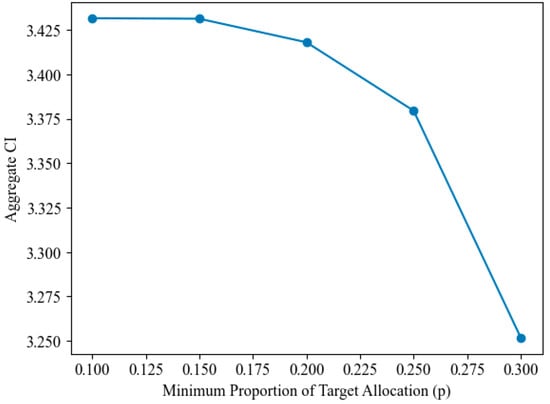
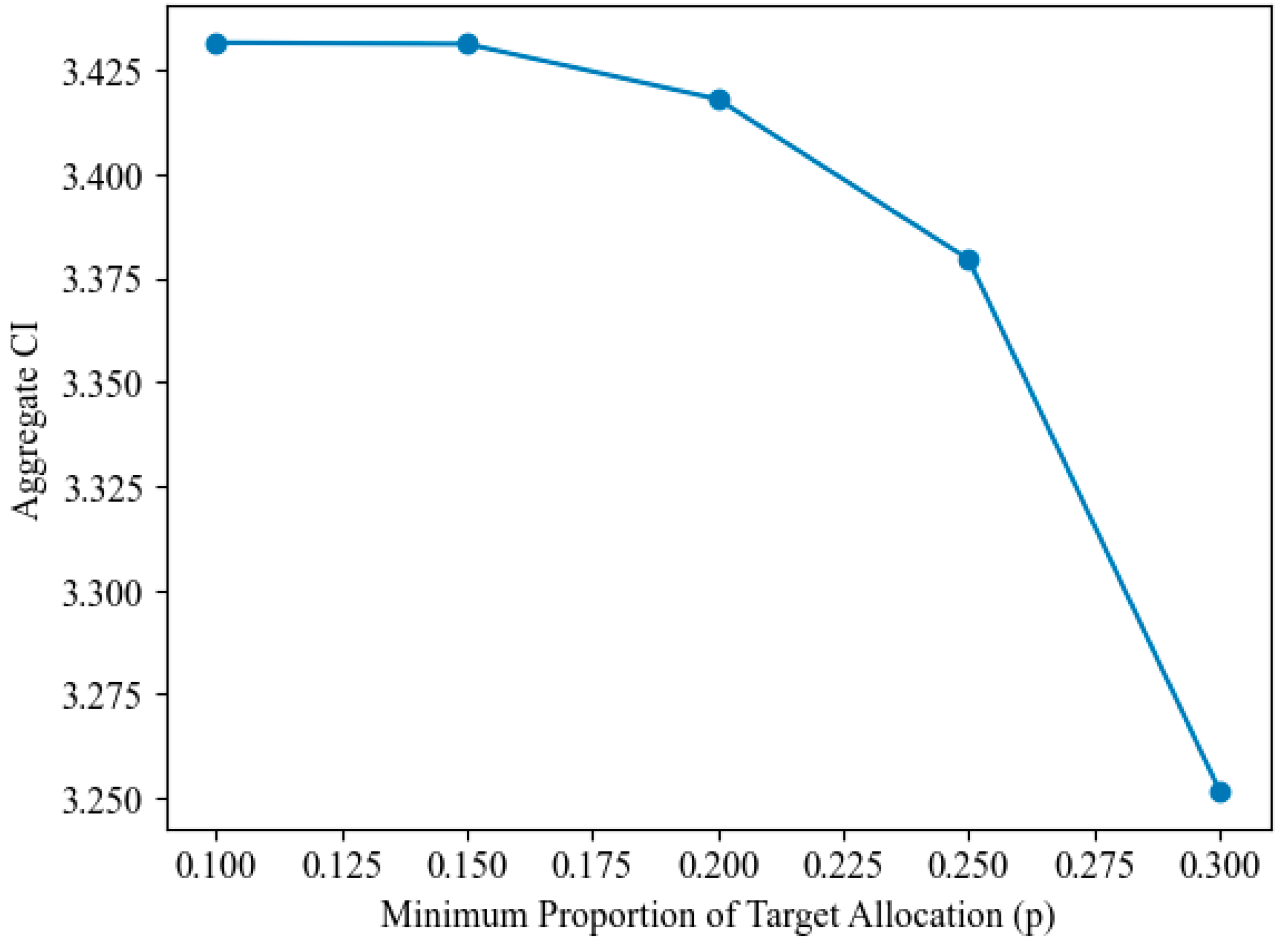
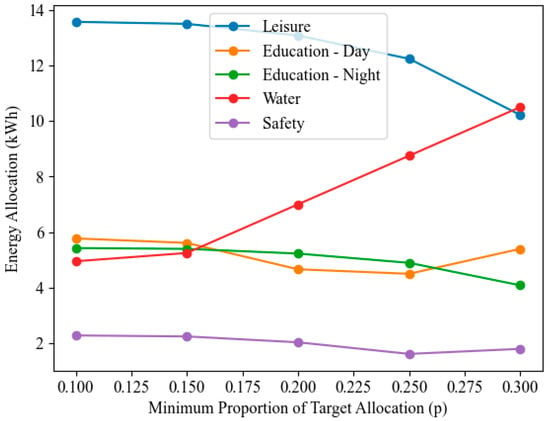
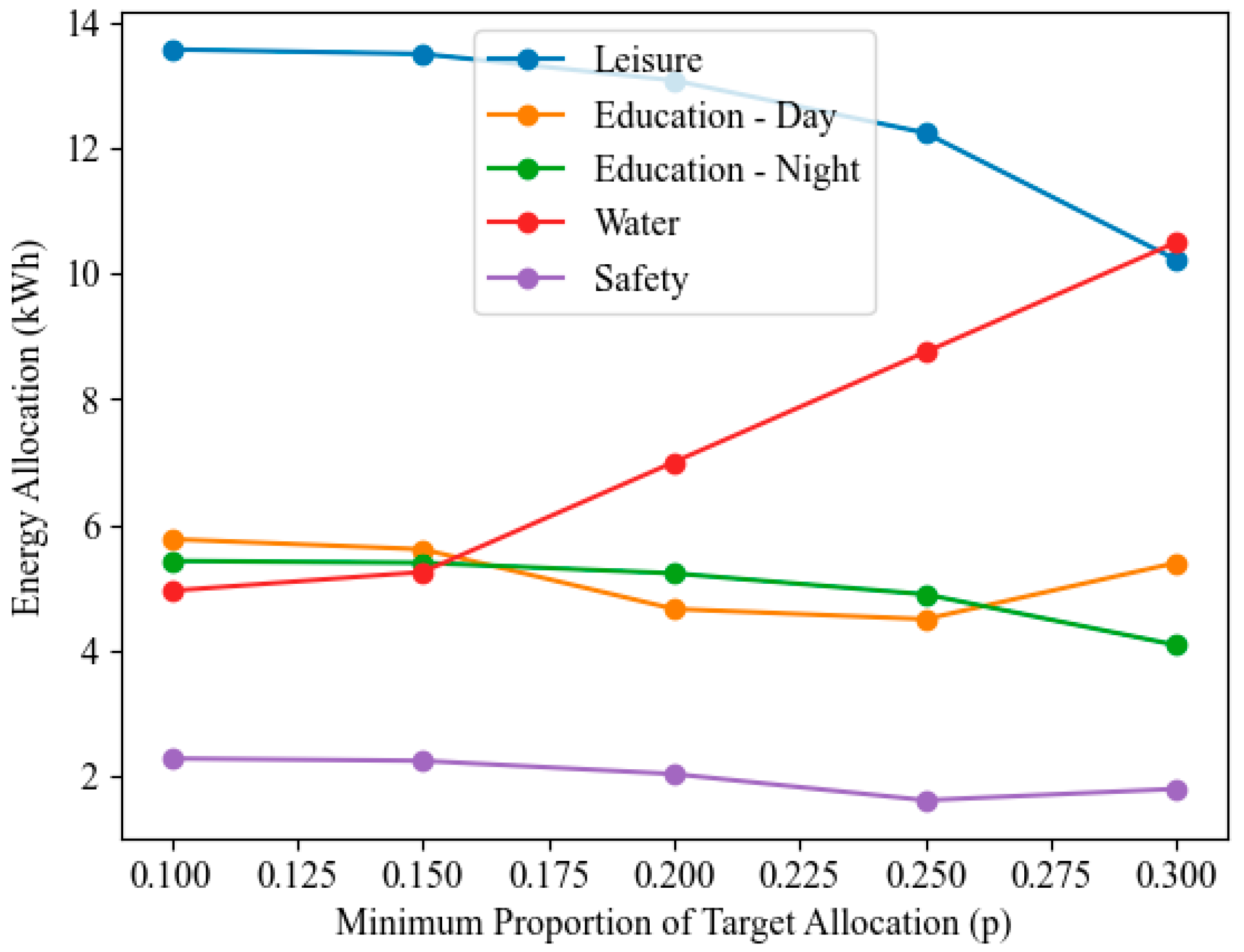
Figure 3 and Figure 4 summarize the optimization results for Microgrid 1. In Figure 3, the aggregate CI remains nearly constant for low minimum requirement levels , indicating that the minimum constraints are not binding and the optimizer can freely allocate energy to maximize community benefit. As increases, these constraints begin to limit flexibility, forcing additional energy into lower-priority services and causing a steady decline in aggregate CI.
Figure 3.
The change in objective function, that is, the aggregate CI as p increases (microgrid 1).
Figure 4.
Adjustments to power allocation as p increases (microgrid 1).
Figure 4 shows how individual service allocations evolve with increasing . At low , high-priority services such as leisure and education receive the largest allocations, while water and safety remain lower. As rises, the minimum requirement pushes all services closer to their targets, leading water to increase significantly and eventually overtake leisure. Meanwhile, allocations to the originally dominant services decrease. Together, the two figures reveal that Microgrid 1 operates efficiently when service requirements are flexible, but becomes increasingly constrained as grows, reducing both allocation freedom and total community benefit.
4.3. Microgird 2: High-Minimum-Requirement Case Study
To further evaluate the behavior of the proposed allocation framework, a second case study, referred to as Microgrid 2, was developed. Unlike Microgrid 1—which represented a community operating under relatively flexible service expectations—Microgrid 2 models a context in which strict minimum service guarantees are imposed across all QoL services. These guarantees are represented by high values of the minimum requirement parameter p, ranging from 0.30 to 0.70. Such a scenario is relevant for communities governed by equity-driven energy policies, where planners must ensure that every essential service receives a substantial portion of its target energy allocation regardless of its relative CI importance. Introducing this case study enables examination of system performance under fairness-dominated conditions and highlights how policy constraints can reshape the feasible allocation space.
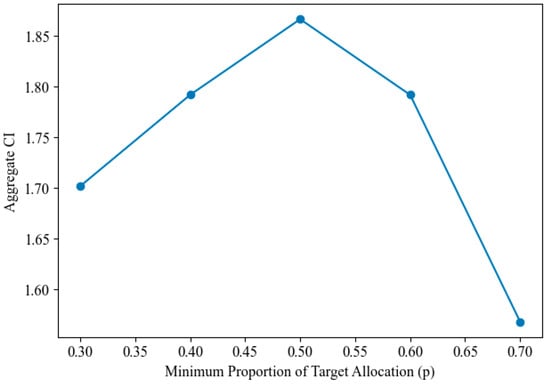
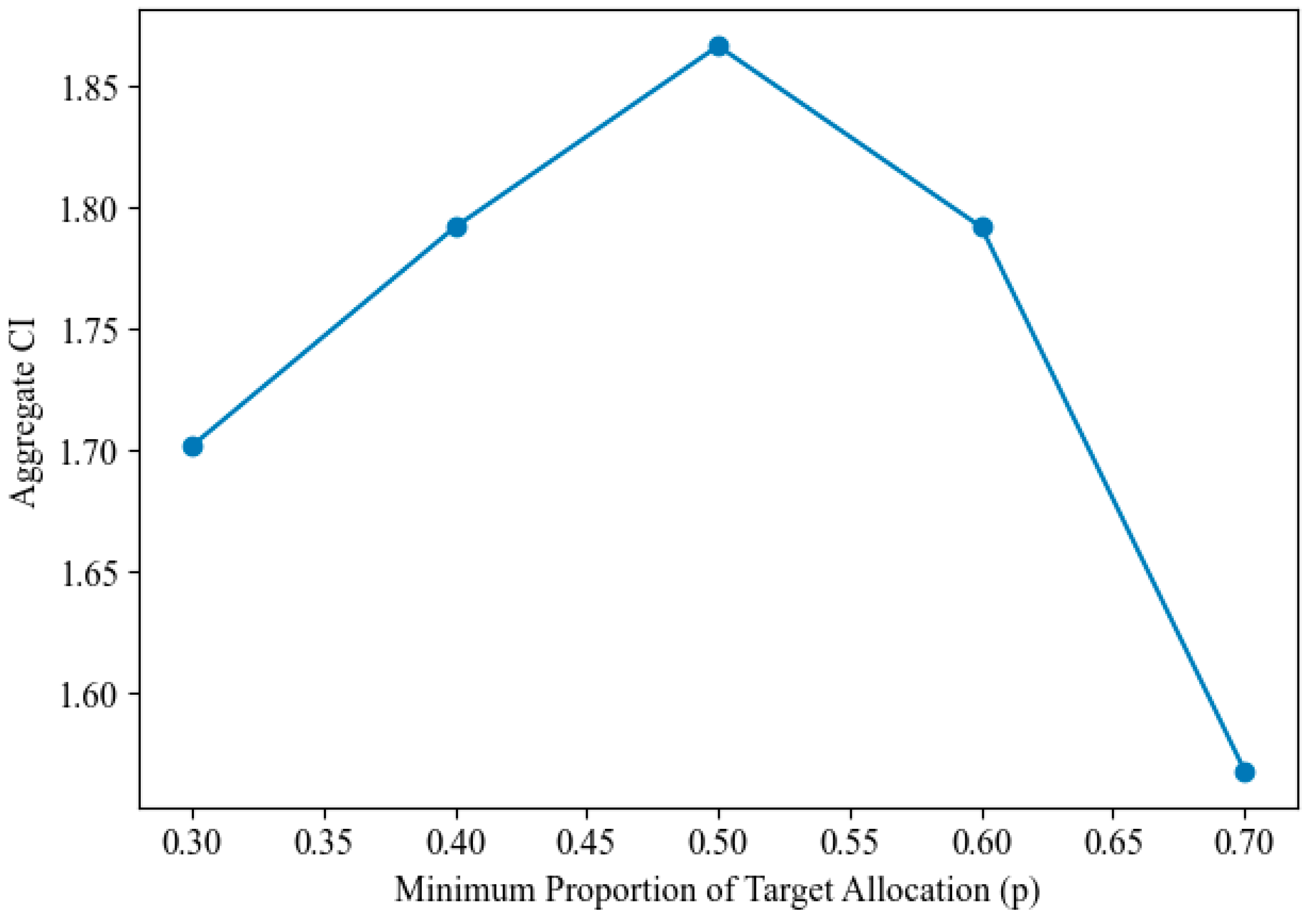
Microgrid 2 also provides a contrasting environment to illustrate the fairness–efficiency tradeoff inherent in constrained resource allocation. As p increases, a larger fraction of the limited daily energy resource (32 kWh) must be allocated to every service, reducing the optimizer’s flexibility to prioritize high-CI categories. This produces the characteristic behavior observed in the results: aggregate CI initially increases (as under-served services are brought closer to their targets) but ultimately decreases sharply when high minimum requirements force energy away from high-impact services. Including Microgrid 2 therefore demonstrates how strict equity constraints influence overall community satisfaction and reveals the boundary conditions under which the allocation model transitions from CI-driven to constraint-driven behavior.
Microgrid 2 uses the same target energy values and total daily generation as Microgrid 1 but represents a different community with its own service priorities and conditions. The weights and condition scores produce CI values that differ from Microgrid 1, reflecting a new pattern of community needs. Microgrid 2 also applies much higher minimum requirement levels, , forcing every service to receive a large fraction of its target. This setup creates a fairness-dominated scenario and allows comparison with the more flexible allocation observed in Microgrid 1.
Figure 5 shows how the aggregate CI changes in Microgrid 2 as the minimum requirement p increases. At moderate values of p, aggregate CI improves because under-served services receive more energy, but at higher p levels, the fairness constraint becomes restrictive and forces energy away from higher-impact services, causing CI to decline.
Figure 5.
The change in objective function, that is, the aggregate CI as p increases (microgrid 2).
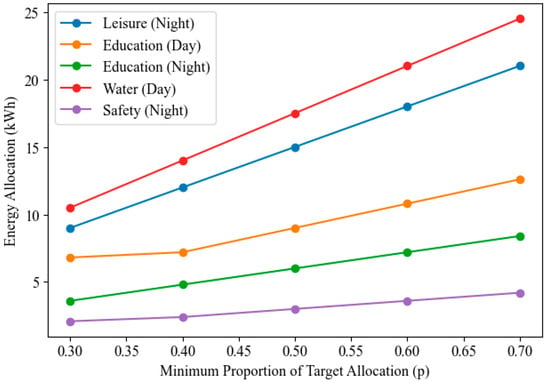
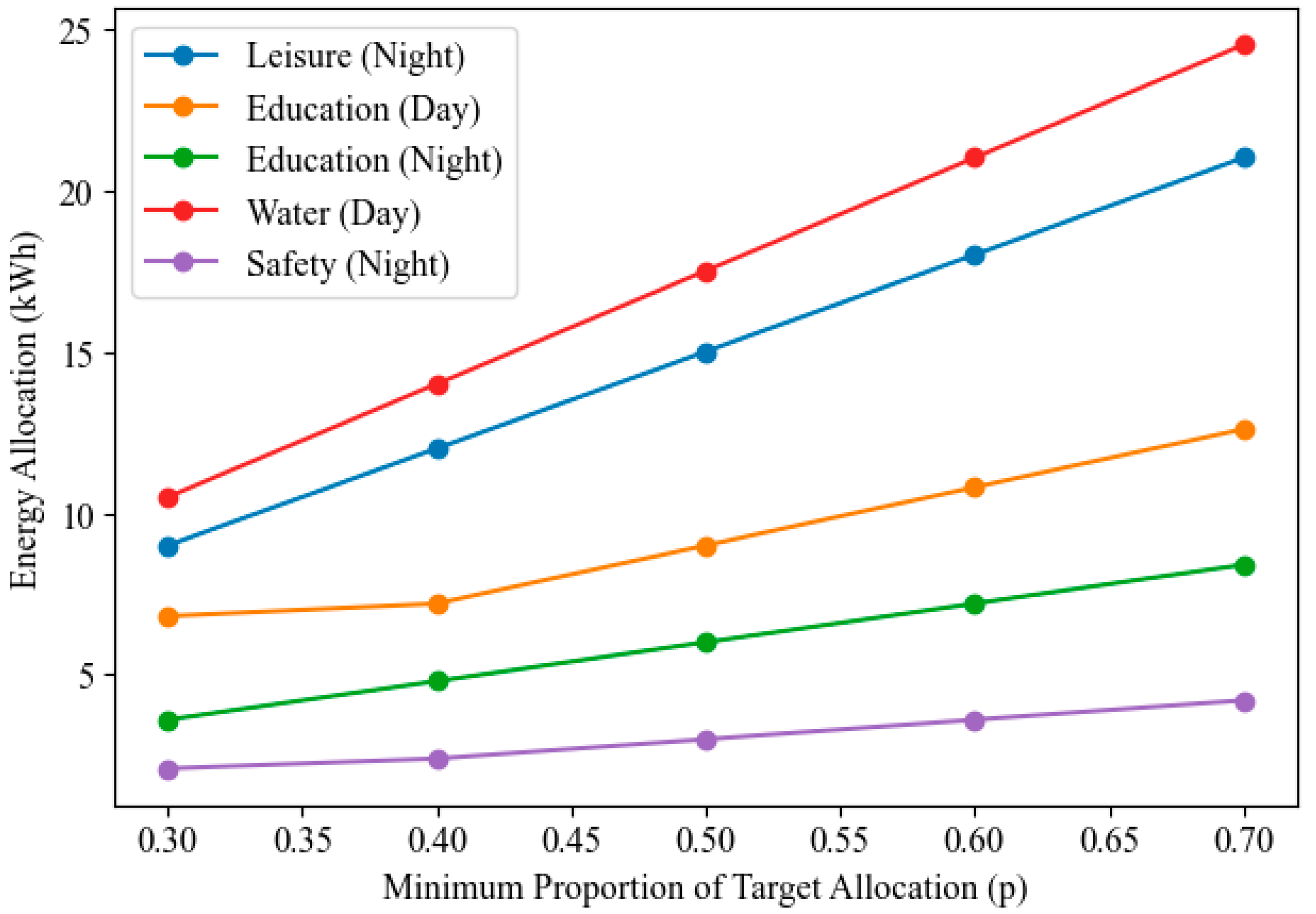
Figure 6 illustrates the resulting energy allocation to each service under increasing values of p. As minimum requirements rise, allocations grow proportionally with their target values, demonstrating how strict fairness constraints dominate the optimization and drive the system toward more uniform, lower-flexibility energy distributions.
Figure 6.
Adjustments to power allocation as p increases (microgrid 2).
5. Discussion
Microgrid 1 and Microgrid 2 highlight how minimum service requirements influence both energy allocation and overall community benefit. In Microgrid 1, low minimum thresholds allow the optimizer to allocate energy based primarily on CI, resulting in stable aggregate CI and higher allocations to leisure and education services. Only at higher values of do the constraints begin to limit flexibility and reduce total performance. Microgrid 2, by contrast, applies much higher minimum requirements, forcing all services to receive a substantial share of their targets. This shifts the system from a CI-driven regime to a fairness-dominated one, where allocations rise proportionally and aggregate CI eventually declines as constraints tighten. Together, the two microgrids demonstrate the tradeoff between maximizing community benefit and ensuring equitable service levels, emphasizing the role of minimum requirements in shaping optimal allocation outcome.
Beyond the comparison of these two microgrids, the results demonstrate the versatility and strength of the proposed framework. Because it integrates service conditions, community priorities, and operational constraints within a single optimization model, it can be adapted to a wide range of real-world planning scenarios. For example, the same structure could be used to allocate limited generation on remote islands supporting critical loads such as data centers, research stations, or cryptocurrency mining facilities, where energy demand can be high and reliability requirements strict. By adjusting the weights, conditions, and target values, the model can represent any combination of industrial, commercial, or community services, providing decision-makers with a transparent tool to explore tradeoffs between efficiency, fairness, and operational feasibility. This adaptability makes the framework broadly applicable to emerging energy systems where demand is diverse and resources are constrained.
6. Conclusions
This work introduced a qualitative-driven power management framework for microgrids that explicitly incorporates human-centered priorities into operational energy allocation decisions. Unlike conventional approaches that rely primarily on quantitative performance metrics, the proposed framework provides a structured way to define and integrate qualitative factors—such as community importance, level of fulfillment, and energy demand—into a mathematical formulation suitable for resource-constrained environments.The framework was demonstrated using a wind-powered microgrid case study to illustrate how qualitative priorities can influence allocation behavior under limited and variable generation. The results show that the proposed approach enables differentiated allocation among services based on qualitative importance, while maintaining feasible operation under constrained supply conditions. Rather than serving as a benchmark optimization algorithm, the case study highlights the feasibility and interpretability of the proposed approach and its potential role as a decision-support layer in microgrid operation. The proposed framework is intended as a starting point for further exploration of qualitative-driven power management. Future work will focus on extending the formulation to include additional operational constraints, uncertainty in renewable generation and demand, and computational performance analysis to assess real-time deployment potential.
Author Contributions
Conceptualization, J.H.; methodology, M.Y.; software, M.Y.; formal analysis, M.Y.; investigation, M.Y.; data curation, M.Y.; writing—original draft preparation, M.Y.; writing—review and editing, J.H.; visualization, M.Y.; supervision, J.H.; project administration, J.H. All authors have read and agreed to the published version of the manuscript.
Funding
This research received no external funding.
Data Availability Statement
The original contributions presented in this study are included in the article. Further inquiries can be directed to the corresponding author.
Conflicts of Interest
The authors declare no conflict of interest.
References
- Hu, R.L.; Skorupski, R.; Entriken, R.; Ye, Y. A mathematical programming formulation for optimal load shifting of electricity demand for the smart grid. IEEE Trans. Big Data 2016, 6, 638–651. [Google Scholar] [CrossRef] [Scilit]
- Koutsopoulos, I.; Tassiulas, L. Control and optimization meet the smart power grid: Scheduling of power demands for optimal energy management. In Proceedings of the 2nd International Conference on Energy-Efficient Computing and Networking, New York, NY, USA, 31 May–1 June 2011; pp. 41–50. [Google Scholar]
- Cortes-Robles, O.; Barocio, E.; Segundo, J.; Guillen, D.; Olivares-Galvan, J. A qualitative-quantitative hybrid approach for power quality disturbance monitoring on microgrid systems. Measurement 2020, 154, 107453. [Google Scholar] [CrossRef] [Scilit]
- Fragniere, E.; Sandoz, S.; Abdenadher, N.; Moussa, M.; Serugendo, G.D.M.; Glass, P. Improving the social acceptability of microgrids. In Proceedings of the 2023 IEEE Renewable Energy and Sustainable E-Mobility Conference (RESEM), Bhopal, India, 17–18 May 2023; pp. 1–5. [Google Scholar]
- Ahmed, S.; Ali, A.; D’angola, A. A review of renewable energy communities: Concepts, scope, progress, challenges, and recommendations. Sustainability 2024, 16, 1749. [Google Scholar] [CrossRef] [Scilit]
- Fields, N.; Leonard, A.; Mutembei, M.; Nganga, A.; Martindale, L.; Bergman, M.; Kaoma, M.; Howells, M.; Brown, E. Endogenous integration of qualitative factors into quantitative energy transition modelling for development. Renew. Sustain. Energy Rev. 2025, 220, 115917. [Google Scholar] [CrossRef] [Scilit]
- Vågerö, O.; Zeyringer, M. Can we optimise for justice? Reviewing the inclusion of energy justice in energy system optimisation models. Energy Res. Soc. Sci. 2023, 95, 102913. [Google Scholar] [CrossRef] [Scilit]
- Amin, R.; Mathur, D.; Ompong, D.; Zander, K.K. Integrating social aspects into energy system modelling through the lens of public perspectives: A review. Energies 2024, 17, 5880. [Google Scholar] [CrossRef] [Scilit]
- Akinyele, D.; Belikov, J.; Levron, Y. Challenges of microgrids in remote communities: A STEEP model application. Energies 2018, 11, 432. [Google Scholar] [CrossRef] [Scilit]
- Eklund, M.; Khalilpour, K.; Voinov, A.; Hossain, M. Understanding the community in community microgrids: A conceptual framework for better decision-making. Energy Res. Soc. Sci. 2023, 104, 103260. [Google Scholar] [CrossRef] [Scilit]
- Cravioto, J.; Ohgaki, H.; Che, H.S.; Tan, C.; Kobayashi, S.; Toe, H.; Long, B.; Oudaya, E.; Rahim, N.A.; Farzeneh, H. The effects of rural electrification on quality of life: A southeast Asian perspective. Energies 2020, 13, 2410. [Google Scholar] [CrossRef] [Scilit]
- Lloyd, P.; Cowan, B.; Mohlakoana, N. Improving access to electricity and stimulation of economic growth and social upliftment. In Proceedings of the Contribution to the Conference ‘Improving Access to Modern Energy Services Through CDM and Technology Transfer’, Eskom Conference Centre, Johannesburg, South Africa, 27–29 July 2004; pp. 27–29. [Google Scholar]
- Kojonsaari, A.-R.; Palm, J. The development of social science research on smart grids: A semi-structured literature review. Energy Sustain. Soc. 2023, 13, 1. [Google Scholar] [CrossRef] [Scilit]
- Wen, C.; Long, Y. Exploring the mechanisms of microgrid management from a structural view: A qualitative study from China. Energy Sustain. Dev. 2024, 81, 101485. [Google Scholar] [CrossRef] [Scilit]
- Raman, G.; Yang, Y.; Peng, J.C.-H. The social factors shaping community microgrid operation. Nat. Commun. 2024, 15, 6451. [Google Scholar] [CrossRef] [Scilit] [PubMed]
- Tamasiga, P.; Onyeaka, H.; Altaghlibi, M.; Bakwena, M.; houssin Ouassou, E. Empowering communities beyond wires: Renewable energy microgrids and the impacts on energy poverty and socio-economic outcomes. Energy Rep. 2024, 12, 4475–4488. [Google Scholar] [CrossRef] [Scilit]
- El Gohary, F.; Nyström, S.; Reitsma, L.; Bartusch, C. Identifying challenges in engaging users to increase self-consumption of electricity in microgrids. Energies 2021, 14, 1257. [Google Scholar] [CrossRef] [Scilit]
- Eklund, M.; Khalilpour, K.; Voinov, A.; Hossain, M. Barriers to Community Microgrids in Fragmented Communities: Insights from a Case Study. In Proceedings of the 2023 International Conference on Future Energy Solutions (FES), Vaasa, Finland, 12–14 June 2023; pp. 1–5. [Google Scholar]
- Tahir, F.; Dwyer, S.; Kelly, S. Embracing complexity: Microgrids and community engagement in Australia. Energy Res. Soc. Sci. 2024, 118, 103811. [Google Scholar] [CrossRef] [Scilit]
- Abo-Zahhad, E.M.; Rashwan, A.; Salameh, T.; Hamid, A.K.; Faragalla, A.; El-Dein, A.Z.; Chen, Y.; Abdelhameed, E.H. Evaluation of solar PV-based microgrids viability utilizing single and multi-criteria decision analysis. Renew. Energy 2024, 221, 119713. [Google Scholar] [CrossRef] [Scilit]
- Alqaisi, W.; El-Bayeh, C.Z.; Alzaareer, K.; Zellagui, M.; Flah, A.; Brahmi, B. Multi-Criteria Decision-Making (MCDM) methods for micro-grids: An overview. In Innovation and Technological Advances for Sustainability; CRC Press: Boca Raton, FL, USA, 2024; pp. 341–351. [Google Scholar]
- Bohra, S.S.; Anvari-Moghaddam, A.; Mohammadi-Ivatloo, B. AHP-assisted multi-criteria decision-making model for planning of microgrids. In Proceedings of the IECON 2019—45th Annual Conference of the IEEE Industrial Electronics Society, Lisbon, Portugal, 14–17 October 2019; Volume 1, pp. 4557–4562. [Google Scholar]
- Miao, H.; Yu, Y.; Kharrazi, A.; Ma, T. Multi-criteria decision analysis for the planning of island microgrid system: A case study of Yongxing island, China. Energy 2023, 284, 129264. [Google Scholar] [CrossRef] [Scilit]
- Panwar, M.; Suryanarayanan, S.; Hovsapian, R. A multi-criteria decision analysis-based approach for dispatch of electric microgrids. Int. J. Electr. Power Energy Syst. 2017, 88, 99–107. [Google Scholar] [CrossRef] [Scilit]
- Feng, S.; Cucuzzella, M.; Bouman, T.; Steg, L.; Scherpen, J.M. An integrated human–cyber–physical framework for control of microgrids. IEEE Trans. Smart Grid 2023, 14, 3388–3400. [Google Scholar] [CrossRef] [Scilit]
- Wurtz, F.; Delinchant, B. “Smart buildings” integrated in “smart grids”: A key challenge for the energy transition by using physical models and optimization with a “human-in-the-loop” approach. Comptes Rendus Phys. 2017, 18, 428–444. [Google Scholar] [CrossRef] [Scilit]
- Korkas, C.D.; Baldi, S.; Kosmatopoulos, E.B. Grid-connected microgrids: Demand management via distributed control and human-in-the-loop optimization. Adv. Renew. Energ. Power Technol. 2018, 2, 315–344. [Google Scholar]
- Yang, L.; Sun, Q.; Zhang, N.; Liu, Z. Optimal energy operation strategy for we-energy of energy internet based on hybrid reinforcement learning with human-in-the-loop. IEEE Trans. Syst. Man Cybern. Syst. 2020, 52, 32–42. [Google Scholar] [CrossRef] [Scilit]
- Li, K.; Guo, H. Human-in-the-loop policy optimization for preference-based multi-objective reinforcement learning. arXiv 2024, arXiv:2401.02160. [Google Scholar]
- Shandiz, S.C.; Foliente, G.; Rismanchi, B.; Wachtel, A.; Jeffers, R.F. Resilience framework and metrics for energy master planning of communities. Energy 2020, 203, 117856. [Google Scholar] [CrossRef] [Scilit]
- Eklund, M.; Khalilpour, K.; Voinov, A.; Hossain, M. Community microgrids: A decision framework integrating social capital with business models for improved resiliency. Appl. Energy 2024, 367, 123458. [Google Scholar] [CrossRef] [Scilit]
- Dioba, A.; Giannakopoulou, A.; Struthers, D.; Stamos, A.; Dewitte, S.; Fróes, I. Identifying key barriers to joining an energy community using AHP. Energy 2024, 299, 131478. [Google Scholar] [CrossRef] [Scilit]
- Suk, H.; Hall, J. Connecting qualitative and quantitative analysis through bond graph modeling and system dynamics. In Proceedings of the International Design Engineering Technical Conferences and Computers and Information in Engineering Conference, Virtual, 17–19 August 2021; Volume 85390, p. V03BT03A018. [Google Scholar]
- Suk, H.; Sharma, A.; Nellippallil, A.B.; Das, A.; Hall, J. A framework for improving rural microgrid sustainability through integrated socio-technical considerations. In Design for Tomorrow—Volume 3: Proceedings of ICoRD 2021; Springer: Berlin/Heidelberg, Germany, 2021; pp. 285–295. [Google Scholar]
- Suk, H.; Sharma, A.; Nellippallil, A.B.; Das, A.; Hall, J. Socio-technical modeling to manage power distribution for microgrid systems with limited production capacity. J. Sol. Energy Eng. 2022, 144, 011010. [Google Scholar] [CrossRef] [Scilit]
- Toossi, A.; Camci, F.; Varga, L. Developing an AHP based decision model for energy systems policy making. In Proceedings of the 2013 IEEE International Conference on Industrial Technology (ICIT), Cape Town, South Africa, 25–28 February 2013; pp. 1456–1460. [Google Scholar]
- Read, L.; Madani, K.; Mokhtari, S.; Hanks, C. Stakeholder-driven multi-attribute analysis for energy project selection under uncertainty. Energy 2017, 119, 744–753. [Google Scholar] [CrossRef] [Scilit]
- Diakoulaki, D.; Antunes, C.H.; Gomes Martins, A. MCDA and energy planning. In Multiple Criteria Decision Analysis: State of the Art Surveys; Springer: Berlin/Heidelberg, Germany, 2005; pp. 859–890. [Google Scholar]
- Subramanian, V.; Bereznychenko, V. Cognitive fuzzy logic-integrated energy management for self-sustaining hybrid renewable microgrids. Sci. Rep. 2025, 15, 9915. [Google Scholar]
- Maqekeni, S.; Obileke, K.; Ndiweni, O.; Mukumba, P. Application of Fuzzy Logic Techniques in Solar Energy Systems: A Review. Appl. Syst. Innov. 2025, 8, 144. [Google Scholar] [CrossRef] [Scilit]
- Sugeno, M.; Yasukawa, T. A fuzzy-logic-based approach to qualitative modeling. IEEE Trans. Fuzzy Syst. 1993, 1, 7. [Google Scholar] [CrossRef] [Scilit]
- Oztaysi, B.; Çevik Onar, S.; Bolturk, E.; Kahraman, C. Fuzzy Forecasting Methods for Energy Planning. In Energy Management—Collective and Computational Intelligence with Theory and Applications; Springer: Berlin/Heidelberg, Germany, 2018; pp. 65–81. [Google Scholar]
- Nasr, M.-A.; Nikkhah, S.; Gharehpetian, G.B.; Nasr-Azadani, E.; Hosseinian, S.H. A multi-objective voltage stability constrained energy management system for isolated microgrids. Int. J. Electr. Power Energy Syst. 2020, 117, 105646. [Google Scholar] [CrossRef] [Scilit]
- Baset, A.; Jradi, M. Data-driven decision support for smart and efficient building energy retrofits: A review. Appl. Syst. Innov. 2024, 8, 5. [Google Scholar] [CrossRef] [Scilit]
- Höper, L.; Schulte, C. Empowering Students for the Data-Driven World: A Qualitative Study of the Relevance of Learning about Data-Driven Technologies. Inform. Educ. 2024, 23, 593–624. [Google Scholar] [CrossRef] [Scilit]
- Liu, B.; Penaka, S.R.; Lu, W.; Feng, K.; Rebbling, A.; Olofsson, T. Data-driven quantitative analysis of an integrated open digital ecosystems platform for user-centric energy retrofits: A case study in northern Sweden. Technol. Soc. 2023, 75, 102347. [Google Scholar] [CrossRef] [Scilit]
- Mononen, M.; Saarenpää, J.; Johansson, M.; Niska, H. Data-driven method for providing feedback to households on electricity consumption. In Proceedings of the 2014 IEEE Ninth International Conference on Intelligent Sensors, Sensor Networks and Information Processing (ISSNIP), Singapore, 21–24 April 2014; pp. 1–6. [Google Scholar]
- Vavouris, A.; Guasselli, F.; Stankovic, L.; Stankovic, V.; Gram-Hanssen, K.; Didierjean, S. A complex mixed-methods data-driven energy-centric evaluation of net-positive households. Appl. Energy 2024, 367, 123404. [Google Scholar] [CrossRef] [Scilit]
- Nakabi, T.A.; Toivanen, P. Deep reinforcement learning for energy management in a microgrid with flexible demand. Sustain. Energy Grids Netw. 2021, 25, 100413. [Google Scholar] [CrossRef] [Scilit]
- Yao, J.; Xu, J.; Zhang, N.; Guan, Y. Model-Based Reinforcement Learning Method for Microgrid Optimization Scheduling. Sustainability 2023, 15, 9235. [Google Scholar] [CrossRef] [Scilit]
- Waghmare, A.; Singh, V.; Varshney, T.; Sanjeevikumar, P. A systematic review of reinforcement learning-based control for microgrids: Trends, challenges, and emerging algorithms. Discov. Appl. Sci. 2025, 7, 939. [Google Scholar] [CrossRef] [Scilit]
- Wang, H.; Hua, W.; Peng, J.; Hu, M. Public sentiment analysis of data center energy consumption using social media data and large language models. Energy Build. 2025, 341, 115802. [Google Scholar] [CrossRef] [Scilit]
- Forootani, A.; Rastegar, M.; Jooshaki, M. An advanced satisfaction-based home energy management system using deep reinforcement learning. IEEE Access 2022, 10, 47896–47905. [Google Scholar] [CrossRef] [Scilit]
- Hosamo, H.; Mazzetto, S. Performance Evaluation of Machine Learning Models for Predicting Energy Consumption and Occupant Dissatisfaction in Buildings. Buildings 2024, 15, 39. [Google Scholar] [CrossRef] [Scilit]
- Nambi, S.A.U.; Prasad, R.V. Toward the development of a techno-social smart grid. IEEE Commun. Mag. 2016, 54, 202–209. [Google Scholar] [CrossRef] [Scilit]
- Van Sluisveld, M.A.; Hof, A.F.; Carrara, S.; Geels, F.W.; Nilsson, M.; Rogge, K.; Turnheim, B.; Van Vuuren, D.P. Aligning integrated assessment modelling with socio-technical transition insights: An application to low-carbon energy scenario analysis in Europe. Technol. Forecast. Soc. Change 2020, 151, 119177. [Google Scholar] [CrossRef] [Scilit]
- Casella, E.; Silvestri, S.; Baker, D.A.; Das, S.K. A Human-Centered Power Conservation Framework Based on Reverse Auction Theory and Machine Learning. ACM Trans. Cyber-Phys. Syst. 2024, 8, 1–26. [Google Scholar] [CrossRef] [Scilit]
- Santos, A.Q.; Ma, Z.; Olsen, C.G.; Jørgensen, B.N. Framework for microgrid design using social, economic, and technical analysis. Energies 2018, 11, 2832. [Google Scholar] [CrossRef] [Scilit]
- Kumar, A.; He, X.; Deng, Y.; Singh, A.R.; Sah, B.; Kumar, P.; Bansal, R.; Bettayeb, M.; Rayudu, R. A sustainable rural electrification based on a socio-techno-economic-environmental-political microgrid design framework. Energy Environ. Sci. 2022, 15, 4213–4246. [Google Scholar] [CrossRef] [Scilit]
- Rahmann, C.; Núñez, O.; Valencia, F.; Arrechea, S.; Sager, J.; Kammen, D. Methodology for monitoring sustainable development of isolated microgrids in rural communities. Sustainability 2016, 8, 1163. [Google Scholar] [CrossRef] [Scilit]
- Emmanouil, S.; Philhower, J.; Macdonald, S.; Khadim, F.K.; Yang, M.; Atsbeha, E.; Nagireddy, H.; Roach, N.; Holzer, E.; Anagnostou, E.N. A comprehensive approach to the design of a renewable energy microgrid for rural Ethiopia: The technical and social perspectives. Sustainability 2021, 13, 3974. [Google Scholar] [CrossRef] [Scilit]
- Palma-Behnke, R.; Ortiz, D.; Reyes, L.; Jiménez-Estévez, G.; Garrido, N. A social SCADA approach for a renewable based microgrid—The Huatacondo project. In Proceedings of the 2011 IEEE Power and Energy Society General Meeting, Detroit, MI, USA, 24–28 July 2011; pp. 1–7. [Google Scholar]
- Schwaegerl, C.; Tao, L. Quantification of technical, economic, environmental and social benefits of microgrid operation. In Microgrids; John Wiley and Sons: Hoboken, NJ, USA, 2013; pp. 275–313. [Google Scholar]
- Muttaqee, M.; Furqan, M.; Boudet, H. Community response to microgrid development: Case studies from the US. Energy Policy 2023, 181, 113690. [Google Scholar] [CrossRef] [Scilit]
- Sabzi, B.; Ezzati, F.; Shi, J.; Lim, G.; Wang, K.; Dong, S. Energy Equity-Centered Planning of Community Microgrids. TechRxiv 2024. [Google Scholar] [CrossRef] [Scilit]
- Syed, M.M.; Morrison, G.M. A rapid review on community connected microgrids. Sustainability 2021, 13, 6753. [Google Scholar] [CrossRef] [Scilit]
- Bosco, K.J.; Biswas, K.K. Socio-Technical Analysis of Renewable Microgrids for Energy Access in Developing Regions. Natl. J. Renew. Energy Syst. Innov. 2025, 1, 1–9. [Google Scholar]
- Tahir, F.; Dwyer, S.; Kelly, S. Emergent opportunities and barriers on the feasibility of microgrids: Qualitative findings from an Australian funding program. Energy Res. Soc. Sci. 2024, 109, 103423. [Google Scholar] [CrossRef] [Scilit]
- Balducci, P.; Mongird, K.; Wu, D.; Wang, D.; Fotedar, V.; Dahowski, R. An evaluation of the economic and resilience benefits of a microgrid in Northampton, Massachusetts. Energies 2020, 13, 4802. [Google Scholar] [CrossRef] [Scilit]
- Vargas, C.; Morales, R.; Sáez, D.; Hernández, R.; Muñoz, C.; Huircán, J.; Espina, E.; Alarcón, C.; Caquilpan, V.; Painemal, N. Methodology for microgrid/smart farm systems: Case of study applied to indigenous mapuche communities. In Proceedings of the International Conference of ICT for Adapting Agriculture to Climate Change, Colombia, CA, USA, 21–23 November 2018; pp. 89–105. [Google Scholar]
- Lu, X.; Wang, J.; Guo, L. Using microgrids to enhance energy security and resilience. Electr. J. 2016, 29, 8–15. [Google Scholar] [CrossRef] [Scilit]
- Pangia, A.; Suk, H.; Yaghoubirad, M.; Khan, T.; Hall, J. Electrifying Rural Life: A Socio-Technical Framework for Power Distribution in Microgrids. In Proceedings of the ASME International Mechanical Engineering Congress and Exposition, Portland, OR, USA, 17–21 November 2024; Volume 88643, p. V006T08A024. [Google Scholar]
- Wu, C.; Mohsenian-Rad, H.; Huang, J.; Wang, A.Y. Demand side management for wind power integration in microgrid using dynamic potential game theory. In Proceedings of the 2011 IEEE GLOBECOM Workshops (GC Wkshps), Houston, TX, USA, 5–9 December 2011; pp. 1199–1204. [Google Scholar]
- Suk, H. A Mathematical Framework for Power Management of a Microgrid Based on the Quality of Life in Rural Development. Master’s Thesis, State University of New York at Buffalo, Buffalo, NY, USA, 2020. [Google Scholar]
- Suk, H. Cyber-Physical-Social Systems for Sustainable Development. Ph.D. Thesis, State University of New York at Buffalo, Buffalo, NY, USA, 2022. [Google Scholar]

Disclaimer/Publisher’s Note: The statements, opinions and data contained in all publications are solely those of the individual author(s) and contributor(s) and not of MDPI and/or the editor(s). MDPI and/or the editor(s) disclaim responsibility for any injury to people or property resulting from any ideas, methods, instructions or products referred to in the content. |
© 2025 by the authors. Licensee MDPI, Basel, Switzerland. This article is an open access article distributed under the terms and conditions of the Creative Commons Attribution (CC BY) license.