


Abstract
The increasing popularity of automated systems and the increased market share of producers of robotic feeding equipment for cows causes the need for a deeper study of energy demand in such technologies. This article provides an analysis of the inputs of energy accumulated in conventional (CFS) and automated feeding systems (AFS) for cattle. The aim of this is to determine the impact of robotic technologies for the preparation and feeding of fodder on the cumulative energy inputs. The aim of this paper is to investigate the effect of machinery and the equipment applied to the cumulative energy intensity in cattle farming facilities. The cumulative energy consumption for four technologies of automated cattle feeding (AFS) was tested and compared to the energy consumption for six technologies with a conventional feeding system (CFS). The research involved nine cow barn facilities for dairy cows and one for beef cattle. An evaluation has been made for cattle farming structures (milk and meat production) with various mixing and feeding systems for feeds of various concentrations, and keeping system (tied system and free-stall). The cow barns differed in feed mixing, feeding machinery, and equipment. Measurements of live labor inputs and the consumption of electric and mechanical energy carriers were carried out, and the mass of various types of machines and devices with software was taken into account, which became the basis for calculating cumulative energy consumption for individual technologies. The obtained average of electric and mechanical energy inputs for robotic technologies of feeding fodder (AFS) was 0.60025 kWh∙day−1∙LU−1(where LU means Large Animal Unit 500 kg), and it was 39.3% lower than for conventional technologies (CFS) where it was 0.989052 kWh∙day−1∙LU−1. However, taking into account all components of cumulative energy consumption, the average for the group of robotic technologies (AFS) was higher by 35.18% than for conventional technologies (CFS).
1. Introduction
Dairy farms play an important role in shaping energy footprints at a global scale [1,2]. In 2019, EU-27 produced 158.2 million tons of raw milk and the average apparent milk yield per cow across the EU-27 was 7346 kg [3]. Polish farmers account for supplying 8% of the total EU milk production. Sustainable development should include all the branches of economy, including agriculture. The principles of sustainable development in agriculture cover the following elements to be addressed: social, economic, and welfare [4]. These factors share a common goal—to minimise negative environmental impacts [5,6]. The plant production sector can alleviate climate change when sustainable land-use methods are applied [7]. In plant production, precision farming guarantees a sustainable use of resources (Colaço et al., 2020). However, in animal production, adequate natural fertilizer management, through the use of the fertilizer for biogas and energy production, is one of the ways of ensuring sustainable production [8]. Increasing agricultural production in the European Union countries comes with the growing energy and fuel demands of agricultural machinery and tractors, which result in an increase in CO2 emissions [1,9,10]. According to Wójcicki [11], converted into energy units, the value of the final agricultural production in Poland was 900 m GJ of cumulative energy, or 435 m GJ when the energy value was considered. The cumulative material and energy inputs were estimated (together with labor) in Poland to be 1288 m GJ, including 550 m GJ for plant production and 738 m GJ for animal production [11]. Producing a high-quality milk, meat, or eggs, requires considerable mechanical and electrical energy inputs. In the structure of energy costs for animal production, the largest components are milking, milk cooling, feed preparation and feeding, so it is important to look for ways to reduce them.
The aim of this study is to develop cattle farming livestock facilities (milk and meat production) with various feed preparation and feeding systems with varied concentrations, and keeping systems (tied-up and free-stall). This paper presents the technological characteristics of the facilities and the machinery and equipment applied for feed mixing and feeding. The characteristics of the facilities (cow barns) were provided in terms of real labor, electrical, and mechanical energy inputs, as well as in terms of the technological and process parameters for the buildings and mechanization systems. The facilities demonstrated a high level of mechanization; the daily unitary labor inputs were below 2 min·day−1·LU−1 for mechanization level IV and below 1 min.·day−1·LU−1 for mechanization level V. The process and technical parameters provided the grounds for determining the cumulative energy inputs for feeding expressed in MJ⋅LU−1 as well as per 1 L of milk (in MJ⋅L−1). The statistical dependencies were calculated between the energy of machinery, human labor, diesel oil, and electrical energy consumed.
The automated feed mixing and feeding systems researched in this article are becoming more and more popular, next to milking robotization. Globally, according to estimates, in 2018, there were more than 1250 automated feeding systems (AFS) in operation [12,13].
Aiming for the most effective milk production is possible thanks to the application of the TMR, a system which is effective in terms of minimizing energy inputs, and which guarantees a high production potential [13,14].
The TMR (Total Mixed Ratio) also provides other benefits, e.g., a decrease in labor inputs and a decrease in milk production costs. A further decrease in production costs is guaranteed with feed mixing and feeding mechanization and automation. The application of sensors and computers equipped with dairy herd barn-management software facilitates a feeding system evolution towards implementing equipment which would be more reliable, animal-friendly, and which would decrease the farmer’s labor inputs. The feed mixing and feeding actions (currently performed by the farmer) upon the development of electronic equipment and entire computer-controlled lines, can be now replaced with fully-robotized equipment [4].
Depending on the level of complexity of the feeding line applied, in the feed selection, mixing and feeding in cattle, the action can be divided into three categories:
- Mixing cattle feed ingredients in a stationary mixer, robot feeding and feed pushing to make it better accessible to animals;
- Filling the loading devices with fodder, mixing, feeding the animals with a robot. The robot runs along a rail along the feed corridor and moves the forage towards the animals.
Feeding is performed with a TMR robot sliding on a rail along the feed passage. The robot collects the feed components from loading devices, and then it mixes them and feeds them to the feed passage.
- III.
- Transporting silage and loading the “feed kitchen”; filling the robot with feed, mixing in the robot, feeding with the robot, and feed pushing [13].
The third feeding automation level is the most advanced system in feed mixing and feeding; it includes a fully-automated cattle-feeding line, which starts from the collection of the silage from silos and then feeding to the feed passage. Silage is transported with the feeders directly from silos to the mixing-dosing robot.
Depending on the farm, robotic mixing and feeding is carried out using advanced drive systems. The greatest drive diversity is found in rail supplying systems. Rail-sliding robots can be power-supplied with electricity, or with battery-supplied electrical engines. Belt conveyers, on the other hand, are only supplied with electrical engines. Feed mixing and feeding equipment drives have both advantages and disadvantages. Table 1 provides the characteristics of different drive variants for rail-sliding robots.
Table 1.
Characteristics of different drive variants for rail-sliding robots.
The factors affecting the energy consumption during feed mixing and feeding are the feeding system and the feeding schedule and frequency [15,16]. Feeding frequency is closely related to the mixer wagon capacity. The recommended mixer wagon capacity depends on the cow stocking density and it ranges from 7 m3 for a stocking density of 74, to 20 m3 for a stocking density of 214 animals [17].
In 2010, Grothmann and Nydegger investigated 18 dairy farms with a herd size of 60–120 cows in Denmark, Germany, Holland, and Switzerland. Modeling of working hours showed that a farm with 60 LU and equipped with AFS had to allocate 50.6 min/day, and 120 animals—65.2 min/day. This includes the working time required to prepare the feed ration, daily filling of storage bins and daily cleaning of the feed alley. Providing the same herd with a fodder wagon with feed and feeding the feed three times a day would require 71.3 min/day for 60 LU and 202.8 min/day for 120 LU [18]. This means working time savings of 29.0% for the herd of 60 LU and 67.8% for the herd of 120 LU. The same authors in 2013 investigated three free-stall barns with stocking densities of 30, 50, and 80 LU which were equipped with an automated feed mixing and feeding line, including a stationary TMR feed mixer and a feeding robot. The study covered the investment costs, the period of use, and the operation time of the entirety of the feed mixing and feeding lines in the respective barns (Table 2). The feeding line use period was determined from the barn stocking density and the operation time, ranging from 10 to 17 years, whereas the daily line operation time depended on the animal stocking density, ranging from 33 to 88 min [19].
Table 2.
Analysis of investment costs, use period, and feed mixing and feeding line operation time in barns with stocking densities of 30, 50, and 80 LU.
The current state of knowledge of comparative cattle feeding systems in robotized barns is still insufficient, which justifies the applicability of the topic covered in this article. There are no studies in the literature assessing the total energy consumption of robotic feeding systems, taking into account all the elements that make up the energy intensity. This article attempts to assess the energy consumption of highly robotized feed systems, taking into account not only direct energy consumption (electrical and mechanical), but also human labor inputs and the types of machines and devices used with software.
2. Materials and Methods
The study involved a selection of barns with a high level of feeding mechanization with stocking densities from 45 to 320 LU of cattle (HF) breed cows. Nine farms were involved in dairy farming, mostly Friesian-Holstein breed, while one farm was involved in meat cattle farming. The criteria applied for selecting the facilities included:
1. Self-propelled robot feed working cycle; 2. Level IV—daily labor inputs per 1 LU: 1–2 min; feeding with mechanical means of transport with a possibility of silage loading and unloading from bunker silos; 3. Level V—daily inputs per 1 LU: 0.5–1 min; animal feeding is fully mechanized.
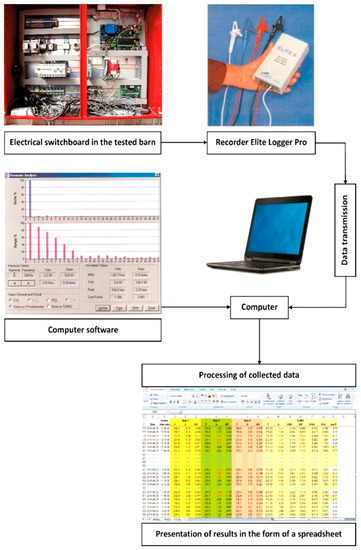
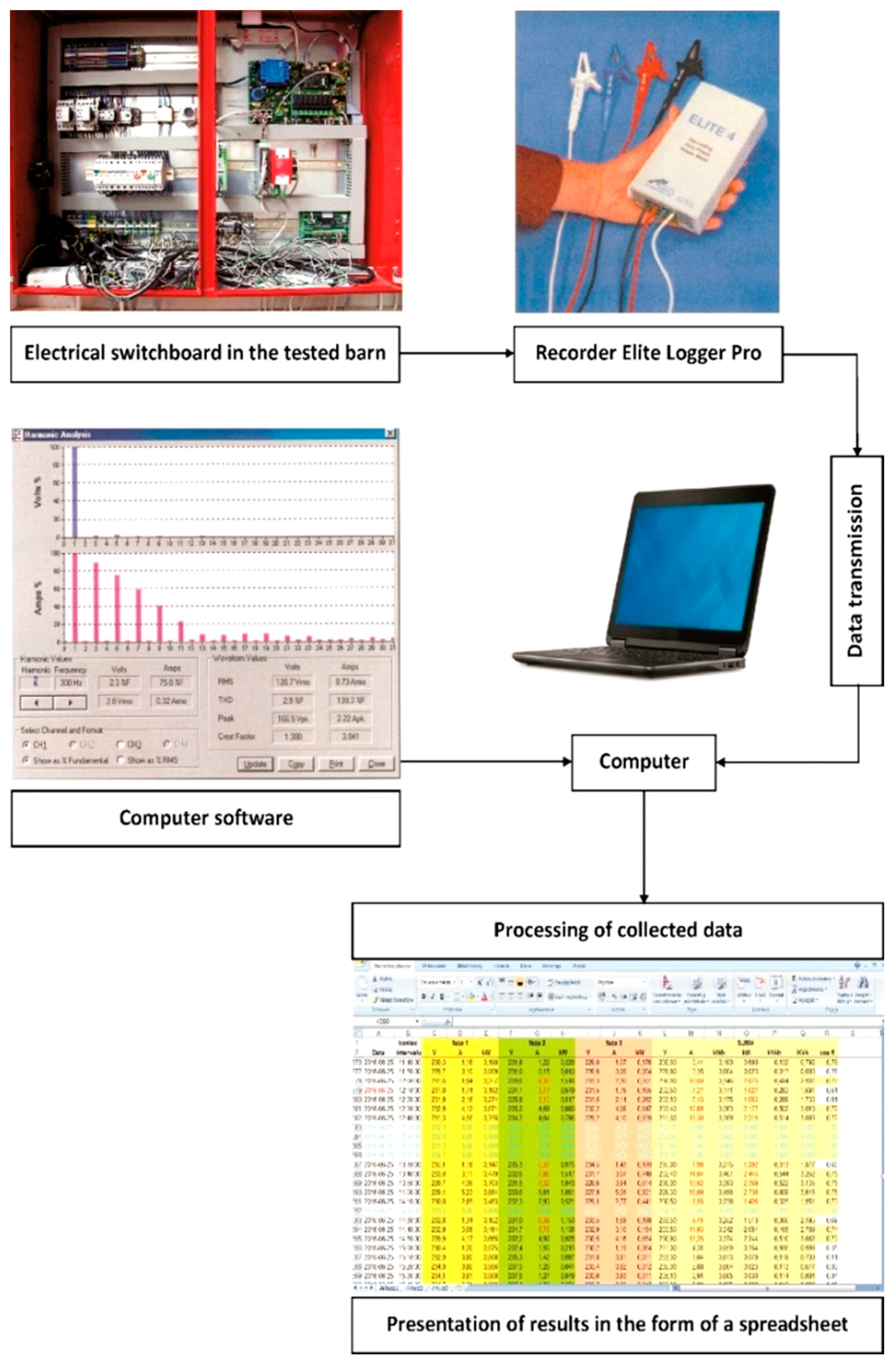
Electrical energy consumption measurements for machinery and equipment were taken with a mobile 3-phase recorder; Elite Logger Pro was presented on the diagram in Figure 1.
Figure 1.
Diagram of the research stand for recording the electrical energy consumption during feed mixing and feeding in the barns.
Cumulative Energy Intensity Calculation
Cumulative energy intensities, more specifically material and energy inputs, were analyzed in four energy fluxes, such as: (1) in tractors, machinery, and means of transport; (2) in spare parts and materials used for repairs; (3) in a direct energy carrier (fuel and electrical energy); (4) in consumables and raw materials; as well as in human labor [9,10,20]. Energy intensities accumulated for the practices undergoing study have been calculated from the following formula:
where:
ETech = ELab + EEF + EEq
ETech—energy intensity of the technology under study, [MJ⋅LU−1⋅year−1];
ELab—total human labor energy intensity [MJ⋅LU−1⋅year−1];
EEF—total consumed fuel and electrical energy intensity [MJ⋅LU−1⋅year−1];
EEq—total machinery and equipment energy intensity [MJ⋅LU−1⋅year−1].
The results were statistically verified with the use of Statistica. The tables present some selected values of the coefficient of correlation and the figures—selected dependencies.
The costs of electrical energy consumed by the machinery and equipment were calculated from the formula:
where:
Nei—electrical energy inputs for feed mixing and feeding machinery and equipment [kWh⋅year−1];
PkWh—electrical energy unit price [PLN⋅kWh−1].
The coefficient values for calculating the cumulative energy are presented in Table 3 from the source literature. Table 3 was based on Romaniuk et al. [21].
Table 3.
Selected values of cumulative energy intensities assumed for calculations according to the research methodology and operation.
3. Results
A description of the farms under study is provided in Table 4, whereas Table 5 breaks down the technical characteristics of the facility, including feeding practice. Table 6 provides a breakdown of the machinery and equipment, covering feed mixing and feeding technologies. The data provided in Table 5 and Table 6 were used to calculate the cumulative energy inputs for feeding, and the results have been broken down for feeding and provided in Table 7, with characteristic items, e.g., electrical and mechanical electrical energy inputs and labor inputs, i.e., machinery, equipment, and human working time, as well as cumulative energy intensity.
Table 4.
Farm characteristics.
Table 5.
Values of technical parameters for the barns under study.
Table 6.
Breakdown of feeding machinery and equipment for mechanization and automation in barns.
Table 7.
Values of process parameters for the barns under study, including labor inputs, electrical energy consumption, and cumulative energy intensity per feeding practice.
Table 8 presents cumulative energy intensity y4 for machinery and equipment involved in feeding practice broken down into actions: loading (y4a) and mixing, as well as feeding to the feed passage (y4b).
Table 8.
Cumulative energy intensities for machinery and equipment.
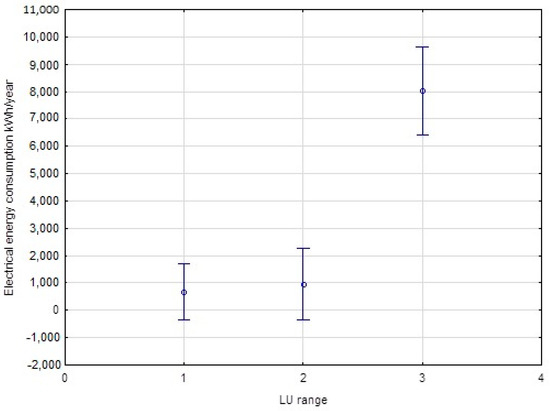
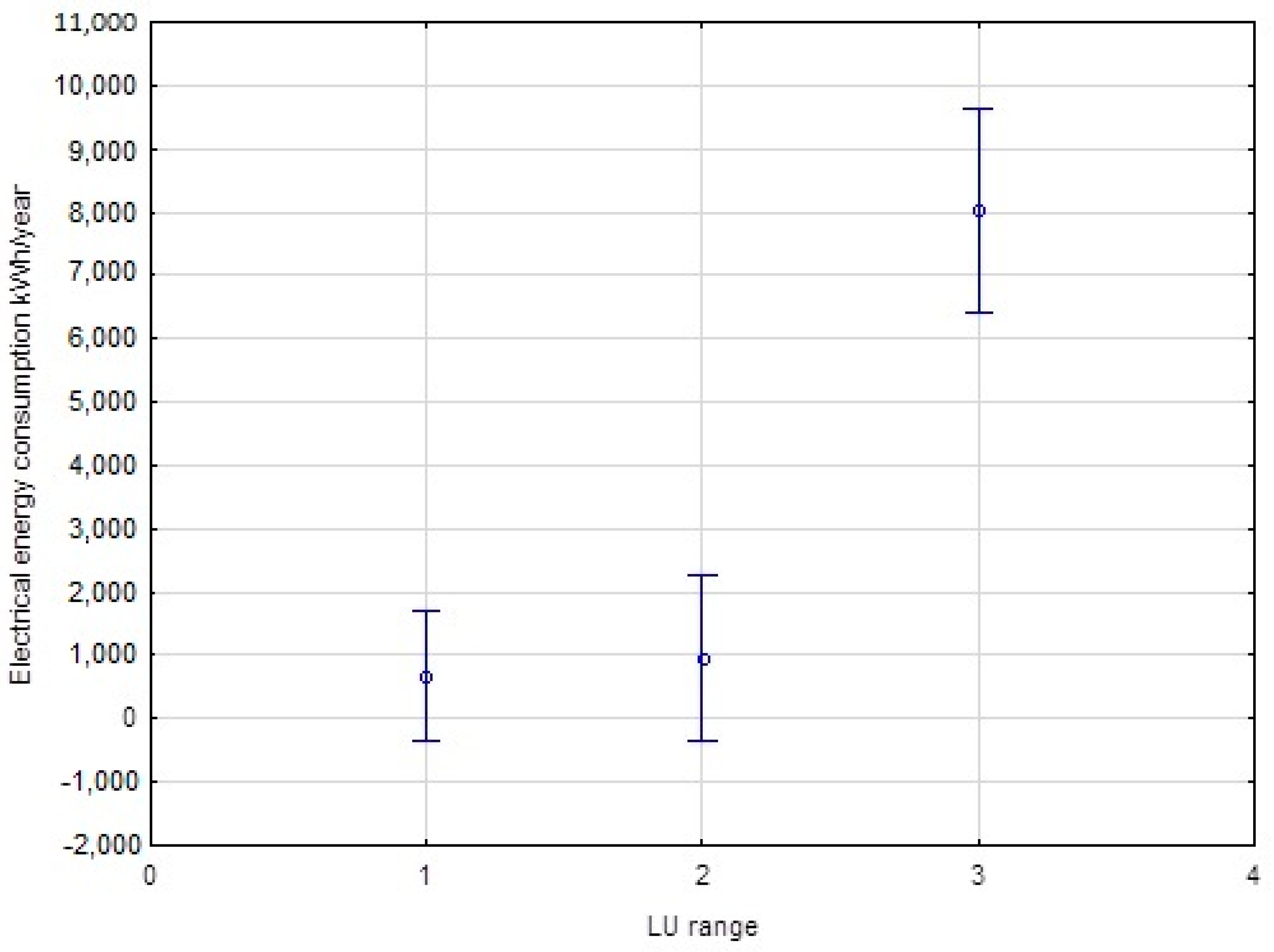
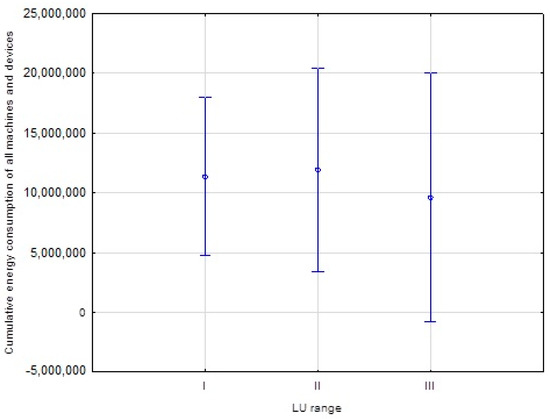
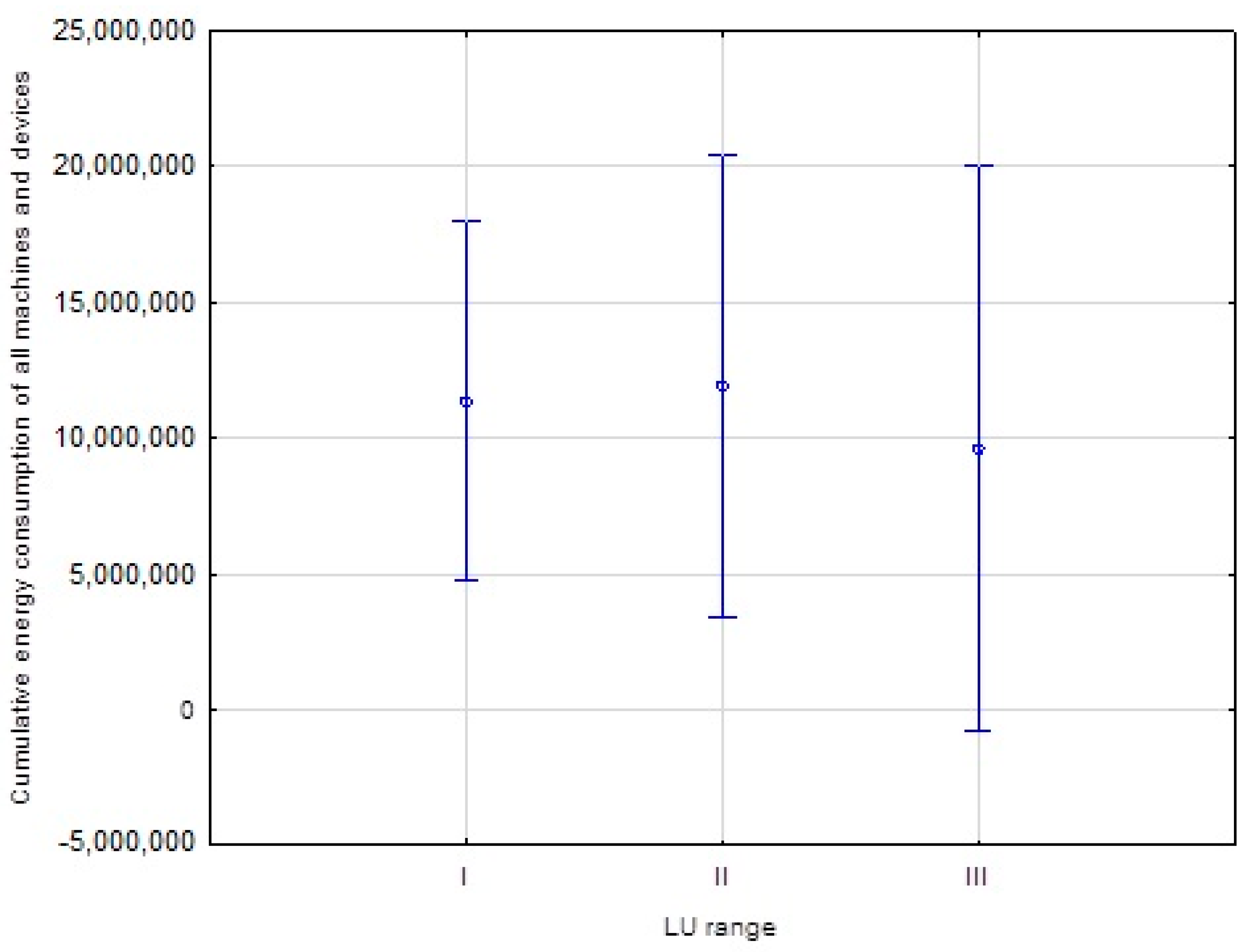
The dependence of electrical energy consumption on the 1 LU may show the economic approach of energy consumption in cattle breeding. According to the above, the statistical analysis [22] of the factors was supported by a post-hoc test (e.g., Duncan test), which allows for more advanced conclusions. To illustrate the occurring dependencies of the analyzed factors, the LU number was divided into three ranges (I, II, and III). In the first range (I) density values were below >100 LU, in the second (II) density values were between <100 and 200>, and the last range (III) contained LU numbers that were over <200. The obtained results were analyzed statistically. The significance level in the dependence test of the electrical energy consumption of the LU number was low and under 0.05 for the statistical empirical value: F(2, 27) = 34.679. Vertical bars represent 0.95 confidence intervals. The average values of the dependence of the electrical energy consumption on the LU number was presented in Figure 2.
Figure 2.
Dependence of electrical energy consumption on the LU number.
The established significance level in impact measurements of the electrical energy consumption concerning the tested density level (LU range) was less than 0.05, therefore, as a rule, Duncan′s statistical test was performed to determine homogeneous groups. Homogeneous groups defining the belonging of particular groups of groups (I, II, and III) to electrical energy consumption. The results are presented in Table 9.
Table 9.
Average values of electrical energy consumption divided into homogeneous groups according to LU range.
In addition, besides the correlation of electrical energy consumption on the LU number provided above, the dependence of the cumulative energy intensity was also statistically measured. In this case, the significance level in the dependence test of the cumulative energy intensity for various feed mixing and feeding technologies on the LU number was higher than previously for the statistical empirical value F(2, 7) = 0.08670. The average values of the dependence of cumulative energy intensity for various feed mixing and feeding technologies on the LU number were presented in Figure 3.
Figure 3.
Dependence of cumulative energy intensities for various feed mixing and feeding technologies on the LU number.
It was statistically found that in the tested range the cumulative energy intensity for various feed mixing and feeding technologies had no effect on the LU number. The significance level of p = 0.91792 was higher than the adopted significance level of 0.05. The homogeneous groups were not presented because they are in one group, as evidenced by the adopted significance level that was above the border level. The selected values of the coefficient of regression for the variables under study were presented in Table 10.
Table 10.
Selected statistical dependencies based on linear regression.
4. Discussion
The cumulative labor energy intensities in a group of barns with robotized feed mixing and feeding line (AFS) were 94% lower than in the group of barns with wagon-coupled-with-a-tractor feeding (CFS). Tangorra and Calcante reported on a considerable human labor input reduction. With robotization applied in cattle feeding, human labor is limited to filling silos with the concentrated feed and roughage, to loading equipment [12,23]. Our study notes over 5.59 times higher electricity consumption due to robotization compared to the traditional method of mechanization of feeding. Tangorra and Calcante also reported on lowered electrical energy inputs for the AFS, which resulted in a 33% decrease in daily production cost compared with the CFS; however, there were 40% higher initial investment costs (the daily cost was 33% lower than the TMR wagon-coupled-with-a-tractor feeding, despite the investment required to purchase the AFS, was more than 40% higher than that required for the CFS [12]).
In 2016, Mantoam reports that a heavier tractor requires 70.6% less energy per unit of power than a 3 times lighter tractor [24].
The application of cattle feeding robotization can lead to an increase in electrical energy consumption, while feeding with a mixing feed wagon is related to diesel oil consumption. A comparison of the present results with those reported by Oberschätzl, Haidn, Neiber, and Neser [15] in a group of robotized barns (technologies AFS1 to AFS4), shows the daily unitary mechanical energy inputs to be 87.7% lower compared with the mean value for the group of farms CF1 to CF6 of 0.9755 [kWh∙day−1∙LU−1]; an almost six-fold increase in electrical energy consumption for the group of AFS-equipped farms.
The daily electrical energy inputs in a group of automated technologies ranged from 0.9 to 7.56 kWh for the semi-automated system to 31.04 kWh for the fully-automated system (technology AFS4). Reports by Oberschätzl et al. 2015, on the other hand, for four dairy barns with the semi-automated and fully-automated feed mixing and feeding systems, demonstrated the daily electrical energy consumption on those farms to be 8.8 kWh with the semi-automated feeding system, and up to 52.6 kWh for the fully-automated system. It was found that the key diesel oil consumers are loaders for selecting and transporting feeds from bunker silos to mixers, while the key electrical energy consumers are the mixers that the feed is mixed in [15].
Automatic feeding systems have a number of advantages, including the social aspects related to the reduction of the workload of the operators; they also contribute to the reduction of greenhouse gas emissions through the reduced unit inputs of electrical and mechanical energy.
However, in some cases, especially for the third stage of robotization, we are dealing with higher energy consumption resulting from the need to use a large number of machines and devices with complex structures and considerable weight, which increase the power demand for propulsion, and thus have a negative impact on the environment. For such a high level of automation to remain cost effective, it can only be introduced into herds with a sufficiently high livestock density.
An example is the examined AFS4 technology, in which practically all the activities that make up the procedure of preparing and feeding the feed are robotic, with a high density of animals (320 LU). The energy intensity in this facility was lower than the highest of the results obtained for the conventional CFS4 technology, where the number of animals was lowest.
5. Conclusions
- The automated feed mixing and feeding technologies recorded the lowest cumulative human labor energy intensities compared with conventional mixing and feeding technologies (CFS1 to CFS2);
- The high level of automation of the preparation and feeding of fodder for four technologies in the nutrition of both dairy and beef cattle guarantees low labor demand, which is of key importance for agricultural producers due to the increasing labor costs and difficulties in finding labor;
- The lowest energy inputs were found in a group of farms equipped with automated feed mixing and feeding equipment (from AFS1 to ASF4), but which, when combined with a high cumulative energy intensity of machinery and equipment, resulted in the total highest value of cumulative energy intensity for feed mixing and feeding in that technology group;
- A practical conclusion for scientists and agricultural producers, resulting from the research on cumulative energy consumption, is much lower (39.3%) total electric and mechanical energy inputs for robotic feed preparation and feeding technologies compared to simple conventional technologies;
- Carrying out an LCA in the longer term will allow for a comprehensive assessment of the impact of modern technologies on cattle nutrition, which will contribute to future articles;
- The dependence of electrical energy consumption on the LU density may show the economic approach of energy consumption in cattle breeding. According to the statistical analysis supported by a post-hoc test (e.g., Duncan), it turned out that the significance level in the dependence test was low—under 0.05. Three groups were presented, in which groups I and II, LU numbers were the same, in distinction to group III. The cases of the dependence of cumulative energy intensities for various feed mixing and feeding technologies on LU numbers had no differences in all of the homogenous groups.
Author Contributions
Conceptualization, W.J.W., K.E.M., K.R., M.R. and M.M.; methodology, W.J.W., K.E.M., K.R., M.R. and M.M.; software, W.J.W., K.R. and M.R.; validation, K.E.M., K.R. and M.R.; formal analysis, W.J.W., K.E.M., K.R., M.R. and M.M.; investigation, W.J.W., K.E.M., K.R. and M.M.; resources, W.J.W., K.E.M., K.R. and M.R.; data curation, W.J.W., K.E.M., K.R. and M.R.; writing—original draft preparation, W.J.W., K.E.M., K.R., M.R. and M.M.; writing—review and editing, W.J.W., K.E.M., K.R., M.R. and M.M.; visualization, W.J.W., K.E.M., K.R. and M.R.; supervision, W.J.W., K.E.M., K.R. and M.R.; project administration, W.J.W., K.E.M., K.R. and M.R.; funding acquisition, W.J.W., K.E.M., K.R. and M.R. All authors have read and agreed to the published version of the manuscript.
Funding
This research was funded by the National Centre for Research and Development, grant number BIOSTRATEG1/269056/5/NCBR/2015.
Institutional Review Board Statement
Not applicable.
Informed Consent Statement
Not applicable.
Conflicts of Interest
The authors declare no conflict of interest. The funders had no role in the design of the study; in the collection, analyses, or interpretation of data; in the writing of the manuscript, or in the decision to publish the results.
References
- Todde, G.; Murgia, L.; Caria, M.; Pazzona, A. A Comprehensive Energy Analysis and Related Carbon Footprint of Dairy Farms. Part 1: Direct Energy Requirements. Energies 2018, 11, 451. [Google Scholar] [CrossRef] [Scilit]
- Todde, G.; Caria., M.; Gambella., F.; Pazzona., A. Energy and Carbon Impact of Precision Livestock Farming Technologies Implementation in the Milk Chain: From Dairy Farm to Cheese Factory. Agriculture 2017, 7, 79. [Google Scholar] [CrossRef] [Scilit]
- Eurostat 2020. Available online: https://ec.europa.eu/eurostat/statistics-explained/index.php?title=Milk_and_milk_product_statistics (accessed on 12 August 2021).
- Borusiewicz, A.; Majchrzak, M.; Romaniuk, W. Monograph. In Robotization of Cattle Feeding Taking into Account Energy Expenditure and Renewable Energy Sources in Modern Cowsheds; Higher School of Agribusiness in Lomza: Lomza, Poland, 2018; p. 171. ISBN 978-83-947669-3-1. [Google Scholar]
- Berebeć, A.K.; Feledyn-Szewczyk, B.; Thalmann, C.; Wyss, R.; Grenz, J.; Kopiński, J.; Stalenga, J.; Radzikowski, P. Assessing the Sustainability Performance of Organic and Low-Input Conventional Farms from Eastern Poland with the RISE Indicator System. Sustainability 2018, 10, 1792. [Google Scholar] [CrossRef] [Scilit]
- Rokochinskiy, A.; Frolenkova, N.; Turcheniuk, V.; Volk, P.; Prykhodko, N.; Tykhenko, R.; Openko, I. The variability of natural and climatic conditions in investment projects in the field of nature management. J. Water Land Dev. 2021, 4, 48–54. [Google Scholar]
- Maria, V.C.; Riccardo, V. A land-based approach for climate change mitigation in the livestock sector. J. Clean. Prod. 2021, 283, 124622. [Google Scholar] [CrossRef] [Scilit]
- Wałowski, G. Multi-phase flow assessment for the fermentation process in mono-substrate reactor with skeleton bed. J. Water Land Dev. 2019, 42, 150–156. [Google Scholar] [CrossRef] [Scilit]
- Konieczna, A.; Kamil, R.; Monika, R.; Damian, Ś.; Michał, R. Energy Efficiency of Maize Production Technology: Evidence from Polish Farms. Energies 2021, 14, 170. [Google Scholar] [CrossRef] [Scilit]
- Konieczna, A.; Kamil, R.; Kinga, B.; Emilia, G. GHG and NH3 Emissions vs. Energy Efficiency of Maize Production Technology: Evidence from Polish Farms: A Further Study. Energies 2021, 14, 5574. [Google Scholar] [CrossRef] [Scilit]
- Wójcicki, Z. Metodyka badania energochłonności produkcji rolniczej. Problemy Inżynierii Rolniczej. Z. 2015, 4, 17–29. [Google Scholar]
- Tangorra, F.M.; Calcante, A. Energy consumption and technical-economic analysis of an automatic feeding system for dairy farms: Results from a field test. J. Agric. Eng. 2018, 49, 228–232. [Google Scholar] [CrossRef] [Scilit]
- Oberschätzl-Kopp, R.; Haidn, B. Automatische Fütterungssysteme für Rinder—Technik, Leistung, Planungshinweise; DLG-Merkblatt 398; DLG International: Cherry Hill, NJ, USA; Frankfurt am Main, Germany, 2018; p. 20. Available online: https://www.dlg.org/fileadmin/downloads/landwirtschaft/themen/publikationen/merkblaetter/dlg-merkblatt_398.pdf (accessed on 5 December 2021).
- Belle, Z.; Andre, G.; Pompe, J.C.A.M. Effect of automatic feeding of total mixed rations on the diurnal visiting pattern of dairy cows to an automatic milking system. Biosyst. Eng. 2012, 111, 33–39. [Google Scholar] [CrossRef] [Scilit]
- Oberschätzl, R.; Haidn, B.; Neiber, J.; Neser, S. Automatic feeding systems for cattle—A study of the energy consumption of the techniques. Environmentally Friendly Agriculture and Forestry for Future Generations. In Proceedings of the XXXVI CIOSTA & CIGR Section V Conference, Saint Petersburg, Russia, 26–28 May 2015; p. 966. [Google Scholar]
- Calcante, A.; Oberti, R. A Technical-Economic Comparison between Conventional Tillage and Conservative Techniques in Paddy-Rice Production Practice in Northern Italy. Agronomy 2019, 9, 886. [Google Scholar] [CrossRef] [Scilit]
- Muzalewski. Zasady Doboru Maszyn Rolniczych. Kryteria Oceny Racjonalności Doboru oraz Wykorzystania Wybranych Maszyn i Urządzeń Rolniczych w Ramach Programu Rozwoju Obszarów Wiejskich (PROW 2007–2013) Pod Kątem Działania Modernizacja Gospodarstw Rolnych; Instytut Technologiczno-Przyrodniczy: Warsaw, Poland, 2008; p. 92. ISBN 978-83-89806-21-5. [Google Scholar]
- Grothmann, A.; Nydegger, F. Landtechnik im Alpenraum. Available online: https://docplayer.org/113517161-Landtechnik-im-alpenraum.html (accessed on 5 December 2021).
- Grothmann, A.; Nydegger, F. Robotertechnik für den Füttertisch. Available online: https://docplayer.org/20426533-Robotertechnik-fuer-den-futtertisch.html (accessed on 5 December 2021).
- Dobek, T.; Inżynieria, R. Energy Effectiveness of Edible Potato Production in the Selected Farmsteads. Inżynieria Rol. 2006, 10, 239–246. [Google Scholar]
- Romaniuk, W.; Borek, K.; Borusiewicz, A.; Mazur, K.; Wardal, W. Analysis of Technological Solutions for Stanchion Barns for Dairy Cattle; High School of Agribusiness in Lomza: Łomża, Poland, 2018; p. 260. ISBN 978-83-947669-4-8. [Google Scholar]
- Roman, K.; Michał, R.; Dominika, S.; Jan, S.; Emilia, G. Evaluation of Physical and Chemical Parameters According to Energetic Willow (Salix viminalis L.) Cultivation. Energies 2021, 14, 2968. [Google Scholar] [CrossRef] [Scilit]
- Vaculík, P.; Smejtkova, A. Assessment of selected parameters of automatic and conventional equipment used in cattle feeding. Agron. Res. 2019, 17, 879–889. [Google Scholar] [CrossRef]
- Mantoam, E.J.; Romanelli, T.L.; Gimenez, L.M. Energy demand and greenhouse gases emissions in the life cycle of tractors. Biosyst. Eng. 2016, 151, 158–170. [Google Scholar] [CrossRef] [Scilit]

Publisher’s Note: MDPI stays neutral with regard to jurisdictional claims in published maps and institutional affiliations. |
© 2021 by the authors. Licensee MDPI, Basel, Switzerland. This article is an open access article distributed under the terms and conditions of the Creative Commons Attribution (CC BY) license (https://creativecommons.org/licenses/by/4.0/).