


Abstract
Chinese garden painting traditions have long emphasised the compositional importance of pavilions and have often treated them as visual focal points. However, whether a compositional focal point also becomes a focus of viewers’ attention during actual viewing remains an open question. This exploratory study examines five pavilion scenes from Forty Views of the Yuanmingyuan by combining historical plan reconstruction, compositional analysis, eye tracking, and post-viewing questionnaires. Thirty participants viewed the paintings while fixation timing, order, duration, and frequency were recorded. Across most scenes, pavilions were not the first elements to attract attention and generally received less cumulative attention than vegetation, topography, or larger architectural groups. Their visual prominence varied with spatial position, scale, and relationships with paths, water, terrain, and surrounding buildings. Across scenes, pavilion fixation probability and time to first fixation did not differ significantly, whereas total fixation-duration proportion and fixation count did; JJMQ exceeded each of the other four scenes on both cumulative measures. The findings suggest that pavilions function not as fixed visual centres but as conditional nodes of attention whose observed salience was associated with spatial relationships and pictorial composition in the five scenes examined.
1. Introduction
In traditional Chinese landscape painting, the “pavilion” has often been regarded as an important element of composition and as a device connecting paths, water and the terrain. Guo Xi described water as taking mountains for its face and pavilions for its ‘brows and eyes’, a metaphor that joins pictorial emphasis to spatial articulation [1]. The term jingyan, literally the ‘eye of the scene’, is used here as visual focus: the element that gives a scene compositional emphasis and tends to draw the viewer’s gaze.
The Mustard Seed Garden Manual of Painting similarly links the placement of buildings to the organisation of a landscape image. Its discussion of waterside pavilions, bridges, trees, and open halls treats architecture as a means of establishing emphasis and spatial relation rather than as an isolated object [2].
An inscription by Zhang Xuan on Ni Zan’s Xiting shanse tu gathers the surrounding rivers and mountains into a single pavilion, expressing the idea that a small architectural element can concentrate the meaning of an extensive scene [3].
The same literature also gives the pavilion a spatial role. Guo Xi’s ideal of landscapes that can be travelled through, viewed, wandered in, and inhabited connects pictorial experience with imagined movement. Ji Cheng later argued that the location of a pavilion should harmonise with water features, floral displays and tranquil surroundings; whereas Tang Dai believed that pavilions should be determined according to the site conditions and the compositional requirements of the scene [4,5].
These sources explain why the pavilion may be of significant importance in terms of composition, but they do not show when viewers actually look at it, how long their attention is held, or whether the pavilion remains the focal point once it has been transformed from a plan view into a scene within the painting.
Research on the Forty Views of Yuanmingyuan has concentrated on textual and visual interpretation, relations between poetry and image, and the history of particular landscape elements [6,7,8,9,10,11]. Behavioural evidence remains scarce, and the garden plans have not been used to test how the selection of a painted view may affect attention to pavilions within the image.
Against this background, eye tracking offers a means of investigating this issue. Research into the viewing of works of art has linked fixation patterns to the attractiveness and salience of the image, as well as to age, specialist knowledge, personal preferences, the title of the work, museum displays and the pictorial composition [12,13,14,15,16,17,18,19,20]. Studies of architecture and urban space have likewise used eye tracking to compare representations and to identify features that organise visual engagement with buildings and street edges [21,22,23,24]. Together, this work shows that a formally prominent element need not attract the earliest or longest attention under every viewing condition.
This study therefore asks three questions. First, how were pavilion locations and spatial sequences in the garden plan transformed into the five painted scenes? Second, compared with other elements, did the pavilion attract people’s attention earlier or more consistently? Third, are variations in the attention paid to different pavilions associated with differences in location, composition, and viewing direction—for example, when the same pavilion receives different levels of attention in two images? This analysis draws on a combination of historical floor plans, formal interpretation, eye-tracking data and questionnaire results; accordingly, the study takes an exploratory approach to these research questions, with particular attention to the spatial-organisational role of pavilions in pictorial composition and its relationship to viewers’ patterns of visual attention. In this study, a compositional focal point refers to an element interpreted as structurally important in organising the image, whereas an attentional focal point refers to an element showing empirically observed priority or concentration of gaze. These related but distinct constructs were evaluated separately.
2. Materials and Scene Selection
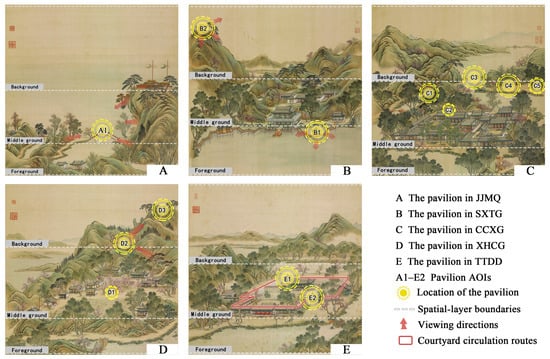
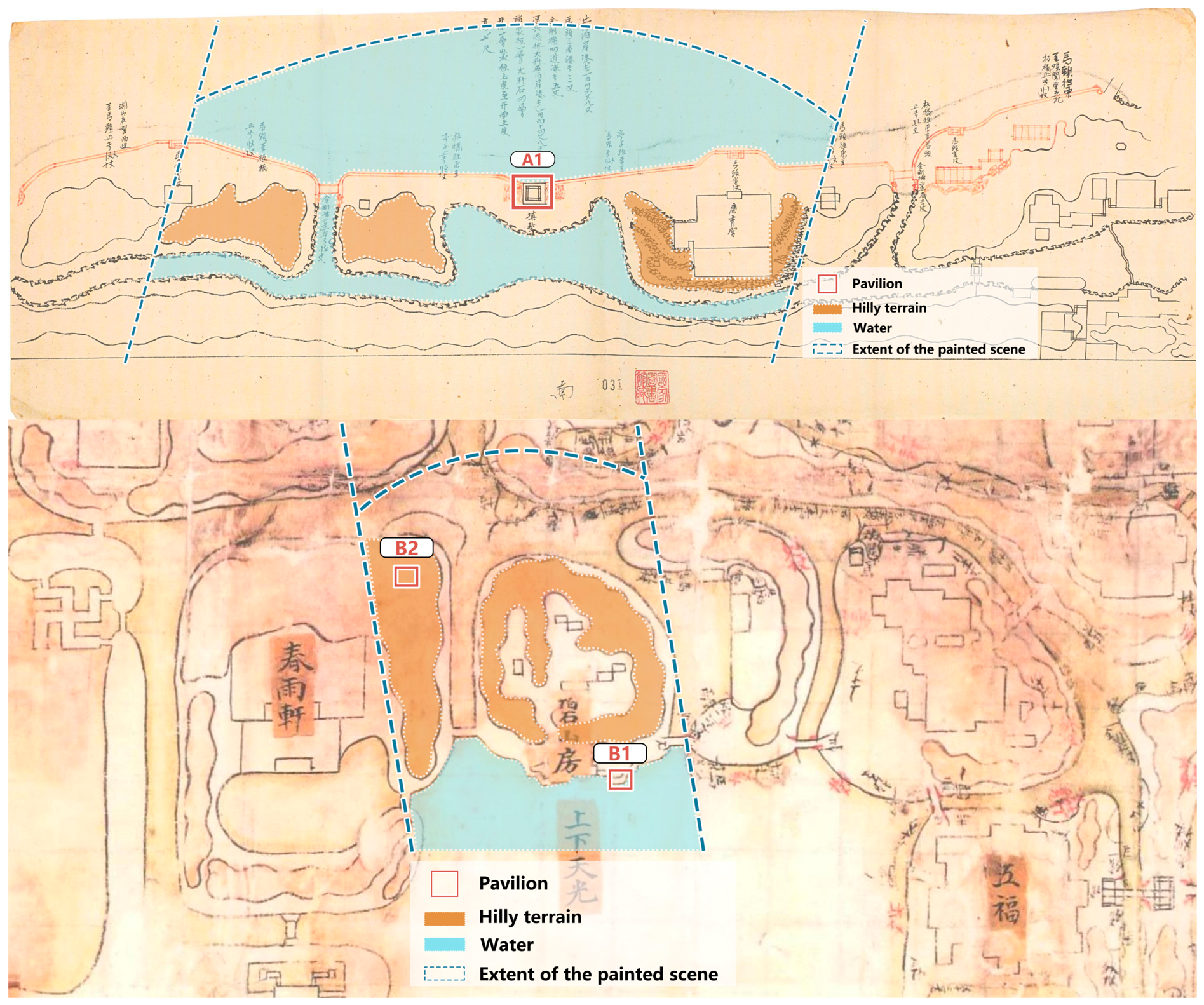
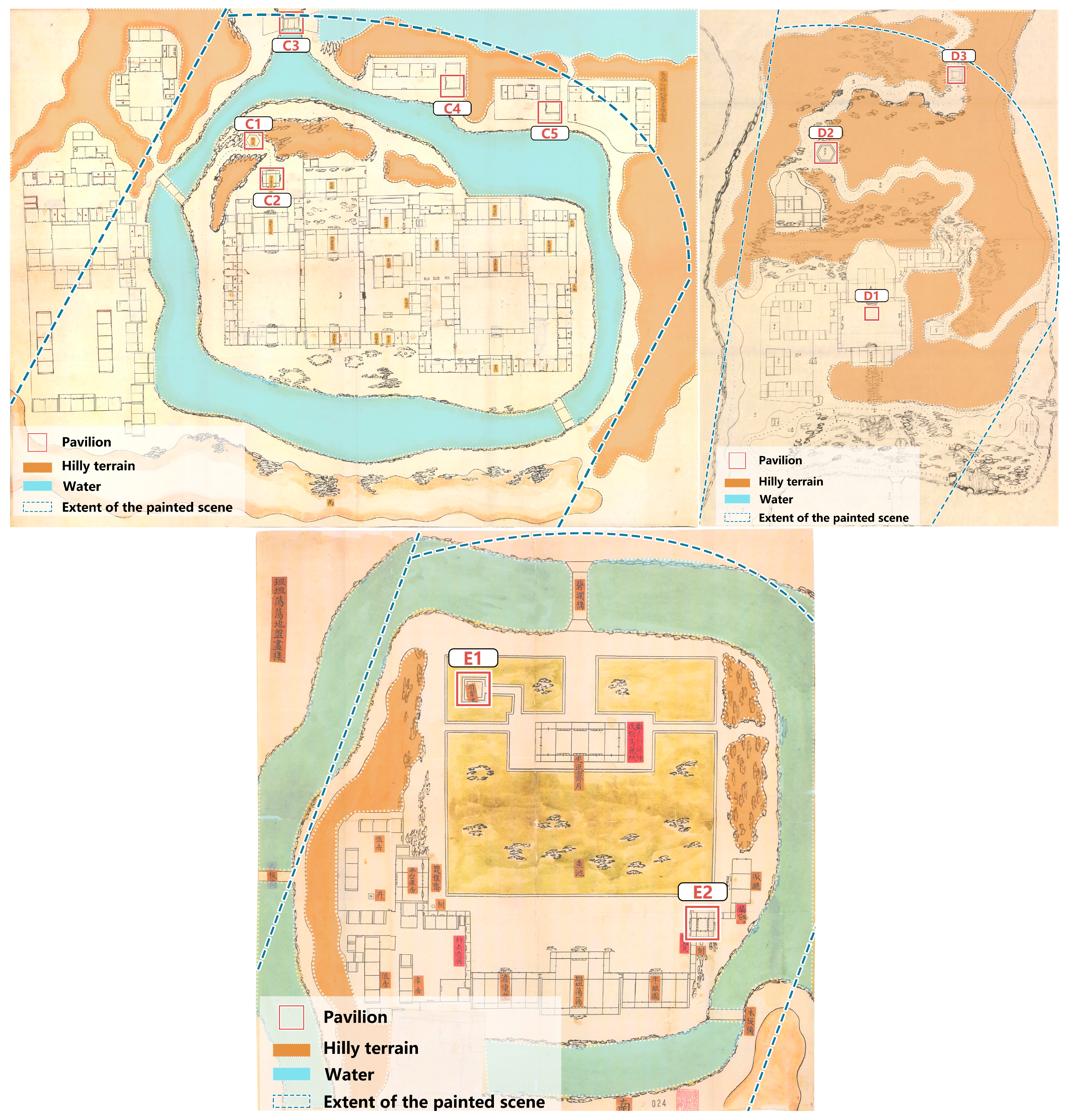
The primary material is Forty Views of the Yuanmingyuan, an album of paintings completed in 1744 by Qing dynasty court painters based on the landscapes of the imperial gardens [25]. Five images from this collection were purposively selected as experimental stimuli; the selection criteria were that the pavilions and gazebos in these paintings were clearly identifiable, their spatial layers were suitable for comparison, and the compositions contained minimal visual distractions. These criteria supported comparison but did not constitute representative sampling of the album. Figure 1 and Table 1 summarise the 13 pavilion areas and their locations.
Figure 1.
Positions and spatial-layer distribution of the pavilion areas in the five painted scenes.
Table 1.
Positions, environmental settings, compositional roles, and proportional areas of the 13 pavilion AOIs.
The scene abbreviations used below are Jiajing mingqin (JJMQ), Shangxia tianguang (SXTG), Changchun xianguan (CCXG), Xinghua chunguan (XHCG), and Tantan dangdang (TTDD).
Plan-Based Reconstruction of the Painted Views
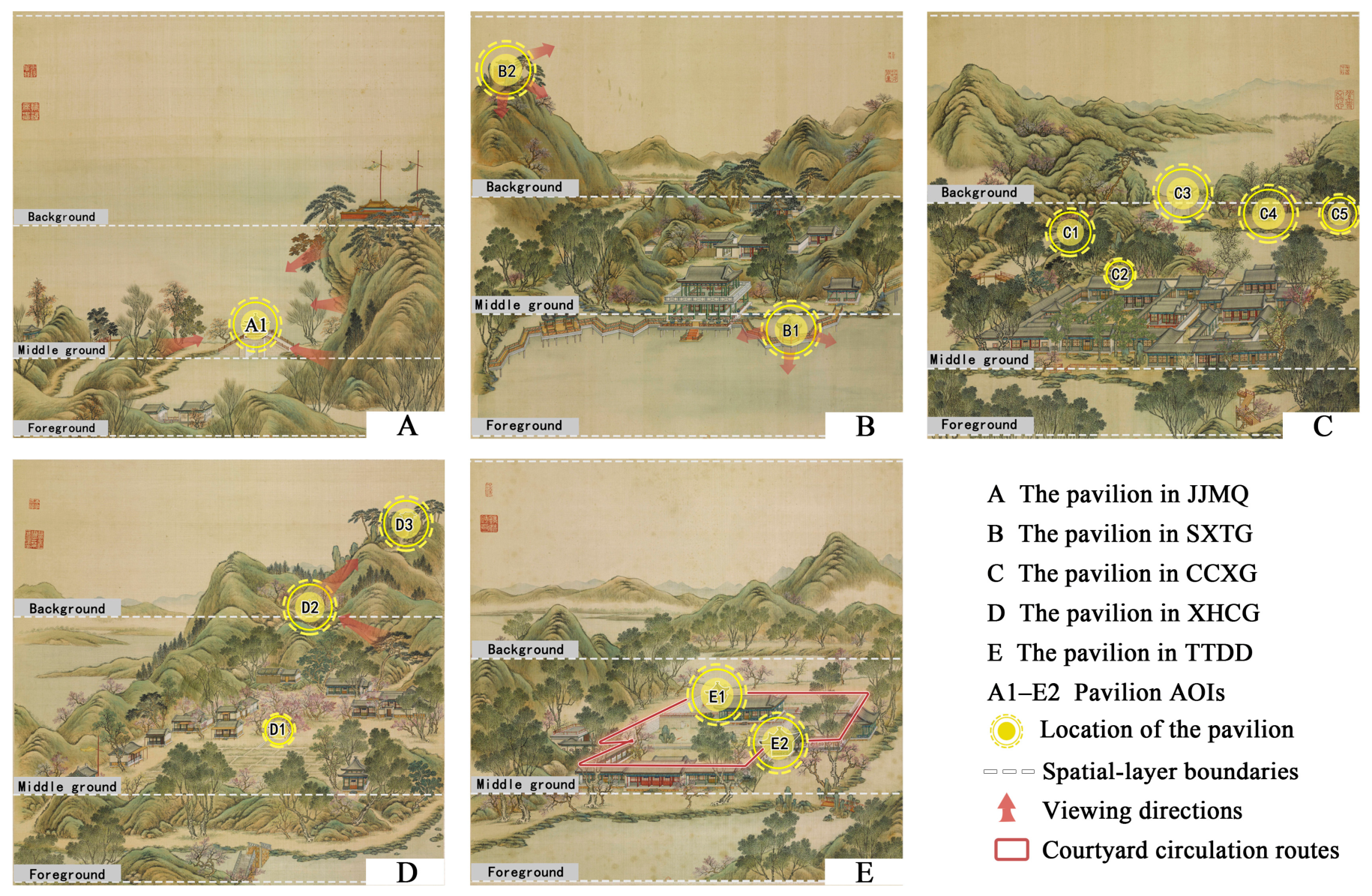
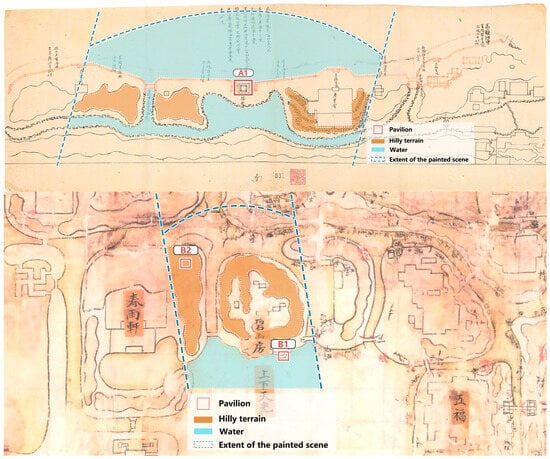
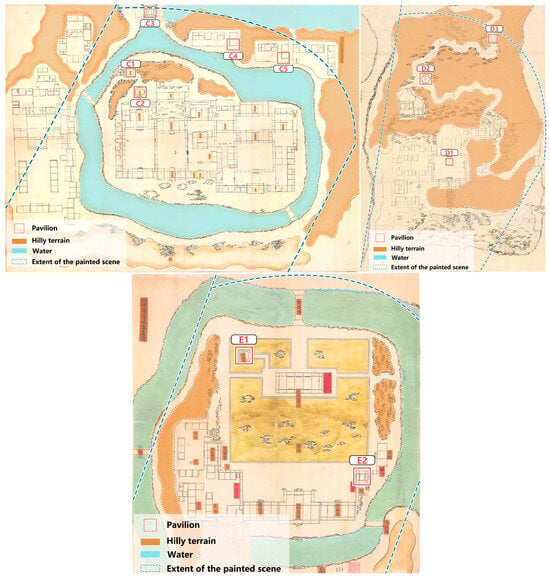
To examine the relationship between the layout of the garden and the visual focal points in the paintings, this study marked the locations on the Yangshi Lei archives floor plans that corresponded to the areas of interest (AOIs) of the pavilions depicted in the paintings, and the approximate framing ranges and primary viewing directions for each painting were estimated (Figure 2; see [26]). The paintings adopt a bird’s-eye view, and the perspective from which different elements are depicted varies; the floor plans were primarily used to analyse the framing range, the adjacency of elements, and the directional emphasis within the composition, rather than to establish a single, fixed viewpoint.
Figure 2.
Plan-based reconstruction of the five painted scenes and their pavilion AOIs. Sources: National Library of China [26], Yangshi Lei Archives, Yuanmingyuan Preliminary Series, Portfolio 9, p. 9 (JJMQ); Portfolio 1, p. 6, general plan excerpt (SXTG); Portfolio 3, p. 28 (CCXG); Portfolio 4, p. 46 (XHCG); and Portfolio 4, p. 21 (TTDD). Annotations by the authors.
These proposals illustrate how pavilions can organise a scene. In the JJMQ proposal, A1 is situated at the junction of the waterside walkway, the bridge and the opposite bank; the artwork brings these elements together around the pavilion. SXTG utilises pavilions set upon the water and on the hillside to make the pavilions appear to wander through the landscape, whilst the CCXG proposal opts for a wider loop encircling the water and the main courtyard, ensuring that its five pavilion areas remain dispersed. Similarly, the three pavilions in the XHCG proposal are scattered across the courtyard and the hillside behind it. The TTDD proposal retains the sequence of courtyards but reserves the largest pictorial area for the central building and vegetation, rather than the pavilions in E1 or E2.
Furthermore, the SXTG and XHCG drawings reveal a contrast: B2 and D3 are depictions of the same pavilion from different angles. Consequently, any differences in the eye-tracking trajectories between the two must be interpreted in the context of the image scale, compositional positioning, topographical contrasts and surrounding elements, and cannot be attributed solely to the type of pavilion. As the plan in SXTG was extracted from the master plan, it was used as supporting evidence.
Taken together, the relationship between the garden plans and the paintings can be characterised as selective pictorial restructuring: recognisable adjacency relationships between pavilions and water, bridges, paths, courtyards, and hills were retained, while viewpoint, scale, spacing, and visual hierarchy were compressed or reorganised within the bird’s-eye compositions. JJMQ concentrates multiple spatial relationships around a waterside pavilion; SXTG distributes pavilions between the water and the hillside; CCXG organises five pavilion areas around a larger water-and-courtyard loop; XHCG transforms the route from the courtyard to the hillside into a gradually ascending spatial sequence; and TTDD retains the courtyard sequence while subordinating the pavilions to larger buildings and vegetation. Thus, across the five scenes, pavilion locations functioned as nodes of spatial organisation, but their prominence and spatial sequencing were adjusted to the compositional requirements of each painting.
3. Eye-Tracking Method
This experiment examined whether the compositional roles inferred from the historical plans and paintings corresponded to viewers’ actual patterns of visual attention during free viewing. Pavilion AOIs were compared with topography, vegetation, paths, other buildings, and structures within each image. The analysis distinguished between early attention priorities and attention accumulated throughout the viewing session.
3.1. Study Population and Ethics
A total of 30 participants took part in this study (N = 30), including 11 men and 19 women. Twenty-nine participants were aged 18–35 years, and one was aged 36–59 years. The participant pool comprised students from different academic disciplines and other adult members of the public. Recruitment was intentionally broad to maintain diversity in disciplinary and occupational backgrounds rather than concentrating the sample within a single field.
Prior exposure to Chinese ancient landscape painting or garden imagery was assessed using a five-category self-report item in the post-viewing questionnaire. Four participants (13.33%) reported almost no prior exposure, 12 (40.00%) reported occasional exposure, eight (26.67%) reported moderate exposure, four (13.33%) reported frequent exposure, and two (6.67%) reported very frequent exposure through study or work. Specific academic discipline and occupation categories, and separate measures of expertise in architecture, gardens, or visual arts, were not collected in a form suitable for subgroup analysis. All participants had normal or corrected vision and reported no history of serious eye or neurological disorders. This study was approved by the Academic Committee of the School of Architecture and Urban Planning at Beijing University of Civil Engineering and Architecture on 1 January 2026. All participants signed a written informed consent form prior to the commencement of the experiment. To evaluate the statistical sensitivity of the sample size and within-participant design, we conducted a sensitivity power analysis for the two outcomes analysed using one-way repeated-measures ANOVA (α = 0.05, power = 0.80, N = 30, and five repeated measurements). Using the Fisher-z-averaged correlations among repeated measurements (r = 0.356 for the proportion of total fixation duration and r = 0.242 for fixation count) and the Greenhouse–Geisser epsilon estimates (ε = 0.768 and ε = 0.678, respectively), the minimum detectable effect sizes were f = 0.253 for the proportion of total fixation duration and f = 0.287 for fixation count. The design was therefore sensitive to approximately moderate or larger scene effects on these outcomes, whereas smaller effects may have remained undetected. For context, the final sample size falls within the range used in comparable laboratory eye-tracking studies of landscape and art viewing (N = 30–44) [17,27,28,29,30].
3.2. Apparatus and Stimuli
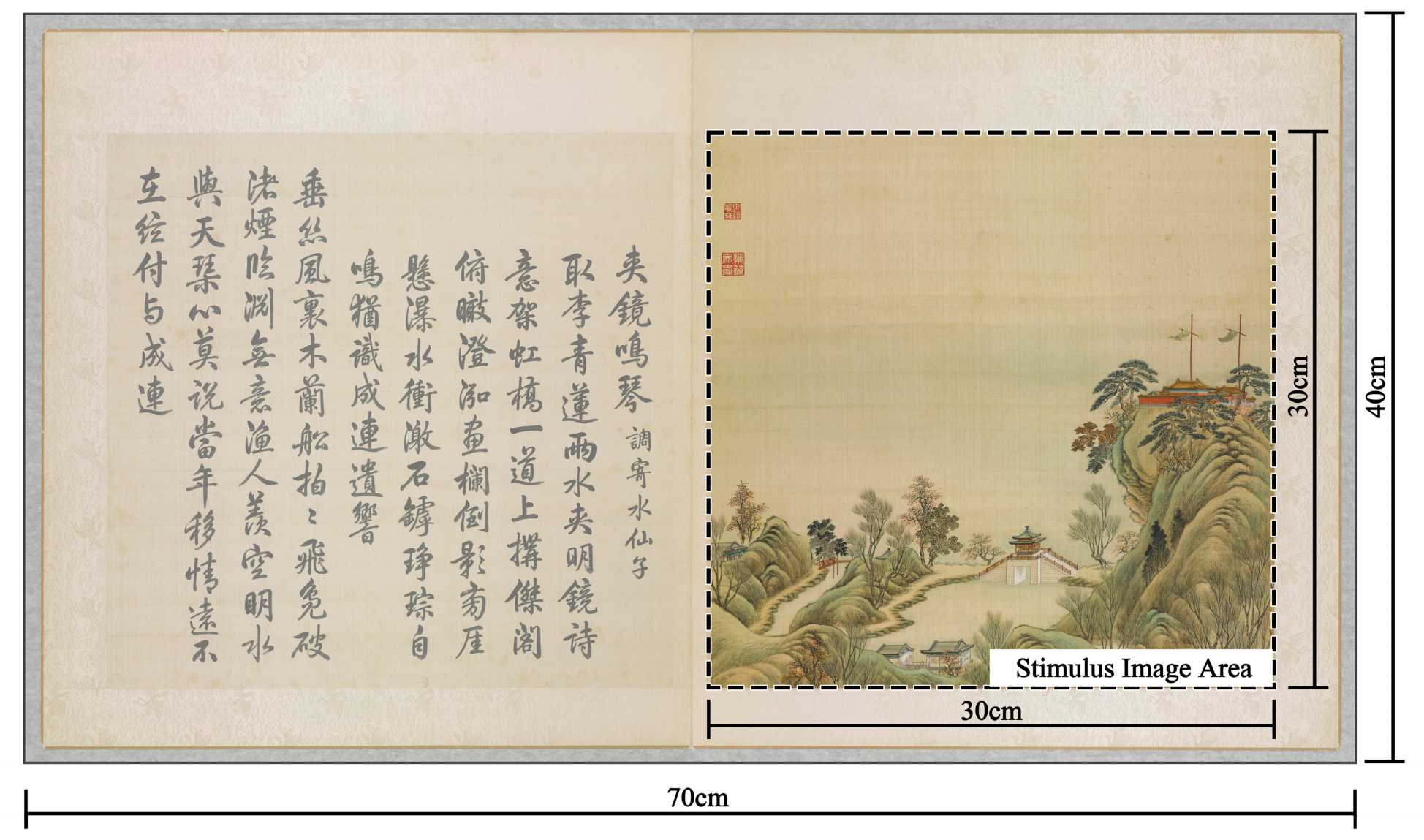
The experiment was conducted in a sound-insulated behavioural laboratory under stable lighting conditions to minimise external interference. Eye movements were recorded using a Tobii Pro Spectrum eye tracker at a sampling rate of 120 Hz, while ErgoLAB software (version 3.17.21; Kingfar International Inc., Beijing, China) controlled calibration, stimulus presentation, and data recording. The images were displayed on a 55-inch Hisense Vidda R55 LCD display (model 55V1KD-R), Hisense Visual Technology Co., Ltd., Qingdao, China with a resolution of 3840 × 2160 pixels. Mounted borders and inscriptions were removed so that only the painted field remained. All five images were centred and proportionally scaled while preserving their original aspect ratios (Figure 3). Participants were seated at a viewing distance of approximately 80 cm from the display and were instructed to minimise head movement.
Figure 3.
Schematic illustration of the stimulus image area.
3.3. Procedure
Each session comprised calibration, five viewing trials, and a questionnaire. A five-point calibration was performed before data collection and was accepted when the calibration error reported by the software did not exceed 0.5°. Participants were instructed to view each image naturally, as they would a painting in an everyday setting. Each image appeared for 25 s, followed by a 5-s grey screen; trial order was randomised across participants. The questionnaire was completed after all five viewing trials.
3.4. Data Preprocessing and Quality Control
Gaze data were processed in ErgoLAB. Data from the two eyes were averaged. Gaps of up to 75 ms were interpolated according to the software settings, and a moving median filter with a three-sample window was applied for noise reduction. Fixations were classified using the I-VT algorithm with a velocity-calculation window of 20 ms and a velocity threshold of 30°/s. Adjacent fixations were merged when the interval between them was no more than 75 ms and their angular separation was no more than 0.5°. Fixations shorter than 60 ms were discarded. Eye movements were acquired at 120 Hz, while the software-generated data used for subsequent statistical analysis were processed at a temporal resolution of 30 Hz. Trial-level data completeness was assessed relative to the number of samples expected from the 30-Hz data used for analysis. Trials were designated for exclusion if more than 20% of the expected samples were missing, if the 25-s stimulus presentation was incomplete, or if the calibration criterion was not met. All 30 participants completed all five trials and met the calibration and data-quality requirements. Consequently, no participant or trial was excluded, and all 150 trials were retained. The absence of a fixation on a pavilion was retained as a valid non-fixation observation rather than treated as missing data.
3.5. Areas of Interest and Outcome Measures
Six AOI categories were defined in each image: Topography, Vegetation, Path, Other Buildings, Pavilion, and Structures. Time to first fixation and first-fixation order indexed early attentional priority. Proportion of total fixation duration indexed cumulative visual weight, mean fixation count indexed repeated attention, and mean fixation duration indexed the duration of a single fixation. Heat maps were used as descriptive spatial summaries and were interpreted alongside the AOI measures rather than as independent evidence. Operationally, fixation probability indicated the likelihood that a pavilion was fixated during viewing; time to first fixation and first-fixation order indicated the temporal priority of attention; and the proportion of total fixation duration and fixation count indicated cumulative attentional engagement. Mean fixation duration was treated as a supplementary measure of the duration of individual fixations. Because these measures capture different dimensions of visual attention, no single measure was considered sufficient to identify a visual focal point. When several indicators jointly showed relatively high attentional priority or concentration, the pavilion was described as exhibiting stronger attentional focality. When the indicators diverged, the specific attentional pattern was reported instead of assigning a binary focal-point classification.
For the across-scene analyses, all pavilion AOIs within each image were aggregated into a scene-level pavilion category for each participant. TTFF was defined as the latency to the first fixation on any pavilion in the image, while the proportion of total fixation duration and fixation count were aggregated across all pavilion AOIs. A TTFF value of zero was treated as non-fixation unless a genuine time-zero fixation was confirmed from the original fixation record. Non-fixations were excluded from descriptive TTFF summaries and right-censored at 25 s in the inferential analysis. Fixation probability was analysed using Cochran’s Q test, followed, where appropriate, by exact McNemar tests. TTFF was analysed using a Cox proportional-hazards model stratified by participant. The proportion of total fixation duration and fixation count were analysed using one-way repeated-measures analyses of variance, followed by Holm-adjusted paired comparisons. Friedman tests and Wilcoxon signed-rank tests were conducted as sensitivity analyses. All tests were two-sided, with α = 0.05. Repeated-measures ANOVA was retained as the primary analysis because the complete and balanced within-participant design permits the direct estimation of mean differences and effect sizes and is reasonably robust to moderate departures from normality. The Friedman and Wilcoxon analyses served as distribution-free sensitivity checks for the bounded fixation-duration proportion and discrete fixation-count outcomes. Sphericity was assessed using Mauchly’s test, and Greenhouse–Geisser-corrected degrees of freedom were reported when the assumption was violated. Holm-adjusted pairwise comparisons are accompanied by 95% confidence intervals for the mean differences. Because the pavilion AOIs varied across scenes in combined area (0.54–1.52% of the image) and number (1–5), the analyses of the two cumulative measures were repeated using two sets of normalised outcomes: each measure was divided (a) by the combined pavilion-AOI area proportion and (b) by the number of pavilion AOIs. The same repeated-measures ANOVA and Friedman procedures were applied to these area- and number-normalised outcomes. Accordingly, Table 2, Table 3, Table 4, Table 5 and Table 6 were treated as descriptive summaries of AOI-level patterns within individual paintings. Formal inferential analyses were restricted to participant-level measures aggregated across all pavilion AOIs within each scene, as reported in Table 7.
Table 2.
Eye-tracking measures for the AOIs in JJMQ.
Table 3.
Eye-tracking measures for the AOIs in SXTG.
Table 4.
Eye-tracking measures for the AOIs in CCXG.
Table 5.
Eye-tracking measures for the AOIs in XHCG.
Table 6.
Eye-tracking measures for the AOIs in TTDD.
Table 7.
Participant-level pavilion measures across the five scenes.
4. Results
4.1. Jiajing Mingqin
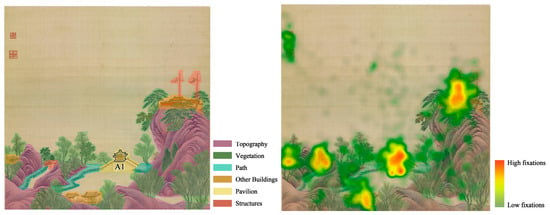
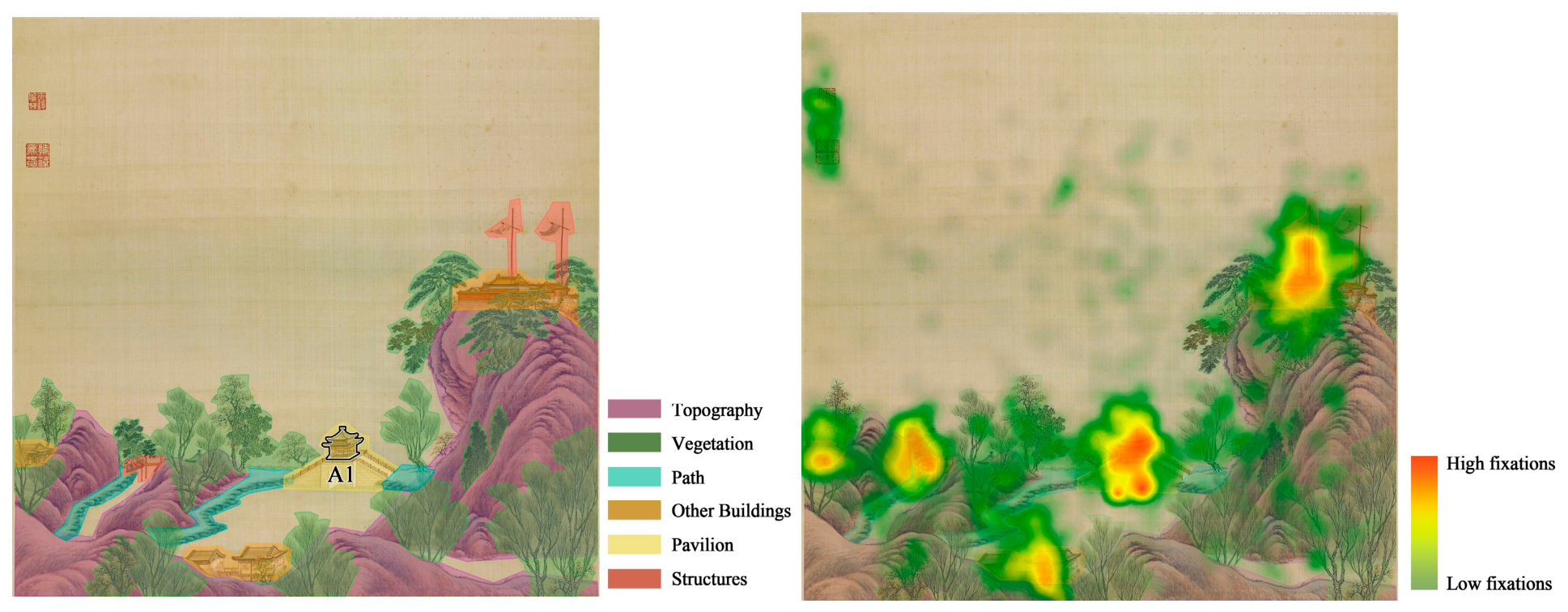
The following AOI-level comparisons are descriptive. Numerical differences between individual AOIs should not be interpreted as statistically tested effects. The AOI overlay and heat map show the highest fixation density around the bridge pavilion and staircase near the centre of the painting. Secondary concentrations appear around the hilltop building cluster and flagpole at the upper right and around several architectural nodes in the valley to the left. Trees and sloping ground also received broadly distributed attention across the image (Figure 4).
Figure 4.
AOI division and heat map for JJMQ.
The AOI statistical results are broadly consistent with the attention distribution shown in the heatmap (Table 2). The time to first fixation at A1 was 4.55 s, and its average position in the sequence of first fixations was approximately 15th, later than that of vegetation, terrain and other buildings. Nevertheless, although A1 accounted for only 0.54 per cent of the frame area, it received 11.63 per cent of the total fixation duration, with an average of seven fixations, indicating descriptively that it received a relatively high share of visual attention within a small area of the frame. Its average fixation duration was 0.33 s, which was close to that of other buildings (0.34 s) and higher than that of vegetation (0.29 s). These results suggest that A1 was fixated relatively late but it received multiple fixations during subsequent viewing, indicating relatively strong cumulative attentional engagement within a small area.
4.2. Shangxia Tianguang
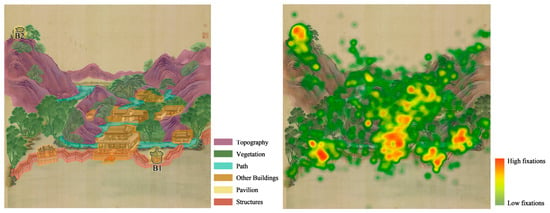
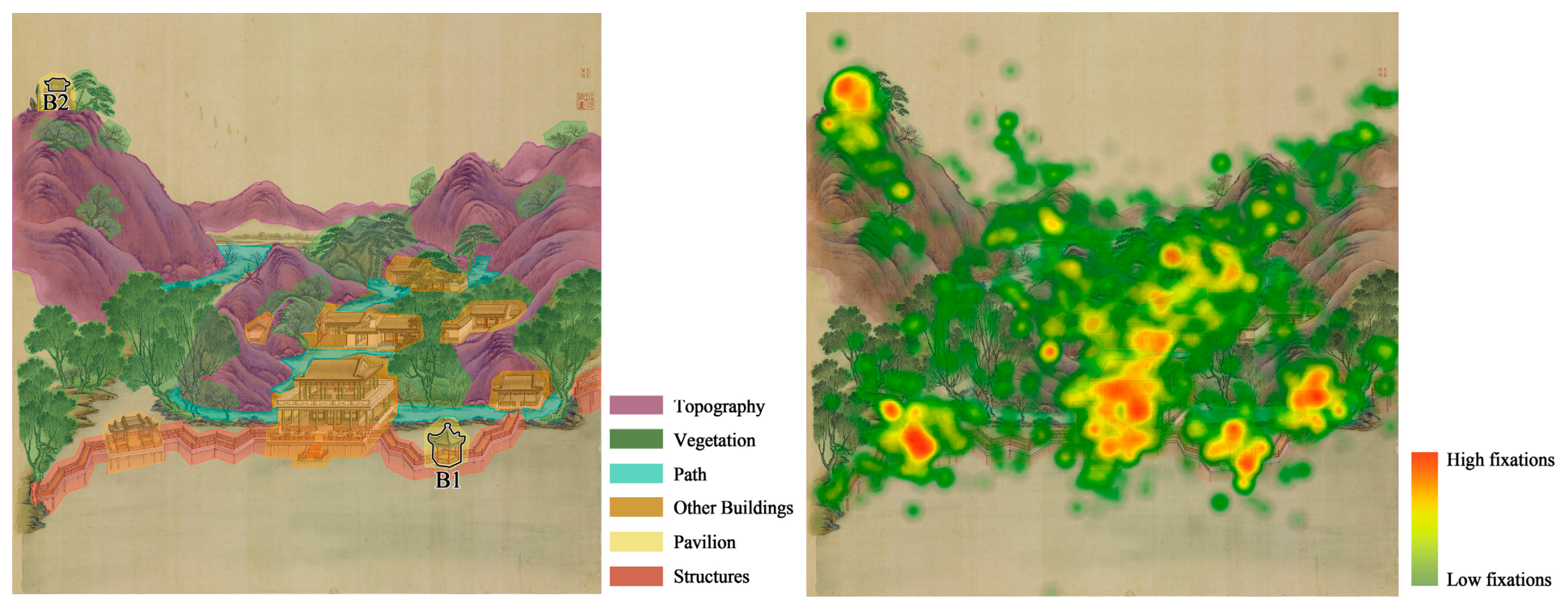
The SXTG heatmap shows that the two-story buildings facing the water in the lower-central part of the image, together with the surrounding complex of buildings, formed the area attracting the most attention. A considerable amount of attention was also directed towards the sloping banks and the tree-lined area along the shore, whilst the building situated high up in the top-left corner formed a secondary local hotspot. The locations of B1 and B2 also exhibited smaller local hotspots (Figure 5).
Figure 5.
AOI division and heat map for SXTG.
The AOI statistics for SXTG are shown in Table 3. The times to first fixation for B1 and B2 were 8.18 s and 10.71 s, respectively, with mean first-fixation orders of approximately 26th and 32nd. They accounted for 3.06 per cent and 2.76 per cent of the total fixation duration, respectively; the average number of fixations for both was 1, whilst the average fixation duration was 0.26 s and 0.25 s, respectively. As can be seen from the heatmaps, although the two pavilions constituted local areas of interest, they attracted attention later than the larger building complexes, topography and vegetation; consequently, their cumulative proportion of fixation duration was lower, and they received fewer repeated fixations.
4.3. Changchun Xianguan
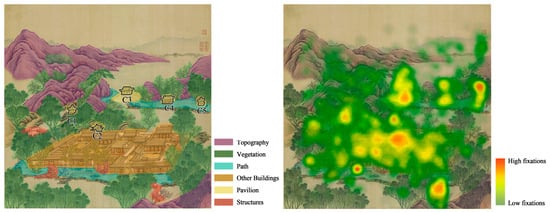
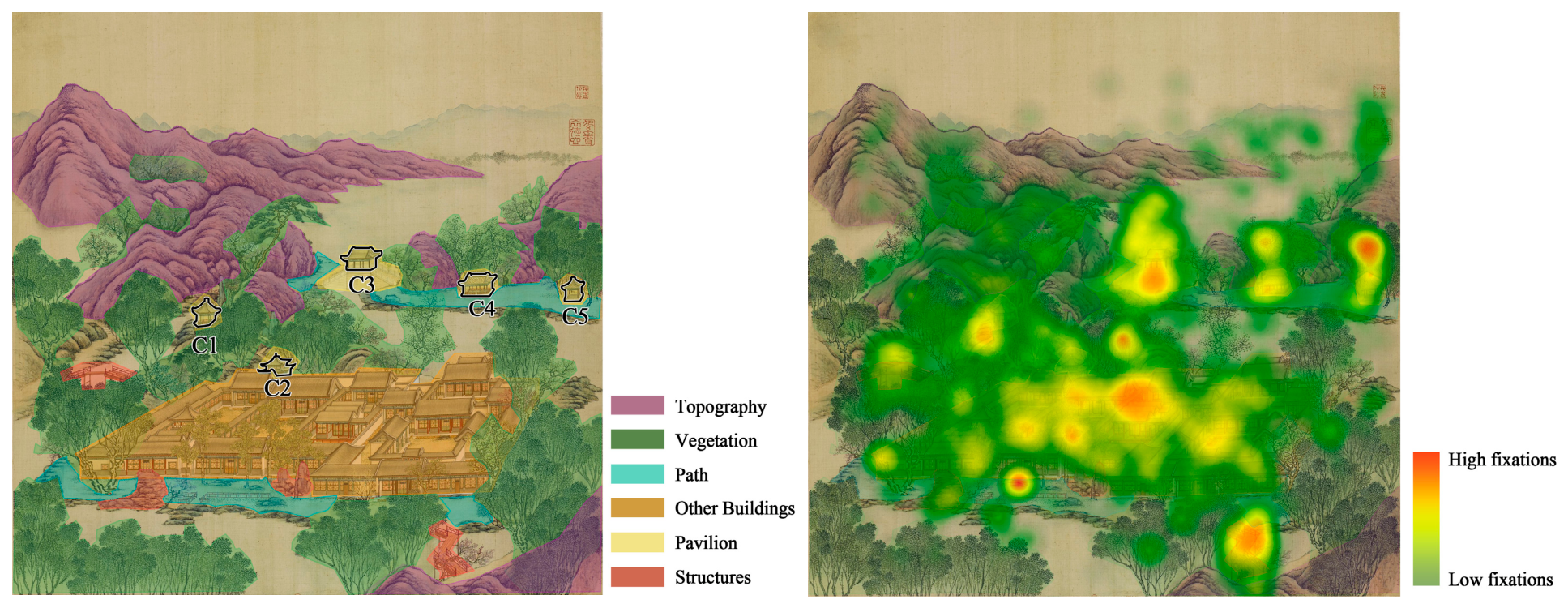
In the CCXG heatmap, the most prominent hotspot was located in the courtyard complex at the centre of the image, whilst the front edge of the courtyard and the surrounding tree line also attracted a considerable amount of visual attention. The intensity of the hotspots varied across the area where the five pavilions are situated; C3 stood out in particular, whilst the areas around the other pavilions were less intense and their distribution was relatively scattered (Figure 6).
Figure 6.
AOI division and heat map for CCXG.
Table 4 shows that the visual attention received by the five pavilions in CCXG was unevenly distributed. C3 was the first to be looked at among the five, with the first fixation occurring at 8.84 s and an average rank of approximately 25th; its total fixation duration accounted for 3.42 per cent, whilst the remaining four pavilions ranged from 0.43 per cent to 1.16 per cent. The average number of fixations on C3 was 2, whilst that for C4 was 1; the mean values for C1, C2 and C5 were all rounded to 0, but their fixation durations were not zero, indicating that these areas still received a small amount of attention. Overall, the viewers’ attention was primarily focused on other buildings and vegetation; the pavilions attracted attention relatively late, and the cumulative duration of fixation was limited. This distribution is broadly consistent with the compositional hierarchy of the image, in which the courtyard complex forms the central subject, whilst the pavilions are scattered around the periphery.
4.4. Xinghua Chunguan
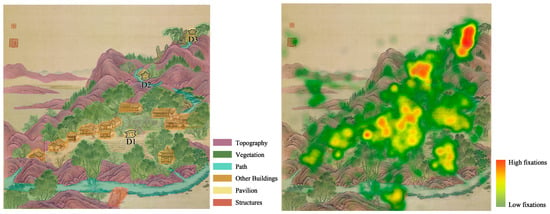
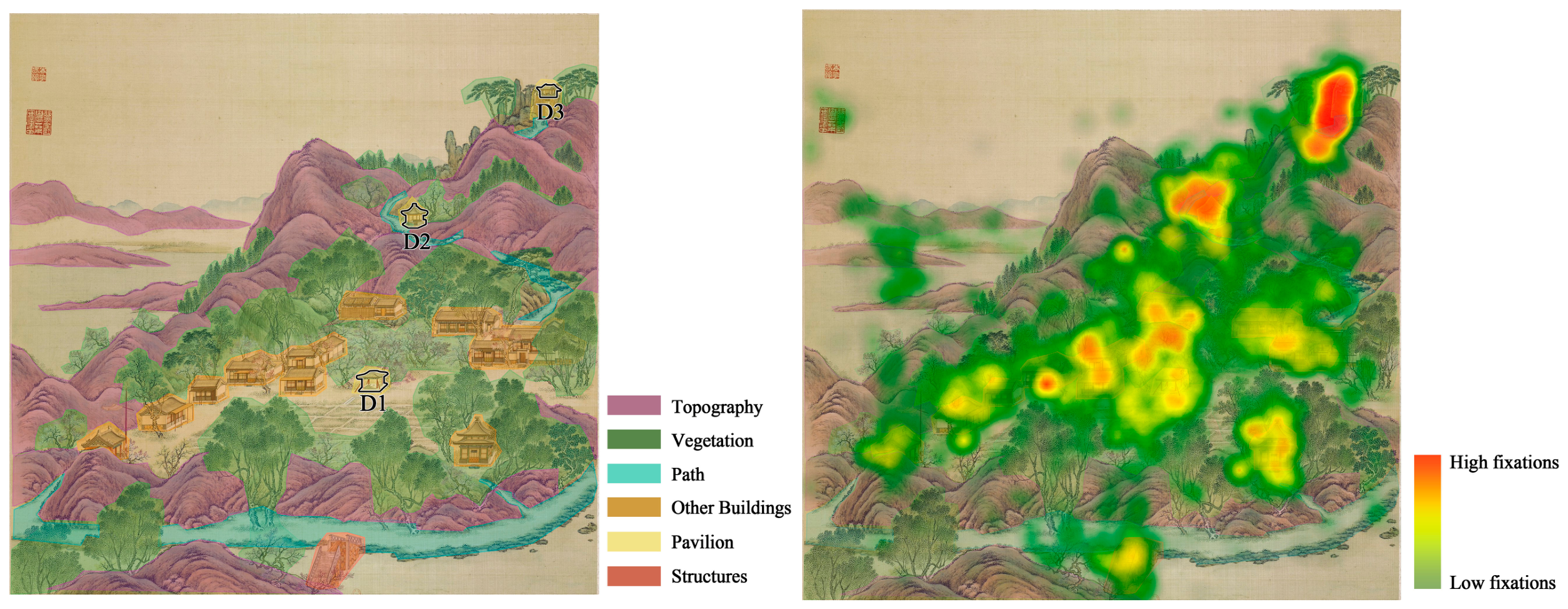
The XHCG heatmap reveals that attention was primarily focused on the cluster of buildings in the lower central part of the image, the trees in front of them, and the building on the mountaintop in the top right-hand corner. Smaller localised hotspots appeared around the pavilions scattered along the valley and the water features. These areas of focus were distributed across different spatial levels, ranging from the low-lying areas in the foreground to the mountaintop in the distance, echoing the composition’s sense of depth (Figure 7).
Figure 7.
AOI division and heat map for XHCG.
Table 5 shows that D1 was the first to attract attention, with the first fixation occurring at 6.53 s, whilst D2 and D3 were 11.11 s and 10.51 s, respectively. However, D3 accounted for the highest proportion of cumulative fixation duration among the three pavilions, reaching 3.76 per cent. Although the average number of fixations was only one, the average duration of a single fixation reached 0.37 s, which was higher than that of other buildings (0.32 s), vegetation (0.29 s), and terrain (0.28 s). This suggests that whilst D3 attracted attention later, once it was observed, the fixation lingered for a relatively long time; this behaviour may be related to its elevated position and the relatively distinct outline of its surroundings.
4.5. Tantan Dangdang
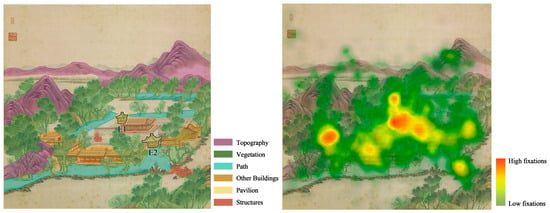
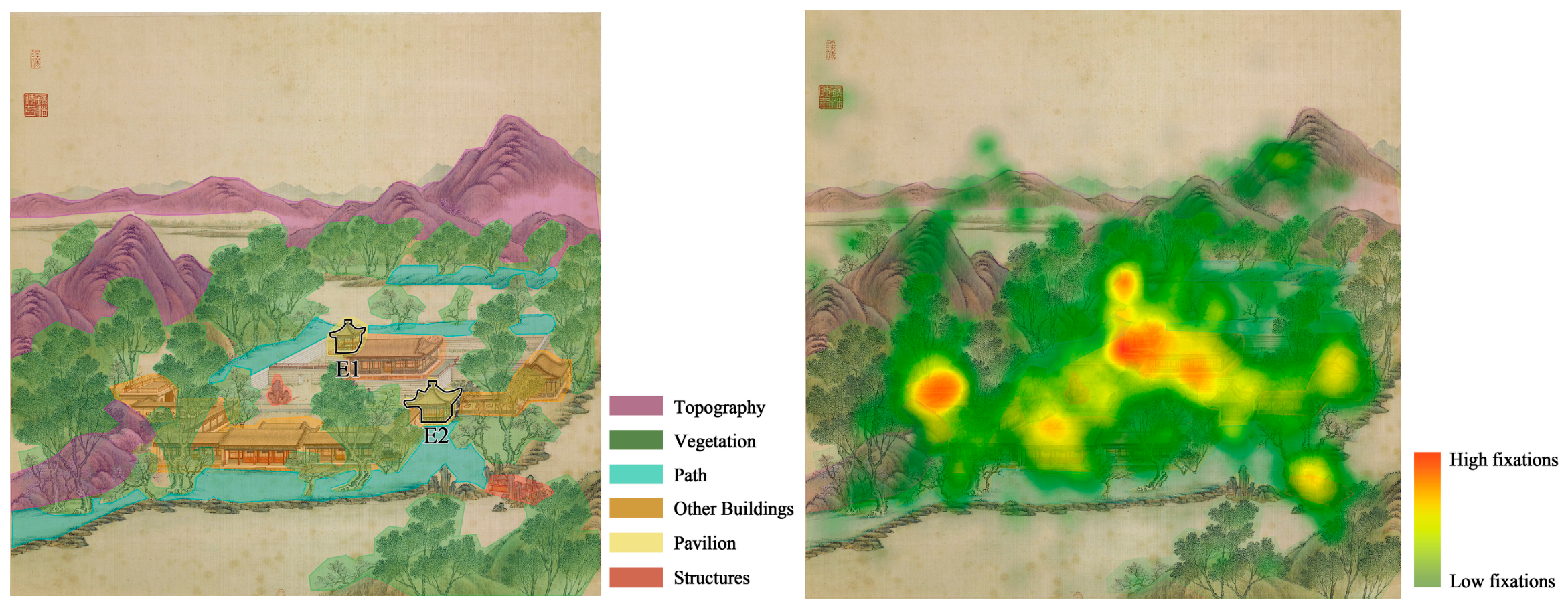
In the heatmap of TTDD, the central courtyard buildings formed the main hotspots, whilst the platform on the left also exhibited a fairly pronounced concentration of attention. Both pavilions are situated within the coverage of the surrounding hotspots and, together with the courtyard, the cluster of trees and the waterside edge, constitute the distribution of attention within the scene (Figure 8).
Figure 8.
AOI division and heat map for TTDD.
Table 6 shows that both pavilions in the TTDD received visual attention later than the main vegetation and building areas. The first fixation at E1 occurred at 7.05 s, earlier than the 9.21 s for E2; the proportion of cumulative fixation duration was also higher for E1, at 3.01 per cent and 1.95 per cent respectively. The average number of fixations for the two pavilions was 2 and 1 respectively, whilst the average duration of a single fixation was 0.23 s and 0.16 s, respectively. Overall, E1 received more visual attention than E2, but neither became the primary focus of the image. Considering the spatial layout, their role as nodes within the sequence of courtyards did not translate into a dominant position during the viewing process.
4.6. Across-Scene Comparison of Pavilion Attention
Table 7 summarises participant-level measures after combining all pavilion AOIs within each scene. Fixation probability did not differ significantly across scenes, Cochran’s Q(4) = 4.78, p = 0.311. The overall scene effect on TTFF did not reach the 0.05 level, likelihood-ratio χ2(4) = 8.82, p = 0.066, and no pairwise comparison remained significant after Holm correction. Assumption checks indicated that sphericity was tenable for fixation-duration proportion, Mauchly’s W = 0.557, χ2(9) = 16.04, p = 0.066, but was violated for fixation count, W = 0.435, χ2(9) = 22.82, p = 0.007; a Greenhouse–Geisser correction (ε = 0.678) was therefore applied to the fixation-count analysis. The proportion of total fixation duration differed significantly across scenes, F(4, 116) = 7.32, p < 0.001, partial η2 = 0.201, and fixation count also differed significantly across scenes, F(2.71, 78.63) = 11.71, p < 0.001, partial η2 = 0.288. Holm-adjusted paired comparisons showed that JJMQ elicited a higher fixation-duration proportion and more fixations than each of the other four scenes. For fixation-duration proportion, the JJMQ-minus-other-scene mean differences in percentage points (95% CI) were 5.81 [2.61, 9.00] for SXTG, 5.45 [2.41, 8.49] for CCXG, 5.14 [1.77, 8.51] for XHCG, and 6.67 [3.26, 10.07] for TTDD. The corresponding mean differences in fixation count were 4.13 [2.63, 5.64], 2.90 [1.08, 4.72], 4.00 [2.33, 5.67], and 3.73 [1.71, 5.76], respectively. Friedman sensitivity analyses led to the same overall conclusions for fixation-duration proportion, χ2(4) = 16.93, p = 0.002, Kendall’s W = 0.141, and fixation count, χ2(4) = 20.08, p < 0.001, Kendall’s W = 0.167. After normalisation by total pavilion-AOI area, significant overall scene effects remained for fixation-duration density, Greenhouse–Geisser-corrected F(2.18, 63.32) = 23.31, p < 0.001, partial η2 = 0.446, and fixation-count density, Greenhouse–Geisser-corrected F(1.77, 51.46) = 33.23, p < 0.001, partial η2 = 0.534. The corresponding Friedman tests yielded consistent results for fixation-duration density, χ2(4) = 39.99, p < 0.001, and fixation-count density, χ2(4) = 38.83, p < 0.001. After normalisation by pavilion number, both outcomes remained significant after Greenhouse–Geisser correction (both p < 0.001). The adjusted pattern was not identical to the raw comparison: CCXG, which contained five pavilion AOIs, had the lowest area-normalised values.
4.7. Questionnaire Results
Following the formal viewing session, this study collected the participants’ subjective impressions via a brief, study-specific questionnaire; a total of 30 valid responses were obtained. Participants were predominantly aged between 18 and 35, with the majority reporting that their exposure to traditional Chinese landscape paintings or images of gardens was occasional or moderate. The questionnaire served two purposes: firstly, to understand participants’ overall viewing patterns and preferences regarding visual focal points; and secondly, to examine, through questions centred on the pavilions, the participants’ self-reported priorities of attention, as well as their assessments of the pavilions’ compositional role and visual appeal. Because the items addressed different aspects of the viewing experience rather than a single psychological construct, the questionnaire findings were used only as exploratory and descriptive evidence to complement the eye-tracking data. Ordinal Likert-type items were summarised using medians and interquartile ranges (IQRs), whereas categorical items were summarised using frequencies and percentages.
Q1. When appreciating these paintings, I first take in the overall composition and then gradually focus on the finer details.
Q2. Of these five paintings, which type of scene made the deepest impression on you?
These two questions examine, respectively, the participants’ self-reported viewing patterns and their subjective impressions of the five paintings. The median score for Q1 was 4 (IQR: 4–5), with 76.67 per cent of participants selecting ‘Agree’ or ‘Strongly Agree’, indicating that the majority felt that their viewing process shifted gradually from the whole to the details. In Q2, the modal response was D (XHCG; 36.67 per cent), followed by B (SXTG; 33.33 per cent); A (JJMQ) and C (CCXG) each accounted for 13.33 per cent, whilst E (TTDD) was not selected by any participant. This suggests that the five paintings left different impressions on the participants; however, as this result reflects a subjective evaluation of the entire painting, it cannot be directly equated with the degree of recall regarding the pavilion architecture depicted therein.
Q3. Compared to natural elements, I tend to notice the buildings in an image more readily.
Q4. For me, the elements most likely to become the visual focal point are: buildings, rocky terrain, bodies of water, trees and flowers, or people and boats.
These two questions examine the participants’ subjective attentional tendencies towards different categories of scenery. The median score for Q3 was 4 (IQR: 4–5), with 83.33 per cent of participants selecting ‘Agree’ or ‘Strongly Agree’, indicating that the majority consider themselves more likely to notice architectural elements. In Q4, ‘buildings’ was the most frequently selected category (96.67 per cent), whilst the proportions for other categories were lower. Both sets of results indicate that participants subjectively attribute greater visual salience to buildings; however, as this tendency applies to buildings as a whole, it does not yet suggest that pavilions are more appealing than other types of buildings.
Q5. I believe that pavilions or similar small structures are very important in the overall composition of a landscape.
Q6. When a pavilion appears in a scene, my gaze is often drawn to it.
These two questions respectively examine the participants’ subjective assessments of the compositional importance and visual appeal of pavilions. The median score for Q5 was 4 (IQR: 3–4), with 70.00 per cent of participants selecting ‘Agree’ or ‘Strongly Agree’, indicating that the majority recognised the role of pavilions in the overall composition. The median score for Q6 was 4 (IQR: 3–5), with a corresponding agreement rate of 60.00 per cent; the agreement rate was lower than that for Q5. The descriptive results suggest that participants rated the compositional importance of pavilions slightly higher than their ability to attract the viewer’s gaze, indicating that these two subjective judgements are not entirely consistent.
Q7. When viewing these paintings, I often find myself subconsciously imagining that I am standing inside the pavilion, gazing out at the surrounding scenery.
Q8. The location and orientation of the pavilion influence my understanding of the spatial relationships within the painting.
These two questions examine, respectively, the participants’ imagination of standing within the pavilion whilst viewing the scenery, and their subjective assessment of the role the pavilion plays in spatial perception. The median score for Q7 was 2.5 (IQR: 2–3), with 50.00 per cent of participants selecting ‘Disagree’ or ‘Strongly Disagree’, indicating that this kind of imaginative viewing is not widespread. The median score for Q8 was 3 (IQR: 3–4), with 36.67 per cent of participants selecting ‘Agree’ or ‘Strongly Agree’, whilst a further 40.00 per cent selected ‘Neutral’. Overall, some participants believe that the pavilion’s location and orientation influence their understanding of the spatial relationships in the image, but this influence has not yet gained widespread acceptance.
5. Discussion
Across the five scenes, the probability of fixating a pavilion did not differ significantly, and the scene effect on TTFF did not reach the 0.05 level. In contrast, significant scene effects were found for the proportion of total fixation duration, F(4, 116) = 7.316, p < 0.001, partial η2 = 0.201, and fixation count, F(2.71, 78.63) = 11.711, p < 0.001, partial η2 = 0.288. Holm-adjusted comparisons showed that JJMQ exceeded each of the other four scenes on both cumulative measures, and non-parametric sensitivity analyses supported the same overall pattern. The results therefore distinguish initial capture from cumulative engagement: the present data do not show a reliable scene difference in whether or how quickly a pavilion was first fixated, but they do show stronger sustained and repeated attention to the pavilion in JJMQ. Because the different indicators did not fully converge, JJMQ is interpreted as showing relatively strong cumulative attentional engagement rather than a fixed focal point across all dimensions of visual attention.
In JJMQ, A1 most closely resembles the traditional notion of ‘the pavilion as a visual focal point’. In terms of spatial layout, the bridge pavilion occupies a key position connecting the path to both banks and spanning the water; the painting concentrates these spatial relationships near the centre of the composition, using the relatively small-scale pavilion to organise the surrounding scenery. Although A1 does not initially attract the viewer’s attention, relative to its area within the composition, it accounts for a high proportion of cumulative fixation duration and receives multiple fixations. Thus, A1’s visual prominence co-occurred with a distinctive spatial and compositional arrangement. A similar pattern of localised attention was observed for B1, B2, D3, and E1, which were situated outside the compositional centre; however, these scenes also differed in terrain elevation, waterside location, background openness, and path direction. These observations are therefore interpreted as descriptive associations rather than evidence of the independent effect of any single feature.
Although their cumulative share of fixation duration was lower than that of larger areas of terrain, vegetation or built-up areas, they still attracted a certain degree of attention within the frame, indicating that smaller pavilions situated off-centre can nevertheless occupy a distinct position within the local visual hierarchy.
The comparison between B2 and D3 is descriptive because both AOIs correspond to the same pavilion depicted in different paintings. Both were first fixated relatively late and received an average of one fixation. Numerically, D3 showed a higher proportion of total fixation duration than B2 (3.76% versus 2.76%) and a longer mean fixation duration (0.37 s versus 0.25 s). In XHCG, the pavilion occupies an elevated and relatively isolated position at the end of a spatial sequence extending from lower ground towards the mountain summit. In SXTG, however, it is integrated into an open scene dominated by water features, topography and the central complex of buildings.
In contrast, in the scenes examined here, pavilions situated at the edge of the frame, partially obscured, or surrounded by dense scenery generally received less attention. In CCXG, attention was primarily focused on the central courtyard complex and vegetation, whilst the hotspots in the areas where most pavilions are located were weaker and more dispersed. E2 in TTDD and D1 and D2 in XHCG also failed to form prominent visual focal points; however, from the perspective of spatial and compositional relationships, they still play a role in connecting the scene. This suggests that the role of pavilions in the spatial organisation of the image does not necessarily translate into a dominant position in terms of visual attention.
The questionnaire and eye-tracking results provide complementary but analytically distinct perspectives on viewing. Most participants reported that they would first scan the overall composition before focusing on specific details; eye-tracking data, in turn, showed that larger areas of vegetation, terrain and architecture typically attracted attention before the pavilion did. These observations are descriptively compatible with a general whole-to-part viewing tendency, but the relationship was not tested at the participant level and should not be interpreted as convergent validation.
These two sets of results also highlighted the distinction between the perceived importance of composition and the actual distribution of attention. Participants rated the compositional importance of the pavilion slightly higher than its ability to attract the gaze, whilst eye-tracking results indicated that the pavilion was not usually the first object to attract attention; some pavilions received a relatively limited number of fixations and cumulative fixation duration. This suggests that whilst viewers may recognise the pavilion’s role in the composition, they do not accord it priority or sustained attention. Consequently, subjective importance cannot directly substitute for measurements of early visual attention.
Furthermore, the low scores for the ‘imagine yourself inside the pavilion’ item suggest that the experience of spontaneously placing oneself within the pavilion to view the scenery is not widespread, nor is it sufficient to support the interpretation of the pavilion as a vantage point onto which viewers project their own perspective. When combined with the compositional analysis, a more prudent interpretation is that the pavilion can function as a spatial node within the composition, contributing to the organisation of the scene, whilst this role does not necessarily entail a distinct sense of being physically present within it.
Limitations
The limitations of this study primarily relate to the experimental conditions and the correspondence between images and historical records. As the study utilised static screen displays, the scope of application of its conclusions is consequently limited. As the areas of interest differ in terms of size, location and surrounding scenery, it is difficult to isolate the influence of these factors when directly comparing fixation metrics. The framing scope and directional annotations on the plan are analytical inferences based on landmark relationships; the drawings used may not fully correspond to the state of the garden as depicted in the 1744 painting. Furthermore, whilst eye-tracking data can reflect the distribution of visual attention, it cannot, on its own, prove the artist’s creative intent or the viewer’s understanding of the significance of the scenery. Although B2 and D3 correspond to the same pavilion and provide clues for comparing the distribution of attention under different compositions, the relevant results remain descriptive observations and require further verification through experiments that control for factors such as the area, position and background of the image. Although the area- and number-normalised analyses indicated that the overall scene effects were not solely attributable to differences in AOI area and number, the adjusted pattern changed, and only five scene-level AOI configurations were available. These sensitivity analyses therefore reduced, but did not eliminate, the potential confounding effects of AOI area and number.
A separate limitation concerns the restricted stimulus set. Because this study examined only five scenes from the Forty Views of the Yuanmingyuan, the findings cannot be considered representative of the visual role of pavilions across the complete album or be directly generalised to other classical Chinese garden paintings. Further research using a larger and more diverse sample of images is needed to validate these observations.
Participant characteristics were available only in broad categories. Detailed academic discipline and occupation categories, together with separate measures of expertise in architecture, garden studies, or visual arts, were not recorded and therefore could not be examined as potential moderators of gaze behaviour. In addition, the sample size provided sensitivity to approximately moderate or larger effects for the repeated-measures ANOVA outcomes, but smaller effects may have remained undetected. Future studies should recruit larger samples and prospectively record or stratify participants according to relevant disciplinary background, professional experience, and prior exposure.
6. Conclusions
In these five scenarios, the pavilion is not always the primary focal point. Its visibility varies with spatial relationships, location and scale, and with its interaction with surrounding landscape elements. A1 in JJMQ received a higher cumulative fixation-duration proportion and more fixations than the combined pavilion areas in each of the other four scenes. This pattern is consistent with the convergence of pathways, watercourses and built elements around A1 in the painting and plan, but the observational comparison does not isolate the causal contribution of any one compositional feature. Most of the other pavilions functioned as local nodes or points within a sequence rather than as dominant visual centres.
The contrast between the plan and the painting provides a spatial basis for understanding these differences in attention. Although B2 and D3 depict the same pavilion, they received varying degrees of attention in different images, suggesting that further examination is needed into how the physical space of the garden is transformed into an image through framing and composition.
As exploratory descriptive evidence, the questionnaire responses suggested a second distinction: viewers may regard a pavilion as an important element even without having first directed their gaze towards it. In the five scenes examined here, pavilions often appeared to contribute to the organisation of the composition. Consequently, the role of the pavilion as the ‘focal point’ in traditional discourse requires a distinction to be made between its organisational significance in composition and the manifestation of attention during the viewing process.
For empirical aesthetics, this study demonstrates the value of combining behavioural measurements with historical spatial evidence. Floor plans aid in identifying the framing range and the relationships between scenic elements, whilst eye-tracking data record the viewer’s actual distribution of attention. Combining the two approaches allows traditional interpretations of visual focal points to be examined through behavioural evidence while distinguishing compositional meaning from observed attention patterns.
Author Contributions
Conceptualization, N.L. and F.F.; Methodology, N.L. and F.F.; Validation, N.L. and F.F.; Formal analysis, N.L.; Investigation, N.L., Y.H. and J.W.; Resources, Y.H.; Data curation, N.L. and J.W.; Writing – original draft, N.L.; Writing – review & editing, F.F., Y.H. and J.W.; Visualization, N.L. and J.W.; Supervision, F.F.; Project administration, F.F.; Funding acquisition, F.F. All authors have read and agreed to the published version of the manuscript.
Funding
This work was supported by the Ministry of Education of the People’s Republic of China, Humanities and Social Sciences Fund Project (Grant 21YJA760018), and the Doctoral Research Capacity Improvement Project of Beijing University of Civil Engineering and Architecture (Grants DG2024003).
Institutional Review Board Statement
The study was conducted in accordance with the Declaration of Helsinki, and approved by the Academic Committee of the School of Architecture and Urban Planning at Beijing University of Civil Engineering and Architecture (with no protocol code and date of 1 January 2026).
Informed Consent Statement
Informed consent was obtained from all subjects involved in the study.
Data Availability Statement
The data presented in this study are available on request from the corresponding author upon reasonable request. The data are not publicly available because they contain participant-level eye-tracking and questionnaire data and are subject to privacy and ethical restrictions.
Conflicts of Interest
The authors declare no conflict of interest.
References
- Guo, X. The Lofty Message of Forests and Streams; Zhou, Y., Ed.; Shandong Pictorial Publishing House: Jinan, China, 2010. [Google Scholar]
- Zhu, S.; Wang, Z.; Wang, G. The Mustard Seed Garden Manual of Painting; China Bookstore Press: Beijing, China, 1982. [Google Scholar]
- Ni, Z. Collected Writings from the Qingbi Pavilion; Jiang, X., Ed.; Xiling Seal Engraver’s Society Publishing House: Hangzhou, China, 2010. [Google Scholar]
- Ji, C. The Craft of Gardens; Liu, Y., Ed.; Jiangsu Phoenix Literature and Art Publishing House: Nanjing, China, 2015. [Google Scholar]
- Tang, D. Subtle Principles of Painting; Shanghai People’s Fine Arts Publishing House: Shanghai, China, 1987. [Google Scholar]
- Chen, H. The art of garden pavilions in the Forty Scenes of Yuanmingyuan. Beauty Times (City Ed.) 2021, 2, 72–73. [Google Scholar]
- Guo, D. The influence of imperial aesthetic ideals on the garden art of Yuanmingyuan. J. Yuanmingyuan 2008, 7, 8. [Google Scholar]
- Wang, Z. The Forty Scenes of Yuanmingyuan. In Yuanmingyuan Xuekan; China Architecture & Building Press: Beijing, China, 1983; Volume 2, p. 1. [Google Scholar]
- Yan, Y.; Jia, J. Analysis of the bridge landscape in Jiajing mingqin at Yuanmingyuan. Zhuangshi 2020, 9, 80–83. [Google Scholar]
- Zhang, J. Interpreting the artistic conception of Qianlong’s imperial poem Wanfang anhe. J. Yuanmingyuan 2010, 10, 14. [Google Scholar]
- Zhao, G. A study of Zuoshi linliu, a scene in Yuanmingyuan. In Yuanmingyuan Xuekan; China Architecture & Building Press: Beijing, China, 1981; Volume 1, p. 10. [Google Scholar]
- Crucq, A. Viewing patterns and perspectival paintings: An eye-tracking study on the effect of the vanishing point. J. Eye Mov. Res. 2020, 13, 15. [Google Scholar] [CrossRef] [Scilit] [PubMed]
- Francuz, P.; Zaniewski, I.; Augustynowicz, P.; Kopiś, N.; Jankowski, T. Eye movement correlates of expertise in visual arts. Front. Hum. Neurosci. 2018, 12, 87. [Google Scholar] [CrossRef] [Scilit] [PubMed]
- Ganczarek, J.; Pietras, K.; Stolińska, A.; Szubielska, M. Titles and semantic violations affect eye movements when viewing contemporary paintings. Front. Hum. Neurosci. 2022, 16, 808330. [Google Scholar] [CrossRef] [Scilit] [PubMed]
- Goller, J.; Mitrovic, A.; Leder, H. Effects of liking on visual attention in faces and paintings. Acta Psychol. 2019, 197, 115–123. [Google Scholar] [CrossRef] [Scilit] [PubMed]
- Locher, P.; Krupinski, E.A.; Mello-Thoms, C.; Nodine, C.F. Visual interest in pictorial art during an aesthetic experience. Spat. Vis. 2008, 21, 55–77. [Google Scholar] [CrossRef] [Scilit] [PubMed]
- Massaro, D.; Savazzi, F.; Di Dio, C.; Freedberg, D.; Gallese, V.; Gilli, G.; Marchetti, A. When art moves the eyes: A behavioral and eye-tracking study. PLoS ONE 2012, 7, e37285. [Google Scholar] [CrossRef] [Scilit] [PubMed]
- Pelowski, M.; Leder, H.; Mitschke, V.; Specker, E.; Gerger, G.; Tinio, P.P.L.; Vaporova, E.; Bieg, T.; Husslein-Arco, A. Capturing aesthetic experiences with installation art: An empirical assessment of emotion, evaluations, and mobile eye tracking in Olafur Eliasson’s Baroque, Baroque! Front. Psychol. 2018, 9, 1255. [Google Scholar] [CrossRef] [Scilit] [PubMed]
- Reitstätter, L.; Brinkmann, H.; Santini, T.; Specker, E.; Dare, Z.; Bakondi, F.; Miscená, A.; Kasneci, E.; Leder, H.; Rosenberg, R. The display makes a difference: A mobile eye tracking study on the perception of art before and after a museum’s rearrangement. J. Eye Mov. Res. 2020, 13, 6. [Google Scholar] [CrossRef] [Scilit] [PubMed]
- Walker, F.; Bucker, B.; Anderson, N.C.; Schreij, D.; Theeuwes, J. Looking at paintings in the Vincent Van Gogh Museum: Eye movement patterns of children and adults. PLoS ONE 2017, 12, e0178912. [Google Scholar] [CrossRef] [Scilit] [PubMed]
- de la Fuente Suárez, L.A. Subjective experience and visual attention to a historic building: A real-world eye-tracking study. Front. Archit. Res. 2020, 9, 774–804. [Google Scholar] [CrossRef] [Scilit]
- Noland, R.B.; Weiner, M.D.; Gao, D.; Cook, M.P.; Nelessen, A. Eye-tracking technology, visual preference surveys, and urban design: Preliminary evidence of an effective methodology. J. Urban. 2017, 10, 98–110. [Google Scholar] [CrossRef] [Scilit]
- Park, J.; Jin, Y.; Ahn, S.; Lee, S. The impact of design representation on visual perception: Comparing eye-tracking data of architectural scenes between photography and line drawing. Arch. Des. Res. 2019, 32, 5–29. [Google Scholar] [CrossRef] [Scilit]
- Simpson, J.; Thwaites, K.; Freeth, M. Understanding visual engagement with urban street edges along non-pedestrianised and pedestrianised streets using mobile eye-tracking. Sustainability 2019, 11, 4251. [Google Scholar] [CrossRef] [Scilit]
- China Yuanmingyuan Society (Ed.) Forty Scenes of Yuanmingyuan; China Architecture & Building Press: Beijing, China, 1985. [Google Scholar]
- National Library of China. Yangshi Lei Architectural Archives: Preliminary Series of the Yuanmingyuan Volume; Architectural Drawings; National Library of China: Beijing, China, 2016. [Google Scholar]
- Kang, T.; Luo, S.; Wang, P.; Tang, T. Influence of figure information on attention distribution in Chinese landscape painting. Heliyon 2023, 9, e15036. [Google Scholar] [CrossRef] [Scilit] [PubMed]
- Villani, D.; Morganti, F.; Cipresso, P.; Ruggi, S.; Riva, G.; Gilli, G. Visual exploration patterns of human figures in action: An eye tracker study with art paintings. Front. Psychol. 2015, 6, 1636. [Google Scholar] [CrossRef] [Scilit] [PubMed]
- Wu, S.-C.; Lee, S.-H.; Lei, T.-C.; Hou, J.-S.; Tzeng, G.-H. Applying eye tracking technology to examine landscape preference using prospect refuge theory. J. Outdoor Recreat. Study 2015, 28, 1–18. [Google Scholar] [CrossRef]
- Zhou, Y.; Kawabata, H. Eyes can tell: Assessment of implicit attitudes toward AI art. i-Perception 2023, 14, 1–14. [Google Scholar] [CrossRef] [Scilit] [PubMed]

Disclaimer/Publisher’s Note: The statements, opinions and data contained in all publications are solely those of the individual author(s) and contributor(s) and not of MDPI and/or the editor(s). MDPI and/or the editor(s) disclaim responsibility for any injury to people or property resulting from any ideas, methods, instructions or products referred to in the content. |
© 2026 by the authors. Licensee MDPI, Basel, Switzerland. This article is an open access article distributed under the terms and conditions of the Creative Commons Attribution (CC BY) license.