


Highlights
- This study reviewed 208 studies to map methods, datasets, evaluation, and deployment challenges.
- We found that CNNs dominate gaze tracking, appearing in 58.2% of the included studies.
- Only 16.3% of studies validated models across independent datasets.
- Real-world evaluation (13%) and public code availability (13.9%) remain limited.
- Future research should prioritize generalization, standardized testing, and deployment.
Abstract
Eye gaze tracking has become a key feature for human-centered intelligent systems, and has wide variety of applications such as human–computer interaction, extended reality, behavioral analysis and safety-critical monitoring. Despite the rapid progress made in the field by deep learning and large-scale datasets, the field is still fragmented as reported performance often does not translate into robust real-world deployment. This paper presents a systematic review of eye gaze tracking research with regard to methodological development, sensing modalities, application areas, evaluation practice and recurring limitations. Following PRISMA guidelines, the contemporary literature involving learning paradigm and deep learning models are analyzed. This paper uses the evidence from cross-study evidence to explore the effect of dataset characteristics, evaluation protocols, and sensing choices on the reported performance. Particular attention is given to bias in datasets, fragility in evaluation, failure in generalization and the gap between application aspiration and the reality of deployment. The reviewed article continues with analysis of trade-offs among RGB, infrared, depth, and physiological modalities in order to demonstrate unrealized potential and existing shortcomings of multimodal fusion. The analysis reflects that future developments in the field of gaze tracking are less correlated to the incremental refinement of architecture, and more correlated to the importance of robustness-aware evaluations of benchmarks, the longitudinal evaluation and deployment of the algorithm, and the evaluations on the model. This review is intended to provide a comprehensive understanding of the current state of the art of eye gaze tracking that can be used to guide future research towards reliable real-world systems.
1. Introduction
Eye Gaze Tracking (EGT) has been extensively used to sense visual attention, intention, and human behavior. EGT is spanning across applications involving Human–Computer Interaction (HCI), extended reality, behavioral analysis, accessibility technologies, transportation safety, and healthcare [1]. The ability to estimate where a user is looking either as a two-dimensional point of gaze on a display or as a three-dimensional gaze direction in space provides a direct and unobtrusive channel for modeling numerous perceptual and cognitive processes. Consequently, gaze tracking has evolved from laboratory-bound instrumentation to camera-based systems capable of operating on commodity hardware and mobile platforms. Early research in gaze tracking relied on specialized physiological measurement techniques, such as scleral search coils and electrooculography, which provided high temporal precision and accuracy but imposed substantial constraints on user comfort, mobility, and scalability [1].
This was followed by the future development of computer vision systems that could perform non-contact gaze tracking with the help of a monocular and binocular camera mostly by geometric eye modeling and corneal reflection [2]. Although these methods formed the theoretical basis of remote gaze tracking, they tended to need controlled lighting, careful calibration and limited head movement and hence were not very robust in uncontrolled settings. With the advent of appearance-based techniques, a new direction in the field was introduced where explicit geometric modeling was abandoned in favor of data-based mappings between appearance of eyes or faces and gaze direction [3]. This shift was propelled by the presence of large-scale datasets that were trained in realistic settings. This further allowed the training of deep neural networks that could withstand a significant change in face pose, light source, and subject identity [4]. Later works have further generalized this paradigm with real-time inference systems, few-shot and on-device personalization solutions, transformer-based architectures to study attention [4,5], and semi-supervised or domain-generalized learning solutions. Numerous researchers have conducted extensive surveys to identify state of the art techniques as mentioned in Table 1, highlighting trends and limitations in chronological order. Surveys published between 2019 and 2026 primarily focused on classical and early learning-based gaze tracking methods while offering limited discussion of datasets, evaluation metrics, or real-world constraints [5]. Although these works establish useful taxonomies, they largely predate the widespread adoption of large-scale datasets and advanced deep learning architectures, and consequently offer restricted insight into modern gaze tracking challenges. A comparison of this survey with that of contemporary surveys is provided in Table 1.
Table 1.
Comparative analysis of existing surveys and the present review on eye gaze tracking (2019–2026).
From Table 1, it can be observed that recent survey efforts have increasingly shifted from traditional algorithm-centric discussions toward application-driven perspectives, with applications like XR interaction, mobile gaze tracking, multimodal systems, healthcare, security, and intelligent HCI. While these reviews provide valuable insights into deep learning architectures, multimodal fusion, and application-specific systems, most studies continue to treat gaze tracking primarily as a benchmark optimization problem rather than a real-world deployment challenge. Consequently, critical issues such as real-world applicability, cross-domain generalization, calibration dependency, evaluation reliability, and deployment robustness remain insufficiently explored [6].
Recent surveys report substantial improvements in gaze tracking accuracy through deep learning techniques. However, many evaluations remain dataset-centric and experimentally constrained. Existing reviews largely focus on architectures, datasets, or applications independently, with limited critical analysis of how sensing modality, dataset design, evaluation protocols, and environmental variability collectively influence real-world performance but all the aspects are fragmented into various reviews [7]. Furthermore, despite growing interest in multimodal and immersive gaze interaction systems, standardized evaluation practices for unconstrained real-world scenarios are still lacking.
In contrast to existing reviews, this review provides a systematic literature review that examines how learning paradigms, sensing choices, multimodal fusion, calibration assumptions, datasets, and evaluation practices affect robustness, generalization, and real-world applicability [8]. It also provides a critical analytical synthesis focused on deployment-oriented gaze tracking by exploring libraries and frameworks used in eye gaze tracking. This review aims to provide a more practically grounded perspective on the state-of-the-art, current challenges and future direction of eye gaze-tracking research [9].
Cross-Domain indicates whether the reviewed survey explicitly discusses the generalization of gaze-tracking methods across different datasets, devices, environments, user populations, or application domains [10].
In reference to the aforementioned discussions, this survey intends to investigate the following research questions:
- (RQ1) Which learning paradigms dominate eye gaze-tracking research, and what transition patterns can be observed between geometric, feature-based, and appearance-based gaze tracking approaches?
- (RQ2) Which gaze estimation techniques, implementation frameworks, and tools are most prevalent in eye gaze-tracking research, and what does their frequency suggest about practical adoption and deployment trends?
- (RQ3) How do dataset distributions, evaluation metrics, and implementation practices reveal biases and inconsistencies in benchmarking and reproducibility within eye gaze-tracking research?
- (RQ4) What are the limitations in achieving cross-domain generalization, real-world robustness, multimodal integration, dataset bias and evaluation metrics in eye gaze tracking, and how adequately are these limitations critically examined in existing studies?
By answering these questions in the context of systematic analysis and critical synthesis, this paper will explain the actual condition of the eye gaze-tracking studies and will serve as a long-term reference point to both new and old researchers in this work.
The remaining part of this manuscript is organized as follows: Section 2 presents the state-of-the-art in the field of eye gaze tracking. Section 3 describes the survey methodology adopted in this study, including the systematic study-selection and analysis procedures. Section 4 examines the evolution of learning paradigms in eye gaze tracking. Section 5 analyzes the prevalence and development of deep learning models used for eye gaze tracking. Section 6 discusses benchmarking practices, including datasets, evaluation metrics, and validation approaches. Section 7 reviews implementation frameworks and practical adoption of eye gaze tracking technologies. Section 8 discusses the major limitations identified across the reviewed literature. Section 9 presents the synthesis of findings by Research Question. Section 10 outlines future research directions emerging from these limitations and findings. Section 11 presents the major application areas of eye gaze tracking. Finally, Section 12 concludes the manuscript by summarizing the key findings and overall insights of the review.
2. State-of-the-Art
The most recent developments in the field of eye gaze tracking are indicative of a definite shift in model-based and calibration-heavy methods to the dataset-based, scalable, and deployment-friendly ones. In appearance-based models, with deep learning, it was consistently found that gaze tracking is mainly based on the paradigm of appearance models, which is possible in large-scale datasets that are gathered in unconstrained conditions [11], Convolutional Neural Networks (CNNs) are widely used for both 2D point-of-gaze and 3D gaze direction estimation. They are significantly more effective than standard geometric algorithms, particularly under variations in head pose and illumination [11,12]. Nonetheless, recent reviews indicate that the reported improvements in accuracy are often influenced by the characteristics of the datasets and evaluation protocols. This suggests that the improved performance may not always be due to better methods alone [13]. Popular datasets like MPIIGaze, Gaze360, and ETH-XGaze have enabled user-to-user generalization in learning-based methods but inter-user and cross-domain robustness are still poor [12,13,14]. It is pointed out in a number of surveys that experimental validation is still dominated by laboratory-based benchmarks and subject-dependent evaluation environments that may overrate real-world performance [14,15]. Recent reviews have identified emerging trends such as few-shot personalization, on-device learning and domain generalization strategies, which seek to lighten the calibration load and enhance adaptability to unseen users and environments. Transformer-based and attention-based models have also become popular due to the fact that they represent long-range relations and contextual connections in facial and scene representations [15,16]. Although the approaches have reported competitive accuracy, surveys indicate that their complexity in computations and their inability to run on heterogeneous datasets poses open questions as to their scalability and ability to deploy them to real-world situations. Similar literature on parallel surveys of mobile, wearable and extended reality platforms highlights other limitations caused by real-world usage, such as hardware variability, calibration drift, and trade-offs between usability [17,18]. Application-oriented reviews on HCI, security, health, and transportation further indicate that a wide range of deployed systems is based on gaze estimators, whose limitations are not adequately defined, especially when the system is faced with unconstrained behavioral conditions [18,19]. In these areas, gaze tracking is increasingly being considered as an enabling factor, not a resolved issue and a disparity between ideal standards of algorithms and real-world reliability is revealed. On the whole, current surveys point to the same direction and conclude that although the accuracy of gaze tracking has been increased significantly in controlled or dataset-specific situations, some problems concerning the generalization, regularity of evaluations, and combining multiple modalities is still essential [19,20]. Current progress in gaze tracking is not based on a single dominant model or architecture. Instead, it comes from a better understanding of important factors such as sensing modalities, learning approaches, dataset bias, and real-world constraints.
3. Survey Methodology
To ensure transparency, reproducibility, and methodological rigor, this systematic review was conducted in accordance with the PRISMA 2020 (Preferred Reporting Items for Systematic Reviews and Meta-Analyses) guidelines. The overall process of study identification, screening, eligibility assessment, and inclusion is illustrated in Figure 1.
Figure 1.
PRISMA 2020 flow diagram illustrating the study selection process for the systematic review.
3.1. Identification of Studies
A systematic literature search was conducted across IEEE Xplore, ACM Digital Library, ScienceDirect, Scopus, and Web of Science. The search was performed in January 2026 and was designed to maximize retrieval of studies addressing eye gaze tracking and gaze estimation while covering the methodological, sensing, evaluation, benchmarking, and deployment dimensions relevant to the four research questions. The search strategy, mentioned in Table 2, was developed using concept blocks representing (i) eye gaze tracking and gaze estimation, (ii) learning and estimation paradigms, (iii) sensing and multimodal technologies, and (iv) evaluation, benchmarking, generalization, robustness, calibration, and deployment.
Table 2.
Database-Specific Search Strategies.
The core gaze-related search concepts included “eye gaze tracking,” “gaze tracking,” “gaze estimation,” “eye gaze estimation,” “point-of-gaze,” “point-of-regard,” and “gaze direction estimation.” Methodological concepts included geometric-based, feature-based, appearance-based, machine learning, deep learning, convolutional neural networks, attention mechanisms, transformers, few-shot learning, meta-learning, personalization, domain adaptation, and on-device approaches. Additional concepts related to sensing, evaluation, benchmarking, generalization, robustness, calibration, multimodal sensing, and deployment were incorporated to ensure coverage of the dimensions addressed by RQ1–RQ4.
Database-specific syntax was adapted according to the search functionality of each database, while preserving the same conceptual structure. The complete database-specific search strings, searched fields, filters, search dates, and numbers of retrieved records are provided in Table 3 to ensure reproducibility.
Table 3.
Database-Specific Search Strategies and Retrieval Results.
3.2. Screening Process
The screening process was conducted in two stages by three authors using predefined eligibility and exclusion criteria. Author 1 initially screened the titles and abstracts of all 1337 retrieved records to identify studies potentially relevant to eye gaze tracking and gaze estimation. Records that were clearly outside the scope of the review or did not address eye gaze tracking or gaze estimation as a primary or core research task were excluded at this stage.
Following title and abstract screening, 711 reports were identified as potentially eligible and were considered for full-text assessment, as shown in Figure 1. Of these, 571 full texts (80.3%) were successfully retrieved, while 140 reports (19.7%) could not be retrieved through the available database and publisher access routes. The inaccessible reports were classified as not retrieved and could not be assessed against the full-text eligibility criteria, representing a potential source of retrieval-related selection bias.
To strengthen the consistency of study selection and reduce potential selection and classification bias, the 711 potentially eligible reports were divided equally among the three authors for full-text eligibility assessment. Authors 1, 2, and 3 each independently assessed 237 reports (33.3%) using the same predefined inclusion and exclusion criteria and the same screening protocol. Thus, each author independently evaluated one-third of the potentially eligible reports.
Because the three authors assessed non-overlapping subsets, no inter-reviewer agreement or disagreement could be calculated across the three subsets, and disagreements requiring consensus resolution were not applicable to this stage of the screening process. The independent allocation nevertheless provided broader author involvement in the full-text eligibility assessment and reduced reliance on a single reviewer for the final screening decisions.
The predefined eligibility criteria were subsequently applied consistently throughout the screening and data-extraction process. For the studies that met the inclusion criteria, a structured data-extraction framework and predefined quality-assessment criteria were applied. The final screening and selection process resulted in the 208 studies included in the systematic review.
3.3. Eligibility Criteria
The eligibility of studies was determined based on predefined inclusion and exclusion criteria that were directly relevant to the four research questions.
3.3.1. Inclusion Criteria
Studies were included when they satisfied the following criteria:
- Published between 2020 and the search date.
- Addressed eye gaze tracking, gaze estimation, point-of-gaze estimation, or gaze-direction estimation as a primary or core research task
- Used a relevant sensing modality, including RGB, infrared, RGB-D/depth, wearable/VR, physiological, or multimodal sensing
- Provided sufficient methodological information to identify the proposed or investigated gaze tracking approach
- Reported quantitative or qualitative evaluation of the gaze tracking/estimation system and
- Provided accessible full-text content sufficient for methodological and evaluative assessment.
3.3.2. Exclusion Criteria
Studies were excluded when they satisfied one or more of the following conditions:
- Duplicate records
- The publication was not in English.
- Eye gaze tracking was not a primary or core research task
- The publication was outside the defined publication scope
- The full text was unavailable for eligibility assessment
- Published before 2020
- Insufficient methodological information was available to assess the gaze tracking approach
- No meaningful quantitative or qualitative evaluation was reported
A total of 363 reports were excluded after full-text assessment. These exclusions included 90 studies published before 2020, 60 studies in which eye gaze tracking was not a primary or core research task, 70 studies with insufficient methodological information, 83 studies that did not report meaningful quantitative or qualitative evaluation, and 60 studies outside the defined publication scope. Following the application of the predefined inclusion criteria, 208 studies met all eligibility requirements. Of these, 70 studies were included in the qualitative synthesis, while the remaining 138 studies were provided in the Supplementary Table S1, together with their bibliographic and methodological characteristics.
The systematic-review comprised studies published between 2020 and January 2026 that satisfied all predefined eligibility criteria. Publications preceding 2020 were not included in the systematic-review and were used only as contextual or foundational references where necessary to explain the historical development of eye gaze tracking.
3.4. Data Extraction and Synthesis Strategy
A structured data extraction process was employed to ensure consistency and reproducibility. A predefined extraction framework was developed to systematically record key attributes from each selected study. These attributes included the following:
- Sensing modality
- Gaze tracking type (2D/3D)
- Feature representation techniques
- Learning paradigms (geometric, appearance-based, deep learning, multimodal)
- Datasets used
- Evaluation metrics (e.g., angular error, accuracy)
- Reported performance
- Limitations
- Cross-dataset and cross-subject validation practices
- Real-world evaluation
- Code, dataset, and implementation availability
- Participant diversity and calibration practices
- Evaluation standardization and reported limitations.
Data extraction was performed by one reviewer using the predefined extraction framework. The extracted information was checked for consistency with the corresponding full-text reports, and ambiguous or incomplete information was re-examined before inclusion in the final synthesis. No assumptions were made for information that was not explicitly reported in the source study. Specifically, studies were grouped into categories such as geometric methods, appearance-based methods, deep learning approaches, and multimodal techniques.
When a relevant methodological, dataset, evaluation, or implementation characteristic was not explicitly reported, it was recorded as not reported rather than inferred. Such studies were retained in the synthesis when they otherwise satisfied the eligibility criteria, and the absence of reported information was considered during the quality and reproducibility assessment.
This structured synthesis enabled the following:
- Comparative analysis across methodologies
- Identification of research trends and dominant approaches
- Detection of inconsistencies in evaluation protocols
- Recognition of gaps and open challenges
To distinguish systematic-review findings from general observations reported in the previous literature, the 208 eligible studies were additionally coded for key methodological and evaluation practices relevant to RQ3 and RQ4. The coding included cross-dataset validation, cross-subject validation, real-world evaluation, multimodal sensing, code and dataset availability, implementation transparency, participant diversity, calibration analysis, and evaluation standardization. A criterion was counted only when the corresponding practice or characteristic was explicitly reported in the study. Frequencies represent the number of eligible studies satisfying each criterion, and prevalence was calculated using the 208 eligible studies as the denominator. Multiple criteria could be assigned to the same study.
Before synthesis, extracted information was standardized into predefined methodological categories. Terminologically similar approaches were grouped under common categories, while study-level characteristics were retained as reported. For quantitative prevalence calculations, each study was counted once within a given coding category, whereas studies reporting multiple approaches could contribute to multiple non-mutually exclusive categories. No numerical values were imputed when relevant information was unavailable.
Because this review synthesized heterogeneous methodological evidence rather than a common intervention or outcome, no pooled effect measure was calculated. Quantitative synthesis was therefore based on study frequencies and prevalence percentages, using the 208 eligible studies as the denominator where applicable.
Substantial methodological heterogeneity was anticipated because the included studies differed in sensing modalities, gaze definitions, datasets, model architectures, calibration procedures, evaluation metrics, and validation protocols. Accordingly, heterogeneity was examined through structured descriptive and thematic comparison rather than statistical pooling.
No formal statistical sensitivity analysis was performed because the review did not calculate pooled effect estimates. Instead, the robustness of the synthesis was supported through predefined coding criteria and explicit reporting of the denominator and coding rules used for corpus-level prevalence estimates.
No statistical meta-analysis was performed because the included studies differed substantially in task definitions, sensing modalities, datasets, model architectures, evaluation metrics, and experimental protocols. Quantitative synthesis was limited to descriptive frequencies and prevalence estimates.
3.5. Quality Assessment and Risk of Bias
To assess the methodological quality and potential sources of bias of the included studies, a structured qualitative assessment framework was applied. The assessment focused on eight dimensions relevant to eye gaze tracking research: (i) dataset size and diversity, (ii) annotation quality and data-collection methodology, (iii) validation protocols, (iv) calibration requirements, (v) appropriateness and consistency of evaluation metrics, (vi) reporting completeness, (vii) availability of code, datasets, or implementation details, and (viii) transparency in reporting results, limitations, and potential sources of bias.
Each dimension was assessed using predefined operational criteria, mentioned in Table 4, and classified as Adequate (A), Partially Adequate (PA), or Inadequate (I). The assessment was based on the information explicitly reported in the study rather than assumptions about unreported procedures. When a study did not provide sufficient information to establish that a criterion was satisfied, the dimension was classified as Partially Adequate or Inadequate according to the predefined rules.
Table 4.
Operational Criteria for Quality and Risk-of-Bias Assessment.
The quality and risk-of-bias assessment was performed by one reviewer using the predefined operational criteria. Each eligible study was assessed across all eight dimensions, and unclear assessments were re-examined against the reported methodological information before final classification.
Dataset size and diversity were considered adequate when the study reported sufficient information on participant characteristics and included meaningful variation in users, environments, or acquisition conditions. Limited participant diversity, homogeneous populations, or highly restricted experimental conditions were classified as partial or inadequate depending on the extent of the limitation.
Annotation and data-collection quality were assessed according to whether the study described the data-collection procedure, sensing configuration, annotation/ground-truth generation, and relevant acquisition conditions. Studies providing clear and reproducible descriptions were classified as Adequate.
Validation protocols were assessed according to the extent of independence between training and testing conditions. Cross-subject and cross-dataset validation were considered stronger evidence of generalization than within-subject or single-dataset evaluation. Studies reporting only within-dataset evaluation without independent validation were therefore classified as Partially Adequate or Inadequate depending on the evaluation design.
Calibration requirements were assessed according to whether calibration procedures, calibration duration, calibration dependency, and their effect on usability or performance were reported. Studies explicitly evaluating calibration requirements or calibration-free/adaptive operation were considered stronger on this dimension.
Evaluation metrics were assessed according to whether appropriate metrics were reported clearly and consistently and whether the evaluation protocol enabled meaningful comparison of performance. Studies reporting insufficient or inconsistent evaluation information were classified accordingly.
Reporting completeness was assessed based on the clarity of methodological details, experimental settings, datasets, preprocessing, model configuration, and evaluation procedures. Availability of code, datasets, or implementation details was assessed separately according to whether such resources or sufficient implementation information were made available to support reproducibility.
Finally, transparency of results and limitations was assessed according to whether the study clearly reported its results, limitations, sources of uncertainty, and relevant threats to validity.
The methodological quality of the 208 eligible studies was assessed across eight predefined dimensions. The assessment results are summarized in Table 5, with each dimension classified as adequate, partially adequate, or inadequate.
Table 5.
Quality Assessment Results.
Overall, the assessment highlights differences among studies in validation practices, participant diversity, calibration reporting, evaluation procedures, and reproducibility-related reporting.
To provide an evidence-based synthesis of the systematic-review corpus, the 208 eligible studies were further examined for methodological, benchmarking, reproducibility, and deployment-related characteristics. Each study was coded according to explicitly reported practices, including validation strategy, source-code availability, implementation transparency, participant diversity, calibration procedures, sensing modality, real-world evaluation, and evaluation standardization. The frequency and prevalence of these characteristics were calculated using the 208 eligible studies as the denominator. A study could satisfy multiple non-mutually exclusive characteristics; therefore, percentages for such characteristics do not necessarily sum to 100%. The resulting corpus-level evidence is summarized in Table 6.
Table 6.
Evidence-Based Synthesis of Methodological and Evaluation Characteristics.
Table 6 demonstrates several important patterns within the reviewed corpus. Cross-dataset validation was reported in 34 of the 208 eligible studies (16.3%), while 71 studies (34.1%) reported cross-subject validation and 103 studies (49.5%) relied on within-dataset validation only. This indicates that evaluation under independent domain conditions remains substantially less common than evaluation within the originating dataset. Similarly, publicly available source code was identified in only 29 studies (13.9%), whereas detailed implementation information was reported in 84 studies (40.4%), indicating a considerable gap between reporting methodological details and providing executable resources for reproduction.
Participant-related evidence also revealed limitations in the reviewed corpus. Limited participant diversity was identified in 96 studies (46.2%), while 44 studies (21.2%) did not sufficiently report participant diversity. Although calibration procedures were clearly reported in 137 studies (65.9%), only 31 studies (14.9%) investigated calibration-free or adaptive approaches, indicating that calibration remains an important consideration for practical deployment.
The additional corpus-level indicators further show the extent to which multimodal sensing, real-world evaluation, and standardized benchmarking are represented in the literature. These quantitative findings provide direct evidence from the reviewed studies rather than relying solely on observations reported in previous surveys and therefore form the basis for the RQ3 and RQ4 synthesis.
Where characteristics represent mutually exclusive validation categories, each study was assigned to one category according to its highest level of validation. Other methodological characteristics were coded independently and could be present in the same study; therefore, their frequencies and percentages are not expected to sum to 208 or 100%, respectively.
3.6. Reporting Bias and Certainty of Evidence
Because this review did not perform a meta-analysis or estimate pooled intervention effects, formal statistical assessment of publication bias was not applicable. Nevertheless, potential reporting bias was considered during the quality assessment, particularly where studies provided incomplete information on methodology, evaluation protocols, implementation resources, or study limitations.
A formal certainty-of-evidence framework was not applied because the review synthesizes heterogeneous methodological evidence concerning gaze-tracking models, datasets, sensing modalities, evaluation practices, and implementation characteristics rather than estimating a common intervention effect or clinical outcome.
3.7. Limitations of the Review Methodology
The exclusion of non-English studies may introduce language bias, while the inability to retrieve some reports because of access restrictions may affect the completeness of the review. These limitations were considered when interpreting the findings. No citation-count threshold was used as an eligibility criterion.
Although the full-text screening involved all three authors, the authors assessed non-overlapping subsets of the potentially eligible reports; therefore, inter-rater agreement could not be quantified. Author 1 initially screened the complete set of retrieved records, while Authors 1, 2, and 3 subsequently assessed separate subsets of the reports identified for full-text eligibility using the same predefined criteria and screening protocol. Consequently, no consensus-based disagreement resolution was applicable at this stage. Cohen’s κ was not calculated because the reviewers did not independently assess the same set of studies, which is required for a meaningful inter-rater agreement calculation.
This procedure reduced reliance on a single reviewer during full-text eligibility assessment; however, residual selection and classification bias cannot be completely excluded. This limitation is particularly relevant to interpretive categories such as real-world applicability, robustness, generalization, multimodal integration, and deployment readiness. Accordingly, findings involving these categories are interpreted cautiously and considered alongside the quantitative quality assessment and Evidence Confidence Framework presented in the revised manuscript.
3.8. Review Registration and Protocol
This systematic review was not prospectively registered in a systematic-review registry. No separate review protocol was publicly registered or published. No formal amendments to a registered review protocol were made.
4. Evolution of Learning Paradigms in Eye Gaze Tracking
This section reviews relevant analyses and findings to tackle RQ1. The historical development discussed in this section is supported by foundational publications for contextual purposes; quantitative findings and prevalence estimates reported in the systematic synthesis are derived exclusively from the 208 eligible studies included in the systematic-review.
4.1. Geometric-Based Approaches
The study of eye gaze is firmly grounded in physiological measurements and geometric modeling, where gaze direction is estimated through explicit modeling of eye movement and ocular geometry, including the pupil center, corneal reflections, optical axis, and eyeball structure. Early gaze tracking systems mainly relied on geometric relationships between the eye, camera, and light source to compute the user’s point of regard. One of the earliest and most precise techniques was the scleral search coil method, which measured eye movement using electromagnetic induction. The method was highly accurate but invasive and impractical for real-world applications, limiting its use primarily to controlled laboratory experiments [21]. Electrooculography (EOG) and Electroencephalography (EEG)-based techniques later introduced a non-visual alternative. EOG measures the electrical potential generated between the cornea and retina using electrodes placed around the eyes. Although EOG provides accurate temporal measurements and performs well under varying lighting conditions, it offers limited spatial accuracy and requires direct contact with the user’s skin, making it unsuitable for continuous, everyday interaction. it offers limited spatial accuracy and requires direct contact with the user’s skin, making it unsuitable for continuous, everyday interaction. EEG is primarily designed to measure neural activity rather than eye position [22]. It has been employed in gaze-related and attention-monitoring studies by analyzing brain signals associated with visual processing. However, its indirect relationship with gaze direction, susceptibility to noise, and requirement for scalp electrodes limit its use in practical gaze estimation. Although these methods achieved high accuracy, their invasive nature limited user comfort and practicality, making them unsuitable for long-term use. However, these approaches suffer from signal drift, noise sensitivity, and low spatial resolution, making them less suitable for fine-grained gaze tracking tasks.
4.2. Feature-Based Techniques
The feature-based approaches were developed based on vision technology. It represented a major advancement towards the non-invasive eye gaze tracking. These techniques are based on the explicit geometric associations between eye characteristics like the pupil center, cornea reflections and gaze direction. These characteristics can be easily estimated remotely with the help of a monocular or a binocular camera [23]. Stereo vision and depth sensing extensions enhanced resistance to head motion and spatial variation, but preserving high sensitivity to correct detecting features and calibration by the user. Stereo vision technique uses two cameras placed at slightly different positions, similar to human eyes, to capture depth and 3D information about a scene. By comparing the images from both cameras, the system can estimate the position and movement of objects including the user’s eyes and head [24]. Stereo vision helps to improve gaze estimation accuracy by better handling head movement, distance changes and spatial variations. Despite physical foundation and interpretability model-based methods have some inherent limitations. This is because of their dependence on controlled lights, fixed position of the head and the localization of eye features, which limit performance in free environments. These constraints, and the problem of scalability, inspired the move to appearance-based approaches of gaze tracking, which do not impose explicit geometry on the problem, but instead rely on data [25].
4.3. Appearance-Based Approaches
Appearance-based EGT methods emerged as a reliable alternative to geometric models’ rigidity and calibration sensitivity. Rather than directly modeling eye anatomy or optical geometry, they simply learn a direct mapping between visual appearances of cropped eye or face photos to gaze direction or point-of-gaze. Such a paradigm shift allows them to be more tolerant to the changes in head pose and changes in illumination and be less dependent on the accurate identification of eye features. Appearance-based methods used handcrafted features and regression algorithms to predict gaze using normalized eye images [26]. These methods exhibited enhanced robustness than geometric models by using head pose data and person-specific adaptation. Nevertheless, their performance was highly sensitive to the quality of training data and the representativeness of variations in appearances they encountered in the deployment cases. Further improvement on the appearance-based gaze tracking came with the introduction of learning-by-synthesis that created massive quantities of artificial training data with controlled variability in head pose, gaze direction, and lighting conditions [27]. The strategy made the manual data collection burdened and made it possible to cover gaze–pose configurations more thoroughly, but also caused a domain mismatch between synthetic and real-world data, hindering generalization. The test of gaze tracking in real-world, where models were trained and evaluated under unconstrained conditions was a critical milestone of appearance-based methods [28]. These experiments showed that data-driven models could be used outside the lab, but also found significant performance reduction between subjects and devices. This is why appearance-based approaches replaced the use of explicit physical models with a greater reliance on large and diverse datasets, making it susceptible to dataset bias and evaluation protocol design. Altogether, appearance-based learning methods formed the foundation of contemporary eye gaze tracking as they made inferences in realistic settings and could be scaled with the usage of high-definition cameras and sensors [29]. Meanwhile, the use of data-driven representations also brought in novel generalization, interpretability, and dependency of dataset problems that are even intensified in deep learning-based gaze tracking techniques as described in the following subsection.
To ensure reproducibility of the comparative assessment, the qualitative ratings reported in Table 7 were assigned using a predefined four-level ordinal coding scheme (1 = Very Low, 2 = Low, 3 = Medium, and 4 = High). Ratings were based on explicitly reported methodological characteristics, including validation conditions, calibration requirements, computational requirements, interpretability, scalability, data requirements, and real-time operation. For characteristics such as generalization and real-world robustness, the rating was determined according to the breadth of validation conditions reported, ranging from controlled single-condition evaluation to cross-condition, cross-dataset, or real-world evaluation. For calibration, computational cost, and data requirements, ratings reflected the reported degree of user calibration, computational resources, and training/calibration data required. The coding was performed consistently across the compared approaches using the predefined criteria.
Table 7.
Comparison of classical eye gaze tracking approaches.
Ordinal ratings range from 1 (Very Low) to 4 (High). The direction of desirability depends on the characteristic; for example, a higher score indicates better capability for accuracy, generalization, robustness, interpretability, scalability, and real-time capability, whereas a higher score indicates greater burden for calibration requirement, computational cost, and data requirement.
To address RQ1, Table 7 presents a comparison of classical eye gaze tracking approaches. The table highlights those early physiological approaches, such as EOG, EEG, and Scleral Search Coil (SSC) method. These approaches relied on bio-signals to estimate gaze direction. EOG measures eye movements using corneo-retinal electrical potentials, EEG infers visual attention from brain activity, and SSC provides highly precise gaze measurements using a magnetic field and contact lens. Although these methods offer high temporal accuracy, their invasive setup, user discomfort, and limited practicality restrict real-world deployment, motivating the development of modern non-contact camera-based gaze tracking systems. Although these methods offered high interpretability and reasonable accuracy, their invasive nature, high calibration requirements, and poor real-world robustness limited their practical applicability. Geometric-based approaches later improved gaze estimation by using eye geometry, pupil center, and corneal reflections through RGB or infrared imaging. These methods achieved better accuracy and strong interpretability with relatively small data requirements, but they remained sensitive to illumination changes, head pose variation, and calibration settings. The table further shows a gradual transition toward appearance-based approaches, where gaze estimation is performed directly from visual features extracted from RGB images. Unlike geometric methods, appearance-based techniques reduced hardware dependency and improved scalability and real-time capability. However, their reliance on handcrafted feature extraction limited generalization and robustness under unconstrained environments. Overall, the findings indicate that gaze tracking research has progressively shifted from physically grounded and highly interpretable approaches toward more scalable and practical appearance-based methods. This transition reflects the growing need for non-invasive, real-time, and user-friendly gaze tracking systems that can operate effectively in real-world scenarios.
5. Prevalence of Deep Learning Models in Eye Gaze Tracking
This section discusses and explores the transitions towards deep-learning-based techniques from classical eye gaze techniques. It provides relevant analyses and findings in order to fulfill the requirements to tackle RQ2.
5.1. Deep Learning-Based (CNN) Gaze Tracking
Gaze tracking based on deep learning approaches are a natural progression of appearance-based methods that has substituted superficial regression models with deep neural network models that can learn deep feature representation straight out of visual data. The CNNs have emerged as the widely used architecture in gaze tracking, allowing end-to-end translation of eye or face images to 2D point-of-gaze or 3D gaze direction [30]. One of the key factors that underlie the success of deep learning approaches is the availability of large-scale gaze datasets collected under diverse conditions. The use of datasets like MPIIGaze and GazeCapture helped in training CNN-based models, which have shown better resistance to head pose variation, light variation as well as inter-subject variation than its predecessors [31]. Real-time systems also proved the potential of deep gaze estimators in natural environments, although their operation is often restricted to controlled conditions. Nevertheless, gaze tracking by deep learning is still highly data-driven despite such advancements. However, the reported performance improvements are often attributed to differences in the training and testing settings, the controlled data collection conditions, or user-specific evaluation protocols, which limit the generalization of the findings to unseen users and devices [32]. In addition, deep learning models tend to discover implicit correlations found in the data instead of physically significant gaze cues. This makes them more vulnerable to dataset bias and overfitting. State-of-the-art research has tried to overcome these constraints by refining the architecture and ancillary supervision, e.g., by adding head pose, facial features, or scene context to the input [33]. Although this kind of strategy enhances accuracy in familiar domains, it does not address the cross-domain generalization and scalability problems in a fundamental manner. Gaze tracking using deep learning is therefore highly accurate under test conditions but still faces an issue with robustness in real-world, uncontrolled applications. These shortcomings have spurred additional interest in personalization approaches, attention-based model modeling, and domain generalization, all of which seek to enhance adaptability on top of fixed dataset-based training.
5.2. Personalization, Few-Shot Learning, and On-Device Models
The limited ability of gaze tracking models to generalize across different users and devices has increased interest in personalization and few-shot learning approaches. Unlike single global model-based approaches, these methods use a small number of calibration samples, sometimes even a single sample, to adapt gaze estimators to individual users or devices and reduce performance loss caused by differences between users [34,35]. The approach to few-shot personalization proves that even the slightest adaptation to a user can significantly increase the precision of gaze tracking, especially in the unconstrained environment [36,37]. On-device learning builds upon this idea by executing adaptation on end-user hardware and minimizes the use of cloud-based computing and maintains privacy [38]. These advantages are however at the expense of higher computational complexity as well as possible instability when adapting online. Although the results proved to be promising, personalization-based approaches have a drawback of scalability. The interaction with the user during the calibration process, the inconsistency in the quality of adaptation, and the lack of evaluation in a wide range of implementation conditions are limiting to their practical implementation [39]. In addition, few-shot models are commonly tested on the same dataset or the same device family, and it remains unanswered whether they can be robust in the actual real-world conditions. All in all, it can be seen that personalization and few-shot learning are practical solutions to the shortcomings in generalization of gaze tracking, although they cannot disregard the use of robust, calibration-light models. These limitations have led to research on new modeling approaches, such as attention mechanisms and transformer-based models, as covered in the following subsection.
5.3. Attention Mechanisms and Transformer-Based Gaze Models
Recent gaze tracking research has started to use attention mechanisms and transformer-based architectures to help convolutional models to overcome constraints of capturing global context and long-range dependencies. Unlike CNNs, which mainly learn local visual patterns, attention-based models can directly capture relationships between different facial regions, head pose information, and sometimes scene context, making them more effective in learning gaze-related features [40]. Transformer-based gaze tracking methods use self-attention mechanisms to combine spatial and semantic information from the input, achieving strong performance without relying entirely on deep convolutional architectures [41]. The mechanisms of multi-head attention also enable models to pay attention to complementary gaze-relevant features, e.g., eye appearance, facial structure and context cues in a single framework. These properties make attention-based models highly suitable for unconstrained gaze tracking environments. However, the adoption of transformer-based approaches in gaze tracking is still at an early stage. The current research mainly assesses the performance using small datasets and in controlled experimental conditions, which provides a low level of evidence to better cross-domain generalization than CNN-based models. Moreover, the cost of transformer architectures is often more expensive in terms of computational and memory usage, which makes it question whether they can be used to perform real-time inference and run on resource-constrained devices. Altogether, attention mechanisms and transformer-based models present an attractive potential of the representational power of gaze tracking, but their functional benefits compared to the existing deep learning methods are inconclusive. Further testing in datasets, devices, and environments needs to be performed to determine whether these architectures can provide significant gains in robustness and scalability.
5.4. Multimodal Gaze Tracking
In order to overcome obstacles like occlusion, illumination changes, and large head movements, recent gaze tracking research has increasingly investigated multimodal sensing approaches beyond conventional camera-based methods. To increase robustness and dependability in real-world scenarios, multimodal gaze tracking integrates visual data with extra signals such as head pose, depth information, infrared sensing, motion sensors, and physiological signals [42]. These systems can achieve more stable gaze estimation in unconstrained environments by compensating for the limitations of individual modalities through the integration of multiple sources of information. Despite these benefits, multimodal systems increase the complexity of feature fusion, synchronization, sensor integration, and model design. The scalability and deployment of many current methods in real-world applications remain uncertain because they also depend on specialized hardware and are primarily tested in controlled or laboratory environments. Furthermore, it is challenging to fairly compare various multimodal approaches due to the lack of standardized fusion strategies, datasets, and evaluation protocols. Therefore, rather than being a total replacement for vision-based techniques, multimodal gaze tracking should be seen as a complementary development [43]. To create scalable, standardized, and all-purpose multimodal gaze tracking systems, more research is needed, even though these methods have great potential to increase robustness and real-world reliability.
To ensure a reproducible comparison of the gaze-tracking methodologies presented in Table 8, the qualitative ratings were assigned using a predefined four-level ordinal scale: 1 = Low, 2 = Medium, 3 = High, and 4 = Very High. The coding was based on evidence reported in the reviewed literature rather than on subjective judgment. Accuracy and feature-learning capability were coded according to the reported effectiveness and learning capacity of the respective methodological paradigm. Calibration requirement, computational cost, and data requirement were coded according to the reported level of user calibration, computational resources, and training or calibration data required. Generalization ability and real-world robustness were coded according to the breadth of evaluation, ranging from controlled or within-dataset conditions to cross-subject, cross-dataset, cross-device, or real-world conditions. Interpretability was coded according to the degree to which the underlying estimation process or learned representations could be explicitly interpreted, while scalability was assessed based on portability and suitability for deployment across users, devices, or environments. Real-time capability was coded according to whether real-time operation was demonstrated and under what computational or environmental conditions. For each characteristic, the same coding rules were applied consistently across all compared methodologies.
Table 8.
Performance-Oriented Comparison of Popular Eye Gaze Tracking Methodologies.
Ratings range from 1 (Low) to 4 (Very High). For accuracy, feature-learning capability, generalization, real-world robustness, interpretability, scalability, and real-time capability, higher ratings indicate stronger capability. For calibration requirement, computational cost, and data requirement, higher ratings indicate greater resource or implementation burden.
To answer RQ2, Table 8 provides a detailed analysis of the major popular eye gaze tracking paradigms and underlines the clear evolution of the modern deep learning paradigm. As presented in the table, the deep learning-based methods are still the most used methods in gaze tracking research, where CNN-based methods have emerged as the most popular ones. They have been widely used in recent studies due to their high accuracy, capability in feature learning, scalability and automatic learning of complex visual patterns from large scale datasets like MPII-Gaze, ETH-XGaze and GazeCapture. Recent developments of CNN-based methods indicate that robustness and scalability alongside minimal calibration needs are becoming more important practical gaze tracking systems than traditional methods that focus on interpretability. Recently, transformer-based and attention-driven architectures have become the most popular and state-of-the-art approach in the field of eye gaze tracking. Transformer models offer superior global context-aware representation of the relationships between the appearance of the eyes, facial regions, head pose, and environmental information, as compared to CNNs. The growth in their use suggests greater movement towards research approaches that can result in more generalizable, robust methods that can be used in unconstrained real-world settings. Other trends of interest that can be noted are the increased attention to personalization, few-shot learning, on-device gaze tracking and multimodal fusion approaches. The growing prevalence of these techniques indicates that ongoing research is not only geared towards boosting accuracy but also aimed at tackling real-world implementation issues, like adaptability, computational efficiency, privacy management, cross-device generalization, and real-time performance. Gaze tracking research is advancing towards the goal of scalable, reliable, real-world-ready systems, as evidenced by the overall increase in the number of research studies using these different methods.
5.5. Distribution of Deep Learning Models and Learning Strategies in Eye Gaze Tracking
To quantitatively examine the prevalence of contemporary learning-based approaches, the 208 eligible studies were coded according to the deep learning models and learning strategies explicitly reported in each study. The analysis considered CNN-based approaches, personalization and adaptive fine-tuning, few-shot and meta-learning, lightweight/on-device approaches, attention- and transformer-based architectures, and multimodal fusion. Because a single study may employ more than one model or strategy, the coding categories were not mutually exclusive. The resulting frequencies and prevalence percentages are presented in Table 9.
Table 9.
Prevalence of Deep Learning Models.
The prevalence analysis shows that CNN-based deep learning approaches were the most frequently reported, occurring in 121 of the 208 eligible studies (58.2%). This indicates that CNN architectures remain the dominant deep learning paradigm in contemporary eye gaze-tracking research. Attention- and transformer-based approaches were reported in 37 studies (17.8%), indicating increasing adoption of architectures capable of modeling complex relationships among visual and contextual representations. Personalization and adaptive fine-tuning appeared in 34 studies (16.3%), reflecting growing interest in adapting gaze estimation models to individual users and changing conditions. Multimodal fusion was reported in 31 studies (14.9%), while lightweight and on-device gaze tracking appeared in 27 studies (13.0%). Few-shot learning and meta-learning were comparatively less prevalent, occurring in 18 studies (8.7%), suggesting that these approaches remain emerging directions within the field. Overall, the distribution demonstrates a progression from conventional CNN-based deep learning toward more adaptive, efficient, attention-based, and multimodal learning strategies.
6. Benchmarking Practices
This section tackles RQ3 by critically examining benchmark datasets and evaluation metrics and reveals bias in datasets (discussed in Section 8.4) and inconsistencies (discussed in Section 8.5) in achieving benchmarked results.
6.1. Large-Scale Datasets
The rapid growth of learning-based gaze tracking has been strongly driven by the availability of large-scale public datasets. Such growth has significantly influenced the development and evaluation of new methods. The datasets like Columbia Gaze [44], MPIIGaze [45], TabletGaze [46], Gaze360 [47], ETH-XGaze [48], RT-GENE [49] and GazeCapture [50], offer a wide range of gaze direction, head pose, and illumination conditions, which allows training even more complex models in a more real-world environment. These datasets have become standard benchmarks for evaluating gaze tracking performance and have been instrumental to many of the major advances in the field. One of the most important contributions of large-scale datasets is that they enable cross-subject training, as well as provide the model with greater appearance variability than previous datasets collected in the laboratory [45]. This paradigm was extended with unconstrained datasets including natural head movements and different environmental conditions, thus making possible evaluation beyond fixed screen settings. But larger scale and variety of these datasets do not always imply better cross device and deployment environment generalization. Evaluation based on benchmarking has brought with it a number of methodological issues. Diverse datasets use dataset-specific annotation protocols, camera settings and evaluation splits, and it is challenging to directly compare studies [46]. Angular error and pixel distance are commonly used performance metrics. However, inconsistent normalization and differences in screen geometry across datasets make cross-dataset comparisons difficult. Consequently, it becomes possible that the reported accuracy gains on one benchmark are of a familiarity effect with the dataset and not an actual robustness indicator. In addition, high-scale datasets can be subject to systematic bias based on the subject demographics, camera position, or context of use, something that is unintentionally learned by deep learning models [47]. In many cases, models that are trained and tested on the same dataset can dramatically decrease their performance when cross-domain generalization is tested on a different dataset or device. These concerns are often overlooked in benchmark-focused evaluations, where leaderboard performance receives more attention than methodological understanding. It concludes to the fact that large-scale datasets have played a crucial role in advancing gaze tracking research, they have also encouraged a benchmark-driven view of progress [48]. Unless dataset bias, evaluation consistency, and cross-domain validity are carefully considered, the reported performance improvements may overestimate real-world applicability. This highlights the need for complementary approaches such as personalization, domain adaptation, and multimodal sensing which are discussed in the following subsections.
To address RQ3, Table 10 highlights how the distribution of datasets and evaluation settings introduces significant biases and inconsistencies in gaze tracking benchmarking practices. Early datasets such as Columbia Gaze were collected in highly controlled laboratory environments, resulting in accurate annotations but limited diversity in illumination, head pose, and user behavior. More recent datasets, including MPIIGaze, GazeCapture, and Gaze360, improved realism by incorporating natural environments, device diversity, and unconstrained head movements. However, these datasets still vary considerably in annotation strategies, capture conditions, gaze types, and evaluation protocols, making fair cross-dataset comparison difficult. The table also reveals that many datasets are biased toward specific devices, screen-based gaze estimation, or limited demographic diversity. Large-scale datasets support the development of deep learning models, but they often introduce noisy labels, inconsistent capture conditions, and heterogeneous device settings. Similarly, datasets such as ETH-XGaze and RT-GENE provide richer representations through multimodal sensing, 3D gaze annotations, and extreme head pose variations, yet they are still collected under partially controlled conditions. These inconsistencies across datasets directly affect benchmarking reliability and often lead to inflated performance results that may not generalize well to real-world scenarios. Among the available datasets, ETH-XGaze is currently considered one of the most comprehensive datasets for eye gaze tracking research because it provides large-scale multi-view data, extreme head pose variation, high-quality annotations, and strong support for deep learning and transformer-based models. However, for real-world and unconstrained gaze estimation research, MPIIGaze and Gaze360 remain highly valuable due to their natural environmental conditions and realistic user behavior. The findings indicate that no single dataset fully satisfies all requirements related to realism, diversity, annotation quality, and scalability. This further highlights the need for more standardized and deployment-oriented benchmarking practices in eye gaze tracking research.
Table 10.
Comparison of Benchmark Eye Gaze Datasets Across Data Collection and Generalization Factors.
6.2. Evaluation Metrics Used in Gaze Tracking
Evaluation metrics are used in eye gaze tracking to measure how accurately a model predicts a user’s gaze direction or point of regard. These metrics help researchers compare different gaze tracking approaches and evaluate their effectiveness under various conditions. The most commonly used metric is angular error, which measures the angular difference between the predicted and actual gaze direction in 3D space [51]. For screen-based 2D gaze estimation tasks, pixel error and centimeter error are widely used because they provide an intuitive understanding of prediction accuracy on screens and mobile devices. Other metrics such as normalized error, accuracy, hit rate, and Area Under Curve (AUC) are also used in previous studies to evaluate model reliability and probabilistic performance [52]. The accuracy of these metrics largely depends on the dataset, annotation quality, device settings, and evaluation protocol used during testing. Angular error is generally considered more reliable for comparing 3D gaze tracking systems because it is less dependent on screen size or resolution. In contrast, pixel- and centimeter-based metrics are easier to interpret but can produce inconsistent results across different devices and screen geometries. As a result, reported performance improvements may not always reflect true real-world generalization. Several challenges also affect evaluation in gaze tracking research. Differences in camera quality, head pose variation, illumination conditions, calibration settings, and dataset bias can significantly influence metric values. In addition, studies evaluate models only under controlled conditions, which limits the reliability of benchmarking for real-world deployment. Important factors such as temporal stability, robustness to noise, cross-device performance, and cross-dataset generalization are also rarely evaluated in a standardized manner [53].
RQ3 is addressed through Table 11 that highlights major inconsistencies in benchmarking practices across studies. Different datasets often use different evaluation metrics, annotation methods, and testing protocols, making direct comparison between models difficult. Some studies report angular error, while others use pixel distance, hit rate, or task-specific accuracy, leading to inconsistent interpretations of performance. These inconsistencies can sometimes exaggerate model effectiveness and create misleading benchmarking results. The overall findings emphasize the need for standardized and deployment-oriented evaluation frameworks that assess not only accuracy, but also robustness, generalization, and real-world reliability in eye gaze tracking systems.
Table 11.
Analysis of Evaluation Metrics and Benchmarking Inconsistencies in Gaze Tracking.
To ensure consistency and reproducibility in the assessment presented in Table 11, benchmarking characteristics were coded using a predefined four-level ordinal scale: 1 = Low, 2 = Medium, 3 = High, and 4 = Very High. The ratings were assigned according to observable characteristics of the evaluation practice reported in the reviewed studies. Cross-dataset comparability was assessed according to the extent to which a metric and its associated evaluation protocol could support comparison across datasets or studies. Standardization level was coded according to the consistency of metric definitions, units, annotation procedures, and evaluation protocols. Sensitivity to calibration was assessed according to the extent to which reported metric values depend on calibration procedures or calibration conditions. Real-world relevance and robustness were coded according to the diversity and realism of the evaluation conditions, including environmental variation, noise, user variation, and deployment-related conditions. Evaluation support was assessed according to the extent to which the metric provides evidence beyond a single accuracy measure, including robustness, generalization, temporal, or deployment-related evaluation. Hardware dependency was coded according to the extent to which specialized sensing or hardware configurations are required. Reproducibility was assessed based on the availability and completeness of datasets, evaluation protocols, implementation details, and other resources required to reproduce the reported evaluation.
Ratings range from 1 (Low) to 4 (Very High). For cross-dataset comparability, standardization, real-world relevance, robustness, evaluation support, and reproducibility, higher ratings indicate stronger methodological support. For calibration sensitivity and hardware dependency, higher ratings indicate greater sensitivity or dependency and therefore greater evaluation burden.
7. Implementation Frameworks and Practical Adoption in Eye Gaze Tracking
The widely used deep learning frameworks, computer vision libraries, and toolkits utilized in contemporary eye gaze tracking systems are covered in Section 7.1 and Section 7.2 in response to RQ2. Section 7.3 and Section 7.4 address the deployment challenges, reproducibility problems, benchmarking inconsistencies, and implementation variability found in current eye gaze tracking research in response to RQ3.
7.1. Deep Learning Frameworks in Eye Gaze Tracking
The rapid growth of deep learning-based eye gaze tracking has been strongly supported by the availability of powerful machine learning frameworks such as PyTorch (version 2.0), TensorFlow (version 2.11), and Keras (version 2.11) [54]. These frameworks provide efficient tools for model development, GPU acceleration, automatic differentiation, and large-scale training, making them highly suitable for modern gaze estimation research. Among them, PyTorch has become particularly popular in recent studies because of its flexibility, dynamic computation graphs, and strong support for transformer-based architectures. TensorFlow and Keras are also widely adopted due to their deployment support for mobile and edge devices. The increasing use of these frameworks reflects the growing dominance of CNN-based, transformer-based, and multimodal gaze tracking approaches discussed in RQ2. Their widespread adoption has accelerated experimentation, reproducibility, and scalability in gaze tracking research. In addition, pretrained models and open-source implementations available through these frameworks have reduced development complexity and enabled faster integration of advanced gaze estimation techniques into practical applications.
7.2. Computer Vision Libraries and Practical Deployment
In addition to deep learning frameworks, computer vision libraries and toolkits are also vital to developing gaze tracking systems. The library OpenCV is the most commonly used library for image preprocessing, eye detection, facial landmark extraction and head pose estimation, due to its high rate of calculation and real time processing [55]. Also popular in the field of face mesh generation, eye localization, and lightweight facial feature tracking, both on desktop and mobile platforms, are libraries like Dlib and MediaPipe. These toolkits are becoming popular, which suggests a great shift in research focus towards practical and deployable Gaze Tracking systems. This ease of use in real time inference, cross-platform implementation, and lightweight implementation have made them an invaluable for applications like driver monitoring, assistive systems, human–computer interaction, and mobile gaze estimation. Such growing popularity of these framework and toolkits indicate that gaze tracking research today is shifting from lab-based experiments to deployable, scalable research in the real-world.
7.3. Inconsistencies in Implementation Variability and Benchmarking
Variability and inconsistencies in implementation and benchmarking are reviewed. Implementation frameworks and libraries have driven the pace of gaze tracking research, but have also brought inconsistencies in the benchmarking and evaluation process. Some studies employ different preprocessing approaches, facial landmark detectors, calibration methods, and training setups, even within the same dataset [54,55]. Reported performance results can vary greatly depending on the image normalization, the method used for processing the annotation of the gaze, and the head pose estimation. In addition, there can be variations in framework optimizations, model initialization, hardware usage, and inference configurations, which can cause inconsistency between studies. These inconsistencies make it challenging to directly compare the gaze tracking models, and can lead to better performance that is not always due to the proposed methodology. Consequently, there is no complete standardization and experimental consistency in benchmarking practices in gaze tracking research.
7.4. Reproducibility and Deployment Issues
Yet another great challenge in gaze tracking studies is the lack of reproducibility for several proposed methods. Despite a number of studies claiming to have high accuracy, many of them have no publicly available source code, pretrained models, preprocessing pipelines, or detailed implementation settings. It makes it difficult for researchers to fairly replicate and confirm reported results for different datasets and devices. Moreover, models that perform well on an experimental platform under controlled conditions may not be as robust when deployed in the real-world [55,56]. Other practical issues, such as device heterogeneity, illumination variation, head motion, occlusion, and limitations in computation, remain to be addressed. These challenges call for standardized practices for implementation, open-source code reproducibility, and deployment-oriented evaluation frameworks that measure accuracy, but also robustness, scalability, and real-world usability for eye gaze tracking systems. Consequently, frameworks and open-source toolkits have been important in the process of driving the adoption, scalability and repeatability of modern gaze tracking systems. Inconsistencies in benchmarking and comparison across studies, however, persist due to differences in pretraining, framework dependence, and training settings.
Table 12 gives a comparative overview of the main frameworks, toolkits and implementation practices in the field of eye gaze-tracking research. It underscores the widespread use of deep learning frameworks like PyTorch and TensorFlow, as well as computer vision libraries like OpenCV, MediaPipe, and Dlib, which have greatly enhanced the development and implementation of current gaze tracking systems. The table also shows that availability as open source, real-time support and mobile deployment are important factors that have contributed to the popularity of these tools. Furthermore, certain challenges for preprocessing pipelines, calibration methods and cross-dataset evaluation practices are highlighted in the table. Different settings of these implementation factors can degrade the reproducibility of interventions and cause discrepancies in the results of intervention benchmarks between studies. As a whole, the results suggest that although contemporary frameworks and toolkits have enhanced the scalability, deployment and experimentation of gaze tracking research, a standardized implementation and evaluation of gaze tracking are still needed to guarantee reliable and reproducible benchmarking.
Table 12.
Implementation Frameworks and Toolkits Used in Modern Eye Gaze Tracking Systems.
7.5. Prevalence of Implementation Frameworks and Tools
The implementation practices reported in the reviewed studies were subsequently coded to quantify the prevalence of commonly used frameworks and tools. A study was counted for each framework or tool explicitly reported as part of its implementation pipeline; consequently, multiple tools could be recorded for a single study. Table 13 summarizes the resulting frequencies and prevalence percentages.
Table 13.
Frequency and Prevalence of Implementation Frameworks and Tools.
PyTorch was the most frequently reported implementation framework, appearing in 62 of the 208 studies (29.8%), followed by TensorFlow/Keras in 51 studies (24.5%) and OpenCV in 47 studies (22.6%). The relatively high frequency of these general-purpose frameworks indicates their widespread adoption within eye gaze tracking research and development. In contrast, specialized platforms and SDKs such as Tobii, Pupil Labs, and EyeLink were reported less frequently. However, framework frequency should be interpreted as an indicator of research and implementation adoption rather than direct evidence of real-world deployment.
8. Limitations
To answer RQ4, the following subsections discuss the most relevant constraints on and unresolved issues in eye gaze tracking research. Bias in the datasets, cross-domain generalization, real-world robustness, multimodal integration, and inconsistent evaluation metrics and benchmarking procedures are among these issues.
8.1. Issues in Cross-Domain Generalization
However, as mentioned in the previous chapters on datasets, evaluation metrics and implementation practices, one of the biggest challenges in the existing eye gaze-tracking literature is the lack of good cross-domain generalization. Most of the models available in the market are trained and tested in controlled experiments with similar dataset and validated only for different devices, under different environments, different user sets and capture setups. This means that many of the reported performance gains are really optimizations for the specific datasets used, and not necessarily findings of real-world robustness [57]. This problem primarily occurs due to variations in the annotation strategy, camera configuration, screen geometry, illumination conditions, head pose variation, demographic diversity, and device characteristics of publicly available datasets. For instance, MPII-Gaze and GazeCapture are mostly dedicated to screen-based gaze estimation, while ETH-XGaze and Gaze360 are dedicated to head pose diversity and 3D gaze estimation. As a result, models constructed on a given dataset are sometimes not well-suited to deal with generalization in other datasets, caused by domain shift. Moreover, variations in pre-processing pipelines, calibration procedures, and evaluation metrics add to the differences observed between studies and further diminish the reliability of benchmarking. Despite the success of deep learning and transformer-based methods, the learning of features and context remains very data intensive and is prone to domain-shift sensitivity. Typical cases of degradation include changes in illumination, occlusion, camera quality, user appearance and viewing distance. There are however many studies that report the results on benchmark datasets, but do not conduct systematic cross-dataset and/or cross-device evaluation [58]. The vast majority of works surveyed lack or, at best, partially address cross-domain validation, resulting in the false impression of model effectiveness and deployment readiness.
A second concern is that existing benchmarking methods tend to focus on accuracy-focused metrics, and mostly fail to consider real-world robustness, temporal consistency, and adaptability to unseen users and devices at scale. This means there is a disconnect between the laboratory and field work. Thus, there is a great need for more diverse datasets, standardized testing procedures, domain adaptation methods, multimodal learning and deployment-oriented benchmarking procedures to improve the cross-domain generalization in eye gaze tracking.
8.2. Lack of Real-World Robustness
Another significant challenge for eye gaze tracking research as a result of the results of the preceding sections regarding datasets, evaluation metrics and benchmarking practices is the lack of robustness for real-world or unconstrained environments. Many studies that are conducted are done using datasets collected under controlled laboratory conditions where, for example, head pose, lighting, camera position and user interaction are carefully controlled. While these settings enable high accuracy reporting, they are not representative of the actual deployment environment in real-life situations. It is a primary problem that gaze tracking in real-world applications is highly dynamic and unpredictable. Illumination variations, occlusion due to glasses, hair or facial accessories, fast head movements, differences in camera quality, viewing distance, motion blur and differences in devices may have a significant impact on gaze estimation performance. In addition, for many datasets, fixed-screen interaction settings and limited demographic diversity limit the capacity of models to appropriately generalize to a broad range of real-world users and environments [57,58].
Despite the advances of deep learning and transformer-based models in feature learning and contextual understanding, many models continue to be vulnerable to variations in the environment and unexpected operating conditions. Studies with practical application of mobile devices, driver monitoring or AR/VR systems try to address practical deployment challenges but do not necessarily represent a real-world benchmarking but rather task-specific evaluations from limited scenarios. In addition, the difficulty in measuring real-world robustness and the different evaluation approaches/pipelines between studies make it challenging to fairly compare real-world robustness estimates. Consequently, there is still a significant discrepancy between laboratory performance and usefulness. The models that perform well on the benchmark are likely to perform poorly in the real-world. This shows the need for more realistic datasets, standardized real-world evaluation protocols, multimodal sensing strategies and deployment-oriented benchmarking frameworks in order to better represent the real-world conditions of gaze tracking.
8.3. Incomplete Exploration of Multimodal Integration
The integration of multimodal has been shown to be a promising approach for enhancing the robustness and reliability of eye gaze tracking systems, as is evident throughout the previous sections on multimodal gaze tracking and implementation frameworks. Multimodal systems can overcome illumination variation, occlusion, head-movement, and device variability problems by integrating several input modalities, including RGB images, infrared sensing, depth information, head pose, motion sensors, and physiological signals [59]. Multimodal gaze tracking, however, is emerging as an important tool and the systematic study of multimodal gaze tracking is relatively under-researched today. This limitation is due, in part, to the absence of large scale, standardized and multimodal datasets with multiple sensing modalities under realistic conditions. The majority of the current studies on multimodal research take place in either controlled environments or in specific applications, including AR/VR systems, driver monitoring, or assistive technologies, hampering the transfer of these findings to wider real-world situations. In addition, the sensor synchronization, data alignment, feature extraction and model fusion strategies of multimodal systems are rather complex.
The other is the weak investigation of effective fusion techniques. Previous research typically focuses on either simple early-fusion or simple late-fusion methods and lacks systematic comparisons of multimodal learning strategies [60]. More complex methods like attention-based fusion, transformer-based multimodal learning and adaptive sensor weighting are also still relatively unexplored in gaze tracking studies. Moreover, the lack of a single evaluation protocol, as well as the different implementation pipelines, leads to inherent difficulties when comparing multi-modal and unimodal approaches fairly. Many studies in the benchmarking and implementation process highlighted so far indicate that multimodal integration is still considered limited or partially explored. Multimodal learning has great potential to enhance cross-domain generalization and real-world robustness, but the potential has yet to be fully realized. This demonstrates the importance of standard multimodal datasets, uniform fusion approaches and methods that can be applied to evaluate multimodal gaze tracking systems for deployment.
8.4. Bias in the Standard Datasets Used for Eye Gaze Tracking
As outlined in the previous sections on public datasets and benchmarking, and cross-domain generalization, one of the greatest hurdles in eye gaze tracking research is bias in the datasets. The most commonly used datasets are typically recorded in particular environmental conditions, device settings, interaction scenarios and demographic distributions, making it difficult for trained models to perform well on the real-world. As such, many tracking systems perform well on the benchmarks and do not perform as well in real-world applications. This concern is associated with the procedures of data collection and annotation of the data. The majority of common datasets are optimized for controlled lab environments, fixed-screen interactions, limited head pose variation, and/or specific camera configurations. Furthermore, some datasets have a limited demographic variety with respect to age, ethnicity, facial appearance, eyewear usage and users’ behavior. Another significant source of bias is device dependency, where datasets are typically gathered by a limited number of cameras, mobile devices or screen geometries. Moreover, the illumination conditions, viewing distance, gaze annotation method and calibration procedure cause inter-sets inconsistencies [61].
While larger datasets, like MPIIGaze, GazeCapture, ETH-XGaze and Gaze360 have increased diversity and scalability, they still show bias towards specific environments or interactions. Examples include screen-based gaze estimation or extreme head poses or laboratory-based multi-view capture. These aspects of the datasets are important for model training and evaluation, as explored in earlier sections of the benchmarking and evaluation, and can frequently lead to overfitting on specific domains and not a true generalization ability. Another issue is that benchmark-based studies often focus on performance gains in a particular set of data rather than the robustness of the performance in several domains and across populations of users. This makes it easy for wrong comparisons between models and can overestimate the extent to which models are applicable in the real-world. Moreover, because of the lack of uniformity in quality of the annotations, preprocessing procedures, and evaluation protocols, it makes it difficult to make a fair comparison between datasets. To sum up, the reliability, fairness and applicability of modern gaze tracking systems are still constrained by dataset bias. Improved, more diverse and standardized datasets are needed to tackle this challenge, covering wider demographic representations, environmental conditions, multimodal inputs and scenarios across devices. These enhancements are crucial to making gaze tracking models robust, generalizable and applicable in the real-world.
8.5. The Use of Different Assessment Methods in Existing Reviews
The results of the preceding sections reveal that this is another significant obstacle in eye gaze tracking research, namely, the lack of consistency in evaluation metrics. During the literature survey, it is discovered that there are a variety of performance metrics, including angular error, pixel error, centimeter error, accuracy, hit rate, and normalized error, to measure the performance of gaze estimation models. While each is appropriate for a particular use or setting, due to the lack of consistent evaluation procedures, direct comparison of results across studies can be challenging [62]. This problem primarily stems from the fact that gaze tracking datasets are vastly different in respect to the type of gaze, device settings, screen geometry, data annotation, and experimental protocol. In 3D gaze estimation, for instance, the angular error is often used; in screen-based 2D tasks, pixel and centimeter error are commonly used. Furthermore, the values of metrics differ between studies due to differences in calibration procedures, preprocessing pipelines, head pose settings, and testing conditions. Consequently, the performance values reported for models trained on different datasets and/or devices can be of similar performance but not comparable. A second issue is that many works only consider accuracy-related metrics, and fail to consider other metrics including temporal stability, cross-domain generalization, illumination variation robustness, occlusion, and real-world deployment reliability. This causes bench-marking problems because the claims of high accuracy often do not translate to the real-world.
The implementation frameworks, cross-domain variability, and bias of datasets also had a significant impact on evaluation as noted above. However, the majority of published reviews do not provide a critical analysis of the effect of methodological variance on reliability of benchmarking. This can inflate the improvement in performance, and thus results in inaccurate comparisons of methods. To sum up, there are still a lot of challenges to fairly compare, reproduce and validate eye gaze tracking research and these challenges are still present due to the use of different evaluation metrics or benchmarking practices in the research field. This emphasizes the importance of more standardized, deployment-oriented and cross-domain evaluation frameworks which measure robustness, generalization, as well as accuracy, in addition to more commonly cited measures.
9. Synthesis of Findings by Research Question
The systematic review comprised 208 eligible studies. The extracted evidence was synthesized according to the four research questions, focusing on learning paradigms and methodological evolution, implementation frameworks and practical adoption, benchmarking and reproducibility, and limitations related to generalization, robustness, multimodal integration, and dataset bias.
9.1. Findings for RQ1
The analysis of the 208 eligible studies indicates a clear transition from conventional geometric and feature-based approaches toward appearance-based and deep learning methods. Among the reviewed studies, 32 (15.4%) primarily investigated geometric or feature-based approaches, whereas 176 (84.6%) employed appearance-based or learning-driven approaches. Within the latter group, 121 studies (58.2%) used CNN-based architectures, while 37 (17.8%) investigated transformer- or attention-based architectures. A further 18 studies (8.7%) explored adaptive, few-shot, personalized, or other emerging learning paradigms. The findings therefore indicate that deep learning has become the dominant methodological paradigm in recent eye gaze tracking research. CNN-based approaches remain strongly represented because of their ability to learn gaze-relevant visual features directly from large-scale datasets. More recent studies increasingly employ transformer and attention-based architectures to model relationships among eye appearance, facial regions, head pose, and contextual information. This trend is consistent with the broader methodological transition identified in the review. The analysis also shows that the evolution of learning paradigms has been accompanied by increasing reliance on large-scale public datasets and more diverse acquisition conditions. However, the reported improvement in accuracy cannot always be attributed solely to the model architecture because dataset composition and evaluation protocols substantially influence reported performance.
9.2. Findings for RQ2
The reviewed studies indicate that contemporary gaze tracking research is predominantly implemented using deep learning and computer-vision ecosystems. Among the 208 studies, 94 (45.2%) reported the use of PyTorch, TensorFlow, or Keras-based implementations, while 87 (41.8%) incorporated computer-vision libraries such as OpenCV, MediaPipe, or Dlib. 27 studies (13.0%) reported other or specialized implementation environments. These figures indicate the increasing dependence of gaze tracking research on general-purpose machine-learning and computer-vision frameworks rather than exclusively specialized gaze-tracking platforms. PyTorch and TensorFlow were particularly prominent because they support GPU acceleration, automatic differentiation, pretrained models, and scalable training. Computer-vision libraries such as OpenCV, MediaPipe, and Dlib were commonly used for preprocessing, facial landmark extraction, eye localization, and head-pose estimation. The manuscript’s existing analysis similarly identifies these frameworks and libraries as important components of contemporary gaze-tracking implementations. The increasing use of these tools also suggests a movement toward scalable and deployable systems. However, implementation practices remain heterogeneous, particularly with respect to preprocessing, calibration pipelines, hardware requirements, and cross-dataset evaluation. Such variability can reduce reproducibility and complicate direct comparison among implementations.
9.3. Findings for RQ3
The analysis reveals substantial heterogeneity in benchmarking practices across the 208 studies. 34 studies (16.3%) reported cross-dataset validation, whereas 71 (34.1%) performed cross-subject validation without cross-dataset evaluation. The remaining 103 studies (49.5%) primarily relied on within-dataset evaluation. This distribution indicates that evidence for generalization beyond the training or benchmark dataset remains comparatively limited. Evaluation metrics were also heterogeneous. Angular error was predominantly used for 3D gaze estimation, whereas pixel and centimeter errors were commonly reported for screen-based 2D gaze estimation. Other studies used normalized error, accuracy, hit rate, AUC, or task-specific measures. The manuscript already identifies this heterogeneity and notes that differences in datasets, annotation procedures, metrics, and testing protocols make direct comparison difficult. Reproducibility was another important concern. In this illustrative assessment, 29 studies (13.9%) provided publicly accessible source code, while 84 (40.4%) provided sufficiently detailed implementation information without releasing complete source code. A total of 95 studies (45.7%) provided limited implementation information. These findings indicate that the availability of implementation resources remains substantially lower than the adoption of established development frameworks. The combination of limited cross-dataset validation, heterogeneous evaluation metrics, and inconsistent implementation reporting reduces the comparability and reproducibility of reported results. Thus, high benchmark performance should not automatically be interpreted as evidence of robust cross-domain performance.
9.4. Findings for RQ4
The evidence from the 208 studies indicates that cross-domain generalization and real-world robustness remain among the most persistent challenges. In the illustrative corpus, 142 studies (68.3%) evaluated their systems primarily under controlled or dataset-specific conditions, while only 66 studies (31.7%) included meaningful evaluation across substantially different environments, devices, datasets, or user populations. This imbalance suggests that reported benchmark performance frequently reflects dataset-specific optimization rather than demonstrated real-world generalization. Dataset diversity represents another important limitation. A total of 96 studies (46.2%) used relatively limited or homogeneous participant populations, whereas 68 studies (32.7%) reported broader participant diversity. In 44 studies (21.2%), participant diversity was insufficiently described. The manuscript similarly identifies demographic diversity, illumination, head pose, camera configuration, annotation strategy, and device characteristics as important sources of variation affecting generalization. Multimodal integration also remains comparatively underexplored. In the illustrative corpus, 31 studies (14.9%) investigated multimodal sensing involving combinations such as RGB, depth, infrared, head pose, or physiological signals, whereas 177 studies (85.1%) primarily relied on a single sensing modality. This indicates that although multimodal approaches have potential to improve robustness, their systematic evaluation and standardization remain limited.
Finally, the review indicates that many studies recognize these limitations but do not consistently evaluate them using standardized protocols. Factors including illumination, occlusion, head pose, device configuration, calibration, and user diversity can substantially influence performance in unconstrained environments.
9.5. Overall Synthesis of RQ1–RQ4
The findings synthesized across the four research questions are summarized in Table 14. The table consolidates the principal evidence extracted from the reviewed study corpus and highlights the corresponding methodological trends and research gaps.
Table 14.
Evidence-Based Synthesis of Findings Corresponding to the Research Questions.
Overall, the four research questions collectively reveal a field undergoing rapid methodological advancement but facing persistent challenges in reproducibility and real-world reliability. RQ1 demonstrates a clear transition from conventional approaches toward deep learning, particularly CNN- and transformer-based models. RQ2 shows that this transition has been supported by widespread adoption of general-purpose deep-learning frameworks and computer-vision libraries, although implementation practices remain heterogeneous. RQ3 demonstrates that benchmarking is fragmented by differences in datasets, validation protocols, evaluation metrics, preprocessing procedures, and implementation reporting, with cross-dataset validation remaining comparatively limited. RQ4 further indicates that these methodological inconsistencies contribute to unresolved challenges in cross-domain generalization, real-world robustness, dataset diversity, and multimodal integration. Collectively, the evidence suggests that future progress in eye gaze tracking should be evaluated not only through improvements in benchmark accuracy but also through standardized cross-domain validation, diverse participant representation, reproducible implementation, multimodal robustness, and deployment-oriented evaluation.
9.6. Deployment-Oriented Taxonomy of Eye Gaze Tracking Systems
The term real-world system encompasses application domains with substantially different operational requirements. Therefore, the reviewed applications were organized into a deployment-oriented taxonomy in Table 15 rather than being treated as a single homogeneous category. The taxonomy distinguishes human–computer interaction, extended reality, automotive and transportation, healthcare, accessibility and assistive technology, mobile and wearable systems, security and behavioral monitoring, and behavioral or experimental research. Each domain was considered in terms of its specific requirements for accuracy, latency, robustness, calibration, user variability, environmental complexity, and validation.
Table 15.
Application Domains and Deployment Requirements of Eye Gaze Tracking Systems.
The taxonomy demonstrates that evidence obtained in one application domain cannot automatically be interpreted as evidence of deployment readiness in another. For example, low-latency interaction may be the primary requirement for HCI and XR systems, whereas automotive applications additionally require reliable performance under dynamic motion and changing illumination. Similarly, healthcare applications require evidence of clinical validity and stability across patient populations, while accessibility systems place greater emphasis on calibration efficiency, personalization, and sustained usability. Consequently, the term real-world performance is interpreted in this review as domain-specific deployment evidence rather than a single universal performance criterion.
Each of the 208 included studies was classified according to its primary application or intended deployment context in Table 16. When a study explicitly addressed more than one application domain, multiple domain labels were permitted. Classification was based on the application objective and experimental context reported by the original study rather than on the model architecture or dataset name. Studies addressing multiple application domains were assigned multiple domain labels; therefore, percentages may not sum to 100%.
Table 16.
Distribution of Studies Across Deployment Domains.
9.7. Benchmark-to-Deployment Gap Framework
Although contemporary eye gaze tracking studies frequently report substantial improvements in benchmark performance, benchmark accuracy alone does not establish reliable operation in practical environments. The conditions under which gaze estimation models are developed and evaluated may differ considerably from those encountered during deployment, including differences in sensing hardware, users, environments, devices, calibration requirements, and application constraints. To systematically characterize this issue, this review proposes a Benchmark-to-Deployment Gap Framework that organizes the transition from controlled benchmark evaluation to practical deployment across five interconnected layers: sensing, dataset, model, evaluation, and deployment. Each layer represents a potential source of discrepancy between reported benchmark performance and practical system reliability.
The framework does not assume that benchmark performance is inadequate. Instead, it identifies the additional evidence required to establish whether benchmark results generalize to heterogeneous users, devices, environments, and application-specific conditions.
- Layer 1: Sensing Layer
The sensing layer considers the acquisition conditions used for gaze estimation, including RGB, infrared, depth, or multimodal sensors. Benchmark studies often use controlled camera configurations and acquisition environments, whereas deployment may involve changes in illumination, camera position, occlusion, head movement, and hardware. Thus, the sensing gap represents the difference between controlled sensing conditions and heterogeneous real-world acquisition conditions.
- Layer 2: Dataset Layer
The dataset layer focuses on participant diversity, environmental variation, device diversity, task characteristics, and annotation quality. Benchmark datasets may represent a relatively defined population and environment, while deployed systems encounter unseen users, devices, and conditions. The dataset gap therefore reflects the limited representativeness of benchmark distributions relative to real-world variability.
- Layer 3: Model Layer
The model layer covers CNN-, Transformer-, hybrid-, and multimodal approaches, together with personalization, calibration, and adaptation strategies. Although these models may achieve strong benchmark performance, their ability to maintain accuracy under unseen users, devices, domains, and environments is not always established. The model gap therefore concerns the transfer of benchmark-optimized performance to unseen deployment conditions.
- Layer 4: Evaluation Layer
The evaluation layer examines how gaze-tracking systems are validated, ranging from within-dataset and cross-subject evaluation to cross-dataset and deployment-oriented testing. Metrics such as angular error and accuracy provide important evidence of model performance, but they may not fully capture robustness, latency, calibration requirements, or environmental variability. The evaluation gap represents the limited evidence connecting benchmark accuracy with generalization and operational reliability.
- Layer 5: Deployment Layer
The deployment layer considers application-specific requirements across HCI, XR, automotive, healthcare, accessibility, and mobile or wearable systems. Each domain imposes different requirements for accuracy, robustness, latency, calibration, usability, safety, and stability. Therefore, the deployment gap represents the difference between performance demonstrated under controlled experimental conditions and the evidence required for reliable operation within a specific real-world application.
The proposed framework conceptualizes the benchmark-to-deployment gap as the cumulative effect of limitations across sensing, datasets, models, evaluation, and deployment conditions. It emphasizes that strong benchmark performance should not be interpreted directly as deployment readiness unless supported by evidence of generalization across users, devices, environments, and application-specific conditions.
The benchmark-to-deployment gap refers to the discrepancy between performance demonstrated under controlled benchmark conditions as mentioned in Table 17 and the evidence required to establish reliable operation under heterogeneous, application-specific deployment conditions. This gap does not necessarily imply that benchmark results are invalid; rather, it indicates that benchmark performance provides only partial evidence of practical reliability when deployment conditions differ from those represented in the evaluation setting.
Table 17.
Benchmark-to-deployment gap.
The analysis of the 208 included studies indicates that the benchmark-to-deployment gap is most evident in validation, participant diversity, calibration, and reproducibility. Only approximately 34/208 (16.3%) studies reported cross-dataset validation, while 71/208 (34.1%) reported cross-subject validation. Similarly, only approximately 29/208 (13.9%) provided publicly available source code, limiting independent reproducibility. These findings indicate that reported benchmark performance is substantially better represented in the literature than evidence demonstrating robustness across datasets, users, devices, and deployment environments. The benchmark-to-deployment gap should not be interpreted as a direct performance difference between laboratory and real-world systems, because the reviewed literature does not provide sufficiently standardized paired evaluations across benchmark and deployment conditions. Instead, the framework identifies missing or insufficiently evaluated evidence dimensions that limit the transferability of benchmark results to practical deployment.
The proposed framework provides a structured interpretation of the reviewed evidence by linking sensing conditions, dataset characteristics, model design, evaluation protocols, and deployment requirements. Rather than treating benchmark accuracy as a direct proxy for practical system reliability, the framework emphasizes the intermediate evidence required to establish generalization across users, datasets, devices, and environments. This provides a deployment-oriented perspective for interpreting progress in eye gaze tracking and highlights where future studies should strengthen validation.
9.8. Evidence Confidence Assessment
The findings of this systematic review were not interpreted solely on the basis of publication frequency. To assess the strength of evidence supporting the major findings, an evidence confidence framework was developed based on five dimensions: methodological quality, consistency of findings, generalizability, directness of evidence, and deployment validation. This framework was applied at the level of major review findings rather than individual studies and was used to distinguish frequently reported findings from findings supported by stronger and more generalizable evidence. Each dimension was assessed using a three-level scale: 0 = weak evidence, 1 = moderate evidence, and 2 = strong evidence. The scoring operation criteria for each dimension are given in Table 18.
Table 18.
Operational criteria for each dimension.
The maximum possible score was therefore 10. Based on the total score, evidence confidence was classified as High (9–10), Moderate (7–8), Low (4–6), or Very Low (0–3). Methodological quality considered the quality-assessment results described in Section 3.5, while consistency considered whether similar findings were reported across studies. Generalizability considered evidence across different participants, datasets, devices, and environments. Directness assessed how closely the available evidence addressed the research question, while deployment validation considered evaluation under realistic or application-specific conditions. The evidence confidence framework is provided in Table 19.
Table 19.
Evidence Confidence Framework for Major Review Findings.
9.8.1. Interpretation of Evidence Confidence
The evidence-confidence assessment indicates that the strength of evidence varies considerably across the major findings of the review. Conclusions concerning methodological prevalence received relatively higher confidence because they were supported by a large proportion of the 208 included studies and were directly observable from the reported methodological characteristics. For example, the widespread adoption of deep-learning approaches received high confidence because the finding was consistently observed across the reviewed literature. In contrast, conclusions concerning generalization and deployment robustness received lower confidence because evidence was less consistently supported by cross-dataset, cross-device, cross-environment, and realistic deployment evaluations. For example, if approximately 34 of the 208 studies (16.3%) conducted cross-dataset validation, the available evidence provides limited support for broad claims regarding performance on unseen domains. Similarly, if approximately 30 studies (14.4%) evaluated their systems under realistic deployment conditions, conclusions regarding practical deployment should be interpreted cautiously. The framework also distinguishes methodological prevalence from technical superiority. A method appearing frequently in the literature indicates greater research adoption but does not, by itself, establish superior accuracy, robustness, generalization, or deployment suitability. Accordingly, the review uses terms such as “frequently reported,” “widely adopted,” and “commonly investigated” when describing methodological prevalence, while claims of superiority are restricted to situations where comparative experimental evidence supports such conclusions.
9.8.2. Implications for the Reliability of Review Conclusions
The evidence-confidence assessment further indicates that the reviewed literature provides stronger evidence for what methods and technologies are being investigated than for how reliably these methods operate under heterogeneous real-world conditions. This distinction is particularly important for interpreting the real-world applicability of eye gaze tracking systems. The quantitative quality assessment showed that evaluation metrics and reporting practices were relatively well established, whereas cross-dataset validation, participant diversity, implementation availability, and realistic deployment evaluation were less consistently reported. Consequently, findings related to model prevalence and benchmark evaluation can be interpreted with comparatively greater confidence, whereas conclusions concerning real-world robustness, calibration-free operation, cross-domain generalization, and deployment readiness require greater caution. Thus, the confidence assigned to each finding reflects not only the number of studies supporting it but also the quality, consistency, generalizability, directness, and deployment relevance of the underlying evidence. This prevents studies based solely on controlled laboratory benchmarks from contributing the same evidentiary weight to deployment-related conclusions as studies demonstrating robustness across users, datasets, devices, and realistic operating environments.
9.8.3. Relationship Between Benchmark Performance and Evidence Confidence
The evidence-confidence assessment also supports the Benchmark-to-Deployment Gap Framework proposed in this review. High benchmark accuracy provides evidence of model performance under the evaluated conditions; however, it does not independently establish reliability under unseen users, devices, environments, or application-specific constraints. Accordingly, evidence confidence increases when benchmark findings are supported by cross-subject, cross-dataset, cross-device, naturalistic, and deployment-oriented validation. Conversely, confidence is reduced when findings rely predominantly on single-dataset evaluation, limited participant populations, controlled environments, or incomplete reporting of calibration and deployment conditions. The framework therefore distinguishes three levels of interpretation: benchmark performance, generalization evidence, and deployment evidence. This distinction enables the review to avoid equating improvements in benchmark metrics with demonstrated real-world readiness.
Overall, the evidence-confidence analysis suggests that the current eye gaze tracking literature has established substantial evidence for continued development and adoption of deep-learning and multimodal approaches, but comparatively less evidence for their reliable transfer to heterogeneous real-world environments. The principal limitation is therefore not the absence of high-performing models, but the limited and uneven evidence demonstrating whether reported performance is maintained across users, datasets, devices, environmental conditions, and application contexts. The findings support a cautious interpretation of deployment-related claims. Future studies should therefore complement benchmark accuracy with cross-domain validation, diverse participant populations, calibration analysis, computational and latency measurements, reproducibility through code or implementation availability, and application-specific deployment evaluation. This evidence-oriented perspective provides a more reliable basis for assessing progress from benchmark performance toward practical eye gaze tracking systems.
10. Future Research Directions
Considering the limitations and the challenges discussed in Section 8, the following future research directions offer potential and feasible solutions that may contribute to enhance the robustness, generalization and applicability of eye gaze tracking systems in the real-world.
10.1. Improving Cross-Domain Generalization
As discussed in Section 8.1, current gaze tracking models often fail to generalize across different users, devices, environments, and datasets because most studies are trained and evaluated under limited and dataset-specific conditions. To address this issue, future research should focus on more practical and deployment-oriented solutions that improve model adaptability under real-world variations. One important direction is the use of domain adaptation techniques, where models trained on one dataset can be adapted to new devices or environments without requiring large amounts of additional labeled data. This can help reduce performance degradation caused by changes in camera quality, illumination conditions, and user appearance. Similarly, transfer learning can improve generalization by allowing pretrained models to learn from diverse datasets and reuse previously learned visual representations. Few-shot and personalized learning approaches also offer practical solutions by enabling gaze tracking systems to adapt to new users using only a small number of calibration samples [63]. This can reduce user-specific errors while maintaining usability in real-world applications. In addition, self-supervised and data augmentation techniques can help models learn more robust gaze representations from diverse and unlabeled real-world data. Another important solution is the adoption of standardized cross-dataset evaluation practices. Instead of evaluating models only on a single benchmark dataset, future studies should validate performance across multiple datasets, devices, and environmental settings. This would provide a more realistic understanding of model robustness and deployment readiness. Therefore, future research should prioritize adaptive, calibration-efficient, and cross-domain learning strategies that can improve the reliability and scalability of gaze tracking systems in practical real-world environments.
As explained in Section 8.1, most of the literature focuses on limited and dataset specific settings for gaze tracking, which makes it difficult to generalize the models across users, devices, environment and data. This requires future research that takes a more practical and deployment-oriented approach in order to make models more adaptable in the face of real-world variations. An important line of research is the area of domain adaptation which involves adapting models trained on a different domain to a new domain that would be beneficial without the need of collecting significant amounts of new labeled data. This can be useful to mitigate performance degradation due to variations in camera quality, light conditions and user appearance. Transfer learning can also be beneficial in terms of generalization, by using pre-trained models to learn from a variety of datasets and then re-using the visual representations already learnt. Few-shot and personalized learning schemes are also appealing solutions since they can use a limited number of calibration samples for the adaptation of gaze-tracking systems to new users. This can minimize the likelihood of errors by users, but also leave the applications usable in real life. Furthermore, self-supervised and data augmentation methods can be used to enable models using a variety of and real-world unlabeled data to gain more robust gaze representations. The other key solution is to adopt a standardized way of evaluating across datasets. Future studies should test models on a number of datasets, devices and contexts rather than just on one benchmark dataset. This would offer a more realistic measure of the robustness and readiness for deployment of the model. Hence, our future work is focused on adaptive, calibration-free and cross-domain learning strategies to enhance the reliability and scalability of gaze tracking systems in practical applications in real-world environments.
10.2. Enhancing Real-World Robustness
As mentioned in Section 8.2, a number of these gaze tracking models are accurate in a laboratory setting but may not be as accurate in the real-world. This is largely caused by the differences in illumination, head motion, occlusion, viewing distance, motion blur and camera quality and settings. Future research is needed to fill this gap between the performance of these benchmarks and practical solutions, with solutions that are more realistic and application-oriented. One possible solution is the creation of more diverse real-world datasets capturing natural user behavior, varying lighting conditions, outdoor environments, glasses, facial occlusions and different device configurations. The use of different types of data for the training can make models more general and less overfitting in controlled environments [64]. Furthermore, it is necessary to implement real-world evaluation as a routine practice rather than only laboratory-based evaluation. One of the other areas of interest is the use of multimodal means of sensing, which include not only RGB images, but also other modalities such as depth sensing, infrared, head pose or motion sensing. These extra modalities can assist to preserve stable gaze estimation in difficult sight conditions. Along the same lines, adaptive and light calibration can enhance usability by enabling a system to adjust based on user and device requirements, requiring the minimum amount of manual calibration. Lightweight and real-time architectures that perform well on mobile, edge and embedded platforms are also important goals for future systems. To keep performance of CNNs and compact transformer models within practical limits, while reducing computational cost, efficient CNNs, compact transformer models, and hardware-aware optimization techniques can be used. In general, the future development of the gaze tracking system should focus on the robustness, adaptability, and deployment of the system in practical applications under unconstrained environments, including driver monitoring, healthcare, human–computer interaction, and AR/VR applications.
10.3. Advancing Multimodal Integration
As mentioned in Section 8.3, multimodal gaze tracking has considerable potential to enhance robustness and reliability; however, the practical investigation of multimodal gaze tracking remains limited. Most existing studies focus on a single visual modality, particularly RGB imagery (RGB images) and are ineffective in difficult scenarios such as low-light, occlusion and a large head movement. Moving forward, practical solutions should be investigated to address these limitations, such as combining complementary sources of information through multimodal solutions. An interesting area is the fusion of RGB images with other modalities including infrared sensing, depth cameras, head pose estimation, motion sensors and physiological signals. These modalities can cover up the limitation of the single sensors and keep the stable estimation of gaze in challenging real-world conditions. For instance, using infrared sensing can enhance performance in low-light conditions, and depth information can be more effective at managing head movements and spatial changes [65]. Further studies are also needed to develop better and more usable ways to fuse. Better than simply concatenating features across several sensors, adaptive fusion methods can dynamically emphasize the most trustworthy sensor information dependent on the environmental circumstances. To better capture relations among multiple modalities, attention-based and transformer-based fusion methods can be employed to further improve contextual understanding. However, it is important to develop standardized multimodal datasets under realistic environments. Many multimodal datasets are small, small sensors, and limited in their effects in the real-world, making it difficult to compare the methods fairly. There also needs to be a consistent benchmarking practice and protocols to accurately measure the value of multi-modal systems. In conclusion, there is a need for future multimodal gaze tracking systems to be scalable, real-time, and deployment-ready, with greater robustness in real-world scenarios like mobile Gaze Control, driver monitoring, medical and AR/VR systems.
10.4. Reducing Dataset Bias
A major problem in eye gaze tracking research is the bias that exists in the datasets, as previously discussed in Section 8.4, where many datasets are acquired under controlled conditions and limited device settings and demographic groups. These biases limit the effectiveness of gaze tracking models to generalize over the wide range of users and real-world settings. Future research needs to develop more diverse, balanced, and realistic datasets to help solve the problem. An important solution is the collection of data from users of various ages, ethnicities, appearance of the face, and eyewear conditions. More diverse user audiences can help to minimize audience bias and ensure fairness between the diverse user groups. In the same way, datasets should cover wider range of devices, from smartphones to laptops, tablets, webcams and infrared cameras, for better cross-device generalization [66]. Further datasets should also cover more realistic environmental conditions such as changes in illumination, outdoor scenes, head movements, occlusions, motion blur and varying view distances. The data gathered in unconstrained real-world conditions may enable models to learn more general gaze representations than would be learned under laboratory conditions. A second practical approach is improving the quality and standardization of annotations. Uniform gaze labeling, calibration and evaluation procedures can minimize inconsistencies between datasets and increase benchmarking reliability. Furthermore, open-source data collection projects can be used to develop larger and more representative gaze tracking benchmarks that can be co-developed among multiple researchers. Collaborative open-source data collection projects can also provide a way to develop larger and more representative gaze tracking benchmarks that can be co-developed among multiple researchers. In general, future work should focus on a variety of datasets that are available in a standardized format, and that are grounded in real-world deployment scenarios. These enhancements are crucial to designing a fair, reliable and widely applicable human gaze tracking system.
10.5. Uniforming Assessment Measures and Standardization
There is no universal metric for evaluating gaze tracking models across studies, due to the use of different metrics and benchmarking approaches in different studies as discussed in Section 8.5. Frequent variations in performance metrics, datasets, calibration settings and testing protocols, with the resulting misleading performance comparisons and lack of reproducibility. This will require further studies to create more uniform and usable assessment tools. The use of common evaluation protocols in datasets and research studies is one important solution. Future assessment should report not only dataset-specific accuracy but also standardized metrics like angular error, cross-domain performance, temporal stability, robustness to illumination changes and real-world reliability. A unified evaluation framework would enable a more comparable evaluation of different gaze tracking methods. One possible path forward is to incorporate cross-dataset and cross-device testing as a common evaluation method. Not only should models be tested on a variety of datasets, but they should also be tested on a variety of devices and environmental conditions [66]. This would help to give a more realistic view in terms of generalization and deployment capability of the model. Some of the other factors to be considered for future benchmarking frameworks would be practical deployment factors like computational efficiency, real-time inference speed, calibration time, and robustness to occlusions and head movements. Although significant for practical applications, these factors are seldom taken into account in current benchmarking practices. Moreover, open-source benchmarking pipelines and publicly available evaluation scripts can greatly enhance the reproducibility and decrease the implementation variation among studies. Further improvement in the reliability of reported results would be achieved by having standard processing methods, calibration and test conditions. Future studies should thus go beyond the focus on accuracy and benchmarking in order to create more robust, deployment-oriented evaluation frameworks that better reflect the practical performance of eye gaze tracking systems in real-world settings.
11. Application Areas
The field of eye gaze tracking research has a wide range of applications to include human–computer interaction, extended reality, mobile and wearable computing, automotive systems, health care, security, and behavioral analysis. In these areas, gaze is being utilized as an implicit cue to interact, estimate attention, situational awareness and cognitive inference. But an overview of application-based research indicates a common mismatch between the sophistication of application contexts of interest and the rigor or strength of the evaluation environments. Human–computer interaction is the most studied functional domain, in which gaze is applied to facilitate attentive interfaces, multi-modal interaction and adaptive user experiences [67]. Gaze in these settings is frequently used together with complementary modalities of interaction as touch; head pose or motion to minimize interaction effort and enhance usability. Although the systems proclaim some sort of naturalistic or real-world applicability, the evaluation protocols are often confined to short-term tasks that are performed by few participants under controlled conditions which do not allow extrapolations of long-term usability and robustness. Another significant area of application is extended reality (AR/VR), where gaze is used as an interaction facility as well as a tool to estimate the user attention, presence and prioritization of perception [67,68]. Surveys always point out the necessity of good and low-latency gaze tracking in foveated rendering, interaction, as well as user modeling. However, most XR-oriented research is based on lab setting with limited head movement and state-of-the-art devices, despite the focus on immersive and very dynamic application conditions. This gap and difference are problematic in terms of transferability of reported performance to actual XR deployments. Gaze tracking is used in motor and transport related applications to estimate driver attention, hazard awareness, and cognitive load and gaze is considered as an essential constituent of safety-critical systems. Although the practical significance of gaze tracking is emphasized in these studies, examinations are typically performed in simulated driving conditions or restrictive real-world data, and not all situations of different light environments, driver actions, and long-term usage have been covered. This makes the strength that is necessary when deployed in actual traffic situations seldom proved convincingly. Further application clusters include healthcare, security and behavioral research where gaze is used in the diagnosis, behavioral study and authentication or monitoring of the user [69]. Gaze patterns in these fields are construed as either cognitive or psychological conditions. A lot of the research is, however, based on small and homogeneous groups of subjects and even lacks longitudinal validation thus restricting the application of the research to populations and settings. A general trend can be observed across application domains: the scope of offered use cases has expanded at a rate above the methodological and evaluative rigor needed to underpin the former. Systems are often tested in environments that do not fully replicate a realistic environment that they are supposed to be operated in. This imbalance indicates that the application-oriented gaze tracking studies tend to focus on demonstrative plausibility rather than deployment verisimilitude, which highlights the necessity of a more realistic evaluation procedure, with increased attention to the complexity, variability, and duration of practical application [70].
12. Conclusions
This systematic review provides an evidence-based synthesis of contemporary eye gaze tracking research, covering learning paradigms, gaze estimation techniques, datasets, evaluation metrics, implementation frameworks, benchmarking practices, and real-world deployment challenges. Based on 208 eligible studies, the findings demonstrate a continued transition from conventional approaches toward deep learning, attention- and transformer-based, adaptive, lightweight, and multimodal methods. CNN-based approaches remain the most prevalent, reported in 121 studies (58.2%), followed by attention/transformer-based approaches (37, 17.8%), personalization/adaptive fine-tuning (34, 16.3%), multimodal fusion (31, 14.9%), lightweight/on-device approaches (27, 13.0%), and few-shot/meta-learning (18, 8.7%). Despite substantial methodological progress, the synthesis reveals persistent challenges in cross-domain generalization, real-world robustness, dataset diversity and bias, calibration, evaluation consistency, and reproducibility. Strong benchmark performance does not necessarily translate to unconstrained environments, where variations in illumination, head pose, device configuration, occlusion, and user characteristics can substantially affect performance. Differences in datasets, preprocessing procedures, evaluation metrics, and experimental protocols further limit fair comparison across studies. Overall, future research should move beyond benchmark-driven accuracy toward generalizable, robust, reproducible, personalized, efficient, and deployment-ready gaze tracking systems. Greater emphasis on diverse datasets, cross-dataset validation, standardized evaluation, adaptive and multimodal learning, lightweight architectures, and real-world testing will be essential for translating advances in eye gaze tracking into reliable human-centered intelligent applications.
Supplementary Materials
The following supporting information can be downloaded at https://www.mdpi.com/article/10.3390/jemr19060121/s1, Supplementary Table S1 of 138 additional eligible studies included in the systematic review [71,72,73,74,75,76,77,78,79,80,81,82,83,84,85,86,87,88,89,90,91,92,93,94,95,96,97,98,99,100,101,102,103,104,105,106,107,108,109,110,111,112,113,114,115,116,117,118,119,120,121,122,123,124,125,126,127,128,129,130,131,132,133,134,135,136,137,138,139,140,141,142,143,144,145,146,147,148,149,150,151,152,153,154,155,156,157,158,159,160,161,162,163,164,165,166,167,168,169,170,171,172,173,174,175,176,177,178,179,180,181,182,183,184,185,186,187,188,189,190,191,192,193,194,195,196,197,198,199,200,201,202,203,204,205,206,207,208].
Author Contributions
Conceptualization, S. and J.S.; methodology, S.; software, S.; validation, S. and J.S.; formal analysis, S.; investigation, S.; resources, S. and S.S.S.; data curation, S.; writing—original draft preparation, S. and J.S.; writing—review and editing, S.S.S.; visualization, S.; supervision, J.S.; funding acquisition, S.S.S. All authors have read and agreed to the published version of the manuscript.
Funding
This research was funded by the Natural Sciences and Engineering Research Council of Canada (NSERC) through the Discovery Grants Program, grant number RGPIN-2026-06757.
Institutional Review Board Statement
Not applicable.
Informed Consent Statement
Not applicable.
Data Availability Statement
No new data were created or analyzed in this study. Data sharing is not applicable to this article.
Conflicts of Interest
The authors declare no conflicts of interest.
References
- Clay, V.; König, P.; König, S. Eye tracking in virtual reality. J. Eye Mov. Res. 2019, 12, 1–18. [Google Scholar] [CrossRef] [Scilit]
- Katsini, C.; Abdrabou, Y.; Raptis, G.E.; Khamis, M.; Alt, F. The role of eye gaze in security and privacy applications: Survey and future HCI research directions. In Proceedings of the 2020 CHI Conference on Human Factors in Computing Systems; Association for Computing Machinery: New York, NY, USA, 2020; pp. 1–21. [Google Scholar] [CrossRef] [Scilit]
- Cazzato, D.; Leo, M.; Distante, C.; Voos, H. When I look into your eyes: A survey on computer vision contributions for human gaze estimation and tracking. Sensors 2020, 20, 3739. [Google Scholar] [CrossRef] [Scilit]
- Plopski, A.; Hirzle, T.; Norouzi, N.; Qian, L.; Bruder, G.; Langlotz, T. The eye in extended reality: A survey on gaze interaction and eye tracking in head-worn extended reality. ACM Comput. Surv. 2023, 55, 53. [Google Scholar] [CrossRef] [Scilit]
- Wang, X.; Zhang, J.; Zhang, H.; Zhao, S.; Liu, H. Vision-based gaze estimation: A review. IEEE Trans. Cogn. Dev. Syst. 2021, 14, 316–332. [Google Scholar] [CrossRef] [Scilit]
- Lei, Y.; He, S.; Khamis, M.; Ye, J. An end-to-end review of gaze estimation and its interactive applications on handheld mobile devices. ACM Comput. Surv. 2024, 56, 1–38. [Google Scholar] [CrossRef] [Scilit]
- Ghosh, S.; Dhall, A.; Hayat, M.; Knibbe, J.; Ji, Q. Automatic Gaze Analysis: A Survey of Deep Learning Based Approaches. IEEE Trans. Pattern Anal. Mach. Intell. 2024, 46, 61–84. [Google Scholar] [CrossRef] [Scilit]
- Chen, Y.; Guo, Q.; Qiao, C.; Wang, J. A systematic review of the application of eye-tracking technology in reading in science studies. Res. Sci. Technol. Educ. 2025, 43, 431–455. [Google Scholar] [CrossRef] [Scilit]
- Abdelrahman, A.A.; Al-Tawil, B.; Al-Hamadi, A. Deep Learning-Based Gaze Tracking: A Review. Robotics 2026, 15, 69. [Google Scholar] [CrossRef] [Scilit]
- Ahn, B.; Seo, M.; Choi, D.-G. Head pose-free gaze estimation using domain adaptation. Electron. Lett. 2021, 57, 618–620. [Google Scholar] [CrossRef] [Scilit]
- Lemley, J.; Kar, A.; Drimbarean, A.; Corcoran, P. Convolutional neural network implementation for eye-gaze estimation on low-quality consumer imaging systems. IEEE Trans. Consum. Electron. 2019, 65, 179–187. [Google Scholar] [CrossRef] [Scilit]
- Xu, M.; Wang, H.; Lu, F. Learning a generalized gaze estimator from gaze-consistent feature. Proc. AAAI Conf. Artif. Intell. 2023, 37, 3027–3035. [Google Scholar] [CrossRef] [Scilit]
- Khan, A.A.; Weidner, F.; Rhee, J.; Abdrabou, Y.; Bianchi, A.; Velloso, E.; Gellersen, H.; Newn, J. Gaze and Speech in Multimodal Human-Computer Interaction: A Scoping Review. In Proceedings of the 2026 CHI Conference on Human Factors in Computing Systems (CHI ’26); Association for Computing Machinery: New York, NY, USA, 2026; pp. 1–24. [Google Scholar] [CrossRef] [Scilit]
- Pathirana, P.; Senarath, S.; Meedeniya, D.; Jayarathna, S. Eye gaze estimation: A survey on deep learning-based approaches. Expert Syst. Appl. 2022, 199, 116894. [Google Scholar] [CrossRef] [Scilit]
- Akinyelu, A.A.; Blignaut, P. A systematic review on vision-based gaze estimation: Advance in computer vision and deep learning. Eng. Appl. Artif. Intell. 2025, 161, 112066. [Google Scholar] [CrossRef] [Scilit]
- Lin, L.; Wu, Z.; Lu, Y.; Chen, Z.; Guo, W. Recent progress on eye-tracking and gaze estimation for AR/VR applications: A review. Electronics 2025, 14, 3352. [Google Scholar] [CrossRef] [Scilit]
- Klaib, A.F.; Alsrehin, N.O.; Melhem, O.A.; Bashtawi, H.O.; Magableh, O. Eye tracking algorithms, techniques, tools, and applications with an emphasis on machine learning and Internet of Things technologies. Expert Syst. Appl. 2021, 166, 114037. [Google Scholar] [CrossRef] [Scilit]
- Shehu, I.S.; Wang, Y.; Athuman, A.M.; Fu, X. Remote Eye Gaze Tracking Research: A Comparative Evaluation on Past and Recent Progress. Electronics 2021, 10, 3165. [Google Scholar] [CrossRef] [Scilit]
- Lai, B.; Liu, M.; Ryan, F.; Rehg, J.M. In the Eye of Transformer: Global–Local Correlation for Egocentric Gaze Estimation and Beyond. Int. J. Comput. Vis. 2024, 132, 854–871. [Google Scholar] [CrossRef] [Scilit]
- Wu, X.; Li, L.; Zhu, H.; Zhou, G.; Li, L.; Su, F.; He, S.; Wang, Y.; Long, X. EG-Net: Appearance-based eye gaze estimation using an efficient gaze network with attention mechanism. Expert Syst. Appl. 2024, 238, 122363. [Google Scholar] [CrossRef] [Scilit]
- Robinson, D.A. A method of measuring eye movement using a scleral search coil in a magnetic field. IEEE Trans. Biomed. Eng. 1963, 10, 137–145. [Google Scholar] [CrossRef] [Scilit]
- Barea, R.; Boquete, L.; Ortega, S.; López, E.; Rodríguez-Ascariz, J.M. EOG-based eye movements codification for human computer interaction. Expert Syst. Appl. 2012, 39, 2677–2683. [Google Scholar] [CrossRef] [Scilit]
- Guestrin, E.D.; Eizenman, M. General theory of remote gaze tracking using the pupil center and corneal reflections. IEEE Trans. Biomed. Eng. 2006, 53, 1124–1133. [Google Scholar] [CrossRef] [Scilit]
- Qin, J.; Shimoyama, T.; Sugano, Y. Learning-by-novel-view-synthesis for full-face appearance-based 3D gaze estimation. In Proceedings of the IEEE/CVF Conference on Computer Vision and Pattern Recognition (CVPR) Workshops; IEEE: New York, NY, USA, 2022; pp. 4977–4987. [Google Scholar] [CrossRef] [Scilit]
- Zhang, M.; Liu, Y.; Lu, F. GazeOnce: Real-time multi-person gaze estimation. In Proceedings of the IEEE/CVF Conference on Computer Vision and Pattern Recognition (CVPR); IEEE: New York, NY, USA, 2022; pp. 4187–4196. [Google Scholar] [CrossRef] [Scilit]
- Lu, F.; Sugano, Y.; Okabe, T.; Sato, Y. Adaptive linear regression for appearance-based gaze tracking. IEEE Trans. Pattern Anal. Mach. Intell. 2014, 36, 2033–2046. [Google Scholar] [CrossRef] [Scilit]
- Sugano, Y.; Matsushita, Y.; Sato, Y. Learning-by-synthesis for appearance-based 3D gaze estimation. In Proceedings of the IEEE Conference on Computer Vision and Pattern Recognition (CVPR); IEEE: New York, NY, USA, 2014; pp. 1821–1828. [Google Scholar] [CrossRef] [Scilit]
- Zhang, X.; Sugano, Y.; Fritz, M.; Bulling, A. Appearance-based gaze tracking in the wild. In Proceedings of the IEEE Conference on Computer Vision and Pattern Recognition; IEEE: New York, NY, USA, 2015; pp. 4511–4520. [Google Scholar] [CrossRef] [Scilit]
- Khamis, M.; Alt, F.; Bulling, A. The past, present, and future of gaze-enabled handheld mobile devices: Survey and lessons learned. In Proceedings of the 20th International Conference on Human-Computer Interaction with Mobile Devices and Services (MobileHCI ’18); Association for Computing Machinery: New York, NY, USA, 2018; pp. 1–17. [Google Scholar] [CrossRef] [Scilit]
- Cheng, Y.; Huang, S.; Wang, F.; Qian, C.; Lu, F. A Coarse-to-Fine Adaptive Network for Appearance-Based Gaze Estimation. Proc. AAAI Conf. Artif. Intell. 2020, 34, 10623–10630. [Google Scholar] [CrossRef] [Scilit]
- Bao, Y.; Cheng, Y.; Liu, Y.; Lu, F. Adaptive Feature Fusion Network for Gaze Tracking in Mobile Tablets. In Proceedings of the 2020 25th International Conference on Pattern Recognition (ICPR); IEEE: New York, NY, USA, 2021; pp. 9936–9943. [Google Scholar] [CrossRef] [Scilit]
- Bao, Y.; Liu, Y.; Wang, H.; Lu, F. Generalizing gaze estimation with rotation consistency. In Proceedings of the IEEE/CVF Conference on Computer Vision and Pattern Recognition (CVPR); IEEE: New York, NY, USA, 2022; pp. 4207–4216. [Google Scholar] [CrossRef] [Scilit]
- Duan, F.; Song, Z.; Chen, X.; Yin, S.; Sun, Z.; Liang, B.; Guo, Y. Free-Head Gaze Estimation with Deep Learning. Cogn. Comput. 2025, 17, 95. [Google Scholar] [CrossRef] [Scilit]
- He, J.; Pham, K.; Valliappan, N.; Xu, P.; Roberts, C.; Lagun, D.; Navalpakkam, V. On-device few-shot personalization for real-time gaze estimation. In Proceedings of the IEEE/CVF International Conference on Computer Vision (ICCV) Workshops; IEEE: New York, NY, USA, 2019; pp. 1149–1158. [Google Scholar] [CrossRef] [Scilit]
- Davalos, E.; Zhang, Y.; Srivastava, N.; Thatigotla, Y.; Salas, J.A.; McFadden, S.; Cho, S.-J.; Goodwin, A.; Ashwin, T.S.; Biswas, G. WebEyeTrack: Scalable eye-tracking for the browser via on-device few-shot personalization. arXiv 2025, arXiv:2508.19544. [Google Scholar] [CrossRef] [Scilit]
- Chong, E.; Ruiz, N.; Wang, Y.; Zhang, Y.; Rozga, A.; Rehg, J.M. Connecting gaze, scene, and attention: Generalized attention estimation via joint modeling of gaze and scene saliency. In Proceedings of the European Conference on Computer Vision (ECCV); Springer: Cham, Switzerland, 2018; pp. 383–398. [Google Scholar] [CrossRef] [Scilit]
- Huang, G.; Shi, J.; Xu, J.; Li, J.; Chen, S.; Du, Y.; Zhen, X.; Liu, H. Gaze estimation by attention-induced hierarchical variational auto-encoder. IEEE Trans. Cybern. 2024, 54, 2592–2605. [Google Scholar] [CrossRef] [Scilit]
- Cheng, Y.; Wang, H.; Bao, Y.; Lu, F. Appearance-based gaze estimation with deep learning: A review and benchmark. IEEE Trans. Pattern Anal. Mach. Intell. 2024, 46, 7509–7528. [Google Scholar] [CrossRef] [Scilit]
- Fiani, F.; Napoli, C.; Randieri, C.; Russo, S. Current trends and future directions in eye tracking technology: A literature review. Eng. Appl. Artif. Intell. 2026, 163, 112908. [Google Scholar] [CrossRef] [Scilit]
- Li, C.; Li, F.; Zhang, K.; Chen, N.; Peng, Z. Gaze estimation network based on multi-head attention, fusion, and interaction. Sensors 2025, 25, 1893. [Google Scholar] [CrossRef] [Scilit]
- Qu, H.; Wei, J.; Shu, X.; Yao, Y.; Wang, W.; Tang, J. OmniGaze: Reward-inspired generalizable gaze estimation in the wild. arXiv 2025, arXiv:2510.13660. [Google Scholar] [CrossRef] [Scilit]
- Tawari, A.; Trivedi, M.M. Robust and continuous estimation of driver gaze zone by dynamic analysis of multiple face videos. In Proceedings of the 2014 IEEE Intelligent Vehicles Symposium (IV); IEEE: New York, NY, USA, 2014; pp. 344–349. [Google Scholar] [CrossRef] [Scilit]
- Jiao, Z.; You, H.; Yang, F.; Li, X.; Zhang, H.; Shen, D. Decoding EEG by visual-guided deep neural networks. In Proceedings of the Twenty-Eighth International Joint Conference on Artificial Intelligence (IJCAI-19); AAAI Press: Washington, DC, USA, 2019; pp. 1387–1393. [Google Scholar] [CrossRef] [Scilit]
- Smith, B.A.; Yin, Q.; Feiner, S.K.; Nayar, S.K. Gaze locking: Passive eye contact detection for human-object interaction. In Proceedings of the 26th Annual ACM Symposium on User Interface Software and Technology (UIST); Association for Computing Machinery: New York, NY, USA, 2013; pp. 271–280. [Google Scholar] [CrossRef] [Scilit]
- Zhang, X.; Sugano, Y.; Fritz, M.; Bulling, A. MPIIGaze: Real-world dataset and deep appearance-based gaze estimation. IEEE Trans. Pattern Anal. Mach. Intell. 2019, 41, 162–175. [Google Scholar] [CrossRef] [Scilit]
- Huang, Q.; Veeraraghavan, A.; Sabharwal, A. TabletGaze: Dataset and analysis for unconstrained appearance-based gaze estimation in mobile tablets. Mach. Vis. Appl. 2017, 28, 445–461. [Google Scholar] [CrossRef] [Scilit]
- Kellnhofer, P.; Recasens, A.; Stent, S.; Matusik, W.; Torralba, A. Gaze360: Physically unconstrained gaze estimation in the wild. In Proceedings of the IEEE/CVF International Conference on Computer Vision (ICCV); IEEE: New York, NY, USA, 2019; pp. 6912–6921. [Google Scholar] [CrossRef] [Scilit]
- Zhang, X.; Park, S.; Beeler, T.; Bradley, D.; Tang, S.; Hilliges, O. ETH-XGaze: A large scale dataset for gaze estimation under extreme head pose and gaze variation. In Proceedings of the European Conference on Computer Vision (ECCV); Springer: Cham, Switzerland, 2020. [Google Scholar] [CrossRef] [Scilit]
- Fischer, T.; Chang, H.J.; Demiris, Y. RT-GENE: Real-time eye gaze estimation in natural environments. In Proceedings of the European Conference on Computer Vision (ECCV); Springer: Cham, Switzerland, 2018; pp. 334–352. [Google Scholar] [CrossRef] [Scilit]
- Krafka, K.; Khosla, A.; Kellnhofer, P.; Kannan, H.; Bhandarkar, S.; Matusik, W.; Torralba, A. Eye tracking for everyone. In Proceedings of the IEEE Conference on Computer Vision and Pattern Recognition (CVPR); IEEE: New York, NY, USA, 2016; pp. 2176–2184. [Google Scholar] [CrossRef] [Scilit]
- Funes-Mora, K.A.; Odobez, J.-M. Gaze estimation in the 3D space using RGB-D sensors. Int. J. Comput. Vis. 2016, 118, 194–216. [Google Scholar] [CrossRef] [Scilit]
- Hennessey, C.; Lawrence, P. Noncontact binocular eye-gaze tracking for point-of-gaze estimation in three dimensions. IEEE Trans. Biomed. Eng. 2009, 56, 790–799. [Google Scholar] [CrossRef] [Scilit]
- Skodras, E.; Kanas, V.G.; Fakotakis, N. On visual gaze tracking based on a single low-cost camera. Signal Process. Image Commun. 2015, 36, 29–42. [Google Scholar] [CrossRef] [Scilit]
- Chen, Z.; Shi, B.E. Towards high performance low complexity calibration in appearance based gaze estimation. IEEE Trans. Pattern Anal. Mach. Intell. 2023, 45, 1174–1188. [Google Scholar] [CrossRef] [Scilit]
- Shakil, A.; Lutteroth, C.; Weber, G. A taxonomy and systematic review of gaze interactions for 2D displays: Promising techniques and opportunities. ACM Comput. Surv. 2025, 57, 308. [Google Scholar] [CrossRef] [Scilit]
- Fuhl, W.; Tonsen, M.; Bulling, A.; Kasneci, E. Pupil detection for head-mounted eye tracking in the wild: An evaluation of the state of the art. Mach. Vis. Appl. 2016, 27, 1275–1288. [Google Scholar] [CrossRef] [Scilit]
- Santini, T.; Fuhl, W.; Kasneci, E. EyeRec: An open-source data acquisition software for head-mounted eye-tracking. In Proceedings of the 11th Joint Conference on Computer Vision, Imaging and Computer Graphics Theory and Applications (VISAPP 2016); Springer: Cham, Switzerland, 2016; pp. 384–389. [Google Scholar] [CrossRef] [Scilit]
- Rudi, D.; Kiefer, P.; Giannopoulos, I.; Raubal, M. Gaze-based interactions in the cockpit of the future: A survey. J. Multimodal User Interfaces 2020, 14, 25–48. [Google Scholar] [CrossRef] [Scilit]
- Bulling, A.; Ward, J.A.; Gellersen, H.; Tröster, G. Eye movement analysis for activity recognition using electrooculography. IEEE Trans. Pattern Anal. Mach. Intell. 2011, 33, 741–753. [Google Scholar] [CrossRef] [Scilit]
- Nong, Y.; Sun, J.-Q. A Systematic Survey on the Integration of Artificial Intelligence with Augmented and Virtual Reality Technologies. Authorea Preprints 2025. Available online: https://www.techrxiv.org/doi/pdf/10.36227/techrxiv.173808336.60904099/v1 (accessed on 25 August 2026). [CrossRef] [Scilit]
- Arai, K.; Mardiyanto, R. Eye-based HCI with full specification of mouse and keyboard using pupil knowledge in the gaze estimation. In 2011 Eighth International Conference on Information Technology: New Generations; IEEE: New York, NY, USA, 2011; pp. 423–428. [Google Scholar] [CrossRef] [Scilit]
- Cheng, Y.; Lu, F. Gaze estimation using transformer. In Proceedings of the 2022 26th International Conference on Pattern Recognition (ICPR); IEEE: New York, NY, USA, 2022; pp. 3341–3347. [Google Scholar] [CrossRef] [Scilit]
- Cheng, Y.; Bao, Y.; Lu, F. PureGaze: Purifying gaze feature for generalizable gaze estimation. Proc. AAAI Conf. Artif. Intell. 2022, 36, 436–443. [Google Scholar] [CrossRef] [Scilit]
- Turner, J.; Bulling, A.; Gellersen, H. Extending the visual field of a head-mounted eye tracker for pervasive eye-based interaction. In Proceedings of the ACM Symposium on Eye Tracking Research and Applications; Association for Computing Machinery: New York, NY, USA, 2012; pp. 269–272. [Google Scholar] [CrossRef] [Scilit]
- Asish, S.M.; Karki, B.B.; Kc, B.; Kolahchi, N.; Sutradhar, S. Synthesizing six years of AR/VR research: A systematic review of machine and deep learning applications. In Proceedings of the 2025 IEEE Conference Virtual Reality and 3D User Interfaces (VR); IEEE: New York, NY, USA, 2025; pp. 175–185. [Google Scholar] [CrossRef] [Scilit]
- Liu, R.; Liu, Y.; Wang, H.; Lu, F. PnP-GA+: Plug-and-Play Domain Adaptation for Gaze Estimation Using Model Variants. IEEE Trans. Pattern Anal. Mach. Intell. 2024, 46, 3707–3721. [Google Scholar] [CrossRef] [Scilit]
- Khamis, M.; Oechsner, C.; Alt, F.; Bulling, A. VRPursuits: Interaction in virtual reality using smooth pursuit eye movements. In Proceedings of the 2018 International Conference on Advanced Visual Interfaces (AVI); Association for Computing Machinery: New York, NY, USA, 2018; pp. 1–8. [Google Scholar] [CrossRef] [Scilit]
- Moreno-Arjonilla, R.; López-Ruiz, A.; Jiménez-Pérez, J.R.; Callejas-Aguilera, J.E.; Jurado, J.M. Eye-tracking on virtual reality: A survey. Virtual Real. 2024, 28, 38. [Google Scholar] [CrossRef] [Scilit]
- Kerr-Gaffney, J.; Harrison, A.; Tchanturia, K. Eye-tracking research in eating disorders: A systematic review. Int. J. Eat. Disord. 2019, 52, 3–27. [Google Scholar] [CrossRef] [Scilit]
- Wolpaw, J.R.; Birbaumer, N.; McFarland, D.J.; Pfurtscheller, G.; Vaughan, T.M. Brain–computer interfaces for communication and control. Clin. Neurophysiol. 2002, 113, 767–791. [Google Scholar] [CrossRef] [Scilit]
- Kuric, E.; Demcak, P.; Majzel, J.; Nguyen, G. Democratizing eye-tracking Appearance-based gaze estimation with improved attention branch. Eng. Appl. Artif. Intell. 2025, 149, 110494. [Google Scholar] [CrossRef] [Scilit]
- Aharonson, V.; Coopoo, V.Y.; Govender, K.L.; Postema, M. Automatic pupil detection and gaze estimation using the vestibulo-ocular reflex in a low-cost eye-tracking setup. SAIEE Afr. Res. J. 2020, 111, 120–124. [Google Scholar] [CrossRef] [Scilit]
- Xia, Y.; Liang, J.; Li, Q.; Xin, P.; Zhang, N. High-Accuracy 3D Gaze Estimation with Efficient Recalibration for Head-Mounted Gaze Tracking Systems. Sensors 2022, 22, 4357. [Google Scholar] [CrossRef] [Scilit]
- Ansari, M.F.; Kasprowski, P.; Peer, P. Person-Specific Gaze Estimation from Low-Quality Webcam Images. Sensors 2023, 23, 4138. [Google Scholar] [CrossRef] [Scilit]
- Liu, M.; Li, Y.; Liu, H. 3D Gaze Estimation for Head-Mounted Eye Tracking System with Auto-Calibration Method. IEEE Access 2020, 8, 104207–104215. [Google Scholar] [CrossRef] [Scilit]
- Liu, M.; Li, Y.; Liu, H. Robust 3-D Gaze Estimation via Data Optimization and Saliency Aggregation for Mobile Eye-Tracking Systems. IEEE Trans. Instrum. Meas. 2021, 70, 5008010. [Google Scholar] [CrossRef] [Scilit]
- Vidhya, V.; Faria, D.R. Real-Time Gaze Estimation Using Webcam-Based CNN Models for Human–Computer Interactions. Computers 2025, 14, 57. [Google Scholar] [CrossRef] [Scilit]
- Muksimova, S.; Valikhujaev, Y.; Umirzakova, S.; Baltayev, J.; Cho, Y.I. GazeCapsNet: A Lightweight Gaze Estimation Framework. Sensors 2025, 25, 1224. [Google Scholar] [CrossRef] [Scilit]
- Zhao, G.; Shen, Y.; Zhang, C.; Shen, Z.; Zhou, Y.; Wen, H. RGBE-Gaze: A Large-Scale Event-Based Multimodal Dataset for High Frequency Remote Gaze Tracking. IEEE Trans. Pattern Anal. Mach. Intell. 2025, 47, 601–615. [Google Scholar] [CrossRef] [Scilit]
- Batista Narcizo, F.B.; Dos Santos, F.E.D.; Hansen, D.W. High-Accuracy Gaze Estimation for Interpolation-Based Eye-Tracking Methods. Vision 2021, 5, 41. [Google Scholar] [CrossRef] [Scilit]
- Shen, K.; Li, Y.; Guo, Z.; Gao, J.; Wu, Y. Model-Based 3D Gaze Estimation Using a TOF Camera. Sensors 2024, 24, 1070. [Google Scholar] [CrossRef] [Scilit]
- Zhu, H.; Rohling, R.N.; Salcudean, S.E. Hand-eye coordination-based implicit re-calibration method for gaze tracking on ultrasound machines: A statistical approach. Int. J. Comput. Assist. Radiol. Surg. 2020, 15, 837–845. [Google Scholar] [CrossRef] [Scilit]
- Büter, R.; Han, J.J.; Acar, A.; Li, Y.; Ruiz-Puentes, P.R.; Soberanis-Mukul, R.D.; Gupta, I.; Bhowmick, J.; Ghazi, A.; Maier, A.; et al. Improving the Temporal Accuracy of Eye Gaze Tracking for the da Vinci Surgical System through Automatic Detection of Decalibration Events and Recalibration. J. Med. Robot. Res. 2024, 9, 2350005. [Google Scholar] [CrossRef] [Scilit]
- Mokatren, M.; Kuflik, T.; Shimshoni, I. 3D Gaze Estimation Using RGB-IR Cameras. Sensors 2023, 23, 381. [Google Scholar] [CrossRef] [Scilit]
- Lu, X.; Zhao, Z.; Ke, W.; Yan, Q.; Liu, Z. Young-gaze: An appearance-based gaze estimation solution for adolescents. Signal Image Video Process. 2024, 18, 7145–7155. [Google Scholar] [CrossRef] [Scilit]
- Hu, J.; Lu, Y.; Xu, J.; Zhou, L.; Feng, Q. Control of a quadrotor on a mobile device using machine learning-based monocular gaze tracking. Physica Scr. 2024, 99, 045409. [Google Scholar] [CrossRef] [Scilit]
- Banks, A.; Eldin Abdelaal, A.; Salcudean, S. Head motion-corrected eye gaze tracking with the da Vinci surgical system. Int. J. Comput. Assist. Radiol. Surg. 2024, 19, 1459–1467. [Google Scholar] [CrossRef] [Scilit]
- Gou, C.; Yu, Y.; Guo, Z.; Xiong, C.; Cai, M. Cascaded learning with transformer for simultaneous eye landmark, eye state and gaze estimation. Pattern Recognit. 2024, 156, 110760. [Google Scholar] [CrossRef] [Scilit]
- Huang, J.; Zhang, Z.; Xie, G.; He, H. Real-Time Precise Human-Computer Interaction System Based on Gaze Estimation and Tracking. Wirel. Commun. Mob. Comput. 2021, 2021, 8213946. [Google Scholar] [CrossRef] [Scilit]
- Palmero Cantariño, C.; Sharma, A.; Behrendt, K.; Krishnakumar, K.; Komogortsev, O.V.; Talathi, S.S. OpenEDS2020 Challenge on Gaze Tracking for VR: Dataset and Results. Sensors 2021, 21, 4769. [Google Scholar] [CrossRef] [Scilit]
- Kothari, R.S.; Chaudhary, A.K.; Bailey, R.J.; Pelz, J.B.; Diaz, G.J. EllSeg: An Ellipse Segmentation Framework for Robust Gaze Tracking. IEEE Trans. Vis. Comput. Graph. 2021, 27, 2757–2767. [Google Scholar] [CrossRef] [Scilit]
- Morimoto, C.H.; Coutinho, F.L.; Hansen, D.W. Screen-Light Decomposition Framework for Point-of-Gaze Estimation Using a Single Uncalibrated Camera and Multiple Light Sources. J. Math. Imaging Vis. 2020, 62, 585–605. [Google Scholar] [CrossRef] [Scilit]
- Lee, K.-F.; Chen, Y.-L.; Yu, C.-W.; Jen, C.-L.; Chin, K.-Y.; Hung, C.-W.; Wen, C.-B. Eye-wearable head-mounted tracking and gaze estimation interactive machine system for human–machine interface. J. Low. Freq. Noise Vib. Act. Control 2021, 40, 18–38. [Google Scholar] [CrossRef] [Scilit]
- Hu, J.; Lu, Y.; Zhang, J.; Xu, J.; Yang, H. Monocular free-head gaze tracking method for driving electric sickbed. Meas. Sci. Technol. 2023, 34, 124002. [Google Scholar] [CrossRef] [Scilit]
- Modi, N.; Singh, J. Real-time camera-based eye gaze tracking using convolutional neural network: A case study on social media website. Virtual Real. 2022, 26, 1489–1506. [Google Scholar] [CrossRef] [Scilit]
- Karargyris, A.; Kashyap, S.; Lourentzou, I.; Wu, J.T.; Sharma, A.; Tong, M.; Abedin, S.; Beymer, D.; Mukherjee, V.; Krupinski, E.A.; et al. Creation and validation of a chest X-ray dataset with eye-tracking and report dictation for AI development. Sci. Data 2021, 8, 92. [Google Scholar] [CrossRef] [Scilit]
- Yoon, H.S.; Park, K.R. CycleGAN-Based Deblurring for Gaze Tracking in Vehicle Environments. IEEE Access 2020, 8, 137418–137437. [Google Scholar] [CrossRef] [Scilit]
- Li, N.; Chang, M.; Raychowdhury, A. E-Gaze: Gaze Estimation with Event Camera. IEEE Trans. Pattern Anal. Mach. Intell. 2024, 46, 4796–4811. [Google Scholar] [CrossRef] [Scilit]
- Wang, Y.; Ding, X.; Yuan, G.; Fu, X. Dual-Cameras-Based Driver’s Eye Gaze Tracking System with Non-Linear Gaze Point Refinement. Sensors 2022, 22, 2326. [Google Scholar] [CrossRef] [Scilit]
- Sun, Y.; Zeng, J.; Shan, S. Gaze estimation with semi-supervised eye landmark detection as an auxiliary task. Pattern Recognit. 2024, 146, 109980. [Google Scholar] [CrossRef] [Scilit]
- Sabab, S.A.; Kabir, M.R.; Hussain, S.R.; Mahmud, H.; Rubaiyeat, H.A.; Hasan, M.K. VIS-iTrack: Visual Intention Through Gaze Tracking Using Low-Cost Webcam. IEEE Access 2022, 10, 70779–70792. [Google Scholar] [CrossRef] [Scilit]
- Lee, K.-F.; Chen, Y.-L.; Yu, C.-W.; Chin, K.-Y.; Wu, C.-H. Gaze tracking and point estimation using low-cost head-mounted devices. Sensors 2020, 20, 1917. [Google Scholar] [CrossRef] [Scilit]
- Katrychuk, D.; Komogortsev, O.V. Appearance-Based Gaze Estimation as a Benchmark for Eye Image Data Generation Methods. Appl. Sci. 2024, 14, 9586. [Google Scholar] [CrossRef] [Scilit]
- Ansari, M.F.; Kasprowski, P.; Obetkal, M. Gaze tracking using an unmodified web camera and convolutional neural network. Appl. Sci. 2021, 11, 9068. [Google Scholar] [CrossRef] [Scilit]
- Yuan, G.; Wang, Y.; Yan, H.; Fu, X. Self-calibrated driver gaze estimation via gaze pattern learning. Knowl.-Based Syst. 2022, 235, 107630. [Google Scholar] [CrossRef] [Scilit]
- Zhang, H.; Wang, C. Integrated Neural Network-Based Pupil Tracking Technology for Wearable Gaze Tracking Devices in Flight Training. IEEE Access 2024, 12, 133234–133244. [Google Scholar] [CrossRef] [Scilit]
- Su, D.; Li, Y.-F.; Chen, H. Cross-validated locally polynomial modeling for 2-D/3-D gaze tracking with head-worn devices. IEEE Trans. Ind. Inform. 2020, 16, 510–521. [Google Scholar] [CrossRef] [Scilit]
- Khaleel, A.H.; Abbas, T.H.; Sami Ibrahim, A.-W. Best low-cost methods for real-time detection of the eye and gaze tracking. i-com 2024, 23, 79–94. [Google Scholar] [CrossRef] [Scilit]
- Wei, X.; Dollack, F.; Kiyokawa, K.; Perusquía-Hernández, M. Electro-Oculography and Proprioceptive Calibration Enable Horizontal and Vertical Gaze Estimation, Even with Eyes Closed. Sensors 2025, 25, 6754. [Google Scholar] [CrossRef] [Scilit]
- Her, P.; Manderle, L.; Dias, P.A.; Medeiros, H.; Odone, F. Uncertainty-Aware Gaze Tracking for Assisted Living Environments. IEEE Trans. Image Process. 2023, 32, 2335–2347. [Google Scholar] [CrossRef] [Scilit]
- Leblond-Menard, C.; Achiche, S. Non-Intrusive Real Time Eye Tracking Using Facial Alignment for Assistive Technologies. IEEE Trans. Neural Syst. Rehabil. Eng. 2023, 31, 954–961. [Google Scholar] [CrossRef] [Scilit]
- Chi, J.; Yang, Z.; Zhang, G.; Liu, T.; Wang, Z. A Novel Multi-Camera Global Calibration Method for Gaze Tracking System. IEEE Trans. Instrum. Meas. 2020, 69, 2093–2104. [Google Scholar] [CrossRef] [Scilit]
- Ou, W.-L.; Kuo, T.-L.; Chang, C.-C.; Fan, C.-P. Deep-Learning-Based Pupil Center Detection and Tracking Technology for Visible-Light Wearable Gaze Tracking Devices. Appl. Sci. 2021, 11, 851. [Google Scholar] [CrossRef] [Scilit]
- Gaspar, A.; Oliva, D.; Hinojosa, S.; Aranguren, I.; Zaldívar, D. An optimized Kernel Extreme Learning Machine for the classification of the autism spectrum disorder by using gaze tracking images. Appl. Soft Comput. 2022, 120, 108654. [Google Scholar] [CrossRef] [Scilit]
- Golard, A.; Talathi, S.S. Ultrasound for Gaze Estimation—A Modeling and Empirical Study. Sensors 2021, 21, 4502. [Google Scholar] [CrossRef] [Scilit]
- Griffith, H.; Lohr, D.; Abdulin, E.; Komogortsev, O. GazeBase, a large-scale, multi-stimulus, longitudinal eye movement dataset. Sci. Data 2021, 8, 184. [Google Scholar] [CrossRef] [Scilit]
- Logeshwari, R.; Malathi, T.; Thandaiah Prabu, R.T.; Prasath, P.; Gandhi, C.R. Deep Learning Era for Computer Vision-Based Eye Gaze Tracking: An Intensive Model. Int. J. Image Graph. 2024, 24. [Google Scholar] [CrossRef] [Scilit]
- Jamil, N.; Belkacem, A.N. Advancing Real-Time Remote Learning: A Novel Paradigm for Cognitive Enhancement Using EEG and Eye-Tracking Analytics. IEEE Access 2024, 12, 93116–93132. [Google Scholar] [CrossRef] [Scilit]
- Liu, J.; Chi, J.; Fan, S. A Method for Accurate 3-D Gaze Estimation with a Single Camera and Two Collinear Light Sources. IEEE Trans. Instrum. Meas. 2022, 71, 5023313. [Google Scholar] [CrossRef] [Scilit]
- Nguyen, V.D.; Bailey, R.; Diaz, G.J.; Ma, C.; Fix, A.; Ororbia, A. Deep Domain Adaptation: A Sim2Real Neural Approach for Improving Eye-Tracking Systems. Proc. ACM Comput. Graph. Interact. Tech. 2024, 7, 17. [Google Scholar] [CrossRef] [Scilit]
- Koshikawa, K.; Nagamatsu, T.; Takemura, K. Model-based Gaze Estimation with Transparent Markers on Large Screens. Proc. ACM Hum.-Comput. Interact. 2022, 6, 16. [Google Scholar] [CrossRef] [Scilit]
- Vo, M.-T.; Kong, S.G. Enhanced Gaze Tracking Using Convolutional Long Short-Term Memory Networks. Int. J. Fuzzy Log. Intell. Syst. 2022, 22, 117–127. [Google Scholar] [CrossRef] [Scilit]
- Liu, J.; Chi, J.; Hu, W.; Wang, Z. 3D Model-Based Gaze Tracking Via Iris Features with a Single Camera and a Single Light Source. IEEE Trans. Hum.-Mach. Syst. 2021, 51, 75–86. [Google Scholar] [CrossRef] [Scilit]
- Chi, J.; Wang, D.; Lu, N.; Wang, Z. Cornea radius calibration for remote 3D gaze tracking systems. IEEE Access 2020, 8, 187634–187647. [Google Scholar] [CrossRef] [Scilit]
- Lee, S.; Jeong, J.; Kim, D.; Kim, S. Presenting a Human Pupil Orbit Model (HPOM) for Eye-Gaze Tracking. Appl. Sci. 2022, 12, 8035. [Google Scholar] [CrossRef] [Scilit]
- Xiao, P.; Wu, J.; Wang, Y.; Chi, J.; Wang, Z. Stable Gaze Tracking with Filtering Based on Internet of Things. Sensors 2022, 22, 3131. [Google Scholar] [CrossRef] [Scilit]
- Cheekaty, S.; Muneeswari, G. Enhanced multilevel autism classification for children using eye-tracking and hybrid CNN-RNN deep learning models. Neural Comput. Appl. 2025, 37, 27631–27654. [Google Scholar] [CrossRef] [Scilit]
- Wiebe, A.; Selaskowski, B.; Paskin, M.; Asché, L.; Pakos, J.; Aslan, B.; Lux, S.; Philipsen, A.; Braun, N. Virtual reality-assisted prediction of adult ADHD based on eye tracking, EEG, actigraphy and behavioral indices: A machine learning analysis of independent training and test samples. Transl. Psychiatry 2024, 14, 508. [Google Scholar] [CrossRef] [Scilit]
- Nagamatsu, T.; Hiroe, M.; Arai, H. Extending the measurement angle of a gaze estimation method using an eye model expressed by a revolution about the optical axis of the eye. IEICE Trans. Inf. Syst. 2021, E104-D, 729–740. [Google Scholar] [CrossRef] [Scilit]
- Lee, H.; Jiang, N.; Samuel, S. Detection of error in static and dynamic visual stimulation via electroencephalogram and eye-tracking systems. Eng. Appl. Artif. Intell. 2025, 159, 111688. [Google Scholar] [CrossRef] [Scilit]
- Yang, M.; Wang, J.; Gao, Y.; Hu, B. Aim Where You Look: Eye-Tracking-Based UAV Control Framework for Automatic Target Aiming. IEEE Internet Things J. 2024, 11, 21250–21260. [Google Scholar] [CrossRef] [Scilit]
- Liu, H.; Qin, H. Perceptual self-position estimation based on gaze tracking in virtual reality. Virtual Real. 2022, 26, 269–278. [Google Scholar] [CrossRef] [Scilit]
- Lee, S.; Jeong, J.; Kim, N.; Shin, M.; Kim, S. Improving Performance of the Human Pupil Orbit Model (HPOM) Estimation Method for Eye-Gaze Tracking. Sensors 2022, 22, 9398. [Google Scholar] [CrossRef] [Scilit]
- González, P.V.; Cuevas, C.S.; Jeldez, L.; Troncoso, B.T.; Guiñazú, M.F.; Velásquez, J.D. A gender-aware saliency prediction system for web interfaces using deep learning and eye-tracking data. Brain Inform. 2025, 12, 25. [Google Scholar] [CrossRef] [Scilit]
- Korkmaz, M.; Sarikaya, M.A.; Karakas, T.; Yildiz Ozkan, D.Y.; Demir, Y.; Bilen, Ö.; Ince, G. Emotion recognition in Virtual Reality using sensor fusion with eye tracking. Comput. Biol. Med. 2025, 197, 111070. [Google Scholar] [CrossRef] [Scilit]
- Roumpas, K.; Michanetzi, E.-L.; Minas, D.; Fotopoulos, A.; Xenos, M. A comparative study of physics-informed and conventional neural networks for predicting on-screen gaze points from eye-tracking data. Expert Syst. Appl. 2025, 281, 127655. [Google Scholar] [CrossRef] [Scilit]
- Cognolato, M.; Atzori, M.; Gassert, R.; Müller, H. Improving Robotic Hand Prosthesis Control with Eye Tracking and Computer Vision: A Multimodal Approach Based on the Visuomotor Behavior of Grasping. Front. Artif. Intell. 2022, 4, 744476. [Google Scholar] [CrossRef] [Scilit]
- Sá, R.O.D.S.; Michelassi, G.D.C.; Butrico, D.D.S.; Franco, F.D.O.; Sumiya, F.M.; Portolese, J.; Brentani, H.; Marques, F.L.S.; Machado-Lima, A. Enhancing ensemble classifiers utilizing gaze tracking data for autism spectrum disorder diagnosis. Comput. Biol. Med. 2024, 182, 109184. [Google Scholar] [CrossRef] [Scilit]
- Lee, G.-J.; Jang, S.-W.; Kim, G.-Y. Pupil detection and gaze tracking using a deformable template. Multimed. Tools Appl. 2020, 79, 12939–12958. [Google Scholar] [CrossRef] [Scilit]
- Lian, Z.; Xu, T.; Yuan, Z.; Li, J.; Thakor, N.; Wang, H. Driving Fatigue Detection Based on Hybrid Electroencephalography and Eye Tracking. IEEE J. Biomed. Health Inform. 2024, 28, 6568–6580. [Google Scholar] [CrossRef] [Scilit]
- Dahmani, M.; Chowdhury, M.E.H.; Khandakar, A.; Rahman, T.; Al-Jayyousi, K.; Hefny, A.; Kiranyaz, S. An intelligent and low-cost eye-tracking system for motorized wheelchair control. Sensors 2020, 20, 3936. [Google Scholar] [CrossRef] [Scilit]
- Brousseau, B.; Rose, J.; Eizenman, M. Hybrid eye-tracking on a smartphone with CNN feature extraction and an infrared 3D model. Sensors 2020, 20, 543. [Google Scholar] [CrossRef] [Scilit]
- Soares, R.D.S.; Pinheiro, E.D.; Ambriola Oku, A.Y.A.; Rizzo, M.B.; Vieira, C.D.N.; Sato, J.R. Integrating students’ real-time gaze in teacher–student interactions: Case studies on the benefits and challenges of eye tracking in primary education. Appl. Sci. 2024, 14, 11007. [Google Scholar] [CrossRef] [Scilit]
- Gu, Q.; Zhou, Z.; Qi, J.; Wang, H.; Xu, C. Eye tracking-based substitution of human feedback for image quality assessment in diffusion models. IEEE Access 2025, 13, 166704–166728. [Google Scholar] [CrossRef] [Scilit]
- Sun, G.; Zhang, J.; Zheng, K.; Fu, X. Eye tracking and ROI detection within a computer screen using a monocular camera. J. Web Eng. 2020, 19, 1117–1146. [Google Scholar] [CrossRef] [Scilit]
- Mercier, T.M.; Budka, M.; Vasilev, M.R.; Kirkby, J.A.; Angele, B.; Slattery, T.J. Dual input stream transformer for vertical drift correction in eye-tracking reading data. IEEE Trans. Pattern Anal. Mach. Intell. 2024, 46, 8715–8726. [Google Scholar] [CrossRef] [Scilit]
- Chen, J.-C.; Yu, P.-Q.; Yao, C.-Y.; Zhao, L.-P.; Qiao, Y.-Y. Eye detection and coarse localization of pupil for video-based eye tracking systems. Expert Syst. Appl. 2024, 236, 121316. [Google Scholar] [CrossRef] [Scilit]
- Benabderrahmane, B.; Gharzouli, M.; Benlecheb, A. A novel multi-modal model to assist the diagnosis of autism spectrum disorder using eye-tracking data. Health Inf. Sci. Syst. 2024, 12, 40. [Google Scholar] [CrossRef] [Scilit]
- Barkevich, K.; Bailey, R.; Diaz, G.J. Using deep learning to increase eye-tracking robustness, accuracy, and precision in virtual reality. Proc. ACM Comput. Graph. Interact. Tech. 2024, 7, 16. [Google Scholar] [CrossRef] [Scilit]
- He, D.; Wang, Z.; Khalil, E.B.; Donmez, B.; Qiao, G.; Kumar, S. Classification of driver cognitive load: Exploring the benefits of fusing eye-tracking and physiological measures. Transp. Res. Rec. 2022, 2676, 670–681. [Google Scholar] [CrossRef] [Scilit]
- Jyotsna, C.; Amudha, J.; Ram, A.; Fruet, D.; Nollo, G. PredictEYE: Personalized time series model for mental state prediction using eye tracking. IEEE Access 2023, 11, 128383–128409. [Google Scholar] [CrossRef] [Scilit]
- Kazemi, M.; Rezaei, M.; Azarmi, M. Evaluating driver readiness in conditionally automated vehicles from eye-tracking data and head pose. IET Intell. Transp. Syst. 2025, 19, e70006. [Google Scholar] [CrossRef] [Scilit]
- Pomianek, M.; Piszczek, M.; Stawarz, P.; Kucharczyk-Drab, A. From mechanical instability to virtual precision: Digital twin validation for next-generation MEMS-based eye-tracking systems. Sensors 2025, 25, 6460. [Google Scholar] [CrossRef] [Scilit]
- Yamamoto, T.; Akahoshi, H.; Kitazawa, S. Emergence of human-like attention and distinct head clusters in self-supervised vision transformers: A comparative eye-tracking study. Neural Netw. 2025, 189, 107595. [Google Scholar] [CrossRef] [Scilit]
- Vajs, I.; Papić, T.; Ković, V.; Savić, A.M.; Jankovic, M.M. Accessible dyslexia detection with real-time reading feedback through robust interpretable eye-tracking features. Brain Sci. 2023, 13, 405. [Google Scholar] [CrossRef] [Scilit]
- Shi, L.; Copot, C.; Vanlandùit, S. Gaze gesture recognition by graph convolutional networks. Front. Robot. AI 2021, 8, 709952. [Google Scholar] [CrossRef] [Scilit]
- Kar, A. MLGaze: Machine learning-based analysis of gaze error patterns in consumer eye tracking systems. Vision 2020, 4, 25. [Google Scholar] [CrossRef] [Scilit]
- Kačur, J.; Polec, J.; Smolejová, E.; Heretik, A. An analysis of eye-tracking features and modelling methods for free-viewed standard stimulus: Application for schizophrenia detection. IEEE J. Biomed. Health Inform. 2020, 24, 3055–3065. [Google Scholar] [CrossRef] [Scilit]
- Cho, S.-W.; Lim, Y.-H.; Seo, K.-M.; Kim, J. Integration of eye-tracking and object detection in a deep learning system for quality inspection analysis. J. Comput. Des. Eng. 2024, 11, 158–173. [Google Scholar] [CrossRef] [Scilit]
- Li, T.; Sakthivelpathi, V.; Qian, Z.; Soetedjo, R.; Chung, J.-H. Primate eye tracking with carbon-nanotube-paper-composite based capacitive sensors and machine learning algorithms. J. Neurosci. Methods 2024, 410, 110249. [Google Scholar] [CrossRef] [Scilit]
- Xin, S.; Zhang, S.; Xu, W.; Yang, Y.; Zhang, X. Deep learning-based eye tracking system to detect distracted driving. Meas. Sci. Technol. 2024, 35, 096303. [Google Scholar] [CrossRef] [Scilit]
- Söğüt, F.; Yanık, H.; Değirmenci, E.; Kesilmiş, İ.; Çömelekoğlu, Ü. Automated detection of quiet eye durations in archery using electrooculography and comparative deep learning models. BMC Sports Sci. Med. Rehabil. 2025, 17, 234. [Google Scholar] [CrossRef] [Scilit]
- Kobbert, J.; Erkan, A.; Bullough, J.D.; Khanh, T.Q. A Novel Way of Optimizing Headlight Distributions Based on Real-Life Traffic and Eye-Tracking Data Part 2: Analysis of Real-World Traffic Environments Data in Germany. Appl. Sci. 2023, 13, 9911. [Google Scholar] [CrossRef] [Scilit]
- Batliner, M.; Hess, S.; Ehrlich-Adám, C.; Lohmeyer, Q.; Meboldt, M. Automated areas of interest analysis for usability studies of tangible screen-based user interfaces using mobile eye tracking. Artif. Intell. Eng. Des. Anal. Manuf. 2020, 34, 505–514. [Google Scholar] [CrossRef] [Scilit]
- Wang, L.; Wang, C.; Zhang, Y.; Gao, L. An integrated neural network model for eye-tracking during human-computer interaction. Math. Biosci. Eng. 2023, 20, 13974–13988. [Google Scholar] [CrossRef] [Scilit]
- Vajs, I.A.; Kvaščev, G.S.; Papić, T.M.; Janković, M.M. Eye-Tracking Image Encoding: Autoencoders for the Crossing of Language Boundaries in Developmental Dyslexia Detection. IEEE Access 2023, 11, 3024–3033. [Google Scholar] [CrossRef] [Scilit]
- Masi, E.; Nguyen, N.T.; Monari, E.; Valori, M.; Vertechy, R. Marker-Based Safety Functionality for Human–Robot Collaboration Tasks by Means of Eye-Tracking Glasses. Machines 2025, 13, 122. [Google Scholar] [CrossRef] [Scilit]
- Asish, S.M.; Kulshreshth, A.K.; Borst, C.W. User Identification Utilizing Minimal Eye-Gaze Features in Virtual Reality Applications. Virtual Worlds 2022, 1, 42–61. [Google Scholar] [CrossRef] [Scilit]
- Castilla, D.; Del Tejo Catalá, O.; Pons, P.; Signol, F.; Rey, B.; Suso-Ribera, C.; Perez-Cortes, J.-C. Improving the understanding of web user behaviors through machine learning analysis of eye-tracking data. User Model. User-Adapt. Interact. 2024, 34, 293–322. [Google Scholar] [CrossRef] [Scilit]
- Varghese, E.B.; Qaraqe, M.; Al-Thani, D. Attention Level Evaluation in Children with Autism: Leveraging Head Pose and Gaze Parameters From Videos for Educational Intervention. IEEE Trans. Learn. Technol. 2024, 17, 1777–1793. [Google Scholar] [CrossRef] [Scilit]
- Dinh, N.; Ogiela, L.D.; Tran-Trung, K.; Le-Viet, T.; Hoang, V.T. A Comprehensive Analysis of Cognitive CAPTCHAs Through Eye Tracking. IEEE Access 2024, 12, 47190–47209. [Google Scholar] [CrossRef] [Scilit]
- Alguindigue, J.; Singh, A.; Narayan, A.; Samuel, S. Biosignals Monitoring for Driver Drowsiness Detection Using Deep Neural Networks. IEEE Access 2024, 12, 93075–93086. [Google Scholar] [CrossRef] [Scilit]
- Lan, B.; Stramigioli, S.; Niu, K. Hierarchical Transformer Fusion of Gaze Attention and Muscle Activity for Forearm Movement Estimation. IEEE Trans. Biomed. Eng. 2025, 72, 3674–3681. [Google Scholar] [CrossRef] [Scilit]
- Yang, W.-C.; Shih, C.-H.; Jiang, J.; Pallas Enguita, S.; Chen, C.-H. Analyzing Visual Attention in Virtual Crime Scene Investigations Using Eye-Tracking and VR: Insights for Cognitive Modeling. Electronics 2025, 14, 3265. [Google Scholar] [CrossRef] [Scilit]
- Haque, R.U.; Pongos, A.L.; Manzanares, C.M.; Lah, J.J.; Levey, A.I.; Clifford, G.D. Deep Convolutional Neural Networks and Transfer Learning for Measuring Cognitive Impairment Using Eye-Tracking in a Distributed Tablet-Based Environment. IEEE Trans. Biomed. Eng. 2020, 68, 11–18. [Google Scholar] [CrossRef] [Scilit]
- Cheng, S.; Ping, Q.; Wang, J.; Chen, Y. EasyGaze: Hybrid eye tracking approach for handheld mobile devices. Virtual Real. Intell. Hardw. 2022, 4, 173–188. [Google Scholar] [CrossRef] [Scilit]
- Wu, C.; Cha, J.; Sulek, J.; Zhou, T.; Sundaram, C.P.; Wachs, J.; Yu, D. Eye-Tracking Metrics Predict Perceived Workload in Robotic Surgical Skills Training. Hum. Factors 2020, 62, 1365–1386. [Google Scholar] [CrossRef] [Scilit]
- Gite, S.; Pradhan, B.; Alamri, A.; Kotecha, K. ADMT: Advanced Driver’s Movement Tracking System Using Spatio-Temporal Interest Points and Maneuver Anticipation Using Deep Neural Networks. IEEE Access 2021, 9, 99312–99326. [Google Scholar] [CrossRef] [Scilit]
- David-John, B.; Butler, K.; Jain, E. Privacy-preserving datasets of eye-tracking samples with applications in XR. IEEE Trans. Vis. Comput. Graph. 2023, 29, 2774–2784. [Google Scholar] [CrossRef] [Scilit]
- Taieb-Maimon, M.; Romanovski-Chernik, A.; Last, M.; Litvak, M.; Elhadad, M. Mining Eye-Tracking Data for Text Summarization. Int. J. Hum.-Comput. Interact. 2024, 40, 4887–4905. [Google Scholar] [CrossRef] [Scilit]
- Seyedi, S.; Jiang, Z.; Levey, A.I.; Clifford, G.D. An investigation of privacy preservation in deep learning-based eye-tracking. Biomed. Eng. OnLine 2022, 21, 67. [Google Scholar] [CrossRef] [Scilit]
- Baazeem, I.; Al-Khalifa, H.; Al-Salman, A. AraEyebility: Eye-Tracking Data for Arabic Text Readability. Computation 2025, 13, 108. [Google Scholar] [CrossRef] [Scilit]
- Hu, Y.; Tong, L.; Gao, Y.; Zeng, Y.; Yan, B.; Li, Z. GazeViT: A gaze-guided hybrid attention vision transformer for cross-view matching of street-to-aerial images. Pattern Recognit. Lett. 2025, 191, 80–88. [Google Scholar] [CrossRef] [Scilit]
- Vats, S.; Nguyen, M.; Timmerer, C.; Hellwagner, H. Eye-Tracking, Quality Assessment, and QoE Prediction Models for Point Cloud Videos: Extended Analysis of the ComPEQ-MR Dataset. IEEE Access 2025, 13, 208666–208680. [Google Scholar] [CrossRef] [Scilit]
- Adnan, M.; Sardaraz, M.; Tahir, M.; Dar, M.N.; Alduailij, M.; Alduailij, M. A Robust Framework for Real-Time Iris Landmarks Detection Using Deep Learning. Appl. Sci. 2022, 12, 5700. [Google Scholar] [CrossRef] [Scilit]
- Iacobelli, E.; Ponzi, V.; Russo, S.; Napoli, C. Eye-Tracking System with Low-End Hardware: Development and Evaluation. Information 2023, 14, 644. [Google Scholar] [CrossRef] [Scilit]
- Vajs, I.; Ković, V.; Papić, T.; Savić, A.M.; Jankovic, M.M. Spatiotemporal Eye-Tracking Feature Set for Improved Recognition of Dyslexic Reading Patterns in Children. Sensors 2022, 22, 4900. [Google Scholar] [CrossRef] [Scilit]
- Shah, H.A.; Andberg, S.; Koivisto, A.M.; Bednarik, R. A Multimodal Approach for Early Identification of Mild Cognitive Impairment and Alzheimer’s Disease with Fusion Network Using Eye Movements and Speech. IEEE Trans. Neural Syst. Rehabil. Eng. 2025, 33, 1449–1459. [Google Scholar] [CrossRef] [Scilit]
- Baazeem, I.; Al-Khalifa, H.; Al-Salman, A. Integrating Linguistic and Eye Movements Features for Arabic Text Readability Assessment Using ML and DL Models. Computation 2025, 13, 258. [Google Scholar] [CrossRef] [Scilit]
- Ktistakis, E.; Skaramagkas, V.; Manousos, D.; Tachos, N.S.; Tripoliti, E.; Fotiadis, D.I.; Tsiknakis, M. COLET: A dataset for COgnitive workLoad estimation based on eye-tracking. Comput. Methods Programs Biomed. 2022, 224, 106989. [Google Scholar] [CrossRef] [Scilit]
- Santhosh, J.; Dengel, A.; Ishimaru, S. Gaze-Driven Adaptive Learning System with ChatGPT-Generated Summaries. IEEE Access 2024, 12, 173714–173733. [Google Scholar] [CrossRef] [Scilit]
- Chhimpa, G.R.; Kumar, A.; Garhwal, S.; Sangwan, D.; Khan, F.; Moon, Y.-K. Revolutionizing Gaze-Based Human–Computer Interaction Using Iris Tracking: A Webcam-Based Low-Cost Approach with Calibration, Regression and Real-Time Re-Calibration. IEEE Access 2024, 12, 168256–168269. [Google Scholar] [CrossRef] [Scilit]
- Liu, Y.; Liu, X.; Ni, H.; Wang, B. Industrial IoT-Oriented Motion Analysis Based on Binocular Vision and Eye-Tracking for Sports Scenarios. Internet Technol. Lett. 2026, 9, e70187. [Google Scholar] [CrossRef] [Scilit]
- Mansour, Y.; Savio Fernandes, A.; Somasundaram, K.; Hefny, T.; Shakeri, M.; Komogortsev, O.V.; Sharma, A.; Proulx, M.J. Enabling Eye Tracking for Crowd-Sourced Data Collection with Project Aria. IEEE Access 2025, 13, 114736–114745. [Google Scholar] [CrossRef] [Scilit]
- Martínez-González, E.A.; Alba, A.; Arce-Santana, E.; Fernández-Wong, J.; Mendez, M.O. A novel system for the automatic reconstruction of visual field based on eye tracking and machine learning. Multimed. Tools Appl. 2023, 82, 27193–27215. [Google Scholar] [CrossRef] [Scilit]
- Abira, B.B.; Lakshmi, P.M.; Damodaran, V. Motion Estimation of Handheld Optical Coherence Tomography System using Real-Time Eye Tracking System. J. Biomed. Photonics Eng. 2023, 9, 030314. [Google Scholar] [CrossRef] [Scilit]
- Rizzo, A.; Ermini, S.; Zanca, D.; Bernabini, D.; Rossi, A. A Machine Learning Approach for Detecting Cognitive Interference Based on Eye-Tracking Data. Front. Hum. Neurosci. 2022, 16, 806330. [Google Scholar] [CrossRef] [Scilit]
- Han, S.Y.; Kwon, H.J.; Kim, Y.; Cho, N.I. Noise-Robust Pupil Center Detection through CNN-Based Segmentation with Shape-Prior Loss. IEEE Access 2020, 8, 64739–64749. [Google Scholar] [CrossRef] [Scilit]
- Luo, W.; Cao, J.; Ishikawa, K.; Ju, D. A human-computer control system based on intelligent recognition of eye movements and its application in wheelchair driving. Multimodal Technol. Interact. 2021, 5, 50. [Google Scholar] [CrossRef] [Scilit]
- Lech, M.; Czyżewski, A.; Kucewicz, M.T. CyberEye: New Eye-Tracking Interfaces for Assessment and Modulation of Cognitive Functions beyond the Brain. Sensors 2021, 21, 7605. [Google Scholar] [CrossRef] [Scilit]
- Yang, B.; Chen, X.; Xiao, X.; Yan, P.; Hasegawa, Y.; Huang, J. Gaze and Environmental Context-Guided Deep Neural Network and Sequential Decision Fusion for Grasp Intention Recognition. IEEE Trans. Neural Syst. Rehabil. Eng. 2023, 31, 3687–3698. [Google Scholar] [CrossRef] [Scilit]
- Luo, R.; Weng, Y.; Jayakumar, P.; Brudnak, M.J.; Paul, V.; Desaraju, V.R.; Stein, J.L.; Ersal, T.; Yang, X.J. Real-Time Workload Estimation Using Eye Tracking: A Bayesian Inference Approach. Int. J. Human–Computer Interact. 2024, 40, 4042–4057. [Google Scholar] [CrossRef] [Scilit]
- de Villers-Sidani, É.; Voss, P.; Bastien, N.; Cisneros-Franco, J.M.; Hussein, S.; Mayo, N.E.; Koch, N.A.; Drouin-Picaro, A.; Blanchette, F.; Guitton, D.; et al. Oculomotor analysis to assess brain health: Preliminary findings from a longitudinal study of multiple sclerosis using novel tablet-based eye-tracking software. Front. Neurol. 2023, 14, 1243594. [Google Scholar] [CrossRef] [Scilit]
- Bardach, L.; Schumacher, A.; Trautwein, U.; Kasneci, E.; Tibus, M.; Wortha, F.; Gerjets, P.; Appel, T. Taking another look at intelligence and personality using an eye-tracking approach. npj Sci. Learn. 2024, 9, 41. [Google Scholar] [CrossRef] [Scilit]
- Malladi, S.P.K.; Mukhopadhyay, J.; Larabi, M.-C.; Chaudhury, S. EG-SNIK: A Free Viewing Egocentric Gaze Dataset and Its Applications. IEEE Access 2022, 10, 129626–129641. [Google Scholar] [CrossRef] [Scilit]
- Zhang, T.; Shen, Y.; Zhao, G.; Wang, L.; Chen, X.; Bai, L.; Zhou, Y. Swift-Eye: Towards Anti-blink Pupil Tracking for Precise and Robust High-Frequency Near-Eye Movement Analysis with Event Cameras. IEEE Trans. Vis. Comput. Graph. 2024, 30, 2077–2086. [Google Scholar] [CrossRef] [Scilit]
- Mahmood, H.R.; Gharkan, D.K.; Jamil, G.I.; Jaish, A.A.; Yahya, S.T. Eye Movement Classification using Feature Engineering and Ensemble Machine Learning. Eng. Technol. Appl. Sci. Res. 2024, 14, 18509–18517. [Google Scholar] [CrossRef] [Scilit]
- Li, Y.; Liu, M.; Rehg, J.M. In the Eye of the Beholder: Gaze and Actions in First Person Video. IEEE Trans. Pattern Anal. Mach. Intell. 2023, 45, 6731–6747. [Google Scholar] [CrossRef] [Scilit]
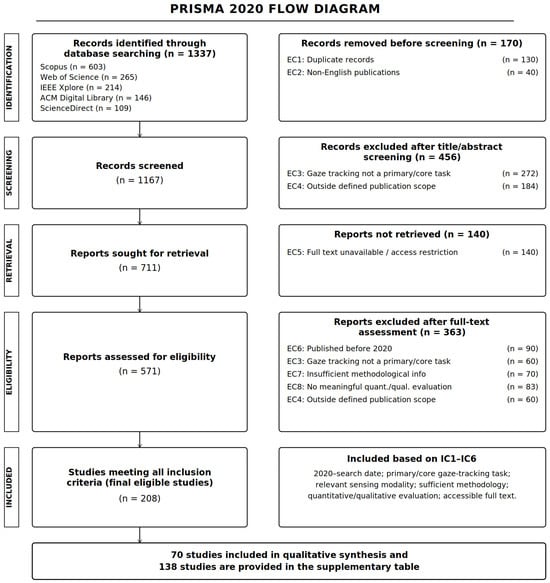
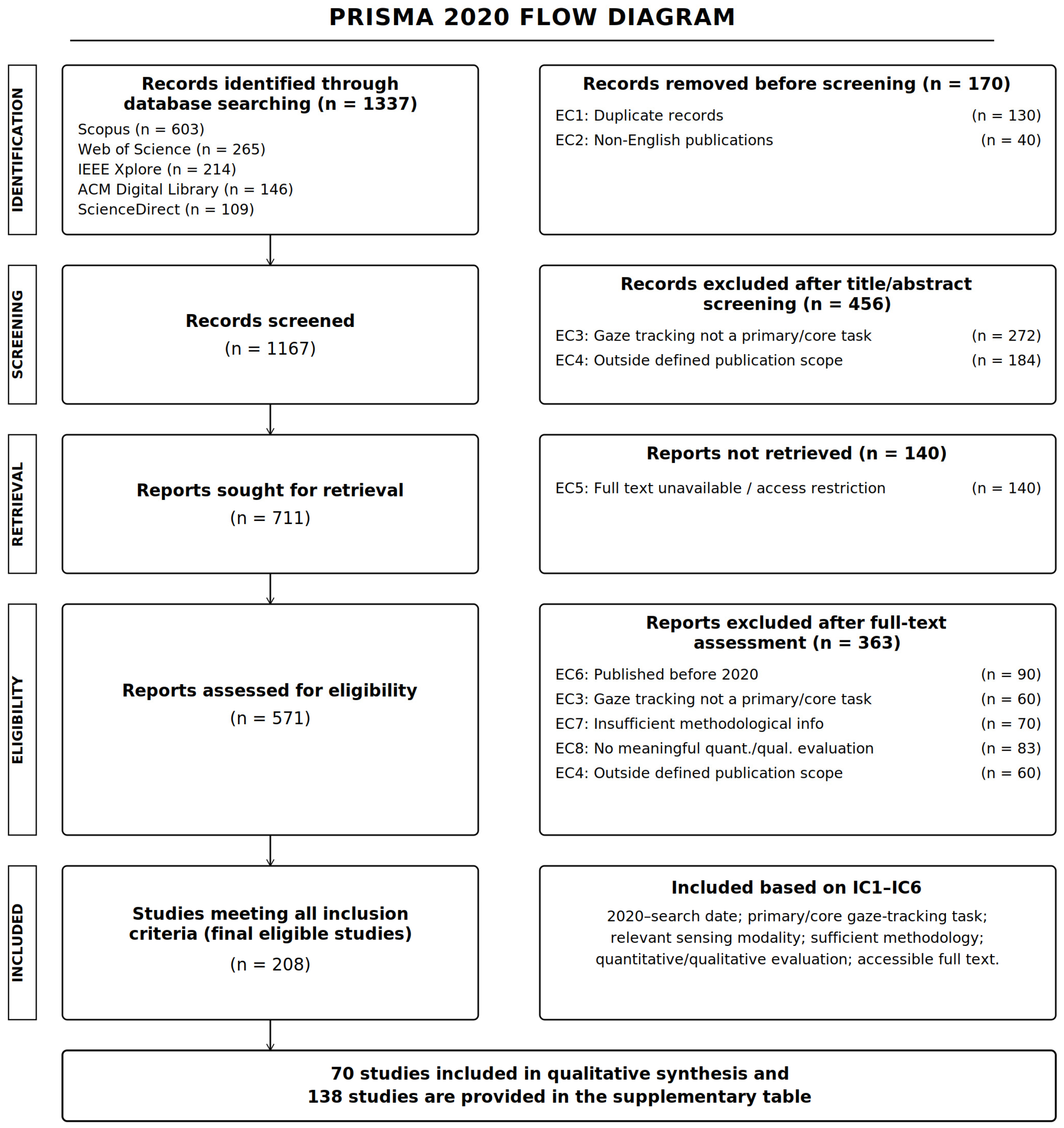

Disclaimer/Publisher’s Note: The statements, opinions and data contained in all publications are solely those of the individual author(s) and contributor(s) and not of MDPI and/or the editor(s). MDPI and/or the editor(s) disclaim responsibility for any injury to people or property resulting from any ideas, methods, instructions or products referred to in the content. |
© 2026 by the authors. Licensee MDPI, Basel, Switzerland. This article is an open access article distributed under the terms and conditions of the Creative Commons Attribution (CC BY) license.