


You are currently on the new version of our website. Access the old version .

Journal of Eye Movement Research, Volume 18, Issue 5

2025 October - 23 articles

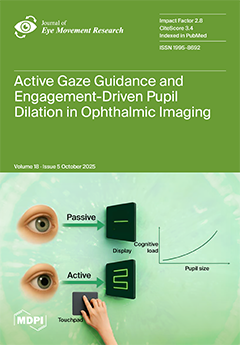
Cover Story: Modern ophthalmic imaging, such as optical coherence tomography (OCT), relies on mechanical scanners to move the light beam while the patient passively fixates. This proof-of-concept study explores whether natural eye movements can replace scanner motion through active gaze guidance. Using an infrared fundus setup, the subjects traced visual patterns with real-time feedback instead of passively viewing them. Active tracing increased pupil diameter by an average of 17.8 % and reduced blinking, with stronger effects for more complex patterns. These findings show that patient-driven gaze guidance can induce natural pupil dilation and may enhance image quality in future scannerless OCT systems. View this paper
  • Issues are regarded as officially published after their release is announced to the table of contents alert mailing list .
  • You may sign up for email alerts to receive table of contents of newly released issues.
  • PDF is the official format for papers published in both, html and pdf forms. To view the papers in pdf format, click on the "PDF Full-text" link, and use the free Adobe Reader to open them.

Articles (23)

  • Article
  • Open Access
754 Views
17 Pages

This study examined how drivers’ eye fixations change before, during, and after recognizing road markings, and how these changes relate to driving speed, visual complexity, cognitive functions, and demographics. 20 licensed drivers viewed on-board mo...

  • Article
  • Open Access
644 Views
27 Pages

Oculomotor reading behavior is influenced by both universal factors, like the “big three” of word length, frequency, and contextual predictability, and language-specific factors, such as script and grammar. The aim of this study was to examine the in...

  • Article
  • Open Access
897 Views
13 Pages

This study investigated the effectiveness of visual strategies in guiding gaze behavior and attention on Yi graphic symbols using eye-tracking. Four strategies, color brightness, layering, line guidance, and size variation, were tested with 34 Thai p...

  • Article
  • Open Access
787 Views
26 Pages

DyslexiaNet: Examining the Viability and Efficacy of Eye Movement-Based Deep Learning for Dyslexia Detection

  • Ramis İleri,
  • Çiğdem Gülüzar Altıntop,
  • Fatma Latifoğlu and
  • Esra Demirci

Dyslexia is a neurodevelopmental disorder that impairs reading, affecting 5–17.5% of children and representing the most common learning disability. Individuals with dyslexia experience decoding, reading fluency, and comprehension difficulties, hinder...

  • Article
  • Open Access
859 Views
18 Pages

Head and Eye Movements During Pedestrian Crossing in Patients with Visual Impairment: A Virtual Reality Eye Tracking Study

  • Mark Mervic,
  • Ema Grašič,
  • Polona Jaki Mekjavić,
  • Nataša Vidovič Valentinčič and
  • Ana Fakin

Real-world navigation depends on coordinated head–eye behaviour that standard tests of visual function miss. We investigated how visual impairment affects traffic navigation, whether behaviour differs by visual impairment type, and whether this funct...

  • Feature Paper
  • Article
  • Open Access
807 Views
11 Pages

Test–Retest Reliability of a Computerized Hand–Eye Coordination Task

  • Antonio Ríder-Vázquez,
  • Estanislao Gutiérrez-Sánchez,
  • Clara Martinez-Perez and
  • María Carmen Sánchez-González

Background: Hand–eye coordination is essential for daily functioning and sports performance, but standardized digital protocols for its reliable assessment are limited. This study aimed to evaluate the intra-examiner repeatability and inter-examiner...

  • Article
  • Open Access
1,652 Views
22 Pages

Accurate recognition of basic facial emotions is well documented, yet the mechanisms of misclassification and their relation to gaze allocation remain under-reported. The present study utilized a within-subjects eye-tracking design to examine both ac...

  • Article
  • Open Access
1 Citations
1,187 Views
17 Pages

In safety-critical systems like nuclear power plants, the rapid and accurate perception of visual interface information is vital. This study investigates the relationship between visual attention dispersion measured via heatmap entropy (as a specific...

  • Article
  • Open Access
667 Views
10 Pages

Diagnosing Colour Vision Deficiencies Using Eye Movements (Without Dedicated Eye-Tracking Hardware)

  • Aryaman Taore,
  • Gabriel Lobo,
  • Philip R. K. Turnbull and
  • Steven C. Dakin

Purpose: To investigate the efficacy of a novel test for diagnosing colour vision deficiencies using reflexive eye movements measured using an unmodified tablet. Methods: This study followed a cross-sectional design, where thirty-three participants a...

  • Article
  • Open Access
1 Citations
694 Views
21 Pages

This study investigated how simulated ophthalmic visual field deficits affect visual attention and economic information processing. Using webcam-based eye tracking, 227 participants with normal vision recruited through Amazon Mechanical Turk were ass...

of 3

Get Alerted

Add your email address to receive forthcoming issues of this journal.

XFacebookLinkedIn
J. Eye Mov. Res. - ISSN 1995-8692