

You are currently viewing a new version of our website. To view the old version click .

Journal of Eye Movement Research

Journal of Eye Movement Research (JEMR) is an international, peer-reviewed, open access journal on all aspects of oculomotor functioning including methodology of eye recording, neurophysiological and cognitive models, attention, reading, as well as applications in neurology, ergonomy, media research and other areas, and published bimonthly online by MDPI (from Volume 18, Issue 1 - 2025).

Indexed in PubMed | Quartile Ranking JCR - Q1 (Ophthalmology)

All Articles (598)

The Impact of Ophthalmic Lens Power and Treatments on Eye Tracking Performance

  • Marta Lacort-Beltrán,
  • Adrián Alejandre and
  • Sara Guillén
  • + 5 authors

Eye tracking (ET) technology is increasingly used in both research and clinical practice, but its accuracy may be compromised by the presence of ophthalmic lenses. This study systematically evaluated the influence of different optical prescriptions and lens treatments on ET performance using DIVE (Device for an Integral Visual Examination). Fourteen healthy participants underwent oculomotor control tests under thirteen optical conditions: six with varying dioptric powers and six with optical filters, compared against a no-lens control. Key parameters analysed included angle error, fixation stability (bivariate contour ellipse area, BCEA), saccadic accuracy, number of data gaps, and proportion of valid frames. High-powered spherical lenses (+6.00 D and −6.00 D) significantly increased gaze angle error, and the negative lens also increased data gaps, while cylindrical lenses had a moderate effect. Among filters, the Natural IR coating caused the greatest deterioration in ET performance, reducing valid samples and increasing the number of gaps with data loss, likely due to interference with the infrared-based detection system. The lens with basic anti-reflective treatment (SV Org 1.5 AR) also showed some deterioration in interaction with the ET. Other filters showed minimal or no significant impact. These findings demonstrate that both high-powered prescriptions and certain lens treatments can compromise ET data quality, highlighting the importance of accounting for optical conditions in experimental design and clinical applications.

29 December 2025
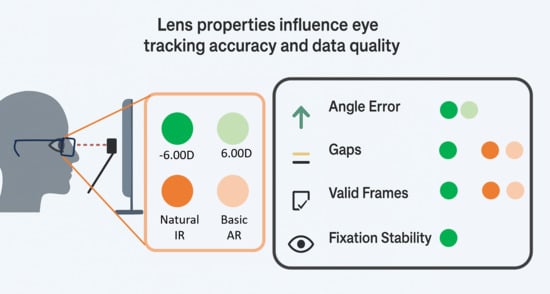
DIVE diagram showing a side view of the device, the position of the patients’ eyes at 65 cm from the screen, and the infrared light path from the eye tracker to the eyes.

This article examines the nature of musical stimuli used in eye-movement research on music reading, with a focus on syntactic elements essential for fluent reading: melody, rhythm, and harmony. Drawing parallels between language and music as syntactic systems, the study critiques the widespread use of stimuli that lack coherent musical structure, such as random pitch sequences or rhythmically ambiguous patterns. Eight peer-reviewed studies were analyzed based on their use of stimuli specifically composed for research purposes. The findings reveal that most stimuli do not reflect authentic musical syntax, limiting the validity of conclusions about music reading processes. The article also explores how researchers interpret the concept of “complexity” in musical stimuli, noting inconsistencies and a lack of standardized criteria. Additionally, it highlights the importance of considering motor planning and instrument-specific challenges, which are often overlooked in experimental design. The study calls for more deliberate and informed stimulus design in future research, emphasizing the need for syntactically meaningful musical excerpts and standardized definitions of complexity. Such improvements are essential for advancing the understanding of syntactic processing in music reading and ensuring methodological consistency across studies.

29 December 2025

Musical stimuli adapted from Figures 1, 3 and 6 in Kinsler and Carpenter [42]. The notation has been redrawn by the author to illustrate the original rhythmic content. Green and red circles mark rhythm positions that create metrical ambiguity.

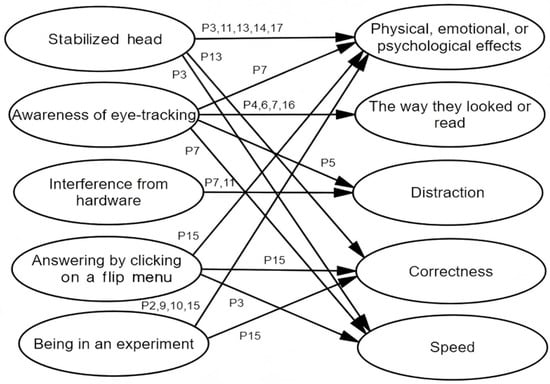
This study compares the roles of eye-tracking and verbal reports (think-alouds and retrospective verbal reports, RVRs) in L2 reading process research through three qualitative studies. Findings indicate that eye-tracking provided precise, quantitative data on visual attention and reading patterns (e.g., fixation duration, gaze plots) and choice-making during gap-filling. Based on our mapping, it was mostly effective in identifying 13 out of 47 reading processing strategies, primarily those involving skimming or scanning that had distinctive eye-movement signatures. Verbal reports, while less exact in measurement, offered direct access to cognitive processes (e.g., strategy use, reasoning) and uncovered content-specific thoughts inaccessible to eye-tracking. Both methods exhibited reactivity: eye-tracking could cause physical discomfort or altered reading behavior, whereas think-alouds could disrupt task flow or enhance reflection. This study reveals the respective strengths and limitations of eye-tracking and verbal reports in L2 reading research. It facilitates a more informed selection and application of these methodological approaches in alignment with specific research objectives, whether employed in isolation or in an integrated manner.

25 December 2025

Causes and effects of reactivity of eye-tracking.

Discriminative Capabilities of Eye Gaze Measures for Cognitive Load Evaluation in a Driving Simulation Task

  • Anastasiia Bakhchina,
  • Karina Arutyunova and
  • Evgenii Burashnikov
  • + 3 authors

Driving is a cognitively demanding task engaging attentional effort and working memory resources, which increases cognitive load. The aim of this study was to evaluate the discriminative capabilities of an objective eye tracking method in comparison to a subjective self-report scale (the NASA–Task Load Index) in distinguishing cognitive load levels during driving. Participants (N = 685) performed highway and urban driving in a fixed-base driving simulator. The N-Back test was used as a secondary task to increase cognitive load. In line with previous studies, the NASA–Task Load Index was shown to be an accurate self-report tool in distinguishing conditions with higher and lower levels of cognitive load due to the additional N-Back task, with best average accuracy of 0.81 within the highway driving scenario. Eye gaze metrics worked best when differentiating between stages of highway and urban driving, with an average accuracy of 0.82. Eye gaze entropy measures were the best indicators for cognitive load dynamics, with average accuracy reaching 0.95 for gaze transition entropy in the urban vs. highway comparison. Eye gaze metrics showed significant correlations with the NASA–Task Load Index results in urban driving stages, but not in highway driving. The results demonstrate that eye gaze metrics can be used in combination with self-reports for developing algorithms of cognitive load evaluation and reliable driver state prediction in different road conditions.

24 December 2025

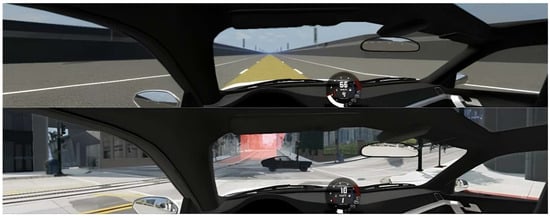
Screen view of the simulator environments. Highway driving scenario (top) and urban driving scenario (bottom).

News & Conferences

Issues

Open for Submission

Editor's Choice

Get Alerted

Add your email address to receive forthcoming issues of this journal.

XFacebookLinkedIn
J. Eye Mov. Res. - ISSN 1995-8692