


Abstract
Introduction: Offloading adherence (OA) is critical for diabetic foot ulcer (DFU) healing. This report investigated whether DFU patients with low overall OA (<20%) limit offloading device usage to days they come to the clinic. Methods: Activity monitors measured OA 24 h/day. Daily walking and standing OA were calculated for up to four weeks, and participants self-reported their cumulative adherence. Each day was classified as to whether a DFU-related clinic visit occurred. Results: Four participants from an ongoing RCT were identified with <20% overall adherence, despite self-reporting 65–80% adherence. Most days they did not wear their devices at all, while the majority of wear-days coincided with footcare visits. Conclusions: This report describes a cohort that had low daily OA yet consistently wore their devices to the clinic and self-reported inflated OA. To improve OA and DFU healing, more research is needed to understand this phenomenon and help clinicians ascertain adherence during patient encounters.
1. Introduction
Diabetic foot disease is the 11th-largest-contributing health condition to the global disability burden [1], with diabetic foot ulcers and amputations constituting its most dire outcomes. Adherence to therapeutic offloading devices is essential for promoting the healing of diabetic foot ulcers (DFUs) [2,3,4]. However, adherence rates are often low, with many patients failing to use their offloading devices as prescribed [5,6,7]. Despite objective studies of offloading adherence (OA) finding mean rates ranging within 28–59% [5,6,8], patients generally self-report higher adherence rates [9]. Within an ongoing randomized controlled trial of offloading interventions, it was anecdotally noted that individuals with low objectively measured OA regularly reported to the clinic wearing their devices. This report preliminarily examines the subsequently formulated hypothesis that DFU patients with low overall OA temporarily alter their OA tendencies in association with attending footcare clinic visits.
2. Methods
Participants with less than 20% adherence to their prescribed knee-high or ankle-high removable cast walker (RCW) offloading device (Össur, Reykjavik, Iceland) were identified from an ongoing IRB-approved randomized controlled trial investigating DFU wound healing (Table 1). OA was objectively monitored using a pair of triaxial accelerometer-based activity monitors (ActivPAL4, PAL Technologies Ltd., Glasgow, Scotland, UK), employing an advancement to the methodology previously used by our group [5,10].
Table 1.
Baseline demographics.
Within the parent randomized controlled trial, adherence was intended to be monitored for a four-week period. During this period, participants returned to the clinic at least once per week for wound care. For data from each day without a clinic visit to be considered valid, data needed to be available for the full 24 h period. On some clinic visit days, monitors were replaced to ensure battery life. On those days, data from the first set of monitors that were collected up to the time of the clinic visit were paired with data from the second set of monitors, beginning one hour after the scheduled visit. Twenty-three hours of combined data were considered a valid day of monitoring in that scenario. This approach avoided the incorporation of inaccurate data, i.e., when monitors were being detached from/attached to participants and their RCW. With respect to this publication, if adherence data were lacking for a clinic visit day, that entire week’s data were excluded from analyses.
Briefly, an activity monitor attached to the participant’s thigh continuously recorded all daily physical activity (e.g., walking, standing, and sitting). A second monitor was attached to the study-provided RCW to measure RCW-specific movement. Data from the RCW monitor were time-synchronized with those from the thigh monitor, and physical activities (walking and standing) logged by the latter were coded as being conducted with or without the RCW being worn (i.e., adherent or nonadherent to offloading). To avoid a possible Hawthorne effect [11,12] the placement of the RCW monitor was concealed from participants.
In contrast to past work by our group that focused exclusively on OA during periods of walking [5,10], objectively monitored adherence was independently assessed for walking (steps) and standing (time) and reported as mean values per day for each participant. Furthermore, each day of adherence monitoring was classified as to whether the participant visited a clinical site for DFU treatment. Additionally, at the end of the entire adherence monitoring period, participants were asked to self-report, “What percentage of the time that you were weightbearing (ex. walking or standing) over the past 4 weeks did you wear your boot (RCW)?”
3. Results
From the initial twelve participants enrolled in the parent RCT, four participants were identified with both walking and standing total adherence values of <20%. The individual mean daily walking adherence rates for these participants were 9%, 13%, 4%, and 4%, which contrasts with a range of 28–95% for other participants enrolled in the study. The low-adherence participants’ mean daily standing adherence values were similarly low at 4%, 10%, 2%, and 3%, in contrast to a range of 24–78% for the RCT’s other study participants.
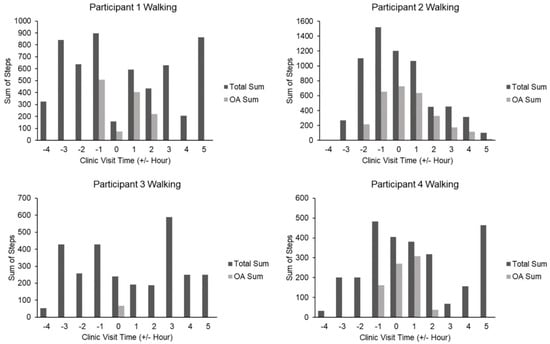
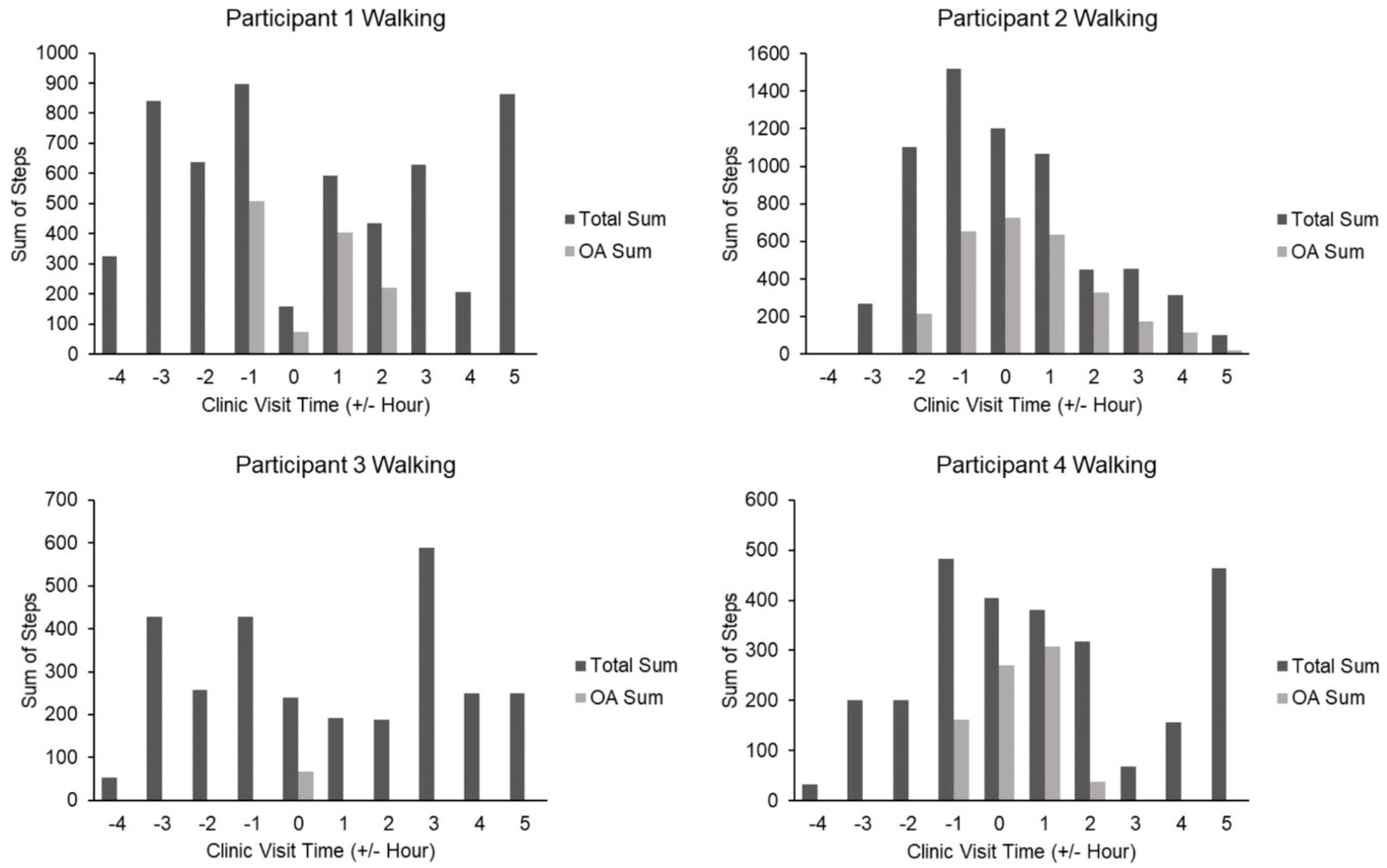
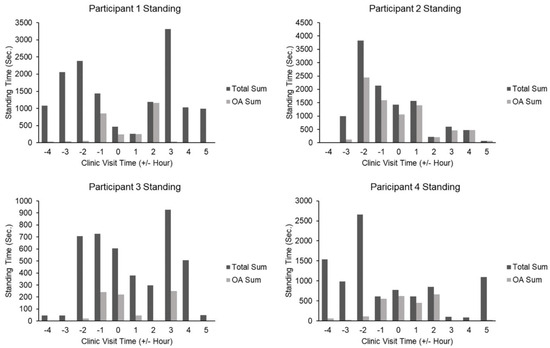
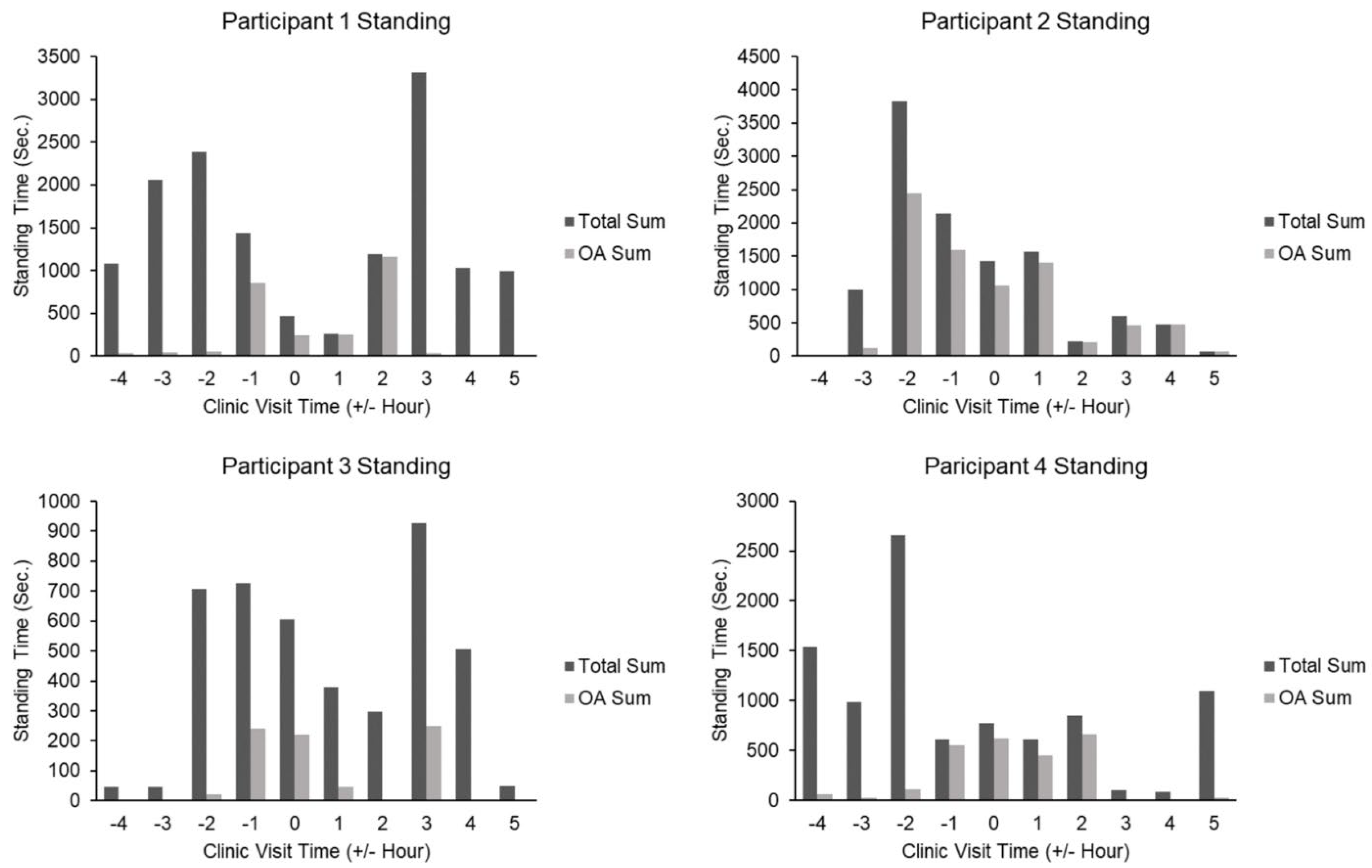
As shown in Table 2, the number of days low-adherence participants wore the RCW was disproportionately small compared to their total monitored days. Notably, adherence on footcare-related clinic visit days accounted for a substantial proportion of total RCW usage (Table 2). In contrast to the low-adherence participants’ exceptionally low values across the entire monitoring period, their walking adherence increased to 41%, 76%, 62%, and 79% on days they visited the clinic. Similarly, their standing adherence rose to 44%, 79%, 55%, and 67% on clinic days. This phenomenon of RCW usage in association with clinic visits was further evidenced by the hour-by-hour adherence rates on clinic visit days. In the hours preceding clinic visits, OA physical activity increased, and then OA decreased in the hours following the visits (Figure 1 and Figure 2).
Table 2.
Objectively calculated adherence with RCW offloading device.
Figure 1.
Temporal association of walking OA with clinic visits. Note: The figure displays hourly step count distributions relative to clinic visit times for the four low-OA participants. Data were normalized according to when clinic visits took place, with Timepoint 0 corresponding to the hour clinic visits occurred. The “Total Sum” and “OA Sum” represent the combined step counts across all clinic visit days for which a participant had available data: Participant 1 had 3 clinic visit days, Participant 2 had 4 clinic visit days, Participant 3 had 1 clinic visit day, and Participant 4 had 1 clinic visit day. Total Sum values represent total steps taken at the corresponding time points. OA Sum values represent the total steps taken while wearing one’s offloading device at the corresponding time points.
Figure 2.
Temporal association of standing OA with clinic visits. Note: The figure displays hourly standing time distributions relative to clinic visit times for the four low-OA participants. Data were normalized according to when clinic visits took place, with Timepoint 0 corresponding to the hour clinic visits occurred. The “Total Sum” and “OA Sum” represent the combined standing time across all clinic visit days for which a participant had available data: Participant 1 had 3 clinic visit days, Participant 2 had 4 clinic visit days, Participant 3 had 1 clinic visit day, and Participant 4 had 1 clinic visit day. Total Sum values represent the total standing time taken at the corresponding time points. OA Sum values represent the total standing time while wearing one’s offloading device at the corresponding time points.
Relative to the objectively captured adherence metrics, the low-adherence participants self-reported substantially inflated combined walking and standing adherence values for the entire study period of 75%, 80%, 65%, and 80%. This was in contrast to self-reported values of 40–100% from the other study participants.
4. Discussion
Adherence to therapeutic offloading devices for DFU has consistently been found to be lower than desired [5,6,8], even in preventative contexts [13,14]. Relative to adherence values determined via objective monitoring, patients often present inflated impressions of their adherence [9]. The present report adds insight into this phenomenon by specifically focusing on individuals that objectively exhibited particularly low use of their offloading devices. Within this report’s set of low-adherence individuals, objectively measured adherence values were substantially lower than self-reported adherence values. Furthermore, this report represents the first time a temporal relationship between clinic visits and offloading device usage has been observed. Despite non-use of their offloading device on 67–84% of monitored days, the low-OA individuals consistently wore their devices to the clinic. Furthermore, despite the most adherent of these individuals having only 13% walking and 10% standing adherence over the entire monitoring period, there was only one instance of an individual in this cohort not wearing their offloading device on a footcare clinic visit day.
There is likely a host of factors that leads to both conscious and unconscious inflations of self-reported OA. In a prior publication regarding footwear to prevent DFU, our group described a case of an in-person interview in which a patient insisted she wore therapeutic footwear all day while visibly not wearing such footwear [15]. The individual was likely uncomfortable disclosing to the clinical team that they (at least at times) did not wear their therapeutic footwear. Whether it was the participant in our prior work erroneously reporting always wearing therapeutic footwear or participants in the present project who grossly over-reported their offloading device usage, inflated self-reports of OA are likely influenced by poor recollection and social desirability bias, which is a tendency to provide answers perceived as favorable [9,16].
Although the observation that low-adherence participants used their devices consistently on clinic days in the present study could be considered a positive example of external accountability [16] driving beneficial behavior, the use of offloading devices on clinic days was generally confined to the time period immediately prior to and following the visits. The consistent use of offloading devices only on clinic visit days, paired with inflated self-reports of overall use of the devices in this cohort, suggests that clinicians should be cautious in relying on self-reports of OA. In the case of individuals with nonhealing DFUs who have been provided with a removable offloading device, a more thorough discussion than simply asking how much the device is worn is warranted. The potential for adherence to significantly decline when individuals are not under the watchful eyes of the clinical team underscores the need to address barriers and facilitators to consistent, real-world device use. By engaging with patients, means to increase OA may be identified, such as providing an alternative offloading device or limb lift for the contralateral limb to increase comfort when the offloading device is worn [3]. Alternatively, clinicians and patients may jointly arrive at the decision to transition to a non-removable offloading device.
Possible reasons for poor adherence with removable devices include discomfort or dissatisfaction with the RCW and lack of perceived benefit. RCWs are often heavy and bulky, which can affect posture and gait. Additionally, RCWs can be cumbersome to wear at home, where patients take many steps and stand frequently [17], creating a barrier to consistent use in daily activities. There is also a significant social component to poor adherence, as patients may feel self-conscious about wearing an offloading device outside or in public settings. These physical and social challenges underscore the need for tailored device designs that prioritize comfort, usability, and discretion while addressing the unique needs of individuals with diabetes-related foot ulcers [5,18].
In conclusion, this report provides preliminary findings of a novel outcome (variability in OA habits in association with visiting the clinic) that supports the need for clinicians to be cautious in accepting self-reports of OA from DFU patients. While patients may report to the clinic wearing an offloading device, their usage of the device may drop dramatically once they leave. Further research to investigate this phenomenon and reduce its occurrence will undoubtedly lead to improved clinical outcomes for those individuals that struggle to regularly use their offloading devices.
Author Contributions
Conceptualization, R.T.C.; methodology, R.T.C., N.N.-F. and S.V.Y.; software, S.V.Y.; formal analysis, N.N.-F. and S.V.Y.; investigation, R.T.C., N.N.-F., A.E.F. and N.J.R.; writing—original draft preparation, R.T.C. and N.N.-F.; writing—review and editing, S.V.Y., A.E.F., A.J.M.B., N.D.R., L.V. and N.J.R.; funding acquisition, R.T.C., A.J.M.B., N.D.R., L.V. and N.J.R. All authors have read and agreed to the published version of the manuscript.
Funding
This work was supported by Award Number R01DK131303 from the National Institutes of Health. The content is solely the responsibility of the authors and does not necessarily represent the official views of the National Institute of Diabetes and Digestive and Kidney Diseases or the National Institutes of Health.
Institutional Review Board Statement
This study was reviewed and approved by the Rosalind Franklin University Institutional Review Board as protocol number SCPM22-362 (Date: 20 January 2023).
Informed Consent Statement
Informed consent was obtained from all subjects involved in the study.
Data Availability Statement
The raw data supporting the conclusions of this article will be made available by the authors on request.
Acknowledgments
Standardized shoe gear (Dr. Comfort Diabetic Shoes) was provided for use on the non-ulcerated foot for all study participants in association with a grant from Dr. Comfort, LLC, Mequon, WI, USA.
Conflicts of Interest
The authors declare no potential conflicts of interest with respect to the research, authorship, and/or publication of this article.
References
- Lazzarini, P.A.; Raspovic, K.M.; Meloni, M.; van Netten, J.J. A new declaration for feet’s sake: Halving the global diabetic foot disease burden from 2% to 1% with next generation care. Diabetes Metab. Res. Rev. 2024, 40, e3747. [Google Scholar] [PubMed]
- Lazzarini, P.A.; Armstrong, D.G.; Crews, R.T.; Gooday, C.; Jarl, G.; Kirketerp-Moller, K.; Viswanathan, V.; Bus, S.A. Effectiveness of offloading interventions for people with diabetes-related foot ulcers: A systematic review and meta-analysis. Diabetes Metab. Res. Rev. 2024, 40, e3650. [Google Scholar] [PubMed]
- Bus, S.A.; Armstrong, D.G.; Crews, R.T.; Gooday, C.; Jarl, G.; Kirketerp-Moller, K.; Viswanathan, V.; Lazzarini, P.A. Guidelines on offloading foot ulcers in persons with diabetes (IWGDF 2023 update). Diabetes Metab. Res. Rev. 2024, 40, e3647. [Google Scholar] [PubMed]
- Snyder, R.J.; Frykberg, R.G.; Rogers, L.C.; Applewhite, A.J.; Bell, D.; Bohn, G.; Fife, C.E.; Jensen, J.; Wilcox, J. The management of diabetic foot ulcers through optimal off-loading: Building consensus guidelines and practical recommendations to improve outcomes. J. Am. Podiatr. Med. Assoc. 2014, 104, 555–567. [Google Scholar] [PubMed]
- Crews, R.T.; Shen, B.J.; Campbell, L.; Lamont, P.J.; Boulton, A.J.; Peyrot, M.; Kirsner, R.S.; Vileikyte, L. Role and Determinants of Adherence to Off-loading in Diabetic Foot Ulcer Healing: A Prospective Investigation. Diabetes Care 2016, 39, 1371–1377. [Google Scholar] [CrossRef] [Scilit] [PubMed]
- Armstrong, D.G.; Lavery, L.A.; Kimbriel, H.R.; Nixon, B.P.; Boulton, A.J. Activity Patterns of Patients With Diabetic Foot Ulceration: Patients with active ulceration may not adhere to a standard pressure off-loading regimen. Diabetes Care 2003, 26, 2595–2597. [Google Scholar] [PubMed]
- Ababneh, A.; Finlayson, K.; Edwards, H.; Lazzarini, P.A. Factors associated with adherence to using removable cast walker treatment among patients with diabetes-related foot ulcers. BMJ Open Diabetes Res. Care 2022, 10, e002640. [Google Scholar] [CrossRef] [Scilit] [PubMed]
- Ababneh, A.; Finlayson, K.; Edwards, H.; van Netten, J.J.; Lazzarini, P.A. Differences in adherence to using removable cast walker treatment during daytime and nighttime weight-bearing activities in people with diabetes-related foot ulcers. Ther. Adv. Endocrinol. Metab. 2023, 14, 20420188221142457. [Google Scholar] [CrossRef] [Scilit] [PubMed]
- Ababneh, A.; Finlayson, K.; Edwards, H.; Armstrong, D.G.; Najafi, B.; van Netten, J.J.; Lazzarini, P.A. The Validity and Reliability of Self-Reported Adherence to Using Offloading Treatment in People with Diabetes-Related Foot Ulcers. Sensors 2023, 23, 4423. [Google Scholar] [PubMed]
- Crews, R.T.; Armstrong, D.G.; Boulton, A.J. A method for assessing off-loading compliance. J. Am. Podiatr. Med. Assoc. 2009, 99, 100–103. [Google Scholar] [CrossRef] [Scilit] [PubMed]
- Petersen, B.; Vesper, I.; Pachwald, B.; Dagenbach, N.; Buck, S.; Waldenmaier, D.; Heinemann, L. Diabetes management intervention studies: Lessons learned from two studies. Trials 2021, 22, 61. [Google Scholar] [CrossRef] [Scilit] [PubMed]
- Peeters, L.E.J.; van Gelder, T.; van Dijk, L.; Koch, B.C.P.; Versmissen, J. Lessons learned from conducting a randomized controlled trial to improve non-adherence to antihypertensive drug treatment. Blood Press. 2023, 32, 2281316. [Google Scholar] [CrossRef] [Scilit] [PubMed]
- Waaijman, R.; de Haart, M.; Arts, M.L.; Wever, D.; Verlouw, A.J.; Nollet, F.; Bus, S.A. Risk factors for plantar foot ulcer recurrence in neuropathic diabetic patients. Diabetes Care 2014, 37, 1697–1705. [Google Scholar] [CrossRef] [Scilit] [PubMed]
- Waaijman, R.; Keukenkamp, R.; de Haart, M.; Polomski, W.P.; Nollet, F.; Bus, S.A. Adherence to wearing prescription custom-made footwear in patients with diabetes at high risk for plantar foot ulceration. Diabetes Care 2013, 36, 1613–1618. [Google Scholar] [CrossRef] [Scilit] [PubMed]
- Knowles, E.A.; Boulton, A.J. Do people with diabetes wear their prescribed footwear? Diabet. Med. 1996, 13, 1064–1068. [Google Scholar] [CrossRef] [Scilit]
- Meisters, J.; Hoffmann, A.; Musch, J. Controlling social desirability bias: An experimental investigation of the extended crosswise model. PLoS ONE 2020, 15, e0243384. [Google Scholar] [CrossRef] [Scilit] [PubMed]
- Crews, R.T.; Yalla, S.V.; Dhatt, N.; Burdi, D.; Hwang, S. Monitoring Location-Specific Physical Activity via Integration of Accelerometry and Geotechnology Within Patients with or at Risk of Diabetic Foot Ulcers: A Technological Report. J. Diabetes Sci. Technol. 2017, 11, 899–903. [Google Scholar] [PubMed]
- Jarl, G.; Tranberg, R.; Johansson, U.; Alnemo, J.; Lundqvist, L.O. Predictors of adherence to wearing therapeutic footwear among people with diabetes. J. Foot Ankle Res. 2020, 13, 45. [Google Scholar] [CrossRef] [Scilit] [PubMed]

Disclaimer/Publisher’s Note: The statements, opinions and data contained in all publications are solely those of the individual author(s) and contributor(s) and not of MDPI and/or the editor(s). MDPI and/or the editor(s) disclaim responsibility for any injury to people or property resulting from any ideas, methods, instructions or products referred to in the content. |
© 2026 by the authors. Published by MDPI on behalf of the American Podiatric Medical Association (APMA). Licensee MDPI, Basel, Switzerland. This article is an open access article distributed under the terms and conditions of the Creative Commons Attribution (CC BY) license.