


Abstract
Background: Plantar fasciitis is a common condition likely caused by abnormal foot alignment, such as flatfoot. Insoles are commonly used to treat flatfoot, and systematic reviews have shown that insoles improve pain; however, the underlying mechanism is unclear. This study aimed to investigate the effects of insoles on plantar fascial tension during running in individuals with flatfoot. Methods: The participants were 14 individuals with flatfoot. The task involved running under two conditions: with and without insoles. Insoles that absorbed the shock and supported the medial longitudinal arch were used. The foot marker trajectories and ground reaction forces were measured during running sessions. The plantar fascia tension was estimated based on the ground reaction force, moment arm of the ground reaction force, and that of plantar fascia. Statistical parametric mapping was used to compare the plantar fascia tension during the stance phase between the two conditions. Results: When running with and without insoles, the peak plantar fascial tension was observed at midstance. Planar fascial tension was significantly lower with insoles over a wider range during the stance phase than that without insoles (p < 0.05). Conclusions: This study provided evidence that insoles can reduce plantar pain while running. This result may be useful for reducing pain in individuals with flatfoot and preventing the onset of plantar fasciitis.
1. Introduction
In recent years, the number of running-related injuries has increased given the increase in the running population. According to a systematic review, the incidence of running-related injuries ranges from 19.4% to 79.3% [1]. Plantar fasciitis is one of three most common injuries in runners [2], with a prevalence of 5.2% to 17.5%. As plantar fasciitis is a chronic condition prone to recurrence, prevention before its onset is important.
Plantar fasciitis is a running injury caused by several factors, such as flatfoot [3]. Flatfoot is a common foot deformity with a prevalence of 11.2% to 29.0% in adults [4,5,6,7]. Pohl et al. [8] showed that foot posture with a decreasing medial longitudinal arch, such as flatfoot, is related to a history of plantar fasciitis. The plantar fascia was the greatest contributor to arch stability, providing 79.5% of resistance to arch decrease [9]. Eversion of the rearfoot and midfoot, which represents a reduction in the medial longitudinal arch, increases in individuals with flatfoot during running [10], whereas the plantar fascia thickens [11]. Considering these previous studies, individuals with flatfoot are believed to have a foot posture that is more likely to expose their plantar fascia to overload. To prevent the onset of plantar fasciitis, it is necessary to reduce the load on the plantar fascia during running in individuals with flatfoot.
Foot orthoses such as insoles are prescribed for flatfoot to reduce foot complaints and pain. The standard of care for conservative flatfoot treatment is exercise therapy or foot orthosis [12]. Insoles are commonly used in clinical settings because of their simplicity and low risk of adverse events. Insoles can support the medial longitudinal arch, realign the foot posture, and enhance stability. A recent systematic review reported that a three-dimensional (3D)-printed insole may have a positive effect on relieving pain [13]. However, previous studies have only described the therapeutic effects and function of insoles; the biomechanical effects of using insoles on the plantar fascia have not been fully investigated. It is unclear why the use of insoles reduces foot pain in flatfoot.
Previous studies have investigated the effects of insoles on the kinematics and kinetics of running. The use of insoles has been found to reduce the peak vertical ground reaction force during running [14]. Lee et al. [15] found that the Achilles tendon load and ankle joint plantar flexion moment during running with orthoses (arch support) were significantly reduced compared with individuals with flatfoot without orthoses. Moreover, insoles with a medial heel wedge during running in individuals with flatfoot can decrease ankle dorsiflexion and eversion compared to those without insoles [16]. Although the effects of insoles on running biomechanics have been reported, the plantar fascial tension, which is directly related to the occurrence of plantar fasciitis, has not been examined. Exploring this may provide a rationale and mechanism for improving pain in individuals with flatfoot, and help prevent the onset of plantar fasciitis.
Therefore, this study aimed to estimate the effect of insoles on the plantar fascia in individuals with flatfoot. The hypothesis of this study was that plantar fascia tension during the stance phase of running can be reduced by using insoles based on observations that insoles alleviate pain [13] and reduce vertical ground reaction forces during running [14].
2. Methods
2.1. Participants
Fourteen males with flatfoot (height: 171.2 (5.3) cm, body mass: 62.6 (7.9) kg, age: 20.9 (0.5) years) were recruited from participating university institutions. Foot posture was assessed using the arch height index (ratio of the dorsum height to truncated foot length) while standing (50% weight bearing) using the arch height index measurement system (JAKTOOL LLC, Cranbury, NJ, USA). Arch height index values < 0.310 were considered to indicate flatfoot based on the mean (standard deviation, SD) data from university students without flatfoot [17]. The foot characteristics required to calculate the arch height index were evaluated by a single assessor. The exclusion criteria were as follows: (1) lower limb disorders or injuries within the past six months, (2) history of lower limb surgery, (3) neurological disease, and (4) foot deformities other than flatfoot. Since lower-extremity kinematics [18,19] and kinetics [20] during running differ by sex, which may have influenced the results, this study targeted only male participants. The participants were given an explanation of the study before the experiment, and their written consent to participate was obtained before the experiment was conducted. This study was approved by the IRB of the affiliated institution on February 2021 (No. 185831-210218).
2.2. Equipment
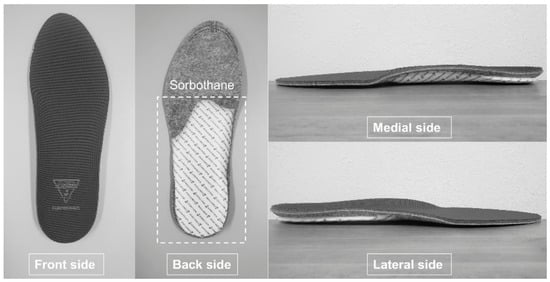
For motion analysis, a 3D motion analyzer (VICON, Oxford Metrics, Oxford, UK), including 12 infrared cameras, a force plate (Amti Inc., Watertown, MA, USA), and a photocell (Dashr, Dashr Motion Performance Systems, Omaha, NE, USA), was used. The sampling frequency was 250 Hz for the 3D motion analyzer and 1000 Hz for the force plate. Based on the plug-in gait lower model, 16 infrared reflective markers with a diameter of 9.5 mm were attached to the left and right anterior superior iliac spine, left and right posterior superior iliac spine, left and right lateral thighs, left and right lateral epicondyles of the thighs, left and right lateral lower legs, left and right lateral malleolus, toe (midpoint of the left and right second and third metatarsal heads), and calcaneus (left and right most posterior points of the foot). This model is also used in the analysis of running motion [21]. The insole (Sanshin Kosan Co., Ltd., Tokyo, Japan) was made of the shock-absorbing material sorbothane, a commercially available insole that supports the medial, lateral, and transverse arches (Figure 1).
Figure 1.
The insole was made of the shock-absorbing material sorbothane. The medial and lateral longitudinal arches are 2 cm and 1.5 cm high, respectively.
2.3. Task
The task movement involved rearfoot contact running with and without insoles. Rearfoot contact was determined using ORPHE shoes (Asics, Kobe, Japan). The shoes contained sensors that determined the contact patterns. The running speed was considered successful if the passing time of two photocells installed 154 cm apart was 0.46 s ± 0.02 s (11.25 km/h to 13.09 km/h). Before the measurement, the participants practiced the speed and contact method sufficiently, and measurements were performed after confirming that they were familiar with the task movement. A 5 min rest period was provided between each condition to confirm that the participants were not fatigued. Each participant was evaluated after 5 successful executions.
2.4. Data Analysis
Analysis was performed using Nexus (Vicon) software (version 2.10). The analysis period ranged from the initial contact (IC) to the toe-off (TO) on the right side. The frame in which the vertical component of the ground reaction force was 20N or more was defined as IC, and the frame in which it was less than 20 N was defined as TO. Time normalization was performed using an IC of 0% and TO of 100%.
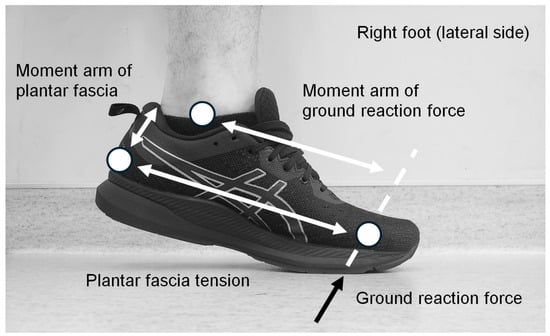
The plantar fascial tension (Figure 2) was estimated based on a formula (Equation (1)) reported in a previous study [22].
Figure 2.
Calculation of plantar fascia tension.
Note that 0.5 indicates the degree of contribution of the plantar fascia.
We measured the distance between the lateral malleolus marker and the line connecting the calcaneus and toe markers (perpendicular line), and referred to this distance as plantar fascia moment arm. Additionally, we computed the 2D vectors for ground reaction force moment arm and ground reaction force. Ground reaction force moment arm represents the 2D vector from the lateral marker to the center of pressure, while ground reaction force refers to the ground reaction force in the sagittal plane. The data for each participant obtained from five successful trials under two conditions were averaged for each of the two conditions, and the data for 14 participants were averaged. Plantar fascial tension during the stance phase of the right leg were analyzed.
2.5. Statistical Processing
Statistical parametric mapping (SPM) was used for statistical analysis. SPM is a statistical method that can prevent type I errors and analyze time-series data. Using SPM with a one-sample t-test, the difference in plantar fascial tension during running with and without insoles was analyzed. The significance level was set at 5%.
3. Results
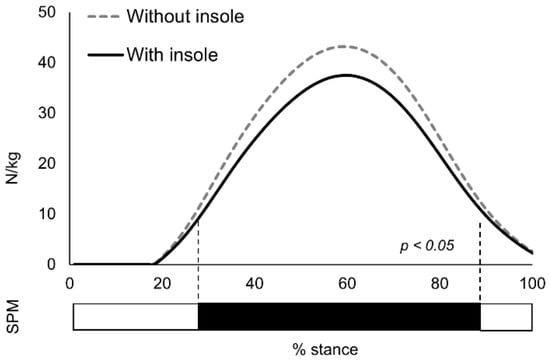
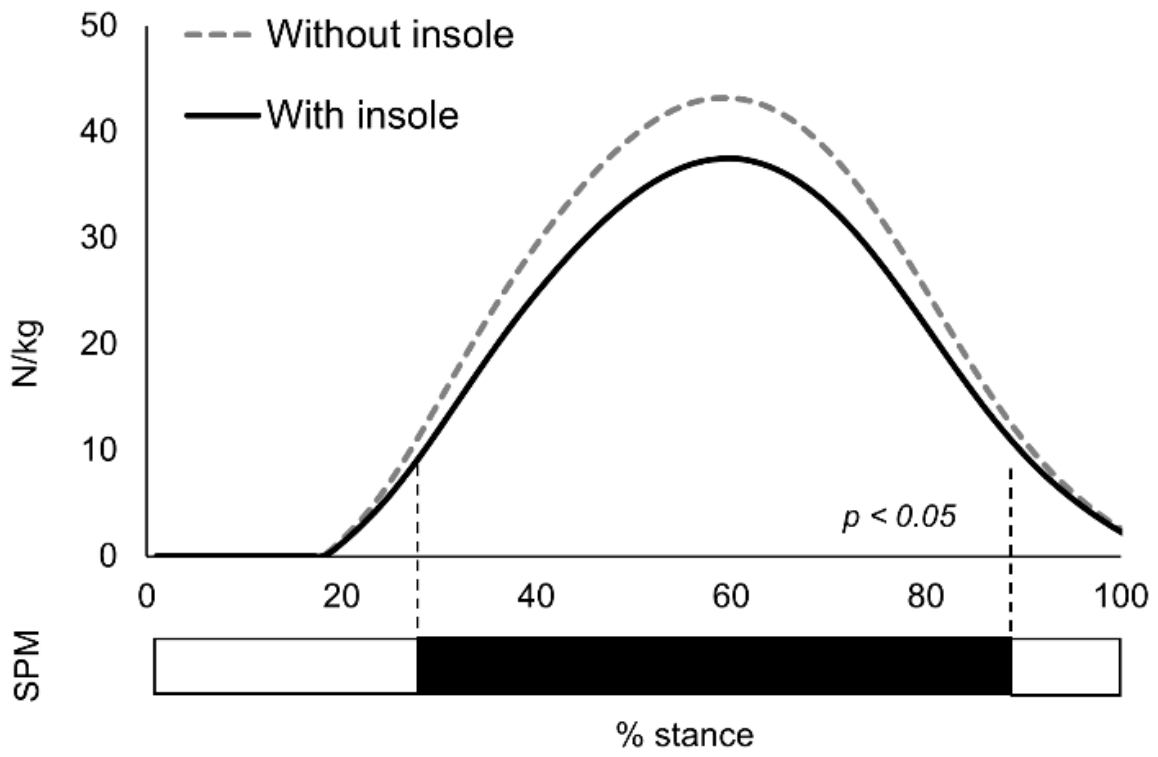
Figure 3 shows the waveform patterns of the plantar fascia tension with and without insoles. With regard to plantar fascial tension, the peak occurred in the midstance (approximately 60%), regardless of whether insoles were used. Compared with individuals without insoles, there was a significant decrease in plantar fascia tension from the early stance (approximately 25%) to the late stance (approximately 90%) in insole condition.
Figure 3.
Plantar fascia tension during running with and without insoles. Black regions indicate statistical significance from statistical parametric mapping (SPM).
4. Discussion
This study examined the effects of insoles on plantar fascial tension during running in individuals with flat feet. The hypothesis for this study was that plantar fascial tension would be reduced when insoles are used compared with when they are not used. This study showed that the use of insoles reduced the peak plantar fascial tension and significantly reduced plantar fascial tension from the early stance (approximately 25%) to the late stance (approximately 90%). The results of this study support this hypothesis.
In this study, plantar fascial tension was significantly reduced when insoles were used compared with when they were not used. A previous study has reported that insoles that support the medial longitudinal arch limit eversion of the hindfoot [16]. Decreasing of the medial longitudinal arch is accompanied by hindfoot eversion and stretches the plantar fascia. Of the structures that support the medial longitudinal arch, the plantar fascia makes the greatest contribution to arch stability, and it provides 79.5% of the resistance to the arch drop [9]. It is known that the arch collapses when body weight is applied, and a previous study found that tension in the plantar fascia increases during the stance phase of running [23]. Thus, it is thought that the support of the medial longitudinal arch provided by the insole prevents the arch from descending while running, thereby contributing to a reduction in plantar fascia tension. A recent systematic review has reported that using insoles while running has beneficial effects such as correcting abnormal foot plantarflexion moment, but the effect of insoles on plantar fascia tension during running was not reported in the review. The results of this study provide new insight into previous insole research. However, movement of the medial longitudinal arch could not be observed because participants were wearing shoes when running. The exact reason for this result in this study will require further analysis, including movement of arch.
Sorbothane has the advantage of shock absorption, and several previous studies have reported that it can reduce load. For example, sorbothane insoles reduced ground reaction force [14] and Achilles tendon tension [24] during running. On the other hand, alignment-adjusting insoles, such as arch supports and heel supports, which do not contain sorbothane, can also alter joint kinematics and kinetics, as shown in a systematic review [25]. In this way, both sorbothane insoles and arch-adjusting insoles can influence running biomechanics. This study used insoles that included both sorbothane material and arch support. Therefore, it should be noted that it was not possible to examine the effects of either component independently, as the insoles used in this study provided both arch support and sorbothane.
A previous study [8] showed that abnormal foot posture such as flatfoot is related to a history of plantar fasciitis; therefore, participants with flatfoot, which is considered a risk factor for plantar fasciitis, were enrolled and the experiments were conducted using commercially available insoles (sorbothane) that are easy to obtain. Most previous studies examining plantar fasciitis have used custom insoles for patients with plantar fasciitis. The insoles used in these studies were made of EVA resin, which is the most commonly used material in clinical practice, such as in a previous study [26]. Studies using EVA resin insoles reported reduced pain in patients with plantar fasciitis [27,28]. The insoles used in this study are thought to have similar effectiveness to insoles made of EVA resin material. This suggests that commercially available insoles can reduce pain caused by plantar fasciitis without the need for customization. The fact that they are low-cost and time-saving makes them useful for athletes with flat feet and therapists. However, according to a meta-analysis [29], the development of plantar fasciitis involves not only plantar fascia tension but also other factors, such as plantarflexion range of motion, body mass index, and body mass. These factors ultimately contribute to stress on the plantar fascia. Therefore, it is important to note that the evaluation of these factors is also crucial in clinical settings.
This study has some limitations. First, the experiments were conducted using only one type of insole and the durometer of this insole is unknown. The results of this study may differ when using insoles made of materials with higher cushioning than those used in this study. Therefore, future studies will need to be conducted with insoles made of various materials. Second, only healthy male participants without plantar fasciitis were included in the study. Lastly, the task involved a rearfoot strike pattern, and the running speed was also standardized. Differences in foot strike patterns can alter the biomechanics of the lower limb during running, as shown in a systematic review [30]. As a result, plantar fascia tension may change with or without insoles for other foot strike patterns. Therefore, the results of this study may not be applicable to other foot strike patterns or running speeds. These limitations should be addressed in future studies involving female participants and patients with plantar fasciitis, considering different running speeds and foot strike patterns.
5. Conclusions
The results of this study confirmed that using insoles in people with flatfoot reduces plantar fascial tension. This study provided evidence that insoles can reduce plantar pain while running. This result may be useful for reducing pain in individuals with flatfoot and preventing the onset of plantar fasciitis.
Author Contributions
Conceptualization, M.M. and T.T.; methodology, M.M. and T.T.; software, T.T.; validation, T.T.; formal analysis, M.M. and H.N.; investigation, M.M. and H.N.; resources, T.T.; data curation, M.M.; writing—original draft preparation, M.M. and T.T.; writing—review and editing, T.T.; visualization, T.T.; supervision, T.K. and M.K.; project administration, M.K.; funding acquisition, M.K. All authors have read and agreed to the published version of the manuscript.
Funding
Part of this work was supported by the Japan Society for the Promotion of Science under Grant [No. 21K11300].
Institutional Review Board Statement
The present study was reviewed and approved by the ethical committee of the Niigata University of Health and Welfare (protocol code No. 185831-210218 and date of approval 18 February 2021).
Informed Consent Statement
All participants provided informed consent prior to participation.
Data Availability Statement
The raw data supporting the conclusions of this article will be made available by the authors on request.
Acknowledgments
We thank the members of our institution for their assistance, and English language editing.
Conflicts of Interest
The authors declare no conflicts of interest.
References
- van Gent, R.N.; Siem, D.; van Middelkoop, M.; van Os, A.G.; Bierma-Zeinstra, S.M.; Koes, B.W. Incidence and determinants of lower extremity running injuries in long distance runners: A systematic review. Br. J. Sports Med. 2007, 41, 469–480; discussion 480. [Google Scholar] [CrossRef] [Scilit] [PubMed]
- Lopes, A.D.; Hespanhol Junior, L.C.; Yeung, S.S.; Costa, L.O. What are the main running-related musculoskeletal injuries? A Systematic Review. Sports Med. 2012, 42, 891–905. [Google Scholar] [CrossRef] [PubMed]
- Wearing, S.C.; Smeathers, J.E.; Urry, S.R.; Hennig, E.M.; Hills, A.P. The pathomechanics of plantar fasciitis. Sports Med. 2006, 36, 585–611. [Google Scholar] [CrossRef] [Scilit] [PubMed]
- Pita-Fernandez, S.; Gonzalez-Martin, C.; Alonso-Tajes, F.; Seoane-Pillado, T.; Pertega-Diaz, S.; Perez-Garcia, S.; Balboa-Barreiro, V. Flat Foot in a Random Population and its Impact on Quality of Life and Functionality. J. Clin. Diagn. Res. JCDR 2017, 11, Lc22–Lc27. [Google Scholar] [CrossRef] [Scilit] [PubMed]
- Aenumulapalli, A.; Kulkarni, M.M.; Gandotra, A.R. Prevalence of Flexible Flat Foot in Adults: A Cross-sectional Study. J. Clin. Diagn. Res. JCDR 2017, 11, Ac17–Ac20. [Google Scholar] [CrossRef] [Scilit] [PubMed]
- Azhagiri, R.; Malar, A.; Hemapriya, J.; Sumathi, G. The cause and frequency of PES Planus (Flat Foot) problems among young adults. Asian J. Med. Sci. 2021, 12, 107–111. [Google Scholar] [CrossRef] [Scilit]
- Dare, N.; Onyije, F.; Osoma, S. Pes planus (flatfoot) in male and female adults of Bayelsa-Nigeria. Electron. J. Biomed. 2012, 3, 17–21. [Google Scholar]
- Pohl, M.B.; Hamill, J.; Davis, I.S. Biomechanical and anatomic factors associated with a history of plantar fasciitis in female runners. Clin. J. Sport Med. Off. J. Can. Acad. Sport Med. 2009, 19, 372–376. [Google Scholar] [CrossRef] [Scilit] [PubMed]
- Iaquinto, J.M.; Wayne, J.S. Computational model of the lower leg and foot/ankle complex: Application to arch stability. J. Biomech. Eng. 2010, 132, 021009. [Google Scholar] [CrossRef] [Scilit] [PubMed]
- Takabayashi, T.; Edama, M.; Inai, T.; Kubo, M. Differences in rearfoot, midfoot, and forefoot kinematics of normal foot and flatfoot during running. J. Orthop. Res. Off. Publ. Orthop. Res. Soc. 2020, 389, 565–571. [Google Scholar] [CrossRef] [Scilit] [PubMed]
- Huang, Y.C.; Wang, L.Y.; Wang, H.C.; Chang, K.L.; Leong, C.P. The relationship between the flexible flatfoot and plantar fasciitis: Ultrasonographic evaluation. Chang Gung Med. J. 2004, 27, 443–448. [Google Scholar] [CrossRef] [Scilit]
- Wapner, K.L.; Chao, W. Nonoperative Treatment of Posterior Tibial Tendon Dysfunction. Clin. Orthop. Relat. Res.® 1999, 365, 39–45. [Google Scholar] [CrossRef] [Scilit] [PubMed]
- Daryabor, A.; Kobayashi, T.; Saeedi, H.; Lyons, S.M.; Maeda, N.; Naimi, S.S. Effect of 3D printed insoles for people with flatfeet: A systematic review. Assist. Technol. Off. J. RESNA 2023, 35, 169–179. [Google Scholar]
- O’Leary, K.; Vorpahl, K.A.; Heiderscheit, B. Effect of cushioned insoles on impact forces during running. J. Am. Podiatr. Med. Assoc. 2008, 98, 36–41. [Google Scholar] [CrossRef] [Scilit] [PubMed]
- Lee, K.K.W.; Ling, S.K.K.; Yung, P.S.H. Controlled trial to compare the Achilles tendon load during running in flatfeet participants using a customized arch support orthoses vs an orthotic heel lift. BMC Musculoskelet. Disord. 2019, 20, 535. [Google Scholar] [CrossRef] [Scilit] [PubMed]
- Ataabadi, P.A.; Abbassi, A.; Letafatkar, A.; Vanwanseele, B. The effects of foot orthosis and low-dye tape on lower limb joint angles and moments during running in individuals with pes planus. Gait Posture 2022, 96, 154–159. [Google Scholar] [CrossRef] [Scilit] [PubMed]
- Takabayashi, T.; Edama, M.; Inai, T.; Nakamura, E.; Kubo, M. Effect of Gender and Load Conditions on Foot Arch Height Index and Flexibility in Japanese Youths. J. Foot Ankle Surg. Off. Publ. Am. Coll. Foot Ankle Surg. 2020, 59, 1144–1147. [Google Scholar] [CrossRef] [Scilit] [PubMed]
- Sakaguchi, M.; Ogawa, H.; Shimizu, N.; Kanehisa, H.; Yanai, T.; Kawakami, Y. Gender differences in hip and ankle joint kinematics on knee abduction during running. Eur. J. Sport Sci. 2014, 14, S302–S309. [Google Scholar] [PubMed]
- Takabayashi, T.; Edama, M.; Nakamura, M.; Nakamura, E.; Inai, T.; Kubo, M. Gender differences associated with rearfoot, midfoot, and forefoot kinematics during running. Eur. J. Sport Sci. 2017, 17, 1289–1296. [Google Scholar] [CrossRef] [Scilit] [PubMed]
- Bazuelo-Ruiz, B.; Durá-Gil, J.V.; Palomares, N.; Medina, E.; Llana-Belloch, S. Effect of fatigue and gender on kinematics and ground reaction forces variables in recreational runners. PeerJ 2018, 6, e4489. [Google Scholar] [CrossRef] [Scilit] [PubMed]
- Ogaya, S.; Suzuki, M.; Yoshioka, C.; Nakamura, Y.; Kita, S.; Watanabe, K. The effects of trunk endurance training on running kinematics and its variability in novice female runners. Sports Biomech. Int. Soc. Biomech. Sports 2024, 23, 997–1008. [Google Scholar]
- Scott, S.H.; Winter, D.A. Internal forces of chronic running injury sites. Med. Sci. Sports Exerc. 1990, 22, 357–369. [Google Scholar] [CrossRef] [Scilit]
- Chen, T.L.; Wong, D.W.; Wang, Y.; Lin, J.; Zhang, M. Foot arch deformation and plantar fascia loading during running with rearfoot strike and forefoot strike: A dynamic finite element analysis. J. Biomech. 2019, 83, 260–272. [Google Scholar] [CrossRef] [Scilit] [PubMed]
- Sinclair, J.; Isherwood, J.; Taylor, P.J. Effects of foot orthoses on Achilles tendon load in recreational runners. Clin. Biomech. 2014, 29, 956–958. [Google Scholar] [CrossRef] [Scilit] [PubMed]
- Chen, H.; Sun, D.; Fang, Y.; Gao, S.; Zhang, Q.; Bíró, I.; Gu, Y. Effect of orthopedic insoles on lower limb motion kinematics and kinetics in adults with flat foot: A systematic review. Front. Bioeng. Biotechnol. 2024, 12, 1435554. [Google Scholar] [CrossRef] [Scilit] [PubMed]
- Ribeiro, A.P.; João, S.M.A. The Effect of Short and Long-Term Therapeutic Treatment with Insoles and Shoes on Pain, Function, and Plantar Load Parameters of Women with Plantar Fasciitis: A Randomized Controlled Trial. Medicina 2022, 58, 1546. [Google Scholar] [CrossRef] [Scilit] [PubMed]
- Ribeiro, A.P.; de Souza, B.L.; João, S.M.A. Effectiveness of mechanical treatment with customized insole and minimalist flexible footwear for women with calcaneal spur: Randomized controlled trial. BMC Musculoskelet. Disord. 2022, 23, 773. [Google Scholar] [CrossRef] [Scilit] [PubMed]
- Costa, A.R.A.; de Almeida Silva, H.J.; Mendes, A.; Scattone Silva, R.; de Almeida Lins, C.A.; de Souza, M.C. Effects of insoles adapted in flip-flop sandals in people with plantar fasciopathy: A randomized, double-blind clinical, controlled study. Clin. Rehabil. 2020, 34, 334–344. [Google Scholar] [PubMed]
- Hamstra-Wright, K.L.; Huxel Bliven, K.C.; Bay, R.C.; Aydemir, B. Risk Factors for Plantar Fasciitis in Physically Active Individuals: A Systematic Review and Meta-analysis. Sports Health 2021, 13, 296–303. [Google Scholar] [CrossRef] [Scilit] [PubMed]
- Xu, Y.; Yuan, P.; Wang, R.; Wang, D.; Liu, J.; Zhou, H. Effects of Foot Strike Techniques on Running Biomechanics: A Systematic Review and Meta-analysis. Sports Health 2021, 13, 71–77. [Google Scholar] [PubMed]
Disclaimer/Publisher’s Note: The statements, opinions and data contained in all publications are solely those of the individual author(s) and contributor(s) and not of MDPI and/or the editor(s). MDPI and/or the editor(s) disclaim responsibility for any injury to people or property resulting from any ideas, methods, instructions or products referred to in the content. |
© 2026 by the authors. Published by MDPI on behalf of the American Podiatric Medical Association (APMA). Licensee MDPI, Basel, Switzerland. This article is an open access article distributed under the terms and conditions of the Creative Commons Attribution (CC BY) license.