


Simple Summary
Mutations in the Kirsten rat sarcoma viral oncogene homologue (KRAS) play an important role in colorectal cancer and are linked to higher morbidity and mortality rates while also being historically difficult to treat. This review summarises the pathophysiology which leads the mutation to tumour formation, its impact on disease prognosis, and an up-to-date overview of the drug classes which target the mutation, ranging from the approved use of specific variants to the broader drugs still in preclinical development stages.
Abstract
Purpose: This review aims to provide an updated overview of Kirsten rat sarcoma viral oncogene homologue (KRAS) mutations in colorectal carcinoma (CRC), focusing on their role in tumorigenesis, prognostic implications, and recent advances in targeted therapy. Major findings: KRAS mutations occur in approximately 40% of colorectal cancers and play a central role in tumour initiation and progression through constitutive activation of MAPK pathways. Clinically, KRAS mutations are well established as predictors of resistance to anti-EGFR therapy. Increasing evidence also supports their role as prognostic biomarkers, with KRAS-mutant tumours associated with increased recurrence risk and reduced survival, including in patients undergoing hepatic metastasectomy. Therapeutically, recent advances, most notably KRAS G12C inhibitors and combination strategies targeting upstream or parallel pathways, have expanded treatment options, although efficacy varies across KRAS mutation subtypes. Conclusions: KRAS mutations have important implications for the behaviour, prognosis, and management of colorectal cancer. Integrating KRAS mutational status into clinical decision-making may enable more personalised prognostication and treatment strategies. Continued research is required to broaden effective targeted therapies for the diverse spectrum of KRAS-mutant disease.
1. Introduction
Colorectal carcinoma (CRC) represents a major global health challenge with it being the third-most diagnosed cancer and the second leading cause of cancer-related mortality worldwide [1]. Over 1.9 million new CRC cases and approximately 935,000 deaths were reported in 2020 alone [2]. CRC rates vary by region, with higher incidence rates observed in high-human-developmental-index (HDI) regions, likely influenced by lifestyle factors such as diet and obesity. However, incidence rates are rapidly increasing in low-HDI regions, reflecting ongoing changes in dietary habits and urbanisation [3]. The incidence of early-onset colorectal cancer (eoCRC, defined as age at diagnosis < 50) has been rising in the past several decades in 27 of 50 countries while rates of CRC in older adults (age >= 50) are stabilising or declining in some countries including the United States [4].
While environmental and lifestyle factors, including high consumption of red and processed meats, low fibre intake, smoking, obesity, sedentary lifestyle, and alcohol use, contribute significantly to CRC risk [5], these external factors alone do not fully explain individual susceptibility to the disease. The interaction between exposome and inherited genetic predispositions play a critical role in determining CRC risk [3].
Early research on CRC focused on tumour morphology and clinical staging; however, subsequent molecular studies have found that a series of defined genetic events drive the development of the disease [6,7]. Over time, our understanding of these genetic alterations has expanded—from the identification of inherited conditions like familial adenomatous polyposis (FAP) and Lynch syndrome (hereditary non-polyposis colorectal cancer, HNPCC), to the characterisation of somatic mutations in key oncogenes and tumour suppressors. Among these, at least three genetic mutations are typically required for CRC to develop, with frequent involvement of APC, TP53, and KRAS [8,9]. A concise overview of the most common hereditary syndromes and somatic mutations in CRC with clinical implications are summarised in Table 1, providing context for the central focus of this Kirsten rat sarcoma viral oncogene homologue (KRAS) review.
Table 1.
Selected genetic alterations in colorectal cancer. Data adapted [10,11,12].
Among these alterations, KRAS mutations are particularly prevalent and have been widely studied due to their involvement in colorectal, lung, and pancreatic cancers. Their significance lies not only in its frequency, but also in its functional impact on tumour behaviour, including its aggressiveness and response to targeted therapies [13]. Its role in CRC development, from early adenoma formation to malignant transformation, alongside its impact on therapeutic resistance, remains a priority in cancer research. These insights pave the way toward improved prognostic tools and novel targeted therapies that could ultimately enhance patient outcomes.
2. Methods
Two databases were used for all searches performed: PubMed Central and OVID Embase. A filter for articles published between January 2010 and June 2026 was applied for the search terms “colorectal cancer” AND “KRAS” AND “targeted therapy.” However, important seminal articles or groundbreaking work before the search time frame were included. Approximately 100 relevant articles were identified during the initial search. They were then screened by title, abstract, and full text to ensure they met the following criteria: human research on CRC involving KRAS mutations, published in English with full text availability, and presenting original data (clinical trials, cohort studies, and translational research) or systematic reviews. Non-human studies, editorials, and conference abstracts were excluded.
The selected literature was assessed and narratively reviewed. Quality and risk of bias were considered qualitatively, with priority given to high-impact clinical trials and recent research.
3. KRAS in CRC
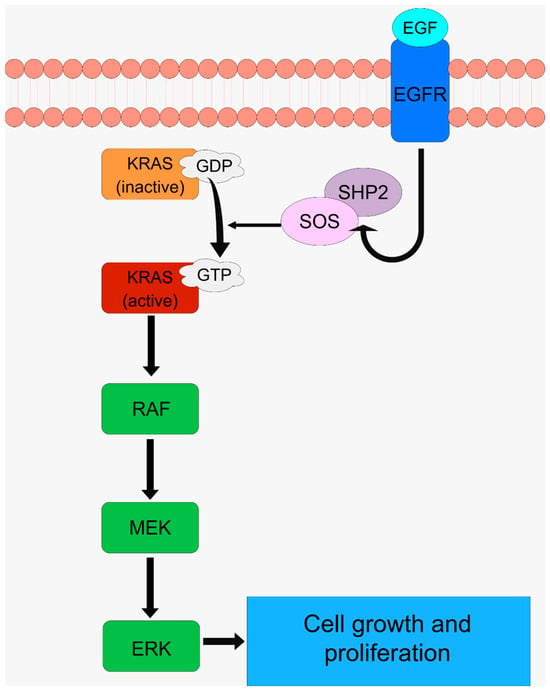
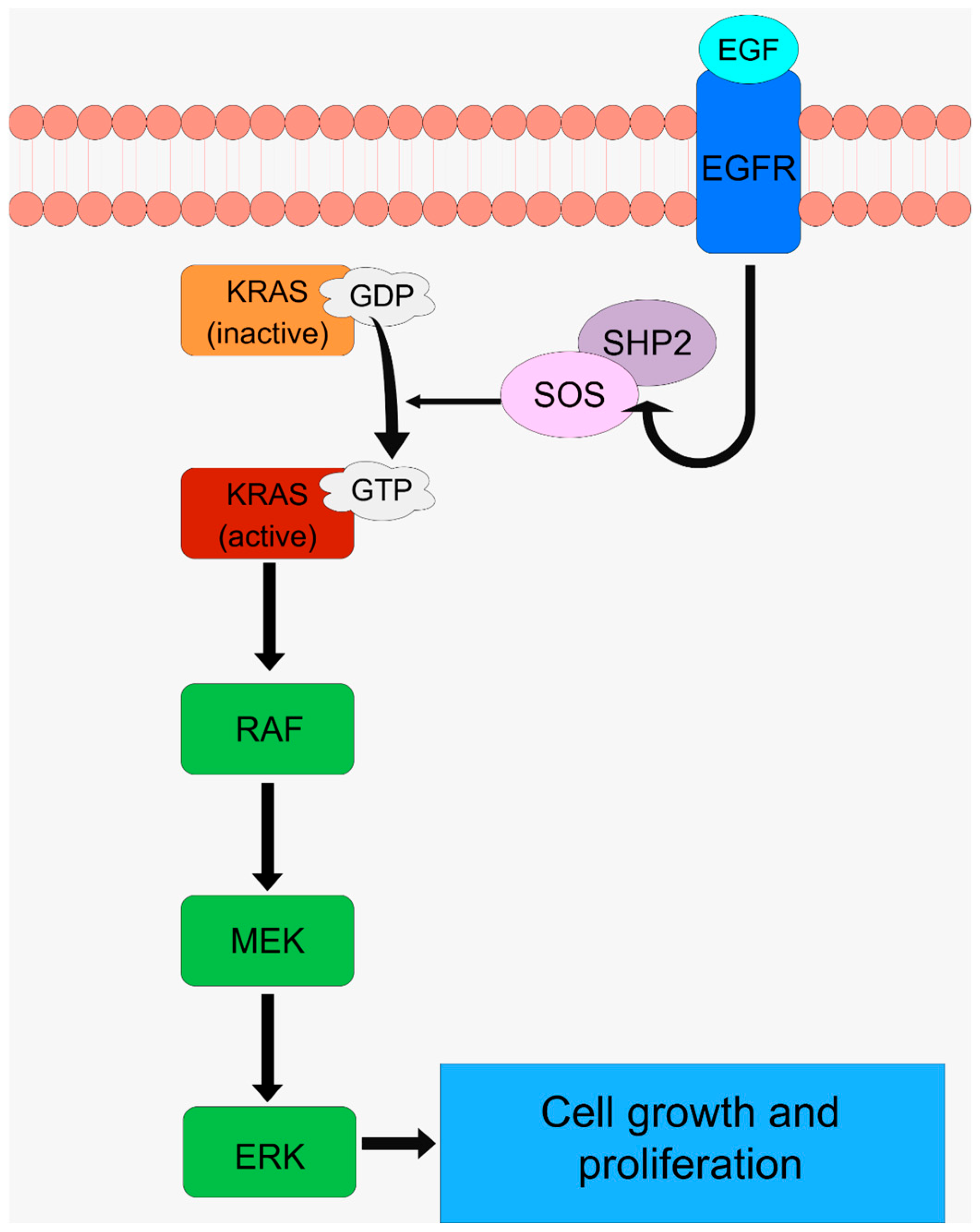
The KRAS gene belongs to the rat sarcoma (RAS) family of proto-oncogenes. These genes encode for RAS proteins which can alternate between active and nonactive states when bound to guanosine triphosphate (GTP) and guanosine diphosphate (GDP) molecules, respectively. The protein exists in a balance between its GTP-bound and GDP-bound states, which allows it to turn on and off the intracellular signalling of growth factor receptors, such as the epidermal growth factor receptor (EGFR) and other tyrosine kinase receptors [14]. When active, RAS proteins can trigger a number of transduction cascades, particularly the mitogen-activated protein kinase pathway (MAPK) [15,16]. Figure 1 illustrates how EGFR activation, via SOS and SHP2, leads to KRAS activation and RAF-MEK-ERK signalling, therefore promoting cell life proliferation and survival.
Figure 1.
Diagram of the KRAS-RAF-MAPK signalling pathway. Ligand binding to EGFR activates adaptor proteins (SHP2, SOS) that stimulate KRAS to initiate MAPK pathway. This figure was created using draw.io (diagrams.net).
Mutations in KRAS impair the protein’s intrinsic GTPase activity, causing inefficient hydrolysis of GTP. This defect keeps KRAS in an active, GTP-bound state, which in turn drives persistent stimulation of downstream pathways that promote cellular survival [17].
KRAS mutations represent the predominant mutation among RAS-family alterations, accounting for roughly 86% of RAS-driven cancers [18]. In CRC, they are present in about 40% of cases, making it one of the most common genetic alterations in the disease and are more frequent among right- than left-sided colon cancers [19]. The mutations typically occur at codons 12 and 13, where specific variants have distinct biological behaviours with potential prognostic and therapeutic implications [13,20].
CRC harbouring oncogenic KRAS mutations (KRAS-mutant CRC) are generally associated with a poorer prognosis than KRAS wild-type CRC, which lacks oncogenic mutations. Mutations at codon 12, such as G12V and G12D, have worse survival outcomes and higher recurrence rates. Among all subtypes, G12C appears to confer the most unfavourable prognosis [21,22]. Co-mutational burden is also important, as combined alterations in other pathways, such as with TP53, can portend even more aggressive disease patterns [23].
Given its prevalence and prognostic impact, KRAS plays a pivotal role in the development of CRC, acting as an important driver in both the traditional adenoma–carcinoma sequence and, to a lesser extent, the serrated neoplasia pathway. Understanding how KRAS contributes to these distinct routes of tumorigenesis offers a valuable insight into its functional impact on CRC progression.
4. CRC Pathways
4.1. Adenoma–Carcinoma Sequence
The first hypothesis regarding the tumorigenesis of colorectal tumours was the Fearon–Vogelstein model. This model described tumour formation through a series of genetic mutations which ultimately activate oncogenes and inactivate tumour suppressor genes [24]. The most notable pathway following this model involves the loss of the tumour suppressor genes APC and TP53, as well as the addition of the KRAS oncogene [25]. The series begins with a mutation in the APC gene in the Wnt signalling pathway that helps regulate intestinal cell proliferation and homeostasis. In normal circumstances, APC forms part of a protein complex associated with the degradation of the main mediator of the pathway (β-catenin); this process helps keep Wnt signalling under control. However, mutations in APC disrupt the pathway regulation, resulting in β-catenin accumulation and therefore hyperactivation of Wnt signalling. This leads to uncontrolled cell proliferation and adenomatous polyp formation [26,27,28].
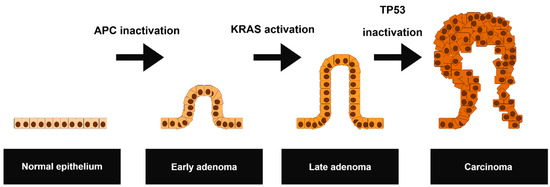
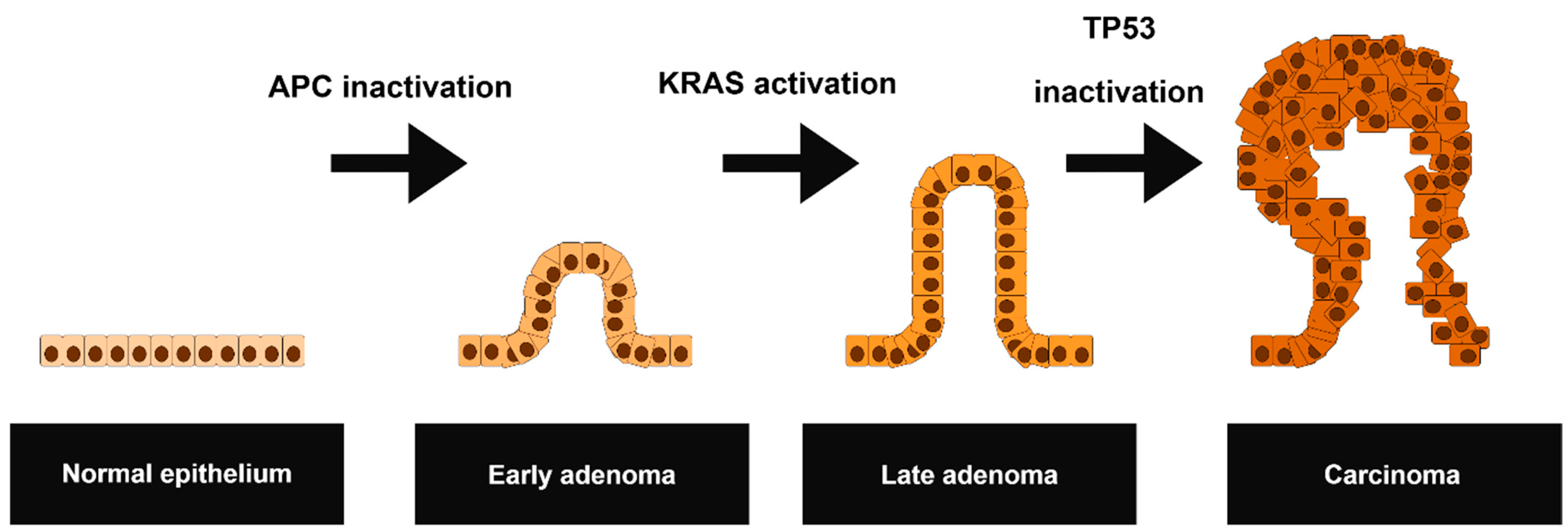
In the classic adenoma–carcinoma sequence of CRC, APC inactivation typically occurs first, followed by KRAS activation, with TP53 inactivation almost always occurring as the final event (Figure 2) [25]. While KRAS mutations do not directly cause malignancy, they facilitate progression of early-stage adenomas to a later stage by sustaining proliferative signalling and preventing apoptosis (see KRAS in CRC). These mutations impair the KRAS GTPase activity, leading to persistent activation of downstream pathways and tumour growth [15,16].
Figure 2.
Location of the KRAS mutation in the adenoma–carcinoma pathway. This figure was created using draw.io (diagrams.net).
TP53 mutations are generally considered a late event in the sequence, frequently arising in high-grade adenomas and associated with the transition to invasive carcinoma [25,29]. Most cancers, and up to 60% of CRC patients, exhibit TP53 mutations, which correlate with a poorer prognosis [30,31]. The p53 transcription factor, encoded by TP53, is important to the cell cycle as it prevents tumorigenesis through the induction of DNA repair or apoptosis in response to damaged or irreparable cells [32]. In CRC, most of the mutations are missense, leading to a dysfunctional p53 protein that not only loses its tumour-suppressive mechanisms, but can also exert gain-of-function effects, enhancing genomic instability which further accelerates accumulation of genetic alterations that promote metastasis [30,33,34].
4.2. Serrated Pathway
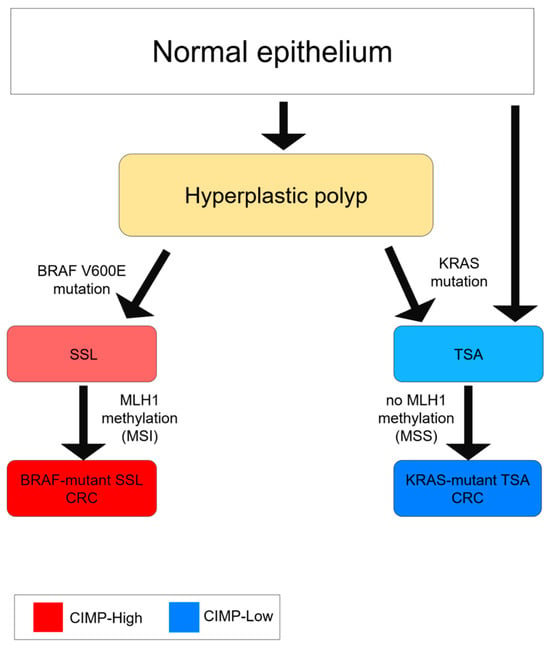
While the adenoma–carcinoma series accounts for most CRC cases, up to 30% develop via an alternative serrated pathway. This pathway begins with serrated polyps, named for their characteristic saw-tooth appearance [35]. These polyps can develop into two main malignant precursors: sessile serrated lesions (SSLs) and traditional serrated adenomas (TSAs). SSLs, the more common lesion in this pathway, are strongly linked to the BRAF V600E mutation, whereas TSAs are typically associated with KRAS mutations. BRAF mutations can occur in TSAs but are less common [36,37]. Both lesions can arise from hyperplastic polyps, but TSAs may also develop de novo in certain cases [38]. The mutational background tends to influence progression; hyperplastic polyps with BRAF mutations generally evolve into SSLs, whereas those with KRAS mutations are more likely to give rise to TSAs (Figure 3). Within SSLs, mutations in KRAS/BRAF are more frequently in the right side of the colon and commonly present with microsatellite instability [19].
Figure 3.
Flow chart showing the sessile and traditional serrated pathway. This figure was created using draw.io (diagrams.net).
SSLs may advance to carcinoma when the MLH1 gene becomes heavily methylated, which often leads to DNA changes called microsatellite instability (MSI). However, some SSL cancers remain microsatellite stable (MSS), meaning they do not show these changes. In contrast, cancers that arise from TSAs are usually MSS [39,40].
Regardless of microsatellite status, both tumour types typically display a CpG island methylator phenotype (CIMP), in which hypermethylation silences tumour suppressor genes [41,42]. CIMP can be classified as high or low, depending on the extent of methylation. SSL cancers are usually high, whereas TSA cancers are low [40]. Rarely, MSI CRCs may also carry KRAS mutations [43].
These alternative tumorigenic routes underscore the genetic heterogeneity of CRC and highlight the recurring role of KRAS across distinct molecular contexts. Given its frequent occurrence and functional significance, KRAS stands out as a pivotal driver in CRC pathogenesis.
5. Clinical Implications
5.1. Response to Anti-EGFR Therapy
RAS mutations influence both prognosis and treatment selection and therefore should be considered when evaluating treatment options. One of its most important implications is that it predicts a poorer response to anti-EGFR therapies. Anti-EGFR monotherapy has little place in the treatment of KRAS mutations as the proteins are able to completely bypass EGFR inhibition by activating MAPK pathways, and thereby promoting tumour survival despite anti-EGFR therapy. For this reason, RAS-mutant metastatic CRC patients tend to be treated with cytotoxic chemotherapy and anti-VEGF agents. This is different to the treatment of RAS wild-type metastatic CRC as the treatment choice is often determined by which side the tumour is present. Malignancies on the left side in RAS wild-type CRC are more likely to receive cetuximab or panitumumab alongside chemotherapy agents FOLFOX or FOLFIRI. Right-sided tumours more commonly have co-occurring BRAF V600E mutations and are treated using chemotherapy and anti-VEGF therapy. It is important to note that MMR/MSI status heavily impact management options for KRAS mutations. For example, immunotherapy is the first-line therapy option for MSI-H/dMMR metastatic CRC, regardless of RAS mutation status [44].
Testing for specific KRAS mutations is now standard practice to stratify patients for anti-EGFR therapy eligibility, specifically KRAS and NRAS exons 2, 3, and 4, examining codons 12, 13, 59, 61, 117 and 146 as mutations in these exons predict lack of benefit from conventional anti-EGFR monoclonal antibodies [45]. In practice, broad next-generation sequencing is preferred to simultaneously identify other actionable or trial-relevant mutations and MMR/MSI status. As KRAS mutations typically emerge early in carcinogenesis, its status is highly concordant between the primary tumour and metastatic sites, allowing for either site to be used in testing [45].
Approximately 40–50% develop acquired resistance within 4–8 months of treatment initiation [46,47]. This resistance tends to arise from mutations in the extracellular portion of EGFR or by the constitutive activation of pathways driving proliferation independent of EGFR. Moreover, secondary KRAS mutations can emerge during treatment as well as mutations in BRAF, MET or HER2 amplification and PI3K pathway activation [46,47]. Tumours with acquired RAS mutations have been found to behave more aggressively than those with EGFR-mediated resistance and are frequently associated with shorter PFS and more limited tumour shrinkage [48,49,50]. Recent work has also identified non-genomic resistance to EGFR therapy, via transformation to Paneth-like cells via increased SMAD1-FGFR3 signalling [51]. These findings support molecular reassessment at progression.
5.2. Liquid Biopsy
The emergence of resistance underscores the importance of early detection of evolving mutations, which can guide treatment changes. Liquid biopsy has emerged as a promising approach for this purpose, providing a non-invasive method for analysing tumour-derived material from blood or other bodily fluids [52]. One of the key components of liquid biopsy is the analysis of circulating tumour DNA (ctDNA), which consists of fragmented tumour-derived DNA that are released into the circulation through tumour cell apoptosis and necrosis [53]. While tissue biopsy remains the gold standard for molecular diagnosis, liquid biopsy serves as a valuable complementary tool for identifying RAS and BRAF mutations and for longitudinal monitoring during therapy. Its clinical use has been demonstrated not only in CRC but also other malignancies, including breast and non-small-cell lung cancer (NSCLC) [52]. In particular, anti-EGFR rechallenge has emerged as a strategy for select patients by selecting for patients found to have a decline in KRAS mutant resistant clones. In the CHRONOS trial, ctDNA was utilised to select patients with metastatic CRC for panitumumab rechallenge based on absence of resistance mutations in RAS, BRAF and EGFR. Disease control rate was 63% in the selected cohort. A 2026 meta-analysis by Kuznetsova et al. of three phase II trials with metastatic CRC undergoing anti-EGFR rechallenge found that rechallenge improved disease control rate, objective response rate and progression-free survival. However, an overall survival benefit was not observed, suggesting that rechallenge may be most suitable for patients in whom tumour shrinkage or short-term disease control is critical [54].
By allowing assessment of tumour-derived genetic material, liquid biopsy can be used to detect CRC at earlier stages, facilitating prompt intervention. The integration of liquid biopsies into clinical practice is valuable for both early KRAS mutation detection, ongoing monitoring of resistance during anti-EGFR therapy and guiding anti-EGFR rechallenge [55]. However, ctDNA is not without its limitations. Earlier-stage and low volume disease may shed minimal ctDNA, thus impacting sensitivity. This may further be impacted by site of disease, such as reduced sensitivity with peritoneal or lung metastasis [53]. Furthermore, clinical implementation itself may ultimately be limited by turnaround time as well as cost and reimbursement. Additionally, KRAS status can evolve over treatment, with reports of “regression” in which a detectable KRAS-mutant clone disappears [56]. This is thought to be driven by clonal selection rather than genetic reversion and thus should not be used as a marker of disease control or to determine surgical candidacy. KRAS mutational regression has particularly been described in oligometastatic disease and may have implications in supporting longitudinal molecular monitoring and consideration of treatment re-sensitisation.
5.3. Prognostic and Surgical Implications of KRAS Targeting
Beyond their established role in predicting resistance to anti-EGFR therapy, KRAS mutations have emerged as an important prognostic biomarker in CRC. Increasing evidence suggests that KRAS-mutant status provides independent prognostic information, tending to be more aggressive, which translates into higher rates of recurrence and poorer survival outcomes, even in patients undergoing curative surgery [13,57]. This has significant implications for surgical decision-making and postoperative management.
In this context, detection of KRAS-mutant ctDNA has demonstrated substantial prognostic value. Preoperative identification of KRAS-mutant ctDNA has been shown to be independently associated with an increased risk of postoperative recurrence following curative CRC resection, likely reflecting the presence of minimal residual disease not detectable by conventional imaging modalities [45,53,58,59]. As such, preoperative KRAS-mutant ctDNA testing may help identify patients at higher risk of early recurrence who could benefit from more stringent postoperative surveillance or adjuvant therapy.
The prognostic impact of KRAS mutations is also evident in the metastatic setting, particularly among patients undergoing liver resection for CRC liver metastases. Molecular analysis of resected metastases has demonstrated that RAS mutations, including KRAS, are associated with significantly worse overall survival following hepatic surgical resection as well as increased risk for extrahepatic recurrence [60]. Notably, this adverse effect appears to be more pronounced in patients with eoCRC, with particularly poor outcomes observed in patients before the age of 40 [61]. This age-dependent effect supports the idea that KRAS-mutant tumours arising in younger individuals may represent a biologically distinct and more aggressive disease subset. Interestingly, several recent reports have also found that patients with polymetastatic disease are more enriched for KRAS mutations compared with those with oligometastatic disease. This suggests a genomic distinction between these two groups, rather than oligometastatic disease simply representing lower volume disease [62,63].
Collectively, this data suggests that KRAS mutational status has the potential to inform surgical decision-making in CRC. Ultimately, KRAS mutations are a risk modifier rather than an absolute contraindication to curative or repeat surgery. Their presence does not warrant more extensive surgery but could identify patients at increased risk of recurrence despite complete resection. In such cases, KRAS status, especially when combined with preoperative ctDNA analysis, may support the use of neoadjuvant or perioperative systemic therapy, influence the timing of surgery, or justify more intensive postoperative surveillance strategies.
5.4. Challenges in KRAS Targeting
Due to the relevance of KRAS mutations on disease prognosis and treatment selection, researchers have explored the concept of targeting KRAS directly. However, studies have confirmed the protein to have limited numbers of available binding sites due to its small structure and smooth surface. Additionally, KRAS naturally exhibits high affinity for GTP, which exists at great concentrations. KRAS structures can also differ significantly between variants, thus limiting therapeutic efficacy across multiple variants [64]. These factors collectively hinder the development of effective competitive inhibitors [65]. Even with an effective inhibitor, bypassing mutations or feedback activation loops can ultimately restore signalling.
Thus, research efforts have focused on combination therapies to target KRAS indirectly, including agents which can chemically alter its expression, disrupt its membrane localisation, and interfere with its interaction with downstream mediators. Unfortunately, most of these approaches have been unable to achieve complete suppression of KRAS-driven tumour formation [66]. Table 2 summarises the challenges of designing KRAS inhibitors and how those difficulties have been handled.
Table 2.
Challenges and strategies in KRAS targeting.
6. Emerging Therapies
6.1. G12C Inhibitors
The development of a new drug class targeting the specific KRAS G12C mutant variant has marked a turning point in the management of CRC. Despite only making up ~4% of all CRC cases, KRAS G12C has demonstrated to be associated with a higher mortality compared to other variants [67].
KRAS G12C inhibitors work by binding to the switch-II pocket on the G12C mutant and initiating a conformational change that will lock the protein in an inactivated state [68]. Sotorasib and Adagrasib are the most promising agents of this class, with ongoing trials proving their effectiveness against tumours of the G12C variant. Both drugs share commonly reported side effects being diarrhoea, nausea and vomiting, and fatigue [67,69].
One limitation of G12C inhibitor monotherapy is its susceptibility to adaptive resistance due to feedback activation of upstream EGFR signalling. KRAS G12C inhibitors were initially developed in non-small-cell lung cancer where monotherapy was found to be efficacious. However, CRC retains strong EGFR-driven feedback signalling; this compensatory pathway reactivation restores downstream MAPK signalling despite KRAS inhibition, thereby limiting the efficacy of G12C inhibitors when used alone [45]. This has prompted investigation into combination regimens with anti-EGFR agents such as cetuximab and panitumumab, which have shown to be effective in treatment of metastatic CRC [67,70]. To date, sotorasib plus panitumumab as well as adagrasib plus cetuximab are approved options for adults with KRAS G12C-mutated metastatic CRC after prior fluoropyrimidine, oxaliplatin, and irinotecan-based chemotherapy [71].
Certain studies have found that a combination therapy using SHP2 and SOS1 inhibitors may strengthen the antitumour effects of G12C inhibitors and anti-EGFR therapy combination. Both SHP2 and SOS1 inhibitors have complementary mechanisms of action by restricting different mediators in the RAS signalling cascade, which results in inhibition of pathway reactivation and augmentation of G12C activity [72].
6.2. Other KRAS Variants
In addition to G12C, other KRAS mutations such as G12D, G12V, and G13D represent a larger proportion of CRC cases but currently lack approved direct inhibitors. These variants have posed significant challenges due to the absence of the switch-II binding pocket to which covalent G12C inhibitors may bind, making drug design more complex. Nevertheless, emerging efforts are focused on developing new therapeutic strategies to directly target these prevalent mutations. Evidence has shown that the novel agent HRS-4642 functions as an effective KRAS G12D inhibitor in the treatment of NSCLC [73]. However, being relatively new with limited clinical data in CRC, HRS-4642 is not currently approved for the treatment of G12D-mutant CRC. More recently, additional KRAS G12D-targeted therapies have emerged in pancreatic ductal adenocarcinoma (PDAC). INCB161734 and ASP3082 have been evaluated in PDAC, demonstrating antitumour efficacy as monotherapy and in combination with other chemotherapy regimens such as modified FOLFIRINOX. While these agents are presently being investigated in PDAC, their activity against KRAS G12D highlights their potential relevance for future therapeutic use in G12D-mutant CRC [74,75].
KRAS G12V-selective inhibitors are currently in development, with preclinical trials exploring the tumour regressing effects of EFTX-G12V [76]. EFTX-G12V is an EGFR-directed G12V inhibitor which works by restricting the protein expression via direct suppression of KRAS G12V mRNA [77]. There are other agents with potential to target this variant still in early stages of development. Of these are tri-complex inhibitors, RM-048 and VRTX-171, which are currently being studied to establish their efficacy against the G12V variant [78,79].
Despite the general consensus that RAS-mutant tumours are not significantly impacted by anti-EGFR drugs, rising evidence suggests that the KRAS G13D mutation may retain some amount of sensitivity to these agents. Although the underlying physiology is not entirely understood, some researchers have suggested that the inadequate binding of KRAS G13D to the tumour suppressor NF1 resultantly impairs its function of inhibiting wild-type RAS isoforms. Under this circumstance, an EGFR blockade would therefore decrease the concentration of GTP-bound RAS molecules and stop the signalling cascade [80]. Further research has been undertaken in this field to explore methods that may enhance this sensitivity. One particular approach is by using honokiol, a natural biphenolic compound, which can refine the effectiveness of cetuximab by preventing autophagy and RAS activation [81]. Novel compound YK1 is another method that acts as a small molecule inhibitor to target the HER2-ELF3-KRAS transcriptional axis which otherwise exists in high concentrations in KRAS G13D malignancies. By interfering with this series, HER2 and KRAS become heavily downregulated, and therefore lead to an increase in cetuximab sensitivity [82]. Although compounds increasing anti-EGFR therapy sensitivity require further clinical trials, these findings suggest promising approaches for targeting KRAS G13D variants. Table 3 summarises the main KRAS mutations and their implications in treatment options.
Table 3.
Summary of current treatment status of KRAS mutation subtypes.
6.3. RAS(ON) Inhibitors
As the use of KRAS inhibitors has found its way into clinical practice, RAS has been identified as a practical target in CRC. RAS(ON) inhibitors have emerged as a broader drug class that can directly inhibit active GTP-bound RAS proteins [83]. KRAS G12C inhibitors can only target the GDP-bound states of one specific variant, meanwhile RAS(ON) inhibitors act more generally to hinder active signalling across multiple RAS isoforms, including KRAS, NRAS, and HRAS. These inhibitors have a wider scope of mutational targets, and can even extend to specific variants [84]. Daraxonrasib (RMC-6236) is a first-in-class, pan-RAS(ON) inhibitor that has been demonstrated to have promising activity against common RAS mutations, including KRAS G12D, G12V, G12A, G12S, G13D, and Q61X variants [84,85,86].
Daraxonrasib binds intracellulary to cyclophilin A; this binary complex then engages the GTP-bound RAS, forming a tri-complex and blocking RAS-effector binding, thereby suppressing downstream signalling [84]. Resistance to daraxonrasib is primarily driven by impairment of daraxonrasib binding, commonly through secondary RAS Y64 mutations, or enhancement of native RAS-RAF signalling, making RAF harder for daraxonrasib to displace, typically through RAS Y71 mutations or kinase-dead/hypoactive BRAF mutations [87]. To date, the strongest evidence has been recorded in PDAC where it has shown promising antitumour activity and is being evaluated in multiple late-stage clinical trials [86,88]. Daraxonrasib is also being investigated in other solid tumours, such as CRC and NSCLC, where ongoing studies are evaluating its efficacy both as a monotherapy and standard chemotherapy regimens [89,90]. Table 4 demonstrates how information of KRAS biology can be utilised by CRC surgeons to enhance management decisions for patients.
Table 4.
Key take home points regarding KRAS in colorectal cancer.
7. Targeting Vertical and Parallel Pathways
New strategies to block KRAS pathways are increasingly focused on shutting down both vertical and parallel signalling routes to overcome resistance. Vertical inhibition targets compounds directly above or below KRAS in the same pathway [91]. One key example is SHP2, a protein that helps stimulate KRAS and maintain its active state for longer. Several drugs designed to block SHP2, such as SHP099, TNO155, and RMC-4630, are now being tested in early studies [92,93]. Another set of drugs block SOS1, a similar KRAS activator, with agents like BI-1701963 and BI-3406 in development [94]. Other approaches aim to disrupt KRAS connections further downstream, such as Emicoron, which reduces KRAS production by binding to specific DNA structures called G-quadruplexes [95].
Parallel pathway inhibition takes a different route by targeting signals outside the main KRAS pathway that malignant cells use to survive when KRAS is blocked. Onvansertib is a promising drug in this category. It has shown its antitumour activity by inhibiting PLK1 proteins that normally regulate the cell cycle [96]. Moreover, Onvansertib provides promising results when combined with standard chemotherapy, producing tumour shrinkage in about one-quarter of patients with KRAS-mutant colorectal cancer in early trials. Larger studies are now testing this drug as part of a first-line treatment [97]. Together, these strategies highlight a shift toward targeting multiple points in cancer signalling rather than KRAS alone.
8. Future Directions
There are ongoing developments within KRAS-directed therapy that show promise. Many KRAS-mutant tumours have an immune-suppressive microenvironment through methods including reduction in T-cell recruitment and promotion of tumour-associated-macrophages. Immunological approaches have thus been investigated, such as engineered T-cell receptors or vaccines targeting KRAS neoantigens although overall efficacy remains uncertain [98]. Tumour-infiltrating lymphocyte (TIL) production has been investigated as well in small studies, including one in which a KRAS G12D reactive TIL resulted in objective regression in one patient with metastatic colorectal cancer [99]. Immunotherapy, while utilised in microsatellite instability-high or mismatch repair-deficient colorectal cancer, remains investigational as a combination therapy in KRAS-mutant disease. Other emerging therapies include proteolysis-targeting chimaeras, which are being investigated and may provide greater efficacy by inducing degradation of KRAS, rather than simple KRAS occupancy [100]. Future prospective studies could benefit from investigating combined modality KRAS treatment. Additionally, trials further investigating utility of ctDNA to guide perioperative therapy, surveillance or repeat ablation or surgery are warranted.
9. Conclusions
Genetic mutations play an extensive role in CRC aetiology. Of all the main mutational statuses, KRAS mutations stand out as having a vast influence on the disease. Studies into the genetic mutation have not only found its direct involvement in the adenoma–carcinoma sequence of CRC tumorigenesis, but have also shown it to be a likely factor for poorer prognosis and anti-EGFR resistance, which ultimately impacts treatment selection for patients with the mutation. Although KRAS has historically proven to be a difficult target to develop competitive inhibitors against, novel compounds have emerged in recent years to target specific variants, such as KRAS G12C inhibitors which have demonstrated high efficacy and antitumour effects. Broader drug classes like RAS(ON) inhibitors, proteolysis-targeting chimaeras and immunologic strategies are currently in development to cover a wider range of mutations in the RAS family. Further research on KRAS genetic mutations and clinical trials are required to develop effective therapies for a wider population in patients with KRAS-mutant CRC.
Author Contributions
Conceptualisation, A.H.X., Z.J. and E.H.A.; methodology, S.I. and E.H.A.; data curation, S.I., A.H.X., Z.J. and E.H.A.; writing—original draft preparation, S.I., A.H.X., Z.J. and E.H.A.; writing—review and editing, S.I., A.H.X. and Z.J.; visualisation, S.I.; supervision, Z.J. and E.H.A.; project administration, E.H.A. All authors have read and agreed to the published version of the manuscript.
Funding
No funding was received to assist with the preparation of this manuscript.
Data Availability Statement
This manuscript does not report data generation or analysis.
Acknowledgments
During the preparation of this manuscript, the authors used ChatGPT 5.6 (OpenAI) for English language translation and grammar improvement. The authors have reviewed and edited the output and take full responsibility for the content of this publication.
Conflicts of Interest
The authors declare no conflict of interest.
References
- Sung, H.; Filho, A.M.; Laversanne, M.; Ferlay, J.; Siegel, R.L.; Soerjomataram, I.; Jemal, A.; Bray, F. Global cancer statistics 2024: GLOBOCAN estimates of incidence and mortality worldwide for 34 cancers in 186 countries. CA Cancer J. Clin. 2026, 76, e70090. [Google Scholar] [CrossRef] [Scilit] [PubMed]
- Zhang, X.; Fan, H.; Han, S.; Zhang, T.; Sun, Y.; Yang, L.; Li, W. Global burden of colon and rectal cancer and attributable risk factors in 204 countries and territories from 1990 to 2021. BMC Gastroenterol. 2025, 25, 332. [Google Scholar] [CrossRef] [Scilit] [PubMed]
- Xie, Y.; Shi, L.; He, X.; Luo, Y. Gastrointestinal cancers in China, the USA, and Europe. Gastroenterol. Rep. 2021, 9, 91–104. [Google Scholar] [CrossRef] [Scilit] [PubMed]
- Sung, H.; Siegel, R.L.; Laversanne, M.; Jiang, C.; Morgan, E.; Zahwe, M.; Cao, Y.; Bray, F.; Jemal, A. Colorectal cancer incidence trends in younger versus older adults: An analysis of population-based cancer registry data. Lancet Oncol. 2025, 26, 51–63. [Google Scholar] [CrossRef] [Scilit] [PubMed]
- Thanikachalam, K.; Khan, G. Colorectal Cancer and Nutrition. Nutrients 2019, 11, 164. [Google Scholar] [CrossRef] [Scilit] [PubMed]
- Nguyen, L.H.; Goel, A.; Chung, D.C. Pathways of Colorectal Carcinogenesis. Gastroenterology 2020, 158, 291–302. [Google Scholar] [CrossRef] [Scilit] [PubMed]
- Senore, C.; Segnan, N.; Gunter, M. Colorectal cancer: Decreasing disparities and promoting prevention are policy priorities. In World Cancer Report: Cancer Research for Cancer Prevention; Wild, C.P., Weiderpass, E., Stewart, B.W., Eds.; International Agency for Research on Cancer: Lyon, France, 2020. [Google Scholar]
- Nagahashi, M.; Wakai, T.; Shimada, Y.; Ichikawa, H.; Kameyama, H.; Kobayashi, T.; Sakata, J.; Yagi, R.; Sato, N.; Kitagawa, Y.; et al. Genomic landscape of colorectal cancer in Japan: Clinical implications of comprehensive genomic sequencing for precision medicine. Genome Med. 2016, 8, 136. [Google Scholar] [CrossRef] [Scilit] [PubMed]
- Del Vecchio, F.; Mastroiaco, V.; Di Marco, A.; Compagnoni, C.; Capece, D.; Zazzeroni, F.; Capalbo, C.; Alesse, E.; Tessitore, A. Next-generation sequencing: Recent applications to the analysis of colorectal cancer. J. Transl. Med. 2017, 15, 246. [Google Scholar] [CrossRef] [Scilit] [PubMed]
- Peltomäki, P.; Nyström, M.; Mecklin, J.-P.; Seppälä, T.T. Lynch Syndrome Genetics and Clinical Implications. Gastroenterology 2023, 164, 783–799. [Google Scholar] [CrossRef] [Scilit] [PubMed]
- Dinarvand, P.; Davaro, E.P.; Doan, J.V.; Ising, M.E.; Evans, N.R.; Phillips, N.J.; Lai, J.; Guzman, M.A. Familial Adenomatous Polyposis Syndrome: An Update and Review of Extraintestinal Manifestations. Arch. Pathol. Lab. Med. 2019, 143, 1382–1398. [Google Scholar] [CrossRef] [Scilit] [PubMed]
- Li, Z.-N.; Zhao, L.; Yu, L.-F.; Wei, M.-J. BRAF and KRAS mutations in metastatic colorectal cancer: Future perspectives for personalized therapy. Gastroenterol. Rep. 2020, 8, 192–205. [Google Scholar] [CrossRef] [Scilit] [PubMed]
- Zhu, G.; Pei, L.; Xia, H.; Tang, Q.; Bi, F. Role of oncogenic KRAS in the prognosis, diagnosis and treatment of colorectal cancer. Mol. Cancer 2021, 20, 143. [Google Scholar] [CrossRef] [Scilit] [PubMed]
- Timar, J.; Kashofer, K. Molecular epidemiology and diagnostics of KRAS mutations in human cancer. Cancer Metastasis Rev. 2020, 39, 1029–1038. [Google Scholar] [CrossRef] [Scilit] [PubMed]
- Takeda, M.; Yoshida, S.; Inoue, T.; Sekido, Y.; Hata, T.; Hamabe, A.; Ogino, T.; Miyoshi, N.; Uemura, M.; Yamamoto, H.; et al. The Role of KRAS Mutations in Colorectal Cancer: Biological Insights, Clinical Implications, and Future Therapeutic Perspectives. Cancers 2025, 17, 428. [Google Scholar] [CrossRef] [Scilit] [PubMed]
- Lavoie, H.; Gagnon, J.; Therrien, M. ERK signalling: A master regulator of cell behaviour, life and fate. Nat. Rev. Mol. Cell Biol. 2020, 21, 607–632. [Google Scholar] [CrossRef] [Scilit] [PubMed]
- Simanshu, D.K.; Nissley, D.V.; McCormick, F. RAS Proteins and Their Regulators in Human Disease. Cell 2017, 170, 17–33. [Google Scholar] [CrossRef] [Scilit] [PubMed]
- Poorebrahim, M.; Abazari, M.F.; Moradi, L.; Shahbazi, B.; Mahmoudi, R.; Kalhor, H.; Askari, H.; Teimoori-Toolabi, L. Multi-targeting of K-Ras domains and mutations by peptide and small molecule inhibitors. PLoS Comput. Biol. 2022, 18, e1009962. [Google Scholar] [CrossRef] [Scilit] [PubMed]
- Loree, J.M.; Pereira, A.A.L.; Lam, M.; Willauer, A.N.; Raghav, K.; Dasari, A.; Morris, V.K.; Advani, S.; Menter, D.G.; Eng, C.; et al. Classifying Colorectal Cancer by Tumor Location Rather than Sidedness Highlights a Continuum in Mutation Profiles and Consensus Molecular Subtypes. Clin. Cancer Res. 2018, 24, 1062–1072. [Google Scholar] [CrossRef] [Scilit] [PubMed]
- Nusrat, M.; Yaeger, R. KRAS inhibition in metastatic colorectal cancer: An update. Curr. Opin. Pharmacol. 2023, 68, 102343. [Google Scholar] [CrossRef] [Scilit] [PubMed]
- Tria, S.M.; Burge, M.E.; Whitehall, V.L.J. The Therapeutic Landscape for KRAS-Mutated Colorectal Cancers. Cancers 2023, 15, 2375. [Google Scholar] [CrossRef] [Scilit] [PubMed]
- Kumar, S.S.; Price, T.J.; Mohyieldin, O.; Borg, M.; Townsend, A.; Hardingham, J.E. KRAS G13D Mutation and Sensitivity to Cetuximab or Panitumumab in a Colorectal Cancer Cell Line Model. Gastrointest. Cancer Res. 2014, 7, 23–26. [Google Scholar] [PubMed]
- Datta, J.; Smith, J.J.; Chatila, W.K.; McAuliffe, J.C.; Kandoth, C.; Vakiani, E.; Frankel, T.L.; Ganesh, K.; Wasserman, I.; Lipsyc-Sharf, M.; et al. Coaltered Ras/B-raf and TP53 Is Associated with Extremes of Survivorship and Distinct Patterns of Metastasis in Patients with Metastatic Colorectal Cancer. Clin. Cancer Res. 2020, 26, 1077–1085. [Google Scholar] [CrossRef] [Scilit] [PubMed]
- Fearon, E.R.; Vogelstein, B. A genetic model for colorectal tumorigenesis. Cell 1990, 61, 759–767. [Google Scholar] [CrossRef] [Scilit] [PubMed]
- Paterson, C.; Clevers, H.; Bozic, I. Mathematical model of colorectal cancer initiation. Proc. Natl. Acad. Sci. USA 2020, 117, 20681–20688. [Google Scholar] [CrossRef] [Scilit] [PubMed]
- Parker, T.W.; Neufeld, K.L. APC controls Wnt-induced β-catenin destruction complex recruitment in human colonocytes. Sci. Rep. 2020, 10, 2957. [Google Scholar] [CrossRef] [Scilit] [PubMed]
- Disoma, C.; Zhou, Y.; Li, S.; Peng, J.; Xia, Z. Wnt/β-catenin signaling in colorectal cancer: Is therapeutic targeting even possible? Biochimie 2022, 195, 39–53. [Google Scholar] [CrossRef] [Scilit] [PubMed]
- Müller, M.F.; Ibrahim, A.E.K.; Arends, M.J. Molecular pathological classification of colorectal cancer. Virchows Arch. 2016, 469, 125–134. [Google Scholar] [CrossRef] [Scilit] [PubMed]
- Mamlouk, S.; Simon, T.; Tomás, L.; Wedge, D.C.; Arnold, A.; Menne, A.; Horst, D.; Capper, D.; Morkel, M.; Posada, D.; et al. Malignant transformation and genetic alterations are uncoupled in early colorectal cancer progression. BMC Biol. 2020, 18, 116. [Google Scholar] [CrossRef] [Scilit] [PubMed]
- Michel, M.; Kaps, L.; Maderer, A.; Galle, P.R.; Moehler, M. The role of p53 Dysfunction in Colorectal Cancer and Its Implication for Therapy. Cancers 2021, 13, 2296. [Google Scholar] [CrossRef] [Scilit] [PubMed]
- Sabapathy, K.; Lane, D.P. Therapeutic targeting of p53: All mutants are equal, but some mutants are more equal than others. Nat. Rev. Clin. Oncol. 2018, 15, 13–30. [Google Scholar] [CrossRef] [Scilit] [PubMed]
- Chen, J. The Cell-Cycle Arrest and Apoptotic Functions of p53 in Tumor Initiation and Progression. Cold Spring Harb. Perspect. Med. 2016, 6, a026104. [Google Scholar] [CrossRef] [Scilit] [PubMed]
- Li, W.; Li, L.; Yang, H.; Shi, C.; Lei, Z.; Guo, L.; Wang, Y. Unraveling the Role of TP53 in Colorectal Cancer Therapy: From Wild-Type Regulation to Mutant. Front. Biosci. 2024, 29, 272. [Google Scholar] [CrossRef] [Scilit] [PubMed]
- Yan, S.; Zhan, F.; He, Y.; Zhu, Y.; Ma, Z. p53 in colorectal cancer: From a master player to a privileged therapy target. J. Transl. Med. 2025, 23, 684. [Google Scholar] [CrossRef] [Scilit] [PubMed]
- Sullivan, B.A.; Noujaim, M.; Roper, J. Cause, Epidemiology, and Histology of Polyps and Pathways to Colorectal Cancer. Gastrointest. Endosc. Clin. N. Am. 2022, 32, 177–194. [Google Scholar] [CrossRef] [Scilit] [PubMed]
- De Palma, F.D.E.; D’Argenio, V.; Pol, J.; Kroemer, G.; Maiuri, M.C.; Salvatore, F. The Molecular Hallmarks of the Serrated Pathway in Colorectal Cancer. Cancers 2019, 11, 1017. [Google Scholar] [CrossRef] [Scilit] [PubMed]
- Zhou, Y.-J.; Lu, X.-F.; Chen, H.; Wang, X.-Y.; Cheng, W.; Zhang, Q.-W.; Chen, J.-N.; Wang, X.-Y.; Jin, J.-Z.; Yan, F.-R.; et al. Single-cell Transcriptomics Reveals Early Molecular and Immune Alterations Underlying the Serrated Neoplasia Pathway Toward Colorectal Cancer. Cell. Mol. Gastroenterol. Hepatol. 2023, 15, 393–424. [Google Scholar] [CrossRef] [Scilit] [PubMed]
- McCarthy, A.J.; Serra, S.; Chetty, R. Traditional serrated adenoma: An overview of pathology and emphasis on molecular pathogenesis. BMJ Open Gastroenterol. 2019, 6, e000317. [Google Scholar] [CrossRef] [Scilit] [PubMed]
- Ceccon, C.; Borga, C.; Angerilli, V.; Bergamo, F.; Munari, G.; Sabbadin, M.; Gasparello, J.; Schiavi, F.; Zovato, S.; Scarpa, M.; et al. MLH1 gene promoter methylation status partially overlaps with CpG methylator phenotype (CIMP) in colorectal adenocarcinoma. Pathol. Res. Pract. 2025, 266, 155786. [Google Scholar] [CrossRef] [Scilit] [PubMed]
- Angerilli, V.; Sabella, G.; Centonze, G.; Lonardi, S.; Bergamo, F.; Mangogna, A.; Pietrantonio, F.; Fassan, M.; Milione, M. BRAF-mutated colorectal adenocarcinomas: Pathological heterogeneity and clinical implications. Crit. Rev. Oncol. Hematol. 2022, 172, 103647. [Google Scholar] [CrossRef] [Scilit] [PubMed]
- Satorres, C.; García-Campos, M.; Bustamante-Balén, M. Molecular Features of the Serrated Pathway to Colorectal Cancer: Current Knowledge and Future Directions. Gut Liver 2021, 15, 31–43. [Google Scholar] [CrossRef] [Scilit] [PubMed]
- Mezzapesa, M.; Losurdo, G.; Celiberto, F.; Rizzi, S.; D’Amati, A.; Piscitelli, D.; Ierardi, E.; Di Leo, A. Serrated Colorectal Lesions: An Up-to-Date Review from Histological Pattern to Molecular Pathogenesis. Int. J. Mol. Sci. 2022, 23, 4461. [Google Scholar] [CrossRef] [Scilit] [PubMed]
- Yamamoto, H.; Watanabe, Y.; Arai, H.; Umemoto, K.; Tateishi, K.; Sunakawa, Y. Microsatellite instability: A 2024 update. Cancer Sci. 2024, 115, 1738–1748. [Google Scholar] [CrossRef] [Scilit] [PubMed]
- André, T.; Shiu, K.-K.; Kim, T.W.; Jensen, B.V.; Jensen, L.H.; Punt, C.J.A.; Smith, D.; Garcia-Carbonero, R.; Alcaide-Garcia, J.; Gibbs, P.; et al. Pembrolizumab versus chemotherapy in microsatellite instability-high or mismatch repair-deficient metastatic colorectal cancer: 5-year follow-up from the randomized phase III KEYNOTE-177 study. Ann. Oncol. 2025, 36, 277–284. [Google Scholar] [CrossRef] [Scilit] [PubMed]
- Grochot, R.; Bartolini, M.; Algaze, S.; Reimann, P.; Winder, T.; Lenz, H.-J.; Fontana, E. Emerging and Established Targets in Colorectal Cancer: Translating Biology Into Therapeutics. Am. Soc. Clin. Oncol. Educ. Book 2026, 46, e516576. [Google Scholar] [CrossRef] [Scilit] [PubMed]
- Parseghian, C.; Eluri, M.; Kopetz, S.; Raghav, K. Mechanisms of resistance to EGFR-targeted therapies in colorectal cancer: More than just genetics. Front. Cell Dev. Biol. 2023, 11, 1176657. [Google Scholar] [CrossRef] [Scilit] [PubMed]
- Diaz, L.A., Jr.; Williams, R.T.; Wu, J.; Kinde, I.; Hecht, J.R.; Berlin, J.; Allen, B.; Bozic, I.; Reiter, J.G.; Nowak, M.A.; et al. The molecular evolution of acquired resistance to targeted EGFR blockade in colorectal cancers. Nature 2012, 486, 537–540. [Google Scholar] [CrossRef] [Scilit] [PubMed]
- Van Emburgh, B.O.; Arena, S.; Siravegna, G.; Lazzari, L.; Crisafulli, G.; Corti, G.; Mussolin, B.; Baldi, F.; Buscarino, M.; Bartolini, A.; et al. Acquired RAS or EGFR mutations and duration of response to EGFR blockade in colorectal cancer. Nat. Commun. 2016, 7, 13665. [Google Scholar] [CrossRef] [Scilit] [PubMed]
- Xia, X.; Du, W.; Gou, Q. Retrospective stratified analysis of resistance mechanisms to anti-EGFR therapy in mCRC using tumor tissue samples. Sci. Rep. 2025, 15, 19607. [Google Scholar] [CrossRef] [Scilit] [PubMed]
- Vitiello, P.P.; Cardone, C.; Martini, G.; Ciardiello, D.; Belli, V.; Matrone, N.; Barra, G.; Napolitano, S.; Della Corte, C.; Turano, M.; et al. Receptor tyrosine kinase-dependent PI3K activation is an escape mechanism to vertical suppression of the EGFR/RAS/MAPK pathway in KRAS-mutated human colorectal cancer cell lines. J. Exp. Clin. Cancer Res. 2019, 38, 41. [Google Scholar] [CrossRef] [Scilit] [PubMed]
- Zhang, Y.; Chen, J.; She, Y.; Fang, Z.; Zhang, Y.; Ruan, D.; Guo, W.; Liao, J.; Zhou, W.; Lao, J.; et al. Paneth-like transition drives resistance to dual targeting of KRAS and EGFR in colorectal cancer. Cancer Cell 2026, 44, 77–93.e8. [Google Scholar] [CrossRef] [Scilit] [PubMed]
- Kourie, H.R.; Zouein, J.; Zalaquett, Z.; Chebly, A.; Nasr, L.; El Karak, F.; Sadek, M.; Safar, O.; Fouani, M.; Bitar, N.; et al. Liquid biopsy as a tool for KRAS/NRAS/BRAF baseline testing in metastatic colorectal cancer. Clin. Res. Hepatol. Gastroenterol. 2024, 48, 102417. [Google Scholar] [CrossRef] [Scilit] [PubMed]
- Bettegowda, C.; Sausen, M.; Leary, R.J.; Kinde, I.; Wang, Y.; Agrawal, N.; Bartlett, B.R.; Wang, H.; Luber, B.; Alani, R.M.; et al. Detection of Circulating Tumor DNA in Early- and Late-Stage Human Malignancies. Sci. Transl. Med. 2014, 6, 224ra24. [Google Scholar] [CrossRef] [Scilit] [PubMed]
- Kuznetsova, O.; Battaiotto, E.; Malvezzi, G.; Gervaso, L.; Zampino, M.G.; Cella, C.A.; Benini, L.; Spada, F.; Fedyanin, M.; Tryakin, A.; et al. Anti-EGFR rechallenge compared with standard of care for patients with ctDNA RAS/BRAF wild-type chemorefractory metastatic colorectal cancer: A systematic review and meta-analysis. Crit. Rev. Oncol. Hematol. 2026, 220, 105180. [Google Scholar] [CrossRef] [Scilit] [PubMed]
- Nouri, M.; Sharif, S.; Soltani, E.; Mozaffari-Jovin, S.; Abbaszadegan, M.R. Performance of KRAS mutation detection in plasma exosomes from patients with early-stage colorectal cancer. J. Transl. Med. 2025, 23, 730. [Google Scholar] [CrossRef] [Scilit] [PubMed]
- Ottaiano, A.; Penta de Vera d’Aragona, R.; Trotta, A.M.; Santorsola, M.; Napolitano, M.; Scognamiglio, G.; Tatangelo, F.; Grieco, P.; Zappavigna, S.; Granata, V.; et al. Characterization of KRAS Mutational Regression in Oligometastatic Patients. Front. Immunol. 2022, 13, 898561. [Google Scholar] [CrossRef] [Scilit] [PubMed]
- Ottaiano, A.; Normanno, N.; Facchini, S.; Cassata, A.; Nappi, A.; Romano, C.; Silvestro, L.; De Stefano, A.; Rachiglio, A.M.; Roma, C.; et al. Study of Ras Mutations’ Prognostic Value in Metastatic Colorectal Cancer: STORIA Analysis. Cancers 2020, 12, 1919. [Google Scholar] [CrossRef] [Scilit] [PubMed]
- Beije, N.; Helmijr, J.C.; Weerts, M.J.A.; Beaufort, C.M.; Wiggin, M.; Marziali, A.; Verhoef, C.; Sleijfer, S.; Jansen, M.P.H.M.; Martens, J.W.M. Somatic mutation detection using various targeted detection assays in paired samples of circulating tumor DNA, primary tumor and metastases from patients undergoing resection of colorectal liver metastases. Mol. Oncol. 2016, 10, 1575–1584. [Google Scholar] [CrossRef] [Scilit] [PubMed]
- Nakamura, Y.; Yokoyama, S.; Matsuda, K.; Tamura, K.; Mitani, Y.; Iwamoto, H.; Mizumoto, Y.; Murakami, D.; Kitahata, Y.; Yamaue, H. Preoperative detection of KRAS mutated circulating tumor DNA is an independent risk factor for recurrence in colorectal cancer. Sci. Rep. 2021, 11, 441. [Google Scholar] [CrossRef] [Scilit] [PubMed]
- Kemeny, N.E.; Chou, J.F.; Capanu, M.; Gewirtz, A.N.; Cercek, A.; Kingham, T.P.; Jarnagin, W.R.; Fong, Y.C.; DeMatteo, R.P.; Allen, P.J.; et al. KRAS mutation influences recurrence patterns in patients undergoing hepatic resection of colorectal metastases. Cancer 2014, 120, 3965–3971. [Google Scholar] [CrossRef] [Scilit] [PubMed]
- Jácome, A.A.; Vreeland, T.J.; Johnson, B.; Kawaguchi, Y.; Wei, S.H.; You, Y.N.; Vilar, E.; Vauthey, J.-N.; Eng, C. The prognostic impact of RAS on overall survival following liver resection in early versus late-onset colorectal cancer patients. Br. J. Cancer 2021, 124, 797–804. [Google Scholar] [CrossRef] [Scilit] [PubMed]
- Sirica, R.; Picone, C.; Sabbatino, F.; Petrillo, N.; Cascella, M.; Santorsola, M.; Granata, V.; Ianniello, M.; Ruggiero, R.; Circelli, L.; et al. Oligometastatic versus polymetastatic colon cancer: Functional and genomic determinants of divergent metastatic trajectories. Explor. Target. Antitumor Ther. 2026, 7, 1002371. [Google Scholar] [CrossRef] [Scilit] [PubMed]
- Ottaiano, A.; Santorsola, M.; Sirica, R.; Di Mauro, A.; Di Carlo, A.; Ianniello, M.; Sabbatino, F.; Castiello, R.; Del Peschio, F.; Cascella, M.; et al. Clinical and genetic drivers of oligo-metastatic disease in colon cancer. Neoplasia 2025, 60, 101111. [Google Scholar] [CrossRef] [Scilit] [PubMed]
- Sahin, I.H.; Garrett, C. The heterogeneity of KRAS mutations in colorectal cancer and its biomarker implications: An ever-evolving story. Transl. Gastrointest. Cancer 2013, 2, 164–166. [Google Scholar] [CrossRef]
- Papke, B.; Der, C.J. Drugging RAS: Know the enemy. Science 2017, 355, 1158–1163. [Google Scholar] [CrossRef] [Scilit] [PubMed]
- Huang, L.; Guo, Z.; Wang, F.; Fu, L. KRAS mutation: From undruggable to druggable in cancer. Signal Transduct. Target. Ther. 2021, 6, 386. [Google Scholar] [CrossRef] [Scilit] [PubMed]
- Ros, J.; Vaghi, C.; Baraibar, I.; Saoudi González, N.; Rodríguez-Castells, M.; García, A.; Alcaraz, A.; Salva, F.; Tabernero, J.; Elez, E. Targeting KRAS G12C Mutation in Colorectal Cancer, A Review: New Arrows in the Quiver. Int. J. Mol. Sci. 2024, 25, 3304. [Google Scholar] [CrossRef] [Scilit] [PubMed]
- Zhang, M.; Wu, D.; Tang, Y.; Zhang, L.; Zhang, S.; Li, W.; Li, N.; Yan, X. Targeting KRAS in colorectal cancer (Review). Mol. Clin. Oncol. 2025, 23, 78. [Google Scholar] [CrossRef] [Scilit] [PubMed]
- Deming, D.A. Development of KRAS Inhibitors and Their Role for Metastatic Colorectal Cancer. J. Natl. Compr. Cancer Netw. 2025, 23, e247067. [Google Scholar] [CrossRef] [Scilit] [PubMed]
- Amodio, V.; Yaeger, R.; Arcella, P.; Cancelliere, C.; Lamba, S.; Lorenzato, A.; Arena, S.; Montone, M.; Mussolin, B.; Bian, Y.; et al. EGFR Blockade Reverts Resistance to KRAS G12C Inhibition in Colorectal Cancer. Cancer Discov. 2020, 10, 1129–1139. [Google Scholar] [CrossRef] [Scilit] [PubMed]
- Fakih, M.G.; Salvatore, L.; Esaki, T.; Modest, D.P.; Lopez-Bravo, D.P.; Taieb, J.; Karamouzis, M.V.; Ruiz-Garcia, E.; Kim, T.-W.; Kuboki, Y.; et al. Sotorasib plus Panitumumab in Refractory Colorectal Cancer with Mutated KRAS G12C. N. Engl. J. Med. 2023, 389, 2125–2139. [Google Scholar] [CrossRef] [Scilit] [PubMed]
- Thatikonda, V.; Lyu, H.; Jurado, S.; Kostyrko, K.; Bristow, C.A.; Albrecht, C.; Alpar, D.; Arnhof, H.; Bergner, O.; Bosch, K.; et al. Co-targeting SOS1 enhances the antitumor effects of KRASG12C inhibitors by addressing intrinsic and acquired resistance. Nat. Cancer 2024, 5, 1352–1370. [Google Scholar] [CrossRef] [Scilit] [PubMed]
- Li, Y.; Zhao, J.; Li, Y. New exploration of KRASG12D inhibitors and the mechanisms of resistance. Exp. Hematol. Oncol. 2025, 14, 39. [Google Scholar] [CrossRef] [Scilit] [PubMed]
- Wainberg, Z.A.; Henry, J.T.; Park, H.; Cosman, R.; Hidalgo, M.; Melisi, D.; Markman, B.; Kitano, S.; Hollebecque, A.; Saldanha, E.; et al. Preliminary phase 1 results of INCB161734, a novel oral Kirsten rat sarcoma (KRAS) G12D inhibitor, as monotherapy or in combination with chemotherapy for advanced/metastatic pancreatic ductal adenocarcinoma (PDAC). J. Clin. Oncol. 2026, 44, 654. [Google Scholar] [CrossRef] [Scilit]
- Kasi, A.; Lopez, C.D.; Fountzilas, C.; Kitano, S.; Hollebecque, A.; Berlin, J.; Wang, J.S.; Pelster, M.; Spira, A.I.; Shoji, H.; et al. Efficacy and safety of ASP3082 monotherapy or in combination with mFOLFIRINOX in patients with pancreatic ductal adenocarcinoma (PDAC). J. Clin. Oncol. 2026, 44, 704. [Google Scholar] [CrossRef] [Scilit]
- Stanland, L.J.; Huggins, H.P.; Sahoo, S.S.; Porrello, A.; Chareddy, Y.; Azam, S.H.; Perry, J.L.; Pallan, P.S.; Whately, K.; Edatt, L.; et al. A first-in-class EGFR-directed KRAS G12V selective inhibitor. Cancer Cell 2025, 43, 1815–1832.e10. [Google Scholar] [CrossRef] [Scilit] [PubMed]
- Papavassiliou, K.A.; Vassiliou, A.G.; Papavassiliou, A.G. EFTX-G12V: A novel KRASG12V-selective RNAi therapeutic. Trends Pharmacol. Sci. 2025, 46, 820–822. [Google Scholar] [CrossRef] [Scilit] [PubMed]
- Lee, B.J.; Cregg, J.; Edwards, A.; Chen, J.; Eriksson, A.; Tonogai, E.; Tomlinson, A.; Seamon, K.; Moreno Ayala, M.; Tovbis Shifrin, N.; et al. Selective inhibition of the active state of KRASG12V with the non-covalent, tri-complex inhibitor RM-048. Mol. Cancer Ther. 2023, 22, B137. [Google Scholar] [CrossRef] [Scilit]
- Patsnap Synapse. VRTX-171 Drug Profile. Available online: https://synapse.patsnap.com/drug/57b47a75708a4394896933682b0b29f6 (accessed on 26 August 2025).
- McFall, T.; Schomburg, N.K.; Rossman, K.L.; Stites, E.C. Discernment between candidate mechanisms for KRAS G13D colorectal cancer sensitivity to EGFR inhibitors. Cell Commun. Signal. 2020, 18, 179. [Google Scholar] [CrossRef] [Scilit] [PubMed]
- Zhu, Q.; Zhang, R.; Gu, X.; Zhao, Z.; Gao, Q.; Chen, M.; Wu, Q.; Xie, T.; Sui, X. Honokiol enhances the sensitivity of cetuximab in KRASG13D mutant colorectal cancer through destroying SNX3-retromer complex. Theranostics 2024, 14, 5443–5460. [Google Scholar] [CrossRef] [Scilit] [PubMed]
- Hwang, S.-Y.; Seo, Y.; Park, S.; Kim, S.-A.; Moon, I.; Liu, Y.; Kim, S.; Pak, E.S.; Jung, S.; Kim, H.; et al. Targeting the HER2-ELF3-KRAS axis: A novel therapeutic strategy for KRASG13D colorectal cancer. Mol. Cancer 2025, 24, 139. [Google Scholar] [CrossRef] [Scilit] [PubMed]
- Nokin, M.-J.; Mira, A.; Patrucco, E.; Ricciuti, B.; Cousin, S.; Soubeyran, I.; San José, S.; Peirone, S.; Caizzi, L.; Vietti Michelina, S.; et al. RAS-ON inhibition overcomes clinical resistance to KRAS G12C-OFF covalent blockade. Nat. Commun. 2024, 15, 7554. [Google Scholar] [CrossRef] [Scilit] [PubMed]
- Wolpin, B.M.; Park, W.; Garrido-Laguna, I.; Spira, A.; Starodub, A.; Sommerhalder, D.; Punekar, S.R.; Barve, M.; Pelster, M.; Herzberg, B.; et al. Daraxonrasib in Previously Treated Advanced RAS-Mutated Pancreatic Cancer. N. Engl. J. Med. 2026, 394, 1790–1802. [Google Scholar] [CrossRef] [Scilit] [PubMed]
- Arguedas, D.; Bui, V.; Law, T.; Rijmers, J.; Tissier, R.; Beijnen, J.H.; van Tellingen, O.; Lebre, M.C.; Schinkel, A.H. Daraxonrasib (RMC-6236) pharmacokinetics: Impact of transporters and drug metabolizing enzymes on a first-in-class pan-RAS molecular glue. Pharmacol. Res. 2026, 229, 108226. [Google Scholar] [CrossRef] [Scilit] [PubMed]
- ClinicalTrials.gov. Phase 3 Study of Daraxonrasib (RMC-6236) in Patients with Previously Treated Metastatic Pancreatic Ductal Adenocarcinoma (PDAC) (RASolute 302). Available online: https://clinicaltrials.gov/study/NCT06625320 (accessed on 14 June 2026).
- Sang, B.; Ye, L.F.; Fu, Z.; Pourfarjam, Y.; Cuevas-Navarro, A.; Fan, S.; Hu, F.; Washington, A.; Rodriguez, D.J.; Vides, A.; et al. Disrupted molecular glue complex drives RAS inhibitor resistance. Cell 2026, 189, 2918–2933.e17. [Google Scholar] [CrossRef] [Scilit] [PubMed]
- ClinicalTrials.gov. Study of RMC-6236 in Patients with Advanced Solid Tumors Harboring Specific Mutations in RAS. Available online: https://clinicaltrials.gov/study/NCT05379985 (accessed on 14 June 2026).
- ClinicalTrials.gov. Study of RAS(ON) Inhibitors in Patients with Gastrointestinal Solid Tumors. Available online: https://clinicaltrials.gov/study/NCT06445062 (accessed on 14 June 2026).
- ClinicalTrials.gov. Study of Elironrasib and Daraxonrasib as Monotherapies and Combination Therapy in Participants with Advanced KRAS G12C Mutant Solid Tumors. Available online: https://clinicaltrials.gov/study/NCT06128551 (accessed on 14 June 2026).
- Ryan, M.B.; Fece de la Cruz, F.; Phat, S.; Myers, D.T.; Wong, E.; Shahzade, H.A.; Hong, C.B.; Corcoran, R.B. Vertical Pathway Inhibition Overcomes Adaptive Feedback Resistance to KRASG12C Inhibition. Clin. Cancer Res. 2020, 26, 1633–1643. [Google Scholar] [CrossRef] [Scilit] [PubMed]
- Lu, H.; Liu, C.; Velazquez, R.; Wang, H.; Dunkl, L.M.; Kazic-Legueux, M.; Haberkorn, A.; Billy, E.; Manchado, E.; Brachmann, S.M.; et al. SHP2 Inhibition Overcomes RTK-Mediated Pathway Reactivation in KRAS-Mutant Tumors Treated with MEK Inhibitors. Mol. Cancer Ther. 2019, 18, 1323–1334. [Google Scholar] [CrossRef] [Scilit] [PubMed]
- Liu, P.; Chen, J. Targeting SHP2: Dual breakthroughs in colorectal cancer therapy—From signaling pathway modulation to immune microenvironment remodeling. World J. Gastrointest. Oncol. 2025, 17, 107380. [Google Scholar] [CrossRef] [Scilit] [PubMed]
- Oya, Y.; Imaizumi, K.; Mitsudomi, T. The next-generation KRAS inhibitors…What comes after sotorasib and adagrasib? Lung Cancer 2024, 194, 107886. [Google Scholar] [CrossRef] [Scilit] [PubMed]
- Porru, M.; Pompili, L.; Caruso, C.; Biroccio, A.; Leonetti, C. Targeting KRAS in metastatic colorectal cancer: Current strategies and emerging opportunities. J. Exp. Clin. Cancer Res. 2018, 37, 57. [Google Scholar] [CrossRef] [Scilit] [PubMed]
- Ahn, D.H.; Ridinger, M.; Cannon, T.L.; Mendelsohn, L.; Starr, J.S.; Hubbard, J.M.; Kasi, A.; Barzi, A.; Samuëlsz, E.; Karki, A.; et al. Onvansertib in Combination With Chemotherapy and Bevacizumab in Second-Line Treatment of KRAS-Mutant Metastatic Colorectal Cancer: A Single-Arm, Phase II Trial. J. Clin. Oncol. 2025, 43, 840–851. [Google Scholar] [CrossRef] [Scilit] [PubMed]
- ClinicalTrials.gov. Study of Onvansertib in Combination with FOLFIRI and Bevacizumab or FOLFOX and Bevacizumab Versus FOLFIRI and Bevacizumab or FOLFOX and Bevacizumab for First-Line Treatment of Metastatic Colorectal Cancer in Adult Participants with a KRAS or NRAS Mutation. Available online: https://clinicaltrials.gov/study/NCT06106308 (accessed on 26 August 2025).
- Tran, E.; Robbins, P.F.; Lu, Y.-C.; Prickett, T.D.; Gartner, J.J.; Jia, L.; Pasetto, A.; Zheng, Z.; Ray, S.; Groh, E.M.; et al. T-Cell Transfer Therapy Targeting Mutant KRAS in Cancer. N. Engl. J. Med. 2016, 375, 2255–2262. [Google Scholar] [CrossRef] [Scilit] [PubMed]
- Wainberg, Z.A.; Weekes, C.D.; Furqan, M.; Kasi, P.M.; Devoe, C.E.; Leal, A.D.; Chung, V.; Perry, J.R.; Kheoh, T.; McNeil, L.K.; et al. Lymph node-targeted, mKRAS-specific amphiphile vaccine in pancreatic and colorectal cancer: Phase 1 AMPLIFY-201 trial final results. Nat. Med. 2025, 31, 3648–3653. [Google Scholar] [CrossRef] [Scilit] [PubMed]
- Bond, M.J.; Chu, L.; Nalawansha, D.A.; Li, K.; Crews, C.M. Targeted degradation of oncogenic KRASG12C by VHL-recruiting PROTACs. ACS Cent. Sci. 2020, 6, 1367–1375. [Google Scholar] [CrossRef] [Scilit] [PubMed]

Disclaimer/Publisher’s Note: The statements, opinions and data contained in all publications are solely those of the individual author(s) and contributor(s) and not of MDPI and/or the editor(s). MDPI and/or the editor(s) disclaim responsibility for any injury to people or property resulting from any ideas, methods, instructions or products referred to in the content. |
© 2026 by the authors. Licensee MDPI, Basel, Switzerland. This article is an open access article distributed under the terms and conditions of the Creative Commons Attribution (CC BY) license.