


Abstract
Acute leukemia is a rapidly progressive cancer of the blood and bone marrow that requires a high degree of complex, specialized, resource-intensive clinical and supportive care. The aging Canadian population has introduced an unprecedented demand on the health care system for a variety of illnesses, including acute leukemia. The purpose of this work was to develop organizational requirements for service providers delivering care for patients aged 18 years and older with acute leukemia within a single-payer health care system in Ontario. This initiative was intended to support streamlining high-quality health care across Ontario. We worked collaboratively with an expert panel to conduct a review of the literature to synthesize the organizational requirements for delivering acute leukemia care. A total of 229 requirements were developed. The requirements were categorized into themes including (1) facility requirements, including infrastructure, data management, safety, policies and procedures; (2) availability of clinical services and service complexity; (3) personnel, including roles, responsibilities, and ongoing education; (4) patient care; (5) quality management; (6) clinical research; and (7) laboratory services. These requirements will act as a framework for the provision of service, complexity of care, safety, accessibility, and quality care across all levels from the patient, organization, and system perspectives. This framework will help support person-centred care, emphasizing providing care close to home, while optimizing the use of specialized resources. Moving forward, Ontario Health (Cancer Care Ontario) will continue to work with acute leukemia service providers in the province to determine compliance and focus improvement efforts in priority areas.
1. Introduction
Acute leukemia is a rapidly progressive cancer of the blood and bone marrow; requiring a high degree of complex, specialized, resource-intensive care which may include chemotherapy, hematopoietic stem cell transplantation and varying degrees of supportive care.
The aging Canadian population has introduced an unprecedented demand on the health care system for a variety of illnesses, including acute leukemia. Appropriate planning for this unique patient population is crucial and necessary to meet this need and must consider several critical components, including a service delivery model that is multidisciplinary, shared across care settings, and is person-centred, all of which must be supported by a transparent funding model and include measurement and performance management strategies to drive system improvements.
The Canadian single-payer health care system is a model of universal health coverage that is publicly funded and administered by the federal, provincial, and territorial governments. The federal government provides funding to the provinces and territories who are then responsible for organizing, delivering, and regulating health care services within their jurisdictions. The Ontario health system provides comprehensive cancer care through a hub-and-spoke model of regional cancer centres, large general hospitals, and smaller community hospitals [1].
Ontario Health (Cancer Care Ontario) is an agency created by the Government of Ontario to connect, coordinate, and transform our province’s health care system. Ontario Health works with partners, providers, and patients to ensure that everyone in Ontario has equitable access to high-quality care, when and where they need it. This provincial agency oversees the coordination of cancer services across the province. This oversight spans the entire spectrum of cancer care including prevention, screening, diagnosis, treatment, survivorship, and palliative care. Ontario Health (Cancer Care Ontario) also supports the improvement of cancer services, ensuring that people have access to high-quality, timely, and equitable cancer care anywhere in Ontario. The Complex Malignant Hematology (CMH) Program, managed by Ontario Health (Cancer Care Ontario), oversees the delivery of acute leukemia care, stem cell transplant, and chimeric antigen receptor therapy. The CMH Program aims to ensure that patients have access to high-quality, safe, and appropriate services across the province and that these services are aligned with best practices and standards.
In 2017, Cancer Care Ontario released the Acute Leukemia Provincial Plan which provides an overview of how adult acute leukemia services should be defined, organized, and delivered across Ontario [2]. The plan outlined strategic goals and objectives to improve the delivery of coordinated, high-quality, and timely care as close to home as possible. The plan focuses on better patient outcomes and experiences by providing evidence-informed clinical care. The establishment of provincial oversight in this area of health care is aimed to support the system to reach these goals.
Performance criteria, such as organizational standards or requirements, can support expectations and quality assurance across public health service providers [3,4]. Organizational standards are valuable tools that help make informed decisions and enhance the quality and effectiveness of programs and services as well as helping to identify resource and human health resource (HHR) gaps [3]. These standards aid in prioritizing and allocating resources, identifying necessary changes in policies or program directions to meet objectives, and informing leadership about operational modifications for improved efficiency [3,4,5,6].
The purpose of this work was to develop organizational requirements for service providers delivering care for patients aged 18 years and older with acute leukemia in Ontario. The organizational requirements serve to provide a framework for planning and delivery of consistent, safe, and evidence-informed care at existing and new acute leukemia service provider sites across the province.
2. Setting
Ontario is a large and diverse province, home to approximately 14.6 million residents. The province encompasses 14 regional cancer programs, each with a host hospital that serves as a regional cancer centre responsible for delivering cancer services to the population within their catchment area, in collaboration with other hospitals, and community care providers. The regional cancer programs vary in size, scope, and capacity, depending on the needs and resources of their regions. Some programs provide specialized services, such as stem cell transplantation and gynecological oncology services, while others offer standard services such as systemic therapy or radiation treatment and refer patients to other centres for more complex treatments. At this time, there are ten centres across Ontario that provide the full spectrum of acute leukemia services.
Target Population: This work is targeted to the provision of acute leukemia care within the adult setting, defined as patients 18 years and older, in Ontario.
Intended Users: This work has been developed for clinicians, other health care professionals, and hospital and system administrators involved in the planning and delivery of adult acute leukemia care at existing Transplant and Acute Leukemia Service Sites, Acute Leukemia Service Sites, and Acute Leukemia Shared-Care Partner Centres, as well as by those interested in becoming service provider sites.
3. Methods
We convened a working group consisting of hematologists, nurse practitioners, and health care administrators, under the guidance of Ontario Health (Cancer Care Ontario)’s Acute Leukemia Advisory Committee to oversee this initiative. A membership list can be found in the Supplementary Materials, Section S1. The role of this group was to (1) develop acute leukemia specifications for the organizational structure and clinical practice at acute leukemia services sites within the Ontario context, (2) assist in the development of dissemination and implementation strategies, and (3) act as champions for the developed specifications.
We conducted an environmental scan and a review of the literature to synthesize the organizational requirements for delivering acute leukemia care.
This work was built upon an existing guideline developed by the Program in Evidence-Based Care (PEBC), Ontario Health (Cancer Care Ontario), which demonstrates a practical framework and standards to guide the delivery of systemic treatment in Ontario [7]. We also used the publicly available Foundation for the Accreditation of Cellular Therapy (FACT) standards to guide the development and organization of our work. FACT is a North American organization that establishes evidence-based organizational standards for high-quality medical and laboratory practice in cellular therapies [8].
We used the PEBC Handbook to guide the reporting of this work [9].
At the time of this work, the province of Ontario had three levels of acute leukemia service providers which were distinguished based on the scope of the services they provided (Table 1). The acute leukemia requirements developed from this work were organized according to these three service types.
Table 1.
Acute Leukemia Service Sites and Services.
3.1. Defining Criteria
We developed a search strategy in consultation with a team of reference librarians (Cancer Care Ontario Library Services). The search strategy was developed with search terms relevant to the organization and delivery of acute leukemia care including ‘acute leukemia’, ‘hematology’, ‘recommendation’, ‘standard’, and ‘guideline’. The search was limited to publications within the previous 10 years of the search date (2007–2017) and to the English language. The complete search strategy can be found in the Supplementary Materials, Section S2.
We searched databases including the Guidelines International Network, National Guidelines Clearinghouse, Standards and Guidelines Evidence Inventory for Cancer Guidelines, Clinical Practice Guidelines Infobase and Trip guideline. We also searched the grey literature which included websites for the National Health System, including the National Institute for Health and Care Excellence (NICE), Scottish Intercollegiate Guidelines Network and Health Improvement Scotland, FACT, American Society of Clinical Oncology, American Society of Hematology, European Society for Medical Oncology, Alberta Health Services, Cancer Care Nova Scotia, British Columbia Cancer Agency, Cancer Care Manitoba, the Hospital for Sick Children, Pediatric Oncology Group of Ontario, Western Australian Department of Health, National Comprehensive Cancer Network, Belgian Health Care Knowledge Centre, European LeukemiaNet, Health Quality Ontario, Agency for Healthcare Research and Quality, and Cancer Care Ontario.
We selected literature based on the following inclusion and exclusion criteria (Table 2).
Table 2.
Inclusion and exclusion criteria.
3.2. Literature Selection
We used a three-phase process to determine the relevancy of the literature. In the first phase, paired reviewers (members of the Cancer Care Ontario team) independently screened titles to determine possible relevancy. In the second phase, abstracts of possibly relevant articles were reviewed, followed by a full-text review. Discussion-based consensus occurred between each phase of the review process. Any disagreements between reviewers regarding relevancy were also resolved through discussion.
3.3. Extraction of Standards and Requirements
The requirements from the relevant literature were extracted from the source into a Microsoft Office Excel table for the working group to review. The table included the source of the requirement, the requirement as worded from the source, and the level of acute leukemia service provider with which the requirement pertained (if this information was known).
3.4. Synthesis and Analysis
The working group members were tasked with assessing each requirement to determine if it should be endorsed as is, adapted to meet the needs of adult patients with acute leukemia in Ontario, or deemed irrelevant/inappropriate for the current context.
The working group also determined where there were gaps in the literature and where developing new requirements would be most appropriate. New requirements were proposed at working group meetings. Each newly proposed requirement was discussed and refined and, finally, agreed upon by the working group members.
We adopted the following nomenclature from FACT to describe the necessity of each requirement (Table 3) [10].
Table 3.
Recommended Nomenclature.
All requirements were further reviewed through a second and third round of reviews which involved members of the Acute Leukemia Advisory Committee, relevant Ontario Health (Cancer Care Ontario) Program administrators, Provincial Program Heads, senior leadership, as well as external clinical and administrative expert reviewers (Supplementary Materials, Section S1). As part of these rounds of review, requirements that were identified as being a responsibility of the hospital, rather than specific to the hospital’s Acute Leukemia Program, were removed; for example, requirements under the provision of Accreditation Canada whereby hospitals are generally required to follow to maintain accreditation in good standing.
Informed by various sources including FACT, NICE, provincial standards, and committee member suggestions, requirements were categorized into groups relevant to the context of Ontario. The categories included (1) facility requirements, including infrastructure, data management, safety, and policies and procedures; (2) availability of clinical services and service complexity; (3) personnel, including roles, responsibilities, and ongoing education; (4) patient care; (5) quality management; (6) clinical research; and (7) laboratory services.
4. Results
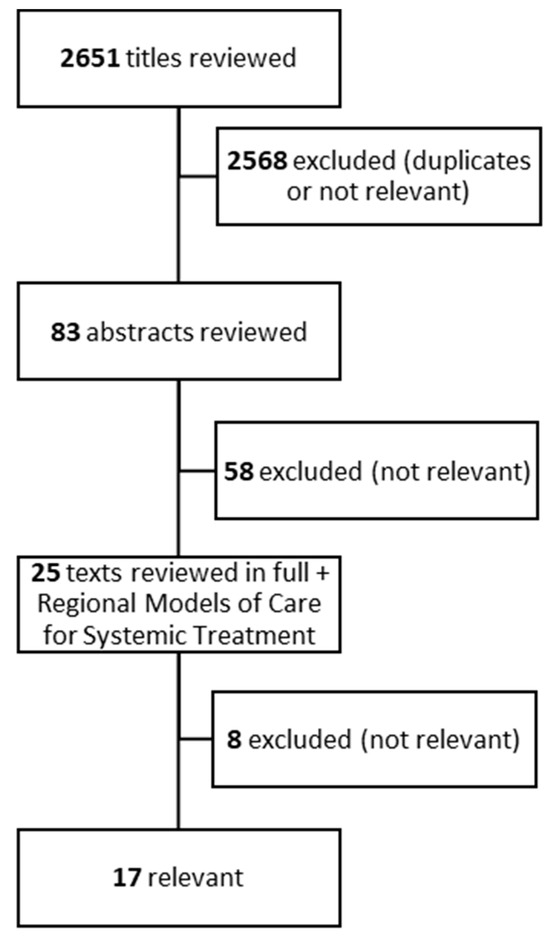
Our literature search identified 2651 records. Of these, 2568 records were identified as either duplicates or deemed not relevant, leaving 83 records for abstract screening. In phase two, we screened 83 abstracts and 25 full-text articles in phase three. Finally, 17 reports were included (Figure 1).
Figure 1.
Flowchart of literature search.
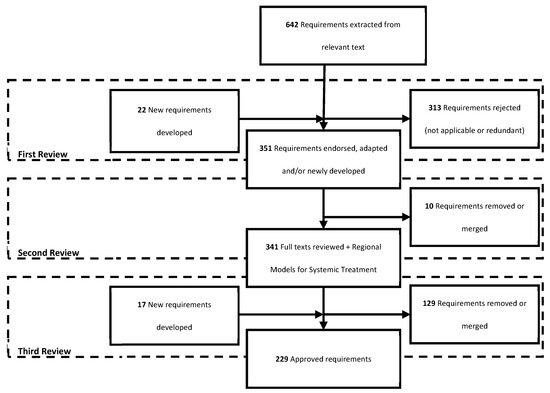
We extracted 642 requirements from the included reports. All requirements were reviewed and refined through a three-part process. During the first round of review by the working group, 313 requirements were rejected as they were determined not relevant to the local context or redundant of other requirements. In addition, 22 requirements were newly developed, determined to fill missing gaps in the literature. The second round of review removed an additional 10 requirements either rejected or merged with other requirements due to similarity. Finally, the third round of review relinquished an additional 129 requirements. At this time, 17 new requirements were generated, yielding a total of 229 requirements included in the final report (Table 4, Figure 2) [11,12,13,14,15,16,17,18,19,20,21,22,23,24,25,26,27,28,29,30,31,32,33].
Figure 2.
Flowchart of requirement review.
Due to the lack of available guidelines and evidence, the requirements are largely based on expert opinion informed by the endorsement and adaptation of existing standards and requirements from other jurisdictions, including from Ontario Health (Cancer Care Ontario), NICE [34], and the Foundation for the Accreditation of Cellular Therapy (FACT) at the University of Nebraska Medical Centre [8]. New requirements were developed where the committee members determined gaps in the literature. The final provincial policy requirements report was completed and made publicly available on the Ontario Health (Cancer Care Ontario) website (cancercareontario.ca/en/guidelines-advice/types-of-cancer/69431).
Table 4.
Organizational Requirements. (Organizational requirements checklist by site type is available in the Supplementary Materials, Section S3).
5. Discussion
A strategic priority of the Ontario Provincial Cancer Plan is to improve access to high-quality cancer care for all Ontarians, regardless of where they live throughout the province. This means providing care closer to home whenever possible, ensuring that patients, of various characteristic backgrounds, needing specialized or complex care can receive the appropriate level of expertise and resources. For patients with acute leukemia, this can be challenging as the diagnosis and treatment of this disease often requires specialized diagnostic and prognostic laboratory testing, drugs, and procedures that are very costly and urgently needed, provided by highly trained, specialized health care professionals, and are not widely available across the province.
Inspired by FACT, which sets standards for the quality and safety of cellular therapy and accredits centres that meet those standards, we wanted to apply a similar approach to acute leukemia care in Ontario, as this is a complex and rapidly evolving field that requires specialized skills and resources. Therefore, Ontario Health (Cancer Care Ontario), in collaboration with regional cancer programs and other stakeholders, have developed a series of organizational requirements for acute leukemia service providers delivering care in Ontario. We conducted a review of the literature to synthesize current organizational standards and developed additional standards when gaps were identified; in the end, we defined 229 organizational requirements.
The intent of this work is not to penalize centres, but rather to support service providers as they work toward meeting the requirements, striving to improve the delivery of high-quality care to patients with acute leukemia. The organizational requirements, as a framework, aim to help cancer centres assess their current infrastructure and readiness to provide care, identify gaps and opportunities for improvement, and develop a road map to achieve their desired level of care. The framework supports consistency of care across sites while also supporting an integrated provincial network of health care across all levels and regions.
A significant benefit of the requirements report is supporting cancer centres to pursue the necessary resources and support to implement plans and ensure quality and safety of care. By using the criteria and indicators in the report, sites can demonstrate their current level of performance, their alignment with provincial requirements and guidelines, and their potential to deliver higher-level care if supported by additional resources. This way, the report can serve as a valuable tool for advocacy and resource mobilization for sites that aspire to improve their acute leukemia care.
We recognize that developing organizational requirements is only the first step in the process of quality improvement and that the successful implementation and evaluation of these requirements depends on many factors, such as leadership, engagement, communication, education, funding, and infrastructure. We highly recommend that organizational requirements are implemented in collaboration with relevant stakeholders to facilitate their adoption and integration into daily practice and to monitor and measure their impact on the quality and safety of care.
5.1. Strengths and Limitations
Strengths: The requirements are derived from a comprehensive literature review and environmental scan of the current state of acute leukemia care in Ontario and other jurisdictions, which provides a foundational evidence base for the requirements. We used an integrated knowledge translation approach throughout the development of our work as it was guided by a provincial advisory committee and a working group consisting of experts and stakeholders from various disciplines and regions, ensuring the relevance and applicability of the requirements to the Ontario context. Using this approach, we ensured end-user buy-in of the final report. Our work offers practical and feasible requirements for sites to improve their infrastructure and quality of care for acute leukemia patients. Finally, the requirements can be used as a framework for assessing and monitoring the performance of sites that offer acute leukemia care, using criteria and indicators that reflect best practices and provincial standards and guidelines.
Limitations: The requirements are drawn from a variety of sources including the expert opinion of clinical and administrative stakeholders from across the province. These requirements have not been validated in an acute leukemia setting. In addition, their applicability and generalizability to different populations is unknown. In addition, we acknowledge that some of the requirements may not be feasible or applicable in all settings. Secondly, the requirements were based upon available data and information at the time of its development, which may not always reflect the most recent evidence or practice. Therefore, the report should be updated and revised periodically to incorporate new knowledge, emerging evidence, and changes in clinical practice. Another limitation of our work is that we did not exhaustively explore all clinical aspects of care. While these are equally important and interrelated components of quality care, they are beyond the scope of this project. We hope that our work will complement and inform the development of clinical practice guidelines and pathways for acute leukemia patients and that together they will provide a comprehensive and coherent framework for improving the outcomes and experiences of this patient group.
5.2. Next Steps and Future Directions
Relevant organizational requirements should be implemented via a staged approach. Our suggested approach is outlined in Figure 3. In collaboration with stakeholders, a subset of requirements of highest priority should be identified. Priority requirements should be used as a baseline for sites interested in becoming service sites. Sites should complete self-assessments to determine which requirements are currently being met and which they should work toward. Finally, using a collaborative approach, sites should be supported in their ambitions for growth in achieving additional organizational requirements.
Figure 3.
Implementation of organizational requirements.
Ontario Health (Cancer Care Ontario) will continue to work with cancer centres across Ontario, in addition to our advisory committee and other applicable stakeholders, to determine and monitor the application of the requirements. Together, we aim to identify areas of focus, inform next steps and support improvement through implementation of these criteria. An example of this future work includes adapting organizational requirements for emerging therapies such as the developing area of highly effective low-intensity therapies which will be administered by many more centres than the current ten.
As the literature surrounding acute leukemia care is ever evolving, it is highly recommended that the organizational requirements presented in this report be reviewed for completeness and accuracy, at a minimum, every three years. Future iterations of this work should consider other guidance released by Ontario Health (Cancer Care Ontario), including guidance related to health equity and the provision of culturally appropriate care.
6. Conclusions
In this paper, we have presented a set of requirements for improving the quality and safety of acute leukemia care in Ontario, based on the best available evidence and expert consensus. These requirements cover various aspects of care delivery, such as diagnosis, treatment, supportive care, and follow-up. We have also outlined the next steps for assessing and monitoring the implementation of these requirements, which involve working collaboratively with service providers and stakeholders to identify gaps, challenges, and opportunities for improvement. Our work aims to support the provision of high-quality care for patients with acute leukemia across Ontario and to foster a culture of continuous learning and improvement in this field. We hope that our work will also be useful for other jurisdictions that are interested in enhancing their acute leukemia services and outcomes.
Supplementary Materials
The following supporting information can be downloaded at: https://www.mdpi.com/article/10.3390/curroncol31080347/s1, Section S1: Members of the Acute Leukemia Specifications Working Group; Section S2: Search Strategy. Section S3: Organizational Requirements Checklist.
Author Contributions
L.V. was responsible for interpreting the results and writing and reviewing the final report manuscript. C.M. was responsible for designing the protocol, screening potentially eligible studies, extracting and analysing data, interpreting results, creating the requirements table, writing and reviewing the provincial policy recommendation, and writing and reviewing the final report manuscript. T.K. was responsible for designing the protocol, interpreting results, facilitating consensus discussion, writing and reviewing the provincial policy recommendation, and writing and reviewing the final report manuscript. M.S. was responsible for interpreting results, writing and reviewing the provincial policy recommendation, and writing and reviewing the final report manuscript. K.Y. was responsible for interpreting results, writing and reviewing the provincial policy recommendation, and writing and reviewing the final report manuscript. K.K. was responsible for interpreting results, writing and reviewing the provincial policy recommendation, and writing and reviewing the final report manuscript. R.B. was responsible for interpreting results, writing and reviewing the provincial policy recommendation, and writing and reviewing the final report manuscript. A.E. was responsible for interpreting results, writing and reviewing the provincial policy recommendation, and writing and reviewing the final report manuscript. S.A. was responsible for screening potentially eligible studies, extracting and analysing data, interpreting results, creating the requirements table, writing and reviewing the provincial policy recommendation, and writing and reviewing the final report manuscript. C.B. was responsible for designing the protocol, interpreting results, facilitating consensus discussion, writing and reviewing the provincial policy recommendation, and writing and reviewing the final report manuscript. All authors have read and agreed to the published version of the manuscript.
Funding
This work was conducted with the support of Ontario Health (Cancer Care Ontario) through funding provided by the Ontario Ministry of Health.
Institutional Review Board Statement
Not applicable.
Informed Consent Statement
Not applicable.
Data Availability Statement
The datasets generated during and/or analyzed during the current study are available from the corresponding author on reasonable request.
Acknowledgements
We would like to acknowledge the efforts and contributions of the Acute Leukemia Specifications Working Group (Supplementary Materials, Section S1) and the Acute Leukemia Advisory Committee. We would also like to thank those who participated in the review of the Report, including the following external reviewers: Andrew Daly, Section of Hematology, Alberta Health Services—Calgary Zone, and Cumming School of Medicine, University of Calgary. C. Fred LeMaistre, Hematology (journal), Sarah Cannon, Nashville, United States of America. Matt Seftel, BC Cancer, and Division of Hematology, Department of Medicine, University of British Columbia. Finally, we would like to thank the Ontario Health (Cancer Care Ontario’s) Library Services for assisting with the literature search, in particular, Jessie Cunningham. This report draws on NICE guidance. © NICE (2016) Haematological cancers: improving outcomes. All rights reserved. Subject to Notice of rights. NICE guidance is prepared for the National Health Service in England. It is subject to regular review and updating and may be withdrawn. NICE accepts no responsibility for the use of its content in this product/publication.
Conflicts of Interest
The authors declare no conflict of interest. The analyses, conclusions, opinions, and statements reported in this article are those of the authors and do not necessarily reflect those of Ontario Health (Cancer Care Ontario). No endorsement by Ontario Health, Ontario Health-Cancer Care Ontario or the Ontario Ministry of Health and Long-Term Care is intended or should be inferred.
References
- Del Paggio, J.C.; Naipaul, R.; Gavura, S.; Mercer, R.E.; Koven, R.; Gyawali, B.; Booth, C.M. Cost and value of cancer medicines in a single-payer public health system in Ontario, Canada: A cross-sectional study. Lancet Oncol. 2024, 25, 431–438. [Google Scholar] [CrossRef] [Scilit] [PubMed]
- Leukemia Provincial Planning Working Group. Acute Leukemia Provincial Plan; Cancer Care Ontario: Toronto, ON, Canada, 2017. [Google Scholar]
- Ontario Ministry of Health and Long-Term Care. Ontario Public Health Organizational Standards; Ministry of Health and Long-Term Care: Toronto, ON, Canada, 2011.
- Mahan, C.S. How can performance standards strengthen accountability for public health? J. Public Health Manag. Pract. 2000, 6, 85–87. [Google Scholar] [CrossRef] [Scilit] [PubMed]
- Landrum, L.B.; Baker, S.L. Managing complex systems: Performance management in public health. J. Public Health Manag. Pract. 2004, 10, 13–18. [Google Scholar] [CrossRef] [Scilit] [PubMed]
- Bakes-Martin, R.; Corso, L.C.; Landrum, L.B.; Fisher, V.S.; Halverson, P.K. Developing national performance standards for local public health systems. J. Public Health Manag. Pract. 2005, 11, 418–421. [Google Scholar] [CrossRef] [Scilit] [PubMed]
- Forbes, L.; Durocher-Allen, L.D.; Vu, K.; Gallo-Hershberg, D.; Pardhan, A.; Kennedy, K.; Newton, J.; Pitre, L.; Root, D. Regional Models of Care for Systemic Treatment: Standards for the Organization and Delivery of Systemic Treatment; Program in Evidence-Based Care Guideline: Hamilton, ON, Canada, 2019. [Google Scholar]
- The Foundation for the Accreditation of Cellular Therapy (FACT). About FACT. Available online: https://factglobal.org/about/ (accessed on 3 November 2023).
- Ontario Health (Cancer Care Ontario). Program in Evidence-Based Care Handbook; Ontario Health (Cancer Care Ontario): Hamilton, ON, Canada, 2020. [Google Scholar]
- Foundation for the Accreditation of Cellular Therapy and Joint Accreditation Committee—ISCT and EBMT. FACT-JACIE International Standards for Hematopoietic Cellular Therapy: Product Collection, Processing, and Administration, 7th ed. 2018. Available online: https://www.ebmt.org/sites/default/files/2018-06/FACT-JACIE%207th%20Edition%20Standards.pdf (accessed on 3 November 2023).
- NICE. Haematological Cancers: Improving Outcomes; NICE Guidance NG 47. 2016. Available online: https://www.nice.org.uk/guidance/ng47/resources/haematological-cancers-improving-outcomes-pdf-1837457868229 (accessed on 3 November 2023).
- Western Australia Cancer and Palliative Care Network. Haematologic Malignancy Model of Care; Government of Western Australia, Department of Health: Perth, Australia, 2009.
- Cancer Care Ontario Complex Malignant Hematology Models of Care Working Group. Complex Malignant Hematology Models of Care: Recommendations for Changes in the Roles and Composition of the Multidisciplinary Team and the Setting of Care to Improve Access for Patients in Ontario; Cancer Care Ontario: Toronto, ON, Canada, 2017. [Google Scholar]
- Cancer Care Ontario. Acute Leukemia Specifications Working Group. 2018.
- Leung, M.; Bland, R.; Baldassarre, F.; Green, E.; Kaizer, L.; Hertz, S.; Craven, J.; Trudeau, M.; Boudreau, A.; Cheung, M.; et al. Safe Administration of Systemic Cancer Therapy Part 1: Safety during Chemotherapy Ordering, Transcribing, Dispensing, and Patient Identification; Cancer Care Ontario: Toronto, ON, Canada, 2012. [Google Scholar]
- Leung, M.; Bland, R.; Baldassarre, F.; Green, E.; Kaiser, L.; Hertz, S.; Craven, J.; Trudeau, M.; Bourdreau, A.; Cheung, M.; et al. Safe Administration of Systemic Cancer Therapy Part 2: Administration of Systemic Treatment and Management of Preventable Adverse Events; Cancer Care Ontario: Toronto, ON, Canada, 2018. [Google Scholar]
- Moehring, A.K. FACT-JACIE International Standards for hematopoitic cellular therapy Product Collection, Processing, and Administration ed. 8.1. 2021. Available online: https://www.ebmt.org/sites/default/files/2021-12/STS_5_2_041_FACT-JACIE%20Standards%20Eighth%20Edition_8_1_R2_12142021_ForWeb.pdf (accessed on 3 November 2023).
- Government of Ontario. Guideline A-12: Guideline for the Implementation of Air Standards in Ontario; Government of Ontario: Toronto, ON, Canada, 2017.
- National Advisory Committee on Blood and Blood Products. Recommendations for Use of Irradiated Blood Components in Canada. 2018. Available online: https://nacblood.ca/en/resource/recommendations-use-irradiated-blood-components-canada (accessed on 3 November 2023).
- Bewersdorf, J.P.; Giri, S.; Tallman, M.S.; Zeidan, A.M.; Stahl, M. Leukapheresis for the management of hyperleukocytosis in acute myeloid leukemia—A systematic review and meta-analysis. Transfusion 2020, 60, 2360–2369. [Google Scholar] [CrossRef] [Scilit] [PubMed]
- Amenudzie, Y.; Georgiou, G.; Ho, E.; O’Sullivan, E. Adapting and applying the Synergy Model on an inpatient hematology unit. Can. Oncol. Nurs. J. 2017, 27, 338. [Google Scholar] [CrossRef] [Scilit] [PubMed]
- NHS England. Manual for Cancer Services: Haemato-Oncology Cancer Measures; NHS England: London, UK, 2013. [Google Scholar]
- Cancer Care Ontario. Symptom Management. 2019. Available online: https://www.cancercareontario.ca/en/symptom-management (accessed on 3 November 2023).
- Canadian Partnership for Quality Radiotherapy. Technical Quality Control Guidelines for Patient-Specific Dosimetric Measurement for Intensity Modulated Radiation Therapies; Canadian Partnership for Quality Radiotherapy: Toronto, ON, Canada, 2016. [Google Scholar]
- Malak, S.; Sotto, J.J.; Ceccaldi, J.; Colombat, P.; Casassus, P.; Jaulmes, D.; Rochant, H.; Cheminant, M.; Beaussant, Y.; Zittoun, R.; et al. Ethical and clinical aspects of intensive care unit admission in patients with hematological malignancies: Guidelines of the ethics commission of the French society of hematology. Adv. Hematol. 2014, 2014, 704318. [Google Scholar] [CrossRef] [Scilit] [PubMed]
- Ontario Palliative Care Network. Palliative Care Health Services Delivery Framework—Recommendations for a Model of Care to Improve Palliative Care in Ontario; Ontario Palliative Care Network: Toronto, ON, Canada, 2019. [Google Scholar]
- Government of Canada—Department of Justice. Medical Assistance in Dying. 2020. Available online: https://www.justice.gc.ca/eng/cj-jp/ad-am/index.html (accessed on 15 October 2023).
- Wright, F.; De Vito, C.; Langer, B.; Hunter, A. Multidisciplinary Cancer Conference Standards; Cancer Care Ontario: Toronto, ON, Canada, 2006. [Google Scholar]
- Leukaemia CARE. Defining High Quality Care for Hematological Patients; Leukaemia CARE: Blackpole East, UK, 2013. [Google Scholar]
- Biddy, R.; Griffin, C.; Johnson, N.; Larocque, G.; Messersmith, H.; Moody, L.; Shamji, H.; Stevens, C.; Zwaal, C.; Singh, S. Person-Centred Care Guideline Expert Panel; Cancer Care Ontario: Toronto, ON, Canada, 2015. [Google Scholar]
- Cancer Care Ontario. Ontario Cancer Plan 5: 2019–2023. 2019. Available online: https://www.cancercareontario.ca/en/cancerplan (accessed on 12 September 2023).
- Cancer Care Ontario Pathology Complex Malignant Hematology Working Group. Consensus Pathology Recommendations for Complex Malignant Hematology; Cancer Care Ontario: Toronto, ON, Canada, 2016. [Google Scholar]
- Döhner, H.; Estey, E.; Grimwade, D.; Amadori, S.; Appelbaum, F.R.; Büchner, T.; Dombret, H.; Ebert, B.L.; Fenaux, P.; Larson, R.A.; et al. Diagnosis and management of AML in adults: 2017 ELN recommendations from an international expert panel. Blood J. Am. Soc. Hematol. 2017, 129, 424–447. [Google Scholar] [CrossRef] [Scilit] [PubMed]
- National Institute for Health and Care Excellence (NICE). NICE Guidance. Available online: https://www.nice.org.uk/about/what-we-do/our-programmes/nice-guidance (accessed on 15 October 2023).
- Health Canada. Good Clinical Practices. 2019. Available online: https://www.canada.ca/en/health-canada/services/drugs-health-products/compliance-enforcement/good-clinical-practices.html (accessed on 12 September 2023).



Disclaimer/Publisher’s Note: The statements, opinions and data contained in all publications are solely those of the individual author(s) and contributor(s) and not of MDPI and/or the editor(s). MDPI and/or the editor(s) disclaim responsibility for any injury to people or property resulting from any ideas, methods, instructions or products referred to in the content. |
© 2024 by the authors. Licensee MDPI, Basel, Switzerland. This article is an open access article distributed under the terms and conditions of the Creative Commons Attribution (CC BY) license (https://creativecommons.org/licenses/by/4.0/).