You are currently viewing a new version of our website. To view the old version click .

Marine Drugs, Volume 22, Issue 11

November 2024 - 44 articles

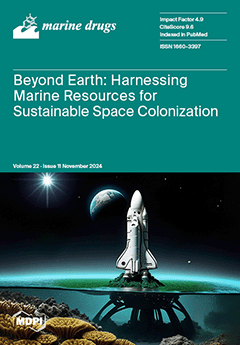
Cover Story: This paper, entitled “Beyond Earth: Harnessing Marine Resources for Sustainable Space Colonization”, explores how marine organisms and their bioactive compounds can address critical challenges of space colonization. By integrating marine and space sciences, this review highlights the potential of algae, invertebrates, and microorganisms in life support systems, food production, pharmaceuticals, energy, and materials in terms of space habitats. With Earth’s oceans offering untapped potential, marine biotechnology emerges as a pivotal tool for humanity's expansion into space. This work envisions a future where humans not only survive but thrive beyond Earth, propelled by the innovative use of marine resources in the final frontier. View this paper
  • Issues are regarded as officially published after their release is announced to the table of contents alert mailing list .
  • You may sign up for email alerts to receive table of contents of newly released issues.
  • PDF is the official format for papers published in both, html and pdf forms. To view the papers in pdf format, click on the "PDF Full-text" link, and use the free Adobe Reader to open them.

Articles (44)

  • Article
  • Open Access
2 Citations
2,305 Views
19 Pages

2-Acetamidophenol (2-AAP) Suppresses the Progression of Atherosclerosis by Alleviating Hyperlipidemia and Attenuating the Ferroptosis Pathway

  • Xiaohan Zang,
  • Yongcheng Wang,
  • Cong Han,
  • Lishuang Cui,
  • Haojie Liu,
  • Shuimiao Tian,
  • Kechun Liu,
  • Peihai Li,
  • Chen Sun and
  • Qing Xia
  • + 1 author

13 November 2024

Hyperlipidemia and consequent endothelial inflammation, along with foam cell generation, promote the progression of atherosclerosis (AS). Here, we aimed to investigate the effects of 2-acetamidophenol (2-AAP), which was selected by zebrafish phenotyp...

  • Article
  • Open Access
2,029 Views
13 Pages

13 November 2024

Haematococcus pluvialis contains valuable bioactive compounds, including astaxanthin, proteins, and fatty acids. Astaxanthin is known for its various health benefits, such as preserving the redox balance and reducing inflammation. However, its low st...

  • Article
  • Open Access
3 Citations
2,171 Views
13 Pages

Chaetomorpha linum Extract as a Source of Antimicrobial Compounds: A Circular Bioeconomy Approach

  • Roberta Barletta,
  • Alfonso Trezza,
  • Michela Geminiani,
  • Luisa Frusciante,
  • Tommaso Olmastroni,
  • Filomena Sannio,
  • Jean-Denis Docquier and
  • Annalisa Santucci

13 November 2024

The circular bioeconomy is currently a promising model for repurposing natural sources; these sources include plants due to their abundance of bioactive compounds. This study evaluated the antimicrobial properties of a Chaetomorpha linum extract. Cha...

  • Review
  • Open Access
12 Citations
5,748 Views
26 Pages

10 November 2024

Exposure to toxigenic harmful algal blooms (HABs) can result in widely recognized acute poisoning in humans. The five most commonly recognized HAB-related illnesses are diarrhetic shellfish poisoning (DSP), paralytic shellfish poisoning (PSP), amnesi...

  • Article
  • Open Access
3 Citations
3,152 Views
32 Pages

Comparison of Microalgae Nannochloropsis oceanica and Chlorococcum amblystomatis Lipid Extracts Effects on UVA-Induced Changes in Human Skin Fibroblasts Proteome

  • Sinemyiz Atalay Ekiner,
  • Agnieszka Gęgotek,
  • Pedro Domingues,
  • Maria Rosário Domingues and
  • Elżbieta Skrzydlewska

10 November 2024

Lipid extracts from the microalgae Nannochloropsis oceanica and Chlorococcum amblystomatis have great potential to prevent ultraviolet A (UVA)-induced metabolic disorders. Therefore, the aim of this study has been to analyze their cytoprotective effe...

  • Article
  • Open Access
2,199 Views
18 Pages

New Polyhydroxysteroid Glycosides with Antioxidant Activity from the Far Eastern Sea Star Ceramaster patagonicus

  • Timofey V. Malyarenko,
  • Viktor M. Zakharenko,
  • Alla A. Kicha,
  • Arina I. Ponomarenko,
  • Igor V. Manzhulo,
  • Anatoly I. Kalinovsky,
  • Roman S. Popov,
  • Pavel S. Dmitrenok and
  • Natalia V. Ivanchina

10 November 2024

Four new glycosides of polyhydroxysteroids, ceramasterosides A, B, D, and E (1–4), and two previously known compounds, ceramasteroside C1 (5) and attenuatoside B-I (6), were isolated from an extract of a deep-sea sea star species, the orange co...

  • Article
  • Open Access
1 Citations
3,350 Views
12 Pages

Salmon Nasal Cartilage-Derived Proteoglycans Alleviate Monosodium Iodoacetate-Induced Osteoarthritis in Rats

  • Inae Jeong,
  • Jinbum Park,
  • Shinjung Park,
  • Tatuya Wada,
  • Dae Soo Lim and
  • Ok-Kyung Kim

8 November 2024

Osteoarthritis is a chronic inflammatory condition characterized by the degeneration of joint cartilage and underlying bone, resulting in pain, swelling, and reduced mobility. This study evaluates the efficacy of salmon nasal cartilage-derived proteo...

  • Communication
  • Open Access
4 Citations
1,827 Views
11 Pages

Aeruginosin 525 (AER525) from Cyanobacterium Aphanizomenon Sp. (KUCC C2): A New Serine Proteases Inhibitor

  • Donata Overlingė,
  • Marta Cegłowska,
  • Robert Konkel and
  • Hanna Mazur-Marzec

8 November 2024

Aeruginosins (AERs) are one of the most common classes of cyanobacterial peptides synthesised through a hybrid non-ribosomal peptide synthase/polyketide synthase pathway. They have been found in Microcystis, Nodularia spumigena, Oscillatoria/Plantoth...

  • Article
  • Open Access
6 Citations
4,996 Views
19 Pages

6 November 2024

Microalga Nannochloropsis oceanica presents a promising source of high-value food ingredients such as protein, omega-3 fatty acids, and vitamins. To fully unlock its potential, a thorough understanding of how cultivation conditions affect both growth...

  • Article
  • Open Access
2 Citations
2,133 Views
10 Pages

6 November 2024

Enhancing microalgal growth and bioactive compound production is becoming a duty for improving photosynthetic microorganisms. In this study, the growth, carotenoid, and fatty acid profiles of Conticribra weissflogii were studied under four different...

of 5

Get Alerted

Add your email address to receive forthcoming issues of this journal.

XFacebookLinkedIn
Mar. Drugs - ISSN 1660-3397