You are currently viewing a new version of our website. To view the old version click .

Marine Drugs, Volume 20, Issue 9

September 2022 - 46 articles

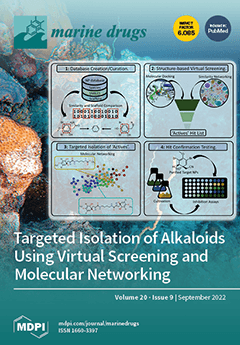
Cover Story: Many targeted natural product isolation approaches rely on the use of pre-existing bioactivity information to inform the strategy used for the isolation of new bioactive compounds. Bioactivity information can be available either in the form of prior assay data or via structure–activity relationship (SAR) information, which can indicate a potential chemotype that exhibits a desired bioactivity. The work described herein utilizes a unique method of targeted isolation using structure-based virtual screening to identify potential antibacterial compounds within the marine sponge order Verongiida active, against MRSA. This is coupled with molecular networking-guided, targeted isolation to provide a novel drug discovery procedure. View this paper
  • Issues are regarded as officially published after their release is announced to the table of contents alert mailing list .
  • You may sign up for email alerts to receive table of contents of newly released issues.
  • PDF is the official format for papers published in both, html and pdf forms. To view the papers in pdf format, click on the "PDF Full-text" link, and use the free Adobe Reader to open them.

Articles (46)

  • Article
  • Open Access
6 Citations
2,940 Views
12 Pages

Chemistry and Bioactivity of the Deep-Water Antarctic Octocoral Alcyonium sp.

  • Anne-Claire D. Limon,
  • Hiran M. L. W. Patabendige,
  • Ala Azhari,
  • Xingmin Sun,
  • Dennis E. Kyle,
  • Nerida G. Wilson and
  • Bill J. Baker

14 September 2022

Chemical investigation of an Antarctic deep-water octocoral has led to the isolation of four new compounds, including three illudalane sesquiterpenoids (1–3) related to the alcyopterosins, a highly oxidized steroid, alcyosterone (5), and five k...

  • Article
  • Open Access
7 Citations
2,947 Views
11 Pages

Phenolic Metabolites from a Deep-Sea-Derived Fungus Aspergillus puniceus A2 and Their Nrf2-Dependent Anti-Inflammatory Effects

  • Jianlin He,
  • Xin Wu,
  • Shuhuan Huang,
  • Juan Wang,
  • Siwen Niu,
  • Meixiang Chen,
  • Gaiyun Zhang,
  • Songyan Cai,
  • Jingna Wu and
  • Bihong Hong

13 September 2022

Four undescribed phenolic compounds, namely asperpropanols A–D (1–4), along with two known congeners 5 and 6, were isolated from Aspergillus puniceus A2, a deep-sea-derived fungus. The gross structures of the compounds were established by...

  • Article
  • Open Access
8 Citations
2,450 Views
10 Pages

Sarcoeleganolides C–G, Five New Cembranes from the South China Sea Soft Coral Sarcophyton elegans

  • Cili Wang,
  • Jiarui Zhang,
  • Xing Shi,
  • Kai Li,
  • Fengling Li,
  • Xuli Tang,
  • Guoqiang Li and
  • Pinglin Li

10 September 2022

Five new cembranes, named sarcoeleganolides C–G (1–5), along with three known analogs (6–8) were isolated from soft coral Sarcophyton elegans collected from the Yagong Island, South China Sea. Their structures and absolute configura...

  • Article
  • Open Access
13 Citations
4,394 Views
25 Pages

9 September 2022

Similar to other marine holobionts, fish are colonized by complex microbial communities that promote their health and growth. Fish-associated microbiota is emerging as a promising source of bioactive metabolites. Pleuronectes platessa (European plaic...

  • Article
  • Open Access
12 Citations
4,086 Views
17 Pages

A Nutraceutical Formulation Containing Brown Algae Reduces Hepatic Lipid Accumulation by Modulating Lipid Metabolism and Inflammation in Experimental Models of NAFLD and NASH

  • Daniela Gabbia,
  • Marco Roverso,
  • Ilaria Zanotto,
  • Martina Colognesi,
  • Katia Sayaf,
  • Samantha Sarcognato,
  • Diletta Arcidiacono,
  • Alice Zaramella,
  • Stefano Realdon and
  • Nicola Ferri
  • + 5 authors

8 September 2022

Recently, some preclinical and clinical studies have demonstrated the ability of brown seaweeds in reducing the risk factors for metabolic syndrome. Here, we analyzed the beneficial effect of a nutraceutical formulation containing a phytocomplex extr...

  • Article
  • Open Access
9 Citations
4,833 Views
16 Pages

8 September 2022

Pelagia noctiluca stings are common in Mediterranean coastal areas and, although the venom is non-lethal, they are painful. Due to its high toxicity and abundance, P. noctiluca is considered a target species for the focus of research on active ingred...

  • Article
  • Open Access
5 Citations
3,126 Views
16 Pages

Saquayamycin B1 Suppresses Proliferation, Invasion, and Migration by Inhibiting PI3K/AKT Signaling Pathway in Human Colorectal Cancer Cells

  • Jianjiang Li,
  • Ningning Han,
  • Hao Zhang,
  • Xiaoyu Xie,
  • Yaoyao Zhu,
  • E Zhang,
  • Jiahui Ma,
  • Chuangeng Shang,
  • Mengxiong Yin and
  • Weidong Xie
  • + 1 author

7 September 2022

Moromycin B (Mor B), saquayamycin B1 (Saq B1), saquayamycin B (Saq B), and landomycin N (Lan N), four angucyclines produced by the marine-derived actinomycete Streptomyces sp., are a class of polyketone compounds containing benzanthracene. Here, the...

  • Article
  • Open Access
7 Citations
3,548 Views
12 Pages

Extracellular Metabolites of Heterotrophic Auxenochlorella protothecoides: A New Source of Bio-Stimulants for Higher Plants

  • Yujiao Qu,
  • Xinxiang Chen,
  • Beibei Ma,
  • Huachang Zhu,
  • Xuan Zheng,
  • Jiazhen Yu,
  • Qinghui Wu,
  • Rong Li,
  • Ziqiang Wang and
  • Yibo Xiao

7 September 2022

The biodiversity of microalgal species is enormous, and their versatile metabolism produces a wide diversity of compounds that can be used in food, healthcare, and other applications. Microalgae are also a potential source of bio-stimulants that enha...

  • Article
  • Open Access
2 Citations
2,972 Views
12 Pages

6 September 2022

Apostichopus japonicus achieves intestinal regeneration in a short period after evisceration, and multiple genes are involved in this process. The transcriptome of A. japonicus was screened for regeneration-associated protein (Aj-Orpin), a gene that...

  • Review
  • Open Access
33 Citations
5,650 Views
31 Pages

Secondary Metabolites from Marine-Derived Bacillus: A Comprehensive Review of Origins, Structures, and Bioactivities

  • Shaoyujia Xiao,
  • Nan Chen,
  • Zixue Chai,
  • Mengdie Zhou,
  • Chenghaotian Xiao,
  • Shiqin Zhao and
  • Xiliang Yang

6 September 2022

The marine is a highly complex ecosystem including various microorganisms. Bacillus species is a predominant microbialflora widely distributed in marine ecosystems. This review aims to provide a systematic summary of the newly reported metabolites pr...

of 5

Get Alerted

Add your email address to receive forthcoming issues of this journal.

XFacebookLinkedIn
Mar. Drugs - ISSN 1660-3397