


Abstract
Continuous glucose monitoring (CGM) might provide immediate feedback regarding lifestyle choices such as diet and physical activity (PA). The impact of dietary habits and physical activity can be demonstrated in real time by providing continuous data on glucose levels and enhancing patient engagement and adherence to lifestyle modifications. Originally developed for diabetic patients, its use has recently been extended to a non-diabetic population to improve cardiovascular health. However, since data in this population are scarce, the effect on cardiovascular outcomes is unclear. CGM may offer potential benefits for cardiovascular prevention in healthy individuals without diabetes. The aim of this systematic review is to evaluate the use of CGM in healthy non-diabetic individuals, focusing on its potential to guide lifestyle interventions in the context of cardiovascular prevention, which may ultimately reduce cardiovascular risk.
1. Introduction
Cardiovascular disease (CVD) remains a leading cause of death globally (World health statistics 2024, [1]) and poses a large social and economic burden on healthcare systems, especially across the European Union (EU), with estimated costs of EUR 282 billion annually [1,2]. While diabetes is a well-known risk factor for CVD, non-diabetic individuals can also exhibit glucose fluctuations that contribute to cardiovascular risk. Higher and/or prolonged glycemic excursions are considered to have a negative effect on health due to an increase in inflammation, endothelial dysfunction, and oxidative stress [3,4,5]. Just like chronic hyperglycemia, augmented blood glucose fluctuations, even within the non-diabetic range, have been shown to influence cardiovascular risk. Emerging evidence suggests that acute glycemic variability can exacerbate oxidative stress, systemic inflammation, and endothelial dysfunction—pathophysiological processes that are central to the development and progression of atherosclerosis and other CVDs. These findings align with epidemiological studies that link higher glycemic variability to increased arterial stiffness, impaired coronary microcirculation, and elevated cardiovascular morbidity. By increasing reactive oxygen species production, they impair endothelial function. Endothelial dysfunction itself promotes the expression of adhesion molecules, so platelets and monocytes migrate into the intima, finally resulting in atherosclerotic plaques as a vascular complication [6]. In fact, increasing evidence indicates that significant variations in serum glucose levels may even be more deleterious than chronic sustained hyperglycemia regarding microvascular complications [7,8].
Continuous glucose monitoring (CGM) has become a valuable tool for measuring glucose fluctuations. The CGM systems consist of a small, wearable device that measures glucose levels in the interstitial fluid (ISF) just beneath the skin. The CGM sensor is inserted under the skin, usually on the abdomen or upper arm. The transmitter sends data to the receiver or a compatible smart device. The glucose concentration in the ISF of the subcutaneous tissue closely correlates with the glucose concentration in the blood. It is also pH stable and not susceptible to contamination. However, precision for very low and high glucose levels is still reduced [9,10]. Unlike traditional blood glucose monitors that provide a single reading at one point in time, CGM systems provide continuous data, giving more insight into trends and patterns of glucose levels. The nature of CGM also makes it useful for measuring acute changes in glycemia following interventions involving nutritional changes or physical activity [11].
Facing these aspects, CGM seems to be a viable tool for glycemic control, and yet, to the best of our knowledge, it has rarely been studied in non-diabetic healthy persons in the context of cardiovascular prevention. Thus, we will systematically review the data on the use of CGM in the high-risk setting of cardiovascular prevention in non-diabetic individuals.
2. Materials and Methods
This systematic review adheres to the Preferred Reporting Items for Systematic Reviews and Meta-Analyses (PRISMA) Statement.
2.1. Data Source, Search, and Study Selection
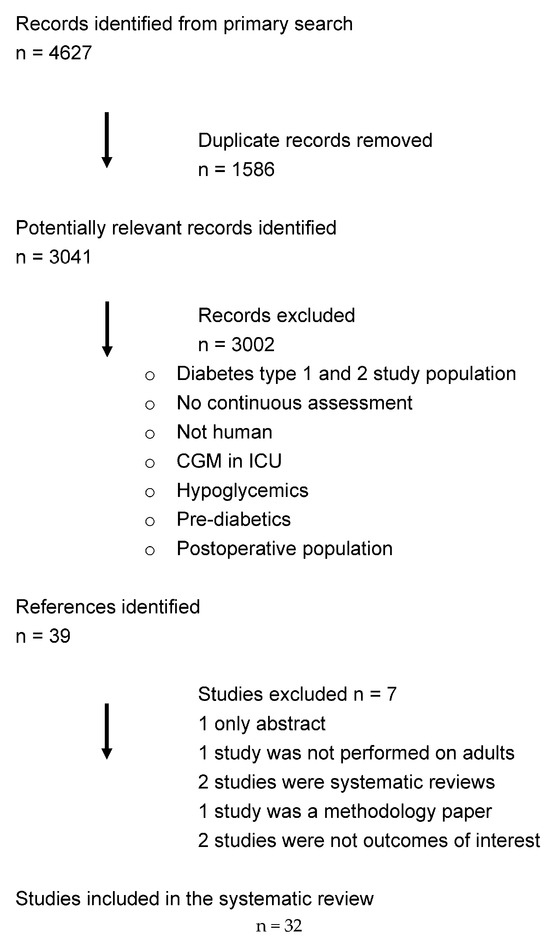
A comprehensive systematic search was conducted using the databases MEDLINE (via PubMed) and Embase for relevant articles, using a combination of the terms CGM and cardiovascular prevention (detailed description in the Supplementary Materials). The search was conducted on 13 March 2024. Details of the search are provided in Figure 1. Two reviewers independently performed screening of titles and abstracts and assessed the full texts for eligibility. Any discrepancies were discussed and resolved by a third reviewer.
Figure 1.
PRISMA diagram for study selection.
Studies were included if they evaluated the impact of CGM on cardiovascular outcomes or related risk factors in non-diabetic, adult individuals. Studies pertaining to pregnant women or hypoglycemia, were excluded. We also excluded studies looking at postoperative cases and patients in the intensive care ward as well as reviews, meta-analyses, comments, and editorials.
2.2. Data Management and Extraction
After pooling all search results in a reference management software program (Zotero Version 7.0.6) [12] and removing duplicated results, two reviewers screened the titles and abstracts. A third member of the team resolved disagreements by discussion. Review of full text and final selection of studies was performed by two independent members of the study team. Disagreements were again resolved by discussion.
Then, the researchers carefully read the full text of the relevant studies based on the eligibility criteria (F.W. and D.N.). The authors (F.W. and D.N.) extracted essential information and entered it into the data extraction table. The extraction form contained items such as bibliographic information, type of study, participants and sample size, data source, (outcomes), and main results.
2.3. Data Synthesis
By aggregating the information extracted from each manuscript, we synthesized and organized the results from the included studies. We also explained the main results in narrative and tabular formats.
3. Results
A total of 3041 articles were identified during screening. After preliminary evaluation, 3009 articles were excluded. The remaining 39 full text publications were reviewed, and a further 7 studies were excluded. The remaining 32 studies were included in the present systematic review. The study selection process and reasons for exclusion are presented in Figure 1. Baseline study characteristics are presented in Table 1.
3.1. CGM, Glycemic Response on Nutritional Behavior
A total of eleven studies examined the association between nutritional behavior, such as mealtime, meal size, carbohydrate load, and the glycemic response. Nutrition is a vital part of cardiovascular prevention for all individuals, independent of baseline cardiovascular risk [13].
According to the results of three studies, a low glycemic index of a diet may influence the glycemic response. Buscemi et al. (2012) demonstrated that glycemic variability ameliorates with a hypocaloric diet with a low glycemic index (GI) and similar macronutrient and fiber content in nondiabetic obese persons. The glycemic index of the diet significantly influenced the 48-h glycemic variability measured as the coefficient of variability (CV%). The CV% decreased after the low GI diet and increased after the high GI diet [14]. Philippou et al. (2007) showed that patients with low GI diets had a significantly lower 24-h glucose profile compared to patients with a high GI diet in a 12-week randomized parallel study [15]. Also, Hafiz et al. (2022) showed that postprandial interstitial glucose levels were significantly higher after intake of instant mashed potatoes in comparison to all forms of chickpeas, which are known for having a very low GI [16]. Similarly, Li et al. (2018) examined the effects of daily consumption of quinoa-enriched bread on markers of CVD risk in healthy subjects, including plasma glucose. They found that daily consumption of quinoa in a short-term intervention appears to significantly lower glucose levels compared to wheat, which has a higher GI [17].
Furthermore, Kang et al. (2013) reported that the amount of carbohydrate in breakfast determines the postprandial glucose fluctuations within 180 min after meal ingestion. Postprandial glucose increased gradually with increased proportions of carbohydrate in breakfast in both impaired glucose regulation (IGR) subjects and normal glucose tolerance (NGT) subjects [18]. Also, Parr et al. (2018) concluded that for adults with prediabetes and prolonged sedentary periods, a low-energy first meal may be desirable for postprandial glucose and insulin regulation although 24-h glycemic control was not impaired by a high-energy first meal [19].
In contrast, Aston et al. (2009) observed no differences in glucose profiles between higher and lower GI interventions in participants, whose diet differed by a GI of 15 Units [20]. Likewise, Tey et al. (2017) showed that no significant differences were found in the mean 24-h glucose, iAUC, total AUC for glucose, and 24-h glycemic variability between beverages sweetened with non-nutritive (e.g., aspartame, monk fruit, or stevia) and nutritive (e.g., sucrose) sweeteners, although they differ strongly in their GI [21]. Kobayashi et al. (2013) reported that skipping breakfast increased the overall 24-h average of blood glucose [22]. Timmer et al. (2022) demonstrated that the glycemic response following consumption of a standardized carbohydrate-rich snack (a 65 g ginger-bread bar) differed over the course of the day. Mean glucose iAUC and mean glucose peak values were highest for snacks consumed between breakfast and lunch [23]. Jansen et al. (2022) showed that the adaptation from a low to a high carbohydrate diet may require many weeks, with implications for the accuracy of diabetes tests [24].
3.2. CGM, Glycemic Response on Physical Activity
Overall, ten studies examined the effects of physical activity (PA), with different types of exercise or exercise timing and/or duration on glycemic response. Current guidelines suggest regular physical activity reduces all-cause mortality, cardiovascular mortality, and morbidity in adults of all ages [13]. However, to what degree an improvement in daily glucose variation leads to improved outcomes in patients without diabetes is unknown.
Regarding the glycemic outcome, several studies showed a favorable effect of exercise. Zhang et al. (2023) demonstrated that both continuous (one 30-min walking bout) and accumulated (three 10-min walking bouts separated by 20-min rest) exercise reduced postprandial glucose (PPG) concentrations and decreased glucose fluctuations. Especially accumulated exercise maintained lower PPG concentrations for a longer time than continuous exercise in young obese adults [25]. Little et al. (2014) showed that high-intensity interval training (HIIT) may be an effective exercise strategy for improving glycemic control. A single session of HIIT in the morning improved postprandial glycemia control in overweight/obese adults for up to 24 h following exercise and was superior to continuous-moderate intensity (CMI) exercise [26]. Nakayama et al. (2022) reported that the glucose concentrations after meal intake (at 45 minutes, 60 minutes, and 75 minutes) and the iAUC were significantly lower in subjects with home-based high-intensity interval exercise (HIIE) and moderate-intensity continuous exercise (MICE) than in the control condition, without significant difference between both [27]. Smith et al. (2021) concluded that mean fasting glucose levels and daily glucose variation (CV%) reduced in frequent activity breaks from sitting (FABS, breaking sitting with three minutes of low-to-moderate-intensity physical activity every 30 min between 8 a.m. and 6 p.m.) [28].
Three studies demonstrated a reverse effect. Mikus et al. (2012) showed that during three days of reduced physical activity (<5000 steps/day), PPG significantly increased in healthy individuals [29]. Also, Trim et al. (2023) found that long-term physical inactivity (60 days of bed rest) increases glycemia (tAUC) [30], and Reynolds et al. (2023) showed that short-term (3 days) removal of exercise impairs glycemic control in older adults as well as young adults [31].
In contrast, Babir et al. (2023) examined the effect of an 11-min session of bodyweight exercise (BWE) on 24-h glycemic response, showing no differences between conditions for 24-h mean glucose, measures of glycemic variability, and the postprandial glycemic outcomes in comparison to a non-exercise sitting control period [32].
Two studies investigated the effect of exercise-meal timing on glycemic response. Solomon et al. (2020) showed that low- to moderate-intensity activity (30-min walking or bodyweight exercise) immediately after breakfast improved glucose control, while pre-breakfast activity or delayed post-breakfast activity did not affect mean glucose, CV, and AUC glucose [33]. Zhang et al. (2021) investigated the effect of post-meal exercise timing using an individualized approach on PPG in overweight or obese young men, demonstrating that walking initiated 20 min before postprandial glucose peak time (PPGP) lowered PPG concentrations [34].
3.3. CGM, Glucose and Cardiovascular Related Parameters
A total of eleven studies explored the association between glycemic variability (GV) and various physiological parameters, including physical constitution, biochemical and biophysical markers, sleep-related features, heart rate variability (HRV), and blood pressure variability (BPV). Salkind et al. (2014) found that normoglycemic and prediabetic morbidly obese individuals exhibit higher GV compared to normal-weight, non-diabetic individuals, suggesting a link/correlation between body composition/BMI and glucose fluctuations [35]. Buscemi et al. (2009) highlighted GV as a potential marker for assessing individual metabolic characteristics and the level of glycemic control. Furthermore, they identified interleukin-6 (IL-6), a proinflammatory cytokine, as an independent predictor for GV [36]. The ZOE PREDICT study by Bermingham et al. (2022) demonstrated that postprandial glucose responses and GV, as measured by continuous glucose monitoring (CGM), were less favorable in post-menopausal women compared to pre-menopausal women, indicating metabolic changes associated with estrogen decline during the menopausal transition [37]. Selvin et al. (2021) investigated CGM patterns in very old adults (range 77–91 years), observing that CGM parameters like mean CGM glucose and mean CV, including hypoglycemic events, differed substantially between the older participants, but mean CGM glucose strongly correlated with HbA1c, suggesting that CGM can provide supplementary information to HbA1c, especially in detecting hypoglycemia in both diabetic and non-diabetic populations. Additionally, they reported high feasibility and acceptability of CGM in very old adults [38]. Castaldo et al. (2011) evaluated the association between episodes of hypoglycemia and preclinical atherosclerosis in non-diabetic individuals with different degrees of glucose tolerance, showing that individuals with impaired glucose tolerance (IGT) spent significantly more time in hypoglycemia and exhibited higher carotid intima-media thickness (IMT) than glucose-tolerant individuals, indicating that hypoglycemia is a potential cardiovascular risk factor in individuals with IGT [39]. Also, Kuroda et al. (2015) demonstrated the impact of glucose fluctuations and hypoglycemia on coronary plaque properties. Both may contribute to lipid-rich plaque formation and fibrous cap thinning in coronary artery disease (CAD) patients [40]. Teshima et al. (2020) showed that chronic heart failure patients are at risk of hypoglycemia even without anti-diabetic therapy. These patients were exposed significantly longer to hypoglycemia compared to patients without chronic heart failure, underscoring the link between heart failure and glucose metabolism [41]. Rothberg et al. (2016) found a correlation between specific HRV patterns and blood glucose levels, but only in T2DM participants, indicating HRV as a potential determinant of glycemic control in these subjects [42]. Sezer et al. (2021) identified a significant correlation between daytime blood pressure values and GV in normotensive and normoglycemic healthy subjects, suggesting that both could serve as early markers of future adverse cardiovascular events [43].
Byun et al. (2020) demonstrated an association between the severity of obstructive sleep apnea (OSA) and changes in nocturnal blood glucose levels, showing that patients with moderate to severe OSA experience an increasing trend in glucose levels after sleep onset, in contrast to those without or with mild OSA, who experience a decreasing trend [44].
Finally, Liao et al. (2020) investigated the acceptability of CGM-incorporated physical activity intervention and changes in exercise motivation. They highlighted CGM as a feasible tool for exercise motivation in sedentary overweight and obese people, especially in the context of the transition from the pre-contemplation stage of behavioral change to the action stage. Additionally, they showed that acceptability ratings of CGM were comparable to those of an activity monitor wristband [45].
Table 1.
Studies reporting results of non-invasive continuous glucose monitoring in patients without diabetes.
4. Discussion
The aim of this paper was to systematically review the scope of literature regarding the application of CGM in cardiovascular disease prevention in non-diabetic individuals. Overall, due to CGM’s real-time visualization of glucose fluctuation in response to nutrition, physical activity, and other physiological parameters outlined previously, GV detection theoretically allows timely lifestyle intervention, which may potentially reduce the risk of cardiovascular disease progression and development [46,47,48].
This review supports the well-investigated change in blood glucose levels after food intake. Most reviewed studies using CGM in non-diabetics support the association between glycemic response measured with CGM, the GI, and the time of day of the meal. One study indicated no differential effect of incorporating higher or lower GI versions of carbohydrate-rich foods on daylong interstitial fluid glucose patterns measured with CGM [20]. In this study, lower or higher GI foods within mixed meals (unlimited quantities), small differences between low and high GI groups (66—high vs. 51 low GI), and a lack of 24-h glucose patterns may have influenced results. Moreover, although non-nutritive and nutritive sweetened beverages differ in their GI, no differences in glucose response have been reported [21].
Lower GI diets are associated with reduced glycemic variability and lower postprandial glucose levels. The amount and type of carbohydrates consumed, especially at breakfast, seem to influence postprandial glucose levels. Consistent meal timing, particularly not skipping breakfast, seems to play a crucial role in maintaining stable glucose levels. Some studies report conflicting results regarding GI and glucose response. A growing body of research is currently trying to establish analytical frameworks to group individuals according to glycemic response patterns, called glucotypes [49,50,51]. High variability of individual responses to the same food intake makes postprandial glucose predictions and glucotype definition difficult. This highlights the complexity of dietary impacts on glycemic control. However, early identification of glucose variability types could potentially serve as a tool for risk stratification for type 2 diabetes and other metabolic diseases [50].
Additionally, physical activity (PA), as well as inactivity, is connected to glycemic response in CGM. Several forms of PA, such as HIIT, moderate-intensity continuous exercise, walking, and activity breaks from sitting, are effective in improving glycemic control. Strategic timing of PA around meals seems to have an additional impact on PPG. Physical activity soon after a meal or strategically timed before peak glucose concentrations can improve PPG levels. The findings highlight the significance of incorporating specific types and timing of exercise to enhance glycemic control, particularly in populations at risk for diabetes.
Multiple studies collectively highlight the significance of glycemic variability (GV) as an associated critical factor in metabolic health. Cardiovascular risk factors other than nutrition and PA and their relationship to glucose variability were confirmed by the reviewed studies. The relationship between glycemic variability and cardiovascular parameters like HRV and BPV suggests a complex interplay between glucose regulation and cardiovascular health. CGM emerges as a valuable tool for assessing GV and its implications across different populations. However, all studies evaluated associations and further investigation regarding outcomes is warranted. Only one study dealt with outcome measures [45]. This study reported elevated exercise motivation with CGM-incorporated PA intervention.
The totality of evidence shows that CGM provides real-time tracking of glucose levels and is recommended as a tool for the early detection of abnormal glucose patterns. It offers a potential solution for normalizing glucose levels by encouraging behavioral changes, such as personalized diet adjustments and increased motivation for physical activity [48]. Especially regarding obesity, one of the greatest risk factors for the development of diabetes [52], CGM data provides biofeedback to support behavioral and lifestyle changes. Healthy behavior, as with increased PA and sleep, as well as portion control, could be helpful to delay or even prevent diabetes. Several biotech companies are marketing CGM to healthy individuals, warning of glucose spikes and promising weight management and PA integration aid [53,54,55]. Scientific proof, however, is lacking and emphasizes the necessity for outcome studies to justify an advantage for CV risk factor modulation by CGM. So far, no drawbacks for personal health have been reported. Infrequent tape allergy and skin trauma are rare and minor factors [51]. Stress or distress regarding constantly available data might negatively influence healthy eating and exercise behavior, triggering eating disorders or over-exaggerated exercise interventions. Also, glucose values highly vary between individuals. This makes interpretation of values for individuals with limited knowledge about blood glucose and the absence of norm values extremely difficult, resulting in possible undesirable effects. Furthermore, CGM measurements are delayed compared to blood glucose measurements due to the diffusion time of glucose to the subcutaneous interstitial fluid, which is significant in terms of rapidly changing glucose conditions such as PA, and therefore should also be taken into consideration in the reading/interpretation of CGM data.
5. Conclusions
Continuous glucose monitoring may offer significant potential benefits for cardiovascular prevention in healthy individuals without diabetes. By providing continuous data on glucose levels, CGM enables early identification of metabolic abnormalities, such as glycemic variability and postprandial hyperglycemia, known to be independent cardiovascular risk factors, and hence might support personalized and favorable lifestyle interventions in nutritional habits and physical activity.
Further research in long-term and outcome-oriented studies on glucose regulation in healthy, non-diabetic individuals and the influence of behavioral factors, is essential to fully understand and utilize its long-term impact on cardiovascular health.
Supplementary Materials
The following supporting information can be downloaded at: https://www.mdpi.com/article/10.3390/s25010187/s1, PRISMA 2020 Checklist. Ref. [56] is cited in the Supplementary Materials.
Author Contributions
Conceptualization, D.N., G.P., J.G.v.d.S. and F.W.; methodology, D.N., G.P. and F.W.; writing, original draft preparation, F.W., G.P. and J.G.v.d.S.; writing, review and editing, D.N.; supervision, D.N. All authors have read and agreed to the published version of the manuscript.
Funding
This research received no external funding.
Institutional Review Board Statement
Not applicable.
Informed Consent Statement
Not applicable.
Data Availability Statement
No new data were created or analyzed in this study.
Conflicts of Interest
The authors declare no conflict of interest.
Abbreviations
The following abbreviations are used in this manuscript:
| AUC | Area Under The Curve |
| iAUC | Incremental Area Under The Curve |
| BMI | Body Mass Index |
| BPV | Blood Pressure Variability |
| BWE | Bodyweight Exercise |
| CAD | Coronary Artery Disease |
| CGM | Continuous Glucose Monitoring |
| CMI | Continuous-Moderate Intensity |
| CV | Coefficient Of Variability |
| CVD | Cardiovascular Disease |
| EU | European Union |
| FABS | Frequent Activity Breaks From Sitting |
| GI | Glycemic Index |
| GV | Glycemic Variability |
| HbA1c | Hemoglobin A1c |
| HIIE | Home-Based High-Intensity Interval Exercise |
| HIIT | High-Intensity Interval Training |
| HRV | Heart Rate Variability |
| ICU | Intensive Care Unit |
| IGR | Impaired Glucose Regulation |
| IGT | Impaired Glucose Tolerance |
| IL-6 | Interleukin-6 |
| IMT | Intima-Media Thickness |
| ISF | Interstitial Fluid |
| MICE | Moderate-Intensity Continuous Exercise |
| NGT | Normal Glucose Tolerance |
| OSA | Obstructive Sleep Apnea |
| PA | Physical Activity |
| PPG | Postprandial Glucose |
| PPGP | Postprandial Glucose Peak Time |
| PRISMA | Preferred Reporting Items for Systematic Reviews and Meta-Analyses |
| T2DM | Type 2 Diabetes Mellitus |
References
- World Health Statistics 2024: Monitoring Health for the SDGs, Sustainable Development Goals; World Health Organization: Geneva, Switzerland, 2024.
- Luengo-Fernandez, R.; Walli-Attaei, M.; Gray, A.; Torbica, A.; Maggioni, A.P.; Huculeci, R.; Bairami, F.; Aboyans, V.; Timmis, A.D.; Vardas, P.; et al. Economic burden of cardiovascular diseases in the European Union: A population-based cost study. Eur. Heart J. 2023, 44, 4752–4767. [Google Scholar] [CrossRef] [Scilit] [PubMed] [PubMed Central]
- Gallwitz, B. Implications of postprandial glucose and weight control in people with type 2 diabetes: Understanding and implementing the International Diabetes Federation guidelines. Diabetes Care 2009, 32 (Suppl. S2), S322–S325. [Google Scholar] [CrossRef] [Scilit] [PubMed] [PubMed Central]
- Ceriello, A.; Esposito, K.; Piconi, L.; Ihnat, M.A.; Thorpe, J.E.; Testa, R.; Boemi, M.; Giugliano, D. Oscillating glucose is more deleterious to endothelial function and oxidative stress than mean glucose in normal and type 2 diabetic patients. Diabetes 2008, 57, 1349–1354. [Google Scholar] [CrossRef] [Scilit] [PubMed]
- Ceriello, A.; Hanefeld, M.; Leiter, L.; Monnier, L.; Moses, A.; Owens, D.; Tajima, N.; Tuomilehto, J. Postprandial glucose regulation and diabetic complications. Arch. Intern. Med. 2004, 164, 2090–2095. [Google Scholar] [CrossRef] [Scilit] [PubMed]
- Zhang, Z.-Y.; Miao, L.-F.; Qian, L.-L.; Wang, N.; Qi, M.-M.; Zhang, Y.-M.; Dang, S.-P.; Wu, Y.; Wang, R.-X. Molecular Mechanisms of Glucose Fluctuations on Diabetic Complications. Front. Endocrinol. 2019, 10, 640. [Google Scholar] [CrossRef] [Scilit] [PubMed] [PubMed Central]
- Ceriello, A.; Esposito, K.; Piconi, L.; Ihnat, M.; Thorpe, J.; Testa, R.; Bonfigli, A.R.; Giugliano, D. Glucose “peak” and glucose “spike”: Impact on endothelial function and oxidative stress. Diabetes Res. Clin. Pract. 2008, 82, 262–267. [Google Scholar] [CrossRef] [Scilit] [PubMed]
- Monnier, L.; Colette, C.; Owens, D.R. Glycemic variability: The third component of the dysglycemia in diabetes. Is it important? How to measure it? J. Diabetes Sci. Technol. 2008, 2, 1094–1100. [Google Scholar] [CrossRef] [Scilit] [PubMed] [PubMed Central]
- Fogh-Andersen, N.; Altura, B.T.; Siggaard-Andersen, O. Composition of interstitial fluid. Clin. Chem. 1995, 41, 1522–1525. [Google Scholar] [CrossRef] [Scilit] [PubMed]
- Schrangl, P.; Reiterer, F.; Heinemann, L.; Freckmann, G.; Del Re, L. Limits to the Evaluation of the Accuracy of Continuous Glucose Monitoring Systems by Clinical Trials. Biosensors 2018, 8, 50. [Google Scholar] [CrossRef] [Scilit] [PubMed] [PubMed Central]
- Little, J.P.; Francois, M.E. High-intensity interval training for improving postprandial hyperglycemia. Res. Q. Exerc. Sport 2014, 85, 451–456. [Google Scholar] [CrossRef] [Scilit] [PubMed]
- Corporation for Digital Scholarship. Zotero, version 6.0.26; Corporation for Digital Scholarship: Vienna, VA, USA, 2023. Original Work Published 2006; Available online: https://www.zotero.org/ (accessed on 20 December 2024).
- Visseren, F.L.J.; Mach, F.; Smulders, Y.M.; Carballo, D.; Koskinas, K.C.; Bäck, M.; Benetos, A.; Biffi, A.; Boavida, J.-M.; Capodanno, D.; et al. ESC Guidelines on cardiovascular disease prevention in clinical practice. Eur. Heart J. 2021, 42, 3227–3337, Erratum in Eur. Heart J. 2022, 43, 4468. [Google Scholar] [CrossRef] [Scilit] [PubMed]
- Buscemi, S.; Cosentino, L.; Rosafio, G.; Morgana, M.; Mattina, A.; Sprini, D.; Verga, S.; Rini, G.B. Effects of hypocaloric diets with different glycemic indexes on endothelial function and glycemic variability in overweight and in obese adult patients at increased cardiovascular risk. Clin. Nutr. 2013, 32, 346–352. [Google Scholar] [CrossRef] [Scilit] [PubMed]
- Philippou, E.; McGowan, B.M.C.; Brynes, A.E.; Dornhorst, A.; Leeds, A.R.; Frost, G.S. The effect of a 12-week low glycaemic index diet on heart disease risk factors and 24 h glycaemic response in healthy middle-aged volunteers at risk of heart disease: A pilot study. Eur. J. Clin. Nutr. 2008, 62, 145–149. [Google Scholar] [CrossRef] [Scilit] [PubMed]
- Hafiz, M.S.; Campbell, M.D.; Orsi, N.M.; Mappa, G.; Orfila, C.; Boesch, C. Impact of food processing on postprandial glycaemic and appetite responses in healthy adults: A randomized, controlled trial. Food Funct. 2022, 13, 1280–1290. [Google Scholar] [CrossRef] [Scilit] [PubMed]
- Li, L.; Lietz, G.; Bal, W.; Watson, A.; Morfey, B.; Seal, C. Effects of Quinoa (Chenopodium quinoa Willd.) Consumption on Markers of CVD Risk. Nutrients 2018, 10, 777. [Google Scholar] [CrossRef] [Scilit] [PubMed] [PubMed Central]
- Kang, X.; Wang, C.; Lifang, L.; Chen, D.; Yang, Y.; Liu, G.; Wen, H.; Chen, L.; He, L.; Li, X.; et al. Effects of different proportion of carbohydrate in breakfast on postprandial glucose excursion in normal glucose tolerance and impaired glucose regulation subjects. Diabetes Technol. Ther. 2013, 15, 569–574. [Google Scholar] [CrossRef] [Scilit] [PubMed] [PubMed Central]
- Parr, E.B.; Devlin, B.L.; Pinto, S.K.; Dunstan, D.W.; Hawley, J.A. Impact of First Meal Size during Prolonged Sitting on Postprandial Glycaemia in Individuals with Prediabetes: A Randomised, Crossover Study. Nutrients 2018, 10, 733. [Google Scholar] [CrossRef] [Scilit] [PubMed] [PubMed Central]
- Aston, L.M.; Laccetti, R.; Mander, A.P.; Hall, R.; Moore, C.S.; Jebb, S.A. No difference in the 24-hour interstitial fluid glucose profile with modulations to the glycemic index of the diet. Nutrition 2010, 26, 290–295. [Google Scholar] [CrossRef] [Scilit] [PubMed]
- Tey, S.L.; Salleh, N.B.; Henry, C.J.; Forde, C.G. Effects of non-nutritive (artificial vs. natural) sweeteners on 24-h glucose profiles. Eur. J. Clin. Nutr. 2017, 71, 1129–1132. [Google Scholar] [CrossRef] [Scilit] [PubMed]
- Kobayashi, F.; Ogata, H.; Omi, N.; Nagasaka, S.; Yamaguchi, S.; Hibi, M.; Tokuyama, K. Effect of breakfast skipping on diurnal variation of energy metabolism and blood glucose. Obes. Res. Clin. Pract. 2014, 8, e249–e257. [Google Scholar] [CrossRef] [Scilit] [PubMed]
- Timmer, R.; Bogaardt, L.; Brummelhuis, W.J.; van Oostrom, C.T.; van Kerkhof, L.W.; Wong, A.; de Valk, H.W.; Ocké, M.C.; van der Maaden, T.; Dollé, M.E. A randomized crossover trial assessing time of day snack consumption and resulting postprandial glycemic response in a real-life setting among healthy adults. Chronobiol. Int. 2022, 39, 1329–1339. [Google Scholar] [CrossRef] [Scilit] [PubMed] [PubMed Central]
- Jansen, L.T.; Yang, N.; Wong, J.M.; Mehta, T.; Allison, D.B.; Ludwig, D.S.; Ebbeling, C.B. Prolonged Glycemic Adaptation Following Transition From a Low- to High-Carbohydrate Diet: A Randomized Controlled Feeding Trial. Diabetes Care 2022, 45, 576–584. [Google Scholar] [CrossRef] [Scilit] [PubMed] [PubMed Central]
- Zhang, X.; Tian, X.Y.; Miyashita, M.; Sun, F.; Huang, W.Y.J.; Zheng, C.; Sum, M.K.; Wong, S.H.S. Effects of accumulated versus continuous individualized exercise on postprandial glycemia in young adults with obesity. Eur. J. Sport Sci. 2023, 23, 1446–1456. [Google Scholar] [CrossRef] [Scilit] [PubMed]
- Little, J.P.; Jung, M.E.; Wright, A.E.; Wright, W.; Manders, R.J. Effects of high-intensity interval exercise versus continuous moderate-intensity exercise on postprandial glycemic control assessed by continuous glucose monitoring in obese adults. Appl. Physiol. Nutr. Metab. 2014, 39, 835–841. [Google Scholar] [CrossRef] [Scilit] [PubMed]
- Nakayama, Y.; Ono, K.; Okagawa, J.; Urabe, J.; Yamau, R.; Ishikawa, A. Home-Based High-Intensity Interval Exercise Improves the Postprandial Glucose Response in Young Adults with Postprandial Hyperglycemia. Int. J. Environ. Res. Public Health 2022, 19, 4227. [Google Scholar] [CrossRef] [Scilit] [PubMed] [PubMed Central]
- Smith, J.A.B.; Savikj, M.; Sethi, P.; Platt, S.; Gabriel, B.M.; Hawley, J.A.; Dunstan, D.; Krook, A.; Zierath, J.R.; Näslund, E. Three weeks of interrupting sitting lowers fasting glucose and glycemic variability, but not glucose tolerance, in free-living women and men with obesity. Am. J. Physiol. Metab. 2021, 321, E203–E216. [Google Scholar] [CrossRef] [Scilit] [PubMed]
- Mikus, C.R.; Oberlin, D.J.; Libla, J.L.; Taylor, A.M.; Booth, F.W.; Thyfault, J.P. Lowering physical activity impairs glycemic control in healthy volunteers. Med. Sci. Sports Exerc. 2012, 44, 225–231. [Google Scholar] [CrossRef] [Scilit] [PubMed] [PubMed Central]
- Trim, W.V.; Walhin, J.-P.; Koumanova, F.; Turner, J.E.; Shur, N.F.; Simpson, E.J.; Macdonald, I.A.; Greenhaff, P.L.; Thompson, D. The impact of physical inactivity on glucose homeostasis when diet is adjusted to maintain energy balance in healthy, young males. Clin. Nutr. 2023, 42, 532–540. [Google Scholar] [CrossRef] [Scilit] [PubMed]
- Reynolds, L.J.; Williams, T.M.; Harden, J.E.; Twiddy, H.M.; Kearney, M.L. Short-term removal of exercise impairs glycemic control in older adults: A randomized trial. Physiol. Rep. 2023, 11, e15591. [Google Scholar] [CrossRef] [Scilit] [PubMed] [PubMed Central]
- Babir, F.J.; Riddell, M.C.; Adamo, L.M.; Richards, D.L.; Gibala, M.J. The effect of bodyweight exercise on 24-h glycemic responses determined by continuous glucose monitoring in healthy inactive adults: A randomized crossover study. Sci. Rep. 2023, 13, 20884. [Google Scholar] [CrossRef] [Scilit] [PubMed] [PubMed Central]
- Solomon, T.P.J.; Tarry, E.; Hudson, C.O.; Fitt, A.I.; Laye, M.J. Immediate post-breakfast physical activity improves interstitial postprandial glycemia: A comparison of different activity-meal timings. Pflügers Arch. Eur. J. Physiol. 2020, 472, 271–280. [Google Scholar] [CrossRef] [Scilit] [PubMed] [PubMed Central]
- Zhang, X.; Wongpipit, W.; Sun, F.; Sheridan, S.; Huang, W.Y.; Sit, C.H.; Wong, S.H. Walking Initiated 20 Minutes before the Time of Individual Postprandial Glucose Peak Reduces the Glucose Response in Young Men with Overweight or Obesity: A Randomized Crossover Study. J. Nutr. 2021, 151, 866–875. [Google Scholar] [CrossRef] [Scilit] [PubMed]
- Salkind, S.J.; Huizenga, R.; Fonda, S.J.; Walker, M.S.; Vigersky, R.A. Glycemic variability in nondiabetic morbidly obese persons: Results of an observational study and review of the literature. J. Diabetes Sci. Technol. 2014, 8, 1042–1047. [Google Scholar] [CrossRef] [Scilit] [PubMed] [PubMed Central]
- Buscemi, S.; Verga, S.; Cottone, S.; Azzolina, V.; Buscemi, B.; Gioia, D.; Cerasola, G. Glycaemic variability and inflammation in subjects with metabolic syndrome. Acta Diabetol. 2009, 46, 55–61. [Google Scholar] [CrossRef] [Scilit] [PubMed]
- Bermingham, K.M.; Linenberg, I.; Hall, W.L.; Kadé, K.; Franks, P.W.; Davies, R.; Wolf, J.; Hadjigeorgiou, G.; Asnicar, F.; Segata, N.; et al. Menopause is associated with postprandial metabolism, metabolic health and lifestyle: The ZOE PREDICT study. eBioMedicine 2022, 85, 104303. [Google Scholar] [CrossRef] [Scilit] [PubMed] [PubMed Central]
- Selvin, E.; Wang, D.; Tang, O.; Minotti, M.; Echouffo-Tcheugui, J.B.; Coresh, J. Glucose Patterns in Very Old Adults: A Pilot Study in a Community-Based Population. Diabetes Technol. Ther. 2021, 23, 737–744. [Google Scholar] [CrossRef] [Scilit] [PubMed] [PubMed Central]
- Castaldo, E.; Sabato, D.; Lauro, D.; Sesti, G.; Marini, M.A. Hypoglycemia assessed by continuous glucose monitoring is associated with preclinical atherosclerosis in individuals with impaired glucose tolerance. PLoS ONE 2011, 6, e28312. [Google Scholar] [CrossRef] [Scilit] [PubMed] [PubMed Central]
- Kuroda, M.; Shinke, T.; Sakaguchi, K.; Otake, H.; Takaya, T.; Hirota, Y.; Osue, T.; Kinutani, H.; Konishi, A.; Takahashi, H.; et al. Association between daily glucose fluctuation and coronary plaque properties in patients receiving adequate lipid-lowering therapy assessed by continuous glucose monitoring and optical coherence tomography. Cardiovasc. Diabetol. 2015, 14, 78. [Google Scholar] [CrossRef] [Scilit] [PubMed] [PubMed Central]
- Teshima, Y.; Shiga, R.; Saito, S.; Kondo, H.; Fukui, A.; Fukuda, T.; Okada, N.; Akioka, H.; Shinohara, T.; Akiyoshi, K.; et al. Potential Risk of Hypoglycemia in Patients with Heart Failure. Int. Heart J. 2020, 61, 776–780. [Google Scholar] [CrossRef] [Scilit] [PubMed]
- Rothberg, L.J.; Lees, T.; Clifton-Bligh, R.; Lal, S. Association Between Heart Rate Variability Measures and Blood Glucose Levels: Implications for Noninvasive Glucose Monitoring for Diabetes. Diabetes Technol. Ther. 2016, 18, 366–376. [Google Scholar] [CrossRef] [Scilit] [PubMed]
- Sezer, H.; Yazici, D.; Copur, S.; Dagel, T.; Deyneli, O.; Kanbay, M. The relationship between glycemic variability and blood pressure variability in normoglycemic normotensive individuals. Blood Press. Monit. 2021, 26, 102–107. [Google Scholar] [CrossRef] [Scilit] [PubMed]
- Byun, J.-I.; Cha, K.S.; Jun, J.E.; Kim, T.-J.; Jung, K.-Y.; Jeong, I.-K.; Shin, W.C. Dynamic changes in nocturnal blood glucose levels are associated with sleep-related features in patients with obstructive sleep apnea. Sci. Rep. 2020, 10, 17877. [Google Scholar] [CrossRef] [Scilit] [PubMed] [PubMed Central]
- Liao, Y.; Basen-Engquist, K.M.; Urbauer, D.L.; Bevers, T.B.; Hawk, E.; Schembre, S.M. Using Continuous Glucose Monitoring to Motivate Physical Activity in Overweight and Obese Adults: A Pilot Study. Cancer Epidemiol. Biomark. Prev. 2020, 29, 761–768. [Google Scholar] [CrossRef] [Scilit] [PubMed] [PubMed Central]
- Acciaroli, G.; Sparacino, G.; Hakaste, L.; Facchinetti, A.; Di Nunzio, G.M.; Palombit, A.; Tuomi, T.; Gabriel, R.; Aranda, J.; Vega, S.; et al. Diabetes and Prediabetes Classification Using Glycemic Variability Indices From Continuous Glucose Monitoring Data. J. Diabetes Sci. Technol. 2017, 12, 105–113. [Google Scholar] [CrossRef] [Scilit] [PubMed]
- Barua, S.; Sabharwal, A.; Glantz, N.; Conneely, C.; Larez, A.; Bevier, W.; Kerr, D. Dysglycemia in adults at risk for or living with non-insulin treated type 2 diabetes: Insights from continuous glucose monitoring. eClinicalMedicine 2021, 35, 100853. [Google Scholar] [CrossRef] [Scilit] [PubMed]
- Oganesova, Z.; Pemberton, J.; Brown, A. Innovative solution or cause for concern? The use of continuous glucose monitors in people not living with diabetes: A narrative review. Diabet. Med. 2024, 41, e15369. [Google Scholar] [CrossRef] [Scilit] [PubMed]
- Hall, H.; Perelman, D.; Breschi, A.; Limcaoco, P.; Kellogg, R.; McLaughlin, T.; Snyder, M. Glucotypes reveal new patterns of glucose dysregulation. PLOS Biol. 2018, 16, e2005143. [Google Scholar] [CrossRef] [Scilit] [PubMed]
- Hulman, A.; Foreman, Y.D.; Brouwers, M.C.G.J.; Kroon, A.A.; Reesink, K.D.; Dagnelie, P.C.; van der Kallen, C.J.H.; van Greevenbroek, M.M.J.; Færch, K.; Vistisen, D.; et al. Towards precision medicine in diabetes? A critical review of glucotypes. PLOS Biol. 2021, 19, e3000890. [Google Scholar] [CrossRef] [Scilit]
- Klonoff, D.C.; Nguyen, K.T.; Xu, N.Y.; Gutierrez, A.; Espinoza, J.C.; Vidmar, A.P. Use of Continuous Glucose Monitors by People Without Diabetes: An Idea Whose Time Has Come? J. Diabetes Sci. Technol. 2022, 17, 1686–1697. [Google Scholar] [CrossRef] [Scilit] [PubMed]
- Aras, M.; Tchang, B.G.; Pape, J. Obesity and Diabetes. Nurs. Clin. N. Am. 2021, 56, 527–541. [Google Scholar] [CrossRef] [Scilit]
- Levels-Unlock Your Metabolic Health. Levels. Available online: https://www.levels.com/ (accessed on 10 October 2024).
- Supersapiens|Glucose Monitor for Metabolic Efficiency. Available online: https://www.supersapiens.com/ (accessed on 10 October 2024).
- Nutrisense-Smart Insights into Your Unique Body with CGMs & Personal Nutritionists. Available online: https://www.nutrisense.io/ (accessed on 10 October 2024).
- Page, M.J.; McKenzie, J.E.; Bossuyt, P.M.; Boutron, I.; Hoffmann, T.C.; Mulrow, C.D. The PRISMA 2020 statement: An updated guideline for reporting systematic reviews. BMJ 2021, 372, n71. [Google Scholar] [CrossRef] [Scilit] [PubMed]
Disclaimer/Publisher’s Note: The statements, opinions and data contained in all publications are solely those of the individual author(s) and contributor(s) and not of MDPI and/or the editor(s). MDPI and/or the editor(s) disclaim responsibility for any injury to people or property resulting from any ideas, methods, instructions or products referred to in the content. |
© 2025 by the authors. Licensee MDPI, Basel, Switzerland. This article is an open access article distributed under the terms and conditions of the Creative Commons Attribution (CC BY) license (https://creativecommons.org/licenses/by/4.0/).