You are currently viewing a new version of our website. To view the old version click .

Diversity, Volume 13, Issue 2

February 2021 - 64 articles

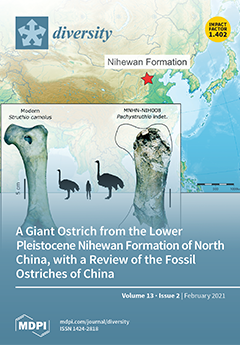
Cover Story: A femur found in 1925 by the French naturalist Emile Licent shows that giant ostriches inhabited what is now Northern China some 1.8 million years ago. The specimen comes from the Lower Pleistocene Nihewan Formation of the Nihewan Basin (Hebei, China). It refers to the extinct genus Pachystruthio, hitherto known from Lower Pleistocene localities in Hungary, Crimea, and Georgia, thus much extending the distribution of Pachystruthio eastward. A mass estimate of 300 kg indicates that this Chinese ostrich was twice the weight of the living ostrich Struthio camelus. Pachystruthio was contemporaneous with the early hominins of the Nihewan Basin. View this paper
  • Issues are regarded as officially published after their release is announced to the table of contents alert mailing list .
  • You may sign up for email alerts to receive table of contents of newly released issues.
  • PDF is the official format for papers published in both, html and pdf forms. To view the papers in pdf format, click on the "PDF Full-text" link, and use the free Adobe Reader to open them.

Articles (64)

  • Article
  • Open Access
5 Citations
3,325 Views
10 Pages

15 February 2021

The leafy liverwort Nowellia curvifolia is a widespread Holarctic species belonging to the family Cephaloziaceae. It is made up of a newly sequenced, assembled and annotated organellar genomes of two European specimens, which revealed the structure t...

  • Article
  • Open Access
21 Citations
5,645 Views
15 Pages

13 February 2021

Understanding temporal changes in the distribution and abundance of various species is one of the key goals of conservation biology. During recent decades, the abundance and distribution of many species of plants and animals have declined dramaticall...

  • Article
  • Open Access
2 Citations
3,003 Views
10 Pages

12 February 2021

The majority of plant diversity in the boreal forest of northern Alberta, Canada is comprised of native understory plant species that are continuously facing competition from other species, including both undesirable native and weedy species. In oil...

  • Article
  • Open Access
21 Citations
9,414 Views
58 Pages

Interstitial Annelida

  • Katrine Worsaae,
  • Alexandra Kerbl,
  • Maikon Di Domenico,
  • Brett C. Gonzalez,
  • Nicolas Bekkouche and
  • Alejandro Martínez

12 February 2021

Members of the following marine annelid families are found almost exclusively in the interstitial environment and are highly adapted to move between sand grains, relying mostly on ciliary locomotion: Apharyngtidae n. fam., Dinophilidae, Diurodrilidae...

  • Article
  • Open Access
16 Citations
4,538 Views
18 Pages

Avian Haemosporidian Diversity on Sardinia: A First General Assessment for the Insular Mediterranean

  • Irene Pellegrino,
  • Luca Ilahiane,
  • Giovanni Boano,
  • Marco Cucco,
  • Marco Pavia,
  • Heather L. Prestridge and
  • Gary Voelker

10 February 2021

The Western Palearctic is one of the most investigated regions for avian haemosporidian parasites (Haemoproteus, Plasmodium and Leucocytozoon), yet geographic gaps in our regional knowledge remain. Here, we report the first haemosporidian screening o...

  • Feature Paper
  • Article
  • Open Access
13 Citations
4,647 Views
15 Pages

10 February 2021

Biomonitoring of phytoplankton communities in freshwater ecosystems is imperative for efficient water quality management. In the present study, we present the seasonal diversity of phytoplankton from the non-reservoir area of the Han River (Korea), a...

  • Feature Paper
  • Review
  • Open Access
57 Citations
13,396 Views
18 Pages

Effects of Human Disturbance on Terrestrial Apex Predators

  • Andrés Ordiz,
  • Malin Aronsson,
  • Jens Persson,
  • Ole-Gunnar Støen,
  • Jon E. Swenson and
  • Jonas Kindberg

9 February 2021

The effects of human disturbance spread over virtually all ecosystems and ecological communities on Earth. In this review, we focus on the effects of human disturbance on terrestrial apex predators. We summarize their ecological role in nature and ho...

  • Article
  • Open Access
9 Citations
4,053 Views
12 Pages

9 February 2021

Numerous amphibian species are declining because of habitat loss and fragmentation due to urbanization of landscapes and the construction of roads. This is a mounting threat to species restricted to habitats close to urban areas, such as agricultural...

  • Article
  • Open Access
24 Citations
6,354 Views
17 Pages

9 February 2021

Landraces are an agri-food and historical-cultural heritage but are undergoing losses worldwide. Italy is taking action to counteract this problem by following European guidelines. One of the most important measures is the Agrobiodiversity National R...

  • Article
  • Open Access
21 Citations
4,992 Views
13 Pages

Long Term Interactions of Native and Invasive Species in a Marine Protected Area Suggest Complex Cascading Effects Challenging Conservation Outcomes

  • Charalampos Dimitriadis,
  • Ivoni Fournari-Konstantinidou,
  • Laurent Sourbès,
  • Drosos Koutsoubas and
  • Stelios Katsanevakis

9 February 2021

Understanding the interactions among invasive species, native species and marine protected areas (MPAs), and the long-term regime shifts in MPAs is receiving increased attention, since biological invasions can alter the structure and functioning of t...

of 7

Get Alerted

Add your email address to receive forthcoming issues of this journal.

XFacebookLinkedIn
Diversity - ISSN 1424-2818