


Abstract
Vinylimidazolium salts constitute a highly relevant class of polymerizable heterocycles, especially in the field of so-called polymer ionic liquids (PILs), and they are frequently used as components of polyelectrolytes. Therefore, crystallographic characterizations, in particular studies of charge distribution and conformational features, can provide fundamental insights concerning ion–ion and ion–dipole interactions. The structure of the title compound [1046127-79-0] has the space group symmetry P21/c. Its asymmetric unit contains one formula unit, consisting of two bromide anions and the halves of two cation moieties. The cation units possess inversion symmetry, and their C6H12 chains adopt an all-trans conformation.
1. Introduction
The title compound is a preferred crosslinker for polyelectrolytes, as its two positively charged terminal heterocyclic moieties render copolymers more swellable in polar solvents, in contrast to the similarly popular ethyleneglycol dimethacrylate, EGDMA [1,2,3], or N,N′-methylenebis(acrylamide), (MBAA) [4]. In general, charge, polarity, surface tension activity, rigidity, length of the spacer, and of course the molar fraction of crosslinking comonomers can have detrimental effects on the properties of the resulting copolymers. It is noteworthy that such bridged vinylimidazolium salts have recently been used as crosslinkers for modified polyacrylamides, enabling highly elastic and mechanically and thermally stable hydrogels [5]. Their swelling degradation resistance proved to be significantly better than that of conventional MBAA copolymer materials.
In particular, various analytical separation methods such as solid phase extraction [6] and specific modes of chromatography advantageously use porous monolithic stationary phases [7]. Effects of varying the amount of crosslinker and the porogen composition on the separation or adsorption performance of the resulting columns or resin beads are of high relevance [4]. Therefore, the use of bis-vinylimidazolium bromides with oligomethylene bridges as crosslinkers offers a powerful toolbox for the production of porous polymer networks, not least because of their high compatibility with common porogen mixtures [8]. This applies in particular to the production of molecularly imprinted polymers (MIPs), which have, apart from separation applications, become established in many fields such as biosensor technology, environmental monitoring, and drug delivery technologies [9]. Accordingly, a series of oligomethylene-bridged vinylimidazolium crosslinkers were investigated as matrix carriers for the production of molecularly imprinted polymeric GUMBOS (group of uniform materials based on organic salts) and have been shown to overcome problems in the synthesis of aqueous MIPs [10].
As for recent examples, perfluoroalkyl-tethered anion-exchange resins, which contain [1046127-79-0], have been disclosed as selective adsorbents for fluorosurfactants from water bodies [11]. In addition, sorbents containing hexamethylene-bridged vinylimidazolium salts have been developed that provide sorption-based SO2-selective porous PILs to treat flue gas streams and minimize sulfur dioxide emissions therefrom [12]. Our interest in the present crystal structure study was originally sparked by the completely unexpected poor solubility of the analogous dichloride salt in all common solvents, including water. As a result, it has not yet been possible to obtain suitable single crystals, which coincides with a surprising lack of information in the literature about this compound. Because of its significantly cheaper synthesis based on 1,6-dichlorohexane, the dichloride salt is potentially an even more attractive crosslinker than its dibromide counterpart.
2. Results and Discussion
Crystal Structure
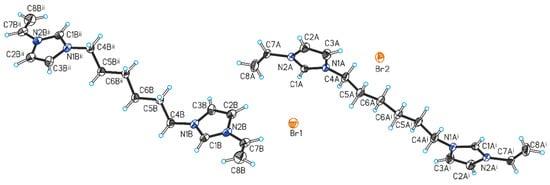
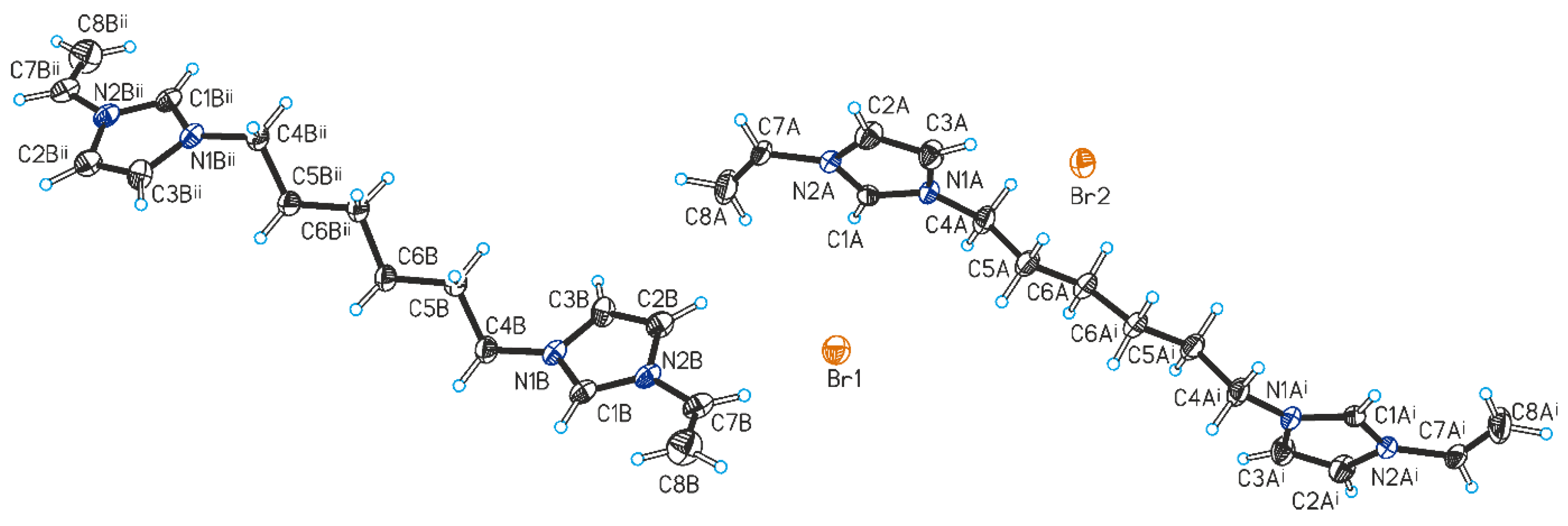
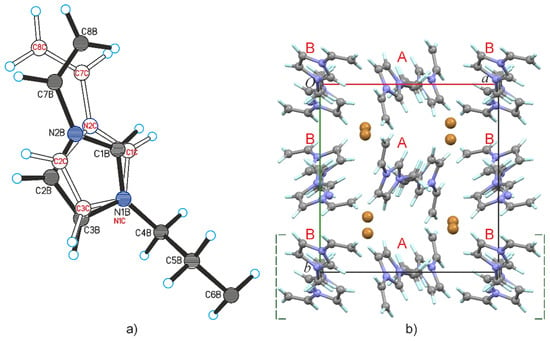
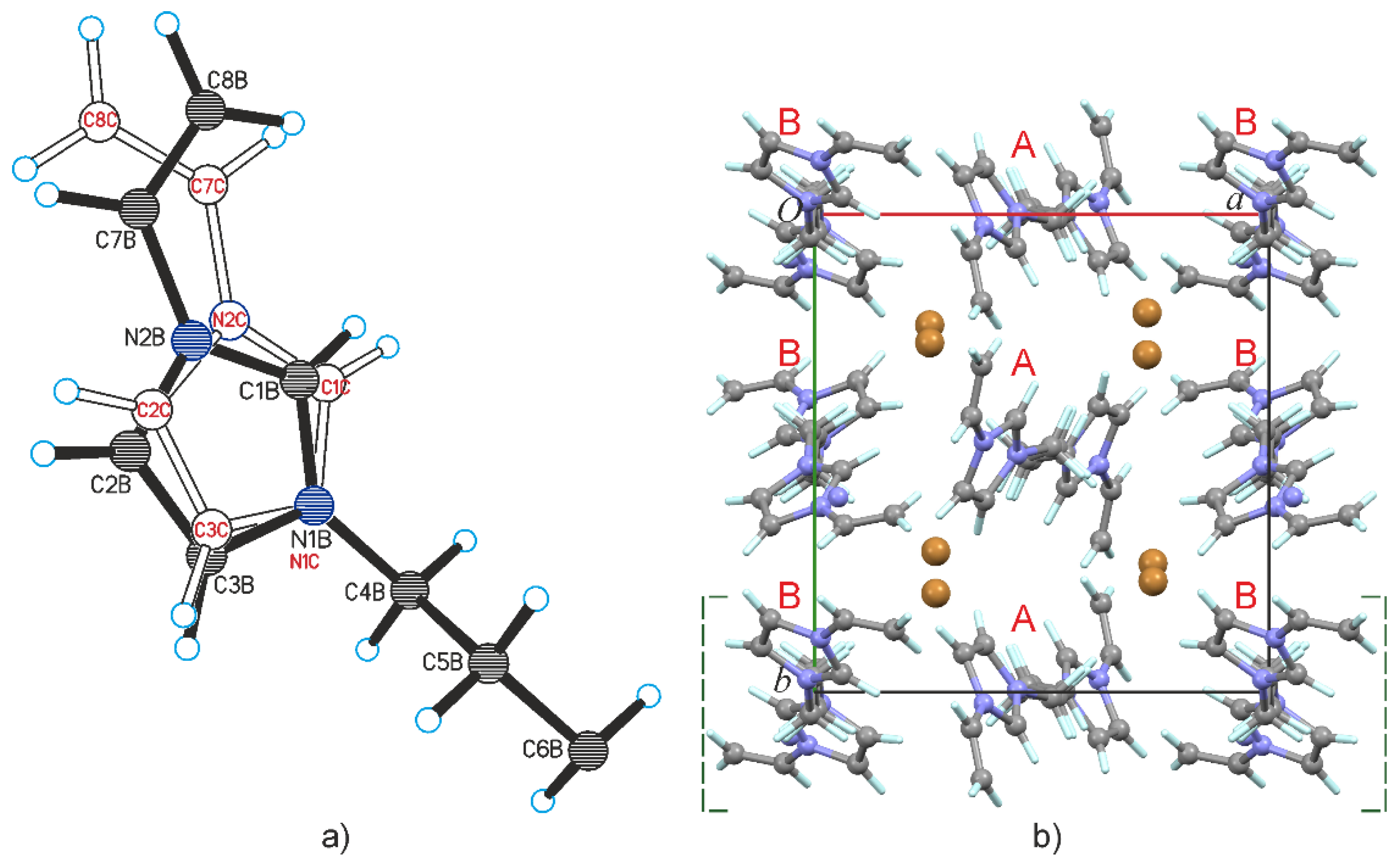
Crystallographic data for [1046127-79-0] and details of the crystal structure determination are collected in Table 1. The asymmetric unit contains one formula unit consisting of the halves of two cation moieties (denoted as A and B) and two bromide anions (Figure 1). Both cations possess inversion symmetry. The C6H12 chains of A and B adopt an all-trans conformation. The mean plane of the alkyl chain is twisted by 54.6 (3)° against the plane of the imidazole ring in A and by 64.1 (6)° in B. The 1-vinylimidazolium unit of cation B was found to be disordered over two sites (N1B > C8B vs. N1C > C8C) with an occupancy ratio of 0.569 (9):0.431 (9). These disorder components represent two fundamentally different orientations of vinyl group with respect to the imidazole ring (Figure 2a). The vinyl group lies almost in the plane of the imidazole ring in each component. It is oriented towards the ring atom C1 in one component [torsion angle C1B–N2B–C7B–C8B = 12.2 (14)°] and towards C2 in the other [C1C–N2C–C7C–C8C = 170.5 (9)°]. As illustrated in Figure 2a, the disorder fragments of B differ slightly in the position of the imidazole ring. For the A-type cation, the C1A–N2A–C7A–C8A torsion of 13.5 (5)° indicates an almost planar 1-vinylimidazolium geometry where the vinyl group is oriented towards the ring atom C1 (similar to the first component of B). The most significant cation⋯cation interactions in the crystal are associated with extensive van der Waals contacts. There are two sets of such interactions, one along the crystallographic c axis (A⋯A and B⋯B) and another (A⋯B) along the a axis. Therefore, cations are most tightly bound to one another within layers parallel to the ac plane; see Figure 2b (bottom). Bromide ions occupy the interlayer space so that each Br− is surrounded by multiple cations and the six shortest Br⋯H separations lie between 2.7 and 3.1 Å.
Table 1.
Crystal data and structure refinement.
Figure 1.
Molecular structure with non-H atoms depicted as ellipsoids at the 50% probability level and H atoms drawn as blue circles of random size (disorder omitted for clarity). Symmetry operations: (i) 1 − x, 1 − y, 2 − z (ii) −x, −y, −z.
Figure 2.
(a) Fragment of molecule B, showing the disorder of the 1-vinylimidazolium unit (N1B > C8B vs. N1C > C8C); (b) crystal packing of cation types A and B and Br− (view along [001]). The bracket at the bottom indicates a layer containing the most significant cation⋯cation interactions (ac plane).
3. Materials and Methods
The synthesis was carried out according to the literature [13] with some adjustments for a larger batch size: 1,6-dibromohexane (96% purity; 38.1 g; 150.0 mmol) and 1-vinylimidazole (99% purity; 28.3 g; 300.0 mmol) were thoroughly mixed at RT and left to stand for 3 h (Scheme 1). Due to the exothermic nature of the reaction and to avoid side reactions, the mixture was then cooled by means of an ice bath for 3 h before the reaction temperature was allowed to return to RT. After 15 h, the mixture was heated to 100 °C for 30 min in order to maximize product formation before the resulting solid block was treated with MeOH (100 mL). The suspension was ultrasonicated by means of an ultrasonic bath, until a clear solution was formed. Thereafter, Et2O (350 mL) was added while stirring. The resulting precipitate was filtered off, washed with Et2O (100 mL), and dried under high vacuum for 24 h, yielding 55.6 g (86%) of pure, white 3,3′-(hexane-1,6-diyl)bis(1-vinylimidazolium) bromide. M.p.: 218 °C. FT-IR (ATR, neat) ν = 3135, 3071, 3029, 2979, 2934, 2915, 2860, 1648, 1571, 1551, 1476, 1394, 1308, 1176, 1112, 956, 918, 823, 734, 622, 592 cm−1. 1H NMR (300 MHz, MeOH–d4) δ = 9.61 (t, J = 1.9 Hz, 2H), 8.14 (t, J = 1.9 Hz, 2H), 7.94 (t, J = 1.9 Hz, 2H), 7.38 (dd, J = 15.6, 8.7 Hz, 2H), 6.04 (dd, J = 15.6, 2.7 Hz, 2H), 5.47 (dd, J = 8.7, 2.7 Hz, 2H), 4.40 (t, J = 7.4 Hz, 4H), 2.02 (m, 4H), 1.50 (m, 4H) ppm (Figure S1). 13C NMR (75 MHz, MeOH–d4) δ = 136.31 (2C), 129.81 (2C), 124.49 (2C), 120.72 (2C), 109.95 (2C), 50.95 (2C), 30.50 (2C), 26.32 (2C) ppm (Figure S2).
Scheme 1.
Synthesis of 3,3′-(hexane-1,6-diyl)bis(1-vinylimidazolium) bromide.
Single-Crystal Structure Determination
White needles of the title compound suitable for structure analysis were obtained through slow evaporation of a methanolic solution of [1046127-79-0]. Intensity data were collected at 173 K, using Mo radiation (λ = 0.71073 Å), on an Oxford Diffraction Gemini-R Ultra diffractometer. The data were corrected for absorption effects by means of comparison of equivalent reflections (Figure S3). The crystal structure was solved by Direct Methods with SIR2004 [14] and refined with the least-squares techniques using SHELXL [15]. H atoms were identified in difference-Fourier maps, and those bonded to carbon atoms were refined using a riding model with Uiso parameters set to 1.2 Ueq of the parent C atom. The two disorder components (i.e., N1B > C8B/N1C > C8C) were refined using restraints on chemically equivalent 1,2- and 1,3-distances. Enhanced rigid bond restraints (RIGU) were applied on the anisotropic displacement parameters of atoms in the two disorder components.
4. Conclusions and Outlook
In conclusion, the structurally characterized title compound will certainly remain an attractive starting material for many fields of materials science. Notably, it can be further converted very efficiently into a neutral, i.e., uncharged, thione system, [2127366-93-0] [16]. Such bridged heterocyclic thione derivatives [17], like other vinylimidazole-based polymers, also offer high potential for use as thermal interface materials (TIMs) with improved interface adhesion to metals [18], which is mediated by the high thiophilicity of metal surfaces. Finally, the thinoes could then be even S-alkylated by another linking reagent [16], which in turn would produce charged heterocyclic moieties bearing four polymerizable vinyl groups available in one hypercrosslinker molecule [19].
Supplementary Materials
Figure S1: 1H-NMR, 3,3′-(hexane-1,6-diyl)bis(1-vinylimidazolium) bromide; Figure S2: 13C-NMR, 3,3′-(hexane-1,6-diyl)bis(1-vinylimidazolium) bromide; Figure S3: Experimental powder X-ray diffraction pattern recorded at room temperature (top) and the simulated PXRD pattern obtained from single-crystal structure data (173 K; bottom).
Author Contributions
Conceptualization, H.S. and G.P.; structure refinement, T.G. and V.K.; software, T.G. and V.K.; crystal growing, G.P.; resources, H.S. and S.N.; writing—original draft preparation, H.S. and J.F.; writing—review and editing, T.G., J.B. and S.N.; visualization, T.G.; supervision, G.P. and H.S.; project administration, J.F. and J.B.; funding acquisition, H.S., J.B. and S.N. All authors have read and agreed to the published version of the manuscript.
Funding
This work is part of the project PFAS-Trap (project no. C220002), funded by the Federal Ministry Republic of Austria, Climate Action, Environment, Energy, Mobility, Innovation and Technology. This work was co-funded by the European Union through the Interreg VI-A Austria–Germany/Bavaria 2021–2027 Programme (ERDF), project PFASelect (Grant No. BA0100270).
Data Availability Statement
CCDC 2478092 contains the supplementary crystallographic data for this paper. These data can be obtained free of charge from the Cambridge Crystallographic Data Centre via www.ccdc.cam.ac.uk/structures. The original contributions presented in this study are included in the article and Supplementary Material. Additional data supporting the findings of this study are available from the corresponding author upon reasonable request.
Acknowledgments
We would like to express our sincere thanks to Raphael Plangger, Innotope GmbH; Innrain 80-82, 6020 Innsbruck, Austria (https://www.innotope.at), for synthesis repetitions analogous to published procedures on a semi-bulk scale of [1046127-79-0] [16].
Conflicts of Interest
Sven Nerdinger was employed by Sandoz GmbH and declares no competing financial interest. The remaining authors declare that the research was conducted in the absence of any commercial or financial relationships that could be construed as a potential conflict of interest.
Abbreviations
The following abbreviations are used in this manuscript:
| PIL | polymer ionic liquid |
| EGDMA | ethylene glycol dimethacrylate |
| MBAA | N,N′-methylenebis(acrylamide) |
| MIP | molecularly imprinted polymer |
| GUMBOS | Group of Uniform Materials Based on Qrganic Salts |
| TIM | thermal interface material |
References
- Kara, A.; Uzun, L.; Beşirli, N.; Denizli, A. Poly(ethylene glycol dimethacrylate-n-vinyl imidazole) beads for heavy metal removal. J. Hazard. Mater. 2004, 106, 93–99. [Google Scholar] [CrossRef] [Scilit] [PubMed]
- Otter, M.; Partl, G.; Noisternig, M.; Bakry, R. Fluoroponytailed ionic liquids as co-porogens for poly(butyl methacrylate-co-ethylene dimethacrylate) monolithic supports for thin layer chromatography. Analyst 2022, 147, 534–541. [Google Scholar] [CrossRef] [Scilit] [PubMed]
- Freilinger, J.; Back, J.O.; Plangger, R.; Schottenberger, H.; Huck, C.W.; Rupprich, M.; Bakry, R. Development of a fluorophilic ion-exchange material with dual binding mechanism for solid-phase extraction of PFAS. J. Hazard. Mater. Lett. 2025, 6, 100158. [Google Scholar] [CrossRef] [Scilit]
- Passamonti, M.; de Roos, C.; Schoenmakers, P.J.; Gargano, A.F.G. Poly(acrylamide-co-N,N’-methylenebisacrylamide) Monoliths for High-Peak-Capacity Hydrophilic-Interaction Chromatography-High-Resolution Mass Spectrometry of Intact Proteins at Low Trifluoroacetic Acid Content. Anal. Chem. 2021, 93, 16000–16007. [Google Scholar] [CrossRef] [Scilit] [PubMed]
- Wang, C.; Guan, X.; Yuan, Y.; Wu, Y.; Tan, S. Polyacrylamide crosslinked by bis-vinylimidazolium bromide for high elastic and stable hydrogels. RSC Adv. 2019, 9, 27640–27645. [Google Scholar] [CrossRef] [Scilit] [PubMed]
- Harder, M.; Bakry, R.; Lackner, F.; Mayer, P.; Kappacher, C.; Grießer, C.; Neuner, S.; Huck, C.W.; Bonn, G.K.; Rainer, M. The Crosslinker Matters: Vinylimidazole-Based Anion Exchange Polymer for Dispersive Solid-Phase Extraction of Phenolic Acids. Separations 2022, 9, 72. [Google Scholar] [CrossRef] [Scilit]
- Murauer, A.; Bakry, R.; Partl, G.; Huck, C.W.; Ganzera, M. Optimization of an innovative vinylimidazole-based monolithic stationary phase and its use for pressured capillary electrochromatography. J. Pharm. Biomed. Anal. 2019, 162, 117–123. [Google Scholar] [CrossRef] [Scilit] [PubMed]
- Lakshmi, D.S.; KS, R.; Castro-Muñoz, R.; Tańczyk, M. Emerging Trends in Porogens toward Material Fabrication: Recent Progresses and Challenges. Polymers 2022, 14, 5209. [Google Scholar] [CrossRef] [Scilit] [PubMed]
- van Wissen, G.; Lowdon, J.W.; Cleij, T.J.; Eersels, K.; van Grinsven, B. Porogenic Solvents in Molecularly Imprinted Polymer Synthesis: A Comprehensive Review of Current Practices and Emerging Trends. Polymers 2025, 17, 1057. [Google Scholar] [CrossRef] [Scilit] [PubMed]
- Hamdan, S.; Moore, L.; Lejeune, J.; Hasan, F.; Carlisle, T.K.; Bara, J.E.; Gin, D.L.; LaFrate, A.L.; Noble, R.D.; Spivak, D.A.; et al. Ionic liquid crosslinkers for chiral imprinted nanoGUMBOS. J. Colloid Interface Sci. 2016, 463, 29–36. [Google Scholar] [CrossRef] [Scilit] [PubMed]
- Freilinger, J.; Bakry, R.; Schottenberger, H.; Obholzer, T.; Rupprich, M.; Färber, R. Method for Removing Per- and Polyfluoroalkyl Substances. U.S. Patent WO2025191130A1, 14 March 2025. [Google Scholar]
- Milind, M.; Vaidya Sebastien, A.; Veera Venkata, R.D.; Lithoxoos, T.G.; Harale, A.; Hamad, F.; AL-OTAIBI, F.D. Reducing Sulfur Emissions of Sulfur Recovery Plant by a Sorption Based SO2 Selective Crosslinked Polyionic Liquid System. U.S. Patent US11759766 B1, 9 September 2025. [Google Scholar]
- Cui, J.; Zhu, W.; Gao, N.; Li, J.; Yang, H.; Jiang, Y.; Seidel, P.; Ravoo, B.J.; Li, G. Inverse opal spheres based on polyionic liquids as functional microspheres with tunable optical properties and molecular recognition capabilities. Angew. Chem. Int. Ed. Engl. 2014, 53, 3844–3848. [Google Scholar] [CrossRef] [Scilit] [PubMed]
- Burla, M.C.; Caliandro, R.; Camalli, M.; Carrozzini, B.; Cascarano, G.L.; de Caro, L.; Giacovazzo, C.; Polidori, G.; Spagna, R. SIR2004: An improved tool for crystal structure determination and refinement. J. Appl. Crystallogr. 2005, 38, 381–388. [Google Scholar] [CrossRef] [Scilit]
- Sheldrick, G.M. Crystal structure refinement with SHELXL. Acta Crystallogr. C Struct. Chem. 2015, 71, 3–8. [Google Scholar] [CrossRef] [Scilit] [PubMed]
- Partl, G.; Laus, G.; Kahlenberg, V.; Huppertz, H.; Schottenberger, H. 3,3′-(Hexane-1,6-diyl)bis(1-vinyl-4-imidazoline-2-thione). IUCrData 2017, 2, x170599. [Google Scholar] [CrossRef] [Scilit]
- Lobana, T.S. Heterocyclic-2-thione derivatives of group 10–12 metals: Coordination versatility, activation of C S (thione) bonds and biochemical potential. Coord. Chem. Rev. 2021, 441, 213884. [Google Scholar] [CrossRef] [Scilit]
- Luo, X.; Lin, Z.; Yang, B.; Rao, T.; Zeng, J.; Jiang, Y.; Ren, L.; Sun, R.; Yao, Y. Poly(ionic liquid)-Based Thermal Interface Materials with Enhanced Interfacial Adhesion and Thermal Stability for Advanced Electronic Cooling. Adv. Mater. Technol. 2025, 10, e01321. [Google Scholar] [CrossRef] [Scilit]
- Zhang, H.; Yin, R.; Wang, C. Recent advances of hyper-crosslinked porous polymers in environment related fields: Synthesis, functionalization, and applications. Environ. Technol. Rev. 2025, 14, 427–457. [Google Scholar] [CrossRef] [Scilit]



Disclaimer/Publisher’s Note: The statements, opinions and data contained in all publications are solely those of the individual author(s) and contributor(s) and not of MDPI and/or the editor(s). MDPI and/or the editor(s) disclaim responsibility for any injury to people or property resulting from any ideas, methods, instructions or products referred to in the content. |
© 2026 by the authors. Licensee MDPI, Basel, Switzerland. This article is an open access article distributed under the terms and conditions of the Creative Commons Attribution (CC BY) license.