
Short Note

(2R,3R,5R,6S)-5-Bromo-2-{[(2R,3R,5R)-3-bromo-5-(propa-1,2-dien-1-yl)tetrahydro-furan-2-yl]methyl}-6-ethyltetrahydro-2H-pyran-3-ol


by
Vincenzo Piccialli
1,*,
Nicola Borbone
2,* and
Monica Terracciano
2
1
Dipartimento di Scienze Chimiche, Università Degli Studi di Napoli Federico II, Via Cintia 4, 80126 Napoli, Italy
2
Dipartimento di Farmacia, Università Degli Studi di Napoli Federico II, Via D. Montesano 49, 80131 Napoli, Italy
*
Authors to whom correspondence should be addressed.
Molbank 2026, 2026(1), M2137; https://doi.org/10.3390/M2137
Submission received: 19 January 2026 / Revised: 5 February 2026 / Accepted: 6 February 2026 / Published: 9 February 2026
(This article belongs to the Section Organic Synthesis and Biosynthesis)

Abstract

As a part of an SAR study aimed at testing the antitumor activity of some C15 acetogenins related to mycalin A, we report here the synthesis of the C-1 debromo-derivative of laurenciallene, a substance recently isolated from the red alga Laurencia obtusa. This new substance has been obtained by the selective, reductive debromination of the terminal bromoallene moiety of laurenciallene with Zn/AcOH. Its structure has been fully characterized by spectral methods, including 2D-NMR spectra.

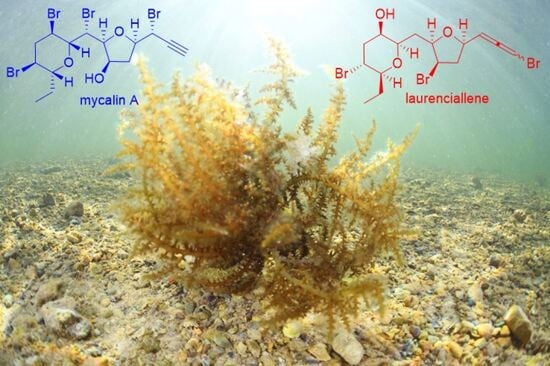
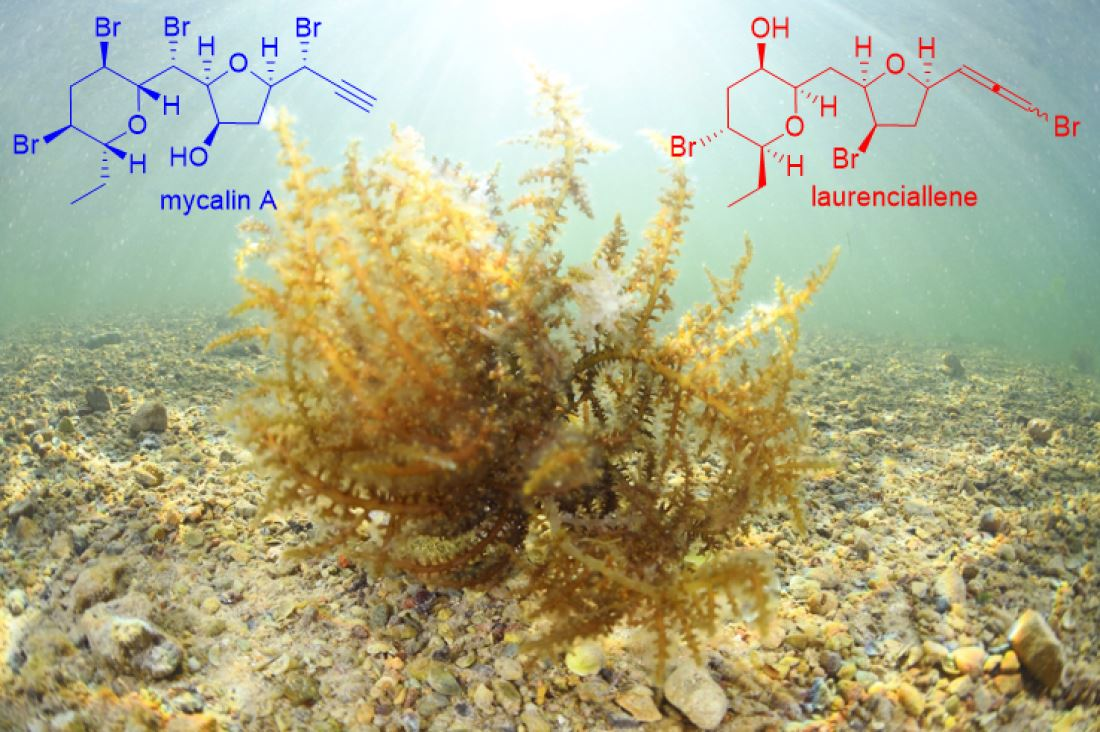
Graphical Abstract

1. Introduction

The search for new biologically active compounds is an important goal in medicinal chemistry. The marine environment has historically furnished a great number of structurally diverse substances, some of which have subsequently become lead compounds for drug development [1].
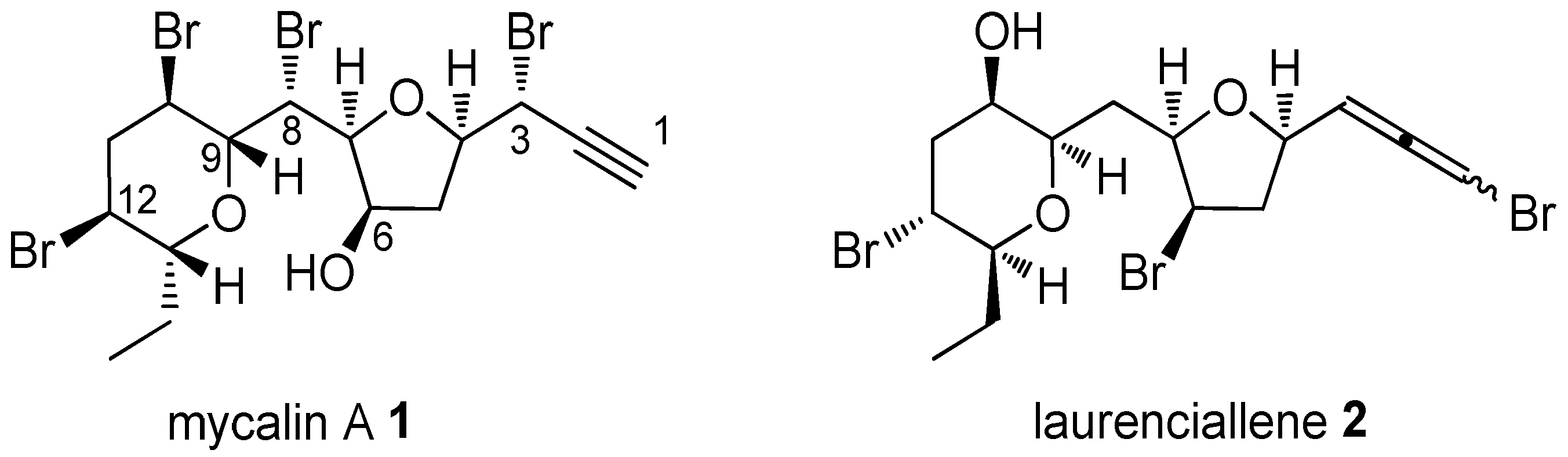
Mycalin A (1, Figure 1) is a polybrominated C15 acetogenin (ACG) isolated some years ago by our group from the encrusting sponge Mycale rotalis [2]. This substance was later isolated from the algae Laurencia paniculata [3], collected at Çeşmealt (Turkey), and Laurencia obtusa [4], collected in the Ionian Greek Sea. We have recently shown that mycalin A possesses strong antiproliferative activity towards the human melanoma (A375), the human cervical adenocarcinoma (HeLa) [5], and the human metastatic melanoma (WM266) cells [6]. Mycalin A was also shown to induce cell death through an apoptotic mechanism on the A375 cell line [5]. In addition, further studies carried out by our group on HeLa cell lysates allowed us to identify mortalin, a protein playing an anti-apoptotic role in cancer, as the main target of mycalin A [7].
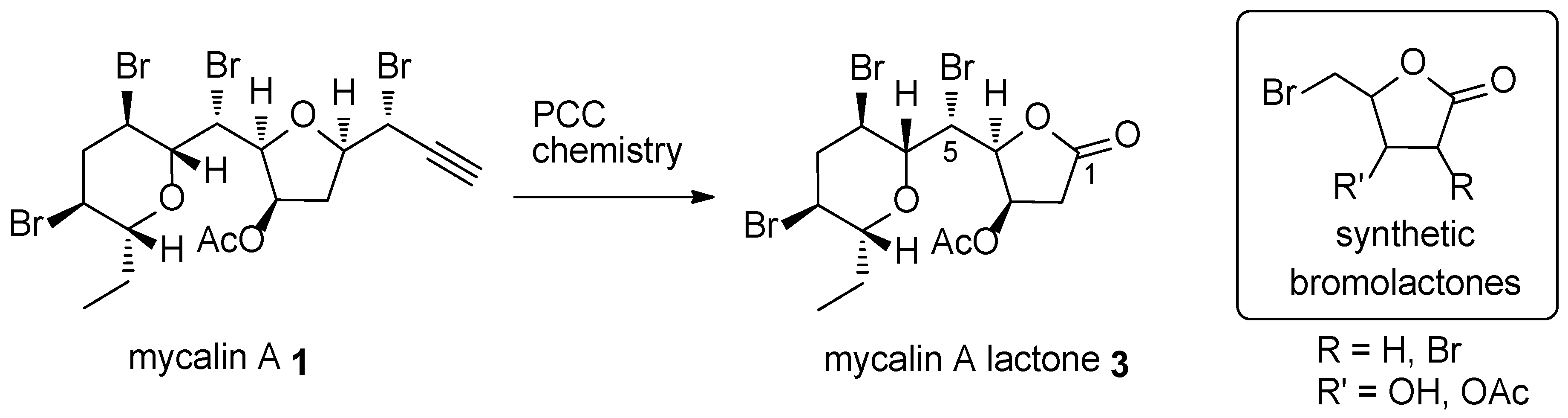
As a part of a structure–activity relationship (SAR) study aimed at selecting derivatives of mycalin A possessing enhanced selectivity towards tumor cells, various analogs and degraded derivatives of this substance [5] were prepared. Among the synthesized compounds, a structurally simplified lactone derivative of mycalin A lactone 3 (Figure 2), lacking the C1–C3 side chain of mycalin A, was shown to be the most active substance, exhibiting a strong cytotoxicity towards both A375 and HeLa cells, but not towards human dermal fibroblasts (HDFs), used as healthy control cells. This finding, and the acquisition of evidence indicating that the THF-containing portion of mycalin A was essential for the antiproliferative activity [5], prompted us to synthesize a number of five-membered bromolactones (Figure 2), structurally related to the C1–C5 portion of mycalin A lactone. Particularly, starting from commercially available D-xylonolactone and D-ribonolactone [6], various simplified bromolactones (Figure 2) retaining the antiproliferative activity and selectivity of mycalin A lactone were easily obtained.

2. Results and Discussion

All the above evidence prompted us to extend our studies to substances related to mycalin A with the aim of studying their antiproliferative properties. Laurenciallene 2 (Figure 1) [8] († Appendix A) is a C15 ACG, recently isolated from the red alga Laurencia obtusa, structurally related to mycalin A. Although both mycalin A and laurenciallene possess the same linear C15 carbon skeleton characterized by a THF/THP-based structure, laurenciallene lacks the bromine atom on the methylene (C-8) bridging the two rings, possesses a terminal bromoallene side-chain in place of a bromo-enine terminus, and a bromine at C-6 in place of the hydroxyl group present in mycalin A. In addition, although it includes substituents at the same positions as mycalin A, the THP ring of laurenciallene is characterized by an opposite configuration at three (C-9, C-12, and C-13) out of its four asymmetric carbons, and by a C-10 OH group in place of the bromine atom present in mycalin A.
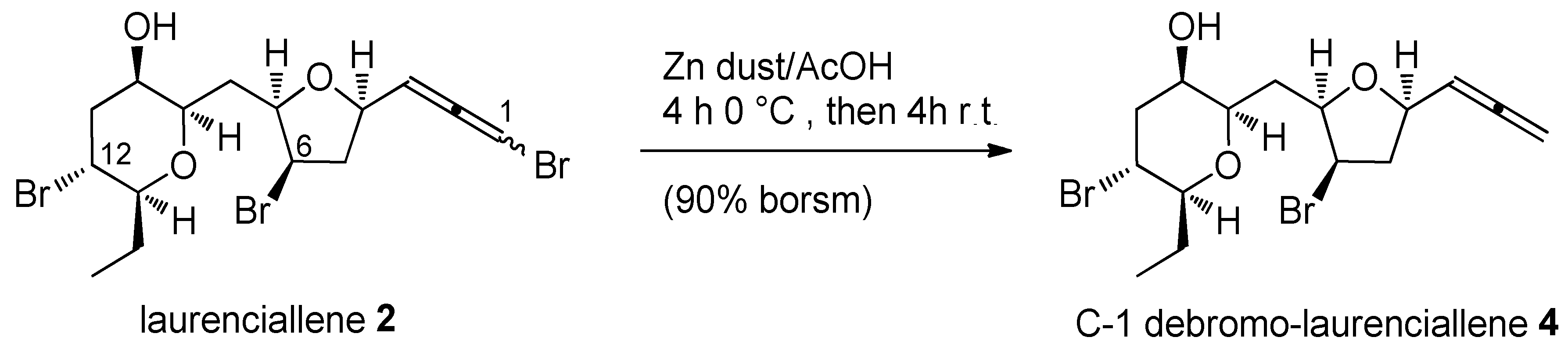
All these structural differences made lurenciallene a good candidate for a structure–activity relationship study, presumably providing access to a new set of mycalin A-like substances, once suitably derivatized. Therefore, as a first step, laurenciallene was isolated from Laurencia obtusa in a sufficient amount to conduct the preparation of a set of its derivatives for SAR studies and biological assays. In this paper, we report the synthesis of one of such derivatives, namely C-1 debromo-laurenciallene 4 (Scheme 1).
It is well known that zinc dust in glacial acetic acid can induce the reductive cleavage of carbon-halogen bonds [9,10,11]. Therefore, treatment of laurenciallene with Zn/AcOH was seen as a way to access debrominated laurenciallene derivatives. Interestingly, when compound 2 was reacted with Zn/AcOH, the sole debromination at C-1 occurred, cleanly giving compound 4 in 90% yield (based on reacted starting material, Scheme 1). No debromination occurred at the other two carbons (C-6 and C-12) carrying bromine atoms, as evaluated by NMR evidence. The selective reactivity observed in this process is an interesting result that is certainly worth further investigation.
Spectral data of 4 were in full agreement with the structure shown. The 1H-NMR spectrum of 4 (see Figure S2 in the Supplementary Material) showed the absence of the signals at 6.11 and 5.11 ppm (H-1 and H-3, respectively, both dd), relevant to the bromoallene side-chain of 2 [8] (Figure S1 in the Supplementary Material shows the proton spectrum of laurenciallene for comparison purposes), while it included signals for a terminal allene function centered at 5.44 ppm (1H, ddd, J = 6.7, 6.7, 6.7, H-3) and 4.85 ppm (2H, AB system further coupled, JAB = 11.1, H2-1) [12]. The rest of the signals belonging to the proton spectrum of 4 showed chemical shifts and shapes almost identical to those exhibited by the corresponding signals in laurenciallene [8], clear evidence of the absence of modifications in the remaining part of laurenciallene. As expected, among these signals, only the one pertinent to H-4 (apparent broad ddd at 4.51 ppm), adjacent to the newly created allene function, was more significantly shifted if compared with the signal pertaining to the same proton in laurenciallene 2 (4.64 ppm, dddd) [see also 1H-NMR data reported in [8]]. 13C-NMR data of 4 (see Figure S3 in the Supplementary Material) were also in perfect accord with the presence in 4 of a terminal allene moiety, showing characteristic signals at 208.32 ppm (C-2), 92.65 ppm (C-3), and 77.10 ppm (C-1) [13]. The 1H-1H COSY spectrum of 4 (see Figure S4 in the Supplementary Material) allowed tracing the sequential connectivity of all the protons of the molecule. As expected, the HSQC spectrum of 4 (see Figure S5 in the Supplementary Material) showed correlation peaks between the proton signals at 5.44 ppm (H-3) and 4.85 ppm (H2-1) and the carbon signals at 92.65 ppm (C-3) and 77.10 ppm (C-1), respectively, relevant to the allene function. All the other 1H-13C correlation peaks included in the HSQC spectrum of 4 paralleled those observed in laurenciallene [8]; the HSQC maps for 2 and 4 were strictly similar to each other as well [see the HSQC spectrum reported in [8]]. Further evidence for the absence of a bromine atom in 4, when compared with 2, was provided by the ESI-MS spectrum of the former, which showed the molecular ion pattern (1:2:1 triplet at m/z 431/433/435 [M + Na]+) expected for a substance containing only two bromine atoms. In addition, the IR spectrum of 4 contained a broad hydroxyl band at nmax = 3417 cm−1 and a low-intensity stretching band at nmax = 1958 cm−1 for the terminal allene moiety.

3. Materials and Methods

3.1. General Information

All reagents were purchased in the highest commercial quality (Aldrich, St. Louis, MO, USA) and used without further purification. Reactions were monitored by thin-layer chromatography carried out on precoated silica gel plates (Merck 60, F254, 0.25 mm thick, Rahway, NJ, USA). Nuclear magnetic resonance (NMR) experiments were acquired on a Bruker Avance Neo 600 MHz spectrometer (Bruker-Biospin, Billerica, MA, USA) in CDCl3. The NMR spectra were processed using the MestReNova (version 14.3.0, Mestrelab Research, Santiago de Compostela, Spain) suite. Proton chemical shifts were referenced to the residual CHCl3 signal (δ = 7.26 ppm). Abbreviations for signal couplings are as follows: s = singlet, d = doublet, t = triplet, q = quartet, m = multiplet, and b = broad. Coupling constants are given in Hertz. The IR spectrum was recorded neat with a Jasco FT-IR 4700 spectrophotometer (JASCO, GmbH, Pfungstandt, Germany) and is reported in cm−1. 13C-NMR chemical shifts were referenced to the solvent (δ = 77.0 ppm). The ESI-MS spectrum was recorded on a Thermo Scientific LTQ XL (Walthman, MA, USA) mass spectrometer in positive mode (MeOH as solvent).

3.2. Extraction of the Alga and Isolation of Laurenciallene 2

The alga L. obtusa was collected in the Stagnone di Marsala lagoon (Sicily) during the autumn of 2020. A voucher specimen is on file in our laboratories in the Dipartimento of Scienze Chimiche, University of Naples Federico II, Naples, Italy. The collected alga was immediately frozen and transported to Naples. The freshly thawed alga was extracted two times with CHCl3-MeOH (1:1). The combined extracts were evaporated under reduced pressure, leaving an aqueous suspension, which was extracted with CHCl3. The dried (Na2SO4) extract was concentrated in vacuo to give an oily residue (11.05 g), which was fractionated on an open Si gel column (500 g, 5 cm diameter) using increasing amounts of EtOAc in petroleum ether as eluent. One of the fractions eluted with petroleum ether–EtOAc 8:2 (2.57 g), containing laurenciallene, was then separated on silica gel, slowly eluting with petroleum ether–EtOAc (9:1) to give a fraction (248 mg) further enriched in laurenciallene. Final separation of this fraction was carried out by HPLC on a Phenomenex Luna silica column (250 × 10 mm, 5m), using n-hexane/EtOAc (8:2), to give pure laurenciallene 2 (76.1 mg).

3.3. Synthesis of C-1 Debromo-Laurenciallene 4

Zn dust (4.2 mg, excess) was added to a solution of laurenciallene 2 (2.4 mg, 0.0049 mmol) in acetic acid (1 mL) at 0 °C under stirring. After 4h at 0 °C and then 4h at r.t., the mixture was filtered, and the filtrate was taken to dry to give 1.9 mg of oil. Separation of this material by HPLC on a Phenomenex Luna silica column (250 × 4.6 mm, 5m, eluent: n-hexane–EtOAc, 8:2) gave 0.9 mg (90%, based on reacted 2) of compound 4 and 0.8 mg of unreacted laurenciallene 2. NMR data of laurenciallene 2 were identical to those reported [8].
4: White solid; IR nmax = 3417, 1958 cm−1; 1H NMR (600 MHz, CDCl3) δ 5.44 (1H, ddd, J = 6.7, 6.7, 6.7, H-3), 4.87 (1H, A part of an AB system further coupled, J = 11.1, 6.6, 1.5, HA-1), 4.83 (1H, B part of an AB system further coupled, J = 11.1, 6.5, 1.5, HB-1), 4.51 (1H, bddd, J = 6.8, 6.8, 6.8, H-4), 4.44 (1H, m, H-6), 4.02 (1H, ddd, J = 12.4, 10.9, 4.6, H-12), 3.83 (1H, ddd, J = 9.6, 3.6, 2.3, H-7), 3.74 (1H, bs, partly overlapped to H-9, H-10), 3.72 (1H, dd, partly overlapped to H-10, J = 9.9, 4.7, H-9), 3.83 (1H, ddd, J = 9.6, 9.6, 2.3, H-13), 2.91 (1H, ddd, J = 15.1, 8.8, 6.6, Ha-5), 2.59 (1H, ddd, J = 13.5, 4.6, 3.6, Heq-11), 2.41 (1H, ddd, J = 14.9, 5.1, 2.1, Hb-5), 2.12 (1H, ddd, 13.1, 13.1, 3.0, Hax-11), 2.04 (1H, m, partly overlapped to other signals, Ha-14), 1.99 (1H, ddd, J = 14.7, 9.6, 2.2, Ha-8), 1.86 (1H, ddd, J = 14.7, 9.6, 4.2, Hb-8), 1.52 (1H, m, Hb-14), 0.97 (3H, dd, J = 7.4, 7.4 H3-15); 13C NMR (150 MHz, CDCl3) δ 208.32, 92.65, 83.44, 78.60, 77.10, 76.18, 69.74, 53.58, 48.08, 43.10, 43.04, 36.25, 29.69, 26.35, 9.56; ESI-MS m/z 431/433/435 (1:2:1) [M + Na]+ 367/369 (1:1) [M + K-HBr]+.

4. Conclusions

In conclusion, the new C-1 debrominated laurenciallene derivative 4 has been synthesized. Further studies to test its antiproliferative activity towards the same tumor cells tested with mycalin A and its derivatives, namely human melanoma (A375), human cervical adenocarcinoma (HeLa), and human metastatic melanoma (WM266) cells, as well as the preparation of other derivatives of laurenciallene, are currently in progress in our laboratories. The results of these studies will be reported in due time.

Supplementary Materials

The following supporting information are available online. Figure S1: 1H-NMR spectrum of laurenciallene 2. Figure S2: 1H-NMR spectrum of 4. Figure S3: 13C-NMR spectrum of 4. Figure S4: 1H-1H COSY spectrum of 4. Figure S5: HSQC spectrum of 4. Figure S6: IR spectrum of 4. Figure S7: ESI-MS spectrum of 4.

Author Contributions

Conceptualization, V.P. and N.B.; methodology, V.P., N.B. and M.T.; investigation, V.P., N.B. and M.T.; data curation, V.P., N.B. and M.T.; writing—original draft preparation, V.P.; writing—review and editing, V.P., N.B. and M.T. All authors have read and agreed to the published version of the manuscript.

Funding

This research received no external funding.

Data Availability Statement

The original contributions presented in this study are included in the article/Supplementary Material. Further inquiries can be directed to the corresponding authors.

Acknowledgments

The author is grateful to the “Centro di Servizi Interdipartimentale di Analisi Strumentale” (CSIAS) for supplying the NMR facilities.

Conflicts of Interest

The authors declare no conflicts of interest.

Appendix A

† Since in the original manuscripts (see [8]) no common name was given to this compound, we here propose the common name of laurenciallene for compound 2.

References

  1. Huffman, B.J.; Shenvi, R.A. Natural products in the “marketplace”: Interfacing synthesis and biology. J. Am. Chem. Soc. 2019, 141, 3332–3346. [Google Scholar] [CrossRef] [PubMed]
  2. Giordano, F.; Mayol, L.; Notaro, G.; Piccialli, V.; Sica, D. Structure and absolute configuration of two new polybrominated C15 acetogenins from the sponge Mycale rotalis. J. Chem. Soc. Chem. Commun. 1990, 22, 1559–1561. [Google Scholar] [CrossRef]
  3. Imre, S.; Aydogmus, Z.; Güner, H.; Lotter, H.; Wagner, H. Polybrominated nonterpenoid C15 compounds from Laurencia paniculata and Laurencia obtusa. Z. Naturforschung 1995, 50C, 743–747. [Google Scholar] [CrossRef]
  4. Mihopoulos, N.; Vagias, C.; Scoullos, M.; Roussis, V. Laurencienyne B, a new acetylenic cyclic ether from the red alga Laurencia obtusa. Nat. Prod. Lett. 1999, 13, 151–156. [Google Scholar] [CrossRef]
  5. Capasso, D.; Borbone, N.; Terracciano, M.; Di Gaetano, S.; Piccialli, V. Antiproliferative activity of mycalin A and its analogues on human skin melanoma and human cervical cancer cells. Mar. Drugs 2020, 18, 402–419. [Google Scholar] [CrossRef] [PubMed]
  6. Capasso, D.; Marino, P.; Di Gaetano, S.; Borbone, N.; Trani, R.; Longo, C.; Piccialli, V. Synthesis of brorminated lactones related to mycalin A: Selective antiproliferative activity on metastatic melanoma cells and inhibition of the cell migration. Mar. Drugs 2023, 21, 349–372. [Google Scholar] [CrossRef] [PubMed]
  7. Morretta, E.; Capuano, A.; D’Urso, G.; Voli, A.; Mozzicafreddo, M.; Di Gaetano, S.; Capasso, D.; Sala, M.; Scala, M.C.; Campiglia, P.; et al. Identification of mortalin as the main interactor of mycalin A, a poly-brominated C15 acetogenin sponge metabolite, by MS-based proteomics. Mar. Drugs 2024, 22, 52–68. [Google Scholar] [CrossRef] [PubMed]
  8. Esselin, H.; Tomi, F.; Bighelli, A.; Sutour, S. New metabolites isolated from a Laurencia obtusa population collected in Corsica. Molecules 2018, 23, 720–729. [Google Scholar] [CrossRef] [PubMed]
  9. Li, Y.; Li, W.D.Z. Reductive transformations mediated by zinc dust in acetic acid. Tetrahedron 2024, 152, 133817. [Google Scholar] [CrossRef]
  10. Xiao, J.; Liu, Z.-H.; He, Z.-F.; He, Q.-Y.; Ding, Y.-C.; Wang, Y.-W.; Han, W.-H.; Peng, Y.; Li, W.-D.Z. Bioinspired divergent synthesis of tricyclic sesquiterpenoids: Cedrane, angular triquinane, allo-cedrane, and zizaene. J. Org. Chem. 2025, 90, 13636–13642. [Google Scholar] [CrossRef] [PubMed]
  11. Xiao, J.; Liu, Z.-H.; He, Z.-F.; Wu, P.; Wang, Y.-W.; Li, W.-D.Z.; Peng, Y. Bioinspired total synthesis of 3-epi-junipercedrol. Org. Lett. 2024, 26, 7463–7467. [Google Scholar] [CrossRef] [PubMed]
  12. Hoffman-Röder, A.; Krause, N. Synthesis and properties of allenic natural products and pharmaceuticals. Angew. Chem. Int. Ed. 2004, 43, 1196–1216. [Google Scholar] [CrossRef] [PubMed]
  13. Spande, T.F.; Jain, P.; Garaffo, H.M.; Pannell, L.K.; Yeh, H.J.C.; Daly, J.W.; Fukumoto, S.; Imamura, K.; Tokuyama, T.; Torres, J.A.; et al. Occurrence and significance of decahydroquinolines from dendrobatid poison frogs and a myrmicine ant: Use of 1H and 13C NMR in their conformational analysis. J. Nat. Prod. 1999, 62, 5–21. [Google Scholar] [CrossRef] [PubMed]
Figure 1. Comparison of the structure of mycalin A and laurenciallene, a substance structurally related to mycalin A.
Molbank 2026 m2137 g001
Figure 2. Preparation of mycalin A lactone (3). Synthetic bromolactones, mimicking the C1–C5 portion of mycalin A lactone, are shown on the right.
Molbank 2026 m2137 g002
Scheme 1. The capton is: Synthesis of C-1 debromo-laurenciallene 4.
Molbank 2026 m2137 sch001
Disclaimer/Publisher’s Note: The statements, opinions and data contained in all publications are solely those of the individual author(s) and contributor(s) and not of MDPI and/or the editor(s). MDPI and/or the editor(s) disclaim responsibility for any injury to people or property resulting from any ideas, methods, instructions or products referred to in the content.