Short Note

Diisopropyl(6-(phenyl(phenylthio)arsaneyl)-1,2-dihydroacenaphthylen-5-yl)phosphane


School of Chemistry, University of St Andrews, St Andrews, Fife KY16 9ST, UK
*
Author to whom correspondence should be addressed.
Molbank 2026, 2026(1), M2139; https://doi.org/10.3390/M2139
Submission received: 19 December 2025 / Revised: 23 January 2026 / Accepted: 4 February 2026 / Published: 10 February 2026

Abstract

Peri-substituted bis(tertiary) phosphine-arsine Acenap(PiPr2)(As(SPh)Ph) (4, Acenap = acenaphthene-5,6-diyl) was synthesized by the reaction of the chloroarsine (PiPr2)(AsPhCl) with PhSLi. The X-ray crystal structure of this compound reveals an intramolecular P∙∙∙As–Cl pnictogen bond, with the phosphorus lone pair donating into the As–S σ* orbital.

1. Introduction

Peri-substitution on naphthalene and related polycyclic hydrocarbons often results in unique bonding and reactivity. This arises from the rigid backbone, which forces the two peri-substituents into close proximity, leading to overlap of their occupied orbitals [1]. For certain combinations of atoms, this enforced interaction can give rise to attractive covalent or non-covalent interactions [2,3].
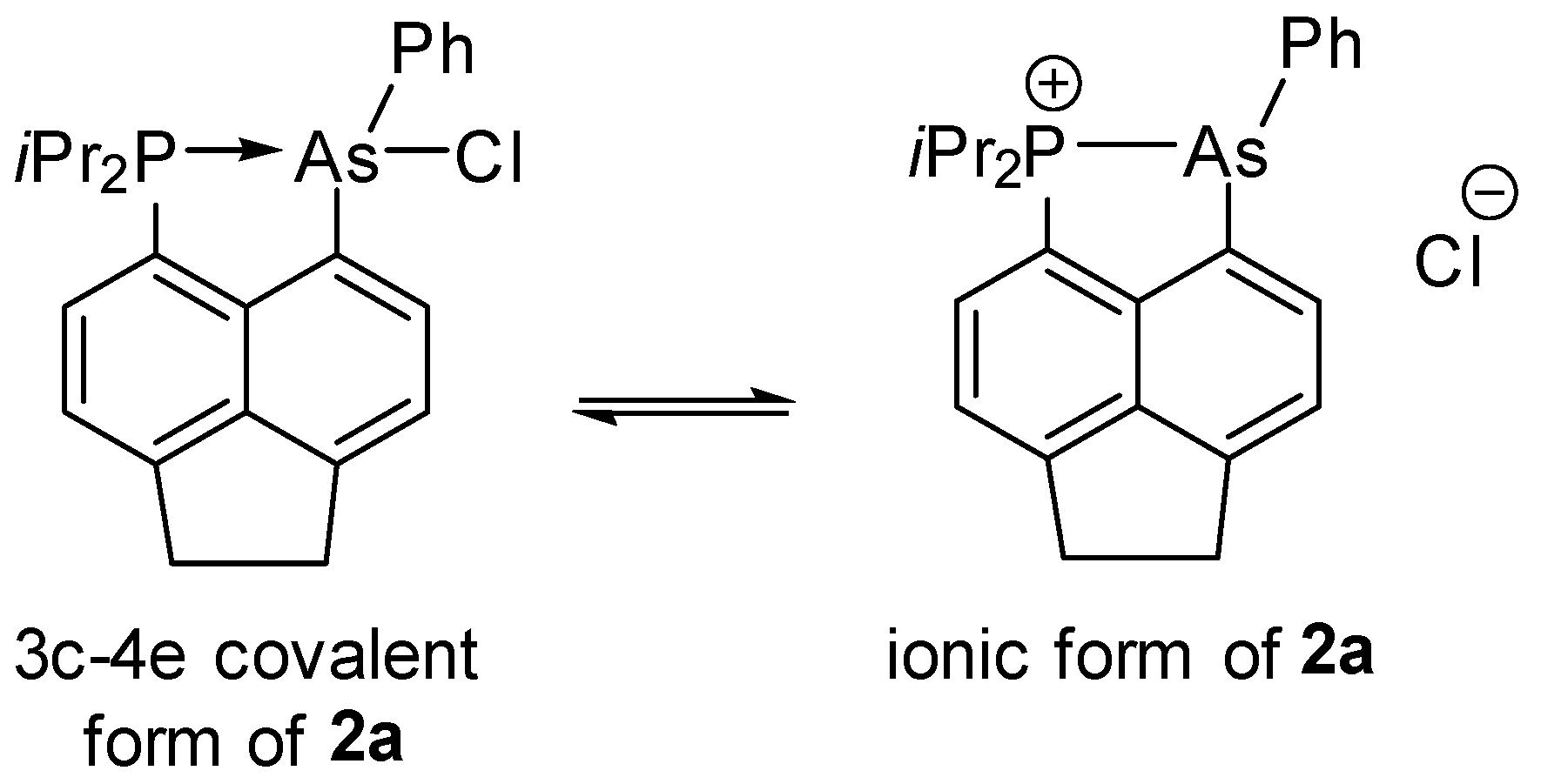
One example of such forced interaction is the bonding observed in the chloroarsine Acenap(PiPr2)(AsPhCl) (2a, Scheme 1) [4]. In this compound, the phosphine lone pair is donated into the As–Cl antibonding (σ*) orbital, forming a near-linear P–As–Cl motif. This results in the substantial elongation of the As–Cl bond (2.9016(8) Å), while the P–As bond length (2.4239(7) Å) is comparable to a standard P–As covalent distance [4]. Compound 2a straddles the boundary between a molecular donor–acceptor complex (3c-4e bonding) and an ionic phosphonium salt. While this 3c-4e bonding is present in the solid state, it is likely that 2a dissociates into ions in solution, as shown in Scheme 1.
Typically, As–Cl bonds are reactive toward nucleophiles. We therefore considered it of interest to investigate whether compound 2a retains this usual reactivity toward nucleophiles, specifically toward the thiolato species PhS, and whether the resulting product (4) will support the 3c-4e bonding observed in the halogen species 2a. The results of our investigations are reported here.

2. Results and Discussion

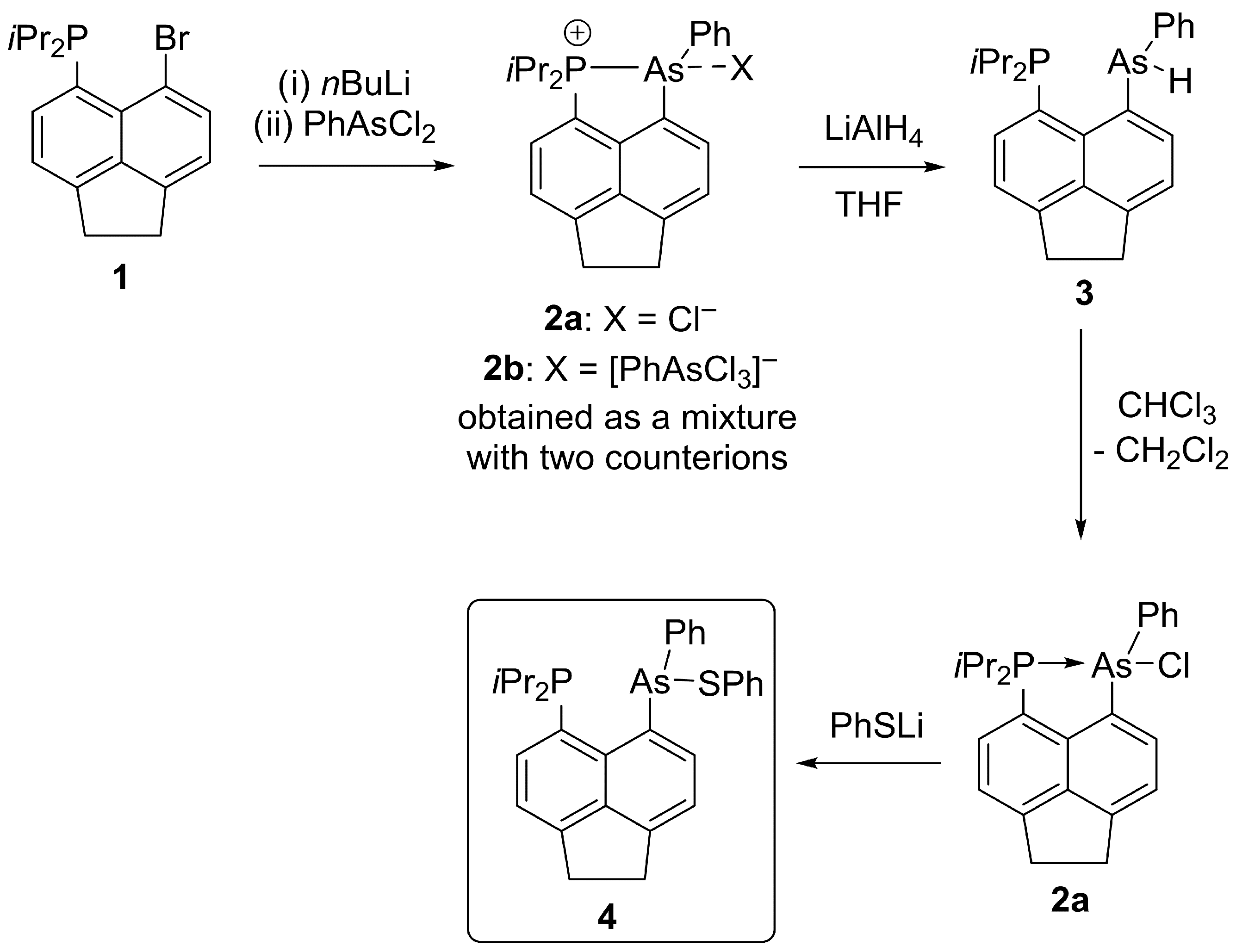
As reported by our group previously [4], the reaction of Acenap(PiPr2)(Li) with PhAsCl2 affords an arsinophosphonium salt with a mixture of two different counterions (Cl (2a) and PhAsCl3 (2b), Scheme 2). While this was not a problem for the synthesis of 3, as the PhAsCl3 anion is removed in the reduction with LiAlH4 [4], it does cause issues in the synthesis of 4. Treatment of the mixture of 2a and 2b with PhSLi afforded 4, contaminated with a significant quantity of an unknown impurity. This impurity appears as several complex multiplets in the aromatic region of the 1H NMR spectrum and is presumed to be the product of PhSLi reacting with the PhAsCl3 counterion.
To circumvent this, the mixture of 2a and 2b was first reduced to 3 and then treated with chloroform. This resulted in chlorination to give pure 2a, which was precipitated with diethyl ether and collected by filtration [4].
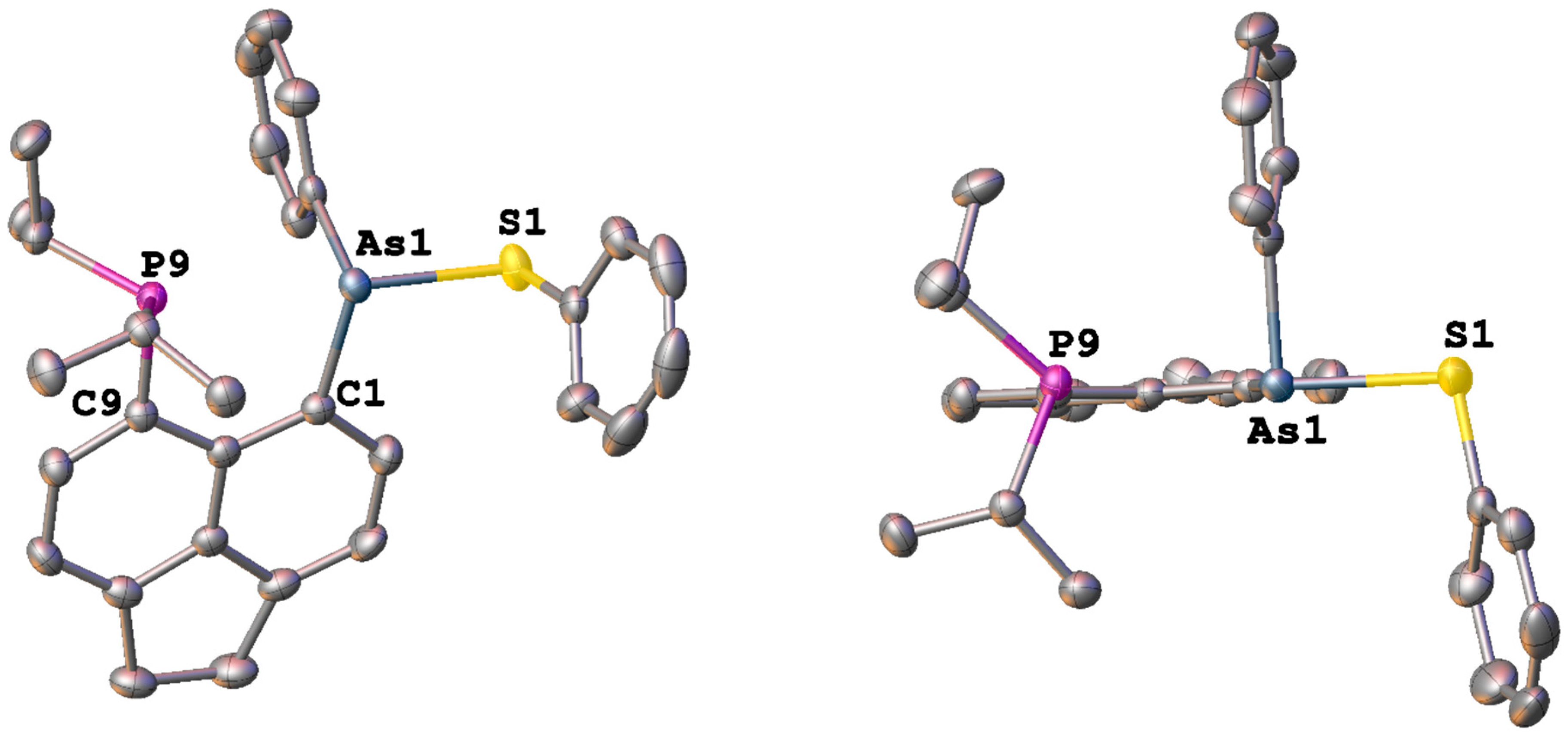
Treatment of 2a with a slight excess of PhSLi afforded 4 in very good yield (89%) and free from impurities. Compound 4 was fully characterized by multinuclear NMR (see Supplementary Materials), mass spectrometry, microanalysis, and single-crystal X-ray diffraction. The solid-state structure of 4 is shown in Figure 1, with data in Table 1.
The solid-state structure of 4 is rather interesting and warrants further examination. As shown in Figure 1 (right), there is an approximately linear arrangement of the phosphorus, arsenic, and sulfur atoms (P···As–S = 176.73(2)°). The P···As distance (2.9232(6) Å) is significantly elongated when compared to the P–As bond length in 2a (2.4239(7) Å). It is too long to be considered a formal P–As bond, yet it is substantially shorter than the sum of the van der Waals radii of the two atoms (4.0 Å) [5]. The As–S bond length of 2.3412(7) Å is longer than a typical As–S bond (median As–S bond length: 2.247 Å) [6], and the molecule appears relatively unstrained, with a modest splay angle (+9.4(4)°) and relatively small out-of-plane displacements (Table 1).
All of these factors point towards the existence of an intramolecular pnictogen bond (i.e., weak attractive interaction), with the phosphorus lone pair donating into the As–S σ* orbital. However, the attractive P···As interaction is much weaker than that observed in the chloro species 2a.
The pnictogen bond nevertheless weakens the As–S bond, which was expected to undergo facile bond cleavage. To probe this, compound 4 was heated under reflux in xylenes, and the reaction was monitored by 31P{1H} NMR spectroscopy. However, 4 proved to be rather thermally robust, as significant decomposition occurred only after several days of heating, leading to a mixture of phosphorus-containing compounds rather than the expected P–As coupling with elimination of PhSiPr. This behaviour was anticipated based on indirect analogy with dealkanative reactions observed for the secondary arsine Acenap(PiPr2)(AsPhH) [4].

3. Materials and Methods

3.1. General Considerations

All synthetic manipulations were performed under an atmosphere of dry nitrogen using standard Schlenk techniques or under an argon atmosphere in a Saffron glove box. Dry solvents were collected from an MBraun SPS-800 Solvent Purification System (Garching, Germany) and stored over appropriate molecular sieves. “In vacuo” refers to a pressure of ca. 1 × 10⁻¹ mbar. Compound 2a was synthesized via a literature method [4].
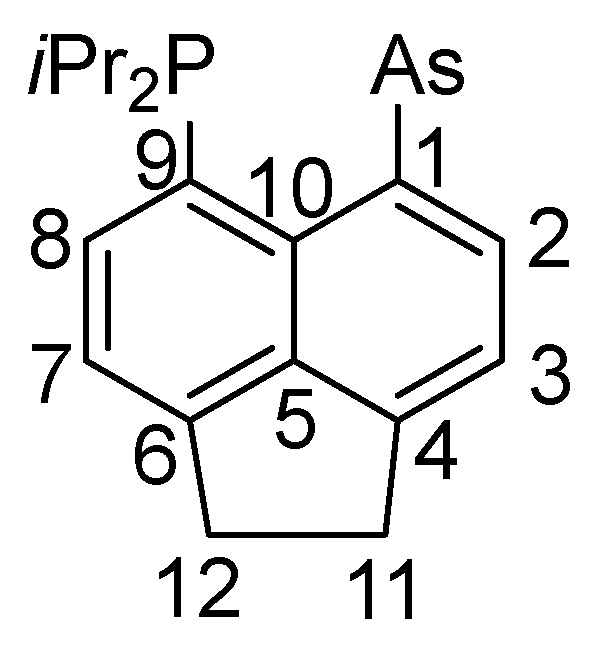
All NMR spectra were recorded at 20 °C using a Bruker AV400 or Bruker AVII400 spectrometer (Ettlingen, Germany). Assignments of 1H and 13C spectra were made in conjunction with H-H DQF COSY, H-C HSQC, and H-C HMBC spectra. 13C NMR spectra were recorded using the DEPTQ pulse sequence with broadband proton decoupling. For both 1H and 13C NMR, chemical shifts are relative to Me4Si, which was used as an external standard. The residual solvent peaks were used for calibration (CHCl3 δH 7.26, δC 77.16 ppm). For 31P NMR, 85% H3PO4 in D2O (δP 0 ppm) was used as an external standard. The NMR numbering scheme is shown in Scheme 3.
Elemental analyses (C, H, and N) were performed at London Metropolitan University. High-Resolution Mass Spectrometry was performed by the EPSRC UK National Mass Spectrometry Facility (NMSF) at Swansea University using a Waters Xevo G2-S (ASAP) mass spectrometer (Milford, MA, USA).

3.2. Synthesis of Acenap(PiPr2)(As(SPh)Ph) (4)

To a stirred solution of thiophenol (0.17 mL, 1.66 mmol) in THF (5 mL), cooled to −78 °C, nBuLi (0.66 mL of a 2.5 M solution in hexanes, 1.66 mmol) was added, and the mixture was stirred for 30 min. The resulting solution was then added dropwise via cannula to a stirred suspension of compound 2a (0.690 g, 1.51 mmol) in THF (30 mL) at −78 °C. The reaction was allowed to warm to room temperature, with stirring overnight, to give a yellow solution. Volatiles were removed in vacuo, the resulting solid was redissolved in toluene (30 mL), and the solution was filtered to remove insoluble impurities. Volatiles were removed in vacuo to give the product as a yellow oil. Trituration with hexane (20 mL) and removal of solvent in vacuo afforded 4 as a pale yellow solid (0.713 g, 1.34 mmol, 89%).
Crystals suitable for single-crystal X-ray diffraction were grown from acetonitrile at room temperature.
Found: C 67.84; H 6.01. Calc. for C30H32AsPS: C 67.92; H 6.08.
1H NMR δH (400 MHz; CDCl3) 8.96 (1H, d, 3JHH = 7.2 Hz, 2-H), 7.59 (1H, dd, 3JHH = 7.1 Hz, 3JHP = 4.8 Hz, 8-H), 7.50 (1H, 3JHH = 7.2 Hz, 3-H), 7.41–7.38 (2H, m, SPh o-Ph CH), 7.36 (1H, d, 3JHH = 7.1 Hz, 7-H), 7.35– 7.31 (2H, m, o-Ph CH), 7.20–7.16 (3H, m, m/p-Ph CH), 7.15–7.10 (2H, m, SPh m-Ph CH), 7.07–7.02 (1H, m, SPh p-Ph CH), 3.47 (4H, s, 11-H, 12-H), 2.32–2.12 (2H, m, 2 × iPr CH), 1.14 (3H, dd, 3JHP = 15.0 Hz, 3JHH = 7.0 Hz, iPr CH3), 1.06 (3H, dd, 3JHP = 10.8 Hz, 3JHH = 7.0 Hz, iPr CH3), 0.88 (3H, dd, 3JHP = 16.1 Hz, 3JHH = 6.9 Hz, iPr CH3), 0.10 (3H, dd, 3JHP = 14.4 Hz, 3JHH = 7.0 Hz, iPr CH3).
13C{1H} NMR δC (101 MHz; CDCl3) 149.8 (s, qC-6), 148.1 (d, 4JCP = 1.8 Hz, qC-4), 142.2 (d, 5JCP = 5.7 Hz, i-Ph qC), 140.8 (d, 2JCP = 34.5 Hz, qC-10), 140.5 (s, SPh i-Ph qC), 140.2 (d, 3JCP = 11.6 Hz, qC-5), 137.9 (s, C-2), 133.8 (d, 2JCP = 3.2 Hz, C-8), 133.2 (d, 6JCP = 1.8 Hz, o-Ph CH), 132.9 (s, qC-1), 131.7 (s, SPh o-Ph CH), 128.42 (s, m/p-Ph CH), 128.38 (s, m/p-Ph CH), 127.9 (s, SPh m-Ph CH), 126.7 (d, 1JCP = 4.6 Hz, qC- 9), 124.5 (s, SPh p-Ph CH), 120.7 (s, C-3), 119.4 (d, 3JCP = 1.8 Hz, C-7), 30.7 (s, C-11/C-12), 30.0 (s, C- 11/C-12), 25.8 (d, 1JCP = 5.9 Hz, iPr CH), 25.1 (d, 1JCP = 15.2 Hz, iPr CH), 19.7 (d, 2JCP = 9.5 Hz, iPr CH3), 19.0 (d, 2JCP = 16.3 Hz, iPr CH3), 18.7 (s, iPr CH3), 18.1 (d, 2JCP = 9.7 Hz, iPr CH3).
31P NMR δP (109 MHz; CDCl3) −8.5 (m).
31P{1H} NMR δP (109 MHz; CDCl3) −8.5 (s).
MS (ASAP+) m/z 379.06 (32%, M − SPh − iPr + H), 421.11 (100, M − SPh + H), 531.13 (2, M + H).
HRMS (ASAP+) Found: 531.1256; Calc. for C30H33AsSP (M + H): 531.1257.

3.3. X-Ray Experimental

X-ray diffraction data for compound 4 were collected at 173 K using a Rigaku FR-X Ultrahigh Brilliance Microfocus RA generator/confocal optics [Mo Kα radiation (λ = 0.71075 Å)] with an XtaLAB P200 diffractometer (Rigaku Corporation, Tokyo, Japan). Intensity data were collected using ω steps, accumulating area detector images spanning at least a hemisphere of reciprocal space. All data were corrected for Lorentz, polarization effects, and absorption using CrystalClear [7]. The structure was solved by Patterson methods (PATTY [8]) and refined by full-matrix least-squares against F2 (SHELXL-2025/1 [9]). Non-hydrogen atoms were refined anisotropically, and hydrogen atoms were refined using a riding model. All calculations were performed using the CrystalStructure [10] interface.
Crystal data for 4: C30H32AsPS, M = 530.54, monoclinic, a = 10.7791(12), b = 12.6606(13), c = 19.5130(18) Å, β = 103.212(3)°, Vol. = 2592.5(5) Å3, T = 173 K, space group P21/n (no. 14), Z = 4, 31,236 reflections measured, 4744 unique (Rint = 0.0376), which were used in all calculations. The final R1 [I > 2σ(I)] was 0.0281, and wR2 (all data) was 0.0582.

4. Conclusions

The presence of a near-linear P···As–S motif in the structure of 4 is indicative of pnictogen-bond formation, with the As–S(Ph) fragment acting as the pnictogen-bond donor. Structural analysis of 4 suggests that either the σ* orbital associated with the As–Cipso (phenyl) bond or that of the As–S bond could, in principle, participate in pnictogen bonding. The observed interaction, however, demonstrates a clear preference for the involvement of the As–S σ* orbital, indicating that the As–S fragment is the more effective pnictogen-bond donor in this system.

Supplementary Materials

The following supporting information can be downloaded online, Figure S1. 31P{1H} NMR spectrum of 4; Figure S2. 31P NMR spectrum of 4; Figure S3. 1H NMR spectrum of 4; Figure S4. 13C{1H} DEPTQ NMR spectrum of 4; Figure S5. MS (ASAP) spectrum of 4; Figure S6. Exact mass (ASAP) spectrum of 4; Figure S7. Exact mass (ASAP) spectrum of 4, elemental composition report.

Author Contributions

Conceptualization, P.K. and L.J.T.; investigation, L.J.T. and P.P.; crystallography, D.B.C.; writing—original draft preparation, L.J.T. and P.K.; writing—review and editing, P.K. and D.B.C.; supervision, P.K. All authors have read and agreed to the published version of the manuscript.

Funding

This research received no external funding.

Data Availability Statement

CCDC 2512960 contains the supplementary crystallographic data for this paper. These data can be obtained free of charge from The Cambridge Crystallographic Data Centre via www.ccdc.cam.ac.uk/structures. The research data supporting this publication can be accessed at https://doi.org/10.17630/7b4b4ea0-3229-4aaa-bc72-89c4ac6c6460.

Conflicts of Interest

The authors declare no conflicts of interest.

References

  1. Kilian, P.; Knight, F.R.; Woollins, J.D. Naphthalene and Related Systems peri-Substituted by Group 15 and 16 Elements. Chem.–A Eur. J. 2011, 17, 2302–2328. [Google Scholar] [CrossRef] [PubMed]
  2. Chalmers, B.A.; Bühl, M.; Athukorala Arachchige, K.S.; Slawin, A.M.Z.; Kilian, P. Structural, Spectroscopic and Computational Examination of the Dative Interaction in Constrained Phosphine–Stibines and Phosphine–Stiboranes. Chem.–A Eur. J. 2015, 21, 7520–7531. [Google Scholar] [CrossRef] [PubMed]
  3. Hupf, E.; Lork, E.; Mebs, S.; Chęcińska, L.; Beckmann, J. Probing Donor–Acceptor Interactions in peri-Substituted Diphenylphosphinoacenaphthyl–Element Dichlorides of Group 13 and 15 Elements. Organometallics 2014, 33, 7247–7259. [Google Scholar] [CrossRef]
  4. Taylor, L.J.; Buhl, M.; Chalmers, B.A.; Ray, M.J.; Wawrzyniak, P.; Walton, J.C.; Cordes, D.B.; Slawin, A.M.Z.; Woollins, J.D.; Kilian, P. Dealkanative Main Group Couplings across the peri-Gap. J. Am. Chem. Soc. 2017, 139, 18545–18551. [Google Scholar] [CrossRef] [PubMed]
  5. Batsanov, S.S. Van der Waals Radii of Elements. Inorg. Mater. 2001, 37, 871–885. [Google Scholar] [CrossRef]
  6. Thomas, I.R.; Bruno, I.J.; Cole, J.C.; Macrae, C.F.; Pidcock, E.; Wood, P.A. WebCSD: The online portal to the Cambridge Structural Database. J. Appl. Crystallogr. 2010, 43, 362–366. [Google Scholar] [CrossRef] [PubMed]
  7. CrystalClear-SM Expert, v2.1; Rigaku Americas: The Woodlands, TX, USA; Rigaku Corporation: Tokyo, Japan, 2015.
  8. Beurskens, P.T.B.G.; de Gelder, R.; Garcia-Granda, S.; Gould, R.O.; Israel, R.; Smits, J.M.M. DIRDIF-99; Crystallography Laboratory, University of Nijmegen: Nijmegen, The Netherlands, 1999. [Google Scholar]
  9. Sheldrick, G.M. Crystal structure refinement with SHELXL. Acta Crystallogr. Sect. C Struct. Chem. 2015, 71, 3–8. [Google Scholar] [CrossRef] [PubMed]
  10. CrystalStructure, v4.3.0; Rigaku Americas: The Woodlands, TX, USA; Rigaku Corporation: Tokyo, Japan, 2018.
Scheme 1. Covalent and ionic forms of Acenap(PiPr2)(AsPhCl) 2a.
Molbank 2026 m2139 sch001
Scheme 2. Synthesis of compound 4.
Molbank 2026 m2139 sch002
Figure 1. Structure of 4 in the solid state, shown from two different angles. (Left): View approximately perpendicular to the acenaphthene ring. (Right): View along the acenaphthene ring, highlighting the near-linear arrangement of the P9∙∙∙As1-S1 motif. Hydrogen atoms are omitted for clarity. Thermal ellipsoids are drawn at 50% probability.
Molbank 2026 m2139 g001
Scheme 3. NMR numbering scheme.
Molbank 2026 m2139 sch003
Table 1. Selected geometric parameters for 4.
Distances (Å)
C1–As12.005(2)C9–P91.824(2)
As1···P92.9232(6)As1–S12.3412(7)
Displacements (Å)
out-of-plane displacement (As1)0.022(2)out-of-plane displacement (P9)0.167(2)
Angles (Å)
P9···As1–S1176.73(2)Splay angle a +9.4(4)
a The splay angle is defined as the sum of the bay-region angles minus 360°.
Disclaimer/Publisher’s Note: The statements, opinions and data contained in all publications are solely those of the individual author(s) and contributor(s) and not of MDPI and/or the editor(s). MDPI and/or the editor(s) disclaim responsibility for any injury to people or property resulting from any ideas, methods, instructions or products referred to in the content.