


Abstract
Low Molecular Weight Glutenin Subunits (LMW-GS) proteins have great effects on the end-use quality of bread wheat and are difficult to differentiate directly. It is very important to characterize and classify LMW-GS genes systematically. In this paper, 692 complete Glu-3 gene sequences were retrieved from GenBank and were grouped based on their sequence characters and variations. Based on the characters of their N-terminal sequences, these genes were classified into two types, LMW-m and LMW-i, of which LMW-m genes were further classified into three sub-types based on their first amino acid (AA) (LMW-M, LMW-V and LMW-I). Based on the first seven or eight AA variations in the N-terminal sequence, LMW-GS Glu-3 genes were classified into 16 types, namely LMW-N1 to LMW-N16. Based on the last 10 AA variations in the C-terminal, the Glu-3 genes were classified into 22 types, designated as LMW-C1 to LMW-C22. Based on the number and distribution of cysteines, the Glu-3 genes classified into 22 types included 7 conventional types with eight cysteines and 15 variant types with seven or nine cysteines. In addition, two new Glu-A3 genes (GluA-10 and GluA-11) were identified based on their sequence homology, and the connection between different classification methods was analyzed briefly. The results provide insight into the nature of the Glu-3 gene family and are valuable for molecular marker-assisted selection of end-use quality traits in wheat improvement.
1. Introduction
Wheat is one of the most widely cultivated crops in the world, with more than 220 million ha planted annually under a wide range of climatic conditions and in many geographic regions [1]. Bread wheat (Triticum aestivum L., n = 7, AABBDD) flour has distinctive properties for forming doughs that are suited for the production of breads and lots of other important foods [2,3]. The processing properties of wheat flour are mainly affected by HMW-GS and LMW-GS proteins that form the disulphide-bonded gluten macropolymer [4,5,6] and contribute to the basic aspects of dough quality such as viscoelasticity and extensibility [7,8,9]. Therefore, HMW-GS and LMW-GS genes are essential for improving wheat’s end-use quality [10,11,12,13,14].
LMW-GS represents approximately one third of total seed storage proteins and 60% of the gluten fraction, and it has great effects on the end-use quality of bread wheat [15,16]. Most LMW-GS genes are encoded by the composite gene loci of Glu-A3, Glu-B3 and Glu-D3 on the short arms of the group 1 chromosomes of wheat [17,18,19,20], though LMW-GS loci on other chromosomes have also been reported, such as Glu-B2 and Glu-B4 on 1B [21,22], Glu-D4 on 1D and Glu-D5 on 7D [23]. Due to their clear resolution by gel electrophoresis and low gene copy number, the allelic variation in HMW-GS and its relation to wheat quality have been widely studied, and PCR-based DNA markers are available to differentiate the most important Glu-1 alleles [24,25,26]. However, the resolution of gel electrophoresis-based LMW-GS analysis is low, and it is difficult to distinguish different alleles by analyzing the proteins directly because of their larger number of expressed subunits and their overlapping mobility with abundant gliadin proteins [27,28,29,30]. In view of this, the effects of individual LMW-GS genes on wheat quality are not very clear [31], and it is essential to characterize and categorize wheat LMW-GS genes and their deduced AA sequences.
A lot of LMW-GS genes or partial genes from bread wheat and its relatives have been cloned and registered in GenBank [32,33,34,35,36,37,38]. Zhao et al. cloned six different Glu-D3 genes, identified 12 haplotypes in the six varieties and made a clear distinction among the subunits, coding genes, alleles and haplotypes of Glu-D3 proteins [39,40]. Wang et al. identified six Glu-B3 genes with 26 allelic variants and five Glu-A3 genes with 19 allelic variations, respectively, and developed some DNA markers for their use in wheat breeding [41,42]. Based on the first AA presented in the N-terminal sequences of the glutenin subunits, three types of LMW-GS genes were identified, including LMW-s, starting with serine, LMW-I, starting with isoleucine, and LMW-m, starting with methionine [43,44,45,46]. Ikeda et al. further classified the LMW-GS genes into 12 groups according to their deduced amino acid sequences and, in particular, the number and position of cysteine residues [47], which could form intermolecular disulphide bonds [48]. Long et al. retrieved sixty-nine LMW-GS genes from GenBank and categorized them into nine groups using the deduced amino acid sequences of their highly conserved N-terminal domains [49]. With the increase in genes registered in GenBank, new types of Glu-3 genes have been found, necessitating re-analysis of Glu-3 gene sequences.
In our previous study, 146 Glu-A3 genes, 136 Glu-B3 genes and 311 Glu-D3 genes with complete coding sequences were retrieved from GenBank, and they were classified into 9 Glu-A3 genes with 69 allelic variants, 11 Glu-B3 genes with 64 allelic variants and 10 Glu-D3 genes with 96 variants, respectively, based on a homology comparison of nucleotide and deduced amino acid sequences [50]. In the present paper, more Glu-3 genes were obtained from GenBank and were used to characterize and categorize LMW-GS genes systematically, as well as to verify and improve traditional classification methods. The results will be conducive to understanding LMW-GS genes more clearly and will provide a theoretical reference for the molecular marker-assisted improvement in wheat quality traits.
2. Results
The deduced amino acid sequences of 692 Glu-3 genes with complete coding regions were compared, analyzed and classified based on the variations in their N-terminal sequences, C-terminal sequences and cysteine number and distribution. The results were as follows:
2.1. Classification of LMW-GS Genes Based on the Amino Acid Variations in Their N-Terminal Sequences
Based on the sequence variation in the N-terminal domain, two types of LMW-GS proteins were found among the 692 haplotypes, designated LMW-m and LMW-i, which accounted for 88.15% and 11.85% of the total, respectively (Table 1 and Table S1). Further analysis showed that the LMW-i type was relatively stable and had no variation at the first six AA loci in the N-terminal region. However, the LMW-m type had three allelic variants at the first AA locus, which were designed as LMW-M, LMW-I and LMW-V (using capital letters here to distinguish from LMW-m and LMW-i), accounting for 86.56%, 1.45% and 0.14%, respectively.
Table 1.
The first 7 or 8 AA variations in N-terminal sequences.
Based on the first seven or eight AAs in the N-terminal sequences, the LMW-m type was further divided into 15 sub-types, i.e., METSCIP, METSCIS, METSHIPG, METSHIPS, METSRVP, METRCIP, METRCVP, METSCIH, METSQIP, MDTSCIP, MDTSYIP, MEARCIP, MENSHIP, IENSHIP and VETSRVP, designed as LMW-N1 to LMW-N15 (shortened as N1 to N15 in this paper), respectively (Table 1 and Table S1). It was obvious that N6 was the most abundant variation type, accounting for 18.79%, followed by N5 (14.02%), N2 (13.01%), N13 (11.27%), N4 (10.12%) and N1 (8.38%). On the contrary, N7, N8, N12 and N15 were the least abundant LMW-m genes, each of which had only one variant in the 692 sequences. In addition, the fifth AA locus at the N-terminal was the most variable one with five allelic variations, compared with two or three mutations at the other AA loci (Table S1).
2.2. Classification of LMW-GS Genes Based on the Amino Acid Variations in C-Terminal Sequences
The sequence analysis of C-terminal peptides showed that there was no variation at the 11th AA (P) locus from the end, so the last 10 AAs were chosen for analysis of LMW-GS types. The grouping results presented that the 692 Glu-3 genes were divided into 22 LMW-GS types, i.e., FGVGTGVGAY, FGVGAGVGAY, FGVGTGVGGY, FGVGTQVGAY, FGVGTRVGAY, FDVGTGVGAY, FGVDTGVGAY, FSVGTGVGAY, FGVSAGVGAY, FGVGSGVGAY, FGVGTGVSAY, FAVGTGVSAY, FGVGTGVGSY, FSIGTGVGAY, FSIGTGVGGY, LGVGSRVGAY, LGVGIGVGVY, LGVGIRVGVY, LGIGIGVGVY, LSIGTGVGGY, LGVGTGVGAY and LGVGIGVGXY, which were designated as LMW-C1 to LMW-C22 (here simplified as C1 to C22) (Table 2 and Table S2).
Table 2.
The last 10 AA variations in C-terminal sequences.
Among the 22 LMW-GS types, C1 was the predominant variation type, accounting for 33.82%, followed by C15 (11.56%), C5 (10.84%) and C17 (9.25%). Contrarily, C7, C9, C10, C12, C18, C20 and C21 were the least variable, with only one allelic variant in each group among the 692 sequences. Furthermore, the second AA from the last had the most variation (five), followed by the sixth and ninth AAs from the end, each having four variants. In addition, the last (Y) and the fourth (V) AAs backwards were very conserved, with no SNP found in the 692 Glu-3 genes.
2.3. Classification of LMW-GS Genes Based on the Number and Distribution of Conserved Cysteine Residues
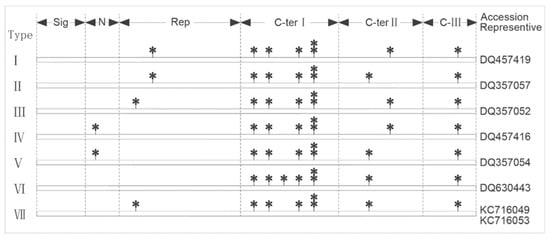
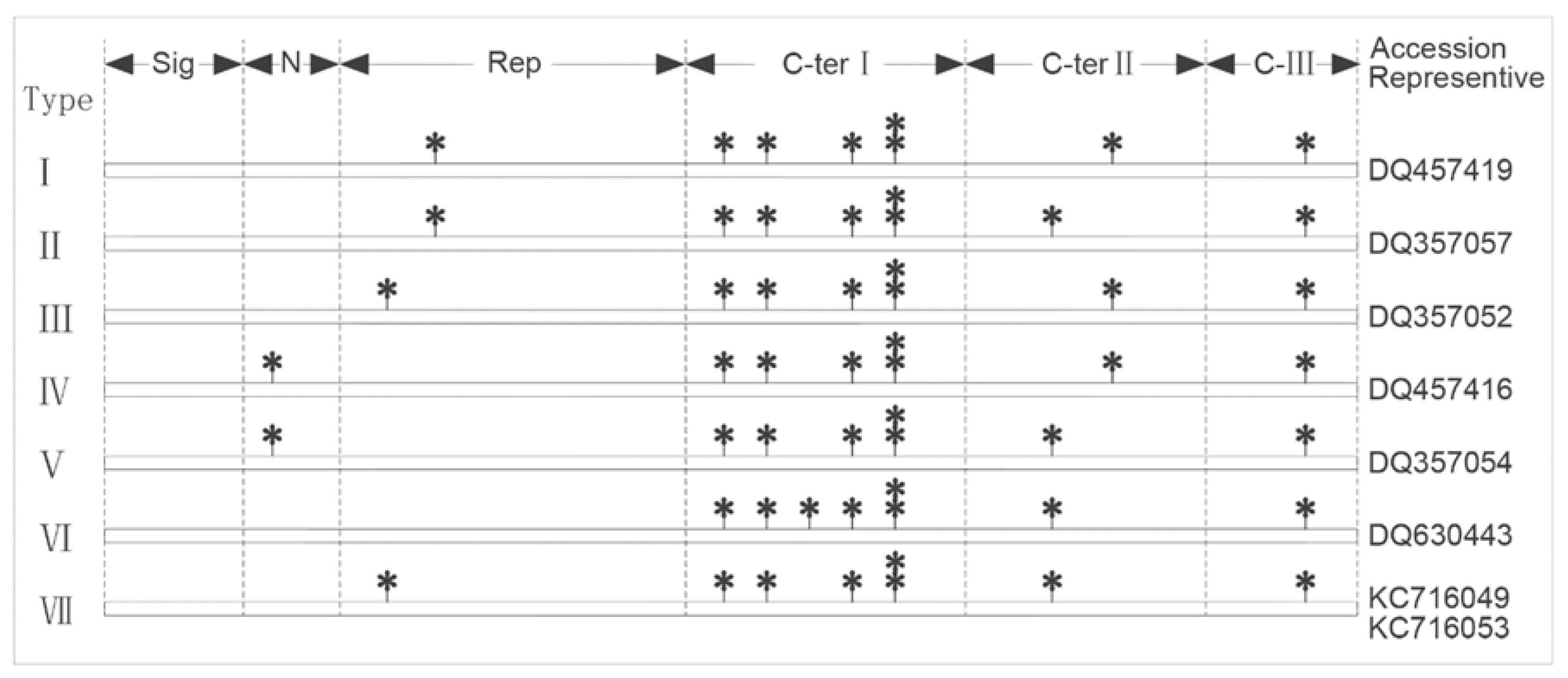
Based on the number and distribution of conserved cysteine residues, the 692 LMW-GS were classified into 22 types, including 7 conventional types with eight cysteines and 15 variation types with seven or nine cysteines (Figure 1 and Figure S1). Apart from the six conventional types (LMW-I to LMW-VI) named by Ikeda et al. [47], a new type (LMW-VII) was identified in this study. For the LMW-i type, all eight cysteines were located in the C-terminal domain and their locations were conserved, so only one type (VI) was identified. For the LMW-m type, seven cysteines were located in the C-terminal, and one was located in the N-terminal or in a repetitive region. Furthermore, the locations of the first cysteine in the repetitive region and the seventh cysteine in the C-terminal II were variable. Thus, a total of six types were found. Among them, LMW-IV and LMW-V were the most abundant types, and they accounted for 25.29% and 20.09%, respectively. And LMW-VII was the least variable type, with only two haplotypes identified in the 692 sequences (Table 3).
Figure 1.
Classification of conventional LMW-GS sequences with 8 cysteines (*).
Table 3.
The statistical table of seven types of LMW-GS genes based on the cysteine number and loci.
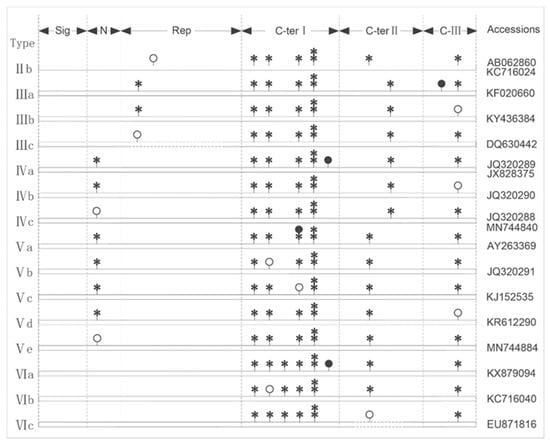
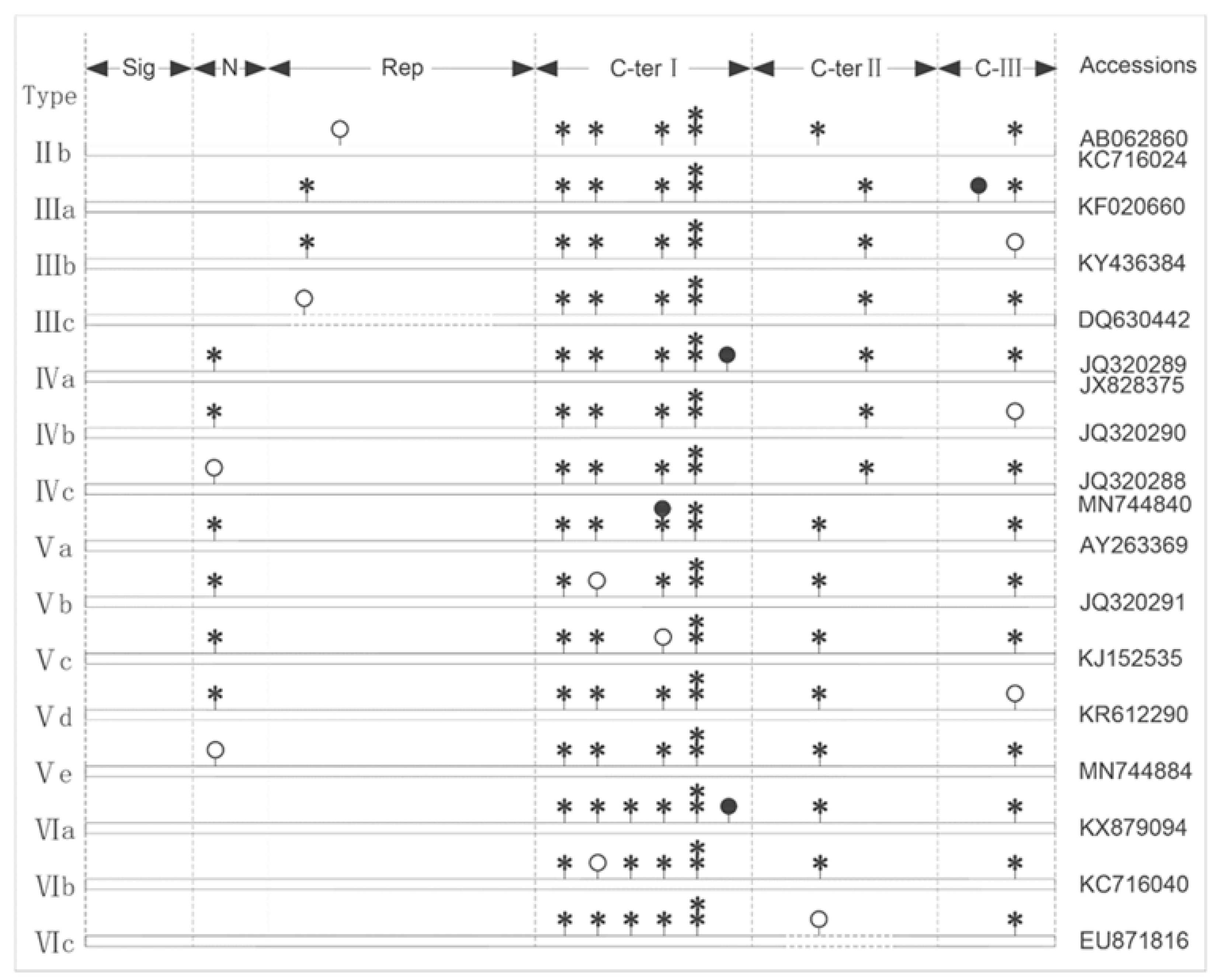
Among the 15 variation types with seven or nine cysteines, 13 were caused by cysteine mutations (SNP) and 2 by sequence fragment (Indel; IIIc and VIc). Therefore, they were named as LMW-IIb, IIIa, IIIb, IIIc, IVa, IVb, IVc, Va, Vb, Vc, Vd, Ve, VIa, VIb and VIc on the basis of conventional types, of which 4 genes had nine cysteines (IIIa, IVa, Va and VIa) and the other 11 had seven cysteines (Figure 2 and Figure S1). LMW-II, III, IV, V and VI had one, three, three, five and three variant types, respectively, and no variation was found in LMW-I and LMW-VII. The 15 variant types included only 18 haplotypes, accounting for 2.6% of the 692 sequences.
Figure 2.
Classification of variation in LMW-GS sequences with 7 or 9 cysteines. Asterisks present the locus of original cysteines; a black circle presents the locus of an extra cysteine; and a white circle presents the locus of a missing cysteine.
2.4. Association Analysis of Glu-3 Genes Among Different Classification Methods
In our previous study, 9 Glu-A3, 10 Glu-B3 and 11 Glu-D3 genes with complete coding regions were named, respectively, by means of a homology comparison of nucleotide and AA sequences [50]. In this study, two new Glu-A3 genes were added, designated as GluA3-10 (JX878001, JX878048 and JX878064) and GluA3-11 (JX877796 and JX877797), which presented an AA similarity of less than 91% and 98% with the other 9 Glu-A3 genes, respectively (Table 4, Tables S1 and S2). The 489 located Glu-3 genes (excluding pseudogenes) were selected to conduct an association analysis of N-terminal and C-terminal sequences. It was found that each Glu-3 gene contained 1-3 C-terminal types and 1-3 N-terminal types except GluD3-2, which had 5 N-terminal types. In addition, the Glu-B3 genes had relatively fewer variant types, including four N-terminal types (N4, N5, N9 and N13) and six C-terminal types (C1, C3, C5, C13, C14 and C15). But the Glu-D3 genes had the most variant types, including 11 N-terminal types and 10 C-terminal types (Table 4). Based on the classification of cysteine location, Glu-A3, Glu-B3 and Glu-D3 genes had four, three and five types of LMW-GS proteins, respectively (Table 3). This indicates that the Glu-D3 genes coded the most diverse LMW-GS proteins.
Table 4.
Association analysis of 489 located Glu-3 genes between N-terminal types and C-terminal types.
Further analysis showed that N1 had the most C-terminal variations (eight), followed by N6 (six), N16 (six), N2 (five) and N13 (five). This suggests that these were the major LMW-GS types. Similarly, C1 represented the most N-terminal variations (10), followed by C5 (4) and C6 (4), indicating that they were also among the major LMW-GS types (Table 4). Interestingly, all 66 LMW-N16 types presented at the Glu-A3 locus and belonged to the LMW-i type (Table 3 and Table S3).
3. Discussion
The wheat LMW-GS represents a special protein family that is mainly coded by more than 30 genes at Glu-A3, Glu-B3 and Glu-D3 loci [50]. In this study, 692 complete Glu-3 gene sequences were retrieved from GenBank and were grouped based on their sequence characters and variations with the purpose of gathering insight into the nature of the Glu-3 gene family. This is helpful for understanding the end-use quality traits in wheat improvement.
3.1. Characteristics of LMW-GS Genes and Their Structural Domain Variations
The differentiation of proteins and scoring of alleles by direct analysis of LMW-GS genes was extremely difficult because of their high similarity, repeatability and complexity [40,42]. It is very important to characterize and categorize the LMW-GS genes and their deduced AA sequences to understand their functions and improve wheat end-use quality.
The deduced AA sequences indicated that all the 692 LMW-GS had five typical domains, i.e., N-terminal conservation, repetition, C-terminal I (cysteine-rich), C-terminal II (glutamine-rich) and C-terminal III (conserved domain) [40]. Among them, 674 genic sequences showed a typical eight conserved cysteine residues, and 18 genic sequences had seven or nine cysteine residues [51,52,53,54,55], which were from AA mutation or fragment deletion. Based on the number and distribution of cysteines [47,56], they were classified into 22 types, including 7 conventional types and 15 variant types. It was interesting that the locations of the eight cysteines were well regulated. For the LMW-i type, all eight cysteines were found in the C-terminal region and their locations were conserved, so there was only one type of LMW-i (LMW-VI). For LMW-m, six cysteines had fixed locations, but the first cysteine presented three location variations, one located in the N-terminal conservation region and two in the repetitive region. The seventh cysteine in the C-terminal region also had two locus variations. Therefore, the LMW-m peptides had six types in all (Figure 1).
It is generally recognized that the first and seventh cysteine seem to be involved in the formation of intermolecular disulphide bonds [57], and the additional cysteine may offer more opportunity for the LMW-GS proteins to form larger polymeric proteins, which would contribute to dough elasticity [51]. The studies of Dong et al. show that the ratio of α-helix plus β-folding in the secondary structure of LMW-GS genes with seven cysteines was obviously higher than those with eight cysteines [58]. This suggests that the 15 variant types may be beneficial to change the tertiary structure of peptides, and then may affect the protein function and flour quality of wheat.
3.2. Classifications of LMW-GS Genes and Their Association Analysis
Although several classification methods have been proposed in previous studies [28,46,56], their classification results may be outdated now because of the limited number of analyzed sequences. It was widely accepted that there were three types of LMW-GS genes based on the first AA of deduced peptides, LMW-m, LMW-s and LMW-i [32,43,44,45]. However, the LMW-s type was not found among the 692 Glu-3 genic sequences. The sequence analysis indicated that LMW-s should be an incomplete gene (i.e., partial gene), which may be from the deletion of the first three AAs of the N-terminal (MET or MDT; Table 1 and Table S1).
In fact, the two types of LMW-GS (LMW-m and LMW-i) should be named based on the sequence characters of the N-terminal domain, rather than based on the first AA. When based on the first AA, LMW-m could be further divided into three sub-types, LMW-M, LMW-V and LMW-I (the latter two should be mutation types of LMW-M), and LMW-i had no variant type. In addition, LMW-m could be further classified into 15 types based on the first seven or eight AAs of the N-terminal, much more than the reported types by Ikeda et al. [47]. This indicates that the AA variation in the N-terminal region was more diverse than imagined.
As for the classification based on the AA variations in the C-terminal sequences, no systematic research result was reported before, though some works were conducted by Ikeda et al. [56]. In this paper, a total of 22 types were found based on the last 10 AAs of the C-terminal region (LMW-C1 to LMW-C22). Among them, LMW-C1 was the main type, accounting for 33.82%, and 2–5 allelic variations were found at each AA locus except the first, fourth and eleventh locus from the end, which were conservative and had no AA variation in any of the 692 deduced peptides. This indicates that the conservativeness in the C-terminal domain was also relative.
It was found that these Glu-3 genes showed a certain connection among different classification methods. For instance, all 66 LMW-N16 types presented at the Glu-A3 locus and belonged to LMW-i type (Table 3, Figure S1), and all GluD3-5, GluD3-3 and GluD3-1 genes belonged to the LMW-I, -II and -III types, respectively. Each of the Glu-3 genes contained 1-3 C-terminal types and 1-3 N-terminal types except GluD3-2, which had 5 N-terminal types. In addition, no LMW-I, LMW-II or LMW-III types were found in the Glu-A3 genes, no LMW-IV, LMW-V and LMW-VI types were found in the Glu-B3 genes, and the locus of the LMW-VII type was unclear. It was obvious that the Glu-D3 genes had the most variant types, including 11 N-terminal types and 10 C-terminal types (Table 4). The variant types of LMW-GS indicate the complex regulatory mechanisms of wheat adaptability under the pressures combined by different agroecological zones and end-use quality. These results are beneficial to understanding the complex factors determining wheat quality.
3.3. Application Prospects of LWM-GS in Wheat Quality Breeding
LMW-GS genes play a pivotal role in determining wheat end-use quality [51]. Characterizing LMW-GS genes and their deduced amino acid (AA) sequences is therefore essential for deciphering gluten formation mechanisms and guiding wheat quality improvement breeding. However, direct analysis of LMW-GS for protein differentiation and allele scoring remains highly challenging due to the high similarity, repetitiveness and complexity of the Glu-3 genes [40,41,42], which have received considerable attention from wheat researchers.
This study presents the importance of characterizing the LMW-GS genes and their allelic variations, and the results indicate that the LMW-GS genes were more complicated than expected. Though earlier studies have indicated that some alleles of LMW-GS are clearly more beneficial or detrimental on dough properties than others [6,7,8,20], and different molecular markers have been developed base on some identified Glu-3 gene sequences [11,40,41], the function of individual LMW-GS genes in the determination of wheat quality is still less clear.
The results of this study should be helpful for the systemic identification and characterization of more LMW-GS genes for the development of functional markers to improve the selection efficiency of wheat quality breeding.
4. Materials and Methods
4.1. Sequence Collection and Alignment of LMW-GS Genes
The LMW-GS gene sequences of wheat located at the three Glu-3 loci were retrieved from the NCBI (National Center for Biotechnology Information, www.ncbi.nlm.nih.gov; accessed before 10 January 2025). A total of 692 Glu-3 gene sequences with complete coding regions were obtained, including 489 located and 203 unlocated. Pseudogenes were excluded from subsequent analyses. All retrieved DNA and protein sequences were aligned and analyzed using DNAman software, version 9.0 (Lynnon Biosoft, San Ramon, CA, USA) with default parameters.
4.2. Classification of LMW-GS Gene
The deduced amino acid sequences of all 692 LMW-GS genes were compared, and classification was performed according to sequence variation patterns among various Glu-3 loci. The serial numbers of the Glu-A3, Glu-B3 and Glu-D3 genes were assigned a serial number based on the sequence homology established by Zhao et al. (2025) [50]. To further characterize the structural diversity of the LMW-GS proteins, the N-terminal and C-terminal regions were classified based on the sequence variations in the N-terminal domain and C-terminal sequences according to the methods proposed by Kasarda et al. [43,44] and Ikeda et al. [47], respectively. Additionally, the number and positional distribution of cysteine residues were analyzed and used as classification indicators following the methods proposed by Ikeda et al. [47] and Long et al. [49].
5. Conclusions
In this study, 692 Glu-3 genic sequences with complete coding domains were retrieved from GenBank, and their sequence characters and variations were compared and analyzed systematically. On this basis, the traditional classification methods and results of LMW-GS genes were revised and supplemented. In addition, the connection between different classification methods was discussed. The results may be useful for understanding the diverse nature of LMW-GS genes at Glu-3 loci and will be of help in systemically identifying and characterizing more LMW-GS genes for the development of functional markers to improve the selection efficiency for quality wheat breeding.
Supplementary Materials
The following supporting information can be downloaded at https://www.mdpi.com/article/10.3390/ijms262110482/s1.
Author Contributions
Conceptualization and methodology, X.Z.; validation and supervision, Y.Z.; investigation, D.Z. and H.Y.; writing—original draft preparation, X.Z.; writing—review and editing, Y.Z. and Z.X.; funding acquisition, Y.Z. and D.Z. All authors have read and agreed to the published version of the manuscript.
Funding
This research was funded jointly by the Emerging Subject Project of HAAS (NO. 2024XK08), the Independent Innovation Project of HAAS (NO. 2025ZC04), the Henan Province Joint Fund (NO. 232301420107) and the Natural Science Foundation of China (NO. 31271726).
Institutional Review Board Statement
Not applicable.
Informed Consent Statement
Not applicable.
Data Availability Statement
The LMW-GS gene sequences of wheat at three Glu-3 loci were searched at NCBI (National Centre for Biotechnology Information, www.ncbi.nlm.nih.gov. Accessed on 9 January 2025).
Acknowledgments
We are very grateful to Xiangyang Xu (Peanut and Small Grains Research Unit, USDA-ARS) for reviewing this manuscript.
Conflicts of Interest
The authors declare no conflicts of interest.
Abbreviations
The following abbreviations are used in this manuscript:
| LMW-GS | Low-molecular-weight glutenin subunit |
| AA | Amino acid |
| Glu | Glutenin |
References
- Shiferaw, B.; Smale, M.; Braun, H.J.; Duveiller, E.; Reynolds, M.; Muricho, G. Crops that feed the world 10. Past successes and future challenges to the role played by wheat in global food security. Food Secur. 2013, 5, 291–317. [Google Scholar] [CrossRef] [Scilit]
- Payne, P.I. Genetics of wheat storage proteins and the effect of allelic variation on bread-making quality. Ann. Rev. Plant Physiol. 1987, 38, 141–153. [Google Scholar] [CrossRef]
- Brites, C.; Carrillo, J.M. Influence of high molecular weight (HMW) and low molecular weight (LMW) glutenin subunits controlled by Glu-1 and Glu-3 loci on durum wheat quality. Cereal Chem. 2001, 78, 59–63. [Google Scholar] [CrossRef] [Scilit]
- Gras, P.W.; Anderssen, R.S.; Keentock, M.; Bekes, F.; Appels, R. Gluten protein functionality in wheat flour processing: A review. Aust. J. Agric. Res. 2001, 52, 1311–1323. [Google Scholar] [CrossRef] [Scilit]
- Dai, S.F.; Xu, D.Y.; Yan, Y.L.; Wen, Z.J.; Zhang, J.B.; Chen, H.X.; Lu, Z.F.; Li, H.Y.; Cong, H.; Wei, Y.M.; et al. Characterization of high- and low-molecular-weight glutenin subunits from Chinese Xinjiang wheat landraces and historical varieties. J. Food Sci. Tech-Mysore 2020, 10, 3823–3835. [Google Scholar] [CrossRef] [Scilit]
- Guzman, C.; Crossa, J.; Mondal, S.; Govindan, V.; Huerta, J.; Crespo-Herrera, L.; Vargas, M.; Singh, R.P.; Ibba, M.I. Effects of glutenins (Glu-1 and Glu-3) allelic variation on dough properties and bread-making quality of CIMMYT bread wheat breeding lines. Field Crops Res. 2022, 284, 108585. [Google Scholar] [CrossRef] [Scilit]
- Wesley, A.S.; Lukow, O.M.; Ames, N.; Kovaks, M.I.P.; McKenzie, R.I.H.; Brown, D. Effect of single substitution of glutenin or gliadin proteins on flour quality of Alpha 16, a Canada Prairie Spring wheat breeder line. Cereal Chem. 1999, 76, 743–747. [Google Scholar] [CrossRef] [Scilit]
- Wesley, A.S.; Lukow, O.M.; McKenzie, R.I.H.; Ames, N.; Brown, D. Effect of multiple substitution of glutenin or gliadin proteins on flour quality of Canada Prairie Spring wheat. Cereal Chem. 2001, 78, 69–73. [Google Scholar] [CrossRef] [Scilit]
- Luo, C.; Griffin, W.B.; Branlard, G.; Mcneil, D.L. Comparison of low- and high molecular-weight wheat glutenin allele effects on flour quality. Theor. Appl. Genet. 2001, 102, 1088–1098. [Google Scholar] [CrossRef] [Scilit]
- Ma, W.J.; Appels, R.; Bekes, F.; Larroque, O.; Morell, M.K.; Gale, K.R. Genetic characterization of dough rheological properties in a wheat doubled haploid population: Additive genetic effects and epistatic interactions. Theor. Appl. Genet. 2005, 111, 410–422. [Google Scholar] [CrossRef] [Scilit]
- Zhao, X.L.; Ma, W.J.; Gale, K.R.; Lei, Z.S.; He, Z.H.; Sun, Q.X.; Xia, X.C. Identification of SNPs and development functional markers for LMW-GS genes at Glu-D3 and Glu-B3 loci in bread wheat (Triticum aestivum L.). Mol. Breed. 2007, 20, 223–231. [Google Scholar] [CrossRef] [Scilit]
- Ibba, M.I.; Kiszonas, A.M.; Morris, C.F. Development of haplotype-specific molecular markers for the low-molecular-weight glutenin subunits. Mol. Breed. 2018, 38, 68. [Google Scholar] [CrossRef] [Scilit]
- Bayram, M.E.; Korkut, K.Z. Effect of the glutenin genes on quality parameters in common wheat. J. Central Euro. Agric. 2020, 1, 62–76. [Google Scholar] [CrossRef] [Scilit]
- Wiesser, H.; Koehler, P.; Scherf, K.A. Chemistry of wheat gluten proteins: Qualitative composition. Cereal Chem. 2023, 100, 23–35. [Google Scholar] [CrossRef] [Scilit]
- Bietz, J.A.; Wall, J.S. Isolation and characterization of gliadin-like subunits from glutenins. Cereal Chem. 1973, 50, 537–547. [Google Scholar]
- Zhang, X.F.; Liu, D.C.; Zhang, J.H.; Jiang, W.; Luo, G.B.; Yang, W.L.; Sun, J.Z.; Tong, Y.P.; Cui, D.Q.; Zhang, A.M. Novel insights into the composition, variation, organization, and expression of the low-molecular-weight glutenin subunit gene family in common wheat. J. Exp. Bot. 2013, 7, 2027–2040. [Google Scholar] [CrossRef] [Scilit]
- Gupta, R.B.; Shepherd, K.W. Two-step one-dimensional SDS-PAGE analysis of LMW subunits of glutenin. I. Variation and genetic control of the subunits in hexaploid wheats. Theor. Appl. Genet. 1990, 80, 65–74. [Google Scholar] [CrossRef] [Scilit] [PubMed]
- Jackson, E.A.; Holt, L.M.; Payne, P.I. Characterisation of high-molecular-weight gliadin and low-molecular-weight glutenin subunits of wheat endosperm by two-dimentional electrophoresis and chromosomal localisation of their controlling genes. Theor. Appl. Genet. 1983, 66, 29–37. [Google Scholar] [CrossRef] [Scilit]
- Ibba, M.I.; Kiszonas, A.M.; Morris, C.F. Evidence of intralocus recombination at the Glu-3 loci in bread wheat (Triticum aestivum L.). Theor. Appl. Genet. 2017, 130, 891–902. [Google Scholar] [CrossRef] [Scilit]
- Franaszek, S.; Salmanowicz, B. Composition of low-molecular-weight glutenin subunits in common wheat (Triticum aestivum L.) and their effects on the rheological properties of dough. Open Life Sci. 2021, 16, 641–652. [Google Scholar] [CrossRef] [Scilit]
- Jackson, E.A.; Holt, L.M.; Payne, P.I. Glu-B2, a storage protein locus controlling the D group of LMW glutenin subunits in bread wheat. Genet. Res. 1985, 46, 11–17. [Google Scholar] [CrossRef] [Scilit]
- Liu, C.Y.; Shepherd, K.W. Inheritance of B subunits of glutenin and ω- and γ-gliadins in tetraploid wheats. Theor. Appl. Genet. 1995, 90, 1149–1157. [Google Scholar] [CrossRef] [Scilit] [PubMed]
- Sreeramulu, G.; Sigh, N.K. Genetic and biochemical characterization of novel low molecular weight glutenin subunits in wheat (Triticum aestivum L.). Genome 1997, 40, 41–48. [Google Scholar] [CrossRef] [Scilit]
- Lei, Z.S.; Gale, K.R.; He, Z.H.; Gianibelli, M.C.; Larroque, O.; Xia, X.C.; Butow, B.J.; Ma, W.J. Y-type gene specific markers for enhanced discrimination of high-molecular-weight glutenin alleles at the Glu-B1 locus in hexaploid wheat. J. Cereal Sci. 2006, 43, 94–101. [Google Scholar] [CrossRef] [Scilit]
- Liang, X.N.; Zhen, M.; Han, C.X.; Wang, C.; Li, X.H.; Ma, W.J.; Yan, Y.M. Molecular characterization and marker development for hexaploid wheat-specific HMW glutenin subunit 1By18 gene. Mol. Breed. 2015, 35, 221. [Google Scholar] [CrossRef] [Scilit]
- Ravel, C.; Faye, A.; Ben-Saoun, S.; Ranoux, M.; Dardevet, M.; Dupuits, C.; Exbrayat, F.; Poncet, C.; Sourdille, C.; Branlard, G. SNP markers for early identification of high molecular weight glutenin subunits (HMW GSs) in bread wheat. Theor. Appl. Genet. 2020, 133, 751–770. [Google Scholar] [CrossRef] [Scilit]
- Singh, N.K.; Shepherd, K.W. Linkage mapping of genes controlling endosperm storage proteins in wheat. 1. Genes on the short arms of group-1 chromosomes. Theor. Appl. Genet. 1988, 75, 628–641. [Google Scholar] [CrossRef] [Scilit]
- D’Ovidio, R.; Masci, S. The low-molecular-weight glutenin subunits of wheat gluten. J. Cereal Sci. 2004, 39, 321–339. [Google Scholar] [CrossRef]
- Demichelis, M.; Vanzetti, L.S.; Crescente, J.M.; Nisi, M.M.; Pflüger, L.; Bainotti, C.T.; Cuniberti, M.B.; Mir, L.R.; Helguera, M. Significant Effects in Bread-making Quality Associated with the Gene Cluster Glu-D3/Gli-D1 from the Bread Wheat Cultivar Prointa Guazú. Cereal Res. Commun. 2019, 1, 111–122. [Google Scholar] [CrossRef] [Scilit]
- Khoshro, H.H.; Bihamta, M.R.; Hassani, M.E. Relationship between allelic variation at the Glu- 3 loci and qualitative traits in bread wheat. Cereal Res. Commun. 2021, 1, 509–522. [Google Scholar] [CrossRef] [Scilit]
- Zhou, H.W.; Zhang, Y.Q.; Yang, Y.N.; Zhang, Y.Y.; Ban, J.F.; Zhao, B.; Zhang, L.; Zhang, X.K.; Guo, B.L. Effects of Low-Molecular-Weight Glutenin Subunit Encoded by Glu-A3 on Gluten and Chinese Fresh Noodle Quality. Foods 2023, 12, 3124. [Google Scholar] [CrossRef] [Scilit]
- Cloutier, S.; Rampitsch, C.; Penner, G.A.; Lukow, O.M. Cloning and expression of a LMW-i glutenin gene. J. Cereal Sci. 2001, 33, 143–154. [Google Scholar] [CrossRef] [Scilit]
- Zhang, W.J.; Gianibelli, M.C.; Rampling, L.R.; Gale, K.R. Characterisation and marker development for low molecular weight glutenin genes from Glu-A3 alleles of bread wheat (Triticum aestivum L.). Theor. Appl. Genet. 2004, 108, 1409–1419. [Google Scholar] [CrossRef] [Scilit]
- Chen, F.; Zhen, L.; Zhang, Z.; Xia, G.; Min, H. Variation and potential value in wheat breeding of low-molecular-weight glutenin subunit genes cloned by genomic and RT-PCR in a derivative of somatic introgression between common wheat and Agropyron elongatum. Mol. Breed. 2007, 20, 141–152. [Google Scholar] [CrossRef] [Scilit]
- Chen, F.G.; Zhao, F.; Xu, C.H.; Xia, G.M. Molecular characterization of LMW-GS genes from a somatic hybrid introgression line II-12 between Triticum aestivum and Agropyron elongatum in relation to quick evolution. J. Genet. Geno. 2008, 35, 743–749. [Google Scholar] [CrossRef] [Scilit] [PubMed]
- Zhang, X.F.; Liu, D.C.; Jiang, W.; Guo, X.L.; Yang, W.L.; Sun, J.Z.; Ling, H.Q.; Zhang, A.M. PCR-based isolation and identification of full-length low-molecular-weight glutenin subunit genes in bread wheat (Triticum aestivum L.). Theor. Appl. Genet. 2011, 123, 1293–1305. [Google Scholar] [CrossRef] [Scilit]
- Hu, X.K.; Dai, S.F.; Yang, Y.L.; Liu, Y.X.; Zhang, J.B.; Lu, Z.F.; Wei, Y.M.; Zheng, Y.L.; Cong, H.; Yan, Z.H. The genetic diversity of group-1 homoeologs and characterization of novel LMW-GS genes from Chinese Xinjiang winter wheat landraces (Triticum aestivum L.). J. Appl. Genet. 2020, 3, 379–389. [Google Scholar] [CrossRef] [Scilit] [PubMed]
- Huang, J.W.; Dai, S.F.; Song, Z.P.; Liu, L.L.; Liang, L.L.; Li, J.; Yan, Z.H. Characterization of novel LMW-i genes with nine cysteine residues from Chinese wheat landraces (Triticum aestivum L.) and analysis of their functional properties on dough mixing. 3 Biotech 2021, 11, 499. [Google Scholar] [CrossRef] [Scilit] [PubMed]
- Zhao, X.L.; Xia, X.C.; He, Z.H.; Gale, K.R.; Lei, Z.S.; Appels, R.; Ma, W.J. Characterization of three low-molecular-weight Glu-D3 subunit genes in common wheat. Theor. Appl. Genet. 2006, 113, 1247–1259. [Google Scholar] [CrossRef] [Scilit]
- Zhao, X.L.; Xia, X.C.; He, Z.H.; Lei, Z.S.; Appels, R.; Yang, Y.; Sun, Q.X.; Ma, W.J. Novel DNA variations to characterize low molecular weight glutenin Glu-D3 genes and develop STS markers in common wheat. Theor. Appl. Genet. 2007, 114, 451–460. [Google Scholar] [CrossRef] [Scilit]
- Wang, L.H.; Zhao, X.L.; He, Z.H.; Ma, W.J.; Appels, R.; Pena, R.J.; Xia, X.C. Characterization of low-molecular-weight glutenin subunit Glu-B3 genes and development of STS markers in common wheat (Triticum aestivum L.). Theor. Appl. Genet. 2009, 118, 525–539. [Google Scholar] [CrossRef] [Scilit]
- Wang, L.H.; Li, G.Y.; Pena, R.J.; He, Z.H.; Xia, X.C. Development of STS markers and establishment of multiplex PCR for Glu-A3 alleles in common wheat (Triticum aestivum L.). J. Cereal Sci. 2010, 3, 305–312. [Google Scholar] [CrossRef] [Scilit]
- Kasarda, D.D.; Tao, H.P.; Evans, K.; Adalsteins, A.E.; Yuen, S.W. Sequencing of protein from a single spot of a 2-D gel pattern: N-terminal sequence of a major wheat LMW-glutenin subunit. J. Exp. Bot. 1988, 39, 899–906. [Google Scholar] [CrossRef] [Scilit]
- Tao, H.P.; Kasarda, D.D. Two-dimensional gel mapping and N-terminal sequencing of LMW-Glutenin subunit. J. Exp. Bot. 1989, 40, 1015–1020. [Google Scholar] [CrossRef] [Scilit]
- Lew, E.-J.L.; Kuzmicky, D.D.; Kasarda, D.D. Characterization of low molecular weight glutenin subunits by reversed-phase high-performance liquid chromatography, sodium dodecyl sulfate-polyacrylamide gel electrophoresis, and N-terminal amino acid sequencing. Cereal. Chem. 1992, 69, 508–515. [Google Scholar]
- Gianibelli, M.C.; Larroque, O.R.; MacRichie, F.; Wrigley, C.W. Biochemical, genetic and molecular characterization of wheat glutenin and its component subunits. Cereal. Chem. 2001, 78, 635–646. [Google Scholar] [CrossRef] [Scilit]
- Ikeda, T.M.; Nagamine, T.; Fukuoka, H.; Yano, H. Identification of new low molecular weight glutenin subunit genes in wheat. Theor. Appl. Genet. 2002, 104, 680–687. [Google Scholar] [CrossRef] [Scilit] [PubMed]
- Shewry, P.R.; Tatham, A.S. Disuphide bonds in wheat gluten proteins. J. Cereal Sci. 1997, 25, 207–227. [Google Scholar] [CrossRef] [Scilit]
- Long, H.; Wei, Y.M.; Yang, Z.H.; Baum, B.; Nevo, E.; Zheng, Y.L. Classification of wheat low-molecular-weight glutenin subunit genes and its chromosome assignment by developing LMW-GS group-specific primers. Theor. Appl. Genet. 2005, 111, 1251–1259. [Google Scholar] [CrossRef] [Scilit]
- Zhao, Y.Y.; Zhao, X.L.; Xiang, Z.G.; Zhang, D.; Yang, H.S. Comparison and Classification of LMW-GS Genes at Glu-3 Loci of Common Wheat. Genes 2025, 16, 90. [Google Scholar] [CrossRef] [Scilit]
- Zhao, H.X.; Wang, R.J.; Guo, A.G.; Hu, S.W.; Sun, G.L. Development of primers specific for LMW-GS genes located on chromosome 1D and molecular characterization of a gene from Glu-D3 complex locus in breed wheat. Hereditas 2004, 141, 193–198. [Google Scholar] [CrossRef] [Scilit]
- Han, R.; Ma, M.; Wei, Y.Y.; Zhao, H.X. Cloning and characterization of LMW-GS gene at Glu-A3 complex locus in different wheat cultivars. Sci. Agric. Sin. 2010, 5, 884. [Google Scholar]
- Lan, Q.X.; Feng, B.; Xu, Z.B.; Zhao, G.J.; Wang, T. Molecular cloning and characterization of five novel low molecular weight glutenin subunit genes from Tibetan wheat landraces (Triticum aestivum L.). Genet. Resour Crop Evol. 2013, 60, 799–806. [Google Scholar] [CrossRef] [Scilit]
- Si, H.Q.; Zhao, M.L.; Zhang, X.; Yao, G.L.; Sun, G.L.; Ma, C.X. Cloning and Characterization of Low-Molecular-Weight Glutenin Subunit Alleles from Chinese Wheat Landraces (Triticum aestivum L.). Sci. World J. 2014, 2014, 371045. [Google Scholar] [CrossRef] [Scilit]
- Li, L.; Li, S.P.; Li, Y.G. Cloning and sequence analysis of LMW-GS genes from common wheat (Triticum aestivum L.) cultivar Yumai 50. J. Triticeae Crops 2015, 35, 1215–1221. [Google Scholar]
- Ikeda, T.M.; Araki, E.; Fujita, Y.; Yano, H. Characterization of low-molecular-weight glutenin subunit genes and their protein products in common wheats. Theor. Appl. Genet. 2006, 112, 327–334. [Google Scholar] [CrossRef] [Scilit]
- Keck, B.; Kohler, P.; Wieser, H. Disulphide bondsin wheat gluten: Cystine peptides derived from gluten proteins following peptic and thermolitic digestion. Z. Lebensm.-Unters. Forsch. 1995, 200, 432–439. [Google Scholar] [CrossRef] [Scilit]
- Dong, X.; Liu, M.; Wang, Z.; Yang, Y.; Han, B.; Li, S.F.; Zhao, X.L. Isolation and Sequence Analysis of LMW-GS Gene at the Glu-3 loci in Common Wheat. J. Triticeae Crops 2017, 10, 1276–1284. [Google Scholar]

Disclaimer/Publisher’s Note: The statements, opinions and data contained in all publications are solely those of the individual author(s) and contributor(s) and not of MDPI and/or the editor(s). MDPI and/or the editor(s) disclaim responsibility for any injury to people or property resulting from any ideas, methods, instructions or products referred to in the content. |
© 2025 by the authors. Licensee MDPI, Basel, Switzerland. This article is an open access article distributed under the terms and conditions of the Creative Commons Attribution (CC BY) license (https://creativecommons.org/licenses/by/4.0/).