Review

Post-Burn Pruritus

1
Department of Dermatology, Kangnam Sacred Heart Hospital, Hallym University, Seoul 07441, Korea
2
Department of Anesthesiology and Pain Medicine, Burn Center, Hangang Sacred Heart Hospital, Hallym University, Seoul 07247, Korea
*
Author to whom correspondence should be addressed.
Co-first authors: victoryby@naver.com (B.Y.C.)
Int. J. Mol. Sci. 2020, 21(11), 3880; https://doi.org/10.3390/ijms21113880
Submission received: 8 April 2020 / Revised: 21 May 2020 / Accepted: 21 May 2020 / Published: 29 May 2020

Abstract

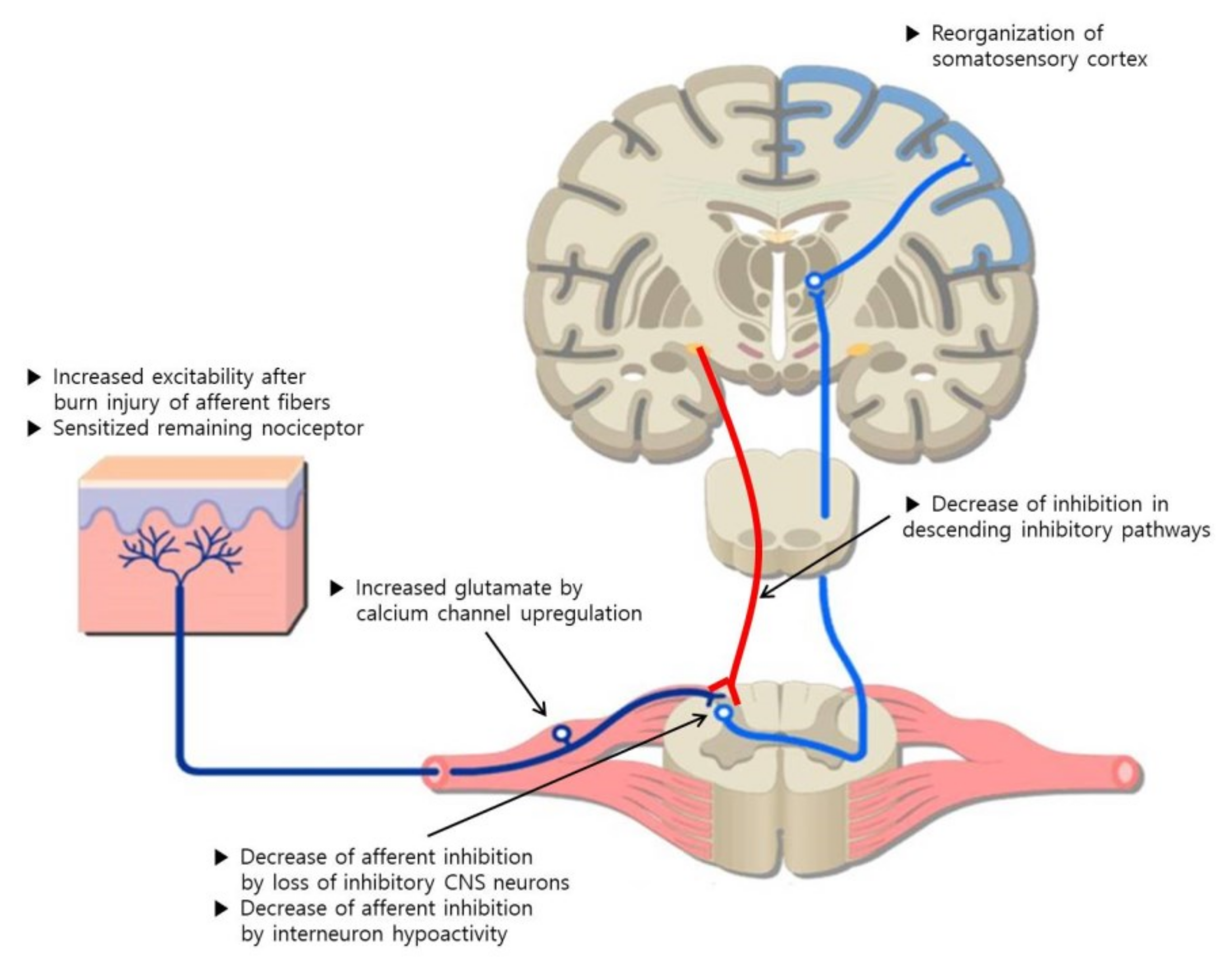
Post-burn pruritus is the pruritus that occurs after burn during the rehabilitation and healing process of burn wounds. The post-burn pruritus is a common and serious complication of burn injury, which severely lowers the quality of life of the patient. Many potential treatments are available for pruritus but there is no consensus of the best single treatment yet. The precise mechanism of post-burn pruritus has not been elucidated, but it appears to have pruritogenic and neuropathic aspects. Clinically, post-burn pruritus tends to be intractable to conventional treatment but rather responds to neuroleptic agents, such as gabapentin and pregabalin. During wound healing, various neuropeptides secreted from the nerves of the skin control epidermal and vascular proliferation and connective tissue cells. When keratinocytes are activated by an itch-inducing substance, they secrete a variety of inflammatory substances that increase the susceptibility of the itch receptor. There are two mechanisms underlying post-burn neuropathic pruritus. The first one is peripheral sensitization. The second one is the intact nociceptor hypothesis. An effective treatment for post-burn pruritus will also be effective in other neuropathic and intractable itching. In this review, we summarized the interaction and mechanism of keratinocytes, immune cells, and nerve fibers related to post-burn pruritus.
Keywords: burn; pruritus; neuropathy; sensitization; neuroleptic agent; TRPV; substance P; GABA; antidepressant; opioid antagonist burn; pruritus; neuropathy; sensitization; neuroleptic agent; TRPV; substance P; GABA; antidepressant; opioid antagonist