


Abstract
Determination of supramolecular host–guest complex stability constants often relies on 1H NMR spectroscopy, particularly when it comes to reactants lacking chromophores. This is usually the case for hydrophobically driven complexation, where hosts such as cyclodextrins and cucurbiturils interact with small, scarcely soluble guests in aqueous media. Even sophisticated solvent suppression techniques still require a small percentage of deuterated water, so the reactions are usually affected by the solvent isotope effect, either kinetically or thermodynamically, the latter being significantly less investigated. In this work, we report a systematic calorimetric study of the influence of solvent deuteration on the thermodynamic reaction parameters (ΔrX°, where X = G, H, S, Cp) in 278−338 K temperature range for the reactions involving cyclodextrins and cucurbiturils and two hydrophobic alcohols. In accord with previous systematic investigations carried out solely at 298 K, the complex stability constants did not vary significantly when transferred from H2O to D2O. This was, in the case of cyclodextrins, a consequence of a partial enthalpy–entropy compensation, as the differences between ΔrH° and –TΔrS° in two media were similar in magnitude but opposite in sign (up to 5 kJ mol−1, excluding one outlier). Thus, our finding indicates that differences in the hydration of the hosts and guests in regular and heavy water partially compensate for each other.
1. Introduction
The first sample of pure deuterium oxide (D2O), commonly known as heavy water, was isolated in 1933 [1,2], two years after the discovery of deuterium [3] and one year after water enriched in D2O was first obtained by fractional electrolysis [4]. Ever since, heavy water has intrigued physicists and chemists alike.
For many years, D2O has played a crucial role in nuclear energy production and, unfortunately, also became strategically important in wartime nuclear programs. Research into the chemical properties of H2O and D2O began in the following year [5,6], with the first studies of heavy water’s physical properties carried out in parallel [2,7]. As expected, D2O was found to be roughly 10% denser than water with natural isotopic abundance. Its molar heat capacity was also higher than that of H2O [8,9,10,11,12], as well as its normal boiling and freezing points [9,13,14], suggesting stronger hydrogen bonding in D2O than in H2O. Interestingly, although the electronic contribution alone would result in approximately 1% weaker O–D···O bond compared to its protium analog [15], nuclear quantum effects act in the opposite direction, rendering the deuterium hydrogen bond approximately 0.8−1.3 kJ mol−1 stronger than that in H2O [16,17,18,19]. Additionally, D2O forms more hydrogen bonds than its counterpart (3.76 on average compared to 3.62 in H2O) [20].
The pronounced influence of replacing protium with deuterium on the reaction rates [5,21,22,23] subsequently prompted extensive kinetic investigations of reactions in D2O. A particularly strong effect of isotope substitution was observed in enzyme-catalyzed metabolic reactions [24,25], with D2O found to be highly toxic to eukaryotic organisms [25]. Although much of the catalytic retardation arises from the mentioned primary kinetic isotope effect associated with proton-transfer [26,27], this is not the sole factor underlying reduced enzyme activity. Namely, stronger interactions with D2O can also impair catalytic activity of certain enzymes [28,29]. On the other hand, D2O has quite a limited effect on reaction rates of simpler supramolecular processes, such as crown ether-cation complexation reactions [30].
The thermodynamic reaction quantities also change upon replacing protium with deuterium, especially for cases where a proton is being transferred from one species to another. Namely, the autoprotolysis constant of D2O is lower than that of H2O (pKw (298.15 K) = 14.87 and 13.995, respectively) [31,32], whereas the pKa values of various acids typically increase by 0.4–0.6 units upon their transfer to D2O [6,33,34,35,36,37,38]. Solvent isotope substitution generally has a smaller effect on equilibrium constants (hence also on ΔrG°) of supramolecular reactions such as ligand:ion-pair formation or inclusion of guests inside cyclodextrins [39,40,41,42,43,44]. The solvent isotopic composition is thus routinely treated as a technical detail rather than as a thermodynamic variable. Deuterated water, for example, is widely used as a standard medium for studying biomolecular structure and dynamics, both because it reduces the dominant H2O signal in 1H NMR and because it provides useful contrast in neutron scattering [18,45]. Further, nuclear magnetic resonance is routinely used to determine drug–cyclodextrin complex stability constants in D2O [46,47,48,49], yet these values are subsequently applied to formulations in H2O. Similarly, dissociation constants of protein-ligand complexes obtained from NMR measurements in D2O buffers are commonly reported alongside calorimetric and spectroscopic values determined in H2O [50].
However, the documented comparative studies, on which this practice relies, were often limited to stability constant determinations, leaving open the possibility that similar ΔrG° values in D2O and water of natural hydrogen isotopic abundance arise from enthalpy–entropy compensation (ΔrG° = ΔrH° − TΔrS°). Given the established differences in hydrogen-bond strength between D2O and H2O [16,17,18,19,20] this possibility warrants further consideration, especially in a wider temperature range, as both heat capacities and viscosities of D2O and H2O exhibit a pronounced temperature dependence [17,51,52].
The recent availability of sensitive and affordable isothermal titration calorimeters has enabled detailed thermodynamic investigations of the supramolecular processes taking place in D2O and H2O. For comparative thermodynamic studies in heavy water and that with natural isotope abundance, reactions that are particularly sensitive to reactant and product solvation are the most relevant. These undoubtedly include the binding of small molecules to proteins and the protein–protein association. Surprisingly, the literature data concerning the isotope effect on the corresponding reaction thermodynamics are extremely scarce. Connelly et al. investigated the binding of the hydrophobic macrolides tacrolimus (FK506) and rapamycin to FK506-binding protein FKBP-12 in H2O (pH = 7) and D2O (pD = 7) [53]. A large enthalpic destabilization in D2O, reaching up to 20 kJ mol−1 over 278–303 K was observed, which they attributed to differential hydration of protein and ligand atoms. Binding of both macrolides was also accompanied by large negative reaction heat capacities, consistent with burial of substantial nonpolar surface area of ligands upon complexation. Szalai et al. conducted ITC studies on the binding of five p-substituted benzamidines to trypsin and nine aromatic and heteroaromatic sulfonamides to bovine carbonic anhydrase II in both media, resulting in ΔΔrH° values that ranged from −11.7 to 24.3 kJ mol−1, with only three ligands (sulfonamides) binding more exothermically in D2O, and the remaining eleven showing the opposite trend [54]. Despite considerable differences in ΔrH° in the examined solvents, a significantly smaller change in complex stability (ΔΔrG° < 4.2 kJ mol−1 among the studied ligand series) was observed due to enthalpy–entropy compensation.
To the best of our knowledge, there are no comparative ITC studies of protein–protein binding in D2O and H2O; however, Eginton and Beckett examined the dimerization of the biotin repressor (BirA) in H2O and D2O using sedimentation equilibrium [55]. The association enthalpy, determined by van’t Hoff analysis (equilibrium constant temperature dependence assuming ΔrCp° ≈ 0) was far more favorable in D2O.
Because of particularly favorable hydration of ions, their binding with both synthetic and natural receptors should also be strongly affected by solvent isotope composition, especially for reactions resulting in extensive ion dehydration. The data are again surprisingly scarce. In contrast with endothermic transfer of calcium cation from H2O to D2O (ΔtH (Ca2+) = 5.4 kJ mol−1) [56], Carl et al. [57] reported that binding of Ca2+ to sodium polyacrylate in heavy water results in slightly more positive enthalpy changes (≈2 kJ mol−1). Similarly, the enthalpies of Rb+ hosting by a uranium cage-shaped macroion (U60) were found to be almost identical in H2O and D2O (≈0.5 kJ mol−1 difference) [58].
Finally, the association of hydrophobic species in water, commonly referred to as the hydrophobic effect, should be mentioned. These processes, which include micelle formation above CMC [59,60,61,62,63,64,65] and the inclusion of hydrophobic moieties inside the non- or weakly polar cavities of hosts such as cyclodextrins, cucurbiturils or cyclophanes [41,42,66,67,68,69], are almost completely solvent-driven and result in a release of quite a few water molecules into the bulk medium. As far as hydration of nonpolar functional groups and molecules in heavy water is concerned, their transfer to D2O is exothermic (ΔtH°(solute, H2O → D2O, 298 K)/kJ mol−1 = −1.09 (methane), −1.35 (ethane), −1.57 (propane)) and entropically unfavorable (−TΔtS°/kJ mol−1 = 0.95 (methane), 1.23 (ethane), 1.47 (propane)), leading to very small ΔtG° (−0.10 up to −0.14 kJ mol−1 for these alkanes) [70,71]. Concurringly, the transfer enthalpies of tetraalkylammonium cations become more negative with increasing alkyl chain length [72,73]. One would therefore expect that the isotope substitution affects the thermodynamics of hydrophobically driven association considerably.
G. C. Kresheck determined the micellization enthalpy of alkyldimethylphosphine oxides in H2O and D2O over 288–352 K, together with the corresponding ΔrCp° values [74]. Micellization was found to be more endothermic by up to 1.3 kJ mol−1 in D2O, where slightly more negative heat capacity changes were also observed. Consistently, a subsequent study by Angarten and Loh on the micellization of nonyl monoglucoside reported marginally more positive enthalpies and entropies in D2O [75].
In a seminal study of solvent isotope effects on the cyclodextrin host reactions, Rekharsky and Inoue investigated the complexation of more than 30 neutral and charged guests with native α-cyclodextrin (α-CD) and native and modified β-cyclodextrin (β-CD) in H2O and D2O by calorimetry at 298 K [66]. Isotope substitution affected both ΔrH° and –TΔrS°, with differences in complexation enthalpies reaching up to 1.9 kJ mol−1; however, these effects were largely compensated by the corresponding entropy changes. To the best of our knowledge, only the binding of camphor to α-CD has been examined at different temperatures in D2O and H2O using ITC, albeit in quite a narrow range (293−313 K) [76]. The reported results show the same compensation pattern: at 298 K, complexation was less exothermic in D2O, resulting in ΔΔrH° = 2.4 and 5.2 kJ mol−1 for (+)- and (−)-camphor, while the −TΔΔrS° amounted to −4.8 and −7.2 kJ mol−1, leading to slightly more stable complexes in D2O. The reaction heat capacities were more negative in D2O by up to 49% for the (+)-enantiomer, while for (−)-camphor this amounted to only 15%.
Because cucurbiturils contain a larger number of less strongly associated water molecules than their cyclodextrin counterparts [77,78,79], a more pronounced isotope effect on binding thermodynamics might be expected for these particularly efficient receptors of hydrophobic and amphiphilic guests, such as α,ω-alkyldications [80]. However, ITC data concerning cucurbituril hosting properties in heavy water remain scarce. To date, only two studies have been reported, both at 298 K. Biedermann et al. found that the inclusion of indole, 2-naphthol, or 2,7-dihydroxynaphthalene derivatives into cucurbit[8]uril:methyl viologen (CB8:MV) complex was more exothermic in D2O (ΔrH°/kJ mol−1 = −58.8 (D2O) and −54.3 (H2O) for indole) [67]. The other study examined the binding of a tertiary amine and a Diels–Alder cycloadduct by cucurbit[7]uril (CB7); however, the complexation thermodynamic parameters were determined solely in D2O [81].
The pronounced variation of ΔrH° and ΔrS° with temperature in H2O is a thermodynamic fingerprint of cyclodextrin and cucurbituril inclusion reactions [40,82,83,84,85] and has been known to correlate with the extent of hydrophobic surface dehydration [86,87,88,89,90,91]. Considering this fact and the notable temperature effect on the organization of D2O and H2O [17,51,52,92], comparative calorimetric studies of the cyclodextrin and particularly cucurbituril complexation reactions involving larger guests whose solvation spheres encompass twenty or more water molecules (e.g., adamantane [93]) could be particularly informative.
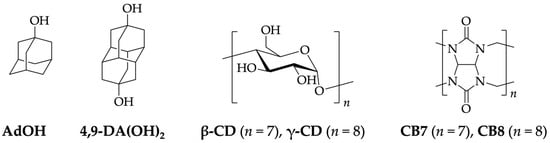
Motivated by this literature gap, we decided to study the binding of adamantan-1-ol (AdOH) and diamantan-4,9-diol (4,9-DA(OH)2) to β- and γ-cyclodextrin (β-CD and γ-CD) as well as to their cucurbituril analogs (Figure 1) using isothermal titration microcalorimetry. Measurements with cucurbit[n]urils (n = 7 and 8, CB7 and CB8) were performed over 278–338 K in H2O and D2O, whereas the binding studies in D2O complement the corresponding H2O data recently reported by our group [82,85].
Figure 1.
Structures of the investigated compounds.
2. Results and Discussion
2.1. Solvent Isotope Effect on Complex Stability
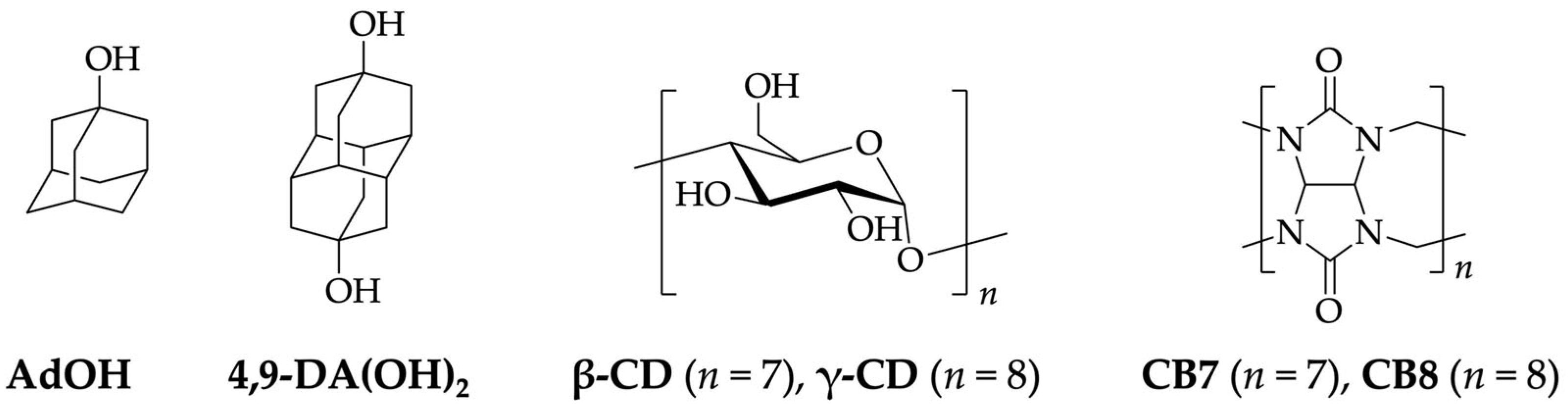
Representative microcalorimetric titrations of 4,9-DA(OH)2 with β-CD in D2O are presented in Figure 2, while the remaining ITC results are provided in Figures S1−S23. The normalized successive enthalpy changes were satisfactorily described by a 1:1 binding model (more details on the fitting procedure are given in Section 3.2), yielding the thermodynamic parameters listed in Table 1. For complexes with stability constants beyond the measurable range of direct ITC titration, only ΔrH° could be obtained.
Figure 2.
Microcalorimetric titrations of 4,9-DA(OH)2 (c0 = 1.25 × 10⁻⁴ mol dm−3) with β-CD (c = 4.94 × 10⁻³ mol dm−3) in D2O at T = 278–338 K. Dependences of the normalized successive enthalpy changes on the host-to-guest molar ratio are given as main figures, and the corresponding titration thermograms as inserts. ■ experimental; − calculated.
Table 1.
Standard thermodynamic parameters for complexation of AdOH and 4,9-DA(OH)2 with cyclodextrins and cucurbiturils in D2O and H2O at T = 278−338 K a.
In general, solvent isotope substitution has only a minor effect on the stability of complexes with cyclodextrins throughout the explored temperature range. At 298 K, Δlog K° (defined as log K°(D2O) − log K°(H2O)) amounts to +0.08 for AdOH:β-CD and +0.10 for 4,9-DA(OH)2:β-CD (Table 1), consistent with previously reported stability increase in D2O [66]. In the case of γ-CD complexes, these differences are slightly larger (Δlog K° ranging from −0.14 to 0.21) and are the most pronounced for 4,9-DA(OH)2, although, due to very low reaction heats and the resulting larger uncertainties, the variations cannot be unambiguously attributed to solvent substitution.
Given the fact that cucurbiturils, compared to their cyclodextrin analogs, contain more frustrated water molecules, which are also considerably less associated [79], one might expect a larger effect of H2O/D2O substitution on the reaction equilibrium constants for CBs than for CDs. However, the observed effects are quite similar. For the AdOH:CB8 complex, Δlog K° at 298 K reaches −0.25, corresponding to K°(D2O)/K°(H2O) = 0.56. This value is close to that reported for methyl viologen binding to CB8 (K°(D2O)/K°(H2O) = 0.50), which, to our knowledge, is the only other study comparing CB8 binding affinities in H2O and D2O [67]. The effect of H2O/D2O substitution on the stability of 4,9-DA(OH)2:CB7 is even smaller. As shown in Table 1, the difference in log K° between H2O and D2O is comparable to the corresponding standard error of the mean.
2.2. Solvent Isotope Effect on the Reaction Enthalpy and Entropy
Prior to discussing the solvent isotope effect, it is worth revisiting the origins of enthalpic and entropic contributions to ΔrG° in the studied systems, especially since the seven chosen guest:host pairs span the range from strongly exothermic (enthalpically driven) to endothermic (entropically driven) binding (Table 1). The enthalpy of hydrophobic guest transfer from water to the macrocycle’s nonpolar cavity should be close to zero. Namely, the enthalpy of cyclohexane dehydration (33.2 kJ mol−1) and its condensation (−33.05 kJ mol−1), which can, in a first approximation, be taken to correspond to the enthalpy of its interaction with the cavity atoms of the host, nearly cancel each other out at 298 K [94,95]. On the other hand, the enthalpically beneficial expulsion of cavity water depends on the guest-host fit (extent of dehydration) and the degree of cavity water association [67,77,78,79,82,83]. Molecular dynamics simulations place the average number of hydrogen bonds per confined water molecule at 1.9 for β-CD against 2.2 for γ-CD, with 3.6 in the bulk [79], so its release is enthalpically more favorable for the smaller macrocycle, while cucurbituril cavities of comparable size contain more “frustrated” water molecules than CDs. Consequently, the inclusion of classically hydrated guests in cucurbiturils is strongly exothermic, less so in β-CD, and often endothermic in γ-CD.
A negative ΔrS° is often attributed to the formation of one species from two reactants, but can also stem from the entropic cost of hydrogen-bond formation upon cavity water expulsion [83], while an entropically positive contribution arises from the dehydration of classically hydrated guests.
As shown, the pronounced decrease in ΔrH° and ΔrS° with temperature is predominantly due to the melting of guest hydration shells and is therefore correlated with the extent of guest dehydration [82,83]. These changes can even shift the inclusion driving force for cyclodextrins [83,84,85,96]. Conversely, their complexation by CB7 and CB8 usually remains predominantly enthalpy-driven across the 278−338 K temperature range [83,84,96].
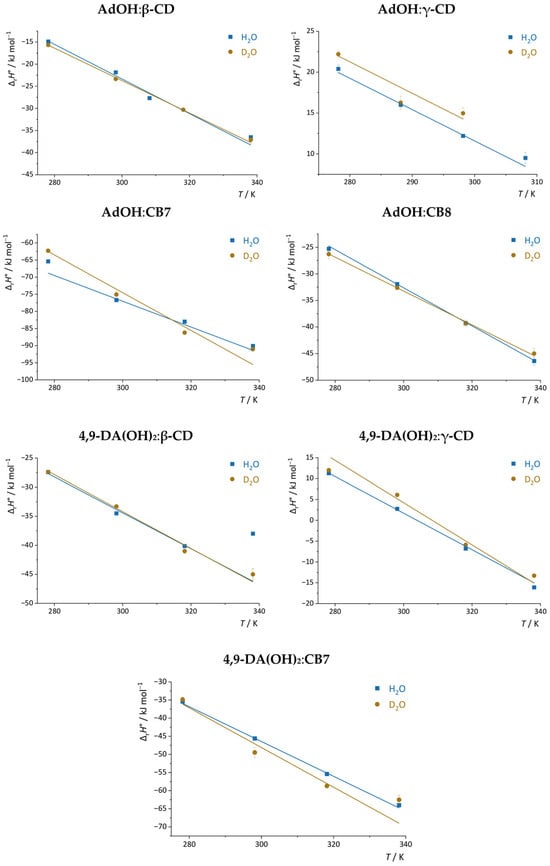
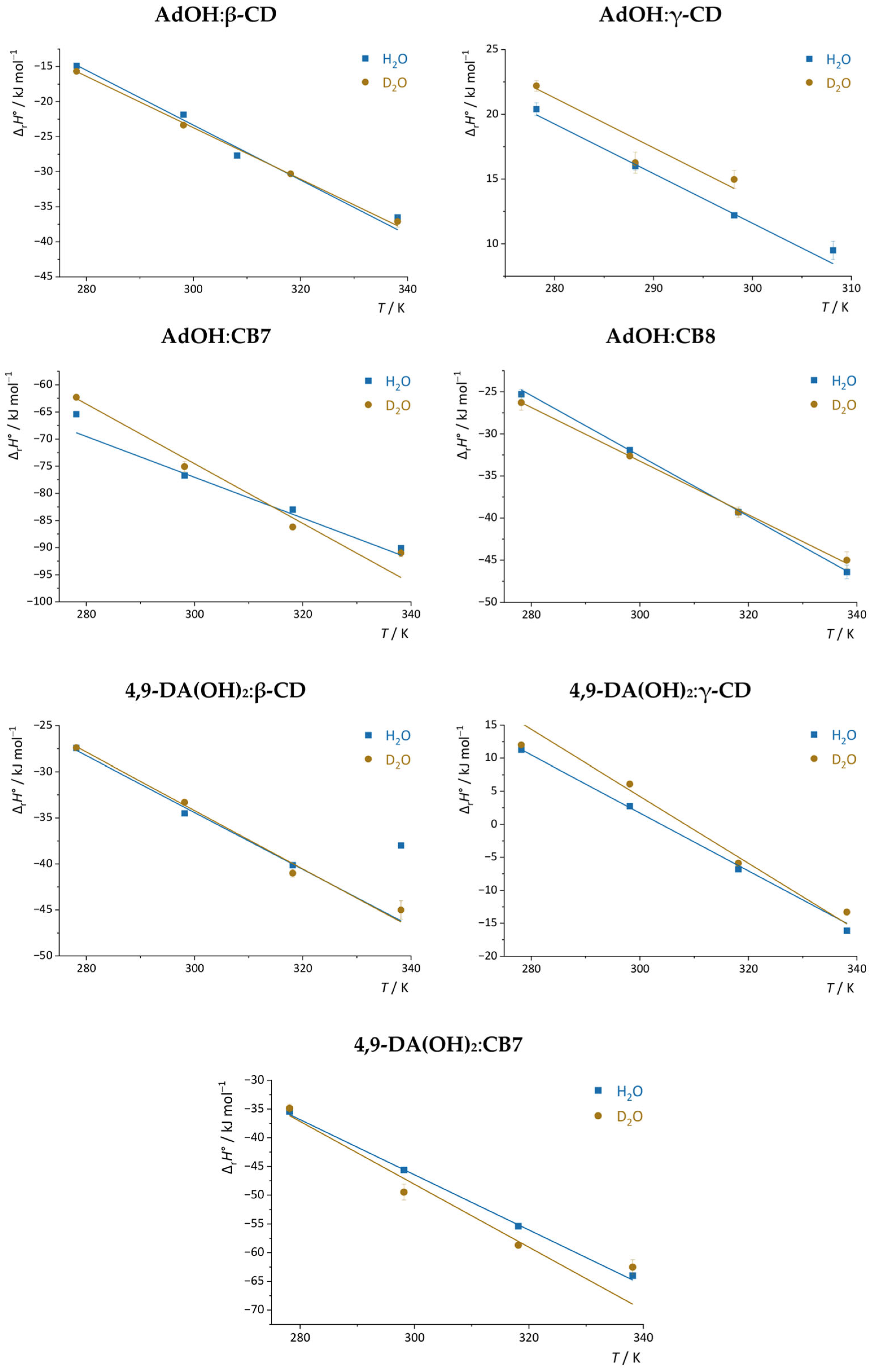
The complexation enthalpies and entropies in some cases reveal a stronger effect of H2O/D2O substitution. Although the differences are rather small on the scale of the absolute values of reaction parameters for most complexes, they are largely outside the experimental uncertainty range. Taken across all seven complexes, the ΔΔrH° (defined as ΔrH°(in D2O) − ΔrH°(in H2O)) ranges from −8.0 to 3.3 kJ mol−1 and depends on the host–guest pair, and the temperature (Figure 3). With the exception of one outlier (4,9-DA(OH)2:β-CD complex at 338 K), both ΔΔrH° and −TΔΔrS° remain within ±5 kJ mol−1.
Figure 3.
Temperature dependence of ΔrH°(guest:host) in H2O (blue squares) and D2O (golden circles). The lines correspond to the weighted linear regression fit of ΔrH°(T) for both systems.
The data listed in Table 1 suggest that the effect of solvent isotope composition is somewhat more pronounced for cyclodextrins, especially in the case of β-CD, which also forms more stable complexes with both alcohols than the larger homolog. One can also observe that the differences in binding enthalpies and entropies between D2O and H2O for both β-CD and γ-CD increase as the temperature rises.
Considering that cucurbiturils contain more water molecules than their cyclodextrin analogues, and that these water molecules are also less strongly associated than those confined within the cavities of CDs, we expected a more pronounced medium effect on the binding thermodynamics. However, as demonstrated above, the differences in ΔrH° and –TΔrS° in D2O and H2O were either comparable or even lower than those observed for cyclodextrin complexes. Nevertheless, several interesting trends for the seven- and eight-membered glycoluril-based macrocyclic hosts can be noticed. For CB8, the enthalpies of AdOH complexation in H2O and D2O are nearly identical above 278 K. In contrast, the ΔrH° values for 4,9-DA(OH)2 and AdOH complexation with CB7 exhibit more complex temperature dependences. For AdOH, binding in H2O is more exothermic at lower temperatures, whereas the opposite holds at 318 and 338 K. A similar behavior is observed for 4,9-DA(OH)2 at 278 and 338 K, while at intermediate temperatures (298 and 318 K), ΔΔrH° is negative.
The near constancy, or complete invariability, of the complex stability constants and consequently of ΔrG° upon transfer to D2O can be attributed to enthalpy–entropy compensation. However, we once again emphasize that the differences in ΔrH° and –TΔrS° between D2O and H2O are generally rather small. This is particularly important because the complex stability constant and binding enthalpy are determined from nonlinear regression analysis of the ΔH°(cG, cH) dependence obtained in a single experiment and are therefore inherently correlated. Consequently, the fitted values and their associated uncertainties are not independent. Differences between the ΔrH° and –TΔrS° values obtained in D2O and H2O should therefore be interpreted with caution, particularly when they are comparable to the uncertainties of the fitted parameters.
To gain a better insight into the solvent effect on the thermodynamic complexation parameters listed in Table 1, error propagation analysis was conducted according to Equations (S1)–(S5) in the Supplementary Materials. The differences between the mean values and estimates of the standard errors of these differences (s(Δlog K°), s(ΔΔrX°)) are given in Table 2. Out of 26 ΔΔrH° values, 19 exceed their combined standard error, with 15 of them exceeding 2s(ΔΔrH°). The reaction Gibbs energies behave differently: only nine of the 21 ΔΔrG° values exceed 2s(ΔΔrG°), whereas the remaining differences are statistically non-significant according to this criterion. The seven reaction enthalpy differences that do not exceed their combined uncertainties are all (in absolute value) below 1.0 kJ mol−1. Four of these correspond to CB7 and CB8 complexes, for which the combined standard errors are the largest, reaching 1.3 kJ mol−1 for AdOH:CB8 at 338 K. The differences in –TΔrS° exceed twice their standard errors for 13 out of the 21 values, similarly to the differences in reaction enthalpy, reflecting the observed enthalpy–entropy compensation. The s(ΔΔrS°) values are again the largest for the formation of the CB7 and CB8 complexes, indicating, together with the corresponding results for ΔΔrH°, that the non-significant differences in ΔrX° for the inclusion within cucurbiturils could be partly due to experimental error.
Table 2.
Solvent isotope effect on the thermodynamic parameters of complexation of AdOH and 4,9-DA(OH)2 with cyclodextrins and cucurbiturils at T = 278−338 K, given as Δlog K° = log K°(D2O) − log K°(H2O) and ΔΔrX° = ΔrX°(D2O) − ΔrX°(H2O), where X = G, H, and S a.
The differences between the thermodynamic parameters determined for the reactions in H2O and D2O were additionally assessed using two-sided Welch’s t-test. The results are presented in Table S1 and are consistent with the considerations discussed above. The differences between the mean stability constants are not statistically significant at the α = 0.05 significance level for most of the systems, with the exception of 4,9-DA(OH)2:γ-CD. However, the reaction enthalpies and entropies differ significantly in a considerable number of cases, again suggesting the above-mentioned enthalpy–entropy compensation in some instances.
The standard isobaric reaction heat capacities in both solvents, obtained by processing the ΔrH°(T) data using a weighted linear regression procedure, with ΔrCp° corresponding to the slope of the obtained dependencies (Figures S24–S30), are also listed in Table 1. The obtained values are in all cases strongly negative (−307 to −545 J K−1 mol−1) and, except for AdOH:CB8 and CB7 complexes, very similar in both H2O and D2O. However, as seen in Table 1, based on the linearization of ΔrH°(T), the hosting of AdOH and 4,9-DA(OH)2 with cucurbit[7]uril resulted in larger ΔrCp° uncertainties in comparison to most of the other examined host–guest pairs, so the observed differences in heat capacities for the binding with this particular host in D2O and H2O must be interpreted carefully. Note that our results are quite different from those for the binding of camphor by α-CD, where differences of ΔΔrCp° = −306 to −100 J K−1 mol−1 were obtained for the 1:2 (guest:host) complexes of (+)- and (−)-camphor with α-CD, respectively [76].
The most negative ΔrCp° values were obtained for the binding of 4,9-DA(OH)2 with CB7, followed by the reaction of this diamantane-based guest with γ-CD. This finding is in accord with the previously observed correlation of reaction heat capacity and the size of buried classically hydrated non-polar guest surface [86,87,88,90]. Both γ-CD, in which 4,9-DA(OH)2 can assume a somewhat tilted conformation, and the barrel like-elongated cavity of CB7 lead to more extensive dehydration of the guest backbone compared to its inclusion inside β-CD [82]. It is worth noting that Grimm et al. [84] obtained very similar ΔrCp° values for the complexation of AdOH and 4,9-DA(OH)2 with β-CD, CB7 and CB8 in H2O, which supports the reliability of the results presented herein.
3. Materials and Methods
3.1. Materials
Adamantan-1-ol (AdOH; Sigma-Aldrich, Steinheim, Germany, 99%) and cucurbit[7]uril (CB7; Sigma-Aldrich, Steinheim, Germany, hydrate) were used as received. β-Cyclodextrin (β-CD; Sigma-Aldrich, Steinheim, Germany, HPLC grade, ≥98%) and γ-cyclodextrin (γ-CD; TCI Chemicals, Tokyo, Japan, >99.9%) were dried at 150 °C prior to use. Diamantan-4,9-diol (4,9-DA(OH)2) was synthesized and purified according to the previously published procedure [97], as was cucurbit[8]uril (CB8) [98]. 18-Crown-6 ether (18C6; Sigma-Aldrich, Steinheim, Germany, 99%) and BaCl2 (Sigma-Aldrich, Steinheim, Germany, 99.9%) were used for calorimeter calibration. Solutions were prepared by direct weighing of the solids and dissolution in D2O (Sigma-Aldrich, Steinheim, Germany, >99.9% D) or Milli-Q water (Merck Millipore, Burlington, MA, USA).
3.2. Isothermal Titration Microcalorimetry
Calorimetric measurements were carried out on a MicroCal PEAQ-ITC microcalorimeter (Malvern Panalytical, Malvern, UK, Vcell = 0.205 mL) at temperatures ranging from 278 to 338 K. The host solutions (c = 1.01 × 10⁻³ to 1.10 × 10⁻² mol dm−3) were added stepwise to the guest solution (c0 = 6.01 × 10⁻⁵ to 1.55 × 10⁻⁴ mol dm−3), with the exception of sparingly soluble CB8 (c0 = 3.21 × 10⁻⁵ mol dm−3) which was titrated with AdOH (c = 3.08 × 10⁻⁴ mol dm−3). The aqueous solubility of CB8 is reported to be below 0.01 mmol dm−3 (ref. [99,100]); to the best of our knowledge, no corresponding value has been reported for D2O. Blank experiments were carried out, and the heats of titrant dilution were subtracted. Nonlinear regression analysis of the thermograms was carried out with the 1:1 stoichiometric model by using PEAQ-ITC Analysis Software (version 1.30, Malvern Panalytical, Malvern, UK) supplied by the manufacturer. The complex stoichiometry was fixed at N = 1 (one-set-of-sites model). Further, the sigmoidal shape of the titration curves in the case of tighter binding (log K° above 4), with the inflection point at a host-to-guest molar ratio of approximately 1, clearly indicated 1:1 stoichiometry of the formed complexes. Fitting the data with a sequential two-site model, which accounts for a higher-stoichiometry complex, did not improve agreement between fitted and experimental values; therefore, the simplest 1:1 model was retained. By fixing the stoichiometry at 1 and reaching saturation, complex stability constants could reliably be determined regardless of a low c parameter [101]. For complexes of very high stability (log K° ≥ 7.5) only ΔrH° was determined. All titrations were performed at least in triplicate. Standard isobaric reaction heat capacities were obtained by weighted linear regression of ΔrH°(T) using Origin 7.0 (OriginLab Corporation, Northampton, MA, USA).
Comparison of the mean values of the thermodynamic parameters determined in H2O and D2O was performed by means of Welch’s t-test using Origin 7.0 (OriginLab Corporation, Northampton, MA, USA).
To assess the impact of OH-OD exchange on the determined thermodynamic reaction parameters, isotope exchange was monitored by 1H NMR (Section 3.3) and the titrations were repeated with the five-day-old solutions. The differences in parameters were below the corresponding experimental uncertainties, suggesting that the H/D exchange of the solute OH group protons affects the thermodynamic reaction parameters very weakly or not at all.
The reliability of the calorimeter was checked by means of the complexation of Ba2+ with 18C6 at 298 K as recommended by Briggner and Wadsö (K = 5.9 × 10³ dm3 mol−1, ΔrG° = −21.5 kJ mol−1, ΔrH° = −31.4 kJ mol−1, ΔrS° = −33.1 J K−1 mol−1) [102,103]. The values obtained were in very good agreement with the literature values: K = (4.9 ± 0.3) × 103 dm3 mol−1, ΔrG° = (−21.1 ± 0.1) kJ mol−1, ΔrH° = (−30.1 ± 0.1) kJ mol−1, and ΔrS° = (−30.2 ± 0.9) J K−1 mol−1.
3.3. 1H NMR Spectroscopy
1H NMR experiments were performed in D2O at 298 K on a Bruker Avance III HD 400 MHz/54 mm spectrometer (Bruker BioSpin GmbH, Rheinstetten, Germany) equipped with an inverse broadband room-temperature probe (5 mm PA BBI 1H/D–BB). Spectra were recorded with standard Bruker pulse sequences and processed with TopSpin software (version 3.6.2, Bruker BioSpin, Rheinstetten, Germany) supplied by the manufacturer. To test whether the OH group proton–deuterium exchange affects the thermodynamic reaction parameters, 1H NMR spectra of the representative solutions were recorded upon their preparation and daily for five days.
4. Conclusions
Complexation of two aliphatic alcohols, adamantan-1-ol and diamantan-4,9-diol, by four macrocyclic receptors (β- and γ-cyclodextrin, cucurbit[7]uril and cucurbit[8]uril) was studied calorimetrically in H2O and D2O over a wide temperature range (278−338 K). By comparing the differences between the mean values of log K°(H2O) and log K°(D2O) with the standard errors of these differences, as well as by assessing their statistical significance using the corresponding t-tests, we found that solvent deuteration has almost no effect on complex stability for most of the investigated systems. The change in log K°(298 K) is below 0.1 for β-CD complexes, and the largest effect was seen for the complex of AdOH with CB8 (K°(D2O)/K°(H2O) = 0.56). Contrary to the expectation that the solvent (H/D) isotope effect on the thermodynamic complexation parameters would be larger for cucurbiturils, which contain more “enthalpically frustrated” water than cyclodextrins, this was not the case. In fact, the effect is slightly more pronounced among cyclodextrins, particularly for the formation of the 4,9-DA(OH)2:γ-CD complex.
For many explored guest:host pairs, the ΔΔrH° and −TΔΔrS° lie outside their experimental uncertainties, yet they remain within ±5 kJ mol−1 (with the exception of one outlier, the 4,9-DA(OH)2:β-CD complex at 338 K). Due to the partial enthalpy–entropy compensation, the ΔΔrG° between D2O and H2O does not exceed 1.4 kJ mol−1 across all systems. These differences are largest at the ends of the examined temperature interval, indicating the importance of conducting such studies across several temperatures. The reaction heat capacities are negative in both solvents (−307 to −545 J K−1 mol−1) and differ within the uncertainty for five out of seven guest:host pairs.
In practical terms, we have found that for hydrophobically driven complexation involving cyclodextrins and cucurbiturils, the complex stability determined in D2O (as is most often the case in 1H NMR experiments) can be transferred to H2O with low uncertainty. However, the same does not necessarily hold for ΔrH° and −TΔrS° which varied by up to 9 kJ mol−1 for the 4,9-DA(OH)2 complex with β-CD at 338 K.
Finally, the findings presented herein may be of practical relevance to medicinal and pharmaceutical applications, given the importance of the stabilization and solubilization properties of the examined hosts. This holds true particularly for cyclodextrins and their derivatives [46,47,48,49,82,96,104], whose excipient properties are often evaluated by routine NMR experiments in D2O at 298 K, while what is actually most relevant is their hosting ability in H2O at formulation storage temperature (customarily 278 K) and body temperature (310 K).
Complexation by these hosts also increases the apparent aqueous solubility of poorly soluble guests, an effect documented both for cyclodextrins [47,48,49] and for cucurbiturils [100,105,106,107,108,109], for which encapsulation increased the solubility of sparingly soluble drugs by one to three orders of magnitude. This should also hold for the guests investigated herein, whereby the differences in the complex stability constants determined in H2O and D2O indicate a negligible solvent isotope effect on the extent of solubilization.
Supplementary Materials
The following supporting information can be downloaded at: https://www.mdpi.com/article/10.3390/molecules31193483/s1, Figures S1−S23: Microcalorimetric titrations of AdOH and 4,9-DA(OH)2 with β-CD, γ-CD, CB7, and CB8 in D2O; Figures S24−S30: Temperature dependence of the standard thermodynamic reaction parameters for complexation of all guests with all hosts. Table S1: p-values of Welch’s t-test for the comparison of mean log K°, ΔrH°, and −TΔrS° determined in H2O and D2O.
Author Contributions
Conceptualization, J.P. and A.U.; methodology, J.P., V.T. and A.U.; validation, J.P., M.A., M.Š., V.T. and A.U.; formal analysis, J.P., M.A., M.Š., V.T. and A.U.; investigation, A.U.; resources, J.P., M.A., V.T. and M.Š.; data curation, A.U.; writing—original draft preparation, J.P. and A.U.; writing—review and editing, J.P., M.A., M.Š., V.T. and A.U.; visualization, A.U.; supervision, J.P.; project administration, J.P.; funding acquisition, J.P., V.T. and M.Š. All authors have read and agreed to the published version of the manuscript.
Funding
This research was funded by the European Union—NextGenerationEU through the National Recovery and Resilience Plan 2021–2026 via the Institutional grants of the University of Zagreb Faculty of Science (NextGenChem and CryoLab), the European Regional Development Fund (infrastructural project CIuK, grant number KK.01.1.1.02.0016) and the Croatian Science Foundation (HRZZ, grant number UIP-2017-05-9653).
Institutional Review Board Statement
Not applicable.
Informed Consent Statement
Not applicable.
Data Availability Statement
The data presented in this study are available in the article and Supplementary Materials.
Conflicts of Interest
The authors declare no conflicts of interest.
Abbreviations
The following abbreviations are used in this manuscript:
| AdOH | adamantan-1-ol |
| 4,9-DA(OH)2 | diamantan-4,9-diol |
| α-CD | α-cyclodextrin |
| β-CD | β-cyclodextrin |
| γ-CD | γ-cyclodextrin |
| CB | cucurbituril |
| CB7 | cucurbit[7]uril |
| CB8 | cucurbit[8]uril |
| 18C6 | 18-crown-6 ether |
| ITC | isothermal titration calorimetry |
| NMR | nuclear magnetic resonance |
| CMC | critical micellization concentration |
References
- Lewis, G.N.; Macdonald, R.T. Concentration of H2 Isotope. J. Chem. Phys. 1933, 1, 341–344. [Google Scholar] [CrossRef] [Scilit]
- Lewis, G.N.; Macdonald, R.T. Some Properties of Pure H2H2O. J. Am. Chem. Soc. 1933, 55, 3057–3059. [Google Scholar] [CrossRef] [Scilit]
- Urey, H.C.; Brickwedde, F.G.; Murphy, G.M. A Hydrogen Isotope of Mass 2. Phys. Rev. 1932, 39, 164–165. [Google Scholar] [CrossRef] [Scilit]
- Washburn, E.W.; Urey, H.C. Concentration of the H2 Isotope of Hydrogen by the Fractional Electrolysis of Water. Proc. Natl. Acad. Sci. USA 1932, 18, 496–498. [Google Scholar] [CrossRef] [Scilit]
- Wynne-Jones, W.F.K. Acid-Base Reactions Involving Deuterium. J. Chem. Phys. 1934, 2, 381–385. [Google Scholar] [CrossRef] [Scilit]
- Lewis, G.N.; Schutz, P.W. The Ionization of Some Weak Electrolytes in Heavy Water. J. Am. Chem. Soc. 1934, 56, 1913–1915. [Google Scholar] [CrossRef] [Scilit]
- Lewis, G.N.; Macdonald, R.T. The Viscosity of H2H2O. J. Am. Chem. Soc. 1933, 55, 4730–4731. [Google Scholar] [CrossRef] [Scilit]
- Kell, G.S. Density, Thermal Expansivity, and Compressibility of Liquid Water from 0 °C to 150 °C. Correlations and Tables for Atmospheric Pressure and Saturation Reviewed and Expressed on 1968 Temperature Scale. J. Chem. Eng. Data 1975, 20, 97–105. [Google Scholar] [CrossRef] [Scilit]
- Herrig, S.; Thol, M.; Harvey, A.H.; Lemmon, E.W. A Reference Equation of State for Heavy Water. J. Phys. Chem. Ref. Data 2018, 47, 043102. [Google Scholar] [CrossRef] [Scilit]
- Hill, P.G.; MacMillan, R.D.C.; Lee, V. A Fundamental Equation of State for Heavy Water. J. Phys. Chem. Ref. Data 1982, 11, 1–14. [Google Scholar] [CrossRef] [Scilit]
- Linstrom, P.J.; Mallard, W.G. (Eds.) NIST Chemistry WebBook, NIST Standard Reference Database Number 69; National Institute of Standards and Technology: Gaithersburg, MD, USA, 2023. [Google Scholar] [CrossRef] [Scilit]
- Blahut, A.; Hykl, J.; Peukert, P.; Vinš, V.; Hrubý, J. Relative Density and Isobaric Expansivity of Cold and Supercooled Heavy Water from 254 to 298 K and up to 100 MPa. J. Chem. Phys. 2019, 151, 034505. [Google Scholar] [CrossRef] [Scilit]
- Water: A Comprehensive Treatise. Aqueous Solutions of Amphiphiles and Macromolecules; Franks, F., Ed.; Springer: Boston, MA, USA, 1975. [Google Scholar]
- Long, E.A.; Kemp, J.D. The Entropy of Deuterium Oxide and the Third Law of Thermodynamics. Heat Capacity of Deuterium Oxide from 15 to 298°K. The Melting Point and Heat of Fusion. J. Am. Chem. Soc. 1936, 58, 1829–1834. [Google Scholar] [CrossRef] [Scilit]
- Clark, T.; Heske, J.; Kühne, T.D. Opposing Electronic and Nuclear Quantum Effects on Hydrogen Bonds in H2O and D2O. ChemPhysChem 2019, 20, 2461–2465. [Google Scholar] [CrossRef] [Scilit]
- Scheiner, S.; Čuma, M. Relative Stability of Hydrogen and Deuterium Bonds. J. Am. Chem. Soc. 1996, 118, 1511–1521. [Google Scholar] [CrossRef] [Scilit]
- Némethy, G.; Scheraga, H.A. Structure of Water and Hydrophobic Bonding in Proteins. IV. The Thermodynamic Properties of Liquid Deuterium Oxide. J. Chem. Phys. 1964, 41, 680–689. [Google Scholar] [CrossRef] [Scilit]
- Giubertoni, G.; Bonn, M.; Woutersen, S. D2O as an Imperfect Replacement for H2O: Problem or Opportunity for Protein Research? J. Phys. Chem. B 2023, 127, 8086–8094. [Google Scholar] [CrossRef] [Scilit]
- Ceriotti, M.; Fang, W.; Kusalik, P.G.; McKenzie, R.H.; Michaelides, A.; Morales, M.A.; Markland, T.E. Nuclear Quantum Effects in Water and Aqueous Systems: Experiment, Theory, and Current Challenges. Chem. Rev. 2016, 116, 7529–7550. [Google Scholar] [CrossRef] [Scilit]
- Soper, A.K.; Benmore, C.J. Quantum Differences between Heavy and Light Water. Phys. Rev. Lett. 2008, 101, 065502. [Google Scholar] [CrossRef] [Scilit]
- Moelwyn-Hughes, E.A.; Klar, R.; Bonhoeffer, K.F. Über die Kinetik der Mutarotation von Glucose in schwerem Wasser. Z. Phys. Chem. 1934, 169A, 113–119. [Google Scholar] [CrossRef] [Scilit]
- Moelwyn-Hughes, E.A.; Bonhoeffer, K.F. Über die Rohrzuckerspaltung in schwerem Wasser. Naturwissenschaften 1934, 22, 174. [Google Scholar] [CrossRef] [Scilit]
- Gross, P.; Steiner, H.; Krauss, F. On the Decomposition of Diazo-Acetic Ester Catalysed by Protons and Deutons. Trans. Faraday Soc. 1936, 32, 877. [Google Scholar] [CrossRef] [Scilit]
- Schowen, R.L. Mechanistic Deductions from Solvent Isotope Effects. In Progress in Physical Organic Chemistry; Streitwieser, A., Taft, R.W., Eds.; Wiley: Hoboken, NJ, USA, 1972; Volume 9, pp. 275–332. [Google Scholar]
- Kushner, D.J.; Baker, A.; Dunstall, T.G. Pharmacological Uses and Perspectives of Heavy Water and Deuterated Compounds. Can. J. Physiol. Pharmacol. 1999, 77, 79–88. [Google Scholar] [CrossRef]
- Bell, R.P. The Proton in Chemistry; Springer: New York, NY, USA, 1973. [Google Scholar]
- Westheimer, F.H. The Magnitude of the Primary Kinetic Isotope Effect for Compounds of Hydrogen and Deuterium. Chem. Rev. 1961, 61, 265–273. [Google Scholar] [CrossRef] [Scilit]
- Kampmeyer, C.; Johansen, J.V.; Holmberg, C.; Karlson, M.; Gersing, S.K.; Bordallo, H.N.; Kragelund, B.B.; Lerche, M.H.; Jourdain, I.; Winther, J.R.; et al. Mutations in a Single Signaling Pathway Allow Cell Growth in Heavy Water. ACS Synth. Biol. 2020, 9, 733–748. [Google Scholar] [CrossRef] [Scilit]
- Jandova, J.; Hua, A.B.; Fimbres, J.; Wondrak, G.T. Deuterium Oxide (D2O) Induces Early Stress Response Gene Expression and Impairs Growth and Metastasis of Experimental Malignant Melanoma. Cancers 2021, 13, 605. [Google Scholar] [CrossRef] [Scilit]
- Alizadeh, N.; Haddadi, H. Solvent Isotope Effects on the Complexation and Exchange Kinetics of Tl(I), K+ and Na+ with 18-Crown-6 by Competitive NMR Spectroscopy: Competition between Homo- and Heterobimolecular Cations Exchange. Polyhedron 2011, 30, 1267–1273. [Google Scholar] [CrossRef] [Scilit]
- Covington, A.K.; Robinson, R.A.; Bates, R.G. The Ionization Constant of Deuterium Oxide from 5 to 50°. J. Phys. Chem. 1966, 70, 3820–3824. [Google Scholar] [CrossRef] [Scilit]
- Gary, R.; Bates, R.G.; Robinson, R.A. Dissociation Constant of Acetic Acid in Deuterium Oxide from 5 to 50°. Reference Points for a pD Scale. J. Phys. Chem. 1965, 69, 2750–2753. [Google Scholar] [CrossRef] [Scilit]
- Glasoe, P.K.; Long, F.A. Use of Glass Electrodes to Measure Acidities in Deuterium Oxide. J. Phys. Chem. 1960, 64, 188–190. [Google Scholar] [CrossRef] [Scilit]
- Krȩżel, A.; Bal, W. A Formula for Correlating pKa Values Determined in D2O and H2O. J. Inorg. Biochem. 2004, 98, 161–166. [Google Scholar] [CrossRef] [Scilit]
- Salomaa, P.; Schaleger, L.L.; Long, F.A. Solvent Deuterium Isotope Effects on Acid-Base Equilibria. J. Am. Chem. Soc. 1964, 86, 1–7. [Google Scholar] [CrossRef] [Scilit]
- Martin, D.C.; Butler, J.A.V. 291. The Dissociation Constants of Some Nitrophenols in Deuterium Oxide. J. Chem. Soc. 1939, 142, 1366. [Google Scholar] [CrossRef] [Scilit]
- Bell, R.P.; Kuhn, A.T. Dissociation Constants of Some Acids in Deuterium Oxide. Trans. Faraday Soc. 1963, 59, 1789. [Google Scholar] [CrossRef] [Scilit]
- Rule, C.K.; La Mer, V.K. Dissociation Constants of Deutero Acids by E.m.f. Measurements. J. Am. Chem. Soc. 1938, 60, 1974–1981. [Google Scholar] [CrossRef] [Scilit]
- Inoue, Y.; Nakagawa, K.; Hakushi, T. Solvent Isotope Effect in Ion-Pair Extraction of Aqueous Lanthanoid(III) Picrates with a Crown Ether. J. Chem. Soc. Dalton Trans. 1993, 8, 1333–1336. [Google Scholar] [CrossRef] [Scilit]
- Rekharsky, M.V.; Inoue, Y. Complexation Thermodynamics of Cyclodextrins. Chem. Rev. 1998, 98, 1875–1918. [Google Scholar] [CrossRef] [Scilit]
- Wang, A.S.; Matsui, Y. Solvent Isotope Effect on the Complexation of Cyclodextrins in Aqueous Solutions. Bull. Chem. Soc. Jpn. 1994, 67, 2917–2920. [Google Scholar] [CrossRef] [Scilit]
- Connors, K.A. The Stability of Cyclodextrin Complexes in Solution. Chem. Rev. 1997, 97, 1325–1358. [Google Scholar] [CrossRef] [Scilit]
- Watanabe, M.; Nakamura, H.; Matsuo, T. Formation of Through-Ring α-Cyclodextrin Complexes with α,ω-Alkanedicarboxylate Anion. Effects of the Aliphatic Chain Length and Electrostatic Factors on the Complexation Behavior. Bull. Chem. Soc. Jpn. 1992, 65, 164–169. [Google Scholar] [CrossRef] [Scilit]
- Castronuovo, G.; Elia, V.; Velleca, F.; Viscardi, G. Thermodynamics of the Interaction of α-Cyclodextrin with α,ω-Dicarboxylic Acids in Aqueous Solutions. A Calorimetric Study at 25 °C. Thermochim. Acta 1997, 292, 31–37. [Google Scholar] [CrossRef] [Scilit]
- Gardner, K.H.; Kay, L.E. The Use of 2H, 13C, 15N Multidimensional NMR to Study the Structure and Dynamics of Proteins. Annu. Rev. Biophys. Biomol. Struct. 1998, 27, 357–406. [Google Scholar] [CrossRef] [Scilit]
- Klarić, D.; Kutleša, L.; Jug, M.; Galić, N. From Mechanochemically Driven Complexation and Multimodal Characterization to Stability and Toxicological Insight: A Study of Cinnarizine–β-Cyclodextrins Complexes. Pharmaceutics 2025, 17, 1338. [Google Scholar] [CrossRef] [Scilit]
- Brewster, M.E.; Loftsson, T. Cyclodextrins as Pharmaceutical Solubilizers. Adv. Drug Deliv. Rev. 2007, 59, 645–666. [Google Scholar] [CrossRef] [Scilit]
- Loftsson, T.; Jarho, P.; Másson, M.; Järvinen, T. Cyclodextrins in Drug Delivery. Expert Opin. Drug Deliv. 2005, 2, 335–351. [Google Scholar] [CrossRef] [Scilit]
- Loftsson, T.; Brewster, M.E. Pharmaceutical Applications of Cyclodextrins. 1. Drug Solubilization and Stabilization. J. Pharm. Sci. 1996, 85, 1017–1025. [Google Scholar] [CrossRef] [Scilit]
- Pellecchia, M.; Bertini, I.; Cowburn, D.; Dalvit, C.; Giralt, E.; Jahnke, W.; James, T.L.; Homans, S.W.; Kessler, H.; Luchinat, C.; et al. Perspectives on NMR in Drug Discovery: A Technique Comes of Age. Nat. Rev. Drug Discov. 2008, 7, 738–745. [Google Scholar] [CrossRef] [Scilit]
- Graziano, G. On the Solvent Isotope Effect in Hydrophobic Hydration. J. Phys. Chem. B 2000, 104, 9249–9254. [Google Scholar] [CrossRef] [Scilit]
- Cho, C.H.; Urquidi, J.; Singh, S.; Robinson, G.W. Thermal Offset Viscosities of Liquid H2O, D2O, and T2O. J. Phys. Chem. B 1999, 103, 1991–1994. [Google Scholar] [CrossRef] [Scilit]
- Connelly, P.R.; Thomson, J.A.; Fitzgibbon, M.J.; Bruzzese, F.J. Probing Hydration Contributions to the Thermodynamics of Ligand Binding by Proteins. Enthalpy and Heat Capacity Changes of Tacrolimus and Rapamycin Binding to FK506 Binding Protein in Deuterium Oxide and Water. Biochemistry 1993, 32, 5583–5590. [Google Scholar] [CrossRef] [Scilit]
- Szalai, T.V.; Bajusz, D.; Börzsei, R.; Zsidó, B.Z.; Ilaš, J.; Ferenczy, G.G.; Hetényi, C.; Keserű, G.M. Effect of Water Networks on Ligand Binding: Computational Predictions vs Experiments. J. Chem. Inf. Model. 2024, 64, 8980–8998. [Google Scholar] [CrossRef] [Scilit]
- Eginton, C.; Beckett, D. A Large Solvent Isotope Effect on Protein Association Thermodynamics. Biochemistry 2013, 52, 6595–6600. [Google Scholar] [CrossRef] [Scilit]
- Marcus, Y. Ion Properties; Marcel Dekker: New York, NY, USA, 1997. [Google Scholar]
- Carl, N.; Prévost, S.; Schweins, R.; Huber, K. Contrast Variation of Micelles Composed of Ca2+ and Block Copolymers of Two Negatively Charged Polyelectrolytes. Colloid. Polym. Sci. 2020, 298, 663–679. [Google Scholar] [CrossRef] [Scilit]
- Li, H.; Shen, Y.; Yang, P.; Szymanowski, J.E.S.; Chen, J.; Gao, Y.; Burns, P.C.; Kortz, U.; Liu, T. Isotope and Hydrogen-Bond Effects on the Self-Assembly of Macroions in Dilute Solution. Chem. Eur. J. 2019, 25, 16288–16293. [Google Scholar] [CrossRef] [Scilit]
- Braibanti, A.; Fisicaro, E.; Compari, C. Hydrophobic Effect: Solubility of Non-Polar Substances in Water, Protein Denaturation and Micelle Formation. J. Therm. Anal. Calorim. 2000, 61, 461–481. [Google Scholar] [CrossRef] [Scilit]
- Maibaum, L.; Dinner, A.R.; Chandler, D. Micelle Formation and the Hydrophobic Effect. J. Phys. Chem. B 2004, 108, 6778–6781. [Google Scholar] [CrossRef] [Scilit]
- Fisicaro, E.; Compari, C.; Duce, E.; Biemmi, M.; Peroni, M.; Braibanti, A. Thermodynamics of Micelle Formation in Water, Hydrophobic Processes and Surfactant Self-Assemblies. Phys. Chem. Chem. Phys. 2008, 10, 3903–3914. [Google Scholar] [CrossRef] [Scilit]
- Fisicaro, E.; Compari, C.; Braibanti, A. Entropy/Enthalpy Compensation: Hydrophobic Effect, Micelles and Protein Complexes. Phys. Chem. Chem. Phys. 2004, 6, 4156–4166. [Google Scholar] [CrossRef] [Scilit]
- Kresheck, G.C.; Hargraves, W.A. Thermometric Titration Studies of the Effect of Head Group, Chain Length, Solvent, and Temperature on the Thermodynamics of Micelle Formation. J. Colloid Interface Sci. 1974, 48, 481–493. [Google Scholar] [CrossRef] [Scilit]
- Paula, S.; Sues, W.; Tuchtenhagen, J.; Blume, A. Thermodynamics of Micelle Formation as a Function of Temperature: A High Sensitivity Titration Calorimetry Study. J. Phys. Chem. 1995, 99, 11742–11751. [Google Scholar] [CrossRef] [Scilit]
- Lah, J.; Bešter-Rogač, M.; Perger, T.-M.; Vesnaver, G. Energetics in Correlation with Structural Features: The Case of Micellization. J. Phys. Chem. B 2006, 110, 23279–23291. [Google Scholar] [CrossRef] [Scilit]
- Rekharsky, M.V.; Inoue, Y. Solvent and Guest Isotope Effects on Complexation Thermodynamics of α-, β-, and 6-Amino-6-Deoxy-β-Cyclodextrins. J. Am. Chem. Soc. 2002, 124, 12361–12371. [Google Scholar] [CrossRef] [Scilit]
- Biedermann, F.; Vendruscolo, M.; Scherman, O.A.; De Simone, A.; Nau, W.M. Cucurbit[8]uril and Blue-Box: High-Energy Water Release Overwhelms Electrostatic Interactions. J. Am. Chem. Soc. 2013, 135, 14879–14888. [Google Scholar] [CrossRef] [Scilit]
- Smithrud, D.B.; Wyman, T.B.; Diederich, F. Enthalpically Driven Cyclophane-Arene Inclusion Complexation: Solvent-Dependent Calorimetric Studies. J. Am. Chem. Soc. 1991, 113, 5420–5426. [Google Scholar] [CrossRef] [Scilit]
- Guo, D.-S.; Uzunova, V.D.; Assaf, K.I.; Lazar, A.I.; Liu, Y.; Nau, W.M. Inclusion of Neutral Guests by Water-Soluble Macrocyclic Hosts–A Comparative Thermodynamic Investigation with Cyclodextrins, Calixarenes and Cucurbiturils. Supramol. Chem. 2016, 28, 384–395. [Google Scholar] [CrossRef] [Scilit]
- Lopez, M.M.; Makhatadze, G.I. Solvent Isotope Effect on Thermodynamics of Hydration. Biophys. Chem. 1998, 74, 117–125. [Google Scholar] [CrossRef] [Scilit]
- Ben-Naim, A.; Marcus, Y. Solvation Thermodynamics of Nonionic Solutes. J. Chem. Phys. 1984, 81, 2016–2027. [Google Scholar] [CrossRef] [Scilit]
- Krishnan, C.V.; Friedman, H.L. Enthalpies of Alkylammonium Ions in Water, Heavy Water, Propylene Carbonate, and Dimethyl Sulfoxide. J. Phys. Chem. 1970, 74, 3900–3907. [Google Scholar] [CrossRef] [Scilit]
- Krishnan, C.V.; Friedman, H.L. Solvation Enthalpies of Various Ions in Water and Heavy Water. J. Phys. Chem. 1970, 74, 2356–2362. [Google Scholar] [CrossRef] [Scilit]
- Kresheck, G.C. A Calorimetric Determination of the Standard Enthalpy and Heat Capacity Changes That Accompany Micelle Formation for Four Long Chain Alkyldimethylphosphine Oxides in H2O and D2O Solution from 15 to 79 °C. J. Am. Chem. Soc. 1998, 120, 10964–10969. [Google Scholar] [CrossRef] [Scilit]
- Angarten, R.G.; Loh, W. Thermodynamics of Micellization of Homologous Series of Alkyl Mono and Di-Glucosides in Water and in Heavy Water. J. Chem. Thermodyn. 2014, 73, 218–223. [Google Scholar] [CrossRef] [Scilit]
- Schmidtchen, F.P. The Anatomy of the Energetics of Molecular Recognition by Calorimetry: Chiral Discrimination of Camphor by α-Cyclodextrin. Chem. Eur. J. 2002, 8, 3522–3529. [Google Scholar] [CrossRef] [Scilit]
- Biedermann, F.; Uzunova, V.D.; Scherman, O.A.; Nau, W.M.; De Simone, A. Release of High-Energy Water as an Essential Driving Force for the High-Affinity Binding of Cucurbit[n]urils. J. Am. Chem. Soc. 2012, 134, 15318–15323. [Google Scholar] [CrossRef] [Scilit]
- Assaf, K.I.; Nau, W.M. Cucurbiturils: From Synthesis to High-Affinity Binding and Catalysis. Chem. Soc. Rev. 2015, 44, 394–418. [Google Scholar] [CrossRef] [Scilit]
- Biedermann, F.; Nau, W.M.; Schneider, H.-J. The Hydrophobic Effect Revisited—Studies with Supramolecular Complexes Imply High-Energy Water as a Noncovalent Driving Force. Angew. Chem. Int. Ed. 2014, 53, 11158–11171. [Google Scholar] [CrossRef] [Scilit]
- Sigwalt, D.; Šekutor, M.; Cao, L.; Zavalij, P.Y.; Hostaš, J.; Ajani, H.; Hobza, P.; Mlinarić-Majerski, K.; Glaser, R.; Isaacs, L. Unraveling the Structure–Affinity Relationship between Cucurbit[n]urils (n = 7, 8) and Cationic Diamondoids. J. Am. Chem. Soc. 2017, 139, 3249–3258. [Google Scholar] [CrossRef] [Scilit]
- De La Vega-Hernández, K.; Suero, M.G.; Ballester, P. Investing in Entropy: The Strategy of Cucurbit[n]urils to Accelerate the Intramolecular Diels–Alder Cycloaddition Reaction of Tertiary Furfuryl Amines. Chem. Sci. 2024, 15, 8841–8849. [Google Scholar] [CrossRef] [Scilit]
- Usenik, A.; Alešković, M.; Roca, S.; Markuš, I.; Šekutor, M.; Požar, J. Hosting of Diamantane Alcohols in Water and Hydrogen-Bonded Organic Solvents: The (Non-)Classical Hydrophobic Effect. New J. Chem. 2023, 47, 18745–18755. [Google Scholar] [CrossRef] [Scilit]
- Usenik, A.; Leko, K.; Petrović Peroković, V.; Car, Ž.; Ribić, R.; Pičuljan, K.; Hanževački, M.; Draženović, J.; Požar, J. Hydrophobically Driven Hosting–What about the Guest? J. Mol. Liq. 2023, 388, 122774. [Google Scholar] [CrossRef] [Scilit]
- Grimm, L.M.; Setiadi, J.; Tkachenko, B.; Schreiner, P.R.; Gilson, M.K.; Biedermann, F. The Temperature-Dependence of Host–Guest Binding Thermodynamics: Experimental and Simulation Studies. Chem. Sci. 2023, 14, 11818–11829. [Google Scholar] [CrossRef] [Scilit]
- Leko, K.; Hanževački, M.; Brkljača, Z.; Pičuljan, K.; Ribić, R.; Požar, J. Solvophobically Driven Complexation of Adamantyl Mannoside with β-Cyclodextrin in Water and Structured Organic Solvents. Chem. Eur. J. 2020, 26, 5208–5219. [Google Scholar] [CrossRef] [Scilit]
- Sturtevant, J.M. Heat Capacity and Entropy Changes in Processes Involving Proteins. Proc. Natl. Acad. Sci. USA 1977, 74, 2236–2240. [Google Scholar] [CrossRef] [Scilit]
- Madan, B.; Sharp, K. Molecular Origin of Hydration Heat Capacity Changes of Hydrophobic Solutes: Perturbation of Water Structure around Alkanes. J. Phys. Chem. B 1997, 101, 11237–11242. [Google Scholar] [CrossRef] [Scilit]
- Spolar, R.S.; Livingstone, J.R.; Record, M.T. Use of Liquid Hydrocarbon and Amide Transfer Data to Estimate Contributions to Thermodynamic Functions of Protein Folding from the Removal of Nonpolar and Polar Surface from Water. Biochemistry 1992, 31, 3947–3955. [Google Scholar] [CrossRef] [Scilit]
- Spolar, R.S.; Ha, J.H.; Record, M.T. Hydrophobic Effect in Protein Folding and Other Noncovalent Processes Involving Proteins. Proc. Natl. Acad. Sci. USA 1989, 86, 8382–8385. [Google Scholar] [CrossRef] [Scilit]
- Schönbeck, C.; Holm, R.; Westh, P.; Peters, G.H. Extending the Hydrophobic Cavity of β-Cyclodextrin Results in More Negative Heat Capacity Changes but Reduced Binding Affinities. J. Incl. Phenom. Macrocycl. Chem. 2014, 78, 351–361. [Google Scholar] [CrossRef] [Scilit]
- Murphy, K.P.; Freire, E. Thermodynamics of Structural Stability and Cooperative Folding Behavior in Proteins. In Advances in Protein Chemistry; Anfinsen, C.B., Richards, F.M., Edsall, J.T., Eisenberg, D.S., Eds.; Academic Press: Cambridge, MA, USA, 1992; Volume 43, pp. 313–361. [Google Scholar]
- Urbic, T.; Dill, K.A. Water Is a Cagey Liquid. J. Am. Chem. Soc. 2018, 140, 17106–17113. [Google Scholar] [CrossRef] [Scilit]
- Ohisa, M.; Aida, M. Solvent Distributions, Solvent Orientations and Specific Hydration Regions around 1-Adamantyl Chloride and Adamantane in Aqueous Solution. Chem. Phys. Lett. 2011, 511, 62–67. [Google Scholar] [CrossRef] [Scilit]
- Acree, W.E., Jr.; Chickos, J.S. Phase Transition Enthalpy Measurements of Organic and Organometallic Compounds. Sublimation, Vaporization and Fusion Enthalpies From 1880 to 2010. J. Phys. Chem. Ref. Data 2010, 39, 043101. [Google Scholar] [CrossRef] [Scilit]
- Gill, S.J.; Nichols, N.F.; Wadsö, I. Calorimetric Determination of Enthalpies of Solution of Slightly Soluble Liquids II. Enthalpy of Solution of Some Hydrocarbons in Water and Their Use in Establishing the Temperature Dependence of Their Solubilities. J. Chem. Thermodyn. 1976, 8, 445–452. [Google Scholar] [CrossRef] [Scilit]
- Usenik, A.; Pičuljan, K.; Kukina Gradečak, K.; Katovčić, S.; Talajić, G.; Šekutor, M.; Požar, J. Molecular Recognition of Steroid Isomers by Cyclodextrins and Cucurbiturils: Thermodynamic Contributions and Structural Determinants. New J. Chem. 2026, 50, 13451–13462. [Google Scholar] [CrossRef] [Scilit]
- Fokina, N.A.; Tkachenko, B.A.; Merz, A.; Serafin, M.; Dahl, J.E.P.; Carlson, R.M.K.; Fokin, A.A.; Schreiner, P.R. Hydroxy Derivatives of Diamantane, Triamantane, and [121]Tetramantane: Selective Preparation of Bis-Apical Derivatives. Eur. J. Org. Chem. 2007, 2007, 4738–4745. [Google Scholar] [CrossRef] [Scilit]
- Huang, W.; Liu, S.; Isaacs, L. Cucurbit[n]urils. In Modern Supramolecular Chemistry; Diederich, F., Stang, P.J., Tykwinski, R.R., Eds.; Wiley: Hoboken, NJ, USA, 2008; pp. 113–142. [Google Scholar]
- Kim, J.; Jung, I.-S.; Kim, S.-Y.; Lee, E.; Kang, J.-K.; Sakamoto, S.; Yamaguchi, K.; Kim, K. New Cucurbituril Homologues: Syntheses, Isolation, Characterization, and X-Ray Crystal Structures of Cucurbit[n]uril (n = 5, 7, and 8). J. Am. Chem. Soc. 2000, 122, 540–541. [Google Scholar] [CrossRef] [Scilit]
- Das, D.; Assaf, K.I.; Nau, W.M. Applications of Cucurbiturils in Medicinal Chemistry and Chemical Biology. Front. Chem. 2019, 7, 619. [Google Scholar] [CrossRef] [Scilit]
- Turnbull, W.B.; Daranas, A.H. On the Value of c: Can Low Affinity Systems Be Studied by Isothermal Titration Calorimetry? J. Am. Chem. Soc. 2003, 125, 14859–14866. [Google Scholar] [CrossRef] [Scilit]
- Briggner, L.-E.; Wadsö, I. Test and Calibration Processes for Microcalorimeters, with Special Reference to Heat Conduction Instruments Used with Aqueous Systems. J. Biochem. Biophys. Methods 1991, 22, 101–118. [Google Scholar] [CrossRef] [Scilit]
- Wadsö, I.; Goldberg, R.N. Standards in Isothermal Microcalorimetry (IUPAC Technical Report). Pure Appl. Chem. 2001, 73, 1625–1639. [Google Scholar] [CrossRef] [Scilit]
- Klarić, D.; Sakoman, F.; Čikoš, A.; Hoelm, M.; Budimir, A.; Tomišić, V.; Galić, N. Comparative Evaluation of Cinnarizine Inclusion Complexes with Native and Modified β-Cyclodextrins: Comprehensive Spectroscopic, Thermodynamic, and Computational Characterization. J. Mol. Struct. 2026, 1378, 147246. [Google Scholar] [CrossRef] [Scilit]
- Alešković, M.; Šekutor, M. Overcoming Barriers with Non-Covalent Interactions: Supramolecular Recognition of Adamantyl Cucurbit[n]uril Assemblies for Medical Applications. RSC Med. Chem. 2024, 15, 433–471. [Google Scholar] [CrossRef] [Scilit]
- Zhao, Y.; Buck, D.P.; Morris, D.L.; Pourgholami, M.H.; Day, A.I.; Collins, J.G. Solubilisation and Cytotoxicity of Albendazole Encapsulated in Cucurbit[n]uril. Org. Biomol. Chem. 2008, 6, 4509–4515. [Google Scholar] [CrossRef] [Scilit]
- Koner, A.L.; Ghosh, I.; Saleh, N.; Nau, W.M. Supramolecular Encapsulation of Benzimidazole-Derived Drugs by Cucurbit[7]uril. Can. J. Chem. 2011, 89, 139–147. [Google Scholar] [CrossRef] [Scilit]
- Lazar, A.I.; Biedermann, F.; Mustafina, K.R.; Assaf, K.I.; Hennig, A.; Nau, W.M. Nanomolar Binding of Steroids to Cucurbit[n]urils: Selectivity and Applications. J. Am. Chem. Soc. 2016, 138, 13022–13029. [Google Scholar] [CrossRef] [Scilit]
- Ma, D.; Hettiarachchi, G.; Nguyen, D.; Zhang, B.; Wittenberg, J.B.; Zavalij, P.Y.; Briken, V.; Isaacs, L. Acyclic Cucurbit[n]uril Molecular Containers Enhance the Solubility and Bioactivity of Poorly Soluble Pharmaceuticals. Nat. Chem. 2012, 4, 503–510. [Google Scholar] [CrossRef] [Scilit]

Disclaimer/Publisher’s Note: The statements, opinions and data contained in all publications are solely those of the individual author(s) and contributor(s) and not of MDPI and/or the editor(s). MDPI and/or the editor(s) disclaim responsibility for any injury to people or property resulting from any ideas, methods, instructions or products referred to in the content. |
© 2026 by the authors. Licensee MDPI, Basel, Switzerland. This article is an open access article distributed under the terms and conditions of the Creative Commons Attribution (CC BY) license.