


Abstract
Augmented reality (AR) is increasingly used in mobile commerce to help consumers evaluate products, but its role in luxury shopping is less clear. Although AR may improve how products are presented, it is uncertain whether this also strengthens trust in the brand. Using a video-based experiment, this study compares an AR virtual try-on demonstration with a conventional non-AR mobile shopping demonstration to examine brand trust, user experience, and purchase intention in luxury m-commerce, as well as the proposed mediating role of brand trust. An online between-subjects experiment randomly assigned 181 Portuguese participants to one of two video-based shopping scenarios featuring Gucci sneakers. Participants in the AR condition reported significantly higher purchase intention, whereas differences in brand trust and user experience were not statistically significant. The indirect effects through brand trust were also not statistically significant. Brand trust was positively associated with both user experience and purchase intention, and user experience was positively associated with purchase intention. The findings indicate a more favorable purchase-related response to the AR virtual try-on demonstration, as implemented in this study, without a statistically significant difference in brand trust. This distinction is relevant to research on consumer responses to immersive commerce.
1. Introduction
In mobile commerce (m-commerce), consumers often evaluate products they cannot inspect or try in person using digital interfaces [1,2,3]. Although mobile shopping offers convenience and immediate access to products and brands, the absence of direct physical interaction can create uncertainty regarding product appearance, suitability, and expected performance, potentially constraining consumers’ ability to make confident purchase decisions [3].
Augmented reality (AR) enables virtual product representations to be integrated into consumers’ physical environments through mobile devices. By enhancing interactivity, vividness, informativeness, and contextualized product visualization, AR can support product evaluation and contribute to experiential and purchase-related responses [1,2,4,5]. Previous studies have also employed video-based experimental approaches to examine consumer responses to AR-enabled shopping demonstrations, including comparisons with conventional shopping presentations and virtual try-on scenarios [6,7,8]. These approaches capture consumer evaluations of observed demonstrations but do not reproduce the interactivity of direct AR use.
The luxury m-commerce context provides a relevant setting in which to examine this question. Luxury products combine substantial financial commitment with symbolic, experiential, aesthetic, and identity-related value, while digital environments cannot fully reproduce the sensory and interpersonal qualities associated with physical luxury retail [9,10,11]. Luxury brands must therefore make products easier to evaluate online without undermining the rarity, desirability, and symbolic meanings central to luxury consumption. This creates a potential tension between the accessibility enabled by mobile commerce and the exclusivity traditionally associated with luxury brands [9,11].
Research on AR in luxury retail has explored how the technology shapes consumers’ experiences, perceptions, and relationships with brands. Previous studies have linked luxury AR experiences to trust-related evaluations, satisfaction with the experience, engagement, brand attachment, psychological ownership, customer experience, and purchase-related outcomes [12,13,14,15,16]. Nevertheless, the effects of AR in luxury contexts are not uniformly positive. Zhu, Du, and Zhang [17] demonstrate that increased psychological proximity generated by AR can weaken perceived exclusivity and reduce luxury-product evaluations. Yet it remains unclear whether a favorable response to an AR-enabled shopping encounter also strengthens consumers’ confidence in the brand. Although previous research has examined trust-related cognition and brand-level responses to luxury AR experiences [12,13], the role of brand trust as a specific relational mechanism connecting AR exposure with both experiential evaluations and purchase intention requires further examination. This distinction is important because a technology-enabled shopping encounter may support purchase consideration without necessarily strengthening consumers’ confidence in the brand itself.
Brand trust reflects consumers’ confidence in a brand’s reliability and ability to fulfill its promises [18,19]. Digital brand encounters can contribute to the development of brand trust, while established trust can also shape consumers’ evaluations of subsequent online brand experiences [20,21]. In luxury AR contexts, engagement with brands deploying immersive technologies can influence perceptions of brand competence, warmth, and social value [13]. This raises two questions: whether an AR shopping demonstration can strengthen brand trust and whether brand trust offers an indirect pathway linking AR exposure to user experience and purchase intention. Importantly, brand trust should be distinguished from trust in the AR technology itself. Whereas technology trust concerns confidence in the functioning and reliability of a technological system, brand trust concerns confidence in the brand associated with the consumer encounter [18,22].
Accordingly, the present study addresses the following research question: To what extent does exposure to an AR virtual try-on demonstration, compared with a non-AR mobile shopping demonstration, influence brand trust, user experience, and purchase intention in luxury m-commerce, and does brand trust statistically mediate the relationships between AR exposure and consumer responses? The primary objective is to examine the effects of exposure to an AR virtual try-on demonstration on brand trust, user experience, and purchase intention, with particular emphasis on the proposed mediating role of brand trust. The study also investigates the association between user experience and purchase intention. To address these objectives, an online between-subjects experiment was conducted with 181 Portuguese consumers randomly assigned to view either an AR-enabled or conventional non-AR mobile shopping demonstration featuring Gucci sneakers.
The study makes two main contributions. First, it extends research on AR-enabled shopping in luxury m-commerce by examining purchase-related and brand-relational responses to the same experimentally assigned shopping demonstration. Participants reported higher purchase intention after viewing the AR-enabled demonstration, whereas the difference in brand trust was not statistically significant. This pattern highlights the importance of examining purchase intention and brand trust as distinct consumer responses rather than assuming that favorable evaluations of technologically enhanced shopping presentations necessarily extend to relational confidence in the brand. Second, the study evaluates brand trust as a proposed statistical mediator linking exposure to an AR-enabled demonstration with user experience and purchase intention. Although brand trust was positively associated with both outcomes, neither hypothesized indirect effect was statistically supported. The findings therefore provide a context-specific qualification of the proposed relational pathway without excluding its potential relevance in other settings. By distinguishing the observed experimental effects from the unconfirmed mediating process, the study contributes to a more differentiated understanding of consumer responses to AR-enabled luxury shopping demonstrations.
2. Literature Review
2.1. Augmented Reality in Luxury m-Commerce
Research on AR in consumer marketing has examined the role of immersive technologies in shaping consumer experiences and influencing responses across the customer journey [23]. Within luxury consumption, studies have investigated both the strategic deployment of AR across brand touchpoints and the experiential, cognitive, and relational processes associated with consumer responses. Javornik et al. [11] examine the strategic deployment of AR by luxury brands, while subsequent research links luxury AR to affective and cognitive responses, brand attachment, engagement, psychological ownership, customer experience, and purchase-related outcomes [12,13,14,15,16].
Mobile AR shopping applications have been associated with experiential benefits for consumers and positive retail-related outcomes [24]. AR-enabled product visualization can also address limitations arising from the absence of direct product inspection by increasing the personal relevance and diagnostic value of product information [4,5]. This is particularly relevant in virtual try-on, where consumers can evaluate products in relation to themselves or their immediate environment [4,5]. However, the luxury context introduces an important boundary to this value-creation logic. Zhu, Du, and Zhang [17] demonstrate that increased psychological proximity generated by AR can weaken perceived exclusivity and reduce luxury-product evaluations. Consequently, AR may create value by facilitating product evaluation while potentially challenging the symbolic distance associated with luxury consumption.
Although much AR research examines hands-on interaction, video demonstrations can also be used to study consumer responses to AR-enabled shopping. Previous studies have employed video-based experimental approaches to investigate consumer evaluations of AR-enabled retail environments, including comparisons between AR and non-AR presentations and demonstrations of virtual try-on applications [6,7,8]. These demonstrations offer a controlled way to compare reactions to different shopping presentations. Nevertheless, observational exposure differs from direct AR interaction, particularly regarding interactivity, personalization, and perceived control. This distinction is relevant when interpreting the effects of AR demonstrations on consumer evaluations.
AR-enabled shopping demonstrations may affect product evaluations differently from perceptions of the brand. Enhanced product visualization may facilitate immediate product assessment and purchase consideration [1,4,5], whereas brand trust reflects confidence in the brand’s reliability and dependability [18,20]. Consequently, favorable purchase-related responses to an AR-enabled demonstration need not coincide with stronger relational confidence in the brand.
2.2. Brand Trust as a Relational Mechanism
Brand trust reflects consumers’ willingness to rely on a brand and their confidence in its reliability and ability to fulfill its promises [18,19]. Brand trust is particularly relevant in digital and mobile commerce, where consumers face uncertainty and have fewer opportunities for direct physical verification [25,26].
In luxury m-commerce, brand trust is particularly salient because luxury consumption combines financial commitment with symbolic, experiential, aesthetic, and identity-related value. Digital environments also face challenges in reproducing the sensory and interpersonal characteristics traditionally associated with physical luxury retail [10,11,27,28]. The financial commitment and symbolic significance associated with luxury purchases may increase consumers’ reliance on a brand’s reliability when evaluating products and making purchase decisions [18,27,28].
Brand trust may therefore contribute to evaluations of the shopping experience and purchase intention, providing a theoretical rationale for examining its potential mediating role in the relationship between AR-enabled product presentation and these outcomes [21,25]. Brand trust can develop through consumers’ accumulated interactions and familiarity with a brand, including experiences in online environments [20]. Research on online brand communities further demonstrates the relational importance of brand trust, identifying its mediating role between value-creation practices and brand loyalty [29]. Furthermore, engagement with luxury brands deploying AR has been associated with brand-level perceptions such as competence, warmth, and social value [13].
Nevertheless, positive evaluations of technological functionality or product visualization do not necessarily imply stronger brand trust. While trust in technology concerns confidence in the functioning and reliability of a technological system, brand trust reflects confidence in the brand itself [18,22]. Although brand trust typically develops through accumulated consumer–brand interactions [20], a single AR-enabled demonstration may provide cues about the brand’s technological competence and commitment to facilitating product evaluation [5,13]. Such cues may influence consumers’ immediate evaluations of brand reliability without necessarily producing enduring changes in brand trust [13,18]. Accordingly, the present study examines whether exposure to an AR virtual try-on demonstration, compared with a conventional non-AR demonstration, results in higher reported brand trust. Accordingly, the following hypothesis is proposed:
Hypothesis H1.
Consumers exposed to an AR (vs. non-AR) condition will report higher brand trust.
2.3. The Mediating Role of Brand Trust
2.3.1. Brand Trust and User Experience
User experience is generally conceptualized as a multidimensional response to interactions with digital environments [30,31]. Research on AR-enabled mobile commerce identifies system quality, information quality, and visual quality as relevant dimensions of consumers’ evaluations of shopping applications [32]. In this study, user experience refers more narrowly to participants’ evaluations of the mobile shopping experience depicted in the experimental demonstration, including interface design, product information, visual presentation, and perceived technical performance. This operationalization captures selected evaluations of the demonstrated shopping environment rather than the full experience of directly interacting with an AR application.
User experience is particularly important in luxury retail because luxury value extends beyond functional utility to include aesthetic, experiential, symbolic, and hedonic benefits [33,34]. Digital luxury environments face challenges in reproducing the sensory richness, interpersonal interaction, and experiential qualities associated with physical luxury retail, making the quality of digitally mediated encounters particularly important [10,34]. Consequently, consumers’ evaluations of digital interfaces and the information they provide may contribute to how luxury shopping experiences are perceived.
Existing trust in a brand may shape how consumers interpret its digital shopping experiences. Confidence in a brand’s reliability can reduce perceived vulnerability and uncertainty in digital environments, potentially contributing to more favorable evaluations of the information and shopping experience associated with that brand [21,25,26].
Previous research indicates that trust can positively influence online brand experience [21]. Conversely, favorable digital experiences can contribute to the development of brand trust, suggesting that the relationship may evolve in both directions across consumer–brand encounters [20,21]. This study examines a proposed pathway in which an AR demonstration may strengthen brand trust, which may in turn be associated with more positive evaluations of the shopping experience. This ordering represents a theoretically proposed mediation pathway rather than an established temporal sequence. Accordingly, the following hypothesis is proposed:
Hypothesis H2.
Exposure to an AR (vs. non-AR) demonstration has a positive indirect effect on user experience through brand trust.
2.3.2. Brand Trust and Purchase Intention
Purchase intention refers to consumers’ stated likelihood or willingness to buy a product. Brand trust can support purchase consideration by reducing uncertainty about the brand’s reliability and ability to deliver expected value [18,25]. Research in luxury AR contexts also links trust-related evaluations with purchase-related responses, although these evaluations should not be assumed to be identical to brand trust [12].
In luxury m-commerce, brand trust can support purchase decisions by reducing uncertainty regarding whether the brand will deliver the value and experience expected by the consumer [10,18,25]. Research on luxury AR further suggests that trust-related cognitive responses contribute to behavioral outcomes, including purchase intention and word of mouth [12]. More broadly, trust remains relevant to purchase decisions in technologically mediated and immersive retail environments [35].
The study therefore examines whether brand trust provides an indirect pathway between exposure to an AR-enabled shopping demonstration and purchase intention [18,25]. Although such demonstrations primarily communicate visual and product-related information, they may also convey brand-relevant cues that influence consumers’ confidence in the brand. This proposed pathway depends on both the potential influence of AR exposure on brand trust and the relationship between brand trust and purchase intention. Accordingly, the following hypothesis is proposed:
Hypothesis H3.
Exposure to an AR (vs. non-AR) demonstration has a positive indirect effect on purchase intention through brand trust.
2.3.3. User Experience and Purchase Intention in Luxury m-Commerce
In digital commerce, consumers’ evaluations of the interface, available information, and overall online experience can influence their willingness to purchase [1,31,36]. In mobile commerce, consumers’ evaluations of AR-enabled shopping applications are influenced by perceived system quality, information quality, and visual quality [32]. In luxury m-commerce, where the digital interface constitutes an important part of the consumer–brand encounter, evaluations of this experience may be relevant to subsequent behavioral responses [10,34]. The aesthetic, symbolic, and identity-related value of luxury products further reinforces the importance of the digital shopping experience [10,27]. As luxury value extends beyond functional product attributes, favorable evaluations of product information, visual presentation, and the shopping interface may contribute to consumers’ purchase intention [1,36].
Previous research has identified positive associations between favorable evaluations of online shopping experiences and purchase intention [1,36]. Accordingly, consumers who evaluate the demonstrated luxury mobile shopping experience more favorably are expected to report stronger purchase intention. The following hypothesis is therefore proposed:
Hypothesis H4.
More favorable evaluations of the demonstrated luxury mobile shopping experience are positively associated with consumers’ purchase intention.
2.4. Proposed Conceptual Model
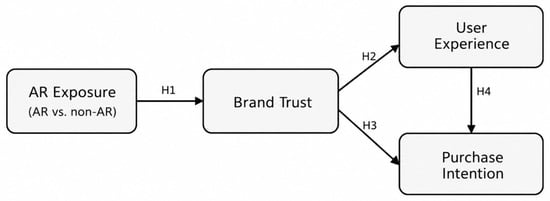
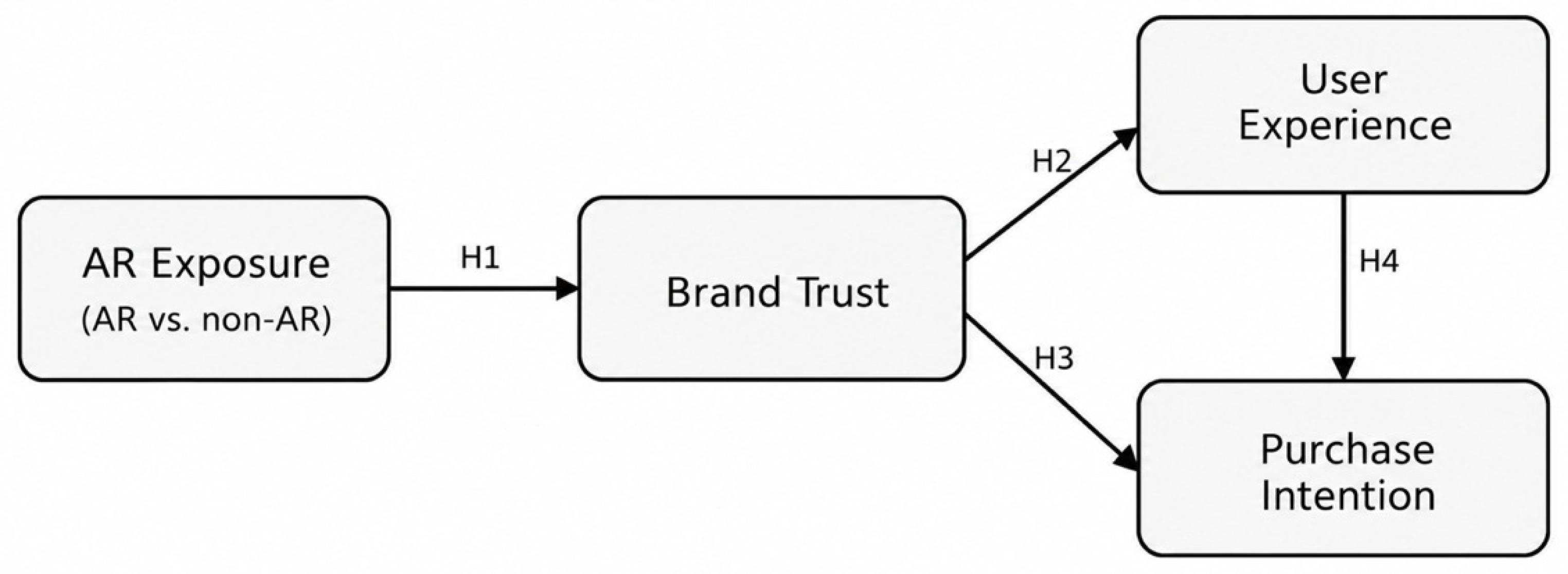
The proposed conceptual framework integrates exposure to an AR-enabled luxury shopping demonstration, brand trust, user experience, and purchase intention. AR versus non-AR condition is the experimental factor, while brand trust is conceptualized as a proposed mediator linking experimental condition with consumer evaluations. Two indirect pathways through brand trust are hypothesized: one relating to user experience and another relating to purchase intention. User experience is additionally expected to be positively associated with purchase intention. Figure 1 summarizes these theoretically proposed relationships. The hypotheses are examined through separate mediation and regression analyses rather than through estimation of an integrated sequential mediation model. Accordingly, the directions shown in the framework represent theoretical propositions rather than established causal ordering among the measured psychological constructs.
Figure 1.
Hypothesized conceptual model. Note: Each mediation pathway was run as a separate mediation model [37].
3. Methodology
3.1. Research Setting and Sampling
The experimental design follows a scenario-based approach, in which participants are instructed to imagine themselves in a realistic shopping situation and evaluate the experience represented by the experimental stimuli. Such an approach is consistent with previous research examining cognitive, affective, and experiential responses to AR through video-based shopping scenarios [6,7,8]. Accordingly, the measurement instruments were intended to capture participants’ subjective evaluations of the simulated shopping experience rather than evaluations derived from actual interaction with the application.
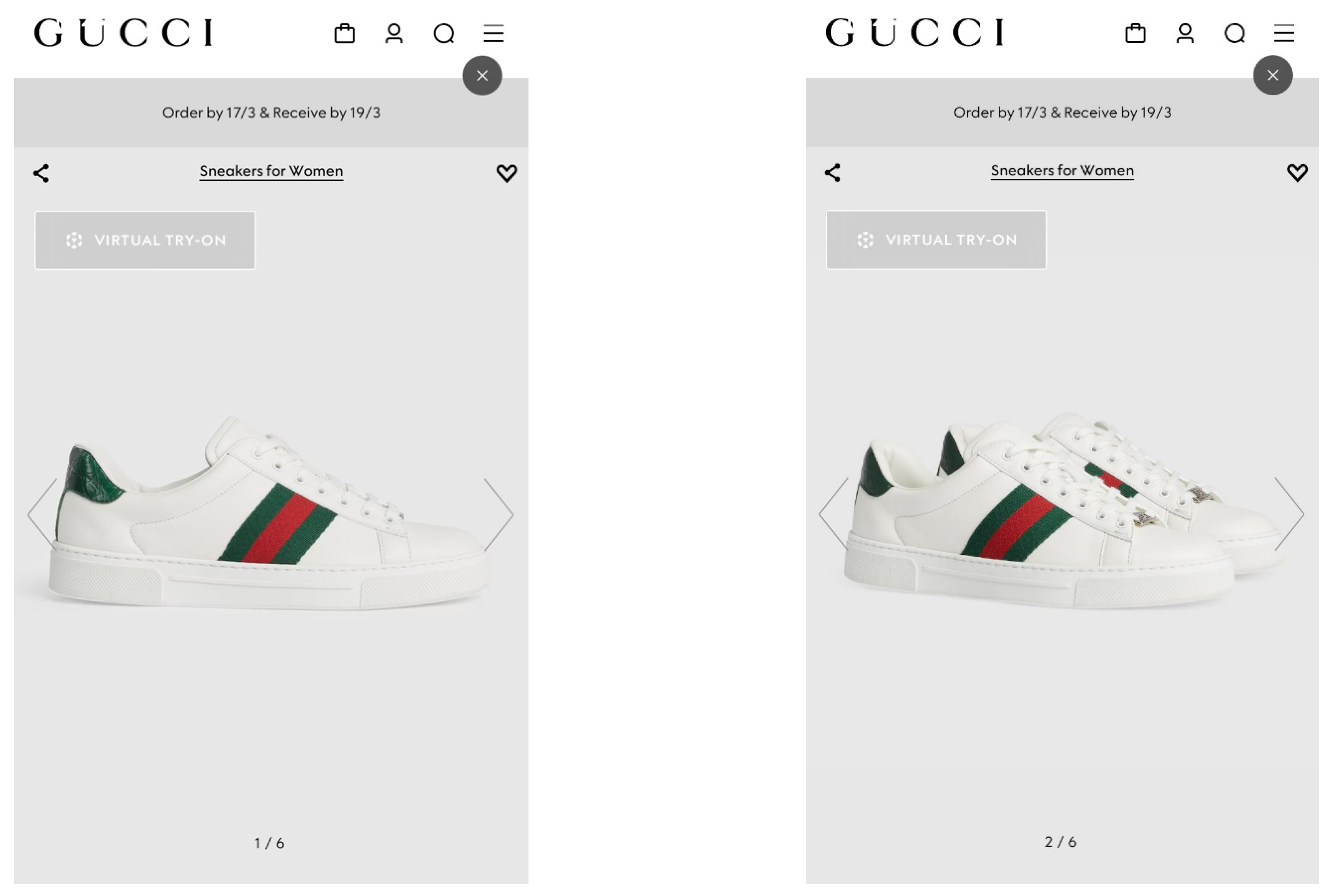
A single-factor (AR vs. non-AR) between-subjects experiment compared responses to an AR virtual try-on demonstration with those to a conventional non-AR mobile shopping demonstration in a luxury m-commerce setting. The use of video-based experimental stimuli is consistent with previous research examining consumer responses to AR-enabled shopping environments [6,7], including virtual try-on applications [8]. Accordingly, the present study investigated responses to exposure to AR-enabled product presentations rather than direct interaction with AR technology. Gucci was selected as the focal luxury brand because of its use of AR-enabled virtual try-on technology for footwear, allowing the development of realistic shopping demonstrations within the Gucci mobile shopping application. Sneakers were selected because their visual characteristics are suitable for virtual try-on. To simulate a mobile shopping experience within an online survey environment, two first-person video demonstrations were developed: one featuring AR-enabled virtual try-on functionality and the other presenting a conventional non-AR shopping experience. Videos lasted 34 s and featured the same Gucci sneaker model, mobile shopping application, shopping context, and first-person perspective. Both videos were presented without sound. In the AR condition (Appendix A), participants watched a demonstration of the Gucci virtual try-on functionality, in which the sneakers were visualized on a foot and were shown from multiple angles through continuous rotation, rather than through a fixed sequence of product views. In the non-AR condition (Appendix A), participants viewed the same sneakers through the conventional Gucci mobile shopping interface, which presented the product’s features without AR functionality. Although both conditions featured the same brand, product, shopping context, and duration, their presentation formats differed. The AR condition incorporated embodied product visualization and multi-angle inspection, whereas the non-AR condition relied on conventional product presentation. The comparison therefore captures consumer responses to these two mobile shopping presentation formats rather than isolating AR functionality independently of the visual characteristics associated with virtual try-on.
A pre-test involving 50 respondents was conducted before the main data collection to assess the clarity of the experimental scenarios and questionnaire items and to identify potential procedural issues. Following the pre-test, minor wording adjustments were introduced to improve the clarity of the shopping scenario and questionnaire instructions, without altering the experimental conditions or the constructs under investigation.
Data were collected through an online questionnaire administered via Qualtrics. Participants were recruited in Portugal through non-probability convenience and snowball sampling, using social media and online networks. Participation was voluntary, and informed consent was requested before the questionnaire began. Eligibility screening considered participants’ age and previous online purchasing experience. Following screening, participants were automatically and randomly assigned to one of the two experimental conditions using the Randomizer feature in Qualtrics. All participants received identical introductory instructions: “Imagine that you have won a monetary prize and would like to purchase a new pair of sneakers from a luxury brand, in this case Gucci. You access the brand’s app to look for a model that appeals to you. After browsing through several models, your attention is drawn to the product shown below, and you decide to evaluate its features in greater detail, including its design and how it fits on your foot. Please watch the video carefully, as it illustrates how you would go about searching for a new pair of sneakers.”
An a priori power analysis was conducted using G*Power 3.1 to determine the required sample size for a two-group design (independent-samples t-test). Assuming a medium effect size (Cohen’s d = 0.50), α = 0.05, and power = 0.80, the analysis indicated that a minimum of 128 participants (64 per group) would be required. The final sample size (N = 181; 89 in the AR condition and 92 in the non-AR condition) exceeded the minimum required to detect medium-sized effects.
A total of 246 responses were initially collected. After excluding incomplete questionnaires (n = 44) and responses that failed the instructed-response attention check (n = 21), the final analytical sample comprised 181 participants. Of these, 89 participants (49.2%) were assigned to the AR condition and 92 (50.8%) to the non-AR condition. Additional analyses were performed to assess demographic balance across the two experimental conditions. Mean age did not differ significantly between participants assigned to the AR demonstration (M = 39.17, SD = 15.95) and those assigned to the non-AR demonstration (M = 39.91, SD = 16.92), t(179) = −0.304, p = 0.761, Cohen’s d = −0.045. Similarly, gender distribution did not differ significantly between conditions, χ2(1, N = 181) = 0.016, p = 0.898, Cramér’s V = 0.010. A supplementary ordinary least squares regression analysis was conducted to assess whether the positive experimental-condition effect on purchase intention remained after adjusting for age and gender. The estimated effect remained positive and statistically significant (B = 0.474, p = 0.004, 95% CI [0.153, 0.794]), indicating that the difference in purchase intention persisted after adjustment for these demographic characteristics. Participants ranged in age from 18 to 88 years (M = 39.55, SD = 16.41), and 61.3% were female. The sample characteristics are presented in Table 1.
Table 1.
Sample profile (n = 181).
3.2. Measures
The questionnaire included three multi-item measures adapted from previous studies to reflect the Gucci mobile shopping scenario. Construct items were rated on five-point Likert-type scales ranging from 1 (strongly disagree) to 5 (strongly agree). User experience was measured using four items adapted from Zhou and Liu [38] (α = 0.848), while purchase intention was assessed using three items adapted from Nguyen et al. [39] (α = 0.902). Brand trust, the proposed mediator, was measured using three items adapted from Laroche et al. [29] (α = 0.893). Composite scores for brand trust, user experience, and purchase intention were calculated as the mean of their respective items.
Cronbach’s alpha was used to assess internal consistency (Appendix B). The questionnaire also included an instructed-response attention check adapted from Pavone et al. [40]: “To confirm your attention, please select option 5 for this question”. The measurement model was also evaluated through confirmatory factor analysis (CFA), composite reliability (CR), average variance extracted (AVE), and discriminant validity using the heterotrait–monotrait ratio (HTMT). Detailed results are provided in Appendix B.
3.3. Ethical Approval
All procedures performed in the study were in accordance with the ethical standards of the institutional and/or national research committee and with the 1964 Helsinki Declaration and its later amendments or comparable ethical standards. Participation in the study was voluntary and restricted to adults. Before completing the questionnaire, participants were presented with an information and consent statement describing the research purpose, the voluntary nature of participation, the right to withdraw, and the intended confidential use of the collected data. Participants were required to indicate their consent before proceeding with the survey.
3.4. Data Analysis
Data were analyzed using IBM SPSS Statistics (version 31.0.2.0). Analyses included reliability assessment, analysis of variance, linear regression, and mediation analysis. Cronbach’s alpha was used to assess internal consistency. Manipulation checks were examined by comparing participants’ recognition of the experimental conditions. Differences between the AR and non-AR conditions were evaluated using one-way analyses of variance. The hypothesized indirect effects through brand trust were examined using two separate simple mediation analyses with PROCESS Model 4 [37], specifying user experience and purchase intention as the respective dependent variables. Indirect effects were estimated using 5000 bootstrap resamples and 95% confidence intervals. The relationship between user experience and purchase intention was examined separately using linear regression. The mediation pathways were estimated separately rather than in an integrated sequential mediation model.
4. Results
4.1. Measurement Model Assessment
The measurement model was assessed through confirmatory factor analysis (CFA). The three-factor model showed mixed model fit results (χ2(32) = 77.22, CFI = 0.960, TLI = 0.944, RMSEA = 0.089, and SRMR = 0.066). Standardized factor loadings ranged from 0.679 to 0.900, composite reliability (CR) values ranged from 0.853 to 0.903, and average variance extracted (AVE) values ranged from 0.594 to 0.757, supporting convergent validity. Discriminant validity was supported by HTMT values below 0.85. Detailed measurement results are presented in Appendix B.
4.2. Manipulation Checks
Manipulation checks were conducted to assess participants’ recognition of the experimental conditions. Four items were used, each measured on a five-point Likert scale. Two composite scores were constructed by summing the corresponding items: perceived AR presence (MAN1 and MAN3) and perceived AR absence (MAN2 and MAN4), each ranging from 2 to 10. A one-way ANOVA revealed a significant difference in perceived AR presence between the AR (M = 9.35, SD = 0.89) and non-AR conditions (M = 3.22, SD = 1.21), F(1, 179) = 1493.08, p < 0.001, η2 = 0.893. Similarly, perceived AR absence differed significantly between the non-AR (M = 9.34, SD = 1.25) and AR conditions (M = 2.51, SD = 0.79), F(1, 179) = 1920.15, p < 0.001, η2 = 0.915. Participants distinguished between the demonstrations in their recognition of AR functionality. However, these measures capture recognition of the presented functionality rather than experiential dimensions such as perceived interactivity, control, or vividness.
4.3. Hypotheses Testing
Hypotheses were examined using one-way analysis of variance, ordinary least squares regression, and PROCESS Model 4 mediation analyses (5000 bootstrap samples). All reported analyses used N = 181. Experimental condition was coded 0 = non-AR demonstration and 1 = AR demonstration. Brand trust was specified as the proposed mediator, with user experience and purchase intention considered separately as outcomes. Because brand trust and the outcomes were measured after exposure, their associations cannot be interpreted as experimentally established causal effects.
4.3.1. Main Effects
H1 predicted higher brand trust following exposure to the AR (vs. non-AR) demonstration. A one-way ANOVA revealed that participants in the AR condition reported higher brand trust (M = 3.82, SD = 0.84) than those in the non-AR condition (M = 3.73, SD = 0.95). However, this difference was not statistically significant (F(1, 179) = 0.512, p = 0.475, η2 = 0.003). Therefore, H1 was not supported. Although the difference in brand trust between the AR and non-AR conditions was not statistically significant, this result should not be interpreted as evidence of equivalence or as demonstrating the absence of an effect. The observed difference was small (Cohen’s d = 0.11), and the sample size provided limited sensitivity to effects of this magnitude. Consequently, the present findings are inconclusive regarding the possibility of a small effect of the AR virtual try-on demonstration on brand trust.
Table 2 presents the descriptive statistics and between-condition comparisons for brand trust, user experience, and purchase intention. Participants exposed to the AR virtual try-on demonstration reported higher purchase intention than those in the non-AR condition (F(1, 179) = 8.64, p = 0.004, Cohen’s d = 0.44). User experience was slightly lower in the AR condition, although this difference was not statistically significant (F(1, 179) = 1.060, p = 0.305, Cohen’s d = −0.15). These results should be interpreted in light of the characteristics of the experimental stimuli and the measurement instruments used.
Table 2.
Descriptive statistics and comparison of the experimental conditions.
To further examine whether the experimental effects on purchase intention and brand trust differed statistically, an additional exploratory analysis was conducted. Because both constructs were assessed using three-item composite scores on the same five-point response scale, a within-participant difference score was calculated by subtracting brand trust from purchase intention. This difference score was then regressed on experimental condition (0 = non-AR; 1 = AR). The results indicated that the experimental effect was significantly more positive for purchase intention than for brand trust (B = 0.384, SE = 0.155, t(179) = 2.478, p = 0.014, 95% CI [0.078, 0.689]). This finding provides evidence that the experimental effects differed between the two observed composite scores. However, given the conceptual distinction between purchase intention and brand trust, this comparison should be interpreted cautiously and does not imply equivalence between the underlying psychological constructs.
4.3.2. Mediation Analysis
To test the proposed indirect effects, two separate simple mediation analyses were conducted using PROCESS Model 4 with 5000 bootstrap samples [37], specifying brand trust as the mediator and user experience and purchase intention as the respective dependent variables. AR exposure was a two-level factor (non-AR vs. AR) and was coded as 0 = non-AR and 1 = AR. The association between user experience and purchase intention was examined separately using ordinary least squares regression. Accordingly, the proposed relationships were not estimated simultaneously within an integrated structural model.
AR exposure did not significantly predict brand trust (B = 0.10, SE = 0.13, t(179) = 0.72, p = 0.475). Indirect effects were assessed using bootstrap confidence intervals because the statistical significance of the individual a-path is not a prerequisite for testing an indirect effect [37].
Brand trust significantly predicted user experience, controlling for AR exposure (B = 0.54, SE = 0.06, t(178) = 9.12, p < 0.001). The bootstrapped indirect effect of experimental condition on user experience through brand trust was not statistically significant (a × b = 0.05, 95% CI [−0.09, 0.18]), as the confidence interval included zero. The direct effect of experimental condition on user experience was also not statistically significant (B = −0.18, SE = 0.11, t(178) = −1.73, p = 0.086). Thus, H2 was not supported.
Brand trust significantly predicted purchase intention, controlling for AR exposure (B = 0.57, SE = 0.08, t(178) = 7.07, p < 0.001). The bootstrapped indirect effect of experimental condition on purchase intention through brand trust was not statistically significant (a × b = 0.05, 95% CI [−0.10, 0.21]), as the confidence interval included zero. The direct effect of experimental condition on purchase intention was statistically significant (B = 0.42, SE = 0.14, t(178) = 2.94, p = 0.004), indicating higher purchase intention in the AR condition than in the non-AR condition. Thus, H3 was not supported (see Table 3).
Table 3.
Indirect effects of AR exposure through brand trust.
Brand trust and the outcome variables were measured simultaneously after exposure. Therefore, the b-paths represent cross-sectional associations and cannot establish brand trust as a mechanism triggered by the experimental manipulation.
4.3.3. User Experience and Purchase Intention
H4 proposed that user experience would be positively associated with purchase intention. In the regression analysis, user experience was positively associated with purchase intention (B = 0.606, β = 0.465, SE = 0.09, p < 0.001, 95% CI [0.44, 0.78]). The overall regression model was statistically significant (F(1, 179) = 49.342, p < 0.001), explaining 21.6% of the variance in purchase intention (R2 = 0.22). Therefore, H4 was supported.
Overall, H4 was supported, whereas H1, H2, and H3 were not supported. AR exposure did not significantly predict brand trust, and the indirect effects of AR exposure on either user experience or purchase intention through brand trust were not statistically significant. Nevertheless, brand trust was positively associated with both user experience and purchase intention. In addition, the experimental condition showed statistically significant positive direct and total effects on purchase intention, with participants in the AR condition reporting higher purchase intention than those in the non-AR condition. User experience was also positively associated with purchase intention. These findings highlight the main experimental result: higher purchase intention following exposure to the AR demonstration, without a statistically significant difference in brand trust. The nonsignificant indirect effects provide no evidence supporting brand trust as a mediating mechanism in the present experimental setting.
5. Discussion
This study examined consumer responses to exposure to an AR virtual try-on demonstration compared with a conventional non-AR mobile shopping demonstration in luxury m-commerce, focusing on brand trust as a proposed mediating mechanism. The findings showed different results across the outcomes. Participants who viewed the AR demonstration reported significantly higher purchase intention, and this difference remained statistically significant after accounting for brand trust in the mediation model. However, no statistically significant difference in brand trust was detected, and neither hypothesized indirect effect through brand trust was statistically supported. Brand trust was positively associated with both user experience and purchase intention, while user experience was positively associated with purchase intention. These results suggest that immediate purchase-related responses and brand-relational evaluations may differ following a single AR virtual luxury shopping demonstration. Examining them separately avoids assuming that greater purchase interest necessarily reflects stronger brand trust.
The supplementary exploratory analysis further indicated that the experimental effect on purchase intention was significantly more positive than that on brand trust. Unlike a comparison based solely on statistical significance, this analysis directly compared the experimental effects on the two outcomes. Nevertheless, as purchase intention and brand trust represent conceptually distinct constructs, this result should be understood as a comparison of observed composite scores rather than evidence of equivalence between the underlying psychological dimensions. The findings therefore reinforce the importance of distinguishing purchase-related responses from brand-relational evaluations when examining consumer reactions to AR virtual luxury mobile shopping demonstrations.
The lack of a statistically significant difference in brand trust between the AR and non-AR conditions (H1) deserves further consideration. Previous research has associated luxury AR experiences with trust-related cognitive responses and broader brand perceptions [12,13]. However, these responses differ from brand trust, which reflects consumers’ confidence in a brand’s reliability and ability to deliver on its promises [18,19]. Brand trust is shaped by previous experiences and familiarity with a brand [20], which may help explain why a single video-based demonstration did not produce a significant change. Although the AR-enabled presentation may have supported product evaluation, its influence on established brand perceptions may have been limited. The nonsignificant result, however, does not rule out a smaller effect that the study may have been unable to detect. It is also important to distinguish confidence in the technology from confidence in the brand offering it [22]. Because technology trust was not measured, the study cannot determine whether participants’ trust in the technology responded differently from their trust in the brand.
The mediation analyses provide additional insight into the proposed role of brand trust. Although brand trust was positively associated with user experience and purchase intention, neither hypothesized indirect effect of AR exposure through brand trust was statistically supported. Positive associations between brand trust and the outcomes do not, by themselves, show that brand trust carries the effect of the experimental condition. The findings are consistent with previous research identifying brand trust as relevant to online brand experiences and purchase-related responses [18,21,25], but they do not provide evidence supporting the specific mediation pathways proposed. Furthermore, the relationship between brand trust and user experience may be reciprocal across consumer–brand encounters, as favorable digital experiences can also contribute to trust development [20,21].
The higher purchase intention observed in the AR condition is consistent with previous research associating AR-enabled shopping experiences with purchase-related outcomes [1,4,5,14,15]. In this video-based luxury shopping setting, participants who viewed the AR virtual try-on demonstration reported higher purchase intention, whereas the difference in brand trust was not statistically significant. The experimental conditions differed not only in AR functionality but also in product presentation. The AR virtual try-on demonstration showed the sneakers on a foot with continuous multi-angle rotation, whereas the non-AR condition used a conventional product interface. Therefore, the observed difference cannot be attributed exclusively to AR technology, but to the virtual try-on demonstration as implemented.
The experimental conditions did not differ significantly in reported user experience, despite the higher purchase intention observed among participants who viewed the AR virtual try-on demonstration. The virtual try-on presentation may have facilitated product evaluation by showing how the sneakers appeared on a foot, encouraging purchase consideration without necessarily improving perceptions of the shopping experience. Another possibility is that the user-experience measure did not fully capture aspects particularly relevant to AR-enabled shopping, such as perceived interactivity, control, vividness, or product diagnosticity [4,5]. However, these dimensions were not directly assessed, and the nonsignificant result does not establish that the two conditions produced equivalent user experiences. The positive association between user experience and purchase intention supports H4 and is consistent with previous research linking favorable evaluations of digital shopping environments with purchase-related responses [1,31,36]. Related research in mobile banking has also identified flow as a predictor of continuance intention, suggesting that experiential processes can contribute to behavioral intentions in mobile service contexts [38].
The findings also contribute to the discussion concerning the implications of AR for luxury consumption. Zhu, Du, and Zhang [17] demonstrate that AR may weaken luxury-product evaluations relative to three-dimensional visualization when increased psychological proximity reduces perceived exclusivity. By contrast, participants in the present study reported higher purchase intention after viewing the AR-enabled demonstration than after viewing the conventional non-AR demonstration. The findings are not necessarily contradictory because the studies used different comparison conditions, outcome measures, and investigated mechanisms. Together, they reinforce the importance of examining AR-related consumer responses in relation to the specific technological presentation and luxury context.
6. Conclusions
This study examined consumer responses to an AR virtual try-on demonstration in luxury mobile commerce, with particular attention to brand trust as a proposed mediating mechanism. Participants exposed to the AR virtual try-on demonstration, as implemented in this study, reported higher purchase intention, but no statistically significant difference in brand trust was observed. However, a small effect on brand trust cannot be ruled out, and the purchase intention effect cannot be attributed exclusively to AR functionality.
The results highlight why purchase-related responses and confidence in the brand should be considered separately when evaluating AR-enabled luxury-shopping demonstrations. The indirect effects through brand trust were not statistically supported in this experimental setting, although the results do not exclude a mediating role under other conditions. The mechanisms underlying the positive purchase intention response remain unidentified. Future research can examine the technological, experiential, and relational processes that may explain this response in immersive luxury commerce.
6.1. Theoretical Implications
The study offers two main theoretical implications. First, it contributes to research on immersive commerce and digital brand relationships by examining purchase intention and brand trust as distinct responses to the same AR-enabled luxury shopping demonstration. Previous research has associated luxury AR experiences with trust-related cognitive evaluations and favorable brand-level perceptions [12,13]. However, confidence in technological functionality and favorable evaluations of immersive experiences should not automatically be equated with confidence in the brand’s reliability and ability to fulfill its promises [18,22]. In the present experiment, participants who viewed the AR-enabled demonstration reported higher purchase intention, while no statistically significant difference in brand trust was detected. This pattern supports treating purchase-related and brand-relational evaluations as separate outcomes when investigating technologically mediated luxury shopping encounters. Second, the study provides an empirical qualification of brand trust as a proposed relational pathway linking AR exposure to consumer responses. Brand trust was positively associated with user experience and purchase intention, consistent with previous research on digital brand relationships [21,25]. Nevertheless, neither hypothesized indirect effect through brand trust was statistically supported. This distinction matters because positive associations between brand trust and consumer responses do not necessarily imply that brand trust transmits the effect of a specific technologically enhanced shopping encounter. Rather than excluding brand trust as a potential mediator, the findings suggest that its explanatory role should be examined in relation to the characteristics of the brand encounter and the conditions under which relational confidence may change.
6.2. Managerial Implications
For luxury brands considering AR-enabled mobile shopping, the findings offer several practical considerations. The higher purchase intention reported after the AR virtual try-on demonstration suggests that showing this functionality may encourage product consideration in luxury mobile shopping contexts. However, because participants viewed a demonstration rather than directly using the application, the findings do not establish that virtual try-on improves decision quality or actual purchasing behavior. Moreover, the absence of a statistically significant difference in brand trust suggests that luxury brands should not assume that AR-enabled demonstrations are sufficient, on their own, to strengthen consumers’ relational confidence in the brand. Because brand trust develops through repeated consumer-brand interactions [18,20], luxury brands may benefit from evaluating AR functionality alongside broader interface characteristics, including usability, product information, visual presentation, and technical reliability. The positive association between user experience and purchase intention does not establish that AR alone improves the digital shopping experience. Usability, product information, visual presentation, technical performance, and overall interface coherence remain important components of the mobile shopping journey. AR should therefore be integrated seamlessly into the broader interface rather than implemented as an isolated technological feature. Finally, luxury brands should remain attentive to the potential tension between accessibility and exclusivity. Although the present study observed higher purchase intention in the AR condition, prior research indicates that increased psychological proximity may reduce perceived exclusivity under some conditions [17]. AR design should therefore balance product accessibility and diagnosticity with premium visual execution and brand-consistent presentation.
6.3. Limitations and Future Research
Several limitations should be considered when interpreting these findings, providing opportunities for future research. First, the study adopted a scenario-based experimental design in which participants were instructed to imagine themselves engaging in the shopping experience represented by the video demonstrations. Although this approach allows the assessment of consumers’ perceptions of a simulated shopping experience, it does not reproduce the interactivity, personalization, or perceived control associated with direct AR use [4,5]. Accordingly, participants’ evaluations of user experience, including perceived usability and service-related expectations, should be interpreted within the simulated shopping context. Future research could complement this approach with interactive AR applications to examine whether the observed consumer responses extend to actual technology use. Second, the study examined a single luxury brand and product category (Gucci sneakers) using a Portuguese convenience and snowball sample, which may limit the generalizability of the findings. Participants’ previous familiarity with Gucci, existing brand attitudes, product preferences, and prior experience with AR mobile shopping may have influenced their evaluations of the experimental demonstrations. However, these characteristics were not assessed before exposure. Future research could incorporate pre-exposure measures of brand trust, brand familiarity, and brand attitudes, to further explore these relationships. Studies involving less familiar or fictional luxury brands, different product categories, and more diverse consumer samples could also help establish whether the observed responses extend beyond the specific context examined. Third, although the sample size exceeded the minimum established by the a priori power analysis, the study may have had limited statistical sensitivity to small effects, particularly regarding brand trust. Consequently, the nonsignificant brand trust result remains inconclusive and does not establish the absence of an effect. Future research employing larger samples and repeated exposure could provide more precise estimates and further clarify the potential influence of AR-enabled demonstrations on brand trust. Finally, the study did not directly examine several mechanisms that may help explain purchase-related responses to AR-enabled shopping presentations, including product diagnosticity, vividness, perceived innovativeness, engagement, psychological ownership, psychological proximity, and perceived exclusivity [4,5,14,15,17]. Future studies should investigate these mechanisms to clarify the circumstances under which AR-enabled presentations facilitate purchase intention and how these responses relate to longer-term brand evaluations.
Author Contributions
Conceptualization, R.S. and M.C.; methodology, R.S. and M.C.; software, R.S. and M.C.; validation, R.S.; formal analysis, R.S.; investigation, R.S., M.C., M.J.S.d.F. and J.E.G.; resources, R.S. and M.C.; data curation, R.S.; writing—original draft preparation, R.S.; writing—review and editing, R.S., M.J.S.d.F. and J.E.G.; visualization, R.S.; supervision, R.S. All authors have read and agreed to the published version of the manuscript.
Funding
This research received no external funding.
Institutional Review Board Statement
The study was conducted in accordance with the Declaration of Helsinki and approved by the Institutional Ethics Committee.
Informed Consent Statement
All participants were informed of the purpose of the study, the voluntary nature of their participation, the anonymity of their responses, and their right to withdraw from the survey at any time before submission. Informed consent was obtained from all participants prior to data collection. All responses were collected anonymously and stored securely.
Data Availability Statement
The data presented in this study are available from the corresponding author upon reasonable request. The data are not publicly available due to privacy and ethical considerations related to participant responses.
Conflicts of Interest
The authors declare no conflicts of interest.
Appendix A. Stimulus Materials
Figure A1.
AR scenario.
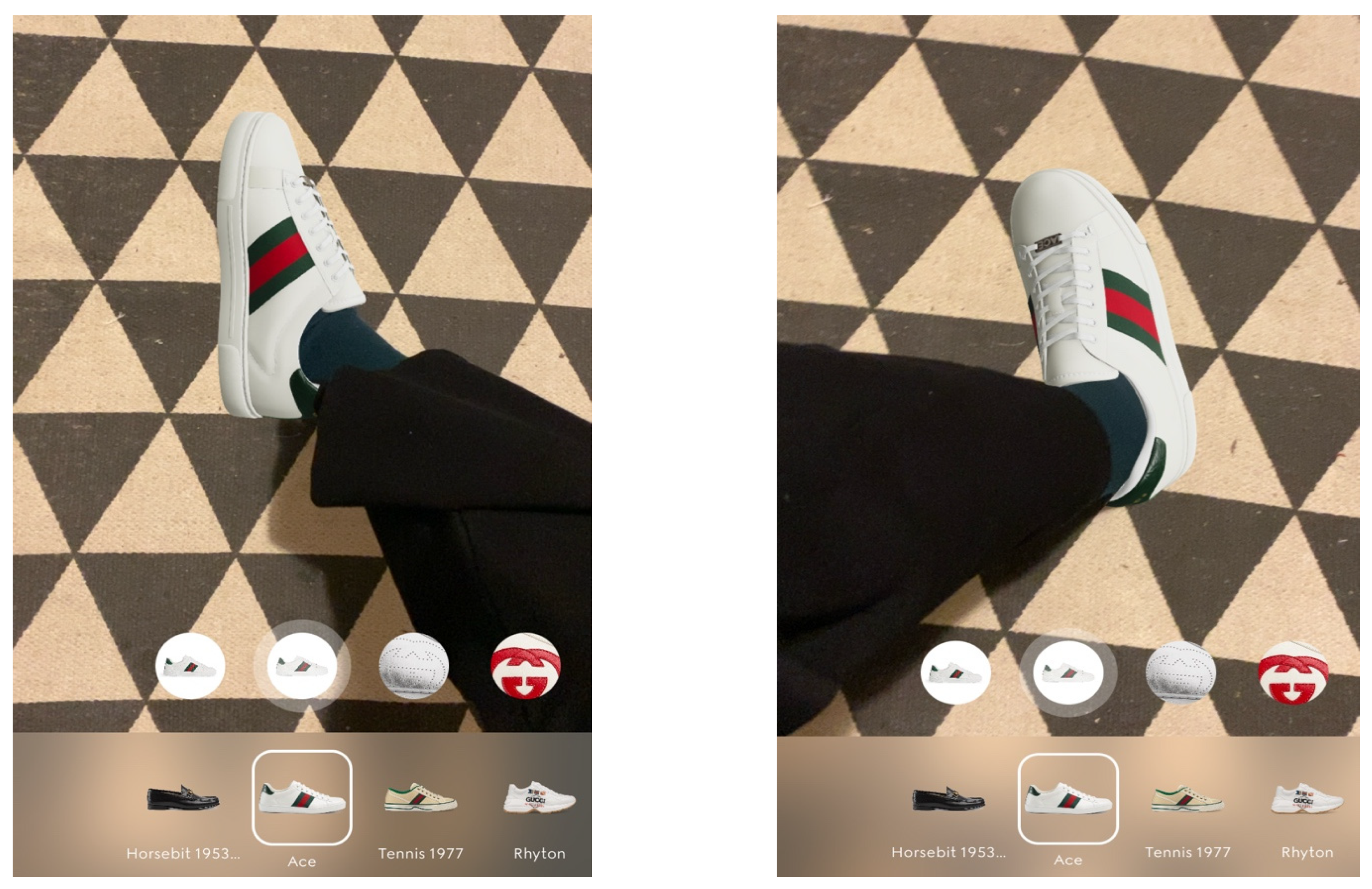
Figure A2.
Non-AR scenario.
Appendix B. Measurement Model Assessment
Table A1.
Confirmatory Factor Analysis Results, Cronbach’s alpha, Composite Reliability, and Average Variance Extracted.
Table A2.
Heterotrait–Monotrait Ratio (HTMT).
References
- Ebrahimabad, F.Z.; Yazdani, H.; Hakim, A.; Asarian, M. Augmented reality versus web-based shopping: How does AR improve user experience and online purchase intention. Telemat. Inform. Rep. 2024, 15, 100152. [Google Scholar] [CrossRef] [Scilit]
- Naveen, L.; Khan, M.I.; Saleh, M.A.; Subudhi, R.N. The influence of mobile augmented reality on consumer behavior: Insights into affective, cognitive, and behavioral responses. Comput. Hum. Behav. 2025, 165, 108558. [Google Scholar] [CrossRef] [Scilit]
- Pfaff, A.; Spann, M. Augmented reality and spatial fit uncertainty in online retailing. J. Retail. Consum. Serv. 2025, 87, 104442. [Google Scholar] [CrossRef] [Scilit]
- Yim, M.Y.-C.; Chu, S.-C.; Sauer, P.L. Is augmented reality technology an effective tool for e-commerce? An interactivity and vividness perspective. J. Interact. Mark. 2017, 39, 89–103. [Google Scholar] [CrossRef] [Scilit]
- Hilken, T.; de Ruyter, K.; Chylinski, M.; Mahr, D.; Keeling, D.I. Augmenting the eye of the beholder: Exploring the strategic potential of augmented reality to enhance online service experiences. J. Acad. Mark. Sci. 2017, 45, 884–905. [Google Scholar] [CrossRef] [Scilit]
- Barhorst, J.B.; McLean, G.; Shah, E.; Mack, R. Blending the real world and the virtual world: Exploring the role of flow in augmented reality experiences. J. Bus. Res. 2021, 122, 423–436. [Google Scholar] [CrossRef] [Scilit]
- Hoffmann, S.; Joerß, T.; Mai, R.; Akbar, P. Augmented reality-delivered product information at the point of sale: When information controllability backfires. J. Acad. Mark. Sci. 2022, 50, 743–776. [Google Scholar] [CrossRef] [Scilit] [PubMed]
- Mollel, J.; Chen, Y. Does AR virtual try-on boost online apparel purchase intentions? An integration of TAM, IDT, FIT perception and body esteem. Young Consum. 2025, 26, 385–402. [Google Scholar] [CrossRef] [Scilit]
- Kapferer, J.-N.; Bastien, V. The specificity of luxury management: Turning marketing upside down. J. Brand. Manag. 2009, 16, 311–322. [Google Scholar] [CrossRef] [Scilit]
- Holmqvist, J.; Wirtz, J.; Fritze, M.P. Luxury in the digital age: A multi-actor service encounter perspective. J. Bus. Res. 2020, 121, 747–756. [Google Scholar] [CrossRef] [Scilit]
- Javornik, A.; Duffy, K.; Rokka, J.; Scholz, J.; Nobbs, K.; Motala, A.; Goldenberg, A. Strategic approaches to augmented reality deployment by luxury brands. J. Bus. Res. 2021, 136, 284–292. [Google Scholar] [CrossRef] [Scilit]
- Darragi Nawres, D.; Bahri-Ammari, N.; Yousaf, A.; Mishra, A. The role of augmented reality in shaping purchase intentions and WOM for luxury products. J. Bus. Res. 2024, 171, 114368. [Google Scholar] [CrossRef] [Scilit]
- Arya, V.; Sethi, D.; Hollebeek, L.D. Using augmented reality to strengthen consumer/brand relationships: The case of luxury brands. J. Consum. Behav. 2025, 24, 545–561. [Google Scholar] [CrossRef] [Scilit]
- Baber, R.; Baber, P.; Narula, S. Driving AR experience to purchase intention: Examining the role of users’ immersiveness, perceived innovativeness and engagement in virtual try-on. Int. J. Consum. Stud. 2026, 50, e70185. [Google Scholar] [CrossRef] [Scilit]
- Zhang, X.; Aw, E.C.-X.; Tan, G.W.-H.; Ooi, K.-B.; Sthapit, E. Creating psychological ownership through augmented reality. Int. J. Consum. Stud. 2026, 50, e70245. [Google Scholar] [CrossRef] [Scilit]
- Bharti, M.; Antil, A. Click, try, luxe: The role of AR virtual try-ons in shaping customer experience for luxury retail. J. Retail. Consum. Serv. 2026, 94, 104992. [Google Scholar] [CrossRef] [Scilit]
- Zhu, L.; Du, J.; Zhang, Y. When closer feels cheaper: How AR undermines luxury perceptions compared to 3D visualization. J. Res. Interact. Mark. 2026, 20, 1373–1389. [Google Scholar] [CrossRef] [Scilit]
- Chaudhuri, A.; Holbrook, M.B. The chain of effects from brand trust and brand affect to brand performance: The role of brand loyalty. J. Mark. 2001, 65, 81–93. [Google Scholar] [CrossRef] [Scilit]
- Delgado-Ballester, E. Applicability of a brand trust scale across product categories: A multigroup invariance analysis. Eur. J. Mark. 2004, 38, 573–592. [Google Scholar] [CrossRef] [Scilit]
- Ha, H.-Y.; Perks, H. Effects of consumer perceptions of brand experience on the web: Brand familiarity, satisfaction and brand trust. J. Consum. Behav. 2005, 4, 438–452. [Google Scholar] [CrossRef] [Scilit]
- Morgan-Thomas, A.; Veloutsou, C. Beyond technology acceptance: Brand relationships and online brand experience. J. Bus. Res. 2013, 66, 21–27. [Google Scholar] [CrossRef] [Scilit]
- McKnight, D.H.; Carter, M.; Thatcher, J.B.; Clay, P.F. Trust in a specific technology: An investigation of its components and measures. ACM Trans. Manag. Inf. Syst. 2011, 2, 12. [Google Scholar] [CrossRef] [Scilit]
- Wedel, M.; Bigné, E.; Zhang, J. Virtual and augmented reality: Advancing research in consumer marketing. Int. J. Res. Mark. 2020, 37, 443–465. [Google Scholar] [CrossRef] [Scilit]
- Dacko, S.G. Enabling smart retail settings via mobile augmented reality shopping apps. Technol. Forecast. Soc. Change 2017, 124, 243–256. [Google Scholar] [CrossRef] [Scilit]
- Kim, D.J.; Ferrin, D.L.; Rao, H.R. Trust and satisfaction, two stepping stones for successful e-commerce relationships: A longitudinal exploration. Inf. Syst. Res. 2009, 20, 237–257. [Google Scholar] [CrossRef] [Scilit]
- Marriott, H.; Williams, M. Exploring consumers perceived risk and trust for mobile shopping: A theoretical framework and empirical study. J. Retail. Consum. Serv. 2018, 42, 133–146. [Google Scholar] [CrossRef] [Scilit]
- Wiedmann, K.-P.; Hennigs, N.; Siebels, A. Value-based segmentation of luxury consumption behavior. Psychol. Mark. 2009, 26, 625–651. [Google Scholar] [CrossRef] [Scilit]
- Ko, E.; Costello, J.P.; Taylor, C.R. What is a luxury brand? A new definition and review of the literature. J. Bus. Res. 2019, 99, 405–413. [Google Scholar] [CrossRef] [Scilit]
- Laroche, M.; Habibi, M.R.; Richard, M.-O.; Sankaranarayanan, R. The effects of social media based brand communities on brand community markers, value creation practices, brand trust and brand loyalty. Comput. Hum. Behav. 2012, 28, 1755–1767. [Google Scholar] [CrossRef] [Scilit]
- Verhoef, P.C.; Lemon, K.N.; Parasuraman, A.; Roggeveen, A.; Tsiros, M.; Schlesinger, L.A. Customer experience creation: Determinants, dynamics and management strategies. J. Retail. 2009, 85, 31–41. [Google Scholar] [CrossRef] [Scilit]
- Flavián, C.; Ibáñez-Sánchez, S.; Orús, C. The impact of virtual, augmented and mixed reality technologies on the customer experience. J. Bus. Res. 2019, 100, 547–560. [Google Scholar] [CrossRef] [Scilit]
- Yoo, J. The effects of perceived quality of augmented reality in mobile commerce—An application of the information systems success model. Informatics 2020, 7, 14. [Google Scholar] [CrossRef] [Scilit]
- Atwal, G.; Williams, A. Luxury brand marketing—The experience is everything! In Advances in Luxury Brand Management; Kapferer, J.-N., Kernstock, J., Brexendorf, T.O., Powell, S.M., Eds.; Palgrave Macmillan: Cham, Switzerland, 2017; pp. 43–57. [Google Scholar] [CrossRef] [Scilit]
- Klaus, P.; Manthiou, A. Applying the EEE customer mindset in luxury: Reevaluating customer experience research and practice during and after corona. J. Serv. Manag. 2020, 31, 1175–1183. [Google Scholar] [CrossRef] [Scilit]
- Nofal, R. Algorithmic transparency and immersive retail: Investigating the joint effects of explainable AI and augmented reality on consumer trust and purchase decisions. J. Theor. Appl. Electron. Commer. Res. 2026, 21, 229. [Google Scholar] [CrossRef] [Scilit]
- Bai, B.; Law, R.; Wen, I. The impact of website quality on customer satisfaction and purchase intentions: Evidence from Chinese online visitors. Int. J. Hosp. Manag. 2008, 27, 391–402. [Google Scholar] [CrossRef] [Scilit]
- Hayes, A.F. Introduction to Mediation, Moderation, and Conditional Process Analysis: A Regression-Based Approach, 3rd ed.; The Guilford Press: New York, NY, USA, 2022. [Google Scholar]
- Zhou, T.; Liu, Y. Examining continuance usage of mobile banking from the perspectives of ECT and flow. Int. J. Serv. Technol. Manag. 2014, 20, 199–214. [Google Scholar] [CrossRef] [Scilit]
- Nguyen, T.K.L.; Nguyen, T.T.T.; Nguyen, D.P. Ad relevance vs. skepticism: Explaining avoidance and purchase intention. Int. J. Mark. Res. 2026, 68, 523–545. [Google Scholar] [CrossRef] [Scilit]
- Pavone, G.; Meyer-Waarden, L.; Munzel, A. Rage against the machine: Experimental insights into customers’ negative emotional responses, attributions of responsibility, and coping strategies in artificial intelligence-based service failures. J. Interact. Mark. 2023, 58, 52–71. [Google Scholar] [CrossRef] [Scilit]

Disclaimer/Publisher’s Note: The statements, opinions and data contained in all publications are solely those of the individual author(s) and contributor(s) and not of MDPI and/or the editor(s). MDPI and/or the editor(s) disclaim responsibility for any injury to people or property resulting from any ideas, methods, instructions or products referred to in the content. |
© 2026 by the authors. Licensee MDPI, Basel, Switzerland. This article is an open access article distributed under the terms and conditions of the Creative Commons Attribution (CC BY) license.