


Abstract
The growth of e-commerce in emerging economies presents a critical opportunity to steer digital consumption toward sustainability, yet the mechanisms that drive online green purchases in these contexts remain underexplored. This study examines how green digital marketing signals, specifically eco-labeling and sustainability claims, influence the online purchase intention for sustainable coffee in urban Ethiopia, introducing digital literacy as a key moderating factor. Grounded in an integrated framework of Signaling Theory and the Theory of Planned Behavior, the research model was tested using Partial Least Squares Structural Equation Modeling (PLS-SEM) on data from 451 urban e-commerce consumers. The results confirm that both eco-labeling and sustainability claims significantly enhance purchase intention, with green trust serving as a significant partial mediator. A pivotal finding is that digital literacy positively and significantly moderates the relationship between green trust and purchase intention, indicating that consumers with higher digital competence are more effective at translating trust into purchase decisions. These findings underscore that the success of online green marketing is contingent not only on signal credibility but also on user capability, offering crucial insights for platform design and policy in emerging digital markets.
1. Introduction
The global marketplace is undergoing a profound transformation driven by the powerful synergy of digital commerce and urgent sustainability goals. Within this dynamic landscape, green consumption is rapidly transitioning from a niche interest to a mainstream expectation [1]. This change is especially relevant in the e-commerce industry, where no one checks the physical appearance of products, and environmental statements and sustainability-related information become the key decision-making indicators [2]. The United Nations Sustainable Development Goals (SDGs) also emphasize the importance of sustainable business practices aimed at green marketing as the heart of ensuring sustainable development [3]. This transformation is particularly acute in emerging economies, where the process of going digital is proceeding very fast, and the environmental awareness is multiplex and becoming increasingly sophisticated [4].
This dynamic presents a compelling paradox in the context of Ethiopia, the historic birthplace of coffee. While the country’s economy and culture are intrinsically linked to this iconic product [5]. The interaction of its local urban consumers with sustainable coffee through e-commerce is a nascent phenomenon, distinct from established Western models. As a rapidly digitalizing nation with a deep cultural attachment to a globally significant commodity, Ethiopia presents a critical case study for understanding how e-commerce can foster sustainable development, a core concern of contemporary electronic commerce research. In this unique market, “green marketing” encompasses not only formal EL but also, and perhaps more critically, claims of origin traceability (e.g., specific regions, cooperatives, or washing stations) and authenticity, which serve as powerful, culturally resonant proxies for sustainability and quality [6].
In the digital marketplace, trust mechanisms are paramount. The inherent information asymmetry of e-commerce, where buyers and sellers are separated, and products cannot be physically inspected, is a fundamental challenge. This is especially true for “experience goods” like coffee, where paramount qualities such as taste and aroma cannot be verified before. Green marketing is now an essential business model to advertise products and services in such a manner that reduces environmental degradation [7]. Companies are being more and more encouraged to incorporate sustainable practices, not only to mitigate ecological factors but also to gain better performance in the market and gain a competitive edge [8]. Although e-commerce is seen as a less materialized and possibly greener substitute for traditional retail, the environmental impact of e-commerce, including packaging waste, the carbon intensity of last-mile delivery, and the energy use of data centers, is heavily criticized [9]. Therefore, green marketing is not just an opportunity but a necessity for the sector to address these inherent challenges and build consumer confidence in a context of high information asymmetry, where establishing trust in the product, the platform’s reliability, and the security of online payments is the essential transactional currency.
This research is grounded in the theoretical integration of Signaling Theory and the Theory of Planned Behavior (TPB). TPB is specifically successful in purchase intention, explaining that attitude, subjective norms, and perceived behavioral control are the key determinants of behavior [10]. One of the main limitations of e-commerce, though, is the imperfect information, as a remote transaction establishes a high level of information asymmetry between buyers and sellers, making the issue particularly worrisome in the context of the emerging markets that do not necessarily have well-established consumer protection systems. Signaling Theory dwells upon this very problem [11]. It indicates that sustainability assertions and eco-labels are plausible cues, which alleviate information asymmetry, and their effectiveness depends on the perceived credibility. The combination of both theories will result in an integrated model: Signaling Theory, whereby trust is accumulated due to external marketing stimuli, and which, in turn, will determine the attitudes and perceived control that are the key elements of the TPB model.
Despite this theoretical foundation, a critical gap remains in the literature. Past research has established general relationships between green marketing signals (like eco-labels), the building of GT, and subsequent purchase intentions [12,13,14]. However, these studies have largely overlooked a crucial boundary condition: the role of the consumer’s DL. In digital commerce contexts, consumers’ skill in navigating online platforms, verifying claims, and completing secure transactions has been shown to affect their engagement and trust in e-commerce environments [15,16]. This gap is especially pronounced in emerging e-commerce markets characterized by high information asymmetry, for “experience goods” like coffee, where quality cannot be verified before purchase, and in settings where informal traceability claims often replace formal EL [17]. The effectiveness of green signals may be insufficient if consumers lack the skills to navigate the platform, verify claims, and complete transactions securely. This directly impacts key e-commerce dimensions, including trust in platform interfaces, risk perceptions in online payments, and overall digital marketplace dynamics [18].
The Ethiopian situation serves as an interesting place to explore these dynamics. Coffee is at the heart of Ethiopia because the economy and culture of the country are closely connected with coffee [5]. The country is undergoing a fast economic growth, urbanization, and the development of a digital infrastructure, which provides a distinctive environment of opportunities and threats to market the most recognizable product in the online environment [19]. The country has taken a commitment in its effect of sustainability in its national projects, such as the Green Legacy Initiative, and telecom liberalization is also increasing internet coverage [20]. The e-commerce business of high-value commodities such as coffee is still in its infancy, and being a major opportunity to incorporate sustainable and inclusive ways of doing things, it is a very critical opportunity to instill sustainable and inclusive behaviors into their business at an early stage [21]. Although it is a critical strategic consideration, none of the empirical studies have quantitatively established the relationship between DL and the psychological processes that establish a connection between the signals of green marketing and consumer purchase intent in the unique socio-digital environment of Ethiopia.
This research fills such gaps with an examination of how green marketing practices affect consumer PI towards sustainable coffee products in Ethiopian e-commerce. It also analyses direct impacts of eco-labeling and sustainability assertions, the moderating effect of GT, and most importantly, the moderating impact of DL on the trust-intention relationship. The following are the research questions:
RQ1: What is the direct relationship between EL and SC and the PI of eco-friendly coffee products in Ethiopian e-commerce?
RQ 2: Does GT mediate the association between these cues of green marketing and PI towards coffee?
RQ3: Does the relationship between GT and PI of coffee rely on DL?
The present study gives some context-specific results by quantitatively surveying 451 people in larger urban areas, such as Addis Ababa, Awasa, Adama, and Dire Dawa. The analysis of the data was done via the Partial Least Squares Structural Equation Modelling (PLS-SEM) using SmartPLS 4.
Therefore, this study aims to develop and test an integrated model to explain the purchase intention for sustainable coffee in Ethiopia’s e-commerce market. The findings demonstrate that both eco-labeling and sustainability claims significantly enhance purchase intention, both directly and through the mediating mechanism of green trust. A pivotal conclusion is that a consumer’s digital literacy acts as a critical positive moderator, significantly strengthening the relationship between green trust and the intention to purchase. This underscores that in emerging digital markets, converting environmental trust into sales is contingent not only on credible marketing signals but also on the digital capability of the consumer.
2. Literature Review and Hypotheses Development
2.1. Theoretical Foundation
This study is grounded in the integration of the Theory of Planned Behavior (TPB) [10] and Signaling Theory [11]. TPB posits that behavioral intention is shaped by an individual’s attitude toward the behavior, subjective norms, and perceived behavioral control. In the context of green consumption, this explains how positive environmental perceptions, social pressures, and the ability to overcome barriers like cost or accessibility influence purchase decisions [22]. Specifically, a positive attitude towards sustainable coffee is formed by believing in its environmental benefits; subjective norms manifest through the growing social expectation among urban consumers to make eco-conscious choices; and perceived behavioral control relates to the consumer’s confidence in their ability to find, evaluate, and purchase these products online.
However, TPB does not fully address the high degree of information asymmetry inherent in e-commerce, where buyers and sellers are separated, and product qualities cannot be directly inspected. Signaling Theory addresses this gap by explaining how sellers use credible, verifiable cues such as third-party eco-labels to convey quality and reliability, thereby reducing buyer uncertainty and skepticism [23]. In an online marketplace flooded with options, these signals help products stand out and provide a heuristic for quality assessment. An integrated TPB-Signaling model offers a robust framework [24], where marketing signals influence TPB’s antecedents: they provide evidence that shapes attitudes, offer social validation that reinforces subjective norms, and reduce perceived risk, thereby enhancing behavioral control. For instance, a recognized eco-label can simultaneously make a consumer feel good about their choice (attitude), signal that the choice is socially approved (subjective norm), and reduce fears about product authenticity (perceived behavioral control). GT serves as the crucial bridge in this model; successful signaling builds trust, which in turn strengthens the psychological drivers of intention. This synthesized framework is particularly apt for the Ethiopian e-commerce context, where establishing trust is paramount for market growth.
2.2. E-Commerce Trust and Information Asymmetry in Emerging Markets
In emerging e-commerce ecosystems, platform-level trust structures such as ratings, secure payment gateways, and traceability interfaces are underdeveloped, magnifying the importance of consumer digital capability. The online environment, particularly in emerging markets like Ethiopia, is defined by a significant information asymmetry. Consumers cannot physically verify product quality, especially for “experience goods” like coffee, where taste, aroma, and quality are paramount and cannot be assessed until after purchase. This challenge is compounded by factors such as nascent platform maturity, complex user interfaces, and pervasive concerns over payment security, all of which elevate perceived risk and inhibit transaction completion [15,25]. The relative novelty of formal e-commerce in Ethiopia means that institutional trust in the system itself is still developing, placing a heavier burden on the credibility of individual sellers and the signals they provide. Trust, therefore, becomes the essential transactional currency. It minimizes uncertainty and is a prerequisite for converting interest into a purchase [26,27]. Credible green signals are a key mechanism to overcome this asymmetry, providing the assurance needed for consumers to act. In this environment, trust is not just about the product being eco-friendly, but also about the platform being reliable and the transaction being secure.
2.3. Green Marketing Signals
2.3.1. Eco-Labeling
Eco-labels are seals or logos indicating that a product meets specific environmental standards set by an independent third party [28]. In digital markets, they act as quick, credible signals that reduce search costs and perceived risk by providing verifiable evidence of a product’s sustainable attributes [29,30]. They function as a shortcut for consumers, allowing them to make confident decisions without needing to become sustainability experts themselves. They are instrumental in building GT and differentiating genuine products from those engaged in “greenwashing” [31]. For Ethiopian coffee, this could include international certifications like Fair Trade or Organic, which provide a globally recognized assurance of sustainable and ethical production practices.
2.3.2. Sustainability Claims
Sustainability claims are brand-generated statements about the environmental benefits of a product or process [32]. Their effectiveness depends on specificity and credibility; tangible, quantifiable claims backed by transparent practices are significantly more compelling than vague assertions [33]. A claim such as “shade-grown to preserve biodiversity in the Yirgacheffe forest” is far more powerful than a generic “eco-friendly” label. In the Ethiopian context, where formal certifications are less common, claims emphasizing origin traceability (e.g., specific regions or cooperatives) and traditional practices serve as culturally resonant and powerful proxies for sustainability and quality [6,34]. These traceability claims tap into the deep cultural heritage of Ethiopian coffee, where the geographic origin (e.g., Sidamo, Harrar) is intrinsically linked to quality and authenticity in the minds of consumers, thus functioning as a potent, locally relevant sustainability signal.
2.4. Hypotheses Development
2.4.1. Direct Effects: Eco-Labeling, Sustainability Claims, and Purchase Intention
Eco-labels are a marketing instrument that present the certifications allowing a product to demonstrate the satisfaction of the specific environmental criteria established by independent third-party institutions [28]. The visual certificates provide direct information about the environmental characteristics of a product, which lowers the risks of online shopping when it is impossible to touch the product [30,35]. Eco-labels in digital markets serve as fast signals that accelerate decision-making, create trust, and emphasize the positive attributes of sustainable products [35,36]. It is established that eco-labeling can enhance the purchase intentions of customers to purchase green products using multiple psychological mechanisms, including trust, reduced information costs, and increased consumer effectiveness perceptions [37,38,39]. The recent review of Generation Z revealed the significant positive impact of eco-labeling on the green PI (0.446, 0.001), in particular, with digitally native consumers [38]. Eco labeling is likely to reduce the perceived risk of a coffee e-commerce in Ethiopia, where authenticity and quality are the primary concerns, and allow buyers to make a decision. Therefore, we propose:
H1:
Eco-labeling has a positive direct effect on Purchase Intention for sustainable coffee.
Sustainability assertions are text, visual, or audio statements explaining the environmental friendliness of a product, brand, or process. They can be useful when it comes to digital marketing [32,40]. More convincing claims tend to be specific, credible, and clear, instead of vague words such as eco-friendly or green [33]. It has been found that the display of tangible, provable sustainability information increases GT and online intention to purchase [41]. The impact is even greater when the statements are backed by real corporate practices and open communication, which is in line with the values of environmentally conscious consumers [7,42]. E-commerce consumer behavior research has continuously discovered that individualized and quantifiable assertions, including carbon-reduction advantages, percentages of recycled content, or percentages of water saved, are much more compelling than general environmental messages [43,44]. Within the market of the Ethiopian coffee industry, where traditional farming techniques and biodiversity preservation are some of the most critical aspects of sustainability, allegations that explicitly tackle the concerns are likely to cause a strong effect on consumer behavior. Therefore, we hypothesize:
H2:
Sustainability claims have a positive direct effect on Purchase Intention for sustainable coffee.
2.4.2. The Mediating Role of Green Trust
Green trust is a multi-dimensional psychological construct, the display of a consumer with a confident dependence on the environmental statements and sustainability promises of a brand [45,46]. It is embedded within the beliefs of organizational trustworthiness, honesty and ability to improve the environment [47]. Trust is the necessary transactional currency in digital commerce, where the immediate verification of the product is not possible, and it minimizes uncertainty and facilitates sustainable consumption [26,27]. Credible eco-labels and substantiated SC are the primary sources of trust, which act as visible indicators of a real corporate environmental performance [48]. Through signaling theory, these marketing cues convey brand honesty and confirm the assumption that sustainability commitment in practice is not marketing presence [49,50]. Empirical research indicates that high levels of GT are formed when consumers perceive the eco labels and SC to be credible, transparent, and verifiable. The presence of this trust, in its turn, enhances the purchase intentions [51,52,53]. GT is the key psychological mediating process that converts the environmental marketing cues into consumer behavior [14,27]. Recent studies in the journal of Frontiers in Sustainable Food Systems show that the indirect impact of sustainability communication on PI highly relies on the perceived value of green and trust, which gives greater importance to trust in transforming environmental messages into purchase commitments [14]. In e-commerce research, it is also found that GT is the mediator that connects environmental knowledge with purchase behavior in the case of experience products, such as coffee, where quality cannot be completely evaluated before purchase [54]. Accordingly, we hypothesize:
H3a:
Green Trust mediates the relationship between Eco-labeling and Purchase Intention.
H3b:
Green Trust mediates the relationship between Sustainability claims and Purchase Intention.
2.4.3. The Moderating Role of Digital Literacy
Digital literacy refers to an individual’s ability to effectively use digital tools to locate, evaluate, and manage online information [16,55]. In the context of e-commerce, DL encompasses a range of practical competencies, including navigating website interfaces, interpreting product-related information, evaluating the credibility of environmental claims, and securely completing online transactions [56,57]. While prior research has commonly examined DL as a direct predictor of technology adoption and online PI [16,58], its potential moderating role in shaping key psychological mechanisms within digital environments remains comparatively underexplored.
This study posits that DL is a crucial boundary condition that specifically strengthens the relationship between GT and purchase intention. Digitally literate consumers can more effectively navigate platform interfaces, verify environmental claims through cross-referencing, and complete transactions with confidence in their security [15,43]. This proficiency reduces the friction and perceived risk associated with acting on one’s trust, making the pathway from GT to PI smoother and more direct [59]. This aligns with core tenets of technology acceptance and e-commerce usability research, which posit that a user’s ability to interact effectively with a system is a critical facilitator of behavioral intention.
Conversely, consumers with lower DL may struggle with these tasks. Even with high levels of GT, they may be unable to complete a purchase due to difficulties in navigating the checkout process or fears about payment security, thereby weakening the trust-intention link [15]. For instance, a user with high GT might still abandon a purchase if they cannot efficiently use search filters to find “organic certified” products, misunderstand security icons during the payment stage, or lack the confidence to finalize an online transaction. This specific moderating role, where DL acts as an amplifier for converting trust into action, represents a key contribution of this research and is critical in emerging e-commerce markets where digital skills vary significantly [4,60]. Empirical support is found in studies showing that higher DL strengthens PI for sustainably labeled products [61]. Therefore, we hypothesize:
H4:
Digital literacy positively moderates the relationship between green trust and purchase intention, such that the relationship is stronger for consumers with higher digital literacy.
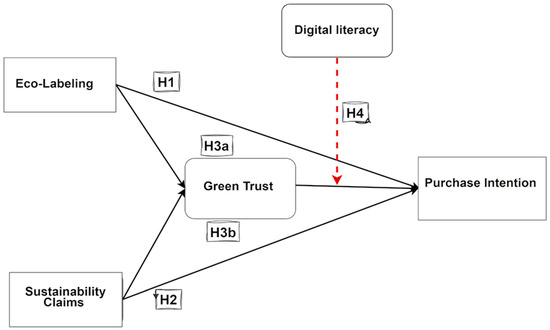
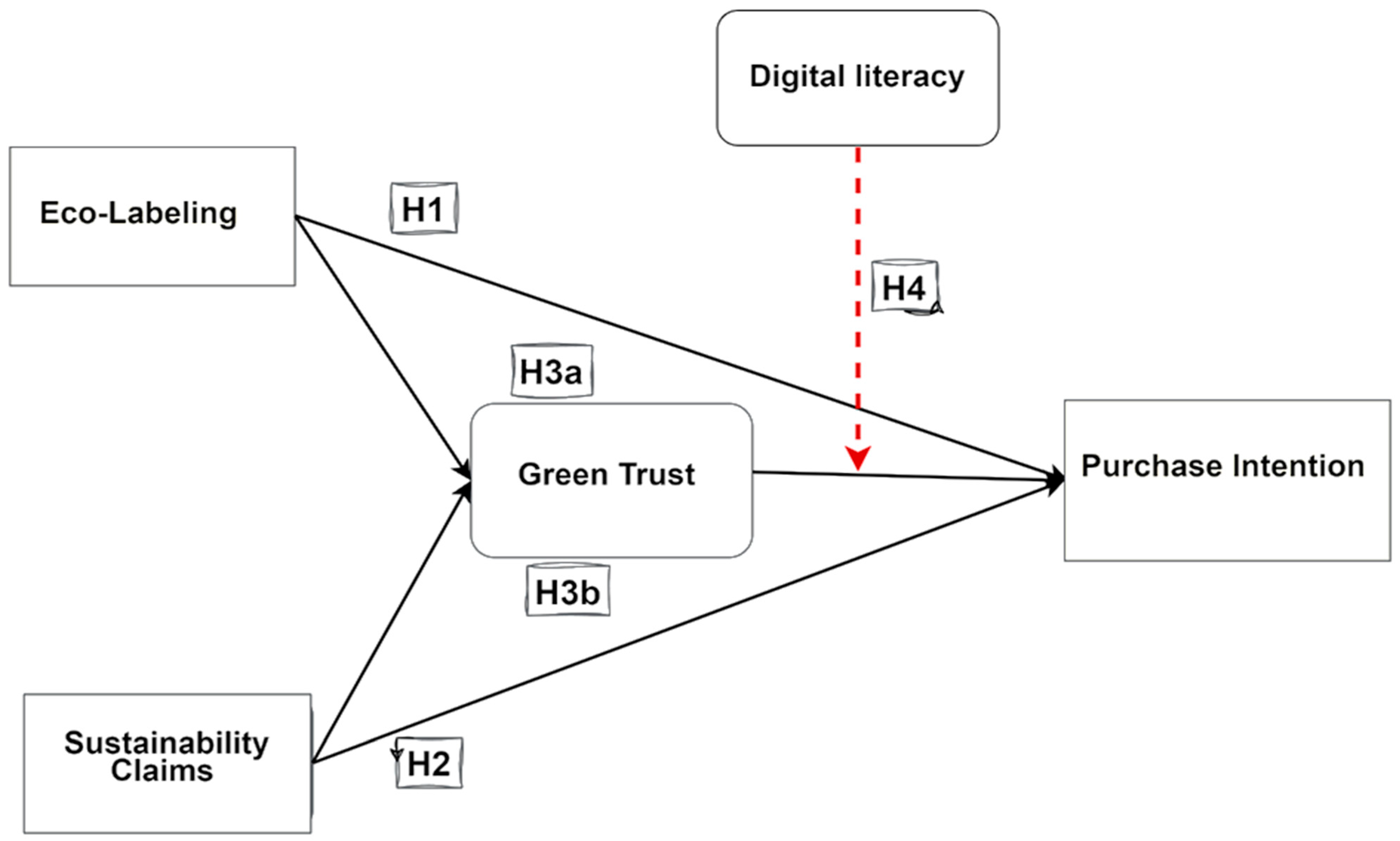
Synthesizing the theoretical foundations and developed hypotheses, this study proposes an integrated conceptual framework (Figure 1) that incorporates green marketing initiatives (Eco-labeling (EL) and Sustainability claims (SC), green trust (GT), digital literacy (DL), and purchase intention (PI) within Ethiopia’s distinctive e-commerce context for coffee products.
Figure 1.
Conceptual Framework.
3. Materials and Methods
3.1. Study Design
The current research employed the quantitative hypothesis-testing design to test the interaction between eco-labeling, sustainability assertion, green-trust, DL, and PI to sustainable coffee in the Ethiopian expanding e-commerce market. The researchers adhered to the positivist philosophy and supposed that reality is objective and can be quantified using observable data [62]. The cross-sectional survey involved a large number of participants at a single point in time, which enabled the researchers to prove the theoretical model and mediate and moderate relationships proposed [63]. Although this design cannot be as convincing as a longitudinal study, it still gives a solid foundation for how to research complex relations in a new study area like Ethiopia [64].
It was designed in accordance with the local Ethiopian e-commerce context, where online trading in agricultural goods such as coffee has yet to establish itself. This was made possible by a quantitative method, which allowed testing relationships statistically and generalizing results to e-commerce shoppers of urban Ethiopia [65]. The exploratory nature of the study was the closest to the cross-sectional approach, in which early empirical evidence was the most critical [66].
3.2. Instrument and Measurement Scale Development
The questionnaire had been constructed as a result of modifying the proven scales used by previous research to ensure that the content validity was upheld, but that it also fit the Ethiopian coffee-e-commerce environment. Measuring each construct, reflective items on the five-point Likert scale between 1 (Strongly Disagree) and 5 (Strongly Agree) were made. The questionnaire was divided into two sections: the first section included the questions of the five latent variables, and the second one contained the demographic information about age, gender, education, income, and the frequency of online shopping.
Eco-labeling was defined as the application of certified labels demonstrating environmental standards, measured with a four-item scale based on [39,67]. SC were defined as textual or visual messages emphasizing environmental benefits, measured with a five-item scale adapted from [32]. To enhance contextual grounding, the generic scale items were adapted with specific examples relevant to the local coffee market. For instance, questions about SC were framed within the context of recognizable Ethiopian coffee origins (e.g., Yirgacheffe, Sidama) and practices (e.g., shade-growing, water conservation).
The mediating variable, GT, was measured with a four-item scale from [46,48]. The moderating variable, DL, was measured with a five-item scale from [16], focusing on practical e-commerce skills. The Digital Literacy scale was adapted from [16,56] to reflect general e-commerce competencies such as navigating platforms, evaluating online information, and completing transactions that are applicable across both desktop and mobile contexts. While the original scale was developed in a desktop-oriented setting, the adapted items focus on core digital skills relevant to the evolving digital landscape in Ethiopia, where mobile internet usage is prominent. focusing on practical e-commerce skills. The dependent variable, purchase intention, was measured with a four-item scale from [68].
The questionnaire underwent extensive validation. It was reviewed by five academic experts in sustainable marketing and consumer behavior for clarity and relevance, leading to minor wording changes. It was then pilot-tested with fifteen regular e-commerce users (excluded from the final sample) to assess understanding, timing, and overall experience, resulting in further refinements. In Table 1, the Questionnaire we used is attached.
Table 1.
Questionnaire.
3.3. Sampling and Data Collection
The research targeted e-commerce shoppers in major Ethiopian cities. A multi-stage sampling design was employed. A purely probability-based method, such as stratified random sampling, was not feasible due to the absence of a reliable and comprehensive national registry or sampling frame for the entire population of urban e-commerce users in Ethiopia. Therefore, the first stage used purposive sampling to select four cities with established e-commerce infrastructure: Addis Ababa, Awasa, Adama, and Dire Dawa.
The second stage involved recruiting active e-commerce shoppers through a non-probability sampling approach combining purposive and snowball techniques. A purely probability-based method, such as stratified random sampling, was not feasible due to the absence of a reliable and comprehensive sampling frame for the entire population of urban e-commerce users in Ethiopia. Therefore, we employed a purposive sampling strategy to target individuals who were known or likely to be active online shoppers [60]. This was supplemented with snowball sampling, where initial participants helped refer other eligible respondents from their networks, to access a broader and more diverse pool within the target demographic. We utilized university contacts, posted surveys at malls with high internet penetration, and advertised on social media groups dedicated to online shopping in each city. This mixed-mode recruitment strategy was paired with a mixed-mode data collection approach to enhance robustness further. To ensure the statistical validity of pooling data from both online and paper questionnaires, a Measurement Invariance of Composite Models (MICOM) test was conducted following the procedure by [69]. The three-step MICOM test assessed configural invariance, compositional invariance, and the equality of composite means and variances across the two data collection modes. The results, detailed in Section 4, confirmed that the measurement model was invariant, thereby justifying the combination of the two datasets for subsequent analysis. The results confirmed configural and compositional invariance, indicating that the online and offline respondent groups did not differ significantly in their understanding and response to the measurement model, allowing us to treat them as a single population for analysis.
Data were collected from July to August 2025. We administered online questionnaires via social media and university mailing lists. Simultaneously, paper questionnaires were distributed face-to-face at selected locations to ensure the inclusion of individuals with varying levels of digital connectivity. This comprehensive approach was deliberately chosen to maximize sample diversity and mitigate the coverage bias inherent in relying solely on online channels in a market characterized by varying levels of digital access and literacy.
A sample size of 500 was targeted, guided by PLS-SEM recommendations, which require a minimum sample of 50 [62], with a higher aim to robustly test mediation and moderation. Of the 500 distributed surveys, 486 were returned (97% response rate). Following data collection, 35 responses were excluded from analysis. The exclusion criteria were explicitly defined as: (1) incomplete responses with more than 20% of data missing, and (2) incongruent responses identified through straight-lining (giving the same answer to all questions in a section) and patterned responses that indicated a lack of engagement. This resulted in 451 valid responses for analysis. The final sample consisted of 298 (66.1%) responses collected online and 153 (33.9%) collected via paper questionnaire. No personally identifiable data was captured, ensuring anonymity and confidentiality.
3.4. Demographic Characteristics of Respondents
The demographic profile of the 451 respondents is presented in Table 2. The sample was relatively balanced in gender, with 52.3% male and 47.7% female participants. Most respondents (68.4%) held undergraduate degrees, while 21.2% had postgraduate qualifications and 10.4% held diplomas or other certifications. The majority (59.3%) were between 25 and 35 years old, and 25.3% were between 18 and 24 years. In terms of e-commerce activity, 57.8% reported shopping online monthly, while 42.2% engaged weekly. Respondents were primarily urban residents from major Ethiopian cities, including Addis Ababa, Awasa, Adama, and Dire Dawa.
Table 2.
Demographic Characteristics of Respondents.
3.5. Data Analysis Techniques
Data were analyzed in two stages using SPSS 28 and SmartPLS 4. Initial screening in SPSS checked for out-of-range values, univariate and multivariate outliers (using Mahalanobis distance), and normality (skewness and kurtosis). The raw dataset supporting the analysis is provided as Supplementary Material (Table S1).
To mitigate common method variance (CMV), we implemented both procedural and statistical remedies. Procedurally, we ensured respondent anonymity, reduced item ambiguity through pilot testing, and counterbalanced question order. Statistically, we employed Harman’s single-factor test, which showed the first factor explained 31.672% of the variance, well below the 50% threshold. Furthermore, we conducted a full collinearity test as per [70], where all Variance Inflation Factor (VIF) values were significantly below the conservative threshold of 3.3, indicating that CMV is not a critical issue in this study.
The primary analysis used PLS-SEM in SmartPLS 4, chosen for its suitability for complex models, exploratory research, and robustness with non-normal data and smaller samples [62,65,66]. We followed a two-step procedure. First, the measurement model was assessed for reliability (Cronbach’s Alpha, Composite Reliability > 0.70) and validity (convergent validity with Average Variance Extracted > 0.50; discriminant validity via the Fornell-Larcker criterion and HTMT ratio < 0.85). Second, the structural model was evaluated by checking for collinearity (VIF < 5), assessing explanatory power (R2 values), and testing the significance of path coefficients and hypotheses using bootstrapping with 5000 subsamples. The model’s predictive relevance was confirmed with Stone-Geisser Q2 values > 0, and model fit was deemed acceptable with an SRMR value of 0.061.
4. Results
As part of the prerequisite assumptions that had to be met to conduct PLS-SEM analysis, the study first analyzed the correlation matrix of the collected data. The results indicated that statistically significant positive relationships exist among the study’s key constructs. This preliminary evidence is essential to fully understanding the proposed path model, indicating a linear relationship among the variables; hence, we could conduct a PLS-SEM analysis.
4.1. Measurement Invariance Assessment
Before testing the structural model, measurement invariance across data collection modes was assessed using the Measurement Invariance of Composite Models (MICOM) procedure. The three-step test confirmed configural invariance (identical model specification and algorithm settings across online and paper-based respondent groups) and full compositional invariance (all permutation-based correlation values > 0.99, p > 0.05). Although partial invariance was observed for mean and variance equality (Steps 3a and 3b), full invariance in the first two steps is sufficient to justify data pooling. Therefore, the online and paper questionnaire responses were combined for subsequent PLS-SEM analysis, as recommended by [69].
4.2. Measurement Model Assessment
Reliability and Validity. As depicted in Table 3, to avoid measurement mistakes, the authors rigorously tested the reliability and validity of this study’s measures to ensure consistency in the study outcome. All the loaded items met the threshold specified by the factor loading analysis suggested by [62], with all outer loadings exceeding 0.70. The composite reliability coefficient (rho_c) ranged from 0.888 to 0.903, exceeding the minimum threshold of 0.70. Cronbach’s alpha (CbA) spanned from 0.832 to 0.866, exceeding the proposed 0.70 threshold [62], indicating a high level of internal consistency. Additionally, each variable’s average variance extracted (AVE) ranged from 0.640 to 0.700, surpassing the 0.50 threshold. Rho_A statistical values, ranging from 0.835 to 0.869, affirmed satisfactory reliability.
Table 3.
Results of Validity and Reliability of Items Constructs.
Common Method Bias (CMB). Data were collected from respondents using a questionnaire. As a result, we had to use the proper statistical procedures to help deal with the bias issues related to the questionnaires. We used the variance inflation factor (VIF) to quantify collinearity among the variables. Table 3 shows that VIF values for all indicator items fall below the 3.3 threshold, ranging from 1.545 to 2.515. Furthermore, the interaction term (DL × GT) had a VIF of 1.000. Hence, this current study did not suffer from critical common method bias.
Assessing the Reflective Measurement Model. The evaluation of this study’s validity involved the computation of the Heterotrait–Monotrait Ratio (HTMT) for the model. Discriminate validity is acknowledged when the researcher’s set of object variables can be distinguished from one another [62]. According to [65], caution is advised when the HTMT value surpasses 0.85, indicating potential issues with discrimination. Therefore, ensuring that the HTMT ratio remains below the 0.85 threshold is crucial. The outcomes depicted in Table 4 reaffirm the established principles by prior scholars, confirming that the HTMT discriminant level is valid in this study, given that all construct values are below the specified threshold of 0.85.
Table 4.
Heterotrait–Monotrait Ratio (HTMT).
4.3. Structural Model and Hypothesis Testing
Model Performance and Goodness of Fit. The structural model was evaluated for its goodness-of-fit and predictive power. The model demonstrated a good fit, with the Standardized Root Mean Square Residual (SRMR) value for the saturated model being 0.061, which is below the recommended threshold of 0.08 [69]. The model’s normal fit index (NFI) value of 0.816 also indicates an acceptable fit.
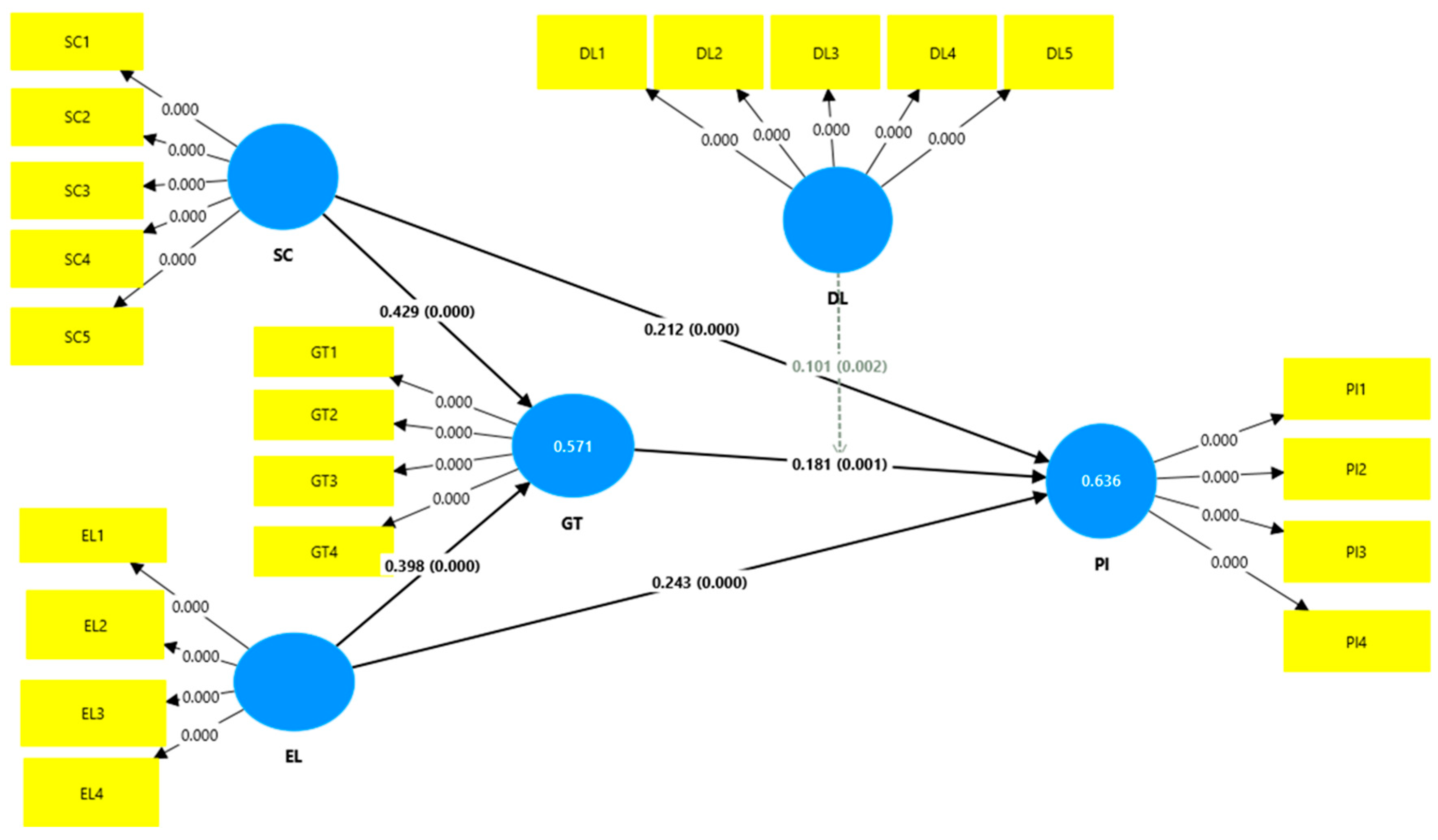
Furthermore, the model exhibited substantial explanatory power, accounting for 57.1% of the variance in GT (R2 = 0.571, Adj. R2 = 0.569) and 63.6% of the variance in PI (R2 = 0.636, Adj. R2 = 0.632). The model’s predictive relevance was confirmed by Stone-Geisser’s Q2 values, which were all well above zero (GT = 0.490, PI = 0.469), indicating a strong predictive power of the model for the endogenous constructs.
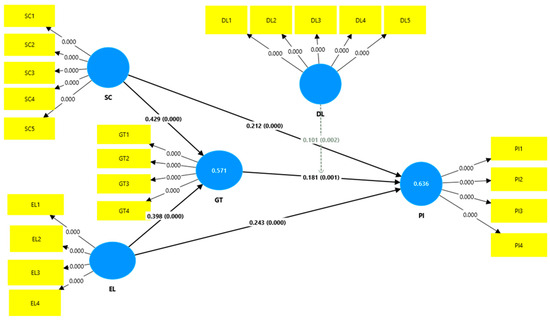
The effect sizes (f2) were also examined to assess the substantive impact of the predictor constructs. The analysis revealed that SC (f2 = 0.235) and EL (f2 = 0.202) had medium to large effects on GT. On Purchase Intention, DL (f2 = 0.111) had a small to medium effect, while EL (f2 = 0.063), SC (f2 = 0.049), GT (f2 = 0.035), and the interaction term DL × GT (f2 = 0.032) all exhibited small effects. A structural model analysis and bootstrapping (5000 subsamples) results from Smart-PLS are displayed in Figure 2.
Figure 2.
PLS-SEM result. Source(s): figure by the author.
Direct Path Analysis. Our empirical discoveries provide robust statistical backing for the direct-effect hypotheses. EL exhibited a significant positive effect on PI (H1: β = 0.243, t = 4.253, p < 0.001). Similarly, SC had a significant positive effect on PI (H2: β = 0.212, t = 3.651, p < 0.001). The results of the direct effects hypothesis testing are summarized in Table 5.
Table 5.
Hypothesis Testing Results for Direct Effects.
Mediation Analysis. The analysis supported the hypothesized mediating role of GT. The specific indirect effects were significant. The indirect effect of EL on PI through GT was positive and significant (H3a: β = 0.072, t = 2.878, p = 0.004). Likewise, the indirect effect of SC on PI through GT was also significant (H3b: β = 0.078, t = 3.275, p = 0.001). These results, confirming the mediating effects, are presented in Table 6.
Table 6.
Hypothesis Testing Results for Mediating Effects.
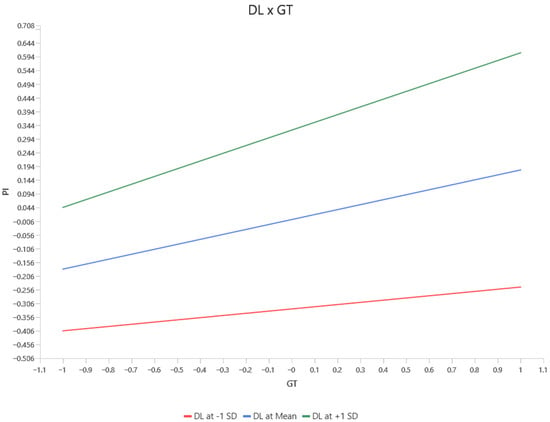
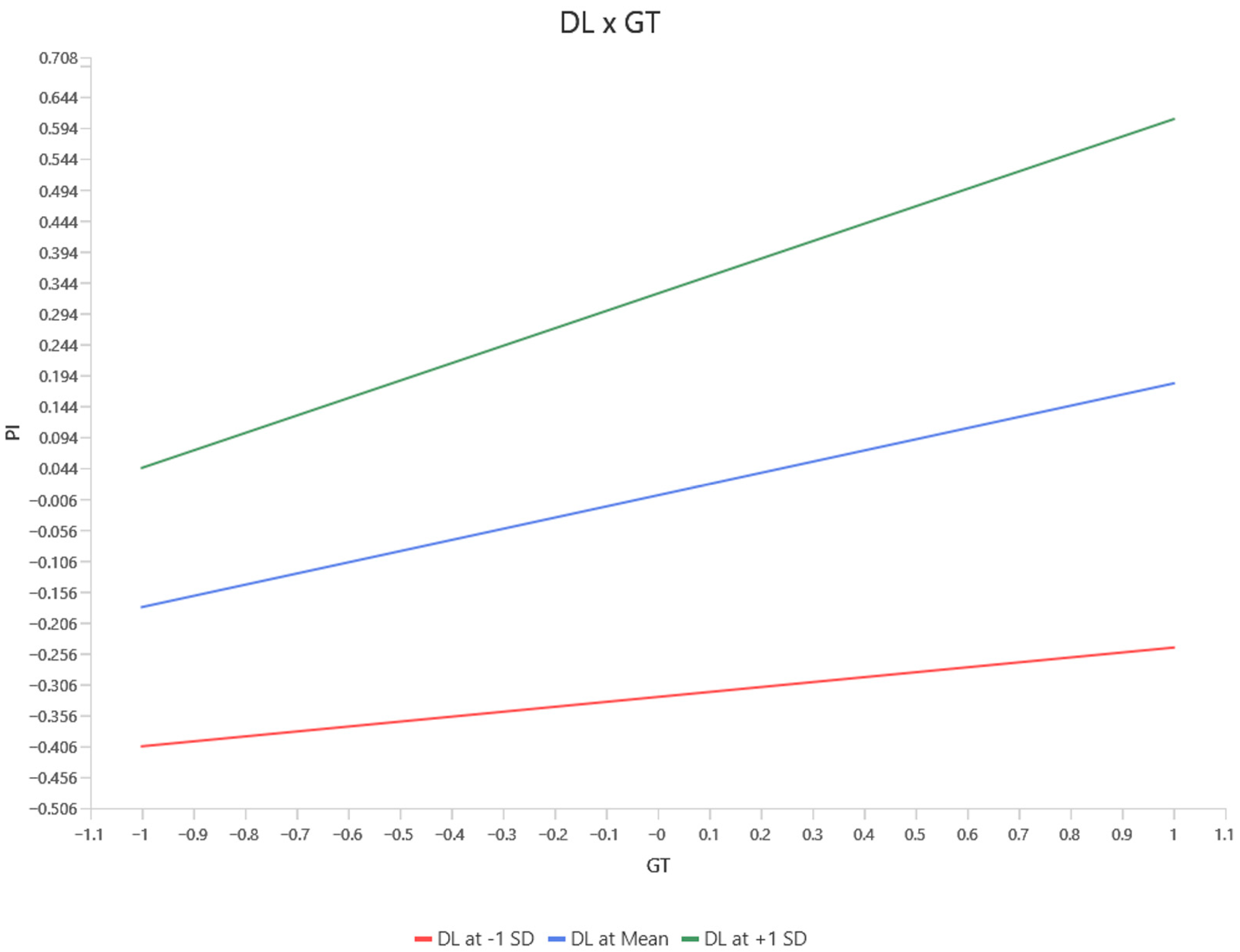
Moderation Analysis. The analysis confirmed the moderating role of DL in the relationship between GT and purchase intention. The interaction term between DL and GT was positive and significant (H4: β = 0.101, t = 3.126, p = 0.002). To probe this interaction, a simple slope analysis was conducted. Figure 3 illustrates this moderating effect. The analysis reveals that the positive relationship between GT and PI is substantially stronger when DL is high (+1 SD: β = 0.282, p < 0.001) than when it is low (−1 SD: β = 0.080, p = 0.084). Thus, consumers with greater proficiency in navigating e-commerce platforms, verifying claims, and completing secure transactions are far more effective at converting their GT into actual purchase intention. The outcome of this moderation analysis is detailed in Table 7.
Figure 3.
The moderating role of DL between GT and PI.
Table 7.
Hypothesis Testing Results for the Moderating Effect.
5. Discussion
This study provides empirical evidence on the mechanisms driving sustainable consumption in Ethiopia’s emerging e-commerce landscape. The findings demonstrate that both EL (β = 0.243, p < 0.001) and SC (β = 0.212, p < 0.001) significantly enhance PI for sustainable coffee products, supporting H1 and H2. These results confirm that in digital marketplaces characterized by high information asymmetry, green marketing signals serve as crucial decision-making heuristics that help consumers navigate product choices despite the inability to physically inspect goods. The significant positive relationships align with previous research in digital commerce contexts [12,38] while extending it to the unique context of Ethiopian e-commerce, where formal certifications are often supplemented by culturally resonant traceability claims [6,34].
The mediation analysis reveals that GT serves as a significant psychological mechanism translating marketing signals into behavioral intentions. The significant indirect effects through GT (H3a: β = 0.072, p = 0.004; H3b: β = 0.078, p = 0.001) demonstrate that trust-building is central to the effectiveness of green marketing in digital environments. This finding substantiates the integrated TPB-Signaling framework proposed in this study, showing that external marketing cues first establish trust, which subsequently strengthens the psychological antecedents of PI [24,27]. The partial mediation suggests that while green signals have direct effects, their impact is substantially enhanced through the trust-building process, particularly important for experience goods like coffee, where quality cannot be verified before purchase [17,54].
A pivotal finding of this research concerns the moderating role of DL in the trust-intention relationship (H4: β = 0.101, p = 0.002). The significant interaction effect, reinforced by simple slope analysis showing a stronger relationship for high DL consumers (β = 0.282, p < 0.001) compared to low DL consumers (β = 0.080, p = 0.084), reveals that digital proficiency acts as a critical amplifier in converting environmental trust into purchase decisions. This finding extends current understanding of DL beyond its conventional role as a direct antecedent of technology adoption [16,58] by positioning it as a boundary condition that determines the effectiveness of trust-based marketing strategies. In practical terms, this means that even when consumers trust environmental claims, they may not complete purchases if they lack confidence in navigating platforms, verifying information, or executing secure transactions [15,59].
The effect sizes observed in this study, while statistically significant, warrant nuanced interpretation. The modest path coefficient from GT to PI (β = 0.181) alongside small effect sizes for several predictors indicates that in emerging e-commerce markets like Ethiopia, purchase decisions are influenced by multiple factors beyond sustainability considerations. Price sensitivity, delivery convenience, general platform trust, and basic product quality requirements likely interact with green marketing elements in complex ways. This suggests that sustainable attributes function as value-added differentiators rather than primary decision drivers in this context.
The integrated model tested in this research demonstrates a sequential process where green marketing signals build trust, which partially translates to purchase intention, with DL enhancing this conversion. This framework advances theoretical understanding by synthesizing signaling theory with behavioral models while incorporating user capability as a critical contingency factor. For the Ethiopian context specifically, where rapid digitalization coexists with significant DL variations [19,20,21] these findings highlight the importance of addressing both technological access and user capability to foster sustainable consumption through e-commerce channels.
6. Conclusions
This study concludes that green digital marketing is a potent driver of purchase intention for sustainable coffee in urban Ethiopia’s e-commerce landscape. The findings demonstrate that eco-labeling and sustainability claims not only have a direct positive effect but also work by building green trust, a relationship that is critically amplified by the consumer’s digital literacy. This research offers specific theoretical, practical, and policy contributions that advance the field of electronic commerce research.
6.1. Theoretical Implications
This study makes several distinct theoretical contributions. The Theory of Planned Behavior (TPB) provides a crucial digital-age extension by empirically demonstrating that external marketing signals (eco-labels, sustainability claims) are powerful antecedents that shape the theory’s core components. These signals provide tangible evidence that cultivates positive attitudes, offer social proof that reinforces subjective norms, and, by building trust, significantly reduce perceived risk, thereby enhancing perceived behavioral control in the online environment [10,24].
For Signaling Theory in digital commerce, this research confirms its relevance in a high-information-asymmetry context and introduces a critical boundary condition. We demonstrate that the efficacy of a signal is not determined solely by its credibility but also by the receiver’s ability to process it. The significant moderating role of digital literacy shows that even credible signals can fail to trigger action if the consumer lacks the skills to navigate the digital platform, verify claims, and complete a transaction securely. This refines Signaling Theory by positioning user capability as a key determinant of signal effectiveness in digital markets [11,15].
For digital literacy research in emerging markets, the study moves the construct beyond its traditional role as a direct antecedent of technology adoption. Our findings establish it as a pivotal moderator that governs the conversion of trust into behavioral intention. This reveals that the “digital divide” is not merely a gap in access but a critical barrier that can decouple positive environmental attitudes from actual purchasing behavior, thereby stifling the growth of sustainable e-commerce [4,16].
6.2. Practical Implications
The findings offer a strategic blueprint for e-commerce platform designers and managers operating in developing economies. To build trust, platforms must engineer trust-building features directly into their interfaces. This includes creating dedicated “sustainability badges” and product page sections for verifiable information, such as photos of cooperatives, links to certification details, and interactive traceability maps.
Regarding digital interface design for sustainability, the moderating effect of digital literacy demands a user-centric approach that accommodates varying skill levels. Interfaces should integrate intuitive, guided workflows for evaluating sustainable products and offer seamless, secure payment gateways. For low-literacy users, interactive guides and tooltips explaining certifications can bridge the gap between trust and purchase intention.
For electronic commerce policy in developing economies, this research underscores that fostering a sustainable digital marketplace requires a multi-stakeholder approach. Policymakers should support digital literacy initiatives to ensure inclusive participation. Furthermore, developing national standards or verification systems for digital sustainability claims would reduce greenwashing, enhance overall signal credibility, and build institutional trust, creating a more efficient and reliable market for all participants [2,3].
6.3. Limitations and Future Research
This study has several limitations that provide fruitful avenues for future inquiry. The use of a mixed-mode data collection approach, employing both online and paper questionnaires, introduces the potential for a mode effect, even though statistical tests for measurement invariance were conducted. Furthermore, the Digital Literacy scale, though adapted for general e-commerce use, was originally designed and validated in desktop-based contexts. While the competencies measured remain relevant, the scale may not fully capture nuances of mobile-first or mobile-only user behavior, which is common among consumers in emerging digital economies like Ethiopia. Future studies could develop or adapt scales that specifically account for mobile-centric digital literacy. The focus on coffee, a product with profound cultural specificity and symbolic value in Ethiopia, may limit the direct generalizability of the findings to other, less symbolically charged product categories or different cultural contexts. To address these limitations and build upon this research, future studies should conduct multi-group analyses to compare the model across key demographic segments such as Generations Z and Y or different income brackets. Employing experimental designs with manipulated eco-labels and sustainability claims would help establish causal relationships more firmly. Undertaking cross-country comparisons within Africa, for instance, between Ethiopia, Kenya, and Rwanda, could elucidate the role of differing institutional and market environments. Research should also investigate platform-side factors, such as how algorithmic transparency and recommendation systems influence the visibility of sustainable products. To move beyond intention, researchers could partner with e-commerce platforms to track actual purchase data, addressing the current reliance on behavioral intentions. Finally, incorporating competing trust antecedents like platform reputation, seller ratings, and payment method security would lead to more comprehensive and robust theoretical models.
Supplementary Materials
The following supporting information can be downloaded at: https://www.mdpi.com/article/10.3390/jtaer21010025/s1, Table S1: Raw data used during analysis.
Author Contributions
Conceptualization, X.S.; methodology, A.H.M.; software, A.H.M.; validations; formal analysis, A.H.M.; investigation, A.H.M.; data curation; writing—original draft preparation.; writing—review and editing, A.H.M.; supervision, X.S. All authors have read and agreed to the published version of the manuscript.
Funding
This research received no external funding.
Institutional Review Board Statement
Ethical approval for the study was obtained from the Research Ethics Committee of Wuhan University of Technology (approval code: EPU-ETH-072018; approval date: 15 May 2025). All participants provided informed consent, and the study was conducted in accordance with the ethical principles of the Declaration of Helsinki.
Informed Consent Statement
Informed consent was obtained from all subjects involved in the study.
Data Availability Statement
The raw data supporting the conclusions of this article were submitted to the journal as Supplementary Materials.
Conflicts of Interest
The authors declare no conflicts of interest.
Abbreviations
The following abbreviations are used in this manuscript:
| Abbreviation | Definition |
| TPB | Theory of Planned Behavior |
| GT | Green Trust |
| DL | Digital Literacy |
| EL | Eco-Labeling |
| SC | Sustainability Claims |
| PI | Purchase Intention |
| PLS-SEM | Partial Least Squares Structural Equation Modeling |
References
- Rosário, A.T.; Dias, J.C. The Role of Digital Marketing in Shaping Sustainable Consumption: Insights from a Systematic Literature Review. Sustainability 2025, 17, 7784. [Google Scholar] [CrossRef] [Scilit]
- Oláh, J.; Kitukutha, N.; Haddad, H.; Pakurár, M.; Máté, D.; Popp, J. Achieving sustainable e-commerce in environmental, social and economic dimensions by taking possible trade-offs. Sustainability 2018, 11, 89. [Google Scholar] [CrossRef] [Scilit]
- Amoako, G.K.; Dzogbenuku, R.K.; Doe, J.; Adjaison, G.K. Green marketing and the SDGs: Emerging market perspective. Mark. Intell. Plan. 2022, 40, 310–327. [Google Scholar] [CrossRef] [Scilit]
- Ahmad, W.; Zhang, Q. Green purchase intention: Effects of electronic service quality and customer green psychology. J. Clean. Prod. 2020, 267, 122053. [Google Scholar] [CrossRef] [Scilit]
- Moat, J.; Williams, J.; Baena, S.; Wilkinson, T.; Demissew, S.; Challa, Z.; Gole, T.; Davis, A. Coffee Farming and Climate Change in Ethiopia: Impacts. In Forecasts, Resilience and Opportunities—Summary Report; Environment & Coffee Forest Forum: Addis Ababa, Ethiopia, 2017. [Google Scholar]
- Demiessie, H. Institutional and Behavioral Modeling of the Economic Fabric of Urban Eastern Ethiopian Communities: Shared Value System, Group Decision Making Behavior and Wellbeing; Jigjiga University: Jijiga, Ethiopia, 2020. [Google Scholar]
- Majeed, M.U.; Aslam, S.; Murtaza, S.A.; Attila, S.; Molnár, E. Green marketing approaches and their impact on green purchase intentions: Mediating role of green brand image and consumer beliefs towards the environment. Sustainability 2022, 14, 11703. [Google Scholar] [CrossRef] [Scilit]
- Sheth, J.N.; Parvatiyar, A. Sustainable marketing: Market-driving, not market-driven. J. Macromarketing 2021, 41, 150–165. [Google Scholar] [CrossRef] [Scilit]
- Sarkar, M. Environmental sustainability under E-commerce: A holistic perspective. Eur. J. Dev. Stud. 2023, 3, 1–6. [Google Scholar] [CrossRef] [Scilit]
- Ajzen, I. The theory of planned behavior. Organ. Behav. Hum. Decis. Process. 1991, 50, 179–211. [Google Scholar] [CrossRef] [Scilit]
- Connelly, B.L.; Certo, S.T.; Ireland, R.D.; Reutzel, C.R. Signaling theory: A review and assessment. J. Manag. 2011, 37, 39–67. [Google Scholar] [CrossRef] [Scilit]
- Khan, K.U.; Atlas, F.; Arshad, M.Z.; Akhtar, S.; Khan, F. Signaling green: Impact of green product attributes on consumers trust and the mediating role of green marketing. Front. Psychol. 2022, 13, 790272. [Google Scholar] [CrossRef] [Scilit]
- Nguyen–Viet, B.; Nguyen Anh, T. Green marketing functions: The drivers of brand equity creation in Vietnam. J. Promot. Manag. 2022, 28, 1055–1076. [Google Scholar] [CrossRef] [Scilit]
- Li, Y.; Shan, B. The influence mechanism of green advertising on consumers’ purchase intention for organic foods: The mediating roles of green perceived value and green trust. Front. Sustain. Food Syst. 2025, 9, 1515792. [Google Scholar] [CrossRef] [Scilit]
- Zhang, Y.; Zhang, Y. The influence of digital literacy on the phenomenon of deviation between farmers’ E-commerce sales willingness and behavior: Evidence from rural China. Sustainability 2024, 16, 3000. [Google Scholar] [CrossRef] [Scilit]
- Ullah, M.S.; Khan, M.K.; Oglu, G.R.A.; Yasmin, T. The influence of digital literacy on consumer perceptions and e-commerce engagement. Policy Res. J. 2025, 3, 92–104. [Google Scholar]
- Onur, I.; Bruwer, J.; Lockshin, L. Reducing information asymmetry in the auctioning of non-perishable experience goods: The case of online wine auctions. J. Retail. Consum. Serv. 2020, 54, 102060. [Google Scholar] [CrossRef] [Scilit]
- Soleimani, M. Buyers’ trust and mistrust in e-commerce platforms: A synthesizing literature review. Inf. Syst. e-Bus. Manag. 2022, 20, 57–78. [Google Scholar] [CrossRef] [Scilit]
- Mezgebo, T.G. Urbanization and development in Ethiopia: Policy issues, trends and prospects. In State of the Ethiopian Economy; Ethiopian Economic Association: Addis Ababa, Ethiopia, 2020; Volume 2021. [Google Scholar]
- Adame, B.O. The Ethiopian telecom industry: Gaps and recommendations towards meaningful connectivity and a thriving digital ecosystem. Heliyon 2021, 7, e08146. [Google Scholar] [CrossRef] [Scilit]
- Wassie, S. Digital Finance and Agri-Food Value Chains: Case Studies from Ethiopia; International Food Policy Research Institute: Washington, DC, USA, 2025. [Google Scholar]
- Yadav, R.; Pathak, G.S. Determinants of consumers’ green purchase behavior in a developing nation: Applying and extending the theory of planned behavior. Ecol. Econ. 2017, 134, 114–122. [Google Scholar] [CrossRef] [Scilit]
- Yadav, R.; Pathak, G.S. Young consumers’ intention towards buying green products in a developing nation: Extending the theory of planned behavior. J. Clean. Prod. 2016, 135, 732–739. [Google Scholar] [CrossRef] [Scilit]
- Shah, R.; Modi, A.; Muduli, A.; Patel, J.D. Purchase intention for energy-efficient equipment appliances: Extending TPB with eco-labels, green trust, and environmental concern. Energy Effic. 2023, 16, 31. [Google Scholar] [CrossRef] [Scilit]
- Damberg, S.; Saari, U.A.; Fritz, M.; Dlugoborskyte, V.; Božič, K. Consumers’ purchase behavior of Cradle to Cradle Certified® products—The role of trust and supply chain transparency. Bus. Strategy Environ. 2024, 33, 8280–8299. [Google Scholar] [CrossRef] [Scilit]
- Guerreiro, J.; Pacheco, M. How green trust, consumer brand engagement and green word-of-mouth mediate purchasing intentions. Sustainability 2021, 13, 7877. [Google Scholar] [CrossRef] [Scilit]
- Kautish, P.; Paul, J.; Sharma, R. The moderating influence of environmental consciousness and recycling intentions on green purchase behavior. J. Clean. Prod. 2019, 228, 1425–1436. [Google Scholar] [CrossRef] [Scilit]
- Nguyen, T.H.; Le Trung, H.; Vu, T.M. The impact of ecolabels on consumers’ attitude and green purchase intention for agricultural products a theoretical approach. Vnu J. Econ. Bus. 2019, 35, 52–61. [Google Scholar]
- Darnall, N.; Ji, H.; Vázquez-Brust, D.A. Third-party certification, sponsorship, and consumers’ ecolabel use. J. Bus. Ethics 2018, 150, 953–969. [Google Scholar] [CrossRef] [Scilit]
- Kim, S.M.; Lee, K.-H. The importance of eco-label: Enhancing consumer perception. In Proceedings of the International Textile and Apparel Association Annual Conference Proceedings, Long beach, CA, USA, 20–23 November 2024. [Google Scholar]
- Kovač, I.; Dunković, D.; Kovač, B. Greenwashing and consumer skepticism toward eco-labels in Croatia: Challenges and policy directions. Br. Food J. 2025. Epub ahead of printing. [Google Scholar] [CrossRef] [Scilit]
- Javed, T.; Yang, J.; Gilal, W.G.; Gilal, N.G. The sustainability claims’ impact on the consumer’s green perception and behavioral intention: A case study of H&M. Adv. Manag. Appl. Econ. 2020, 10, 1–22. [Google Scholar]
- Orazi, D.C.; Chan, E.Y. “They did not walk the green talk!:” How information specificity influences consumer evaluations of disconfirmed environmental claims. J. Bus. Ethics 2020, 163, 107–123. [Google Scholar] [CrossRef] [Scilit]
- Tadesse, M.D.; Gebresenbet, G.; Ljungberg, D.; Tavasszy, L. Digital Traceability Capabilities: The Case of the Ethiopian Coffee Supply Chain. Future Transp. 2024, 4, 780–794. [Google Scholar] [CrossRef] [Scilit]
- Zhan, Y.; Ren, Y.; Xu, J. Willingness to pay a premium for eco-label products in China: A mediation model based on quality value. Sci. Rep. 2025, 15, 1783. [Google Scholar] [CrossRef] [Scilit]
- Taufique, K.M.R.; Vocino, A.; Polonsky, M.J. The influence of eco-label knowledge and trust on pro-environmental consumer behaviour in an emerging market. J. Strateg. Mark. 2017, 25, 511–529. [Google Scholar] [CrossRef] [Scilit]
- Arsyistawa, U.; Hartono, A. The effect of eco-label and perceived consumer effectiveness toward green purchase. Int. J. Res. Bus. Soc. Sci. 2022, 11, 57–66. [Google Scholar] [CrossRef] [Scilit]
- Panopoulos, A.; Poulis, A.; Theodoridis, P.; Kalampakas, A. Influencing green purchase intention through eco labels and user-generated content. Sustainability 2022, 15, 764. [Google Scholar] [CrossRef] [Scilit]
- Dekhili, S.; Akli Achabou, M. Eco-labelling brand strategy: Independent certification versus self-declaration. Eur. Bus. Rev. 2014, 26, 305–329. [Google Scholar] [CrossRef] [Scilit]
- Magnier, L.; Schoormans, J. Consumer reactions to sustainable packaging: The interplay of visual appearance, verbal claim and environmental concern. J. Environ. Psychol. 2015, 44, 53–62. [Google Scholar] [CrossRef] [Scilit]
- Lin, Y.; Li, J.; Xiang, L. Exploring the role of green government publicity influencing people’s pro-environmental behaviors. Front. Psychol. 2022, 13, 973160. [Google Scholar] [CrossRef] [Scilit] [PubMed]
- Schmuck, D. Social media influencers and environmental communication. In The Handbook of International Trends in Environmental Communication; Routledge: Oxfordshire, UK, 2021; pp. 373–387. [Google Scholar]
- Halim, R.E.; Rahmani, S.; Gayatri, G.; Furinto, A.; Sutarso, Y. The effectiveness of product sustainability claims to mitigate negative electronic word of mouth (N-eWOM). Sustainability 2022, 14, 2554. [Google Scholar] [CrossRef] [Scilit]
- Ketron, S.; Naletelich, K.; Migliorati, S. Representational versus abstract imagery: Effects on purchase intentions between vice and virtue foods. J. Bus. Res. 2021, 125, 52–62. [Google Scholar] [CrossRef] [Scilit]
- Chen, Y.-S.; Chang, C.-H. Greenwash and green trust: The mediation effects of green consumer confusion and green perceived risk. J. Bus. Ethics 2013, 114, 489–500. [Google Scholar] [CrossRef] [Scilit]
- de Sio, S.; Zamagni, A.; Casu, G.; Gremigni, P. Green trust as a mediator in the relationship between green advertising skepticism, environmental knowledge, and intention to buy green food. Int. J. Environ. Res. Public Health 2022, 19, 16757. [Google Scholar] [CrossRef] [Scilit]
- Ogbeibu, S.; Senadjki, A.; Luen Peng, T. An organisational culture and trustworthiness multidimensional model to engender employee creativity. Am. J. Bus. 2018, 33, 179–202. [Google Scholar] [CrossRef] [Scilit]
- Wang, R.; Lee, K.E.; Mokhtar, M.; Goh, T.L. The challenges of palm oil sustainable consumption and production in China: An institutional theory perspective. Sustainability 2022, 14, 4856. [Google Scholar] [CrossRef] [Scilit]
- Huang, C.; Zhuang, S.; Li, Z.; Gao, J. Creating a sincere sustainable brand: The application of Aristotle’s rhetorical theory to green brand storytelling. Front. Psychol. 2022, 13, 897281. [Google Scholar] [CrossRef] [Scilit] [PubMed]
- Taoketao, E.; Feng, T.; Song, Y.; Nie, Y. Does sustainability marketing strategy achieve payback profits? A signaling theory perspective. Corp. Soc. Responsib. Environ. Manag. 2018, 25, 1039–1049. [Google Scholar] [CrossRef] [Scilit]
- Khan, N.L.; Qureshi, I.H. Impact of Environmental Concern on Green Purchase Intention: A Mediation Model Using Green Trust. Asian J. Econ. Bus. Account. 2025, 25, 538–550. [Google Scholar] [CrossRef] [Scilit]
- Hameed, I.; Waris, I. Eco labels and eco conscious consumer behavior: The mediating effect of green trust and environmental concern. Hameed, Irfan and Waris, Idrees (2018): Eco Labels and Eco Conscious Consumer Behavior: The Mediating Effect of Green Trust and Environmental Concern. J. Manag. Sci. 2018, 5, 86–105. [Google Scholar]
- Atkinson, L.; Rosenthal, S. Signaling the green sell: The influence of eco-label source, argument specificity, and product involvement on consumer trust. J. Advert. 2014, 43, 33–45. [Google Scholar] [CrossRef] [Scilit]
- Jalil, F.; Yang, J.; Al-Okaily, M.; Rehman, S.U. E-commerce for a sustainable future: Integrating trust, green supply chain management and online shopping satisfaction. Asia Pac. J. Mark. Logist. 2024, 36, 2354–2370. [Google Scholar] [CrossRef] [Scilit]
- Bawden, D. Information and digital literacies: A review of concepts. J. Doc. 2001, 57, 218–259. [Google Scholar] [CrossRef] [Scilit]
- Van Deursen, A.J.; Helsper, E.J.; Eynon, R. Development and validation of the Internet Skills Scale (ISS). Inf. Commun. Soc. 2016, 19, 804–823. [Google Scholar] [CrossRef] [Scilit]
- Schmuck, D.; Matthes, J.; Naderer, B. Misleading consumers with green advertising? An affect–reason–involvement account of greenwashing effects in environmental advertising. J. Advert. 2018, 47, 127–145. [Google Scholar] [CrossRef] [Scilit]
- Nazzal, A.; Thoyib, A.; Hussein, A.S. The influence of digital literacy and demographic characteristics on online shopping intention: An empirical study in Palestine. J. Asian Financ. Econ. Bus. (JAFEB) 2021, 8, 205–215. [Google Scholar]
- Israr, S.; Khan, S.; Riaz, A. digital literacy impact on perceived usefulness, perceived ease of use and online purchase intention in Pakistan. Policy Res. J. 2024, 2, 2103–2110. [Google Scholar]
- Adula, M.; Kant, S. Greening the Skies by Impact of Green Marketing on the Competitiveness of the Ethiopian Aviation Sector With the Mediating Role of Eco-Labeling. In Sustainable Marketing Practices in the Aviation Industry; IGI Global Scientific Publishing: Hershey, PA, USA, 2025; pp. 183–208. [Google Scholar]
- Süzer, Ö.Ö.; Altın, S. Kadın Tüketicilerin Dijital Okuryazarlıklarının E-Satın Alma Niyeti Üzerine Etkisi/The Effect of Female Consumers’ Digital Literacy on E-Purchasing Intention. Uluslararası Ekon. İşletme Ve Polit. Derg. 2023, 7, 203–225. [Google Scholar] [CrossRef] [Scilit]
- Hair, J.F.; Risher, J.J.; Sarstedt, M.; Ringle, C.M. When to use and how to report the results of PLS-SEM. Eur. Bus. Rev. 2019, 31, 2–24. [Google Scholar] [CrossRef] [Scilit]
- Hair, J.; Alamer, A. Partial Least Squares Structural Equation Modeling (PLS-SEM) in second language and education research: Guidelines using an applied example. Res. Methods Appl. Linguist. 2022, 1, 100027. [Google Scholar] [CrossRef] [Scilit]
- Sarstedt, M.; Ringle, C.M.; Hair, J.F. Partial least squares structural equation modeling. In Handbook of Market Research; Springer: Berlin/Heidelberg, Germany, 2021; pp. 587–632. [Google Scholar]
- Ringle, C.M.; Sarstedt, M.; Mitchell, R.; Gudergan, S.P. Partial least squares structural equation modeling in HRM research. Int. J. Hum. Resour. Manag. 2020, 31, 1617–1643. [Google Scholar] [CrossRef] [Scilit]
- Henseler, J.; Ringle, C.M.; Sarstedt, M. A new criterion for assessing discriminant validity in variance-based structural equation modeling. J. Acad. Mark. Sci. 2015, 43, 115–135. [Google Scholar] [CrossRef] [Scilit]
- Riskos, K.; Dekoulou, P.; Mylonas, N.; Tsourvakas, G. Ecolabels and the attitude–behavior relationship towards green product purchase: A multiple mediation model. Sustainability 2021, 13, 6867. [Google Scholar] [CrossRef] [Scilit]
- Yen, Y.Y.; Ling, T.Z. A survey measuring purchase intention towards environmentally friendly products. F1000Research 2024, 13, 938. [Google Scholar] [CrossRef] [Scilit]
- Henseler, J.; Ringle, C.M.; Sarstedt, M. Testing measurement invariance of composites using partial least squares. Int. Mark. Rev. 2016, 33, 405–431. [Google Scholar] [CrossRef] [Scilit]
- Kock, N. Common method bias in PLS-SEM: A full collinearity assessment approach. Int. J. e-Collab. 2015, 11, 1–10. [Google Scholar] [CrossRef] [Scilit]

Disclaimer/Publisher’s Note: The statements, opinions and data contained in all publications are solely those of the individual author(s) and contributor(s) and not of MDPI and/or the editor(s). MDPI and/or the editor(s) disclaim responsibility for any injury to people or property resulting from any ideas, methods, instructions or products referred to in the content. |
© 2026 by the authors. Licensee MDPI, Basel, Switzerland. This article is an open access article distributed under the terms and conditions of the Creative Commons Attribution (CC BY) license.