Article

What Makes Social Posts Go “Hot”? A Multimodal Analysis of Creator–Content–Timing Signals on a Visual Social Platform

1
School of Business, Central University of Finance and Economics (CUFE), Beijing 100081, China
2
School of Business, Inner Mongolia University of Finance and Economics (IMUFE), Hohhot 010051, China
*
Author to whom correspondence should be addressed.
J. Theor. Appl. Electron. Commer. Res. 2026, 21(1), 24; https://doi.org/10.3390/jtaer21010024
Submission received: 3 October 2025 / Revised: 24 December 2025 / Accepted: 29 December 2025 / Published: 6 January 2026

Abstract

Visual social commerce platforms now mediate much of brand communication and conversion, yet managers still lack clear guidance on how brands and creators should technically design posts that consistently achieve high user engagement under budget and platform constraints. Prior research explains why users engage with brands online, but it mainly focuses on individual motives and message features and largely treats the brand–creator–platform relationship and the post-design process as a black box. Drawing on the Technology Affordance Actualization (TAA) framework—which conceptualizes how platform-provided action possibilities (affordances) are selectively enacted through user practices—we develop a Creator–Content–Timing (CCT) perspective on how brands and creators actualize visibility, interactivity, and commercial collaboration affordances into user engagement outcomes. We analyze 138,713 image–text posts from 100 beauty brands on Xiaohongshu using machine learning, text mining, computer vision, and regression and clustering models. The results show that creator tier, brand status, sponsorship, content cues, and posting time have systematic effects on both engagement intensity and a cost-normalized metric, Int_per_cost (interactions per 1000 CNY of estimated advertising cost). Smaller creators and non-sponsored posts achieve higher engagement per impression and higher Int_per_cost than top-tier creators and sponsored posts; moderate text length, non-exclusive brand mentions, human faces, and specific temporal windows are also associated with superior outcomes. The study extends TAA to a creator–brand–platform context by operationalizing affordance actualization as observable CCT configurations at the post level and provides configuration-level guidance on how brands can align creator selection, content design, and scheduling to improve engagement on visual social commerce platforms.

1. Introduction

Visual social platforms have become a central arena for brand communication and social commerce. On platforms such as Xiaohongshu, brands increasingly rely on a stream of image-and-text posts to stimulate attention, conversation, and downstream commercial outcomes. Yet producing “hot posts”—content that attracts disproportionately high user response—remains difficult and resource-intensive. For brand managers, the core strategic question is not only what to post, but also who should post it and when it should be released. These decisions jointly determine whether platform distribution mechanisms translate into exposure and whether exposure translates into user response at an acceptable cost.
As social media platforms have proliferated, user engagement has become a key metric for evaluating communication effectiveness, understanding content diffusion, and assessing firms’ long-term performance. Recent scholarship increasingly treats customer (or consumer) engagement as a strategic variable that shapes competitive advantage and long-run outcomes [1]. A 2025 Special Issue of the Journal of the Academy of Marketing Science further emphasizes that, in emerging contexts such as social media, social commerce, and live streaming, engagement behaviors are deeply embedded in firm–customer interaction processes [2].
Existing research identifies a wide range of psychological, relational, and content-level antecedents of engagement. Studies emphasize value co-creation [3], individual motives such as information seeking and entertainment, and message features such as sentiment, length, and calls to action [4,5]. Influencer marketing research further shows that influencer tier, credibility, and parasocial relationships affect how users respond to branded content [6,7]. However, much of this literature remains user- and message-centric. It often treats the brand, creator, and platform as background conditions, offering limited guidance on how brands and creators jointly design posts on a particular platform to achieve high engagement and cost-adjusted performance. As a result, we know much about why users might want to engage, but less about how brands and creators, in relation to platform affordances, make concrete design choices that systematically relate to engagement outcomes.
We highlight three gaps. First, relatively few studies adopt an explicit creator–brand–platform perspective and treat these actors as strategic design levers rather than fixed context variables. Second, most empirical work examines one dimension at a time—such as text features [8] or influencer tier [9]—and often relies on relatively small or manually coded samples, making it difficult to identify whether high-engagement posts follow systematic patterns in the joint space of creator, content, and timing choices. Third, although the Technology Affordance Actualization (TAA) framework links technological possibilities to behavioral outcomes [10], it has rarely been operationalized at the post level in social commerce, especially in large-scale behavioral data on regional platforms such as Xiaohongshu.
The TAA framework provides a process view of how digital technologies enable action [11]. In this view, affordances are action potentials that arise from the relationship between IT artifacts and goal-directed actors; actualization refers to the concrete actions through which actors realize these potentials; and outcomes are the observable consequences of those actions [12]. In social media contexts, prior work highlights affordances such as visibility, interactivity, connectivity, multimodal presentation, self-presentation, and temporality [13,14]. Yet most TAA studies describe these affordances at a conceptual level and focus on organizations or platforms rather than on measurable post-level design choices that can be systematically analyzed at scale.
We address these gaps by viewing each image–text post as a technical design through which brands and creators actualize platform affordances. Building on TAA, we translate its “who, how, when” process into a Creator–Content–Timing (CCT) framework. The creator dimension captures how creator tiers, brand status, and sponsorship arrangements relate to the actualization of visibility and commercial collaboration affordances. The content dimension describes how textual and visual cues—such as text length, brand mentions, and facial cues—actualize multimodal, self-presentation, and interaction affordances. The timing dimension captures how posting season, day, and within-month timing relate to the actualization of temporal affordances. Within this framework, engagement outcomes provide an empirical footprint of how CCT choices are associated with post-level performance, including potential trade-offs between reach and efficiency across different creator–brand–platform configurations.
Guided by this TAA-based CCT perspective, we examine the following two research questions.
RQ1. At the post level, how are creator, content, and timing choices—interpreted as alternative ways of actualizing platform affordances—associated with engagement scale (total interactions), engagement intensity (interactions per 1000 views), and cost-adjusted engagement efficiency on a visual social commerce platform?
RQ2. Do high-engagement posts concentrate in a limited number of recurring Creator–Content–Timing configurations, rather than being scattered across the CCT space, and how do these configurations differ in engagement scale and efficiency?
Empirically, we analyze 138,713 image-and-text posts linked to 100 beauty brands on Xiaohongshu between December 2022 and February 2024. Beauty is a highly visual, competition-intensive category, making it a suitable category for studying how multimodal design choices relate to engagement in social commerce. China is also one of the world’s most advanced and large-scale social commerce markets, and Xiaohongshu is the leading visual social commerce platform with a predominantly young, beauty-oriented user base, which makes this context theoretically informative for studying how creator–brand–platform configurations shape engagement. For each post we obtain creator and brand attributes, text and image features, and timestamps. We construct post-level variables using machine learning, text mining, and computer vision, and estimate regression and clustering models.
This study makes three contributions. Theoretically, it extends TAA to a creator–brand–platform setting by operationalizing affordance actualization as measurable CCT choices and configurations at the post level. Methodologically, it combines large-scale multimodal data with computational feature extraction and regression and clustering models to identify systematic design patterns behind high engagement and cost-adjusted performance. Managerially, it offers evidence-based guidance on creator selection, content design, and scheduling that helps brands improve both engagement intensity and cost-adjusted engagement on visual social commerce platforms.

2. Literature Review and Theoretical Framework

2.1. User Engagement Behavior in Social Media

2.1.1. User Engagement Behavior

With the rapid diffusion of social media platforms, user engagement behavior has become a key metric for evaluating the effectiveness of content marketing, amplifying brand communication, and shaping firm performance [15]. From a broader marketing perspective, engagement is increasingly regarded as a strategic driver of long-term value creation and customer relationship quality [1,2]. Engagement is widely treated as a multidimensional and context-dependent construct with cognitive, affective, and behavioral components [5,16,17].
Nowadays, marketing research has increasingly shifted its focus from transactions to the broader attitudes and behaviors of users interacting with brands and firms on digital platforms. Following de Vries [18] and Lee [19], we operationalize user engagement behavior as the total volume of active user responses to a post on the platform, including likes, favorites (saves), comments, and shares. By adopting a multidimensional behavioral perspective, this study aims to provide a more comprehensive understanding of how users engage with brands in social media environments and how such engagement contributes to processes of value co-creation.

2.1.2. Determinants of User Engagement Behavior and Theoretical Perspectives

Prior research has identified a wide range of antecedents of user engagement behavior, which can be roughly grouped into individual, message/content, brand and contextual, and platform/technology factors [4]. These antecedents have been examined through diverse theoretical lenses. Table 1 summarizes the main constructs and theories in the literature.
Overall, this stream of work provides a rich view of engagement drivers. The existing theories are predominantly user-centric or message-centric: they explain how users respond to given posts but rarely theorize how brands and creators design posts under platform constraints and commercial objectives. In social commerce, where commercial collaboration and paid promotion are integral to content creation, there is a need for a design-oriented and technology-sensitive perspective that links post-design decisions to the underlying affordances of the platform.
Most studies operate at one level at a time (e.g., content features or influencer attributes) and treat the platform as a background medium or a small set of perceived attributes (e.g., usefulness, richness). Few studies simultaneously integrate (1) the technical environment—what the platform makes possible, (2) the relational configuration between brands and creators, (3) multimodal content design, and (4) the temporal rhythm of posting.
To address this gap, we introduce the Technology Affordance Actualization (TAA) framework and extend it into a Creator–Content–Timing (CCT) perspective that explicitly connects platform affordances, multi-party relationships, and user engagement outcomes.

2.2. Extending the Technology Affordance Actualization Framework to Multimodal Social Media Contexts

2.2.1. Technology Affordance Actualization Theory

The concept of “affordance” was first introduced by psychologists to describe the potential action possibilities that an environment offers to an actor, emphasizing the relational nature between humans and their surroundings rather than intrinsic properties of either [45]. In information systems research, this notion has been elaborated into technology affordance action potentials that emerge from relationships between IT artifacts and goal-directed actors [11]. Building on this foundation, Strong [12] proposed the Technology Affordance Actualization (TAA) framework, which distinguishes three analytically related levels as follows:
Technology affordances: action potentials made possible by relations between technological features and actor goals, directed toward specific immediate outcomes (e.g., “posting content that is visible to followers”, “soliciting feedback”).
Affordance actualization: the concrete actions through which actors realize one or more affordances in specific contexts (e.g., selecting certain features, composing particular types of content, and scheduling posts).
Outcomes: the observable consequences of affordance actualization, including both intended and unintended results (e.g., productivity, relationship strength, user engagement, and value co-creation).
TAA emphasizes that affordance is a latent potential and does not automatically translate into outcomes. Only when actors perceive and enact them through specific practices do they become “actualized” and this process is typically temporal and iterative—actors learn, adjust, and reconfigure their use over time [12,46].

2.2.2. TAA in Social Media and Marketing Research

Recent marketing and social media studies have started to apply TAA and related affordance perspectives. For example, Treem and Leonardi [13] and Evans et al. [14] synthesize social media affordances into categories such as visibility, persistence, editability, association, interactivity, connectivity, and multimodality. Lee and Li [47] show how chatbot affordances such as connectivity, visibility, visualization, and interactivity, when actualized, strengthen perceptions of brand competence and warmth and thereby enhance identification and loyalty. Wang et al. [10] demonstrate how affordances related to visibility and interactivity shape information seeking and affective relationship building in influencer marketing. In virtual and metaverse environments, Shin [46] conceptualizes “met-affordances” such as immersion and presence and shows how they are actualized into concrete user experiences and behaviors.
These studies illustrate that TAA can connect seemingly abstract technological characteristics (e.g., interactivity, visualization, and multimodality) with concrete behavioral outcomes (e.g., engagement, loyalty) via the process of affordance actualization. However, existing TAA work remains limited in several respects as follows:
It typically focuses on organizations or platforms rather than large-scale user behavior and often relies on qualitative case studies. Affordances are usually described at a high level (“visibility”, “interactivity”) rather than being mapped onto measurable design choices in multimodal content and posting strategies. The joint role of brands, creators, and platform algorithms in actualizing affordances in social commerce has not been systematically theorized. In social media settings, most studies either list platform affordances or measure users’ perceived affordances, but do not examine how different actors at different times configure these affordances into bundles of design choices.
To address these gaps, we extend TAA from the question, “What does the platform afford to the question, How do brands and creators, under platform rules and commercial constraints, actualize these affordances through concrete decisions about who speaks, what is shown and said, and when content is posted?”

2.3. From TAA to the Creator–Content–Timing (CCT) Framework

In the TAA framework, technology affordances are the relationship dependent action potentials created by IT artifacts, whereas affordance actualization refers to the actor-level processes of selecting, combining, and using these potentials to achieve specific goals [11,43]. On a visual social commerce platform such as Xiaohongshu, image–text posting can be understood as a sequence of design decisions through which brands and creators actualize platform affordances in pursuit of user engagement.

2.3.1. The Affordances in Visual Social Commerce

Drawing on social media affordance research [10,13,14] and the specific features of Xiaohongshu, we focus on the following five types of technology affordances that bear directly on engagement:
(1)
Visibility affordances
They relate to the platform’s capacity to make accounts and posts seen by others. These affordances are instantiated in the follow, follower system, information-feed ranking, search and hashtag pages, and brand homepages. They determine the potential reach and exposure of content.
(2)
Interactivity affordances
They refer to the platform’s capacity to enable users to respond to content and each other through likes, comments, favorites, shares, @-mentions, hashtags, and replies. These functions create possibilities for conversational and participatory behaviors.
(3)
Multimodality and self-presentation affordances
They refer to the platform’s capacity to allow actors to present information and identity through multiple modalities (text, images, videos, emojis, and filters) and to construct personas (e.g., selfies, “brand selfies”, and lifestyle imagery).
(4)
Commercial collaboration affordances
They refer to the platform’s capacity to support and signal commercial relationships between brands and creators via sponsored post labels, collaboration tags, and advertising tools. In social commerce, these affordances govern how marketing intentions are made visible.
(5)
Temporality affordances
They refer to the platform’s capacity to surface content in a particular time window, including algorithmic preferences for recency, time ordering, event, and specific exposure (festival topics, campaign pages, and holiday banners).

2.3.2. Affordance Actualization and CCT Framework

From a TAA perspective, the key analytics are as follows: Who actualizes which affordances? How are they materialized in content? And when are they enacted in time? We map these “who-how-when” dimensions into our Creator–Content–Timing (CCT) framework. Table 2 provides a structured mapping between the five affordance types, their primary CCT dimension of actualization, and the representative operational variables used in our empirical analysis.
(1)
Creator (who) captures how brand–creator–platform relationships actualize visibility and commercial collaboration affordances through follower coverage, creator tier, brand status, and sponsorship arrangements.
(2)
Content (how) captures how textual and visual design choices actualize multimodality, self-presentation, and partially interactivity affordances through text length, brand mentions, image content, and facial cues, which appear as multimodal signals in the feed.
(3)
Timing (when) captures how posting schedules actualize temporality affordances by embedding content into specific seasonal, monthly, weekly, and daily rhythms of user attention, consumption, and platform activity.

2.3.3. Creator Dimension

On visual social platforms, brands face a fundamental decision—publishing through brand-owned accounts versus collaborating with third-party creators. At the creator level, three attributions—follower reach, account type, and sponsorship mode—jointly condition visibility affordances and commercial collaboration affordances. Specifically, follower scale and account type shape the extent to which creators can leverage platform distribution mechanisms (e.g., recommendation feeds, topic pages) to obtain exposure and interaction, whereas sponsorship arrangements shape whether commercial collaboration is enacted through relatively low-cost or high-investment branded campaigns.
Prior research has documented systematic differences between brand-owned accounts and third-party creators in trust mechanisms and narrative styles, often conceptualized as brand-generated content (PGC) versus user-generated content (UGC). Overall, UGC tends to achieve higher click-through, sharing, and engagement efficiency [4,28]. The influencer marketing literature further suggests examining follower count—often modeled as a continuous variable or within nano-/micro-influencer segments—and its nonlinear association with user engagement. Overall, empirical findings indicate that accounts “neither too small nor too large” often outperform both extremes in engagement efficiency [9,48]. In terms of collaboration formats, explicit sponsorship disclosures improve transparency, compliance, and sometimes algorithmic promotion, but may also activate users’ persuasion knowledge and thereby dampen spontaneous engagement [38]. Thus, the net effect of sponsorship on engagement intensity is theoretically ambiguous, whereas its impact on cost-adjusted efficiency is clearer: sponsorship almost inevitably raises the economic cost per post.
From a TAA perspective, follower reach, account type, and sponsorship mode specify the action possibilities available for visibility and commercial collaboration; however, whether these affordances are actualized into interaction outcomes depends on how brands and creators configure their relationships. Within our CCT framework, the creator dimension moves beyond a binary of “influencer versus non-influencer” and instead examines how specific configurations of creator tier, brand status, and collaboration mode translate platform affordances into distinct input–output patterns. In particular, top-tier influencers and formal sponsorships are generally characterized by high price, high reach, and higher price, whereas mid-tier, emerging, and ordinary creators often operate under tighter budget constraints and may compete more strongly on engagement rate and cost efficiency.
Building on this logic, we formulate the following overarching hypothesis for the creator dimension.
H1 is the creator dimension, configurations of brand–creator–collaboration for high-engagement posts are non-random and are systematically associated with user engagement.
H1a. 
Creator tier and sponsorship mode have significant effects on post-level user engagement.
H1b. 
Creator tier, brand status, and sponsorship mode have significant effects on engagement.

2.3.4. Content Dimension

Digital platforms provide technical affordances for multimodal presentation, interactive features, and commercial collaboration. Whether these affordances translate into user engagement depends on creators’ concrete design choices. In the content dimension, we distinguish three pathways through which affordances are actualized via textual and visual cues.
(1)
Interactivity affordances
Interactive cues such as questions, hashtags, and calls to action reduce the perceived participation threshold and make interaction opportunities more salient. Prior research shows that question cues, hashtags, and related interactive markers can increase social media engagement [49,50]. In our setting, we operationalize interactivity cues using the number of questions in the caption (Question_Count) and the number of hashtags (Tag_Count).
(2)
Multimodality and self-presentation affordances
In information-overloaded environments, users are more likely to process and respond to content that is concise and easy to read, particularly when it contains clear affective or action-relevant signals [33,34]. On the visual side, research on visual social media suggests that human face cues are strongly associated with attention and social presence; in influencer and brand-selfie contexts, showing a real human face can foster perceived closeness and parasocial relationships [31,32]. Accordingly, face-related visual cues can serve as salient carriers of self-presentation and may elicit stronger engagement than purely product-focused still-life imagery.
(3)
Brand-signal and commercial-intent affordances
In commercial posts, mentioning the brand in the caption constitutes a salient brand signal. From a signaling perspective, a moderate brand presence can increase signal clarity and reduce uncertainty [36]. However, frequent and explicit brand references can make a post more readily identifiable as advertising, activate persuasion knowledge, and potentially dampen spontaneous engagement [38,51].
Building on this reasoning, we propose the following hypotheses for the content dimension.
H2. 
Differences in content-related affordances in text and images significantly influence post-level user engagement.
H2a. 
Stronger interactivity affordances and moderate levels of multimodal self-presentation and commercial-intent affordances are positively associated with user engagement.

2.3.5. Timing Dimension

TAA explicitly conceptualizes affordance actualization as a temporal process. The same technology, used at different times or in different sequences, can lead to different outcomes [12]. On social platforms, algorithms often privilege recency and activity, giving more exposure to content posted in high-traffic or campaign periods. Meanwhile, user routines and leisure patterns create daily and weekly rhythms of attention—such that evenings and weekends may offer more browsing time, although cross-platform evidence is mixed. Finally, cultural and commercial calendars, such as seasonal product relevance (e.g., sunscreen in summer), salary days, and shopping festivals or traditional holidays, create seasons in which users are more receptive to certain categories and brands [2].
Empirical studies further show that posting time (day of week and time of day) systematically affects social media engagement [50,52]. Taken together, posting schedules constitute strategic choices through which brands and creators actualize temporality affordances. Holding resources and content constant, engagement outcomes may vary substantially depending on whether posts align with users’ leisure routines and category-relevant consumption contexts.
H3. 
Posts scheduled at times that align with users’ leisure routines and category-relevant consumption contexts are associated with higher engagement than posts released at other times.

2.3.6. CCT Configurations

Affordances are often actualized in bundles rather than in isolation, and affordances across dimensions can be complementary or substitutive [10]. In practice, baseline reach can compensate for less sophisticated content or timing strategies; highly tailored content can partially offset limited reach; and releasing strong content during the holidays can temporarily amplify the influence of otherwise ordinary creators. Accordingly, what drives “viral” or high-engagement posts is unlikely to be any single factor—such as follower count, caption length, or posting time—considered in isolation, but rather the configuration of creator, content, and timing choices.
If creator, content, and timing effects were purely additive, high-engagement posts would reflect small, independent advantages along each dimension. However, configuration-based perspectives and TAA both suggest that affordances are often realized through specific combinations of creator roles, content features, and temporal choices that exhibit complementarities or trade-offs [53]. Because brands operate under resource and relationship constraints, they may adopt distinct configuration strategies—for example, partnering with top-tier influencers and emphasizing reach; compensating for limited reach through higher posting intensity and more authenticity-oriented cues; or combining mid-tier or emerging creators, concise multi-brand content, and carefully chosen timing to improve engagement efficiency.
If the CCT framework captures how affordances are actualized, high-engagement posts should not be randomly distributed across the CCT feature. Instead, they should cluster into a limited number of recurring configurations that differ systematically in both engagement intensity and efficiency. This leads to our final hypothesis:
H4. 
Different CCT configurations—i.e., specific combinations of creator, content, and timing choices—differ significantly in both engagement intensity and cost-adjusted engagement efficiency.
More broadly, prior affordance research has often emphasized platform-level functions (e.g., likes, comments, shares, and visibility tools) while underplaying the creator agency in the actualization process. We argue that affordances reside not only in platform functions but also in creators’ selective choices and configurations of those functions. Accordingly, user engagement is not a direct outcome of platform affordances alone, but the result of creators’ selective actualization of multiple affordances across contexts.

3. Method

3.1. Sample Selection

We study Xiaohongshu, the leading visual social commerce platform in China that combines lifestyle content with embedded e-commerce. Because industry context is an important determinant of user engagement behavior, we focus on a single category—the beauty and personal-care sector, one of the platform’s most active and commercially important domains. Beauty and personal-care brands are prototypical lifestyle brands [54] that rely heavily on esthetic visual cues to communicate values and brand meanings in social media environments [55]. This setting is therefore well suited for examining how creator, content, and timing choices relate to user engagement.
Our sampling procedure proceeds in several steps. We first obtain a list of beauty brands from a professional third-party data provider, HUITUNDATA, which reports brand-level advertising expenditure on Xiaohongshu. We select the top 100 beauty brands by cumulative advertising expenditure between May and October 2023, excluding non-brand channel accounts (e.g., “Tmall”). For these 100 focal brands, HUITUNDATA provides all associated Xiaohongshu posts between December 2022 and February 2024. From this universe, we retain posts with high total user engagement and restrict attention to image-and-text posts for which we can successfully retrieve the first cover image. This yields 169,773 posts for the main empirical analysis.

3.2. Data Collection and Preprocessing

We harmonize numeric, text, and time fields across data sources and standardize all timestamps to local time. To ensure data completeness and consistency, we conduct extensive preprocessing on missing values, outliers, and variable types (numeric, textual, and date-time). Where necessary, raw fields are recast into appropriate integer or floating-point formats after handling missing entries. We then drop posts with missing core information (e.g., deleted notes) and posts for which the first cover image is unavailable. This step removes 31,060 observations and leaves 138,713 image-and-text posts, which serve as our final sample of high-engagement posts.
(1)
Creator and brand variables
Creator tier. We classify creators into five tiers based on follower count, following industry practice, as follows: top-tier (≥500,000 followers), mid-tier (50,000–499,999), emerging (5000–49,999), ordinary users (300–4999), and casual users (≤299). We construct a categorical variable, Influencer_tier, using these thresholds.
Brand-generated accounts. We identify brand-owned accounts by matching the creator name with the brand’s Chinese and English names (Brand_generated_content = 1 if matched; 0 otherwise).
Brand status. We code brand status using the Brand Finance Cosmetics 50 (2023) ranking and supplementary information on publicly listed beauty companies. Brands are grouped into four categories—global leaders, international conglomerates, leading domestic brands, and other brands. We also compute brand-level posting intensity as the number of associated posts for each brand during the sample period.
(2)
Sponsorship and cost variables
The dataset indicates whether a post is registered as a commercial note via Xiaohongshu’s official collaboration system (Sponsored = 1; 0 otherwise). For each post we observe the platform’s estimated advertising quotation, which serves as a proxy for the advertising cost if the post is promoted.
(3)
Image features
We analyze only the first image of each post, as it appears as the cover in users’ feeds and is likely to drive initial attention. We use a commercial computer-vision API to extract up to 11 high-confidence semantic labels (e.g., person, product, and indoor scene) and to detect faces. For images with detected faces, the API outputs the number of faces and face attributes such as age, expression intensity, attractiveness score, gender score, and image quality. For posts with multiple faces, we compute averages of the face attributes.
For clarity, we treat facial attractiveness and related variables strictly as algorithmic outputs that approximate how automated systems might classify visual inputs; we do not interpret these scores as normative judgements of individuals. Ethical and cultural implications are discussed in the Discussion section. Appendix A Table A1 provides a comprehensive variable dictionary. This refined dataset provides the empirical foundation for the subsequent analysis.

3.3. Variable Operationalization

3.3.1. Dependent Variables and Operationalization of High Engagement

(1)
Total engagement
We define user engagement as the total volume of active user responses to social media marketing content on the platform [56], including likes, favorites, comments, and shares. In this study, high engagement posts are operationalized ex-ante at the sampling stage as follows: for each focal brand, we rank all associated posts within the study period by total interactions and retain the top 3000 posts. All analyzes are conducted within this high-engagement subsample of 138,713 image–text posts.
For each post, we construct three related dependent variables that capture the following different facets of engagement: total interactions, engagement rate (interactions per 1000 estimated views), and cost-adjusted engagement (interactions per 1000 CNY of estimated advertising cost).
Total_engagement i = Likes i + Favorites i + Comments i + Shares i
(2)
Engagement_rate
This rate measures how many interactions a post generates for every 1000 impressions.
Engagement   rate i = Total_engagement i Estimated_views i 1000
(3)
Int_per_cost
Int_per_cost is the number of engagements generated per 1000 CNY of estimated advertising cost. It captures cost-adjusted engagement efficiency.
Int_per_cost i = Total_engagement i Estimated_advertising_cost i 1000
All three variables are highly right-skewed. In regression models, we use their natural logarithms as follows: ln_Total_engagement, ln_Engagement_rate, and ln_Int_per_cost.

3.3.2. Creator-Related Variables

Creator-level covariates capture how brands and creators configure visibility and commercial collaboration.
Creator-related variables include follower counts, posting frequency, brand status, and creator type, which distinguishes between brand-owned official accounts and non-brand accounts. According to Xiaohongshu’s platform classification, accounts were divided into five influencer tiers, namely top-tier influencers with at least 500,000 followers, mid-tier influencers with 50,000 to 499,999 followers, emerging influencers with 5000 to 49,999 followers, ordinary users with 300 to 4999 followers, and casual users with 299 or fewer followers. This categorical measure is represented as the influencer type variable.
The frequency of brand mentions was quantified by matching brand names (in both English and Chinese) from the reference list across post titles, textual content, and hashtags. Brand status was coded according to the Cosmetics 50 2023 global ranking published by Brand Finance, supplemented with data from publicly listed cosmetics firms. Based on these sources, brands were grouped into four categories, namely global leaders, international conglomerates, leading domestic brands, and other brands. This classification enables the evaluation of how brand reputation and market position may moderate user engagement. The number of associated posts is the number of associated posts for the brand in the sample period, capturing brand-level posting intensity and historical visibility. These variables allow us to test how different brand–creator configurations relate to engagement.

3.3.3. Content-Related Variables

Content variables are derived from the post text and the cover image.
(1)
Text features
We extract and preprocess titles, captions, and hashtags using Python3.12.4. (i) Text length was calculated by counting the number of characters in cleaned post texts. We also obtain tag_count, which signifies the number of topic tags attached to the post. Question_count, number of question marks in the title and body, is used as a proxy for explicit conversational prompts. (ii) Brand mentions and pattern. We match brand names (Chinese, English, and common abbreviations) in the title, body, hashtags, and obtain mentioned Own Brand dummy equal to 1 if the creator account matches the focal brand name, 0 otherwise. Brand_pattern is a categorical variable capturing brand-mention patterns. Namely, 0 means no brand mentioned, 1 means only the focal brand mentioned (single own brand only), 2 is both focal and other brands mentioned (own + other brands), and 3 means only other brands mentioned (other brands only).
(2)
Visual features
We derive visual variables from the first image because it serves as the cover in users’ feeds and is most likely to drive initial attention. We use the Tencent Image Recognition API to extract up to 11 high-confidence semantic tags per image (e.g., person, product, and indoor scene), which summarize salient visual elements.
The Tencent Image Recognition API was utilized to analyze primary post images. Num_faces is the number of detected faces in the cover image. Avg_age, Avg_expression, Avg_attractiveness, and Avg_gender_score signify average values of age, expression, attractiveness, and gender scores across detected faces, where applicable. These variables capture whether and how human faces and their attributes are used in visual self-presentation. Most images received between five and six tags, accounting for 51.61% (86,396 images) and 39.41% (65,940 images) of the total sample, respectively. Statistical analysis of these tags aimed to elucidate the principal visual components and their distribution within the dataset. Moreover, given prior research emphasizing facial representation, the Tencent Facial Recognition API identified faces in 39,141 images from the total sample. On average, each primary image featured approximately 0.37 faces; 72% of the samples had no faces and 23% contained exactly one face, with a maximum of five faces identified per image. Images containing multiple faces were further analyzed by averaging facial attributes, including age, smiling expressions, attractiveness scores, gender, image quality scores, and hairstyle length.

3.3.4. Timing Variables

To operationalize temporality affordances, we code posting time at multiple temporal granularities, capturing within-day, weekly, within-month, seasonal/quarterly, and holiday window patterns of attention. Specifically, we include (i) season and quarter dummies; (ii) month of year; (iii) day-of-month groups (early month: days 1–4; mid-month; and late month); (iv) weekday dummy (Monday–Sunday); and (v) time-of-day groups (e.g., early morning, daytime, evening, and late night). These variables allow us to test whether brands and creators who systematically time posts to coincide with periods of elevated attention are more likely to be elevated.

3.4. Model Specification

To assess how creator, content, and timing relate to user engagement, we estimate a series of linear regression models at the post level:
Y i = α + β 1 X C r e a t o r , i + β 2 X C o n t e n t , i + β 3 X T i m e , i + j = 1 J γ j X C o n t r o l , j , i + ε i
Y i is one of the engagement outcomes (Total_engagement, Engagement_rate, or Int_per_cost); X X C r e a t o r , i C is the vector of creator-related variables. X C o n t e n t , i is the vector of content-related variables; X T i m e , i is the vector of timing variables; and X C j o n t r o l , j , i are additional controls (e.g., brand-level posting intensity, log estimated ad cost where applicable).

3.5. Descriptive Statistics

The final dataset contains 138,713 image–text posts. Creators have on average 59,073 followers (median = 12,323), with a highly skewed distribution (maximum 17.3 million). The platform’s estimated advertising quotation averages 5856 CNY per post (median = 1200). Posts generate on average 21,576 estimated views and 1734 total interactions, including 1116 likes, 369 favorites, 178 comments, and 71 shares. The mean Engagement_rate is 73.5 interactions per 1000 views (median = 66.3). Most posts do not contain @-mentions, and only about 9% include at least one question mark. Approximately 28% of cover images contain at least one human face, with detected faces having an average age around 24 years and relatively high algorithmic attractiveness scores. These statistics are consistent with Xiaohongshu’s positioning as a young, female-skewed beauty and lifestyle community.

4. Results

Table 3 presents the descriptive statistics of user engagement across 138,713 image–text posts from 100 beauty brands. In total, the dataset generated approximately 1.55 billion estimated views and 239 million user interactions, including 155 million likes, 51.21 million favorites, 24.75 million comments, and 9.83 million shares. On average, each post received 21,600 views, 1116 likes, 369 favorites, 178 comments, and 71 shares, with a mean total engagement of 1733.94 interactions per post. Building on these descriptive patterns, the subsequent analysis applies data mining techniques to examine the determinants and characteristics of high engagement posts.

4.1. Creator Characteristics

4.1.1. Descriptive Statistics of Creator Characteristics

Within the high-engagement sample, content is overwhelmingly produced by non-brand accounts. Brand-owned accounts contribute 5087 posts (3.7%), whereas third-party accounts account for 96.3%.
In terms of creator tiers, emerging and mid-tier influencers generate 39.8% and 20.7% of posts, respectively; ordinary and casual users contribute 18.2% and 19.6%; and top-tier influencers account for only 1.5%. Average followers and estimated advertising quotation increase monotonically across tiers—from casual users (69 followers; 137 CNY) to top-tier influencers (1.26 million followers; 99,037 CNY, As shown in Table 4).
In absolute terms, mid-tier and top-tier influencers achieve the highest total engagement per post (approximately 2044 and 6160, respectively). However, the ranking reverses after normalization. Casual and ordinary creators exhibit the highest engagement rate (≈88–89 interactions per 1000 views), whereas top-tier influencers show the lowest rate (≈55). A similar pattern emerges for cost-adjusted performance (Int_per_cost, interactions per 1000 CNY of estimated advertising cost). Casual creators achieve about 12,820 interactions per 1000 CNY, compared with only 62 for top-tier influencers—approximately a 200-fold difference.

4.1.2. Regression Results for Creator Characteristics

Table 5 reports OLS models with three dependent variables—log total engagement, log engagement rate, and log Int_per_cost as dependent variables. Models (1) and (2) control for brand status, brand-level posting intensity, and log-estimated advertising cost; Model (3) control for brand status, brand-level posting.
Model (2). The pattern persists after normalizing by exposure. All creator tiers exhibit significantly lower engagement rates than casual users (e.g., β_Ordinary = −0.219, β_Emerging = −0.291, β_Mid-tier = −0.397, and β_Top-tier = −0.890; all p < 0.001), implying approximately 20–59% lower engagement probability per impression.
Model (3). Differences are most pronounced for cost-adjusted engagement. Compared with casual users, coefficients for ordinary, emerging, mid-tier, and top-tier creators are −0.738, −2.705, −3.682, and −4.285 (all p < 0.001), implying roughly 52%, 93%, 97%, and 99% fewer engagement per 1000 CNY. Sponsored posts also underperform. The sponsorship indicator has a coefficient of −0.378 (p < 0.001), indicating about 32% lower cost-adjusted engagement than comparable non-sponsored posts.
Brand status is also associated with cost efficiency. Relative to global leaders, “other brands” exhibit substantially lower cost-adjusted engagement (β = −1.341, p < 0.001; ≈74% lower Int_per_cost), with international conglomerates and leading domestic brands falling between these extremes.
Overall, these patterns support H1a and H1b. High-engagement posts are not randomly distributed across creator types. Even within a high-engagement sample, smaller and less commercialized creators generate substantially higher engagement rates and cost-adjusted efficiency than top-tier influencers and brand-owned accounts.

4.1.3. Brand Clustering and Positioning

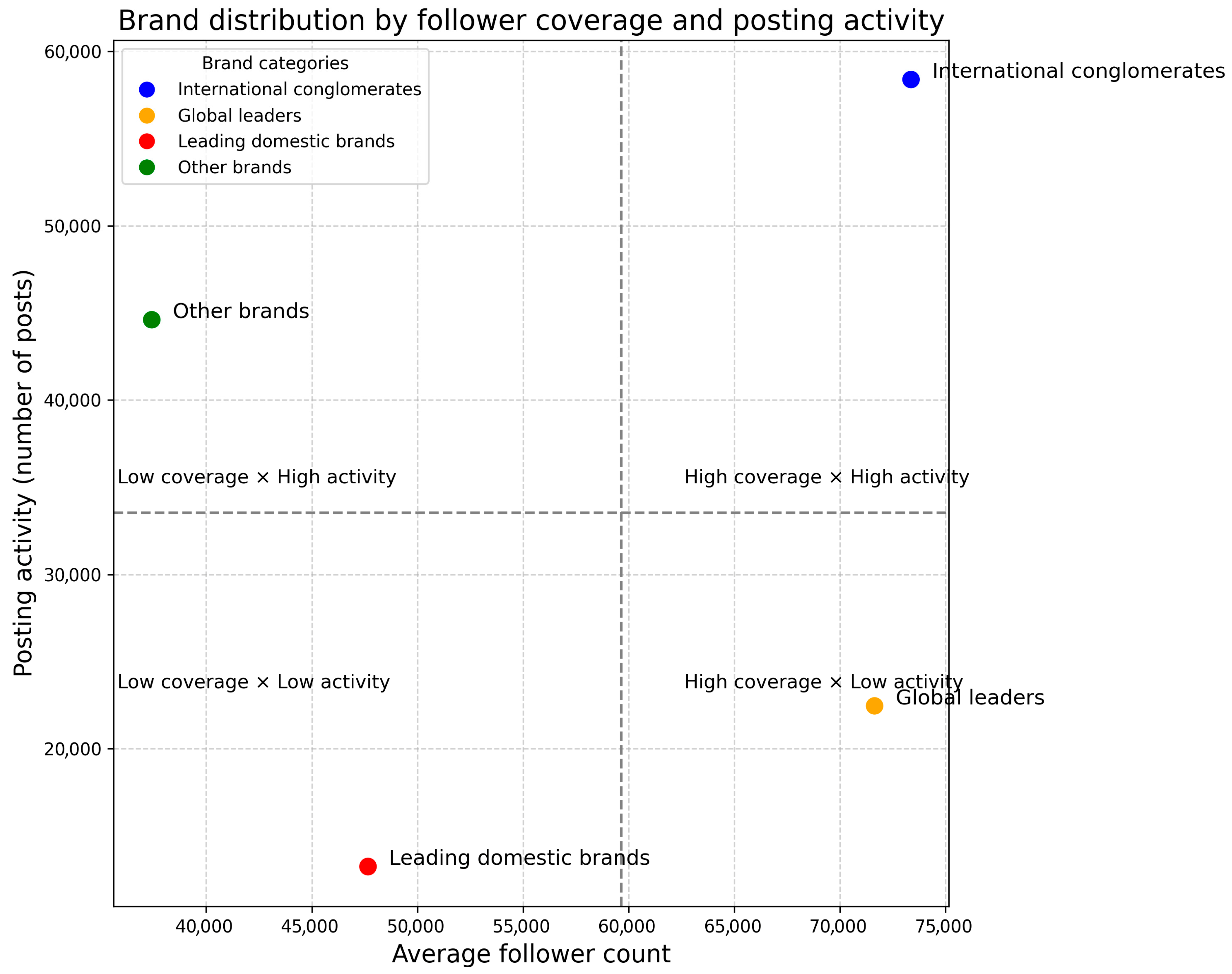
We conduct a clustering analysis using brand-level follower coverage, posting frequency, and we also observe clear positioning differences across brand categories (Figure 1). Clustered international conglomerates concentrate in the “high coverage × high activity” quadrant. Global leaders fell into the “high coverage × low activity” quadrant, sustaining engagement with less frequent posting. Leading domestic brands appeared in the “low coverage × low activity” quadrant, whereas other brands occupied the “low coverage × high activity” quadrant.
These patterns suggest that the high-engagement outcomes reflect not only content characteristics but also brand resources and activity strategies in actualizing visibility affordances. International conglomerates, combining extensive follower bases with frequent posting, were best positioned to generate engagement. Global leaders leveraged follower scale to sustain engagement even with low posting frequency. Leading domestic and other brands compensated for limited follower coverage through topical content or frequent posting.
Figure 1 maps brand positioning by plotting average follower count on the x-axis and posting frequency on the y-axis, with brand categories distinguished by color. The distribution suggests three stylized pathways through which high-engagement posts are produced. A coverage-driven pathway leverages large follower bases to sustain engagement with relatively lower posting activity; an activity-driven pathway compensates for limited reach through frequent posting; and a resource-constrained pathway reflects brands with both limited follower coverage and low activity. Accordingly, high-engagement posts should be interpreted not only as reflections of content characteristics, but also as outcomes of brand resources, market positioning, and strategic choices in actualizing visibility affordances.

4.2. Content Selection

4.2.1. Descriptive Patterns

We next examine how text length, brand-mentions, and visual cues relate to engagement outcomes (Table 6 and Table 7; Figure 2). We group posts into short (0–116 characters), medium (117–258), and long (259+) captions. Short posts account for 25.1% of the sample and achieve the highest mean total engagement per post (2842) and the highest Int_per_cost (≈583 engagement per 1000 CNY). Long posts account for 49.9% of the sample and exhibit the lowest mean total engagement (1279) and the lowest Int_per_cost (≈180). Engagement rates per 1000 views are broadly similar across the three length groups, suggesting that text length primarily relates to engagement scale and cost efficiency rather than per impression conversion.
Visual cues show a similarly nuanced pattern. Approximately 28% of cover images contain at least one detected face. Among face-containing images, the average predicted age is around 24 years. A median split on algorithmic facial attractiveness indicates that “high-attractiveness” images are associated with higher follower counts and higher estimated advertising cost, yet their engagement, after adjusting for advertising cost, is only comparable to that of other images—and in some cases even lower (≈201 vs. 282 engagement per 1000 CNY). This pattern suggests that algorithmic “beauty” does not automatically translate into efficiency.
Brand mentions are classified into four patterns—no brand mentioned, single own brand only, own + other brands, and other brands only. Descriptively, posts that mention only the focal brand exhibit the lowest engagement rate per 1000 views, consistent with a “single-brand penalty”.
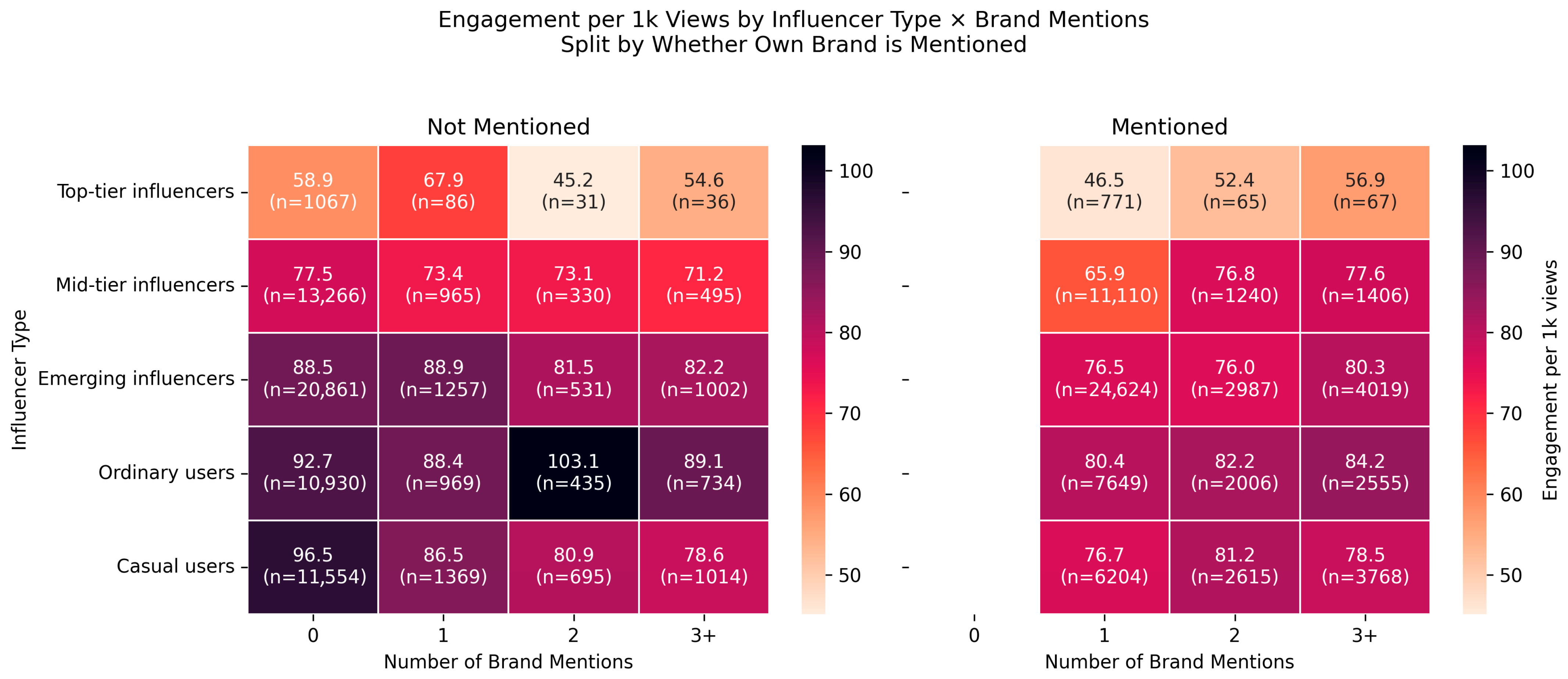
To further visualize how brand-mention intensity interacts with creator type and focal-brand presence, we use heatmaps (Figure 2). Engagement is measured as pooled engagement per 1000 impressions. Brand mentions are highly right-skewed (mean = 1.04; median = 1; 75th percentile = 1; maximum = 20). We therefore classify mention counts into four bins—none, one, two, and three or more—and plot heatmaps separately for posts mentioning the focal brand versus those that do not, stratified by influencer tier.
Overall patterns. Engagement is consistently lower when the focal brand is the only brand mentioned, supporting the single-brand penalty across influencer tiers (e.g., top-tier: 67.9 vs. 46.5; mid-tier: 73.4 vs. 65.9). The marginal effect of additional brand mentions varies by influencer type. Mid-tier and ordinary creators show gains up to two mentions; casual users peak at two mentions; emerging creators remain stable from zero and one mention but decline thereafter; and top-tier creators display a non-monotonic pattern.
Sponsored vs. non-sponsored posts. The single-brand penalty persists in both sponsored posts (official collaborations) and non-sponsored (organic) posts. In sponsored posts, the relative gains from additional mentions are strongest for top-tier and mid-tier influencers, whereas ordinary users experience declines as mentions increase. In non-sponsored posts, the largest benefits occur for ordinary and mid-tier influencers; casual users again peak when two brands are mentioned; and top-tier influencers show little or no systematic benefit. However, the engagement response to additional mentions differs across sponsorship status and influencer tiers. Because some cells contain relatively few observations, these interaction patterns should be interpreted with caution.
Taken together, the descriptive evidence indicates that shorter texts are associated with immediate interaction, medium texts align with follower conversion, and specific visual cues, especially young female faces, are associated with higher attention and response. Posts with limited or implicit branding tend to deliver broader engagement than overtly promotional content. In addition, moderate brand mentions enhance engagement, whereas single-brand or excessive mentions are less effective, reflecting a “single-brand penalty” in which exclusive emphasis on the focal brand reduces user response.

4.2.2. Regression Results of Content Dimension

Table 8 reports OLS models with log total interactions and log engagement rate as outcomes. Both models include brand-mention pattern indicators, text and visual cues, and the same creator, brand, and cost controls as above.
Text length exhibits a strong negative association with engagement. In Model (1), the coefficient of log text length is −0.685 (p < 0.001), indicating that a one-unit increase in log characters (approximately a 2.7× increase in length) is associated with about 50% fewer total interactions (exp(−0.685) ≈ 0.50). In Model (2), the coefficient is −0.032 (p < 0.001), implying a small but statistically significant reduction in engagement rate.
Brand-mention patterns show clear evidence of a single-brand penalty. Using “no brand mentioned” as the reference, (i) “Focal brand only” posts exhibit a significantly lower total engagement (β = −0.436, p < 0.001; exp(−0.436) ≈ 0.65) and lower engagement rate (β = −0.084, p < 0.001; exp(−0.084) ≈ 0.92).
(ii) “Focal + other brands” also underperform “no brand” (β = −0.125 for total interactions; β = −0.063 for engagement rate; both p < 0.001), though the penalty is smaller. (iii) “Other brands only” posts show substantially higher total engagement (β = 0.569, p < 0.001; exp(0.569) ≈ 1.77) but no meaningful difference in engagement rate.
Visual and interactive cues are also associated with engagement. The number of faces in the cover image positively predict total interactions (β = 0.153, p < 0.001) but are slightly negatively associated with engagement rate (β = −0.008, p < 0.01), suggesting that face cues mainly scale engagement volume rather than improve per-impression conversion. Tag_count is negatively associated with total interactions (β = −0.017, p < 0.001) but positively associated with engagement rate (β = 0.003, p < 0.001), while Question_count is positively associated with both outcomes (β ≈ 0.120 for total engagement; β = 0.0101 for engagement rate; p < 0.05).

4.3. Timing Dimension (H3)

4.3.1. Descriptive Temporal Patterns

Using 138,713 high-engagement posts published between 9 December 2022 and 1 February 2024 (420 distinct dates), we examine temporal patterns along three dimensions—season, within-month timing (day of month), and weekday. For each time window W, we report the observed share (p = k/N), Wilson 95% confidence intervals, a baseline probability p0 defined by the share of calendar days in that window, and relative lift (Lift = p/p0). Baselines are 1/4 for seasons, 1/7 for weekdays, and hours/24 for day.
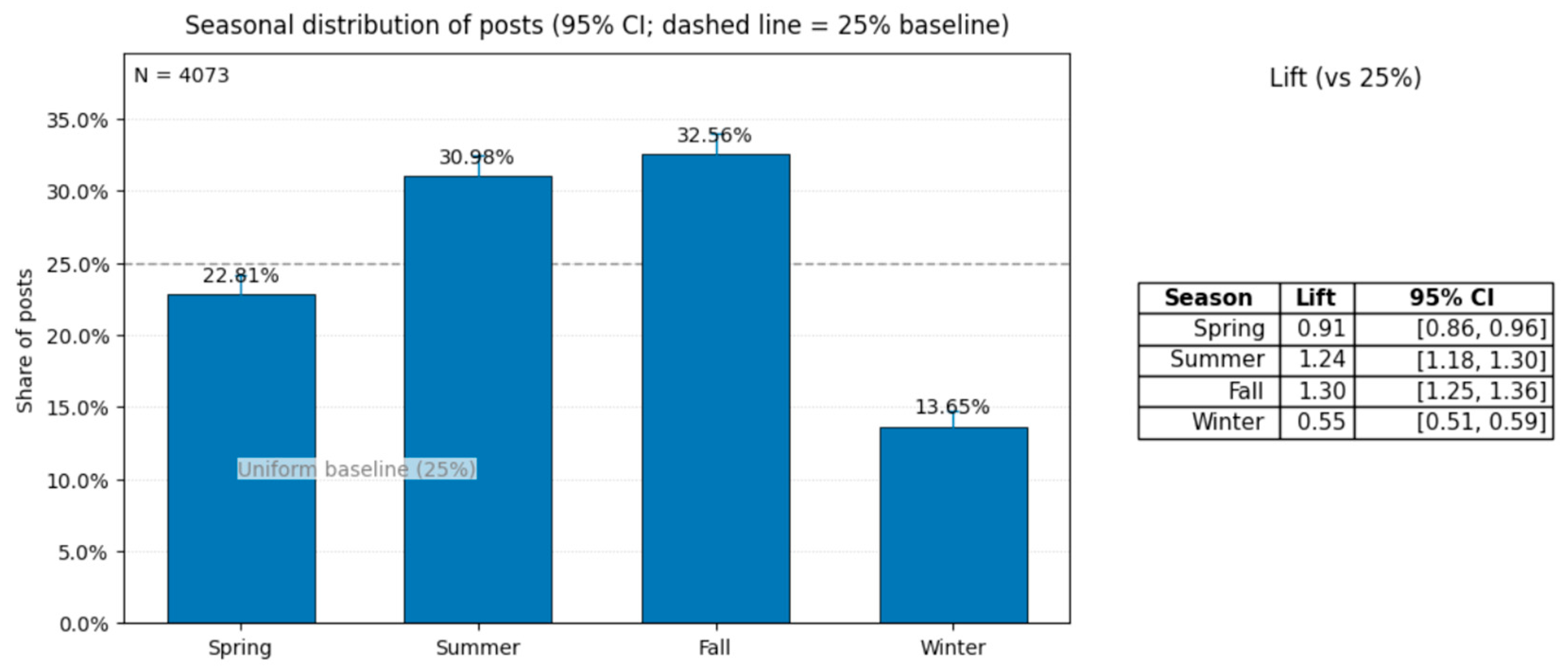
At the seasonal level, high-engagement posts are disproportionately concentrated in summer and autumn relative to a uniform calendar baseline. Fall accounts for 32.56% (Lift = 1.30; 95% CI [1.25, 1.36]) and summer for 30.98% (Lift = 1.24; [1.18, 1.30]). Spring is slightly below baseline (22.81%; Lift = 0.91; [0.86, 0.96]), whereas winter is markedly underrepresented (13.65%; Lift = 0.55; [0.51, 0.59]) (Figure 3).
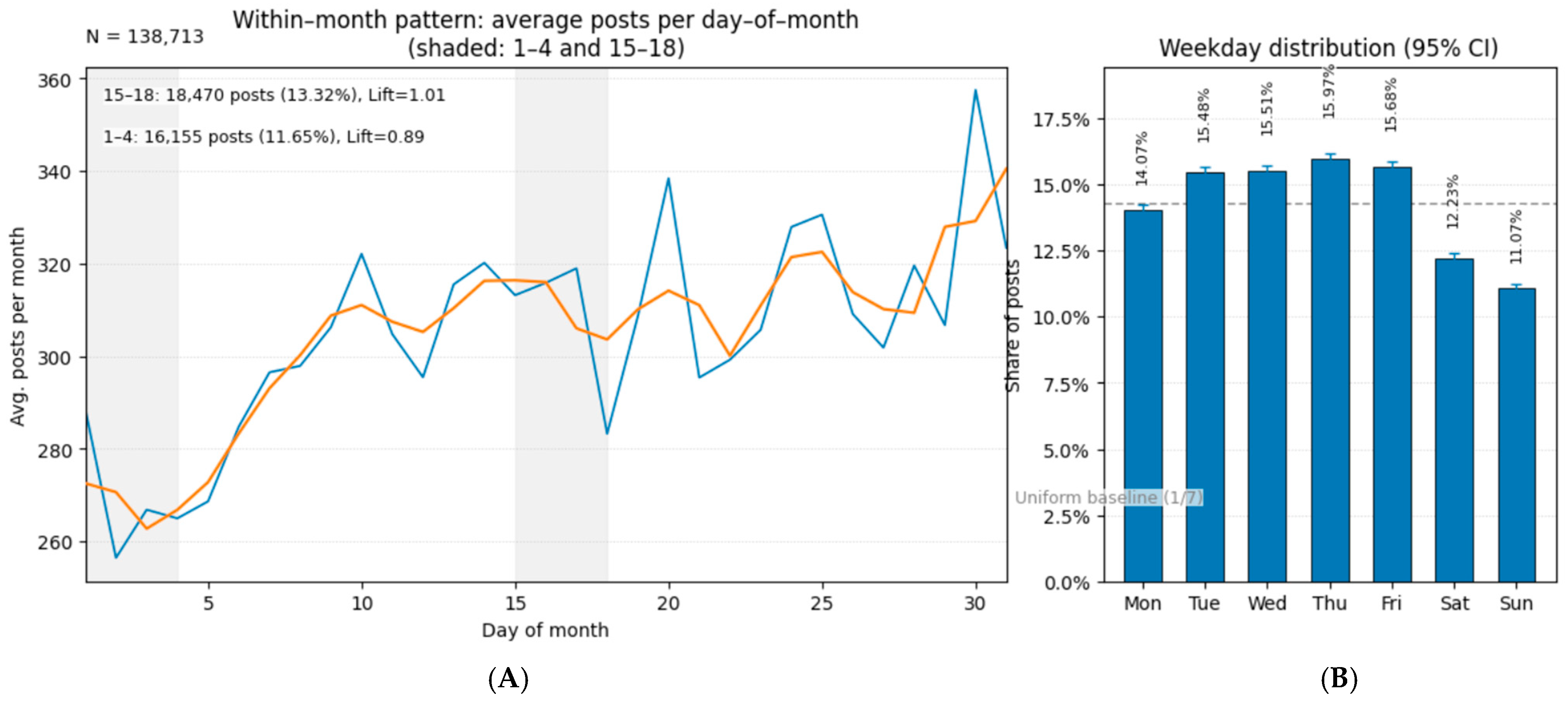
Within-month patterns show a trough at the beginning of the month. Days 1–4 account for 11.65% (95% CI [11.48%, 11.82%]; Lift = 0.89 vs. baseline 13.16%), followed by a gradual rise toward mid-month and a higher share near month-end (Figure 4A). Across weekdays, high-engagement posts are more frequent on Tuesday through Friday. Thursday is the most frequent day (15.97%; 95% CI [15.77%, 16.16%]; Lift ≈ 1.12). Weekends are underrepresented in the posting volume (Figure 4B).

4.3.2. Regression Results of Posting Time

To isolate timing effects, we extend the baseline content-and-creator baseline regressions by adding season, month, day-of-month, and weekday dummies. Table 9 reports key coefficients.
With log engagement rate as the outcome, summer and winter outperform spring (β_Summer = 0.073 (p < 0.001; exp(0.073) ≈ 1.08) and β_Winter = 0.159 (p < 0.001; ≈exp(0.159) ≈ 1.17), whereas fall underperforms (β_Fall = −0.070, p < 0.001; exp(−0.070) ≈ 0.93). With log total interactions as the outcome, fall again shows a significant decrease (β = −0.188, p < 0.001; exp(−0.188) ≈ 0.83), while seasonal differences for summer and winter are smaller and less robust.
Workday patterns are also asymmetrical. Relative to Monday, total interactions are lower from Tuesday to Friday (β between −0.067 and −0.090; all p < 0.001), but higher on Sunday (β = 0.100, p < 0.001; exp(0.100) ≈ 1.11). For engagement rate, Thursday and Friday show small but significant decreases (β ≈ −0.023 and −0.025; p < 0.01), while Sunday is marginally positive.
Including timing variables modestly increases model fit (R2 rises from 0.1975 to 0.2009 for log total interactions, and from 0.0307 to 0.0351 for log engagement rate). Despite the modest R2 gains, the timing coefficients are systematic and robust. Similar weekday patterns emerge when cost-adjusted engagement is used as the outcome (Table A2 in Appendix A). Overall, these results support H3, even within a high-engagement subset; posts released in attention alignment are associated with higher engagement efficiency than those in overcrowded slots (autumn, mid-week).

4.4. CCT Configurations (H4)

4.4.1. Identification of Creator–Content–Timing Clusters

To examine configuration effects, we cluster posts in the Creator–Content–Timing (CCT) feature space. The clustering feature includes creator tier, account type (brand vs. influencer), sponsorship status, text length, brand-mention pattern, number of faces, tag and question counts, season, and weekday dummies. After z-standardization of all the features, we apply k-means clustering with K = 4 (selected based on the elbow criterion and interpretability) and obtain four distinct CCT configurations.

4.4.2. Engagement Differences Across CCT Configurations (H4)

First, an ANOVA using ln (engagement rate) reveals substantial between cluster heterogeneity (F (3, 133,661) = 168.90, p < 0.001). Relative to Cluster 1, controlling for covariates, Clusters 2–4 exhibit higher engagement rates (β = 0.06, 0.63, and 0.106, respectively; all p < 0.001), translating into roughly 6–11% more engagement per 1000 views.
Second, the multivariate results in Table 10 confirm that these engagement gaps persist after controlling for creator-, brand-, sponsorship-, content-, and timing-level covariates. For ln_total_int, Cluster 3 (β = 0.418, p < 0.001) and Cluster 4 (β = 0.961, p < 0.001) outperform Cluster 1, corresponding to 52% and 161% more engagement, whereas Cluster 2 has a small, insignificant effect. For ln(Int_per_cost), Clusters 2–4 exceed Cluster 1 (β = 0.127, 0.766, and 0.615; all p < 0.001), implying an increase of approximately 14%, 115%, and 85% in cost-adjusted engagement.
Overall, high-engagement posts are not randomly distributed across the CCT space. Instead, they concentrate in a set of recurring Creator–Content–Timing configurations. This pattern supports H4 by showing that platform affordances are actualized through a limited number of stable CCT templates which differ systematically in both engagement scale (total interactions) and efficiency (Int_per_cost).

4.5. Robustness Checks

We conduct a series of robustness checks. First, we construct a “very high engagement” indicator that equals 1 if a post’s engagement rate (interactions per 1000 views) is at or above the 75th percentile of the engagement-rate distribution within the high-engagement sample (p75 = 91.76), and 0 otherwise. Logistic models—estimated with and without the full set of creator-, brand-, sponsorship-, content-, and timing-level controls—show that CCT cluster membership remains a significant predictor of belonging to this top-quartile group, with coefficients consistent in sign and statistical significance (reported in Table A4 in Appendix A).
Second, variance inflation factors indicate low multicollinearity (all VIFs < 10; most between 1 and 3; mean ≈ 2.29), alleviating concerns that collinearity drives the estimates. Third, re-estimating the core models using alternative engagement measures and specifications yields qualitatively similar patterns. Finally, additional sensitivity checks on alternative dependent variables use cost-adjusted engagement (reported in Table A2 and Table A3 in Appendix A), which do not change the substantive conclusions.

5. Discussion and Implications

5.1. General Discussion

Social e-commerce platforms have become one of the core strategies for brand dissemination. A key issue for brand managers is whether the choice of creator, content, and timing can generate high-engagement “hot posts.” Based on the Technology Affordance Actualization (TAA) theory, this study proposes the Creator–Content–Timing (CCT) model, which explains how visibility, interactivity, and commercial collaboration, as well as multimodality, self-presentation, and timing, are realized. Through automated text and image analysis of 138,713 Xiaohongshu posts, the study reveals how creator tier, brand status, and collaboration mode influence user engagement.
First, regarding the creator–brand collaboration, the study finds that collaboration with creators with a large follower base does not necessarily lead to higher user engagement. Nano- and micro-influencers and non-sponsored posts show a higher “engagement efficiency per exposure” and “unit cost engagement output.” Medium-sized creators, similar to previous research, often outperform small and large influencers in terms of interaction efficiency. While medium and top-tier influencers generate the highest total interactions, smaller creators have the highest interaction rates when considering costs and exposure.
Second, in terms of content, this study identifies three key pathways for realizing affordances, including interaction affordance, multimodal self-presentation, and commercial intent. Post length is negatively correlated with total interaction volume and rate. Hashtags and specific visual elements, especially young female faces, attract more user attention and promote interaction. Compared to explicit promotional content, posts with ambiguous or hidden brand identifiers tend to generate more engagement.
Third, timing matters. Posts published during leisure times (such as Sunday or end of month) tend to generate more engagement than posts published during busy periods (such as weekdays or autumn).
Fourth, through CCT framework clustering analysis, high engagement is concentrated in a few recurring CCT combinations, indicating that the realization of affordances is not random or unpredictable but can be shaped by the creator’s choice, content cues, and timing.

5.2. Theoretical Implications

First, this study extends the Technology Affordance Actualization (TAA) perspective from platform-function focus to multimodal social commerce context. Prior TAA research has primarily emphasized platform-level affordances, whereas our findings further illustrate how such affordances are actualized through creators’ choices regarding creator, content cues, and posting timing (CCTs). Building on this perspective, we operationalize and quantify CCT-related variables to capture affordance actualization pathways in practice.
Second, we contribute to the influencer marketing literature by distinguishing engagement volume, engagement rate, and engagement cost-efficiency (interactions per unit cost, Int_per_cost). Our results show that ordinary users and ordinary-user collectives achieve higher engagement rates per exposure and exhibit cost-efficiency advantages relative to other creator tiers. In addition, within our sample, sponsored posts demonstrate significantly lower interaction efficiency and cost-efficiency than non-sponsored posts. Moreover, using a clustering approach based on creator type and posting frequency, we identify three affordance-actualization pathways—coverage-driven, activity-driven, and resource-constrained—which provide a comparative framework for understanding heterogeneous routes to highly engaging posts.
Third, in social media content marketing research, we integrate machine learning, text mining, and computer vision to quantify multiple dimensions of multimodal cues using a Xiaohongshu dataset. The results suggest that high engagement is not purely random; rather, it is systematically associated with different types of CCT configurations. This offers a data-driven framework for explaining engagement differences with multimodal evidence.

5.3. Practical Implications

For practitioners, our findings suggest a differentiated allocation strategy in influencer selection and budget deployment. Brands may assign high-budget campaigns aimed at broad reach to top-tier influencers, while allocating efficiency-oriented tasks (e.g., engagement efficiency and community maintenance) to nano- and micro-influencers. Brands should also pay greater attention to non-sponsored content in their content portfolio. The CCT framework can serve as a planning and evaluation tool to coordinate creator selection, content design, and scheduling decisions.
Second, content design should balance exposure and engagement. Compared with lengthy and information-dense copy, concise and focused messages—combined with clear questions and an appropriate number of hashtags—tend to be more conducive to interaction. Over-emphasizing a single focal brand may reduce engagement, whereas moderating brand salience or embedding the focal brand in a multi-brand context may mitigate the “single-brand penalty.” Visually, face-related cues may attract attention and facilitate engagement; however, higher facial attractiveness does not automatically translate into higher efficiency. Authentic visual presentations that resonate with users may yield more stable effects.
Third, brands should optimize posting schedules. Highly engaging posts are more likely to emerge during users’ leisure time. Shifting content to lower-utilization yet higher-efficiency time windows (e.g., Sundays, specific winter periods, or end-of-month windows) may improve engagement outcomes without increasing the budget.

5.4. Societal and Ethical Considerations

First, algorithm-generated facial attractiveness scores are treated solely as technical variables; however, the training data may embed cultural and gendered biases. If such scores are used directly for content optimization and decision-making, they may reinforce narrow esthetic standards and exclusionary norms. Platform designers and brands should therefore apply these signals with caution.
Second, several variables in this study rely on platform algorithms and third-party tools. Estimated views and advertising cost are based on quoted price from the Huitun data platform rather than actual spending, and facial attributes (e.g., age, expression, and attractiveness) are produced by commercial computer-vision APIs. These measures may contain unknown noise, commercial rules, or cultural bias. Although we conducted multiple robustness checks (including alternative outcomes and multicollinearity diagnostics), measurement error and algorithmic bias cannot be fully ruled out. Future research may integrate platform log data, controlled advertising campaigns, or human-coded image and text features to validate and refine these measures, and to more explicitly audit fairness and bias in appearance-related visual attributes.
In sum, on visual social commerce platforms, user engagement can be understood as an outcome of affordance actualization. The alignment among creator, content, and timing significantly shapes actualization efficiency. Brands may dynamically adjust CCT configurations to guide creator selection, content design, and scheduling optimization.


6. Limitations and Future Research

First, the empirical scope of this study is relatively specific. We focus on a visual social commerce platform in China (Xiaohongshu) and on a highly aestheticized category (beauty and personal care). Given cross-regional and cross-industry differences in platform architectures, cultures contexts, and commercial practices, future research may conduct cross-platform and cross-category comparisons (e.g., fashion, electronics, and services) to test the applicability and boundary conditions of the proposed CCT framework.
Second, our sampling strategy centers on highly engaged content from high-investment brands (the top 3000 posts per brand by total engagement). This design is well suited for identifying differentiating features among relatively successful posts, but it underrepresents extremely low exposure content and cannot directly model the process by which posts enter the high-engagement region. Future studies may model the full engagement distribution or adopt a two-stage design (e.g., separating “entry into high-engagement” from “engagement efficiency conditional on exposure”) to more comprehensively capture the mechanisms behind viral post formation.

Author Contributions

Conceptualization, Y.W.; methodology, Y.W.; supervision, Y.W.; formal analysis, Y.W.; writing—original draft preparation, Y.W.; writing—review and editing, Y.W. and Y.X.; data collection and curation, Y.X.; writing—supporting draft preparation, Y.X. All authors have read and agreed to the published version of the manuscript.

Funding

This research was supported by Major Project of the National Social Science Fund of China (Grant No. 23ZD15); Humanities and Social Science Fund of Ministry of Education of China (Grant No. 24YJC630012); Educational Science Research “14th Five-Year Plan” of the Inner Mongolia Autonomous Region (Grant No. NGJGH2023381); and 2024 Special Project on the Five Major Tasks of the Inner Mongolia Autonomous Region at Inner Mongolia University of Finance and Economics (Grant No. NCXWD2462), and the Laboratory of Agricultural and Livestock Product Circulation in Inner Mongolia.

Institutional Review Board Statement

Ethical review and approval were waived for this study because the data were collected from publicly available, non-identifiable social media sources, in compliance with the platform’s terms of service.

Informed Consent Statement

Not applicable. No identifiable personal data are disclosed. Images were processed only to extract aggregate, non-identifiable features.

Data Availability Statement

Data were obtained under license and are not publicly available. Derived code and variable dictionaries are available from the corresponding author upon reasonable request.

Acknowledgments

We thank colleagues for assistance with data preprocessing and valuable comments on earlier drafts.

Conflicts of Interest

The authors declare no conflicts of interest.

Appendix A

Table A1. Variable definitions.
Variable NameVariable TypeDefinitionCalculation/Range
Creator-Related Variables
FollowersIntegerNumber of followers of the content creator[0, 17, 349, 918]
Creator typeCategoricalType of creator (industry classification)Top-tier, Mid-tier, Emerging, Ordinary, Casual
Brand statusCategoricalBrand’s market position based on public sourcesGlobal leaders, International conglomerates, Leading domestic brands, Other brands
Estimated advertising costIntegerPlatform-provided advertising quotation, not actual spending[0, 2, 034, 900]
Sponsored post (commercial note)BinaryWhether the post is reported via Xiaohongshu’s Pugongying system1 = sponsored, 0 = non-sponsored
Number of associated postsNumericNumber of posts associated with a brandCount
Content-Related Variables
Text_lengthNumericLength of post text (caption).Number of characters in cleaned text; non-negative integer (used in log form in regressions)
Tag_countNumericInteractivity cue: number of hashtags in captionCount; range [0, 92] in sample
Question_countNumericInteractivity cue: number of question marks in captionCount; range [0, 18] in sample
Number of brand mentionsIntegerNumber of brands mentioned in post[0, 20]
Image labelStringObjects and scenes identified by API in the primary imageCategorical
Number of facesIntegerNumber of faces detected by API[0, 5]
Average age of facesIntegerMean age of faces detected by the API[0, 65]
Average expression scoreIntegerExpression score of detected faces (0 = neutral, 100 = laugh)[0, 100]
Average attractiveness scoreIntegerAttractiveness score of detected faces (API output)[0, 100]
Average gender scoreIntegerGender score of detected faces by API[0, 100]
Temporal Variables
Publication dateDateTimeDate of publication[9 December 2022, 1 February 2024]
Publication timeDateTimeTime of publicationhh: mm: ss
SeasonCategoricalSeason of posting timeSpring/Summer/Fall/Winter, derived from publication
WeekdayCategoricalWeekday of posting timeMon–Sun, derived from timestamp
Month_of_yearCategoricalMonth of posting time1–12, derived from timestamp (used as month-of-year dummies)
Day_of_monthCategoricalDay within month of posting time1–31, derived from timestamp (used as day-of-month dummies)
User Engagement Variables
Estimated viewsIntegerEstimated number of views (calculated by Gray Dolphin platform)[0, 12, 221, 733]
LikesIntegerActual number of likes[0, 642, 920]
FavoritesIntegerActual number of favorites[0, 367, 664]
CommentsIntegerActual number of comments[0, 311, 315]
SharesIntegerActual number of shares[0, 73, 885]
Total engagementIntegerSum of likes, favorites, comments, and sharesDerived
Engagement_rateNumericEngagement intensity per impressionTotal engagement/estimated views × 1000
Int_per_costNumericCost-adjusted engagement efficiencyTotal engagement/estimated ad cost × 1000 (CNY); defined for posts with positive estimated ad cost
Note. Estimated advertising cost refers to quotation values provided by the Xiaohongshu platform and does not represent actual spending. Sponsored post and commercial note indicate posts officially reported via the Xiaohongshu Pugongying system. Post text includes the full title and body of each post, cleaned for text length and keyword analysis. Image labels and facial attributes (age, expression, attractiveness, and gender) are identified by the Tencent Image Recognition and Facial Recognition APIs, with values averaged when multiple faces appear. Estimated views are derived from the Gray Dolphin platform using algorithmic estimation rather than direct counts. Favorites represent user bookmarks. Total engagement is a derived variable calculated as the sum of likes, favorites, comments, and shares.
Table A2. Robustness: content dimension and cost-adjusted engagement (H2).
Variablesln_Int_per_Cost
Brand-mention pattern (ref. = no brand mentioned)
Single own brand only−0.306 *** (0.013)
Own + other brands−0.036 * (0.017)
Other brands only0.681 *** (0.023)
Text and visual cues
Text length (log characters)−0.816 *** (0.014)
Number of faces0.133 *** (0.007)
Tag count0.008 *** (0.001)
Question count0.098 *** (0.011)
Creator/brand/sponsorship/cost controls
Creator tier dummiesYes
Brand status dummiesYes
Sponsored post dummyYes
ln estimated ad costYes
Number of associated postsYes
Constant13.593 *** (0.058)
N110,232
R20.434
Note. † p < 0.10, * p < 0.05, ** p < 0.01, *** p < 0.001.
Table A3. Robustness: timing dimension and cost-adjusted engagement (H3).
Variablesln_Int_per_Cost
Brand-mention pattern (ref. = no brand mentioned)
Single own brand only−0.329 *** (0.013)
Own + other brands−0.067 *** (0.018)
Other brands only0.635 *** (0.023)
Creator/brand/sponsorship/content controls
Creator tier dummiesYes
Brand status dummiesYes
Sponsored post dummyYes
ln estimated ad costYes
Number of associated postsYes
Text length, faces, tags, questionsYes
Season (ref. = spring)
Summer0.003 (0.023)
Fall−0.032 (0.025)
Winter0.023 (0.028)
Weekday (ref. = Monday)
Tuesday−0.099 *** (0.018)
Wednesday−0.081 *** (0.018)
Thursday−0.101 *** (0.018)
Friday−0.093 *** (0.018)
Saturday0.003 (0.020)
Sunday0.092 *** (0.021)
Month-of-year dummiesYes
Day-of-month dummiesYes
Constant13.665 *** (0.069)
N110,232
R20.437
Note. † p < 0.10, * p < 0.05, ** p < 0.01, *** p < 0.001.
Table A4. Robustness: very high engagement indicator (top quartile of engagement rate). Dependent variable: 1 = post is in the top quartile (p75) of engagement rate (interactions per 1000 views) within the high-engagement sample; 0 otherwise. Robust standard errors in parentheses. Base category: Cluster 1.
Variables(1) Logit(2) Logit + Full Controls
Cluster 20.512 *** (0.023)0.257 *** (0.035)
Cluster 30.212 *** (0.028)0.255 *** (0.048)
Cluster 40.234 *** (0.027)0.563 *** (0.048)
ControlsNoYes
N134,619134,619
R20.0050.022
Note. † p < 0.10, * p < 0.05, ** p < 0.01, *** p < 0.001.

References

  1. Pansari, A.; Kumar, V. Customer Engagement: The Construct, Antecedents, and Consequences. J. Acad. Mark. Sci. 2017, 45, 294–311. [Google Scholar] [CrossRef]
  2. Kumar, V.; Leone, R.P.; McAlister, L. Enhancing Customer Engagement: Exploration and Introduction to the Special Section. J. Acad. Mark. Sci. 2025, 53, 955–967. [Google Scholar] [CrossRef]
  3. Jaakkola, E.; Alexander, M. The Role of Customer Engagement Behavior in Value Co-Creation: A Service System Perspective. J. Serv. Res. 2014, 17, 247–261. [Google Scholar] [CrossRef]
  4. de Oliveira Santini, F.; Ladeira, W.J.; Pinto, D.C.; Herter, M.M.; Sampaio, C.H.; Babin, B.J. Customer Engagement in Social Media: A Framework and Meta-Analysis. J. Acad. Mark. Sci. 2020, 48, 1211–1228. [Google Scholar] [CrossRef]
  5. Lim, W.M.; Rasul, T.; Kumar, S. Customer Engagement and Social Media: Revisiting the Past to Inform the Future. J. Bus. Res. 2022, 148, 325–339. [Google Scholar] [CrossRef]
  6. Zhao, L.; Zhang, M.; Ming, Y.; Niu, T.; Wang, Y. The Effect of Image Richness on Customer Engagement: Evidence from Sina Weibo. J. Bus. Res. 2023, 154, 113307. [Google Scholar] [CrossRef]
  7. Kanuri, V.K.; Hughes, C.; Hodges, B.T. Standing Out from the Crowd: When and Why Color Complexity in Social Media Images Increases User Engagement. Int. J. Res. Mark. 2024, 41, 174–193. [Google Scholar] [CrossRef]
  8. Gkikas, D.C.; Tzafilkou, K.; Theodoridis, P.K.; Garmpis, A.; Gkikas, M.C. How Do Text Characteristics Impact User Engagement in Social Media Posts? Modeling Content Readability, Length, and Hashtags Number in Facebook. Int. J. Inf. Manag. Data Insights 2022, 2, 100067. [Google Scholar] [CrossRef]
  9. Wies, S.; Bleier, A.; Edeling, A. Finding Goldilocks Influencers: How Follower Count Drives Social Media Engagement. J. Mark. 2023, 87, 383–405. [Google Scholar] [CrossRef]
  10. Wang, R.; Chan-Olmsted, S.; Zhou, Q. Information Seeking and Affective Relationship Building in Influencer Marketing: The Role of Social Media Affordances. Humanit. Soc. Sci. Commun. 2025, 12, 557. [Google Scholar] [CrossRef]
  11. Volkoff, O.; Strong, D.M. Critical Realism and Affordances: Theorizing IT-Associated Organizational Change Processes. MIS Q. 2013, 37, 819–834. [Google Scholar] [CrossRef]
  12. Strong, D.M.; Volkoff, O.; Johnson, S.A.; Pelletier, L.R.; Anello, C.; Garber, L. A Theory of Organization–EHR Affordance Actualization. J. Assoc. Inf. Syst. 2014, 15, 53–85. [Google Scholar] [CrossRef]
  13. Treem, J.W.; Leonardi, P.M. Social Media Use in Organizations: Exploring the Affordances of Visibility, Editability, Persistence, and Association. Ann. Int. Commun. Assoc. 2013, 36, 143–189. [Google Scholar] [CrossRef]
  14. Evans, S.K.; Pearce, K.E.; Vitak, J.; Treem, J.W. Explicating Affordances: A Conceptual Framework for Understanding Affordances in Communication Research. J. Comput. Mediat. Commun. 2017, 22, 35–52. [Google Scholar] [CrossRef]
  15. Lee, S.; Choeh, J.Y. The Impact of Online Review Helpfulness and Word of Mouth Communication on Box Office Performance Predictions. Humanit. Soc. Sci. Commun. 2020, 7, 84. [Google Scholar] [CrossRef]
  16. Hollebeek, L.D. Exploring Customer Brand Engagement: Definition and Themes. J. Strat. Mark. 2011, 19, 555–573. [Google Scholar] [CrossRef]
  17. Ma, L.; Ou, W.; Lee, C.S. Investigating Consumers’ Cognitive, Emotional, and Behavioral Engagement in Social Media Brand Pages: A Natural Language Processing Approach. Electron. Commer. Res. Appl. 2022, 54, 101179. [Google Scholar] [CrossRef]
  18. de Vries, L.; Gensler, S.; Leeflang, P.S.H. Popularity of Brand Posts on Brand Fan Pages: An Investigation of the Effects of Social Media Marketing. J. Interact. Mark. 2012, 26, 83–91. [Google Scholar] [CrossRef]
  19. Lee, D.; Hosanagar, K.; Nair, H.S. Advertising Content and Consumer Engagement on Social Media: Evidence from Facebook. Manag. Sci. 2018, 64, 5105–5131. [Google Scholar] [CrossRef]
  20. van Doorn, J.; Lemon, K.N.; Mittal, V.; Nass, S.; Pick, D.; Pirner, P.; Verhoef, P.C. Customer Engagement Behavior: Theoretical Foundations and Research Directions. J. Serv. Res. 2010, 13, 253–266. [Google Scholar] [CrossRef]
  21. Brodie, R.J.; Hollebeek, L.D.; Jurić, B.; Ilić, A. Customer Engagement: Conceptual Domain, Fundamental Propositions, and Implications for Research. J. Serv. Res. 2011, 14, 252–271. [Google Scholar] [CrossRef]
  22. Muntinga, D.G.; Moorman, M.; Smit, E.G. Introducing COBRAs: Exploring Motivations for Brand-Related Social Media Use. Int. J. Advert. 2011, 30, 13–46. [Google Scholar] [CrossRef]
  23. Islam, J.; Rahman, Z.; Hollebeek, L.D. Consumer Engagement in Online Brand Communities: A Solicitation of Congruity Theory. Internet Res. 2018, 28, 23–45. [Google Scholar] [CrossRef]
  24. Dolan, R.; Conduit, J.; Frethey-Bentham, C.; Fahy, J.; Goodman, S. Social Media Engagement Behavior: A Framework for Engaging Customers through Social Media Content. Eur. J. Mark. 2019, 53, 2213–2243. [Google Scholar] [CrossRef]
  25. Mir, I.A.; Salo, J. Analyzing the Influence of Social Media Influencer’s Attributes and Content Aesthetics on Endorsed Brand Attitude and Brand-Link Click Behavior: The Mediating Role of Brand Content Engagement. J. Promot. Manag. 2024, 30, 1–28. [Google Scholar] [CrossRef]
  26. Vargo, S.L.; Lusch, R.F. Evolving to a New Dominant Logic for Marketing. J. Mark. 2004, 68, 3–28. [Google Scholar] [CrossRef]
  27. Vargo, S.L.; Lusch, R.F. Service-Dominant Logic: Continuing the Evolution. J. Acad. Mark. Sci. 2008, 36, 1–10. [Google Scholar] [CrossRef]
  28. Schivinski, B.; Dąbrowski, D. The Effect of Social Media Communication on Consumer Perceptions of Brands. J. Mark. Commun. 2016, 22, 189–214. [Google Scholar] [CrossRef]
  29. Goh, K.-Y.; Heng, C.-S.; Lin, Z. Social Media Brand Community and Consumer Behavior: Quantifying the Relative Impact of User- and Marketer-Generated Content. Inf. Syst. Res. 2013, 24, 88–107. [Google Scholar] [CrossRef]
  30. Song, Y.A.; Wu, J.; Mookherjee, S.; Bose, I. Advertising Green Products on Brands’ Official Social Media Accounts or Mega-Influencer Accounts? Inf. Manag. 2026, 63, 104259. [Google Scholar] [CrossRef]
  31. Li, Y.; Xie, Y. Is a Picture Worth a Thousand Words? An Empirical Study of Image Content and Social Media Engagement. J. Mark. Res. 2020, 57, 1–19. [Google Scholar] [CrossRef]
  32. Hartmann, J.; Heitmann, M.; Schamp, C.; Netzer, O. The Power of Brand Selfies. J. Mark. Res. 2021, 58, 1159–1177. [Google Scholar] [CrossRef]
  33. Cascio Rizzo, G.L.; Berger, J.; De Angelis, M.; Pozharliev, R. How Sensory Language Shapes Influencer’s Impact. J. Consum. Res. 2023, 50, 810–825. [Google Scholar] [CrossRef]
  34. Berger, J.; Milkman, K.L. What Makes Online Content Viral? J. Mark. Res. 2012, 49, 192–205. [Google Scholar] [CrossRef]
  35. del Río, A.B.; Vázquez, R.; Iglesias, V. The Role of the Brand Name in Obtaining Differential Advantages. J. Prod. Brand Manag. 2001, 10, 452–465. [Google Scholar] [CrossRef]
  36. Erdem, T.; Swait, J.; Valenzuela, A. Brands as Signals: A Cross-Country Validation Study. J. Mark. 2006, 70, 34–49. [Google Scholar] [CrossRef]
  37. Pentina, I.; Guilloux, V.; Micu, A.C. Exploring Social Media Engagement Behaviors in the Context of Luxury Brands. J. Advert. 2018, 47, 55–69. [Google Scholar] [CrossRef]
  38. Boerman, S.C.; Willemsen, L.M.; van der Aa, E.P. “This Post Is Sponsored”: Effects of Sponsorship Disclosure on Persuasion Knowledge and Electronic Word of Mouth in the Context of Facebook. J. Interact. Mark. 2017, 38, 82–92. [Google Scholar] [CrossRef]
  39. Hwang, Y.; Jeong, S.H. “This Is a Sponsored Blog Post, but All Opinions Are My Own”: The Effects of Sponsorship Disclosure on Responses to Sponsored Blog Posts. Comput. Hum. Behav. 2016, 62, 528–535. [Google Scholar] [CrossRef]
  40. Cao, Z.; Belo, R. Effects of Explicit Sponsorship Disclosure on User Engagement in Social Media Influencer Marketing. MIS Q. 2024, 48, 375–392. [Google Scholar] [CrossRef]
  41. Davis, F.D. Perceived Usefulness, Perceived Ease of Use, and User Acceptance of Information Technology. MIS Q. 1989, 13, 319–340. [Google Scholar] [CrossRef]
  42. Kaplan, A.M.; Haenlein, M. Users of the World, Unite! The Challenges and Opportunities of Social Media. Bus. Horiz. 2010, 53, 59–68. [Google Scholar] [CrossRef]
  43. Majchrzak, A.; Markus, M.L. Technology Affordances and Constraints Theory (of MIS). In Encyclopedia of Management Theory; Kessler, E.H., Ed.; SAGE Publications: Thousand Oaks, CA, USA, 2014; pp. 832–836. [Google Scholar] [CrossRef]
  44. Qian, S.; Lu, Y.; Peng, Y.; Shen, C.; Xu, H. Convergence or Divergence? A Cross-Platform Analysis of Climate Change Visual Content Categories, Features, and Social Media Engagement on Twitter and Instagram. Public Relat. Rev. 2024, 50, 102454. [Google Scholar] [CrossRef]
  45. Gibson, J.J. The Ecological Approach to Visual Perception; Psychology Press: New York, NY, USA, 2014. [Google Scholar]
  46. Shin, D. The Actualization of Meta Affordances: Conceptualizing Affordance Actualization in the Metaverse Games. Comput. Hum. Behav. 2022, 133, 107292. [Google Scholar] [CrossRef]
  47. Lee, K.W.; Li, C.Y. It Is Not Merely a Chat: Transforming Chatbot Affordances into Dual Identification and Loyalty. J. Retail. Consum. Serv. 2023, 74, 103447. [Google Scholar] [CrossRef]
  48. Korzynski, P.; Protsiuk, O.; Moulard, J.G.; Jain, V. Opinion Leadership in a Digital Age: The Rise of Nano and Micro-Influencers. Telemat. Inform. 2025, 102, 102328. [Google Scholar] [CrossRef]
  49. Chakrabarti, P.; Malvi, E.; Bansal, S.; Kumar, N. Hashtag Recommendation for Enhancing the Popularity of Social Media Posts. Soc. Netw. Anal. Min. 2023, 13, 21. [Google Scholar] [CrossRef]
  50. Yip, Y.Y.; Makmor-Bakry, M.; Chong, W.W. Elements Influencing User Engagement in Social Media Posts on Lifestyle Risk Factors: Systematic Review. J. Med. Internet Res. 2024, 26, e59742. [Google Scholar] [CrossRef]
  51. Friestad, M.; Wright, P. The Persuasion Knowledge Model: How People Cope with Persuasion Attempts. J. Consum. Res. 1994, 21, 1–31. [Google Scholar] [CrossRef]
  52. Antonakopoulou, S.; Veglis, A. How Post Time and Post Type Affect the Engagement on Facebook: The Case of a National Media Organization. Observatorio (OBS*) 2021, 15, 40–57. [Google Scholar] [CrossRef]
  53. Fiss, P.C. Building Better Causal Theories: A Fuzzy Set Approach to Typologies in Organization Research. Acad. Manag. J. 2011, 54, 393–420. [Google Scholar] [CrossRef]
  54. Kim, E.Y.; Brandon, L. Modeling Brand Equity for Lifestyle Brand Extensions. J. Glob. Acad. Mark. Sci. 2010, 20, 35–48. [Google Scholar] [CrossRef]
  55. Peng, Y.; Wen, T.J.; Yang, J. A Computer Vision Methodology to Predict Brand Personality from Image Features. J. Advert. 2024, 53, 626–638. [Google Scholar] [CrossRef]
  56. Cao, D.; Meadows, M.; Wong, D.; Xia, S. Understanding Consumers’ Social Media Engagement Behaviour: An Examination of the Moderation Effect of Social Media Context. J. Bus. Res. 2021, 122, 835–846. [Google Scholar] [CrossRef]
Figure 1. Brand positioning by company status, follower coverage, and posting frequency. Notes: the x-axis plots average follower coverage (mean follower count), and the y-axis plots posting frequency during the sample period. Colors indicate brand categories (international conglomerates, global leaders, leading domestic brands, and other brands).
Jtaer 21 00024 g001
Figure 2. Engagement per 1000 views by influencer type and brand mentions.
Jtaer 21 00024 g002
Figure 3. Seasonal distribution of high-engagement posts.
Jtaer 21 00024 g003
Figure 4. Within-month and weekday distribution of high-engagement posts. (A). Within-month pattern. The blue curve plots the unit-month rate (average posts on day d in a typical month = total posts on day d divided by the number of months that contain day d); the orange curve is a 3-day moving average for visual smoothing. Grey shaded areas indicate selected day-of-month windows (days 1–4 and 15–18) that are discussed in the timing analysis. (B). Weekday distribution with 95% confidence intervals. The dashed line marks the uniform baseline 1/7. Error bars use Wilson intervals; Lift = observed share/(1/7). Sample N = 138,713.
Jtaer 21 00024 g004
Table 1. Summary of key antecedents and theoretical perspectives in the social media engagement literature.
PerspectiveAntecedent ConstructsMain Theoretical PerspectivesRepresentative Studies (Examples)
Individual user
  • U&G motives (information, entertainment, social interaction, self-presentation)
  • involvement; satisfaction; trust
  • brand attitude/attachment; psychological ownership
  • engagement intention, engagement intensity
  • Uses and gratifications
  • Customer engagement/customer engagement behavior
  • Self-determination theory
  • Self-concept/self-congruence Self-presentation and social comparison
van Doorn et al. [20]; Brodie et al. [21]; Hollebeek [16]; Muntinga et al. [22]; Pansari and Kumar [1]; Islam et al. [23]; de Oliveira Santini et al. [4].
Message source/content creator
  • Influencer follower size
  • Source credibility (expertise, trustworthiness, attractiveness)
  • Content source type (firm-created vs. UGC/influencer-generated content)
  • Source credibility theory
  • Parasocial interaction/relationship-marketing perspectives
  • Service-dominant logic, value co-creation
  • Customer engagement frameworks
de Vries et al. [18]; Dolan et al. [24]; Mir and Salo [25]; Vargo and Lusch [26,27]; Wang et al. [10]; Schivinski and Dąbrowski [28]; Goh et al. [29]; Song et al. [30]
Message/content level
  • Text features (length, readability, sentiment, language style, calls-to-action (CTAs), tags)
  • Visual features (faces/expressions, image content type, visual complexity, color)
  • Uses and gratifications theory
  • Emotional arousal/virality perspectives
  • Self-reference, persuasion theories
  • Multimodal information processing
Li and Xie [31]; Zhao et al. [6]; Kanuri et al. [7]; Hartmann et al. [32]; Cascio Rizzo et al. [33]; Gkikas et al. [8]; Berger and Milkman [34].
Post context (brand/industry)
  • Brand awareness/equity, brand reputation/credibility
  • Brand name/differentiation advantages
  • Brand–consumer relationships quality (trust, identification, intimacy)
  • luxury vs. non-luxury, sponsorship disclosure
  • Brand equity/brand-as-signal theories
  • Relationship marketing/brand relationship theories
  • Service-dominant logic, value co-creation
  • Contextualized engagement and brand community research
del Río et al. [35]; Erdem et al. [36]; Pentina et al. [37]; Dolan et al. [24]; Vargo and Lusch [26,27]; Boerman et al. [38]; Hwang and Jeong [39]; Cao and Belo [40].
Platform and technological context (social media affordances)
  • Platform type, media attributes (visual vs. text)
  • Content formats (image–text, short video)
  • Interaction functions (likes, comments, shares, saves)
  • Recommendation and feed ranking
  • Affordances (visibility, interactivity, connectivity, multimodality, persistence, editability, association)
  • Media richness theory
  • Technology-acceptance models (TAM, UTAUT)
  • Social media affordance research
Davis [41]; Kaplan and Haenlein [42]; Treem and Leonardi [13]; Evans et al. [14]; Volkoff and Strong [11]; Majchrzak and Markus [43]; Wang et al. [10]; Qian et al. [44].
Table 2. Technology affordances and their operationalization in the CCT framework.
Type of Technological AffordanceMain Implementation DimensionRepresentative Operationalization
Visibility affordancesCreator (who): reach and presence via brand creator–platform relationships
  • Followers: follower count of the content creator (reach potential)
  • Creator tier (influencer type): top-tier, mid-tier, emerging, ordinary, casual
  • Brand status (company type): global leaders, international conglomerates, leading domestic, other
  • Brand posting intensity: number of posts associated with the brand during the sample period
Interactivity affordancesContent (how): textual cues that lower the interaction threshold and invite engagement
  • Question cues (Question_Count): number of question marks in captions
  • Hashtag cues (Tag_Count): number of topic tags, hashtags
  • Text length: proxy for information load, reading cost
  • Brand mentions: number of times the focal brand is mentioned
  • Note (data limitation): @-mentions/explicit CTAs are not used because >90% of posts contain none
Multimodality and self-presentation affordancesContent (how): multimodal cues used for information expression and self/brand presentation
  • Image labels: semantic labels of the cover image identified by the API (e.g., person/product/scene)
  • Faces: number of detected faces in the cover image
  • Face attributes (averaged): age, expression, attractiveness, gender scores
Commercial collaboration affordancesCreator (who): explicit brand–creator links realized via platform collaboration mechanisms and investment level
  • Sponsored post (commercial note): whether the post is filed via Xiaohongshu “Pugongying” (1/0)
  • Estimated advertising cost: platform-reported quotation (proxy for investment level)
Temporality affordancesTiming (when): scheduling choices embedding content into rhythms of attention/consumption
  • Season/quarter
  • Month of the year
  • Weekday
  • Time-of-day categories (e.g., early morning, daytime, evening, late night)
  • Festival window (e.g., Spring Festival, Mid-Autumn Festival, National Day)
Note: variable definitions and coding rules are reported in Table A1 in Appendix A.
Table 3. Descriptive statistics of main variables (N = 138,713 posts).
VariableMeanSDP25MedianP75MinMax
Followers59,072.61291,469.5195912,32342,367017,300,000
Estimated advertising cost5855.5522,603.421001200420002,034,900
Number of associated posts9213.0520,690.797083680881076126,870
Number of brand mentions1.041.49011020
Number of tags6.245.72358092
Number of questions0.090.41000018
Number of faces0.370.7200105
Average age of faces24.316.1421.52426.2165
Average expression score30.5819.61728410100
Average attractiveness score82.0711.497381910100
Average gender score23.8638.240048099
@ in title (title_at_count)00.0300002
@ in body (note_at_count)0.221.820000255
Estimated views21,576.1295,260.521455254718,998012,221,733
Likes1115.825563.04511736480642,920
Favorites368.922484.8912582070367,664
Comments178.351467.508301060311,315
Shares70.86659.891318073,885
Total_engagement1733.948457.838830511340829,987
Engagement rate73.48119.5648.1466.3191.76022,180.34
Table 4. Influencer tiers and cost-adjusted engagement efficiency.
MetricCasualOrdinaryEmergingMid-TierTop-Tier
Number of posts27,21925,27855,28128,8122123
Share of posts (%)19.618.239.820.71.5
Mean followers69199021,183149,4441,255,381
Mean estimated advertising cost (CNY)137397246215,69399,037
Mean total engagement per post1753.902011.601265.802043.606159.70
Engagement rate (per 1000 views)87.589.183.573.455.3
Mean cost-adjusted engagement (per 1000 CNY)(Int_per_cost)12,820.205065.40514.2130.262.2
Note. Descriptive statistics are based on 138,713 image–text posts from 100 beauty brands on Xiaohongshu. “Total engagement” is the sum of likes, favorites, comments, and shares.
Table 5. Regression results for creator dimension (H1).
Variables(1) ln_Total_Engagement(2) ln_Engagement_Rate(3) ln_Int_per_Cost
Creator tier (ref. = casual)
Ordinary−0.944 *** (0.025)−0.219 *** (0.014)−0.738 *** (0.038)
Emerging−1.521 *** (0.030)−0.291 *** (0.016)−2.705 *** (0.037)
Mid-tier−1.080 *** (0.036)−0.397 *** (0.019)−3.682 *** (0.037)
Top-tier−0.158 *** (0.052)−0.890 *** (0.027)−4.285 *** (0.047)
Brand status (ref. = global leader)
Status = 2 (international conglomerate)−0.794 *** (0.013)−0.117 *** (0.004)−0.703 *** (0.016)
Status = 3 (leading domestic brand)−0.516 *** (0.016)−0.047 *** (0.005)−0.509 *** (0.019)
Status = 4 (other brands)−1.521 *** (0.015)−0.317 *** (0.007)−1.341 *** (0.019)
Sponsored collaboration
Sponsored post (=1)−0.236 *** (0.010)0.084 *** (0.005)−0.378 *** (0.012)
Brand-level posting intensity
Number of associated posts0.000 *** (0.000)0.000 *** (0.000)0.000 *** (0.000)
ln (estimated ad cost)0.191 *** (0.004)0.042 *** (0.002)
Constant6.437 *** (0.015)4.255 *** (0.006)8.338 *** (0.036)
Observations138,713134,619110,862
R-squared0.14560.02850.2754
Note. † p < 0.10, * p < 0.05, ** p < 0.01, *** p < 0.001. Model (1). Relative to casual users; all other creator tiers receive significantly fewer engagement, conditioned on advertising cost. Coefficients for ordinary, emerging, mid-tier, and top-tier creators are −0.944, −1.521, −1.080, and −0.158 (all p < 0.001), corresponding to approximately 61%, 78%, 66%, and 15% fewer engagements, respectively.
Table 6. Engagement outcomes by text length.
MetricShort (0–116 Chars)Medium (117–258)Long (259+)
Number of posts34,79534,68869,230
Total engagement (×10,000)9887.105307.828857.09
Estimated views (×10,000)125,353.0866,973.40106,962.30
Estimated advertising cost (×10,000 CNY)16,963.8715,091.4349,168.82
Share of posts (%)25.10%25.00%49.90%
Mean followers per post (×10,000)5.335.086.62
Mean estimated advertising cost per post (×10,000)0.490.440.71
Mean total engagement per post284215301279
Engagement rate (per 1000 views)78.979.382.8
Int_per_cost (per 1000 CNY)582.8351.7180.1
Table 7. Descriptive statistics by facial attractiveness.
MetricLow AttractivenessHigh Attractiveness
Number of posts19,51619,516
Total engagement (×10,000)4603.174488.88
Estimated views (×10,000)59,900.1263,024.00
Estimated advertising cost (×10,000 CNY)16,305.2122,297.14
Share of posts (%)50.00%50.00%
Mean followers per post (×10,000)8.4811.2
Mean estimated ad cost per post (×10,000 CNY)0.841.14
Mean total interactions per post2359 2300
Engagement rate (per 1000 views)76.871.2
Int_per_cost (per 1000 CNY)282.3201.3
Table 8. Regression results for content dimension (H2).
Variablesln_Total_Engagementln_Engagement_Rate
Brand-mention pattern (ref. = no brand mentioned)
Single own brand only−0.436 *** (0.012)−0.084 *** (0.0065)
Own + other brands−0.125 *** (0.015)−0.063 *** (0.0066)
Other brands only0.569 *** (0.020)−0.006 (0.0099)
Text and visual cues
Text length (log characters)−0.685 *** (0.012)−0.0316 *** (0.0053)
Number of faces0.153 *** (0.007)−0.0076 ** (0.0027)
Tag count−0.0168 *** (0.0009)0.00340 *** (0.00046)
Question count0.120 *** (0.0106)0.0101 ** (0.0045)
ControlsCreator tier dummies, brand status dummies, sponsored post dummy, ln estimated ad cost, number of associated posts
Constant8.286 *** (0.034)4.353 *** (0.0148)
N138,713134,619
R20.19540.0306
Note. † p < 0.10, * p < 0.05, ** p < 0.01, *** p < 0.001.
Table 9. Regression results (H3).
(1) ln_Total_Engagement(2) ln_Engagement_Rate
Season (ref. = spring)
Summer0.039 † (0.021)0.073 *** (0.011)
Fall−0.188 *** (0.023)−0.070 *** (0.012)
Winter0.013 (0.027)0.159 *** (0.014)
Weekday (ref. = Monday)
Tuesday−0.090 *** (0.017)−0.004 (0.008)
Wednesday−0.067 *** (0.017)−0.009 (0.009)
Thursday−0.087 *** (0.017)−0.023 ** (0.009)
Friday−0.088 *** (0.017)−0.025 ** (0.009)
Saturday−0.014 (0.019)−0.009 (0.009)
Sunday0.100 *** (0.019)0.016 † (0.009)
Month-of-year dummiesYesYes
Day-of-month dummiesYesYes
Creator/Brand/Sponsorship/Content controlsYesYes
N138,713134,619
R20.20090.0351
Note. † p < 0.10, * p < 0.05, ** p < 0.01, *** p < 0.001.
Table 10. Creator–Content–Timing clusters.
Variableln_Engagement_Rateln_Total_Engagementln_Int_per_Cost
Cluster 20.060 *** (0.006)−0.028 * (0.024)0.127 *** (0.026)
Cluster 30.063 *** (0.008)0.418 *** (0.035)0.766 *** (0.047)
Cluster 40.106 *** (0.009)0.961 *** (0.035)0.615 *** (0.057)
Controls YesYesYes
N133,665138,713110,232
R20.0460.18830.427
Note. † p < 0.10, * p < 0.05, ** p < 0.01, *** p < 0.001.
Disclaimer/Publisher’s Note: The statements, opinions and data contained in all publications are solely those of the individual author(s) and contributor(s) and not of MDPI and/or the editor(s). MDPI and/or the editor(s) disclaim responsibility for any injury to people or property resulting from any ideas, methods, instructions or products referred to in the content.