1. Introduction
Digital platforms, acting as pivotal digital infrastructures that orchestrate generative ecosystems [
1], inherently promote spatial homogenization. By lowering the costs of information and transactions [
2,
3], they are theoretically designed to facilitate the emergence of spatial flatness [
4]. Digital platforms are thought of as symmetric forces because they try to make the market fair and reduce differences in space. People think that the symmetric force will help regions’ economies come together. In theory, platforms can help people in remote areas connect with more customers and suppliers by breaking down traditional geographic barriers. Platforms should cause more trade and investment between different areas [
5].
The theoretical promise, however, is very different from what actually happens, where spatial asymmetry is still present. This is because of historical path dependency, which has shaped and solidified the structure. The layout of the global economy, especially in continental economies like China, is not the same everywhere. Instead, it has a very different core–periphery structure, with most of the core regions on the east coast [
6]. It creates a fundamental paradox: Why does a symmetric force, designed to foster uniformity, linked to two notably strengthened asymmetric evolutionary trajectories instead of systemic convergence when implemented in a distinctly asymmetric economic system [
7,
8]? The paradox exemplifies the persistent academic discourse concerning the platform economy’s role in either fostering regional equilibrium or intensifying spatial polarization.
This paper presents the concept of Systemic Functional Dependency (SFD) to analytically encapsulate the phenomenon. In the platform economy, SFD denotes a geo-economic condition wherein the developmental trajectory of a peripheral regional subsystem is no longer influenced by its local factor endowments. Instead, it is limited by structural constraints and must align its functional orientation with the rules of algorithmic governance and the needs of network flow in a digital platform system that is mostly controlled by a core. This state is a functional lock-in: peripheral areas are turned into specialized physical service nodes (like warehousing and delivery bases) to support the core’s virtual transaction network. This means that local logistics growth is no longer tied to the local industrial economy.
To systematically examine the macro-level paradox, the research concentrates its analytical focus on a fundamental system that clearly illustrates these underlying mechanisms. The most obvious example of the paradox is how e-commerce, a virtual system that works with almost no spatial friction, and logistics, a physical system that is very limited by geography, have both changed over time. This is the point where the virtual logic of the platform economy meets, interacts with, and changes the real world the most. The literature has conclusively demonstrated a substantial positive correlation between e-commerce and logistics [
9].
Nevertheless, the existing literature primarily functions at the national level, frequently employing a reductive presumption of regional uniformity. The viewpoint predominantly neglects two essential components. The first is spatial heterogeneity, which looks at whether the coupling relationship shows systemic differences between core and peripheral regions based on their starting conditions. The second is the dynamic evolutionary perspective: whether peripheral regions, after being connected to the national digital network, follow a complicated, multi-stage, nonlinear path of evolution.
Path of evolution leads to a more detailed and complicated scientific question: how does platform governance affect the spatial bifurcation of core virtual-physical coupled system that is always changing? Recent scholarly investigations have characterized platforms as entities of algorithmic governance that can alter economic activities [
10]. It is contended that the primary mechanism driving the spatial reconfiguration is the emergence of asymmetric frictions, characterized by the substantial tension between the nearly frictionless nature of virtual transactions and the consistently high-friction attributes of physical logistics. It is still unclear how specific mechanism interacts with regional initial conditions (i.e., path dependency) to bring about evolutionary path bifurcation. The preliminary observations indicate a notable divergence: the e-commerce–logistics system in core regions appears to evolve into a self-reinforcing, synergistic regional network, whereas peripheral regions undergo a more complex decoupling–transition process. The apparent bifurcation directs us to the principal research question that this study aims to investigate.
Consequently, the specific mechanisms through which platform governance reconfigures the relationship between virtual and physical systems, and whether these outcomes lead to convergence or divergence, remain insufficiently examined.
Research Objectives: To address the gap, the principal aim of the study is to clarify the mechanism of path bifurcation—specifically, the reasons why platform intervention results in synergistic coupling in core regions while causing structural decoupling in peripheral areas. To reach the goal, the study has two supporting goals:
Theoretical Construction: This paper formulates the Systemic Functional Dependency (SFD) framework to analytically delineate the novel variant of core–periphery dependency facilitated by algorithmic governance and asymmetric frictions.
Empirical Verification: The paper employs a triangulation empirical strategy (combining growth gap analysis, structural break tests, and spatial econometric modeling) to validate the nonlinear evolutionary trajectory of decoupling–transition–recoupling in peripheral regions.
The rest of paper is organized as follows:
Section 2 reviews the relevant literature.
Section 3 delineates the essential analytical framework of the study.
Section 4 details the research design and methods.
Section 5 presents the empirical results and analysis.
Section 6 discusses the theoretical implications of the empirical findings. The paper ends with a summary and a look ahead to future research in
Section 7.
3. Theoretical Framework and Research Hypotheses
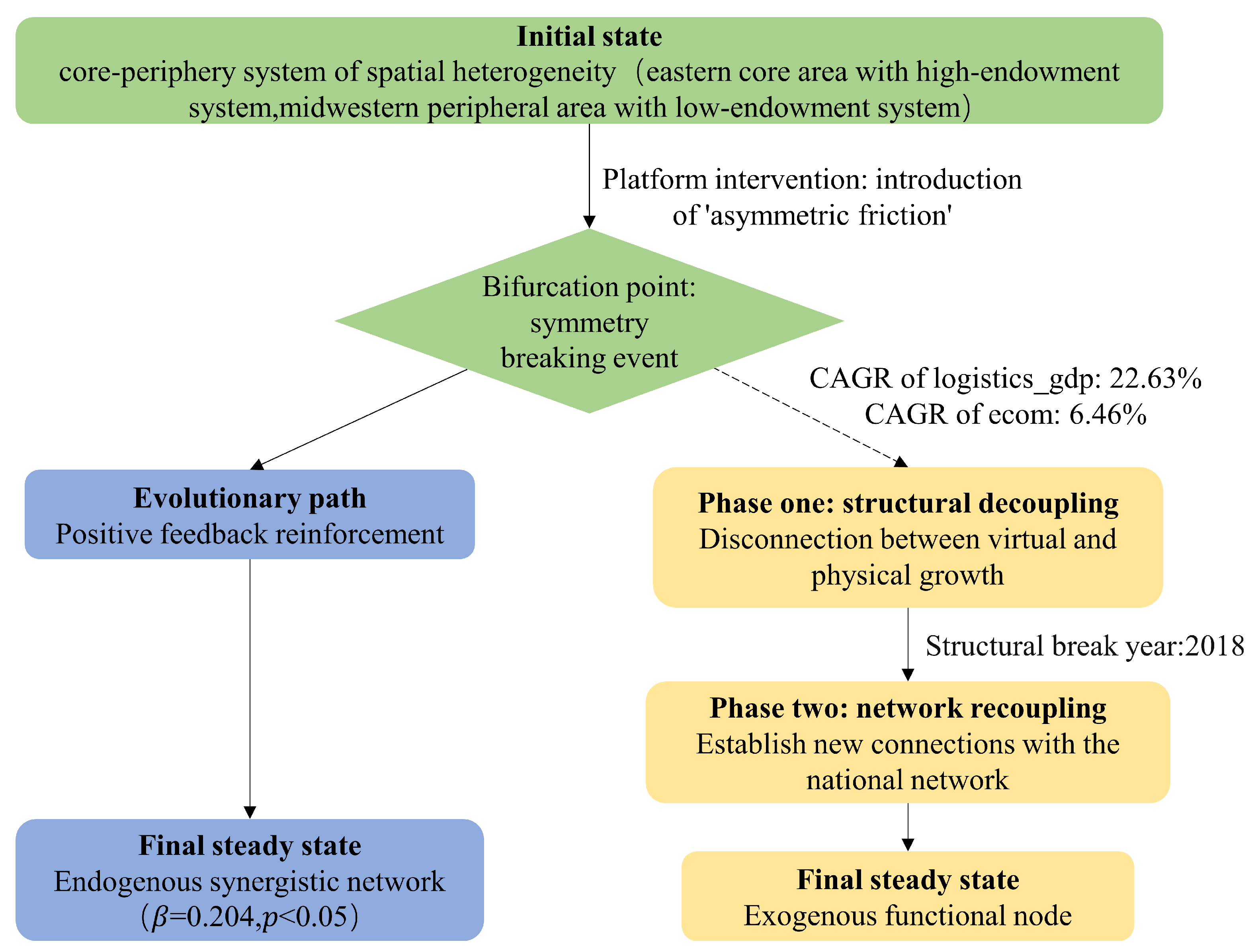
In response to the aforementioned research gaps, this section formulates a dynamic analytical framework (depicted in
Figure 1) to clarify the reasons and mechanisms behind path bifurcation in regional systems. Drawing on the framework, the study advances corresponding research hypotheses.
Figure 1 shows how platform governance can cause path bifurcation in different regions. The process starts with the platform acting as an outside governing body (the left side of the figure). The platform adds digital connectivity to the regional system, which creates a constant pressure of asymmetric frictions. This makes virtual transactions happen almost instantly, but physical logistics are still limited by geography.
The uniform external shock interacts with the different initial endowments of regional subsystems, causing a very important event called symmetry breaking. The system can no longer follow a consistent path of evolution. Instead, the development path splits into two different directions based on how much friction the region can handle.
For Core Regions (Eastern China), characterized by high density and mature infrastructure, the virtual and physical layers are able to reinforce each other. The surge in e-commerce demand is met with efficient local fulfillment, creating a virtuous cycle of positive feedback. This positive feedback leads to a state of Coupling and Synergy, where the region evolves into a self-reinforcing ecosystem.
Conversely, for Peripheral Regions (Central & Western China), the high physical friction cannot match the speed of the virtual layer. This phenomenon gives rise to a structural tension that severs the traditional connection between local consumption and local industry, with a transient state of structural decoupling emerging in its wake. However, as the system adapts, these regions do not simply decline. Instead, they undergo a functional transition, reorienting their logistics assets to serve the throughput needs of the national network rather than the local economy. It leads to a new equilibrium state of network recoupling, where the region functions as a specialized service node within the larger platform ecosystem.
3.1. Concept Definition: Systemic Functional Dependency
In order to explain SFD more clearly, a comparative table (
Table 1) is created to situate the concept in relation to existing theories (NEG—New Economic Geography, path dependency). This table systematically contrasts SFD with NEG and Path Dependency across four key dimensions: Core Mechanism, Spatial Dynamics, Role of Technology/Platform, and Equilibrium State.
3.2. Mechanism Asymmetric Frictions and Symmetry Breaking
It is contended that the solution to the aforementioned inquiries resides in discerning the essential mechanism introduced by the platform economy. Platform governance is defined as the core mechanism, functioning as an algorithmic governance entity that employs algorithmic rules and data-driven feedback loops to exert system-wide control. This control is widely used in advertising, search ranking, product recommendations, and price optimization [
31]. The introduction of asymmetric frictions into the system is what makes it unique. The platform’s technological architecture makes it almost impossible for transactions and information searches to have spatial friction. At the physical level, though, the cost of moving things around physically (i.e., spatial friction) is still very high. There are many steps in physical transportation, such as warehousing, line-haul, and distribution. Each step has its own costs. Last-mile delivery is widely recognized as the most resource-intensive and expensive segment of the logistics chain, often constituting the primary bottleneck in e-commerce fulfillment [
36,
37]. Also, returns of products, which are common in e-commerce, add to the costs. Reverse logistics is the process of sending goods back from the customer to the merchant or warehouse. This requires extra transportation and handling costs [
38].
To understand the spatial impact of platforms, it is necessary to revisit the concept of economic friction. In traditional economic geography, friction is generally modeled as a unified cost of distance-including both the cost of acquiring market information (transaction costs) and the cost of moving goods (transport costs).
However, it is argued that digital platforms introduce a mechanism of Asymmetric Frictions by decoupling these two dimensions. On the virtual layer, platform algorithms significantly reduce search, matching, and contracting frictions, creating a flat transaction environment with near-zero marginal costs. By integrating fragmented supply and demand information, platforms construct a closed-loop of data flows, thereby enabling precise allocation of network traffic [
39]. On the other hand, logistics activities are still limited on the physical layer by the tyranny of distance, which means that fuel, infrastructure, and last-mile delivery costs are very high. This imbalance, where virtual transactions go smoothly but physical fulfillment runs into a lot of problems, creates a structural tension that hits peripheral areas with weaker logistics resources the hardest.
When the uniform external intervention, characterized by asymmetric frictions, is applied to an already spatially heterogeneous system, a symmetric equilibrium—in which all regions evolve identically—is inherently unstable. The dynamics of the process can be comprehended through the analytical framework of symmetry breaking. The system’s existing core–periphery heterogeneity and the asymmetric frictions that drive it interact in such a way that they push the system toward a new, less symmetric stable state. This phenomenon is referred to as path bifurcation.
3.3. The Nonlinear Path of Decoupling–Recoupling
We introduce the mechanism of Asymmetric Friction to explain the causal chain of bifurcation. Digital platforms create a unique spatial duality: they reduce transaction costs to near-zero in the virtual layer (information flow) while physical friction remains high in the logistics layer (material flow).
The direction of the system’s evolution depends on the regional absorptive capacity [
40].
Core Regions (Synergistic Coupling): Due to high population density and mature industrial bases, core regions possess high absorptive capacity [
41]. They can match the high-velocity virtual demand with local physical production and efficient logistics. This creates a positive feedback loop [
42], leading to the hypothesis of synergistic coupling (H1a) [
43].
Peripheral Regions (Structural Decoupling): Conversely, peripheral regions suffer from supply-chain bottlenecks and low absorptive capacity. For instance, these areas have fewer resources to start with, such as not enough internet access [
44], logistics distribution systems that are not fully developed [
45], and rural e-commerce development that is not keeping up [
46]. The surge in platform-driven consumption cannot be met by local manufacturing, leading to a ‘leakage’ of demand to core regions. It is what is meant by asymmetrical friction [
47]. This dynamic aligns with the core–periphery concepts of structural dependency, where digital architectures enforce economic outflows rather than local development [
48,
49]. Consequently, local e-commerce growth fails to stimulate local freight growth, making structural decoupling logically inevitable (H1b).
Why do peripheral regions reorganize into functional nodes instead of facing continued decline? We ground this prediction in Dependency Theory and Multi-level Governance (MLG).
From a platform ecosystem perspective [
50], network value depends on ‘ubiquity.’ Platforms cannot afford to abandon peripheral markets; instead, they must integrate them as delivery endpoints. This creates a functional lock-in where peripheral regions are reorganized to serve the throughput needs of the national network Investments in standardized logistics infrastructure (e.g., cloud warehouses) represent high asset specificity [
51], effectively tethering the region to the platform’s architecture.
Furthermore, under the Multi-level Governance framework, this transition is reinforced by State-Platform interactions. National policies (such as the large-scale infrastructure investment [
52] and the construction of a unified domestic market [
53]; and the expansion of the platform network alongside the entrepreneurial behavior of local governments in the digital economy [
54]) provide the institutional incentives and infrastructure investment that stabilize this new role. Therefore, the shift to an exogenous functional service node is not a temporary adjustment but a systematic transition to a new stable equilibrium—Network Recoupling [
55]. This equilibrium is characterized by a high dependency on external network flows (express delivery) rather than local industrial output.
3.4. Research Hypotheses
Based on the theoretical deductions above, these predictions are translated into the following three core hypotheses to be empirically tested in this study:
Hypothesis 1a (Eastern Regions: Coupling and Synergy). Based on the ideas of positive feedback and path dependency, we hypothesize that the virtual-physical subsystem in core areas will show strong coupling and intra-regional synergy when the platform intervenes. It is anticipated that (i) the advancement of local e-commerce will substantially and favorably propel the expansion of the local logistics sector, and (ii) this trend will be bolstered by significant, positive spatial spillover effects within these core regions.
Hypothesis 1b (Central & Western Regions: Structural Decoupling). Based on the ideas of asymmetric frictions and symmetry breaking, it is hypothesized that the virtual-physical subsystem in peripheral areas will show structural decoupling in its early stages of evolution. The structural decoupling will show up as a statistically insignificant or weak positive link between the growth of the local e-commerce scale and the growth of the local logistics industry.
Hypothesis 2 (Central and Western Regions: Functional Transition and Network Re-coupling). Based on the principles of system adaptation and reorganization, this study further hypothesizes that the decoupled subsystems in peripheral regions will experience a functional transition. The change will turn them into specialized functional service nodes, which will let them network recouple with the higher-level national system. This will be empirically observable in two ways: (i) a functional shift in their logistics operations from servicing local scale to servicing network throughput; and (ii) the emergence of a significant positive correlation between their network function and the overall development of the national e-commerce system in subsequent evolutionary stages.
4. Research Design
4.1. Data Sources and Variable Descriptions
The empirical analysis for this study employs a balanced panel dataset encompassing 30 of mainland China’s provinces, autonomous regions, and municipalities, covering the period from 2013 to 2022 (Tibet, Hong Kong, Macau, and Taiwan are not included in the sample due to data unavailability.). The time frame fully captures how China’s platform economy has changed over time, from its rapid rise to its deep market penetration. The study obtained most of the data for the macroeconomic, logistics, e-commerce, and control variables from the China Statistical Yearbook, the China Tertiary Industry Statistical Yearbook, and individual provincial statistical yearbooks. This study also utilized public data from the State Post Bureau and the National Bureau of Statistics. To account for inflation, all variables that were measured in nominal monetary values were changed to real values using provincial-level GDP deflators (Base year = 2013).
A complete variable system was built to systematically test the hypotheses proposed in this study.
Table 2 gives a full list of the specific definitions, measurement methods, and data sources. The level of digitalization is assessed through a composite evaluation index derived from four dimensions: digital infrastructure, digital innovation, industrial digitalization, and digital industrialization. This indexing method is based on well-known research [
56].
Table 3 shows what the index is made up of and what it means.
4.2. Delimitation of System Boundaries
The study divides mainland China into two main subsystems, Eastern and Central/Western, to see if path bifurcation happens with different initial conditions. The Northeast region is part of the Central/Western subsystem. The difference is because it works better as a stand-in for China’s long-lasting core–periphery economic structure, which was shaped by historical path dependency. Structure is not only based on geography; it also shows that different systems have different levels of technology, market size, and infrastructure. This is directly linked to the distinct starting points outlined in the analytical framework. The descriptive statistics in
Section 5 will empirically validate this partitioning, demonstrating significant statistical differences between the two groups across all key economic variables and confirming their effectiveness as separate subsystems.
The analytical framework focusses on macro-regional path bifurcation, a phenomenon most effectively examined and substantiated at the provincial level. As a result, using panel data at the provincial level is the most important analytical framework needed to explain this systemic evolutionary logic. The objective of research is not to clarify the success or failure of specific urban nodes, but to reveal the inherent disparities in the systemic behavioral patterns of these entire regional systems in response to platform intervention.
4.3. Measurement of Functional Service Transition
The study formulates a measurement strategy to empirically evaluate the principal hypothesis of a functional node transition (H2), focusing on the structural divergence of logistics indicators. This approach aims to ascertain whether peripheral regions (Central and Western China) have experienced a functional role transition—from supporting the local economy to servicing the national network—through a comparative analysis of the growth dynamics of two distinct sets of logistics metrics. These two indicators stand in for two different ways the logistics industry can grow:
(1) Measurement of Network Function: The study uses Express Delivery Volume as a proxy variable for the dimension. This metric was chosen because it accurately measures only the number of packages being sent by e-commerce. So, it is a very accurate measure of how well a region is connected to the national consumption network and how much traffic it can handle [
57]. The growth rate of the variable indicates the growth intensity of the network function in the region.
(2) Measurement of Local Function: The local function is represented by freight volume. This metric primarily quantifies the aggregate physical transport of bulk commodities (e.g., coal, steel, agricultural products) utilized in local industrial and agricultural production. The other proxy suggests that the parcel economy underpinned by e-commerce may differ markedly from this one. It is a strong and traditional sign of how big the local economy is. So, its growth rate shows how well the local function in the area works.
The main idea behind the measurement strategy is that a functional service transition will show up as a big and long-lasting difference between the growth rates of these network- and local-function indicators. In particular, the empirical analysis in
Section 5 will examine the concurrent manifestation of two distinct trends in the Central and Western regions: a rapid increase in express delivery volume, contrasted with a relative stagnation in the growth of freight volume. If the structural divergence is corroborated, it would offer robust support for the notion that the primary impetus behind the regional logistics industry’s growth has transitioned from an endogenous, local-focused framework to an exogenous, network-supporting one.
4.4. Methodological Justification and Model Design
4.4.1. Methodological Justification: The Choice of the SLX Model
To empirically disentangle the complex interactions between digitalization and logistics development, the study adopts the Spatial Lag of X (SLX) model. While the Spatial Autoregressive (SAR) and Spatial Durbin (SDM) models are widely used, the study selects the SLX specification as the most appropriate identification strategy for the specific theoretical context, based on two fundamental considerations.
The first is theoretical coherence regarding local versus global spillovers. The systemic functional dependency framework asserts that platform governance allocates functional roles according to supply chain principles. This means that the e-commerce demand of core markets (
) affects the logistics capacity of peripheral nodes in one direction, rather than in a never-ending cycle of outcomes like global spillover models such as SAR/SDM. When it comes to physical logistics infrastructure, spillover effects are usually limited by transportation costs and do not go on forever throughout the whole national system. By defining local spillovers, the SLX model accurately represents this limited, functional connectivity without making unrealistic assumptions about global feedback [
58].
Second is Robust Identification. As critically noted by Gibbons and Overman [
59], spatial models containing endogenous interaction terms often suffer from weak identification due to the reflection problem. The SLX model completely avoids the identification problem by only using the spatial lags of exogenous explanatory variables. This makes sure that the estimates of regional spillover effects are accurate and reliable.
Interpretation of Coefficients: Consequently, the SLX specification allows for a transparent separation of effects:
The Local Effect (): The coefficient associated with the local variable (e.g., ) measures the intra-regional coupling. A significant positive validates Hypothesis 1a (Synergy), while an insignificant suggests Hypothesis 1b (Decoupling).
The Spatial Spillover Effect (): The coefficient associated with the spatially lagged variable () measures the cross-regional dependency. A significant positive provides strong support for Hypothesis 2, suggesting that the region’s logistics growth may be exogenously shaped by the demand of its neighbors.
4.4.2. Model Design
The study develops a series of econometric models to empirically validate the research hypotheses posited in it. Initially, the Panel Fixed-Effects (FE) Model is utilized as the foundational analytical framework for the study. The model is chosen for its ability to efficiently manage time-invariant, province-level individual heterogeneity, including fixed geographical factors or cultural traditions. The fixed-effects approach enables a more accurate identification of the relationships among the core variables by neutralizing these unobserved confounding factors.
The baseline model is specified as follows:
where
and
represent province and year, respectively. The dependent variable,
, is the natural logarithm of the logistics industry’s value-added. The core explanatory variable,
, is the natural logarithm of e-commerce transaction value.
represents a vector of control variables, including GDP per capita, industrial structure, and the level of digitalization.
denotes province-level fixed effects,
represents year-level fixed effects, and
is the stochastic error term.
Nevertheless, as demonstrated in
Section 5.1, the outcomes from the spatial auto-correlation test (Moran’s I) concerning the development of China’s logistics industry indicate a significant positive spatial clustering effect. The finding suggests that the logistics development of a province is affected by its neighboring provinces; they do not operate in isolation. In this situation, a standard panel model that does not take into account spatial dependencies is likely to give wrong estimates.
The study utilizes the Spatial Lag of X (SLX) model as its primary analytical instrument to accurately capture inter-regional interactions and evaluate the hypotheses regarding different development models. The SLX model can directly measure the spillover effects of economic activities from neighboring regions onto the local region by adding spatially lagged terms of the explanatory variables. The SLX specification is methodologically superior for this study as it avoids the known endogeneity problems that come with Spatial Autoregressive (SAR) or Spatial Durbin (SDM) models, which have a spatial lag of the dependent variable (). This guarantees that the test results for two separate development models are impartial, resilient, and easily comprehensible. It is essential to recognize that the aim of the research is not to accurately quantify the causal elasticity of e-commerce on logistics growth, given that macro-variables may demonstrate bidirectional causality. The primary objective of utilizing the SLX model is to evaluate the theoretical hypothesis of path bifurcation by analyzing the structural variations in relational patterns across distinct regional subsystems. So, the model’s validation depends on the coefficients’ significance and sign, which show these systemic patterns, not on the coefficients’ exact size.
The empirical strategy aims to systematically evaluate the two divergent evolutionary trajectories through the framework of exclusionary inference. The main goal of strategy is to give strong but indirect support for main theory, which says that the Central and Western regions have recoupled to the national core network. This is done by using econometrics to reject the most common alternative hypothesis: that their growth is shaped by local and neighborhood markets.
In this strategy, the spatial weight matrix (W) constructed using the first-order Queen contiguity criterion, serves two purposes. For the Eastern region, it directly tests the intra-regional synergy hypothesis (H1a). It serves as an important falsifier for the Central and Western regions. The fundamental hypothesis (H2) posits that the growth dynamic for the Central and Western regions is exogenous. Consequently, if the SLX model indicates that both local and neighborhood spillover effects are statistically insignificant, this would represent a robust refutation of the local and neighborhood dependency hypothesis. The econometric finding, along with the descriptive evidence of functional transition and network recoupling from
Section 5.3, creates a clear logical framework. It shows that the exogenous functional service node is the best theory to explain all the empirical phenomena that have been seen.
The final SLX model utilized to test the core ideas is specified as follows:
Here, represents a standardized spatial weights matrix. The term constitutes the spatial lag of the core explanatory variable, quantifying the average level of e-commerce development in all geographically contiguous provinces. Consequently, the coefficient quantifies the local effect, while assesses the associated spatial spillover effect from core variable.
The model will be estimated separately for the Eastern and Central/Western sub-samples. This stratified methodology aims to empirically validate hypotheses concerning the two fundamentally divergent systemic pathways.
5. Empirical Results and Analysis
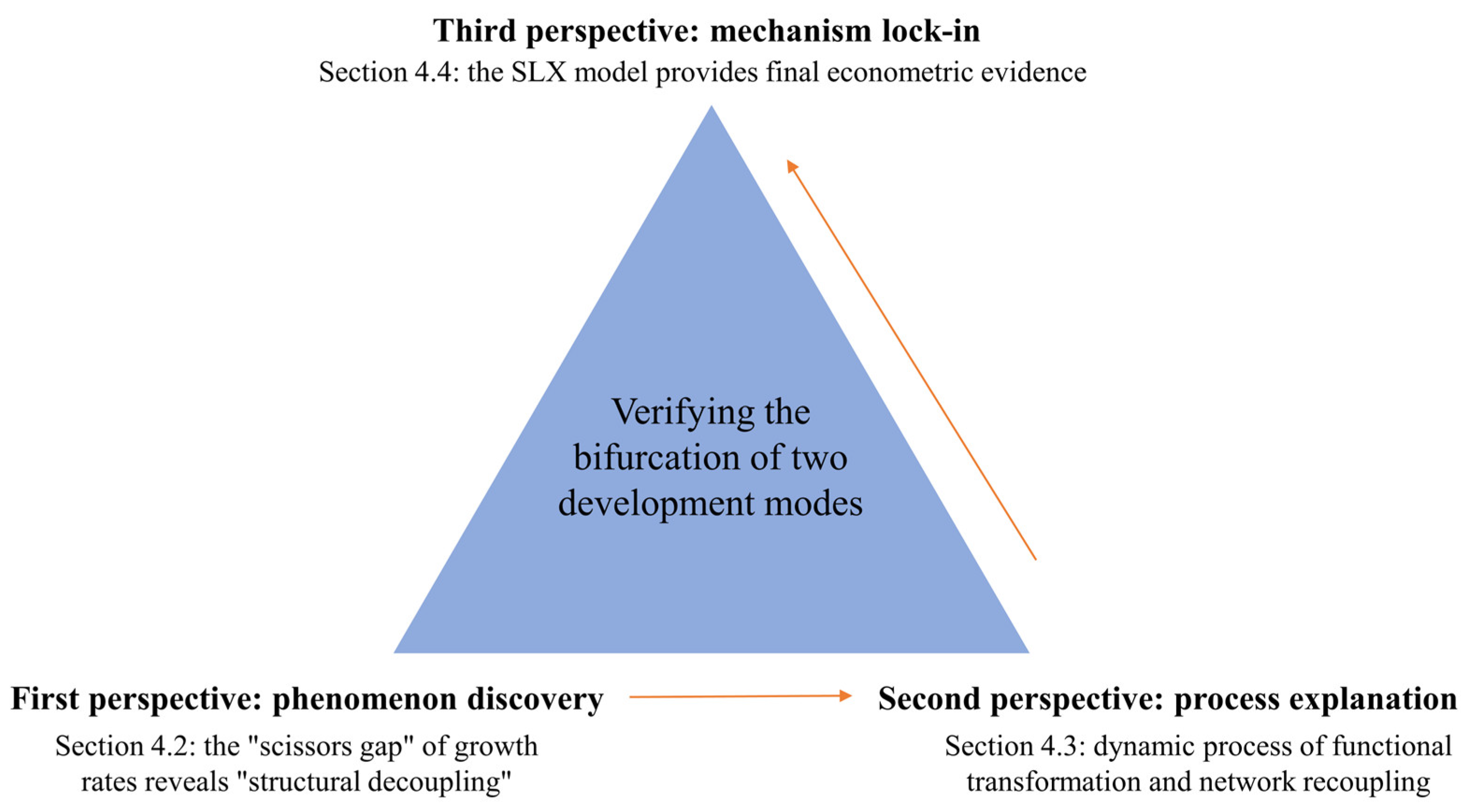
The empirical demonstration in this chapter adheres to a logical triangulation evidentiary framework (illustrated in
Figure 2). The framework seeks to elucidate the two distinct development models through a progressive, three-dimensional, and mutually reinforcing methodology, advancing from phenomenon discovery to process explanation and ultimately culminating in mechanism pinpointing.
In
Section 5.2, the study identifies the primary empirical conundrum—the local decoupling in the Central and Western regions—by analyzing the significant growth gap disparity in critical growth rates. Second (
Section 5.3), The dynamic process of functional service transition and network recoupling is validated by analyzing the divergence of functional indicators, conducting structural break tests, and examining sudden changes in systemic correlations. Finally (
Section 5.4), the study utilizes the SLX spatial econometric model to provide the conclusive and most robust econometric evidence, thereby securing the distinct underlying mechanisms that regulate these two divergent trajectories.
5.1. Descriptive Statistics and Spatial Pattern Analysis
Before conducting rigorous tests of the study’s core ideas, it is necessary to first present a large-scale characterization of the basic spatial layout of China’s e-commerce–logistics coupled system. The first step also helps to prove the reasoning behind using the Eastern-Central/Western divide as the study’s systemic boundary, which was explained in
Section 4.2.
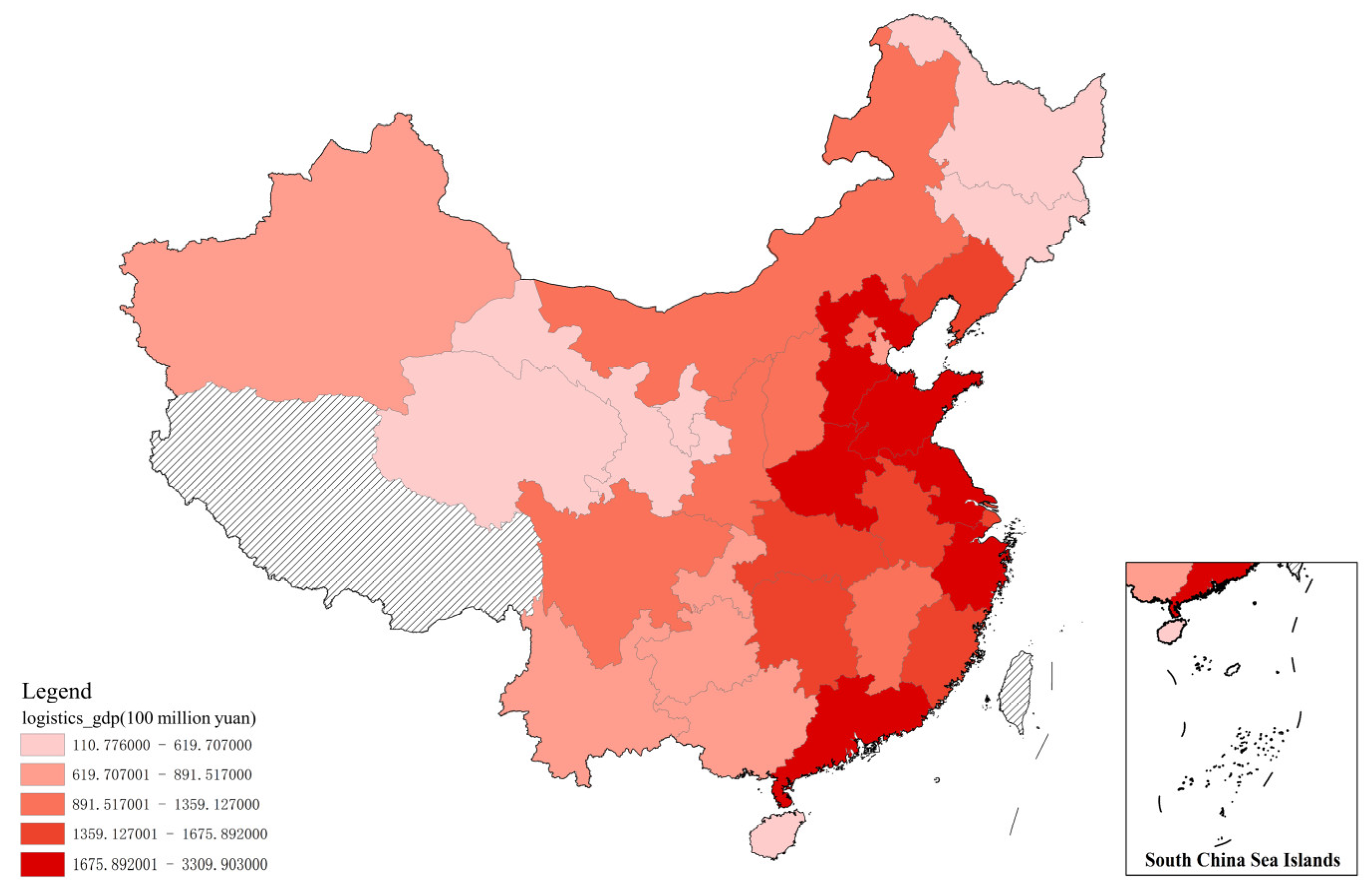
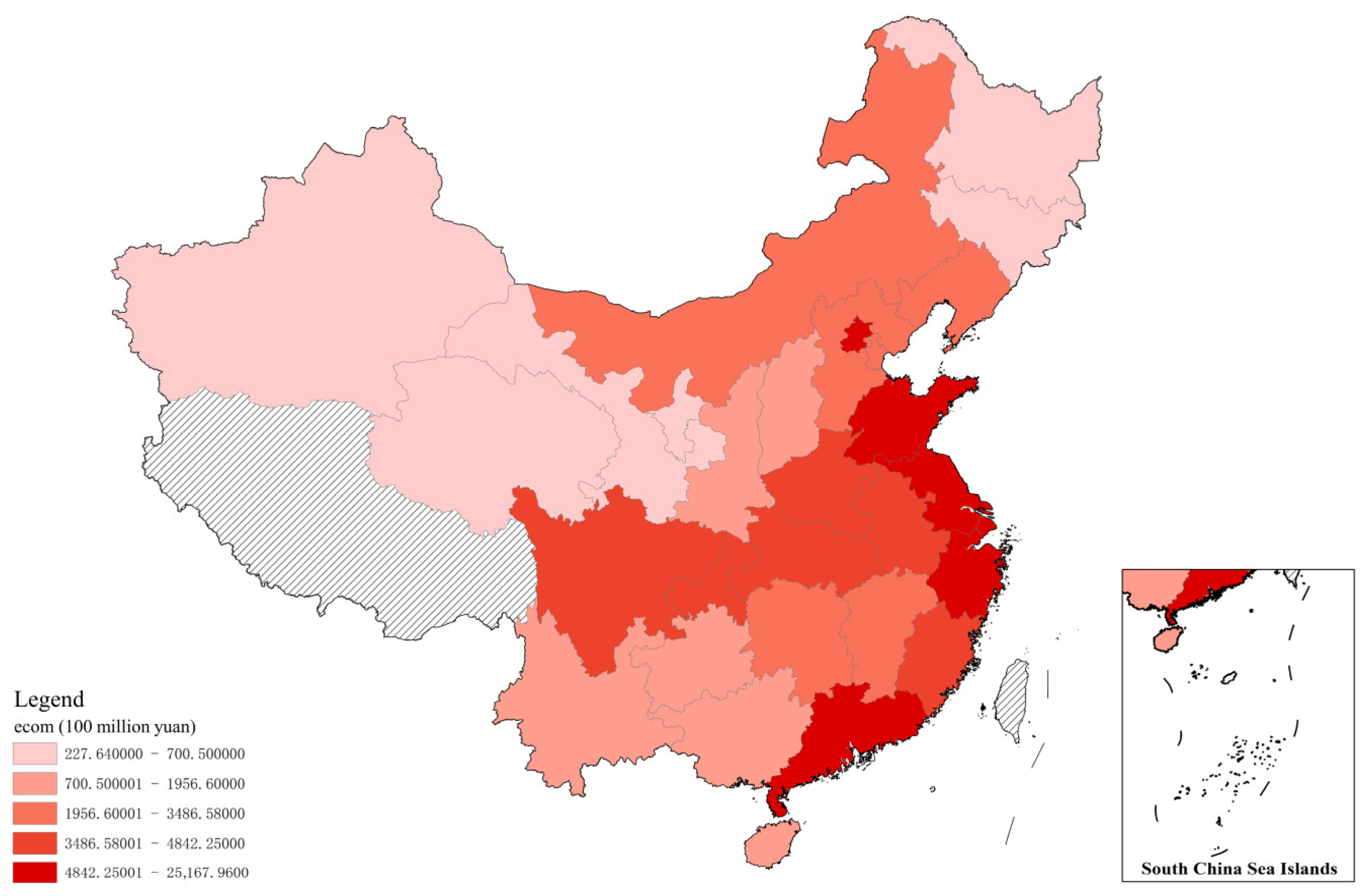
First, maps depicting the national spatial distribution of
and
were developed (
Figure 3 and
Figure 4). These maps show that China’s logistics and e-commerce sectors are growing in very different ways in different parts of the country. This heterogeneity manifests as a clear core–periphery structure, with a lot of activity in the Eastern core and less activity in the Central and Western periphery.
To statistically substantiate the spatial clustering phenomenon, a spatial autocorrelation test was performed on the provincial-level development of the logistics industry.
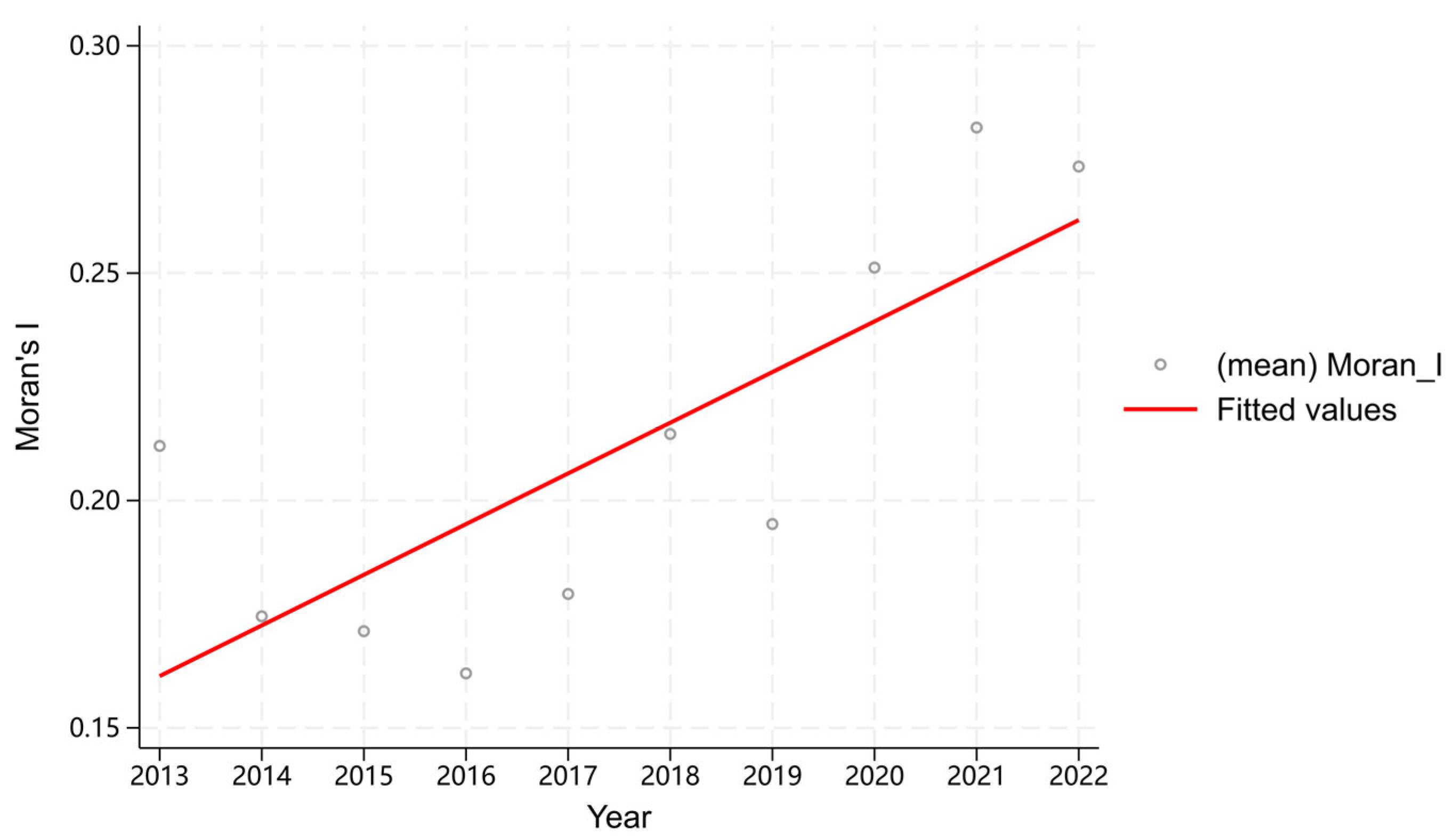
Figure 5 shows that the scatter points represent the actual annual values of Moran’s I, and the red line shows its linear fitting trend. The national Moran’s I for logistics development stayed significantly positive throughout the entire 2013–2022 sample period, with an annual average value of 0.21. The expected value is E(I) = −1/(N − 1) based on the null hypothesis that there is no spatial autocorrelation. For the sample of N = 30, this anticipated value is roughly −0.034. The findings indicate that the development of China’s logistics industry is not a series of spatially random, isolated events. Instead, it shows a strong spatial clustering effect, where the logistics development of one area is clearly affected by that of its neighbors. Notably, the Moran’s I statistic has been going up since 2018. This indicates that inter-regional connections and synergies might be strengthening as the platform economy matures. The finding provides the methodological justification for the use of spatial econometric models (
Section 4.4), which are made to show these kinds of spillover effects.
Next, descriptive statistics for the main variables are presented, divided into the Eastern and Central/Western subsystems.
Table 4 shows the results, which show that there are systemic and, in some cases, substantial differences between the two blocs on almost all key dimensions. The Eastern region has significantly higher average levels of economic development (
), virtual system scale (
), and physical system scale (
). Also, the
p-values for these two-sample t-tests with equal variances are all very close to zero (
Table 5), which is much lower than the 0.05 level of significance. This shows that the means of the Eastern and Central/Western regions are very different from each other for every variable being looked at.
The substantial spatial dependence revealed by the Moran’s I analysis, along with the pronounced regional heterogeneity illustrated in the descriptive statistics, furnish compelling empirical justification for the systemic boundary delineation (Eastern vs. Central/Western) established in
Section 4.2. The body of evidence substantiates that the analysis is examining two distinct subsystems, each characterized by unique initial conditions and consequently governed by different evolutionary principles.
5.2. Analysis of Growth Rate Differences Among Core Variables
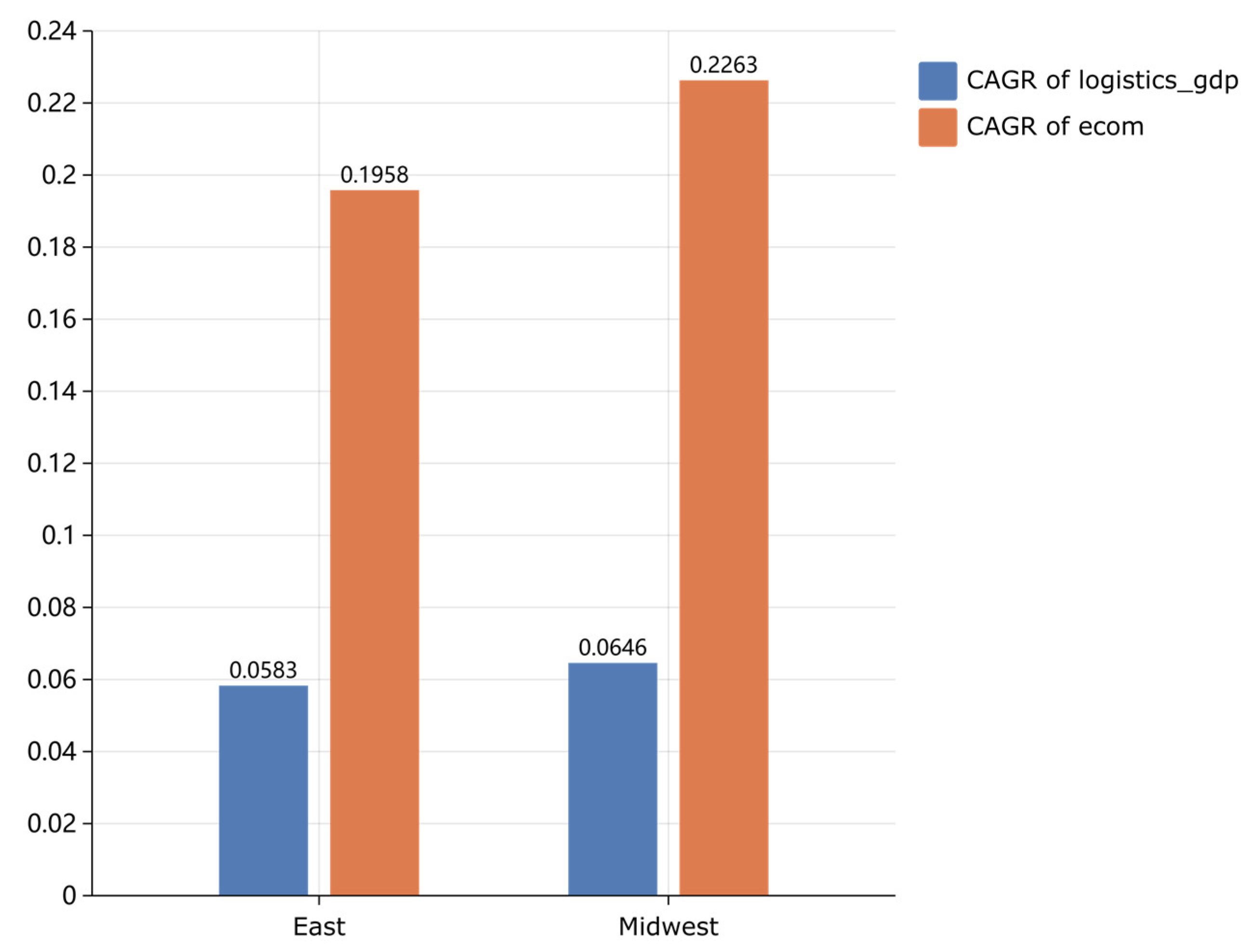
This section seeks to elucidate and empirically substantiate the principal inquiry of the research: the structural decoupling encountered by the Central and Western regions due to the platform economy, as anticipated by Hypothesis H1b. To quantify and visualize the phenomenon, a comparative analysis of the Compound Annual Growth Rates (CAGR) of core variables between the Eastern and Central/Western subsystems for the 2013–2022 period is performed.
Figure 6 provides a compelling visualization of the central puzzle. The four main pieces of information shown there form a logically sound chain of evidence that provides a strong descriptive basis for the systematic testing of main hypotheses.
The figure shows that the CAGR for e-commerce () and logistics value-added () in the Eastern region were 19.58% and 5.83%, respectively. The numbers for the Central and Western regions were 22.63% and 6.46%, respectively.
First, on a larger scale, the data backs up the idea that asymmetric frictions have an effect everywhere. The theoretical foundation of the study asserts that, although the platform economy significantly mitigates virtual transaction friction, physical logistics friction continues to be markedly elevated.
Figure 6 makes this very clear: the e-commerce CAGR (19.58% and 22.63%, respectively) is much higher than the local logistics CAGR (5.83% and 6.46%) in both the Eastern and the Central/Western regions. The finding lends support to the view that asymmetric friction is not a regional anomaly, but rather a pervasive force that the platform economy exerts across the entire national economic system. The direct result is that the virtual economy grows faster than the real economy.
Second, the data shows how much structural tension each regional system has to deal with. The most obvious way this tension shows up is in the difference in growth rates, or growth gap, between the virtual and physical economies. The gap is calculated as follows:
The finding of this section: the Central/Western regions (16.17%) have a much bigger internal growth imbalance—the structural tension—than the Eastern regions (13.75%).
In the end, the interaction between the structural tension and the system’s initial endowments gives rise to path bifurcation. Systems theory and path dependency say that how a system reacts to an outside shock depends on its initial conditions and internal structure. The initial conditions of a system, encompassing its developmental inception, resource distribution, and preliminary technological choices, are pivotal in shaping its future trajectory [
60]. In turn, the internal structure decides how the system can deal with and process these shocks [
61]. The Eastern core is a high-endowment system that has been built up over time through path dependency. It has mature market networks, a lot of logistics infrastructure, and a high level of industrial integration. As a result, the system is more resilient and can take in more information [
62]. Even though the 13.75-percentage-point of structural tension is high for Eastern subsystem, it is still within its structural carrying capacity. The system can handle stress by making changes to its internal parts, which keeps the connection between its virtual and physical parts strong.
The Central and Western peripheral zone, on the other hand, has a logistics infrastructure and industrial support system that is not very strong at first, so it can only carry a limited amount of goods. When a higher structural tension (16.17%) is applied to system, the stress surpasses its internal threshold for adjustment and absorption. The inevitable result is the breakdown of the system’s original stable state. In other words, the rapid growth of local e-commerce can no longer effectively and proportionately shape the growth of the local logistics industry. The coupling relationship that connects them disintegrates. In systems science, this is known as a phase transition, which is a qualitative change brought about by an outside force.
Consequently, the substantial growth gap illustrated in
Figure 6 serves as a principal and persuasive piece of evidence for the disintegration of the e-commerce–logistics linkage in the Central and Western regions. It is concluded that the peripheral regions (Central/West), with their weaker endowments, could not handle the structural pressure because of the asymmetric frictions of the platform economy. As a result, their internal systems went through a structural decoupling of the virtual and physical subsystems in the early stages of their development.
5.3. Analysis of Functional Transformation and Network Recoupling
The local decoupling phenomenon discussed in
Section 5.2 prompts a more profound inquiry: If local e-commerce is not driving the growth of the logistics industry in the Central and Western regions, what is? This section methodically evaluates Hypothesis H2, which asserts that these regions are experiencing a functional service transition—shifting from serving the local economy to servicing the national network—and ultimately attaining a network recoupling with the higher-tier system. Accordingly, a triangulated chain of evidence is employed.
5.3.1. Analysis of Growth Rates of Functional Logistics Indicators
For the identification of functional service transition, the study adheres to the operationalization strategy specified in
Section 4.3, and analyzes the growth dynamics of three distinct categories of logistics indicators:
(1) Freight Volume: This is a traditional way to measure the size of the local and regional real economy by looking at the total physical movement of bulk goods. (2) Freight Turnover: The number is the product of freight volume and transport distance. It better shows the logistics network’s long-haul transport and throughput functions. (3) Express Delivery Volume: The number accurately reflects the parcel economy that e-commerce has created. It is also a good way to tell how well a region is connected to the national consumption network.
It is crucial to distinguish that Freight Volume primarily proxies for the scale of the local industrial economy (internal metabolism), reflecting the physical output of local production. In contrast, Express Delivery Volume proxies for the function of network throughput (external connectivity), reflecting the region’s capacity to process flows generated by the external national platform. The widening gap between these two indicators signifies a fundamental shift in the region’s systemic role, not merely a difference in growth rates.
Table 6 shows that the Compound Annual Growth Rates (CAGR) of these three indicator categories are very different in the Central and Western regions. This divergence provides twofold evidence for the proposed functional transition.
Table 6 clearly reveals a dual signal:
(1) The traditional logistics system is not growing. From 2013 to 2022, the CAGR for freight volume and freight turnover in the Central and Western regions was only 2.44% and 2.30%, respectively. The 22.63% e-commerce CAGR seen in
Section 5.2 is very different from this very slow growth, which is even negative in some provinces. This phenomenon strongly suggests that the rise in local e-commerce consumption did not lead to an increase in traditional logistics demand, which serves local industrial and agricultural production. This is a direct example of local decoupling at the level of physical circulation.
(2) The parcel economy system is growing very quickly. The CAGR for express delivery volume in the Central and Western regions was an amazing 32.21%, which is very different from the stagnation of traditional logistics. The notable difference in order of magnitude suggests that a new, relatively independent growth impetus may have emerged, operating with a certain degree of independence from the traditional freight system.
The significant disparity illustrated in
Table 6 empirically substantiates the dual signal hypothesis posited in
Section 4.3. The first sign is that the parcel economy system is growing very quickly (the CAGR for express delivery is 32.21%). This growth shows that the Central and Western regions are now fully connected to the national e-commerce network and that new growth is happening. The second signal is that the traditional logistics system is not growing either (CAGR for freight volume and freight turnover is only 2.44% and 2.30%, respectively). This clearly shows that the growth of the traditional system is no longer linked to the local economy.
These two signals together provide the strongest proof of the functional service transition. The logistics industry in the Central and Western regions has seen a major change in the way it grows. Its growth is no longer dependent on the internal growth of the local real economy. Instead, it stems from the huge amount of data that these areas now send and receive as functional service nodes in the national e-commerce parcel network. This constitutes the initial substantial evidence corroborating primary hypothesis, H2.
5.3.2. Structural Break Test
If the systemic functional transition mentioned above did happen, a significant structural break should be detectable in the time-series data. This break would mark a pivotal juncture at which the system’s evolutionary logic underwent a fundamental transformation.
To examine the corollary, a theory-driven validation approach is utilized. 2018 is first selected as the proposed break-point based on a broad look at China’s platform economy and logistics sector. This decision was not based on any previous data. Instead, it was based on the overlap of a few big changes at the macro level: (1) Market Maturation: The years around 2018 were a key turning point for China’s e-commerce market. It went from a time of rapid growth to a time of slower, steadier growth. (2) Changes to infrastructure: This is when most of the work on the smart logistics backbone was done, thanks to networks like Cainiao. (3) How well policies work: Around 2018, important national policies like bringing e-commerce to rural areas and fast delivery to the countryside started to have a big and measurable effect.
The choice of 2018 as a structural turning point is not random; it fits perfectly with the time frame for fully implementing national-level logistics plans like the China-Europe Railway Express and the New Western Land–Sea Corridor. While data-driven tests for multiple breaks (such as the Bai-Perron test) allow for endogenous determination of breakpoints, we employ the Chow Test here to specifically verify the impact of the theoretically identified exogenous shock in the 2017–2018 period. This alignment reveals a more profound mechanism of systemic transformation. The theory does not assert that platforms are the exclusive catalyst. It is contended that state-level strategy constituted the fundamental infrastructure framework and institutional assurances for the peripheral regions’ functional service transition, thereby facilitating the potential for transformation. The platform’s internal market network and algorithmic logic took advantage of this chance by leveraging the framework with real commercial and data flows. This platform-driven activation coincided with the formation of the transition’s specific functional form, one centered on serving the national network. Consequently, the observed structural break is the outcome of a phase transition, a synergistic convergence of top-down state design and market-driven platform forces at a particular temporal moment.
After theory-driven identification, using Chow Test to formally test the 2018 structural break hypothesis. The test is implemented by developing a panel fixed-effects model that includes a break-point dummy variable (post2018, coded as 1 for 2018 and all subsequent years) and, importantly, its interaction terms with all explanatory variables. A joint significance F-test is subsequently conducted on the full array of interaction terms.
Table 7 shows that the F-statistic is 2.15 and the
p-value is 0.0763. The finding enables us to dismiss the null hypothesis of no structural change in model coefficients before and after 2018 at the 10% significance level. The offers strong statistical proof that 2018 was an important structural break-point.
The regression coefficients in
Table 7 give a more detailed explanation of structural change, giving two different types of micro-level evidence for the functional transition.
First, it is clear that the main factors that drive growth have changed. The coefficient for before 2018 is 0.974 and very important (p < 0.01). This means that the traditional, local economy was mostly responsible for the growth of the logistics sector in the Central and Western regions at that time. After 2018, though, the interaction term has a very negative coefficient (−0.296, p < 0.1). This shows that the traditional local economic growth had a much weaker effect on the logistics sector after the break.
Second, the connection with local e-commerce changed in a big way. Before 2018, the coefficient for the local e-commerce scale () was −0.076, which was statistically significant (p < 0.05). The negative correlation is very telling because it shows how complicated the local decoupling phenomenon is. It indicates that during the initial phase of evolution, the rapid expansion of local e-commerce may have had a resource-competitive or substitutive impact on the local logistics sector (assessed at the value-added level). The interaction term is significantly positive at 0.067 (p < 0.1) after 2018. This indicates a structural moderation of the pre-existing negative correlation. The total post-break effect (a combined coefficient of −0.009) shows that the relationship is no longer significantly negative. This change sends a clear message: after 2018, the Central and Western logistics industry began to break free from complicated and possibly hostile early relationship with local e-commerce. Its growth logic started to follow a path that was functionally independent.
To further validate the theoretically chosen breakpoint of 2018, we conducted a robustness check using the Bai-Perron test to allow for the endogenous determination of structural breaks. It is important to note that the rigorous implementation of the Bai-Perron test in a panel setting requires sufficient time-series length to estimate coefficients for multiple regimes. Because the time dimension of our dataset is limited to T = 10, estimating the full model with all control variables would use up all the degrees of freedom. Consequently, we employed a parsimonious specification centered on the study’s fundamental explanatory framework: the correlation between regional logistics growth () and e-commerce scale ().
The test results show a very important structural break (supF = 25.37, which is higher than the 1% critical value of 11.44), and the break date is thought to be in 2017. This statistical finding strongly supports our theoretical framework. In the context of systemic functional transitions, statistical signals often emerge in the initiation phase immediately preceding the full establishment of a new functional order. The detection of a break in 2017 captures the onset of the divergence in the developmental trajectory, serving as the statistical precursor to the comprehensive functional transformation that solidified in 2018. Consequently, the endogenous evidence supports the validity of treating the 2017–2018 period as the critical juncture for the system’s structural evolution.
In short, the results of the structural break analysis show that the logistics industry in the Central and Western regions went through a major, systemic change in how it worked around 2018. Its growth drivers are no longer primarily dependent on the scale of the local economy, and its relationship with local e-commerce has been structurally altered. The finding provides the second line of strong econometric evidence for the main point of the study: that the Central and Western regions are becoming functional service nodes that help the national network.
5.3.3. Correlation Analysis Before and After the Breakpoint
The evidence from the previous sections has demonstrated that the Central and Western regions have experienced both local decoupling and a functional transition. This section’s correlation analysis is meant to back up the last step in the evolutionary path, which is network recoupling.
Correlation does not inherently prove causation; however, it can indicate a significant systemic transformation: specifically, whether the operational patterns of the Central and Western logistics system, having separated from its local economic foundation, has begun to align with the overarching dynamics of the national digital economy. The occurrence of such synchronicity would provide an essential connection in the logical framework underpinning the recoupling hypothesis.
To evaluate this hypothesis, the progression of the Pearson correlation coefficient between the logistics function indicators of the Central and Western regions and the national aggregate e-commerce transaction value is analyzed, with a contrast made between the intervals before and after the structural break. Express Delivery Volume is selected as the priority indicator. This is because it is the most direct and sensitive physical sign of e-commerce activity, making it the best way to measure how well the parcel economy network is connected.
As shown in
Table 8, the analysis shows a marked increase from a weak statistical correlation to a state of high synchronicity. This change happens around 2017.
The discovery provides substantial, threefold evidence for network recoupling: First, there was already a positive link between the two groups from 2013 to 2016 (r = 0.9164, p = 0.0836). This means that the parcel flow in the Central and Western regions was, as expected, affected by the larger national e-commerce scene because it is an important part of the national market.
Second, there was a big change in quality after 2017. The correlation coefficient not only increased to 0.9466, but more importantly, its statistical significance rose from a low level (p = 0.0836) to a high level (p = 0.0042). The sudden change—from a weak link to a strong link—gives a clear quantitative sign that network recoupling has begun. It shows that after the decoupling and functional transition, the logistics system in the Central and Western regions was able to successfully integrate itself into the national digital economy. Its developmental dynamics started to align with the national virtual economic system.
Third, the data-driven identification of the 2017 break point gives us a better understanding of the theory. The timing is interpreted as follows: Express delivery volume was the first to show the structural change in 2017. This is because it is the most sensitive leading indicator in the logistics sector to changes in the e-commerce market and smart logistics networks. That year, the smart logistics backbone’s most important nodes, like Cainiao Network, started to have a big effect on operations. This was like an advanced deployment that got the system ready for the big changes in the market and policies that would happen in the following year (2018). Because of this, 2017 can be thought of as the start year of the change in function. The 2018 breakpoint referenced in
Section 5.3.2 can reasonably be interpreted as the year of validation. This is when the full effects of the transition became clear in broader, slower-moving macroeconomic indicators like
.
To further validate the finding, the analysis is replicated using the broader freight turnover indicator.
Table 9 shows that the results follow a similar pattern. After its own break-point in 2019, the correlation also shows a strong upward trend, with the coefficient jumping from 0.6540 to 0.9016, which is significant at the 10% level. The analysis offers supplementary validation for the principal conclusion concerning network recoupling.
In summary, the evidence presented in
Section 5.3—the divergence of functional indicators, the identification of a structural break, and the marked shift in systemic correlation—together constitute a complete evidentiary triangle. This triangulation clearly shows and backs up Hypothesis H2: that the Central and Western regions have gone through a full, nonlinear evolution of decoupling—functional transition—network recoupling.
5.4. Spatial Econometric Model Results
To explore inter-regional synergies and dependencies in greater depth and uncover the underlying mechanisms of the two different development models, the Spatial Lag of X (SLX) spatial econometric model is employed. The model is beneficial because it enables the concurrent estimation of the direct impact of local e-commerce development () and the spatial spillover effects () arising from nearby regions.
5.4.1. Eastern Model: Collaborative Development-Oriented Regional Network
Column (1) of
Table 10 presents the SLX model regression results for the Eastern region sub-sample.
The results are clear: Local Effect (): At the 5% level (p = 0.022), the coefficient for the local e-commerce variable is 0.204, which is very important. This coefficient shows that there is a strong local coupling in economic terms. This finding demonstrates that in the Eastern regions, the expansion of the virtual economy (e-commerce) is effectively integrated and transformed by the efficient local physical economy (logistics). This creates a strong positive synergy between the two systems, which strongly supports the recoupling feature of the path.
Spatial Spillover Effect (): The coefficient for the spatially lagged e-commerce variable, which shows how neighboring areas affect the outcome, is also positive and statistically significant (coefficient = 0.152, p = 0.048). This is arguably a more significant finding. The result indicates a robust regional synergy effect, signifying that the Eastern provinces are not experiencing independent growth. Instead, they have built a network that helps each other. E-commerce’s success in one province may shape the growth of the logistics industry in nearby provinces, likely through shared supply chains and integrated logistics networks.
This statistically significant dual-positive finding—encompassing both local coupling and regional spillovers—provides strong support for Hypothesis H1a. It shows that the Eastern core region has really become an endogenous synergistic regional network, which is one with strong internal connections and important, positive connections between regions.
5.4.2. Central and Western Model: Formation of Exogenous Functional Service Nodes
The developmental logic of the Central and Western regions necessitates a multi-dimensional evidentiary framework for comprehensive understanding, in stark contrast to the Eastern region. Two key pieces of evidence have been established: First (Evidence A), the comparative growth rate analysis in
Section 5.2 (
Figure 6) visually illustrated the growth gap between the virtual economy and the growth of the local physical economy. This is the clearest macroeconomic proof of structural decoupling. Second (Evidence B), the examination of the functional transition in
Section 5.3 (
Table 6) demonstrated—via the pronounced divergence of freight volume, freight turnover, and express delivery volume—that the Central/Western logistics system is transitioning from a local-servicing to a national-servicing model.
The SLX model in this section is meant to add to this base by providing the third and most rigorous line of econometric evidence (Evidence C). Its main goal is to use statistics to test the local and neighborhood dependency hypothesis and then reject it. In
Table 10, column (2) shows the regression results for the Central and Western sub-sample:
Local Effect (): The coefficient for the scale of local e-commerce is not statistically different from zero (coefficient = −0.064, p = 0.402).
The coefficient for e-commerce scale in nearby areas is also not significant (coefficient = −0.016, p = 0.807).
These strongly insignificant results fit perfectly with the macroeconomic growth trends and functional transition signals presented in
Section 5.2 and
Section 5.3. They collectively form the multi-dimensional evidentiary framework that discredits the local dependency hypothesis. The insignificant coefficient on
serves as an econometric reaffirmation of structural decoupling. The insignificant coefficient on
simultaneously eliminates the possibility that their growth dynamic stems from geographically adjacent neighbors.
It must be reiterated, as methodologically delineated in
Section 4.4, that an SLX model based on a geographic contiguity matrix cannot directly assess long-distance functional connectivity. By systematically excluding the driving forces of both local and neighborhood markets, and by synthesizing this null finding with the substantial antecedent evidence (from
Section 5.3.3) that suggests a functional recoupling to the national network, the theoretical hypothesis of the exogenous functional service node emerges as the most parsimonious—and indeed the only—logically coherent framework that can clarify all these empirical phenomena.
Consequently, the results from the SLX model constitute an essential, pivotal element in the comprehensive chain of evidence. They provide strong evidence that the growth dynamic driving the logistics industry in the Central and Western regions is both external and national.
5.4.3. Considering Endogeneity: Dynamic Panel GMM Estimation
Although our fixed effects and SLX models control for time-invariant heterogeneity, two concerns remain: the potential endogeneity arising from bidirectional causality between e-commerce and logistics, and the dynamic panel bias (Nickell bias) inherent in short-T panels (T = 10). To address this, we employ the Dynamic Panel Generalized Method of Moments (GMM) approach.
Robustness Evidence for Central/Western Regions: Difference GMM For the Central/Western sample (N = 20, T = 10), we utilized the Arellano-Bond Difference GMM estimator. To avoid finite sample bias caused by instrument proliferation, we used the ‘collapse’ option to condense the instrument matrix. As shown in
Table 11, the model passed the AR (2) test (
) and Hansen tests (
) for validity. Crucially, while the lagged dependent variable (
) is significant (0.842,
p < 0.05), confirming dynamic inertia, the coefficient for local e-commerce (
) remains statistically insignificant (−0.068,
p = 0.48). Since the difference GMM estimator effectively controls for endogeneity, this lack of significance provides robust, instrument-based evidence reaffirming the local decoupling hypothesis (H1b), suggesting that the link between e-commerce and logistics growth has weakened in this region.
The Eastern Region: Distinct from the Difference GMM approach employed for the Central and Western regions, we retain the Fixed Effects (FE) estimator reported in the baseline results as the preferred specification for the Eastern region subsample. This methodological decision is rigorously justified by two specific econometric characteristics of the data.
First, Sample Size Constraints. The Eastern subsample consists of only 10 cross-sectional units (N = 10). It is well-established in the econometric literature that Dynamic GMM estimators rely on large-N asymptotics. In settings where N is extremely small, GMM estimators suffer from severe finite sample bias and unreliable instrument validity due to instrument proliferation [
63]. Consequently, enforcing a GMM specification on this subsample would lead to overfitting and invalid estimates.
Second, Unit Root Properties and Super-consistency. To validate the robustness of the FE estimator, we examined the time-series properties of the variables using both the Levin-Lin-Chu (LLC) and Im-Pesaran-Shin (IPS) tests. While the LLC test marginally rejects the null hypothesis at the 10% level (p = 0.072), this test imposes the restrictive assumption of a common unit root process. In contrast, the IPS test, which accounts for cross-sectional heterogeneity inherent in the diverse Eastern provinces, fails to reject the null hypothesis for the variables in levels (p = 0.478). However, the test for the first differences strongly rejects the null at the 1% level (p = 0.000).
These results confirm that the key variables in the Eastern region follow an integrated of order one, or I (1), process. According to panel cointegration theory, in the presence of a long-run equilibrium relationship among I (1) variables, the standard Fixed Effects estimator is super-consistent [
64]. This property ensures that the FE estimates converge to the true long-run parameters at a faster rate than in stationary settings, effectively mitigating endogeneity bias in the long run.
Conclusion: Given the small sample constraint and the super-consistency property afforded by the I (1) data structure, the Fixed Effects model represents the most robust and appropriate specification for the Eastern region.
5.5. Robustness Tests
To validate the dependability of the principal findings, a series of stringent robustness checks were conducted. The purpose of these tests was to make sure that the baseline regression results do not depend on how to measure the variables, how long the sample lasted, or any other possible explanations.
5.5.1. Replace the Core Explanatory Variable
The baseline SLX model was re-estimated, given that e-commerce transaction value () primarily measures virtual information flows, whereas express delivery volume () represents its most direct physical counterpart. To achieve this, and its spatial lag term were replaced with the natural logarithm of express delivery volume () and its corresponding spatial lag term.
The results are similar to the baseline model, as shown in Columns (1) and (2) of
Table 12. The coefficients for local express volume (0.00784) and neighboring express volume (0.207) in the Eastern region provide strong support for its internal synergistic development model, with the neighbor effect being significant at the 10% level. The coefficients for the Central/Western region are 0.358 and −0.458. The fact that the neighboring express volume is significant at the 10% level makes the local decoupling conclusion even stronger. This shows that the main results are strong even when using this important proxy variable.
5.5.2. Reduce the Control Variables
Given the risk of redundancy or over-specification associated with an overabundance of control variables, the industrial structure variable was omitted, and the analysis was conducted again. Columns (3) and (4) of
Table 12 show the results. The local effect is still significant at the 1% level for the Eastern region, and the spatial spillover effect is significant at the 5% level. For the Central and Western regions, both the local and spatial spillover coefficients are negative and statistically insignificant. This shows that the findings about the Eastern region’s internal synergy and the Central and Western region’s local decoupling are strong.
5.5.3. Increase the Control Variables
To mitigate apprehensions regarding potential omitted variable bias, the model was enhanced by incorporating a highway infrastructure control variable. The local effect coefficient (0.206) and the spatial spill-over coefficient (0.154) for the Eastern region are both still significant at the 5% level, as shown in Columns (1) and (2) of
Table 13. On the other hand, the coefficients for both the local and spatial effects in the Central and Western regions are negative and not significant. This further supports the strength of the conclusions about the two different paths.
5.5.4. Exclude Some Provinces
Finally, an exclusionary test was conducted to ensure the results were not affected by the anomalous performance of certain provinces. Hebei Province was excluded from the Eastern sample owing to its proximity to Beijing and potential susceptibility to unique capital circle effects. Meanwhile, the three Northeastern provinces (Heilongjiang, Liaoning, and Jilin) were removed from the Central/Western sample due to their distinct economic structures. After that, the SLX model was re-evaluated using these new samples. The local effect (0.202) and spatial spillover effect (0.219) for the Eastern region are still significant at the 5% and 1% levels, respectively, as shown in Columns (3) and (4) of
Table 13. The coefficients for the local and spatial effects in the Central and Western regions are still negative and not significant. This test once again shows that the findings are strong: the Eastern region is defined by internal synergy, while the Central and Western region is defined by local decoupling.
5.5.5. Robustness Check for Spatial Weights
The choice of the spatial weight matrix () determines how inter-regional connections are conceptualized. The baseline model utilizes the Queen contiguity matrix, assuming spatial interactions occur only between adjacent provinces. However, as noted in transport geography literature, logistics networks often facilitate interactions over distances that exceed immediate administrative borders.
To verify that results are not artifacts of the specific matrix choice, we re-estimated the SLX models using an Inverse Distance Weighting (IDW) matrix. In this specification, the spatial weights are defined as , where is the geographical distance between province centroids. This approach allows for spatially decaying but non-zero interactions between non-adjacent regions.
The regression results, presented in
Table 14, indicate no substantial deviation from the baseline findings. Specifically, for the Eastern subsample, the spatial spillover coefficient (
) remains significantly positive (
). Conversely, for the Central and Western subsample, the spatial spillover effect remains statistically insignificant. This consistency provides strong support for the notion that the identified bifurcation constitutes a structural reality of China’s platform economy, with robustness to alternative spatial specifications.
5.6. Competitive Hypothesis Test: Geographic Location or Digitalization Level?
So far, the main idea of the research is that the core–periphery geo-economic structure, which is based on historical path dependency, is what is causing the regional path bifurcation identified in the analysis. A compelling alternative hypothesis suggests that the bifurcation may merely represent a direct expression of high versus low levels of digitalization, rather than being influenced by geographic location. This section aims to directly evaluate these two conflicting hypotheses through a series of subgroup analyses.
To perform the test, provinces were categorized according to their average level of digitalization across the sample period. Two groups—a high-digitalization group and a low-digitalization group—were formed, with the division based on the median value of digitalization level. The results are in
Table 15, columns (1) and (2). The second group is a top-quartile group and a bottom-quartile group, which are shown in columns (3) and (4). To explore the relationship between e-commerce and logistics, separate regression analyses were performed for each of these subgroups. If the digitalization level serves as the determining factor, a substantial positive effect of e-commerce on logistics would be anticipated in the high-digitalization group, while a negligible effect would be expected in the low-digitalization group.
Table 15 shows the results, which clearly show that this other hypothesis is wrong. The data show that the effect of e-commerce (
) and its interaction terms with time on logistics development is not significant across all digitalization subgroups, whether they are in the higher or lower brackets.
This systematic series of null results represents a substantial body of evidence supporting primary thesis. It demonstrates that merely altering the degree of digitalization cannot instigate the pronounced, robust, and systemic division observed between the Eastern and Central/Western blocs. By forcibly dismissing this primary alternative explanation, the finding conversely and significantly enhances the persuasiveness of the central argument: that the core–periphery geo-economic structure—and not merely a disparity in technological endowment—is the more fundamental structural force propelling the emergence of these two divergent evolutionary modes.
5.7. Summary of Empirical Findings
To systematically integrate the empirical evidence from
Section 5.1 to
Section 5.6 and elucidate the validation rationale for core hypotheses, we provide a summary of the hypothesis testing results in
Table 16. This table shows how triangulated empirical strategy, which includes growth gap analysis, structural break tests, correlation shifts, and spatial econometric modeling, makes a clear chain of evidence for the synergy vs. decoupling bifurcation and the functional transition that followed.
6. Discussion
6.1. Summary of Core Findings
The empirical findings of the study systematically demonstrate that, influenced by digital platforms—a significant external coordinating mechanism—China’s pre-existing core–periphery regional economic system has experienced structural reconfiguration along two distinctly divergent trajectories.
In the Eastern core region, a developmental model defined as the endogenous collaborative network was identified. There was a strong and lasting positive link between the growth of local e-commerce and the growth of its logistics sector. The success of e-commerce in nearby areas also had a big, positive effect on the logistics industry in the area. This shows that the Eastern region was able to recouple the virtual and physical parts of the platform economy at both the local and regional levels because it had better initial resources. This made an economic network that strengthened itself and had strong internal synergies.
In stark contrast, the Central and Western peripheral regions developed an exogenous functional service node paradigm. The evolution followed a nonlinear dynamic trajectory. At first, there was a structural decoupling in the region between the rapid growth of its virtual economy (e-commerce consumption) and the growth of its local physical economy (logistics industry). The growth of the local e-commerce scale did not effectively spur the synergistic development of the local logistics sector.
But the system did not stay that way. Later evidence showed that the region went through a big functional transition, in which the logistics system’s job changed from serving the local market to serving national network throughput. The growth of express delivery volume far outpaced that of local freight volume, which showed this. The divergence between express delivery growth and traditional freight growth is not merely a statistical artifact but evidence of Systemic Functional Dependency. Express delivery represents the region’s function within the national platform network (external recoupling), while traditional freight represents the local organic economy. The widening gap between them confirms that the region has successfully transitioned into a specialized service node, validating the theoretical prediction of H2. After a structural break around 2018, the region’s logistics function eventually formed a new, important positive link with the overall growth of the national e-commerce system. This led to a network recoupling to the higher-tier system.
These findings provide a significant insight into the new function of the Central and Western regions in the national digital economy. But they also bring up a more basic theoretical question: What are the specific intrinsic systemic characteristics of this newly recoupled relationship, and what does it mean for digital governance and long-term sustainability? This empirical conundrum, positioned at the intersection of digital commerce, governance, and sustainability, constitutes the foundational basis for the development of systemic functional dependency, an analytical framework.
6.2. Systemic Functional Dependency
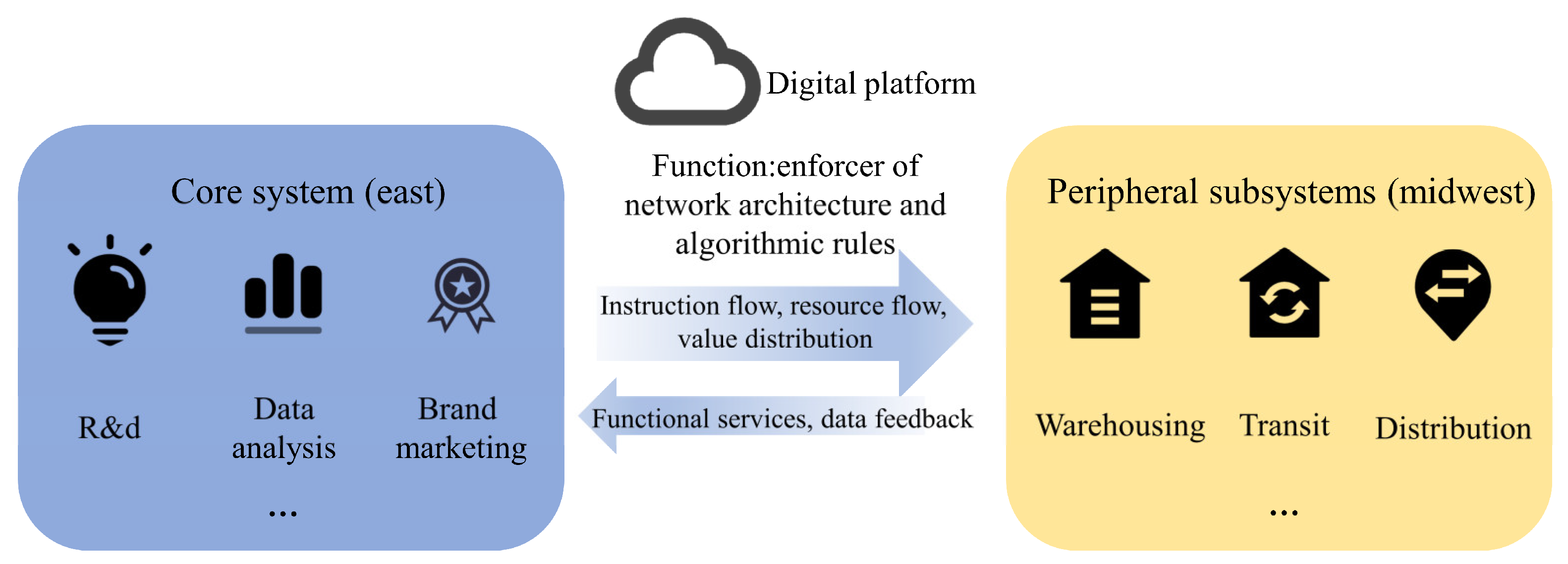
The principal theoretical contribution of this research, based on the comprehensive evidentiary framework outlined by the evidentiary triangle in
Section 5, is the formulation and elucidation of a theoretical construct (
Figure 7): systemic functional dependency, which is proposed as a new framework for comprehending sociotechnical systems within the platform economy.
From a regional socio-economic perspective, systemic functional dependency denotes a condition wherein the primary state variables of a subsystem (e.g., the peripheral region)—encompassing its industrial upgrading trajectory and value capture capabilities—are functionally affected by a network function governed by a remote core system. The conventional definitions of capital or trade no longer predominantly dictate the operation of the function. The algorithms, data flows, and network protocols of the digital platform, on the other hand, decide and enforce it.
The formation of the dependency stems from two primary mechanisms:
Mechanism 1: Governance through Algorithms. The platform needs to do spatial functional rationalization to boost performance, cut costs, and make the user experience better. Within the SFD framework, the platform functions as an algorithmic governance entity. Its primary objective is to optimize network-wide efficiency by enforcing spatial rationalization. It strongly tends to put high-value-added functions like headquarters, R&D, and data analytics in core areas that are rich in information, talent, and capital (usually where the platform itself is based). This agglomeration effect makes operations more efficient and increases the ability to come up with new ideas, which gives you a big edge in a competitive market. At the same time, it strategically places standardized, easily replaceable functions like warehousing, transit, and distribution hubs in areas with lower land and labor costs and better transportation options. The platform’s algorithmic rules and incentive structures make this division of labor in space necessary and enforce it.
Mechanism 2: Data Asymmetry. The platform serves as a central data hub and has almost perfect information about the whole network. The platform creates a closed-loop information ecosystem by bringing together data from suppliers and consumers. This data supremacy lets the core system set the rules for trade. On the other hand, peripheral actors, such as warehouse operators and truck drivers, only have bits and pieces of information that are relevant to their field. This big difference in data is a major source of power. It lets the platform make the best decisions for the whole world, set the rules for trade, and take most of the value that is created. This puts peripheral actors in the group of platform-dependent entrepreneurs, which means they have a big disadvantage in any negotiation or interaction with the platform.
Systemic functional dependency exemplifies a more intricate, technology-enabled variation in dependence in contrast to conventional dependency theory. The primary source of control has transitioned from capital to the platform’s algorithmic regulations, its inconsistent management of data flows, and the standardization mandated by its network protocols. In this relationship, peripheral regions may show signs of modernization and growth in certain industries. However, their basic economic independence—such as their ability to set their own development path, their power to distribute value chains, and their ability to adapt to changes in external networks—will probably be greatly limited.
6.3. Universality of the Mechanism and China’s Role as a Natural Laboratory
Any research predicated on a specific national case must meticulously assess the generalizability of its findings. The study readily acknowledges that its findings are derived from China’s distinctive institutional and market context, characterized by several key specificities. As outlined in the theoretical framework, China’s unique institutional characteristics—specifically, the robust state-led strategic direction and a unified domestic market—have served as catalysts that expedited the establishment of SFD.
Nonetheless, it is asserted that these context-specific factors have primarily served as accelerating factors rather than as the fundamental drivers. The primary driving force identified in the study—the asymmetric friction between the near-frictionless virtual system (e-commerce) and the persistently high-friction physical system (logistics)—constitutes a systemic contradiction inherent to the platform economy as a business model, which is contended to be universally applicable.
In any country with significant geographic disparities in geography and market imbalances, once the platform economy reaches a certain level of penetration, this built-in contradiction will always interact with existing core–periphery structures, causing a structural change in its regional systems. The effect of the platform economy on high-quality regional economic growth follows an inverted U-shaped curve. On the left side of this curve, the platform economy has a big effect on promoting high-quality economic growth. However, after the inflection point, this effect starts to fade.
This study conducts a cross-contextual theoretical extrapolation as follows: In a context such as the United States or the European Union, characterized by more fragmented market structures and varying governmental intervention strategies, this process would probably not be as swift or intense as it has been in China. The process of evolution may vary. It might look like a systemic functional dependency made by one main platform (like Amazon) along some busy logistics corridors, rather than a clear-cut, national-scale zonal bifurcation. Local governments and community groups may also have longer conflicted with platforms, which would give rise to a wider range of coupling patterns. Even with these possible differences, the main idea behind the systemic evolution—path bifurcation arising from uneven frictions—would still be the same.
The main goal of the study is to show that the results are a universal rule of systemic evolution. China’s distinctive institutional and market landscape functioned as an exemplary natural laboratory for the observation of the principle, which developed with remarkable clarity, rapidity, and on a broad scale.
6.4. Policy Implications
The results of the study have significant ramifications for digital governance and regional sustainable development in the contemporary digital era. The functional lock-in identified in study constitutes a direct consequence of prevailing platform governance models., posing a challenge to sustainability that policymakers in peripheral regions of Central and Western China must remain vigilant to avert the emergence of functional lock-in. A major change in policy is needed: moving from just connecting people to focusing on capturing value.
Here are some specific ideas: First, these places need to provide specialized logistics services that add a lot of value. This policy needs to be part of local land-use planning, connecting logistics development to the strengths of the local industry, like specialty agriculture, while still serving as a functional service node. Second, a strategy that should be used at the same time is to actively bring in and support related industries that can add value to the local economy. Third, a lot of money needs to be spent on the local workers, especially to teach them how to use digital tools and keep things running smoothly. Building infrastructure is not enough for making national policy. Policies for land governance need to be in line with the new economic reality, which goes beyond just building infrastructure. National policy should use advanced policies for industry, taxes, and land use to help these hubs grow into industrial ecosystems that are closely linked to the economy of the area.
7. Conclusions and Future Directions
7.1. Research Summary
The study has systematically clarified the phenomenon of regional systemic path bifurcation within the platform economy. To clarify this divergence, the theoretical construct of systemic functional dependency was formulated and empirically validated. The findings indicate that, due to the asymmetric frictions inherent to the platform, China’s established core–periphery structure has transformed into two distinctly divergent modes. The Eastern core region turned into an endogenous synergistic regional network, and its growth showed a lot of local coupling and good regional synergies. The Central and Western peripheral regions, conversely, transformed into exogenous functional service nodes via a nonlinear sequence of decoupling, transition, and recoupling. The empirical evidence clearly shows that their growth is no longer linked to local and neighborhood markets; instead, it is now based on a network that spans the whole country.
The research introduces a dynamic framework for analyzing the impact of platform governance on regional socio-economic inequality. It also helps us understand a new type of regional dependence that is based on data and algorithms. These results give policymakers an important perspective: they need to do more than just connect people; they need to start capturing value. This strategic change is necessary to mitigate the risks of functional lock-in that peripheral regions encounter in the digital era and to foster genuine digital sustainability and equitable socio-economic development in those areas.
Contributions to Theory and Methodology. The research presents three unique contributions to the body of knowledge regarding digital geography and platform governance. First, it builds and tests the Systemic Functional Dependency (SFD) framework in theory. SFD is different from traditional dependency theories that look at capital flows. It describes a new kind of core–periphery relationship that is shaped by algorithmic governance and uneven frictions. This makes it a good way to study digital inequality. Second, it comes up with a triangulation empirical strategy that uses growth gap analysis, structural break tests, and the SLX spatial model. This method effectively captures the nonlinear evolutionary trajectory of intricate regional systems, surpassing the constraints of static linear analyses. Third, the results serve as a cautionary note regarding the connectivity trap and present a strategic foundation for transitioning regional policy from mere infrastructure connectivity to proactive value capture.
7.2. Limitations and Future Directions
First, the study uses provincial-level macro data (N = 30) because there is not enough data available. This sample size is good enough to find systemic trends, but it does not have enough statistical power for more complicated heterogeneity analyses. Subsequent research should endeavor to employ city-level or county-level data to obtain more detailed spatial interactions. Second, the observation period (2013–2022) covers the rapid ascent of China’s platform economy but may not fully capture the post-pandemic structural adjustments. As the platform economy enters a mature governance phase, the long-term stability of the functional service node role requires continued longitudinal observation.
The study offers analytical frameworks and empirical evidence concerning the transformation of regional socio-economic structures in the digital era, while concurrently generating extensive opportunities for subsequent research initiatives.
Based on these results, future research could be broadened in three primary domains of inquiry: first, by using Origin–Destination (OD) flow data at the city or hub level to create network analysis models that can directly measure the strength and growth of long-distance connections; second, by employing qualitative case study methodologies, encompassing extensive fieldwork in representative Central and Western functional service node cities, to comprehensively clarify the micro-mechanisms of the decoupling–transition-recoupling process; and third, by applying the analytical framework of the study in other national or regional settings. Cross-national comparative analyses would investigate the expressions of the fundamental asymmetric friction mechanism across diverse institutional contexts, thereby further evaluating the generalizability of the analytical framework.