

- Article

Temperature-Dependent Performance Optimization of a Filtered ASE Source Employing Low-Concentration Erbium-Doped Fiber
- Wei Liu,
- Jianming Liu and
- Jia Guo
- + 1 author
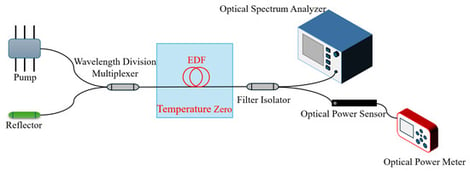
Research on the thermal stability of amplified spontaneous emission (ASE) has mostly focused on broadband spectra. High-precision fiber optic gyroscopes (FOGs), however, require spectrally filtered sources. The impact of erbium-ion doping concentration on the temperature performance of such filtered sources remains relatively explored. This work systematically compares low-concentration and high-concentration erbium-doped fibers (EDFs). The fibers are used in a bidirectional forward-pumped ASE configuration. This configuration integrates a 1530 nm Gaussian filter isolator. The optimized low-concentration EDF fully absorbs pump power over a longer length. Its gain-profile temperature shift partly compensates the filter passband shift. At the optimum fiber length of 10 m, this source shows a mean wavelength temperature drift of only 0.107 ppm/°C. In contrast, the commercial high-concentration EDF gives a drift of 0.136 ppm/°C. The power conversion efficiency of this source reaches 26.9%. The commercial EDF attains 24.5%. The results demonstrate that reducing the Er3+ doping concentration simultaneously improves the wavelength thermal stability and efficiency of filtered ASE sources. This finding offers important guidance for high-accuracy FOG design.
22 May 2026
![Schematics to illustrate photoemission current contribution imposed to electrometer readings depending on the location of the electrometer (A). Rear grounding configuration (the electrometer sensing terminal is connected to the front electrode of the photodiode) is shown. For direct measurement of the photoemission current, the switch SW is set to open [18].](https://mdpi-res.com/cdn-cgi/image/width=281%2Cheight=192/https://mdpi-res.com/qubs/qubs-10-00009/article_deploy/html/images/qubs-10-00009-g001-550.jpg)