Previous Article in Journal
Periodic Noise Reduction in Neutron Imaging
 
 
Due to scheduled maintenance work on our servers, there may be short service disruptions on this website between 11:00 and 12:00 CEST on March 28th.
Article

Vorticity of Twisted Electron Fields: Role of the Energy–Momentum Tensor

1
Department of Physics, The George Washington University, Washington, DC 20052, USA
2
Department of Physics, William & Mary, Williamsburg, VA 23187, USA
3
Department of Physics, Indian Institute of Technology Bombay, Powai, Mumbai 400076, India
*
Author to whom correspondence should be addressed.
Quantum Beam Sci. 2026, 10(2), 8; https://doi.org/10.3390/qubs10020008
Submission received: 22 January 2026 / Revised: 18 February 2026 / Accepted: 5 March 2026 / Published: 25 March 2026
(This article belongs to the Section Radiation Scattering Fundamentals and Theory)

Abstract

Electron fields (and more generally spinor fields) with a vortex structure in free space that allows them to have arbitrary integer orbital angular momentum along the direction of motion have been studied for some time. We point out that there are several ways to calculate the local velocity of the electron field, defined as the ratio of momentum density to energy density, and that all but one show a singular vorticity at the vortex line. That one, using the Dirac bilinear current with no derivatives, is the only one so far (to our knowledge) studied in the literature in this context and we further show how to understand an apparent conflict in the existing results. The momentum densities corresponding to the three possible velocity fields give different physical results, in particular regarding the electron induced quantum superkicks given to small electron-absorbing test objects.

Graphical Abstract

1. Introduction

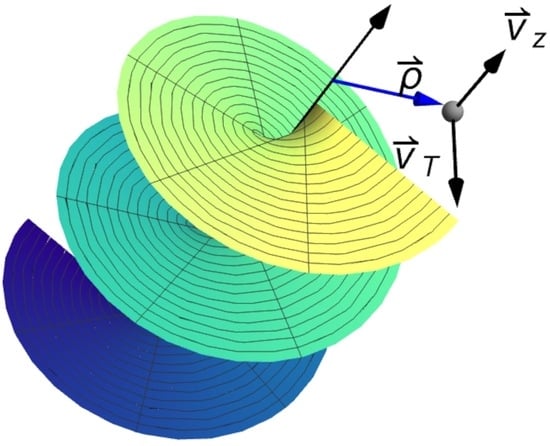
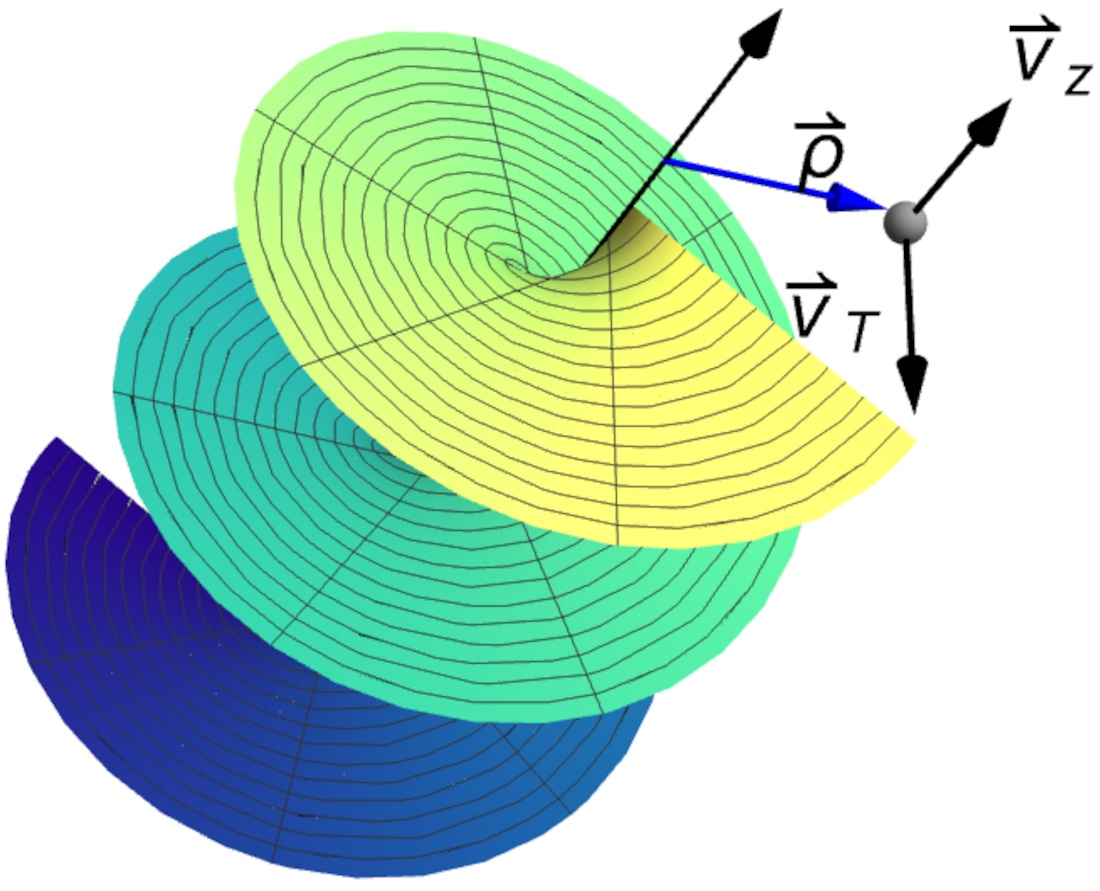
Vorticity is given by the curl of the velocity of a field at a given space-time point. Two overlapping questions in the context of spinor fields with non-uniform wavefronts propagating in free space are how singular the vortex lines may be and what expressions should be used to calculate the momentum densities of structured spinor, here mainly spin 1/2, fields. The discussion can be phrased in terms of twisted electron states, which are wave packets with a definite overall direction of motion and which can have arbitrary integer, times , orbital angular momentum along the propagation direction; reviews can be found in; for example, Refs. [1,2,3,4]. While this paper specifically deals with twisted electrons, the results are equally applicable to twisted neutron states [5,6] or other spinor particles. The twisted spinor state has local momentum densities with azimuthal components that swirl about a vortex line whose direction is set by the overall propagation direction.
The problem considered is closely related to the choice of the form of the energy–momentum tensor, and this choice has an important impact within multiple fields of physics, including atomic, hadronic [7,8,9], condensed matter, and gravitational [10,11].
A first question is whether the twisted electron field has a true vortex, in the sense that the local momenta or local field velocities have a singular curl at the location of the vortex line. Quickly come questions of how one should calculate the local momenta or momentum densities that give the vorticity. We may list three possibilities for the momentum densities. One follows from the Dirac equation, particularly when there are electromagnetic interactions, where one can define a bilinear conserved current. Momenta and thence velocities follow, analogously to electromagnetic currents of classical particles, as ratios of the spatial and temporal components of the corresponding four-vectors. We refer to this as obtaining the momentum density field or the velocity field from the Dirac current. Alternatively, in field theory, one can start from either the canonical or the symmetric Belinfante-Rosenfeld version of the energy-momentum tensor to obtain the momentum density. For a plane wave state, or a momentum eigenstate, the three ways to obtain a momentum density give the same results; however, in a general case, one gets three different numerical answers.
Two papers that introduce the question about the singularity of the vortex line are by Bialynicki-Birula and Bialynicka-Birula [12] and by Barnett [13], with further commentary in [14,15,16] and more recently in [17]. These papers each give coordinate space solutions for twisted electrons valid, in particular, at small distances from the vortex line. They then analyze the vorticity of the velocity field, in both of these papers obtaining the momentum density and velocity field from the Dirac current definition. They give, interestingly enough, different opinions on whether a true vortex exists.
The papers just mentioned [12,13] find solutions by unique and interesting methods and are not the same in appearance. There is still another and different way [1,18] to obtain the twisted spinor fields, from knowledge of how twisted states can be written in momentum space. We will begin by reviewing and comparing the solutions and will observe that the solutions are the same in the sense that all can be expressed as linear combinations of each other.
The different conclusions are a matter of interpretation. Strictly speaking, as we will show in Section 2, when getting the velocity field from the Dirac current, the vortex line does not have a singular vorticity. A classical vortex, and we will define our use of that term below, has singular vorticity at the vortex center. However, as particularly noted by Ref. [13], in a non-relativistic or moderately relativistic situation, there exist special solutions where the twisted electron velocity field is like a classical vortex down to distances of order of an electron Compton wavelength, about 2.4 picometers, from the vortex line. This is a very small distance on an atomic scale and leads Ref. [13] to conclude that although there is a transition to a non-singular behavior inside this radius, nevertheless, for practical purposes, this twisted electron does behave like a state with a singular vortex line. Ref. [12], on the other hand, shows two solutions, one of which finds no classical vortex at any distance, and both of which find no singularity at the vortex line. Their conclusion is the strict one that the vorticity of the vortex line is never singular.
These conclusions involving different opinions were in the context of a momentum density or velocity field obtained from the Dirac current. In Section 3, we present a further analysis based on momentum densities obtained from the canonical and from the symmetrized or Belinfante energy–momentum tensors and show the conclusions are dramatically different from the Dirac current conclusions. The twisted spinor fields always display a classical vortex behavior in the vicinity of the vortex line, and the vorticity is singular at the location of the line.
Working from field theory and from the energy–momentum tensor is rather different than working from the Dirac current. One starts with a Lagrangian and a Noether procedure and studies the response of the system to coordinate translations and thereby obtains the canonical energy–momentum tensor. Certain components of the energy–momentum tensor give the momentum density, and the result is different from the above-mentioned bilinear from the Dirac equation. Further, the canonical energy–momentum tensor is not symmetric in its two indices. This is a problem if one wants to use the energy–momentum tensor as a source in the general relativity field equations, where symmetry is required. One can symmetrize the energy–momentum tensor by adding a total derivative to the canonical result. The full momenta obtained by integrating components of the energy–momentum tensor are then the same in many circumstances, but the local momentum densities are not the same. In the context of twisted electrons, while both the canonical and Belinfante cases give a singular vortex, the strength of the singularity is not the same. Thus there are three local field momentum definitions to choose among, and the conclusion regarding the vorticity of the twisted electrons depends on the choice.
To illustrate the differences among the three momentum density or velocity field definitions, we will use twisted electron Bessel states. We begin with the pure Bessel beam case but realize that the pure Bessel beam requires unlimited space and energy. Hence, for practical purposes, we will also speak of Bessel–Gauss beams, or Bessel beams put in a Gaussian envelope in coordinate space, to constrain the width of the beam surrounding the vortex line in the coordinate direction transverse to the propagation axis. It should be clear that the envelope limiting the beam at large transverse coordinates does not affect the leading behavior or even the next-to-leading behavior of an expansion of the beam’s dependence on transverse coordinate near the vortex line.
Our Bessel beam expressions, except for the Gaussian envelope, are exact solutions of wave equation. The Bessel beam in momentum space or in wave vector space has components, all of which have the same longitudinal (along the overall beam direction) momentum and the same magnitude transverse momentum and varying azimuthal angles. We will work in the lab frame where the longitudinal momentum is not zero. For most laboratory frames, the angle—the pitch angle—between the component wave vectors and the longitudinal axis is small. Equivalently, the ratio of the transverse momentum or transverse component of the wave vector and its longitudinal counterpart is small. We do not need the paraxial approximation, which is an expansion for small pitch angles, keeping only the lowest order. An occasional formula is simplified in this fashion, but the simplification is never essential.
The plan of the paper is to display the twisted electron solutions in coordinate space in Section 2 and begin the discussion of the vorticity, using the Dirac current viewpoint. In Section 3, we will display the energy–momentum tensors derived from the Dirac Lagrangian and symmetrized by the Belinfante or Belinfante–Rosenfeld procedure and show results for the vorticity in these cases. We will offer some closing commentary in Section 4. We use natural units = c = 1 throughout the paper.

2. Twisted Electron Wave Functions and Vorticity

2.1. Opening Commentary

It has been known at least since [18] how to write relativistic twisted electron states, and this is also applicable to other spinor states. What is newer is the discussion of the vorticity. We will in this section review the twisted electron solutions, starting from a momentum space version (beginning where the component electron states have a common helicity), and discuss the vorticity properties of these states, obtaining in this section the velocity field from the Dirac current. We will then write other solutions of interest [12,13] as linear combinations of these solutions and elucidate their vorticity properties.
We will pay special attention to the azimuthal swirling of the velocity field of the state and distinguish between a classical whirlpool, which for us will mean an azimuthal swirling velocity proportional to the inverse of the distance from the whirlpool center, and the swirling one finds in a rotating water bucket, where fluid swirls with constant angular velocity or with linear velocity proportional to the distance from the swirl’s center. We will also discuss the vorticity of the velocity field as defined in fluid mechanics.

2.2. Twisted Electrons and Plane Wave Helicity States

Let us define a twisted electron state with a vortex line passing through the origin as in [19],
| κ , m , k z , λ = A 0 i d ϕ k 2 π ( i ) m e i m ϕ k | k , λ ;
the state inside the integral is an electron momentum eigenstate with helicity λ = ± 1 / 2 and momentum k = ( k , θ k , ϕ k ) in spherical coordinates. Longitudinal momentum k z = k cos θ k and transverse momentum magnitude κ = | k | = k sin θ k are the same for all states. Angle θ k is the pitch angle. The state normalization is k , λ | k , λ = ( 2 π ) 3 2 E δ λ λ δ 3 ( k k ) , where E = k 2 + m e 2 . The phases of the momentum eigenstates will, as in [19], use the Wick convention [20] (rather than Jacob-Wick states [21]). A 0 is a normalization constant; the i is inserted for later convenience.
The wave function in coordinate space is obtained using the Dirac field operator,
ψ κ , m , k z , λ ( x ) = 0 | ψ ( x ) | κ , m , k z , λ = A 0 i e i ( k z z E t ) d ϕ k 2 π ( i ) m e i m ϕ k + i k · ρ u ( k , λ ) ,
where u ( k , λ ) is a Dirac helicity state and we use cylindrical coordinates, ( ρ , ϕ ρ , z ) ( ϕ ρ and ϕ k are azimuthal angles in coordinate and momentum space, respectively). With the traditional representation of the Dirac matrices [22],
u ( k , λ ) = E + m e χ ( k ^ , λ ) ( 2 λ ) E m e χ ( k ^ , λ ) ,
where
χ ( k ^ , 1 / 2 ) = e i ϕ k / 2 cos ( θ k / 2 ) e i ϕ k / 2 sin ( θ k / 2 ) , χ ( k ^ , 1 / 2 ) = e i ϕ k / 2 sin ( θ k / 2 ) e i ϕ k / 2 cos ( θ k / 2 ) .
The positive and negative helicity solutions are
ψ κ , m , k z , 1 2 ( x ) = A 0 E + m e ) ( E + m e ) cos ( θ k / 2 ) f B m 1 / 2 ( κ ρ ) i ( E + m e ) sin ( θ k / 2 ) f B m + 1 / 2 ( κ ρ ) k cos ( θ k / 2 ) f B m 1 / 2 ( κ ρ ) i k sin ( θ k / 2 ) f B m + 1 / 2 ( κ ρ )
and
ψ κ , m , k z , 1 2 ( x ) = A 0 E + m e ( E + m e ) sin ( θ k / 2 ) f B m 1 / 2 ( κ ρ ) i ( E + m e ) cos ( θ k / 2 ) f B m + 1 / 2 ( κ ρ ) k sin ( θ k / 2 ) f B m 1 / 2 ( κ ρ ) i k cos ( θ k / 2 ) f B m + 1 / 2 ( κ ρ ) ,
for f B ( κ ρ ) = e i ( k z z E t + ϕ ) J ( κ ρ ) .
These states are eigenstates of J z , the total angular momentum projected along the propagation direction, with eigenvalue j z = m . They are not eigenstates of the spin or orbital angular momentum separately, although one can obtain, for example, the expectation value of the spin angular momentum by calculation or by inspection,
S z = 1 2 cos θ k
for the first state and the negative of that for the other, independently of the state’s energy.
The velocity field can be obtained from the Dirac current, j μ = ψ ¯ γ μ ψ , thinking of j as density times velocity, so that
v = ψ α ψ ψ ψ ,
and in the present representation
α = 0 σ σ 0
where the σ s are the standard 2 × 2 Pauli matrices. The vorticity, following standard definitions in fluid mechanics, is
w = curl v ,
and curl v = × v when the derivatives can be defined.
Examining the solutions for ψ just given, the transverse components of the velocity field for the solution in Equation (5) have the form
v = κ E J m 1 / 2 ( κ ρ ) J m + 1 / 2 ( κ ρ ) cos 2 ( θ k 2 ) J m 1 / 2 2 ( κ ρ ) + sin 2 ( θ k 2 ) J m + 1 / 2 2 ( κ ρ ) ϕ ^ .
We will take m > 0 for definiteness, so that this is the solution where the orbital angular momentum and spin are parallel to each other ( m λ > 0 ). All the dependence on ρ is in the Bessel functions, and ϕ ^ is a unit vector in the ϕ ρ direction. For small ρ , the Bessel functions are approximately
J ( κ ρ ) 1 ! κ ρ 2 ,
valid for κ ρ + 1 (or m + 1 / 2 ), which we may also write as ρ few × ƛ B / sin θ k , where ƛ B λ B / 2 π is a reduced de Broglie wavelength.
Then—for these ρ —the J m + 1 / 2 2 term in the denominator can be neglected and
v ρ ϕ ^
all the way down to ρ = 0 . This is not the velocity field of a classical whirlpool but rather like the velocity field of water in a rotating bucket, with all locations of the water having a common angular speed. The (z-component of) vorticity is constant at all locations where the linear ρ dependence of v pertains, including at the vortex line itself (see, for example, [23]).
However, for the antiparallel or pure negative helicity solution ( m λ < 0 ), Equation (6), the J 2 and J + 1 2 terms in the denominator of Equation (11) are interchanged. Explicitly, for the antiparallel case
v = κ E J m 1 / 2 ( κ ρ ) J m + 1 / 2 ( κ ρ ) sin 2 ( θ k 2 ) J m 1 / 2 2 ( κ ρ ) + cos 2 ( θ k 2 ) J m + 1 / 2 2 ( κ ρ ) ϕ ^ .
Generally, θ k is small, and for the J m 1 / 2 2 term to dominate one needs to go to very small radii, roughly ρ ( m + 1 / 2 ) tan θ k / κ ( m + 1 / 2 ) ƛ B . In this very small ρ region, the velocity rotation is still “water bucket” like. However, there is a significant region
( m + 1 / 2 ) ƛ B ρ ( m + 1 / 2 ) ƛ B sin θ k
where
v ϕ ^ ρ ,
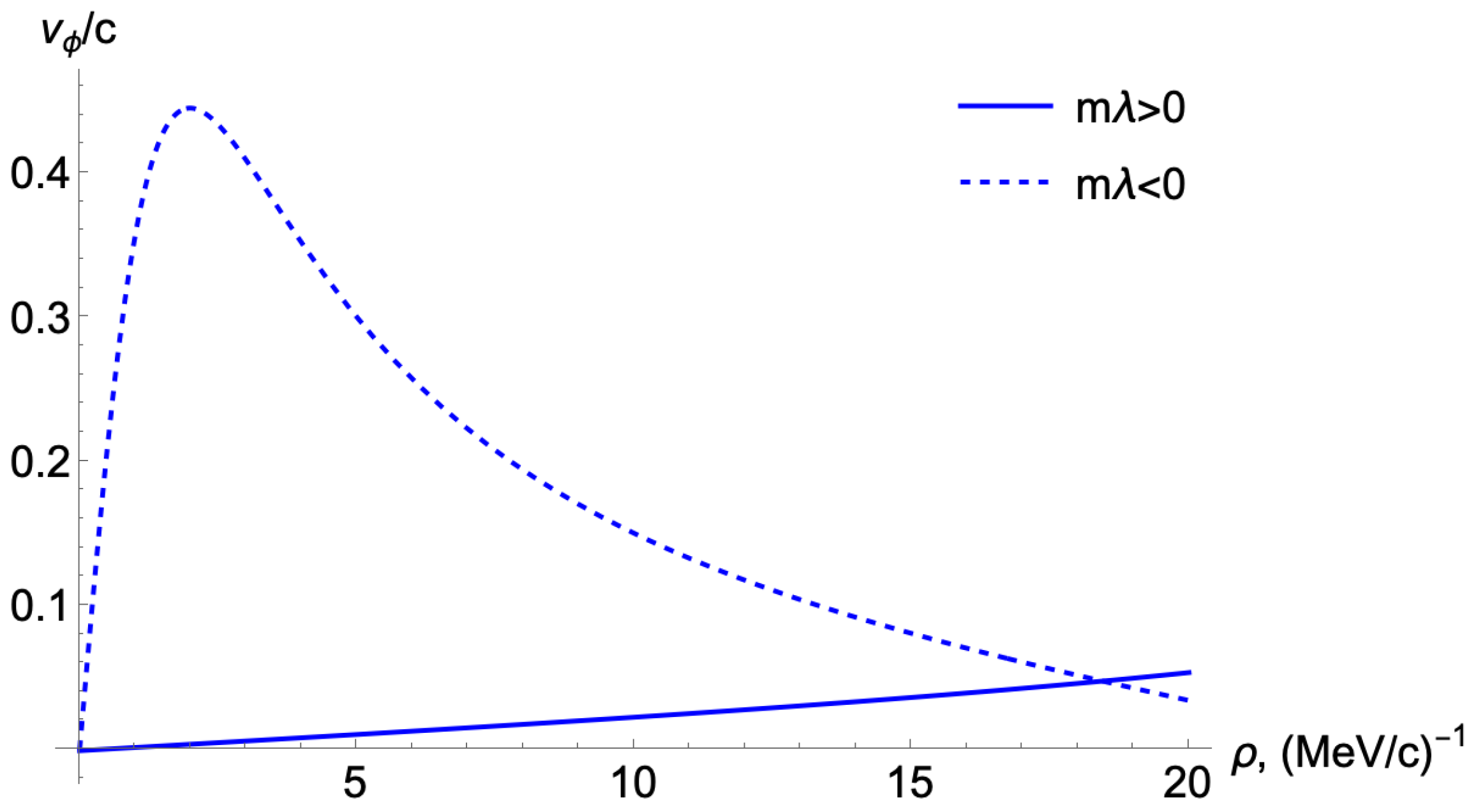
which is the velocity field of a classical whirlpool [24]. At any point with ρ 0 , the vorticity of this velocity field is zero [23]. This behavior of the velocity field is demonstrated in Figure 1.
Of some interest is that if the v 1 / ρ dependence were to persist to the vortex line, the vorticity at the vortex line would be singular rather than zero. To show this, one needs to use the derivative-free definition of the curl [23],
( curl v ) z = lim σ 0 1 σ v · d t ,
where the integral is around the perimeter of a surface in the transverse plane, d t is a differential length tangent to the perimeter, and σ is the area of the surface.

2.3. The Bialynicki-Birula-Bialynicka-Birula Solution

We can now discuss the vorticity of the solutions in [12,13]. (We should remark that [12,13] both limit the solutions at very large radii to avoid the requirement of infinite energy for a pure Bessel wave, but this does not affect the low-radius region needed for the vorticity discussion).
Ref. [12] gives solutions with definite j z . To connect to their states, let us write our existing solutions in linear combination as
ψ B B = a cos ( θ k / 2 ) i b sin ( θ k / 2 ) ψ κ , m , k z , 1 2 ( x ) + i a sin ( θ k / 2 ) + b cos ( θ k / 2 ) ψ κ , m , k z , 1 2 ( x ) ,
where the θ k factors have been chosen so that
ψ B = A 0 E + m e a ( E + m e ) f B m 1 / 2 b ( E + m e ) f B m + 1 / 2 ( a k z i b κ ) f B m 1 / 2 ( i a κ b k z ) f B m + 1 / 2 .
Ref. [12] used a Weyl basis for the Dirac matrices. Using γ W μ to denote the Weyl basis as used in [12], and continuing with γ μ for the standard basis, they have
γ W 0 = 0 1 1 0 , γ W = 0 σ σ 0
(where the units represent 2 × 2 unit matrix sub-blocks and similarly the zeros represent the 2 × 2 zero matrix). Also
γ 0 = 1 0 0 1 , γ = 0 σ σ 0 ,
and one can convert the basis using
γ W μ = U γ μ U with U = 1 2 1 1 1 1 .
Further, if ψ represents a solution obtained using the standard Dirac basis and ψ W a solution using the Weyl basis, then
ψ W = U ψ .
Converting Equation (19) above to its Weyl basis counterpart, it is easy to verify that for suitable choices of a , b , and A 0 , we get the first solution of [12] (their Equation (11)). More specifically, choosing b ( E + m k z ) i a κ = 0 will give zero second component in the Weyl representation, as they wish for this solution. A similar procedure gets their other solution1.
Their [12] solutions may also be called parallel and antiparallel. The parallel solutions show no classical whirlpool behavior for any radius where the small argument expansion of the Bessel functions can be used. The antiparallel solutions do have classical whirlpool solutions in the same range as Equation (15), but revert to the water bucket solutions for the smallest radii, so that neither solution has a singular vortex line. In this, they are like the solutions we have already discussed.

2.4. The Barnett Solution

The remarkably interesting Ref. [13] solutions can be obtained as a linear combination of an a solution from Equation (18) plus a b solution but with m replaced by 1 . This state is not an eigenstate of j z , but that is allowed. The result is a state where all terms not suppressed in the paraxial limit have Bessel functions of the same order. One feature, as we shall see, is the possibility that the transition from a classical whirlpool to a water bucket rotation is pushed to what one might call astonishingly small radii. Explicitly,
E + m e A 0 ψ B = ( E + m e ) a b 0 0 f B m 1 / 2 + k z 0 0 a b f B m 1 / 2 + i κ 0 0 b f B m 3 / 2 a f B m + 1 / 2 .
This mimics the Ref. [13] solution over all space, after inverting the Foldy-Wouthuysen transformation. Ref. [13] gives only the low transverse radius limit, which we can check explicitly. We omit the f B m + 1 / 2 term on the grounds that it is generally small in the paraxial limit and particularly small in the very low ρ limit that can be especially important. We obtain
ψ B = A 0 E + m f B × ( E + m ) a b 0 0 + k z 0 0 a b i 2 ρ e i ϕ 0 0 b 0 .
This is the Ref. [13] solution for small ρ , verifiable upon noting (their notation) u / u + = k / ( E + m ) , which is the same as k z / ( E + m ) paraxially, and reworking the third term suitably.
For the vorticity analysis of these solutions, Equation (25),
ψ α ψ = 4 | A 0 | 2 J 2 ( κ ρ ) | b | 2 ρ ϕ ^ , ψ ψ = | A 0 | 2 J 2 ( κ ρ ) [ 2 E | a | 2 + | b | 2 + 4 2 | b | 2 ( E + m e ) ρ 2 + 4 k z ( E + m e ) ρ Im a * b e i ϕ ] ,
using a paraxial approximation for some terms. Then we can identify behavior at moderate [ ( m 1 / 2 ) / E ρ ( m 1 / 2 ) / ( k sin θ k ) ] and small [ ρ ( m 1 / 2 ) / E ] radii,
v = 2 ( m 1 / 2 ) E | b | 2 | a | 2 + | b | 2 ϕ ^ ρ moderate ρ , E + m e ( m 1 / 2 ) ρ ϕ ^ small ρ .
This is similar to the antiparallel single helicity solution. This solution, this particular linear combination of eigenstates of j z and helicity, is a remarkable choice because it has a classical whirlpool behavior down to a radius determined by the energy rather than by the momentum. This means that the transition radius from the classical whirlpool to the water bucket swirl is less than a few (when is not large) times the electron Compton wavelength. The latter is about 2.4 picometers, small compared to most atomic scales, so that one can suggest [13] that for these solutions the twisted electron swirls like a classical whirlpool at any practical atomic scales. For the solutions discussed earlier, the transition radius is determined by the inverse momentum, or de Broglie wavelength, which of course is frame dependent, but working in the lab for nonrelativistic or moderately relativistic electrons would give a transition radius much larger than a Compton wavelength.
(If b is precisely zero, one will need to restore the mostly small f B m + 1 / 2 term, and find a water bucket swirl at all radii).
Hence, we see and understand the difference between the results given in Ref. [12] and in Ref. [13]. Ref. [12] shows, in general, no classical whirlpool behavior for their twisted fermion solutions at small radii, in common with the twisted fermion states made from Fourier components of definite helicity that we also displayed. (Ref. [12] shows an interesting decomposition of the velocity field for the twisted fermion case into orbital and spin contributions. Each of them separately displays a classical whirlpool behavior, but the singularity cancels in the sum.) Ref. [13], on the other hand, finds a remarkable specific linear combination that does show singular whirlpool behavior, at least down to radii significantly smaller than an atomic radius. But finding the correct linear combination is crucial. With the correct linear combination, one may call this a physical example of a Rankine solution, which is an approximate solution known in fluid mechanics that has a transverse speed proportional to the inverse of the radius at large radii and proportional to the radius at small radii [25].

3. Field-Theory Vorticity Calculations

For the Dirac field, starting from the Lagrangian, one can derive an energy–momentum tensor and from the energy–momentum tensor, obtain the momentum densities of the field. The straightforward or canonical procedure gives an energy–momentum tensor that is not symmetric in its two indices, and it can be symmetrized by a procedure due to Belinfante [26,27] that does not change the total momentum obtained by integration but does change the local momentum densities.
The Dirac Langrangian density in its Hermitian form is ψ ¯ ( i / 2 ) m ψ . The momentum densities that follow are
P μ = i 2 ψ ¯ γ 0 μ ψ , canonical , i 4 ψ ¯ γ 0 μ + γ μ 0 ψ , Belinfante .
For the canonical momentum density and the positive helicity Bessel solution given by Equation (2), the radial momentum density is zero and
P can ϕ ψ ψ = m 1 / 2 ρ + 1 ρ sin 2 ( θ k / 2 ) J m + 1 / 2 2 ( κ ρ ) cos 2 ( θ k / 2 ) J m 1 / 2 2 ( κ ρ ) + sin 2 ( θ k / 2 ) J m + 1 / 2 2 ( κ ρ ) .
for all ρ . The second term is paraxially suppressed and, for m > 1 / 2 , can be neglected at small ρ (in particular including ρ = 0 ). We obtain the velocity field by taking the ratio of the spatial momentum density to the energy density. For either the canonical or Belinfante case,
P 0 = E ψ ψ ,
so that,
v can ϕ = m 1 / 2 ρ E
at small ρ . This swirls at all radii, and gives a singular vortex line at ρ = 0 , and is quite different from the result obtained using the Dirac current for the momentum, given in Equation (13).
This can also be interpreted as giving a momentum p ϕ = ( m 1 / 2 ) / ρ to a small test object that absorbs a twisted electron while located a distance ρ from the axis.
Additionally, for the z-component,
P can z = k z ψ ψ , v can z = k z E ,
exactly as should be desired.
For the Belinfante case, visually the result looks (after the time derivative is turned into an energy) in between the canonical and Dirac results, and for the Bessel solution
P Bel ϕ ψ ψ = 1 2 P can ϕ ψ ψ + κ 2 J m 1 / 2 ( κ ρ ) J m + 1 / 2 ( κ ρ ) cos 2 ( θ k / 2 ) J m 1 / 2 2 ( κ ρ ) + sin 2 ( θ k / 2 ) J m + 1 / 2 2 ( κ ρ ) .
Again the second term can be neglected for small θ k , low ρ , and m > 1 / 2 . Then
v Bel ϕ = m 1 / 2 2 ρ E .
One also does get v Bel z = p z / E , paraxially.
These results show the canonical definition of the momentum density gives whirlpool-like swirling electrons and a definite vortex line with singular vorticity for twisted electrons, and the same is true for the Belinfante definition, but with only half the magnitude of azimuthal velocity at small radii. The maintenance of the classical whirlpool behavior all the way to zero radius does contrast with the behavior in the Dirac current case, where for both the spin and orbital angular momentum parallel and antiparallel cases, one could not stably maintain the 1 / ρ behavior down to zero radius.
Again, the field theoretical results can be interpreted as giving a momentum p ϕ = ( m 1 / 2 ) / ρ , or half of this, to a small test object that absorbs a twisted electron while located a distance ρ from the axis. One would really like to know experimentally which calculation truly gives the momentum acquired by such a test object.
We may comment briefly about experimental tests of the differing suggestions for calculating the electron momentum density. One can envision the electron twisted Bessel beam flowing into a region containing a small test particle away from the beam’s vortex line. Analogous experiments in a photonic context have been done both with microscopic test particles [28] and with single ions [29]. The crucial consideration is energy–momentum conservation between the absorbed electrons and the absorbing target, which of course applies both classically and quantum mechanically. Say the test particle is suspended so that it cannot recoil longitudinally but is free to move in the transverse plane. Electrons from the Bessel beam will be absorbed, and the momentum transferred to the test particle, which will revolve about the Bessel beam’s vortex line. We have in other parts of this paper emphasized the low ρ behavior. Here, there is interest at any ρ since the three predictions are, in general, different at all ρ . Analogous experiments have been completed for Bessel photon beams [28]. One should only be careful not to have the test particle at some particular ρ where the different predictions cross [30].

4. Conclusions

We have discussed how to define the vorticity of twisted electrons, which is an apparent unsettled problem, and then pointed out that expressions for the local momentum density, defined from the energy–momentum tensor, have a decisive impact on the interpretation of the results.
Twisted electrons are an example of structured electron wave fronts, for which, unlike in a plane wave, the velocity of the electron in the wavefront depends on precisely where it is. There is then a velocity field, v ( x ) (with possible time dependence tacit) and in analogy to fluid mechanics, a vorticity given by
w = curl v .
One starting point for calculating the velocity is to use the Dirac current ψ ¯ γ μ ψ , with the velocity obtained from
v = ψ ¯ γ ψ ψ ¯ γ 0 ψ .
Twisted photons have a swirling velocity, with a nominal orbital angular momentum along the direction of motion given by an integer or, in general, units by . The wave function has a ρ or ρ ± 1 , determined by the component dependence, where ρ is the transverse radius in cylindrical coordinates, approximately accurate up to values of ρ / κ , where κ is the transverse wave number of the component electrons that make up the twisted electron. One has κ = k sin θ k , where k is the full wave number of the twisted photon components and θ k is usually a small angle.
We find, using wave functions available from [12,13] as well as wave functions made from electrons of definite helicity [18], that the swirling within the radius given above is often well described as being like liquid in a rotating bucket, where all parts of the velocity field attain the same angular speed. Such a velocity field has constant vorticity [23] and no singularity at the vortex line. Specially selected wave functions, particularly including but not limited to [13], can have a classical whirlpool-like velocity field, with transverse velocity 1 / ρ in the region ( m 1 / 2 ) tan θ k / κ ρ ( m 1 / 2 ) / κ . But even for these solutions, the velocity field reverts to the water bucket distribution and no singularity for very small radii—for this way of calculating the velocity field.
This brings up what is perhaps a larger question, namely, what is the correct expression to use when calculating the velocity field?
In a field theory, starting from a Lagrangian, there follows by a canonical procedure an energy–momentum tensor, and selected components of this tensor give the momentum density and thence the velocity field. The canonical energy–momentum tensor is not symmetric in its two indices, and this is a problem if using it as a source in the Einstein field equation general relativity. The canonical energy momentum tensor can be symmetrized by adding a total derivative term, in a procedure worked out by Belinfante [26] and Rosenfeld [27], which does not affect calculations of total momentum but does change the local momentum density.
The canonical and Belinfante expressions for the momentum density were given in Equation (28). The canonical expression is a gradient expression and gives a twisted electron velocity field with
v , can = m 1 / 2 ρ E ϕ ^
at all radii. Thus there is a classical whirlpool-like swirling of the electron field, with a singular vorticity at the vortex line. The symmetrized or Belinfante result also gives a classical whirlpool at small radii, with a vorticity about half as great as the canonical expression. These results are quite different from the results that follow from the Dirac current.
There is an analogous situation, with a discussion (several examples are [30,31,32,33]) for photons, where there are only two, the canonical and Belinfante, proposals for the momentum density, but also suggestions as to how one may determine which matches nature. This is an important question that requires adjudication also in the electron case.
Experimentally, one can envision a test particle near but not on the axis of a twisted electron beam. The test particle will absorb electrons and absorb the momentum that the electrons carry. Momentum absorbed per unit time, of course, gives the force and consequent measurable acceleration and displacement of that particle. Hence, by observing particularly the transverse motion of the test particle, one can infer the transverse momentum density of the electron wave and see which (if any) of the three momentum densities considered here is correct. In the case of twisted neutrons, a similar scenario can be realized with a nuclear reaction of neutron radiative capture by protons [34]. To our knowledge, no such experiments have been reported for either electron or neutron beams, although analogous measurements have been suggested and carried out for photon beams [30,31,32,33].
In summary, we have identified the source of ambiguity in the results for the vorticity of twisted spinor fields and pointed out how it is possible to determine the more physically relevant form of the energy–momentum tensor by studying the response of microscopic particles or atomic targets to absorbing electrons from a twisted beam. The results of this paper are directly applicable to spinor particles in general, including twisted neutrons that were experimentally demonstrated in Refs. [5,6] or quarks inside a proton [8,9].

Author Contributions

All the authors contributed equally to this work, including conceptualization, methodology, investigation, analysis and writing. All authors have read and agreed to the published version of the manuscript.

Funding

A.A. thanks the National Science Foundation (USA) for support under grant PHY-2111063 and Army Research Office (USA) for support under grants W911NF-19-1-0022 and W911NF-23-1-0085. C.E.C. thanks the National Science Foundation (USA) for support under grant PHY-1812326. A.M. thanks the SERB-POWER Fellowship, Department of Science and Technology, Government of India for support.

Data Availability Statement

The original contributions presented in this study are included in the article. Further inquiries can be directed to the corresponding author.

Conflicts of Interest

The authors declare no conflicts of interest.

Note

1
We obtain the solutions in [12] after correcting a misprint in their Equation (12).

References

  1. Bliokh, K.Y.; Ivanov, I.P.; Guzzinati, G.; Clark, L.; Van Boxem, R.; Béché, A.; Juchtmans, R.; Alonso, M.A.; Schattschneider, P.; Nori, F.; et al. Theory and applications of free-electron vortex states. Phys. Rep. 2017, 690, 1–70. [Google Scholar] [CrossRef]
  2. Lloyd, S.M.; Babiker, M.; Thirunavukkarasu, G.; Yuan, J. Electron vortices: Beams with orbital angular momentum. Rev. Mod. Phys. 2017, 89, 035004. [Google Scholar] [CrossRef]
  3. Larocque, H.; Kaminer, I.; Grillo, V.; Leuchs, G.; Padgett, M.J.; Boyd, R.W.; Segev, M.; Karimi, E. ‘Twisted’ electrons. Contemp. Phys. 2018, 59, 126–144. [Google Scholar] [CrossRef]
  4. Ivanov, I.P. Promises and challenges of high-energy vortex states collisions. Prog. Part. Nucl. Phys. 2022, 127, 103987. [Google Scholar] [CrossRef]
  5. Clark, C.W.; Barankov, R.; Huber, M.G.; Arif, M.; Cory, D.G.; Pushin, D.A. Controlling neutron orbital angular momentum. Nature 2015, 525, 504–506. [Google Scholar] [CrossRef] [PubMed]
  6. Sarenac, D.; Kapahi, C.; Chen, W.; Clark, C.W.; Cory, D.G.; Huber, M.G.; Taminiau, I.; Zhernenkov, K.; Pushin, D.A. Generation and detection of spin-orbit coupled neutron beams. Proc. Natl. Acad. Sci. USA 2019, 116, 20328–20332. [Google Scholar] [CrossRef]
  7. Lorcé, C.; Mantovani, L.; Pasquini, B. Spatial distribution of angular momentum inside the nucleon. Phys. Lett. B 2018, 776, 38–47. [Google Scholar] [CrossRef]
  8. Polyakov, M.V.; Schweitzer, P. Forces inside hadrons: Pressure, surface tension, mechanical radius, and all that. Int. J. Mod. Phys. A 2018, 33, 1830025. [Google Scholar] [CrossRef]
  9. Burkert, V.; Elouadrhiri, L.; Girod, F. The pressure distribution inside the proton. Nature 2018, 557, 396–399. [Google Scholar] [CrossRef]
  10. Forger, M.; Römer, H. Currents and the energy-momentum tensor in classical field theory: A fresh look at an old problem. Ann. Phys. 2004, 309, 306–389. [Google Scholar] [CrossRef]
  11. Blaschke, D.N.; Gieres, F.; Reboud, M.; Schweda, M. The energy–momentum tensor(s) in classical gauge theories. Nucl. Phys. B 2016, 912, 192–223. [Google Scholar] [CrossRef]
  12. Bialynicki-Birula, I.; Bialynicka-Birula, Z. Relativistic Electron Wave Packets Carrying Angular Momentum. Phys. Rev. Lett. 2017, 118, 114801. [Google Scholar] [CrossRef] [PubMed]
  13. Barnett, S.M. Relativistic Electron Vortices. Phys. Rev. Lett. 2017, 118, 114802. [Google Scholar] [CrossRef] [PubMed]
  14. Larocque, H.; Karimi, E. A New Twist on Relativistic Electron Vortices. Phys. Online J. 2017, 10, 26. [Google Scholar] [CrossRef]
  15. Bialynicki-Birula, I.; Bialynicka-Birula, Z. Comment on “Relativistic Electron Vortices”. Phys. Rev. Lett. 2017, 119, 029501. [Google Scholar] [CrossRef]
  16. Barnett, S.M. Barnett Replies. Phys. Rev. Lett. 2017, 119, 029502. [Google Scholar] [CrossRef]
  17. Han, Y.D.; Choi, T.; Cho, S.Y. Singularity of a relativistic vortex beam and proper relativistic observables. Sci. Rep. 2020, 10, 7417. [Google Scholar] [CrossRef]
  18. Bliokh, K.Y.; Dennis, M.R.; Nori, F. Relativistic Electron Vortex Beams: Angular Momentum and Spin-Orbit Interaction. Phys. Rev. Lett. 2011, 107, 174802. [Google Scholar] [CrossRef]
  19. Serbo, V.; Ivanov, I.P.; Fritzsche, S.; Seipt, D.; Surzhykov, A. Scattering of twisted relativistic electrons by atoms. Phys. Rev. A 2015, 92, 012705. [Google Scholar] [CrossRef]
  20. Wick, G.C. Angular momentum states for three relativistic particles. Ann. Phys. 1962, 18, 65–80. [Google Scholar] [CrossRef]
  21. Jacob, M.; Wick, G.C. On the General Theory of Collisions for Particles with Spin. Ann. Phys. 1959, 7, 404–428. [Google Scholar] [CrossRef]
  22. Bjorken, J.D.; Drell, S.D. Relativistic Quantum Fields; McGraw-Hill: New York, NY, USA, 1965. [Google Scholar]
  23. Byron, F.W., Jr.; Fuller, R.W. Mathematics of Classical and Quantum Physics; Dover: Mineola, NY, USA, 1992; p. 24ff. [Google Scholar]
  24. Poe, E.A. A Descent into the Maelström; Graham’s Magazine: Philadelphia, PA, USA, 1841. [Google Scholar]
  25. Acheson, D.J. Elementary Fluid Dynamics; Oxford University Press: Oxford, UK, 1990. [Google Scholar]
  26. Belinfante, F.J. On the current and the density of the electric charge, the energy, the linear momentum and the angular momentum of arbitrary fields. Physica 1940, 7, 449–474. [Google Scholar] [CrossRef]
  27. Rosenfeld, L. On the energy-momentum tensor. Mém. Acad. Roy. Belg. 1940, 18, 711–735. [Google Scholar] [CrossRef]
  28. Garcés-Chávez, V.; McGloin, D.; Padgett, M.J.; Dultz, W.; Schmitzer, H.; Dholakia, K. Observation of the Transfer of the Local Angular Momentum Density of a Multiringed Light Beam to an Optically Trapped Particle. Phys. Rev. Lett. 2003, 91, 093602. [Google Scholar] [CrossRef]
  29. Stopp, F.; Verde, M.; Katz, M.; Drechsler, M.; Schmiegelow, C.T.; Schmidt-Kaler, F. Coherent Transfer of Transverse Optical Momentum to the Motion of a Single Trapped Ion. Phys. Rev. Lett. 2022, 129, 263603. [Google Scholar] [CrossRef]
  30. Afanasev, A.; Carlson, C.E.; Mukherjee, A. Superkicks and the photon angular and linear momentum density. Phys. Rev. A 2022, 105, L061503. [Google Scholar] [CrossRef]
  31. Huard, S.; Imbert, C. Mesure de l’impulsion echangee au cours de l’interaction onde evanescente-atome. Opt. Commun. 1978, 24, 185–189. [Google Scholar] [CrossRef]
  32. Antognozzi, M.; Bermingham, C.R.; Harniman, R.L.; Simpson, S.; Senior, J.; Hayward, R.; Hoerber, H.; Dennis, M.R.; Bekshaev, A.Y.; Bliokh, K.Y.; et al. Direct measurements of the extraordinary optical momentum and transverse spin-dependent force using a nano-cantilever. Nat. Phys. 2016, 12, 731–735. [Google Scholar] [CrossRef]
  33. Leader, E. A proposed measurement of optical orbital and spin angular momentum and its implications for photon angular momentum. Phys. Lett. B 2018, 779, 385–387. [Google Scholar] [CrossRef]
  34. Afanasev, A.; Serbo, V.G.; Solyanik, M. Radiative capture of cold neutrons by protons and deuteron photodisintegration with twisted beams. J. Phys. G Nucl. Part. Phys. 2018, 45, 055102. [Google Scholar] [CrossRef]
Figure 1. Transverse velocity of the electron vortex beam, as defined in Equations (11) and (14), plotted as a function of distance to beam’s axis for two cases: Spin and orbital angular momentum are aligned, m λ > 0 (solid line) and anti-aligned, m λ < 0 (dashed line). In this example, electron’s momentum is chosen k = 1 MeV; m λ = 1 , θ k = 0.1 rad.
Qubs 10 00008 g001
Disclaimer/Publisher’s Note: The statements, opinions and data contained in all publications are solely those of the individual author(s) and contributor(s) and not of MDPI and/or the editor(s). MDPI and/or the editor(s) disclaim responsibility for any injury to people or property resulting from any ideas, methods, instructions or products referred to in the content.