Skip Content
You are currently on the new version of our website. Access the old version .

Vaccines

Vaccines is an international, peer-reviewed, open access journal on laboratory and clinical vaccine research, utilization and immunization, published monthly online by MDPI. 

Indexed in PubMed | Quartile Ranking JCR - Q2 (Medicine, Research and Experimental | Immunology)

All Articles (9,740)

Background/Objectives: Maternal immunization against respiratory syncytial virus (RSV) is an emerging strategy to protect infants during early life when they are most vulnerable to severe RSV infection. However, little is known about the willingness to receive maternal RSV vaccination in China, where the vaccine has not yet been officially approved for marketing. This study aimed to assess the willingness to receive maternal RSV vaccination among women who are currently pregnant and those planning pregnancy in Guangzhou, and to identify the key determinants influencing vaccination willingness. Methods: A cross-sectional survey was conducted in April 2025 among 406 women at Guangzhou Women and Children’s Medical Center, China. Participants completed a self-administered questionnaire covering predisposing factors, enabling resources, health behaviors and awareness, and need factors. Logistic regression analyses were used to identify factors associated with vaccine willingness. A nomogram prediction model was constructed based on significant predictors. Results: Overall, 67.2% (n = 273) of participants reported willingness to receive maternal RSV vaccination. Younger maternal age, higher levels of social support, moderate or high perceived RSV risk, a history of HPV vaccination, and having medical insurance were independently associated with higher willingness to vaccinate. A predictive nomogram incorporating these factors demonstrated good discrimination (AUC = 0.753) and calibration. Age-stratified analysis revealed differing concerns across age groups, with vaccine safety and neonatal protection being the most cited factors influencing decision-making. Conclusions: This study provides the first evidence on maternal RSV vaccination willingness in southern China and highlights several psychosocial and demographic factors influencing vaccine intentions. The nomogram offers a practical tool to estimate individual willingness and guide targeted communication. These findings have implications for future maternal RSV vaccine application strategies in China.

8 February 2026
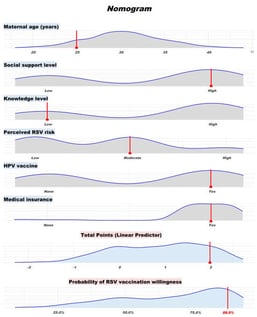
Predictive nomogram for maternal RSV vaccination willingness. Each predictor is plotted with a corresponding distribution, and red markers indicate an individual participant’s profile. The total score is translated into a predicted probability of RSV vaccination willingness. This represents an absolute predicted probability (not a relative risk), facilitating threshold-based clinical counseling and shared decision-making. Blue lines indicate variable distribution density, gray areas reflect population frequency, and red dots/lines represent the representative example prediction.
  • Correction
  • Open Access

The authors would like to make the following correction to the published paper [...]

10 February 2026

As Guest Editors of the Special Issue “Trust, Willingness, and Associated Factors towards COVID-19 Vaccine Uptake” [...]

9 February 2026

Background/Objectives: Sabin strain-based inactivated poliovirus vaccine (sIPV) is increasingly used in China’s routine immunization program and is often administered concomitantly with other childhood vaccines. However, large-scale real-world evidence on the safety of concomitant sIPV vaccination remains limited. This study evaluated the safety of sIPV administered standalone or concomitantly with other routine vaccines using provincial surveillance data. Methods: A retrospective observational study was conducted using data from the China National Adverse Events Following Immunization Surveillance System and the Anhui Provincial Immunization Information Management System. All sIPV doses administered between 1 November 2023 and 31 July 2025 were included. AEFI reporting rates per 100,000 doses were calculated. Descriptive analyses were performed by demographic characteristics and dose number. Multivariable negative binomial regression models were used to assess the association between vaccination mode and AEFI incidence, with dose-stratified analyses when appropriate. Results: Among the 303,526 sIPV doses analyzed (135,550 standalone and 167,976 concomitant), 188 AEFI cases were reported, yielding an overall reporting rate of 61.94 per 100,000 doses. Most AEFI were mild, self-limited general reactions, mainly fever and local injection-site reactions. Only two serious AEFI were reported, both resolving without sequelae. After adjustment for confounders, no significant difference in overall AEFI incidence was observed between standalone and concomitant vaccination (aRR = 0.97, 95% CI: 0.64–1.47). AEFI reporting was associated with age and region, while no consistent dose-related trend was identified. Conclusions: sIPV showed a favorable safety profile when administered standalone or concomitantly with other routine vaccines in real-world settings. Concomitant vaccination did not increase AEFI risk, supporting the continued use of sIPV in routine immunization programs.

9 February 2026

News & Conferences

Issues

Open for Submission

Editor's Choice

Reprints of Collections

Vaccines and Vaccination
Reprint

Vaccines and Vaccination

Feature Papers
Editors: Pedro Plans-Rubió
A World without Measles and Rubella
Reprint

A World without Measles and Rubella

Meeting the Regional Elimination Targets on the Path to Global Eradication
Editors: Jon Kim Andrus, Mark Papania, Sunil Bahl, David N. Durrheim, Katrina Kretsinger, Peter Strebel, Paul A. Rota, Susan Reef

Get Alerted

Add your email address to receive forthcoming issues of this journal.

XFacebookLinkedIn
Vaccines - ISSN 2076-393X