Skip to Content
You are currently on the new version of our website. Access the old version .

Urban Science

Urban Science is an international, scientific, peer-reviewed, open access journal of urban and regional studies, published monthly online by MDPI.
The Urban Land Institute (ULI) is affiliated with the journal.
Quartile Ranking JCR - Q1 (Geography | Urban Studies)

All Articles (1,598)

Medium-sized cities are increasingly affected by processes of urban fragmentation and residential segregation, despite having traditionally been perceived as more socially cohesive and territorially balanced than large metropolitan areas. Acting as functional connectors between metropolitan hubs and rural regions, these cities are particularly vulnerable to unplanned suburban growth, housing market polarization and uneven access to urban opportunities. This study develops and applies a multidimensional Urban Territorial Index (UTI) to diagnose socio-spatial inequality in medium-sized cities, using Ciudad Real (central Spain) and its functional urban area as a case study. The UTI integrates six indicators across three analytical dimensions—socioeconomic, sociodemographic and housing—through a PCA-informed weighting scheme and GIS-based spatial analysis. The index is calculated at census-tract and neighborhood scales and is validated through internal consistency checks, external comparison with a local Human Development Index (r = 0.87; p < 0.001), and qualitative robustness assessments. Results reveal a pronounced core–periphery polarization: central and strategically located neighborhoods associated with key infrastructures (university, high-speed rail station and hospital) concentrate higher income levels, educational attainment and land values, while peripheral municipalities and disadvantaged neighborhoods exhibit higher unemployment, lower housing values and greater social vulnerability. The analysis also identifies population–housing mismatches linked to suburban expansion without equivalent functional integration. Beyond the local case, the study provides a transparent and replicable methodological framework tailored to medium-sized cities, where metropolitan-scale indices often fail to capture fine-grained socio-spatial disparities. The UTI offers a practical tool for comparative analysis, temporal monitoring and evidence-based urban policy, supporting more inclusive and territorially balanced development strategies in diverse institutional and geographical contexts.

14 February 2026
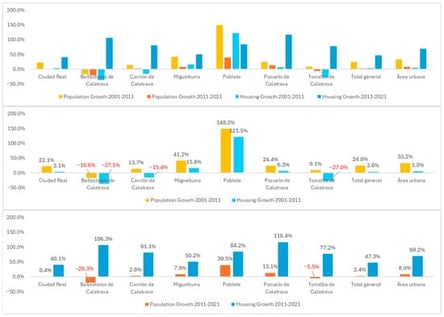
Relative Growth of Population and Housing in Ciudad Real and Its Urban Area.

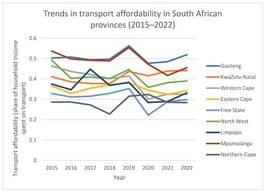
Transport affordability defined as the share of household income devoted to transport expenditure is a key dimension of urban equity and social inclusion, particularly in contexts characterised by spatial inequality and income disparities. This study examines provincial variation in public transport affordability across South Africa using a hierarchical Bayesian regression framework applied to province–year data from 2015 to 2022 (n = 72). Affordability is operationalised as a transport cost burden, with higher values indicating a greater proportion of household income spent on transport, and is modelled as a function of household income, trip frequency, household population, and total provincial employment, with province-level random intercepts capturing unobserved regional heterogeneity. The results indicate that household income is negatively associated with transport cost burden, suggesting that provinces with higher average income devote a smaller share of income to transport and therefore experience better affordability. In contrast, household population and aggregate provincial employment are positively associated with transport cost burden, reflecting higher overall mobility and commuting demands in larger and more economically active provinces rather than improved affordability. Trip frequency shows no statistically meaningful association with affordability once household composition and income capacity are accounted for. After accounting for observed characteristics, between-province variation is limited, indicating that affordability dynamics are broadly similar across provinces over the study period. Methodologically, the hierarchical Bayesian framework enables partial pooling across provinces and supports probabilistic inference through credible intervals, thereby improving the stability of estimates in a small-sample multilevel context. While the analysis is associational rather than causal, the findings provide policy-relevant evidence for monitoring transport affordability, including benchmarking the prevalence of affordability burdens relative to the commonly used 10% threshold.

13 February 2026

Trendline showing provincial transport affordability. Authors’ computation using Microsoft Excel (2025).

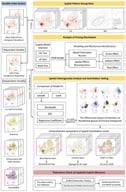
The spatial distribution of immigrants and associated patterns of residential segregation and integration can manifest not only at the metropolitan scale but also at finer micro-spatial resolutions, reflecting the interaction between path dependence and structural reconfiguration. This article examines the micro-spatial residential patterns of Chinese immigrants in Seoul under institutional and market constraints. Using a Spatial Durbin Model and Multiscale Geographically Weighted Regression, it shows that from 2011 to 2025, immigrant settlements shifted from a monocentric pattern to a polycentric, functionally differentiated, and networked structure. While overall spatial embeddedness is high and segregation remains low, traditional cores such as Guro–Daerim persist. Selective clustering is shaped by path-dependent migrant networks, urban redevelopment policies, and intra-group differentiation, while infrastructure homogenization renders transportation accessibility a background condition. The findings support segmented assimilation theory in high-density East Asian cities and underscore the importance of incorporating immigrant needs into urban policy to promote inclusive integration.

12 February 2026

Research processing for this study. Different research stages are indicated by distinct colored title boxes: blue for data preparation and variable selection, yellow for spatial analysis and mechanism identification, and red for spatial validation.

NORC (Naturally Occurring Retirement Community) programs and senior cohousing are two community-based, sustainable initiatives for aging in place associated with cooperative housing in New York and Spain, which are spreading rapidly as an alternative to institutionalization. This paper examines how NORC programs and senior cohousing support aging in place using a conceptual framework derived from theories on active aging and the ecological model of aging, which suggests specific dimensions to characterize the processes through which these initiatives potentially achieve their goal of promoting healthy, active aging, including aspects of the physical and social environment. Our framework was applied to a selection of case studies from each model, allowing us to conceptualize their strengths and weaknesses as developed in cooperatives in these two contexts. Findings show that NORC programs help older people stay in familiar neighborhoods and take advantage of economies of scale; however, dwellings are not adapted for reduced mobility. Spanish senior cohousing is an affordable and accessible alternative; however, existing communities are relatively isolated. Future research should consider hybrid models that incorporate the characteristics of various initiatives best suited to each context’s housing policies and welfare system.

12 February 2026

Socio-ecological framework of the process through which NORC programs and cohousing potentially facilitate aging in place. Source: Author, adapted from [29], p. 276 and [46], p. 5.

News & Conferences

Issues

Open for Submission

Editor's Choice

Reprints of Collections

The Study of Urban Geography and City Planning
Reprint

The Study of Urban Geography and City Planning

Editors: Rubén Camilo Lois González, Luis Alfonso Escudero Gómez, Daniel Barreiro Quintáns
Smart Cities
Reprint

Smart Cities

Infrastructure, Innovation, Technology, Governance and Citizenship Volume II
Editors: Luis Hernández-Callejo, Sergio Nesmachnow, Pedro Moreno-Bernal

Get Alerted

Add your email address to receive forthcoming issues of this journal.

XFacebookLinkedIn
Urban Sci. - ISSN 2413-8851