1. Introduction
In recent years, Portugal has faced a worsening housing crisis, particularly acute in urban centres such as Lisbon, where growing demand coexists with the paradox of thousands of homes remaining unoccupied. While public and political attention has often focused on increasing housing supply and regulating tenant protection, relatively little research has examined the motivations of those who control this hidden stock—the property owners themselves.
This study addresses this gap by focusing on the subjective rationalities and lived perceptions of property owners in the Lisbon Metropolitan Area (LMA). Rather than portraying landlords merely as obstacles to housing reform, we adopt an empathetic and systemic perspective, exploring how legal, financial, and cultural factors shape their choices. Understanding these dynamics is crucial for designing housing policies that effectively address vacancy.
The analysis focuses on the LMA, given its central role in the national housing crisis and its function as a testing ground for successive housing policy reforms. Over the last decade, many of Portugal’s major housing initiatives, including the New Urban Rental Regime (2012), the Affordable Rental Programme (2019) and, more recently, the Mais Habitação (More Housing) package (2023), have been implemented or debated most intensively in the context of Lisbon, given that it is the epicentre of housing pressures in the country.
Although the weight of real estate in the LMA (63%) is slightly lower than the continental average (69%) [
1], this territory offers a distinct context where the intersections between financialization, regulatory changes, and patrimonial attitudes towards property can be observed with greater clarity and usefulness. Portugal presents a particularly instructive case. A combination of historical rent freezes, frequent legislative changes, and unstable tax incentives has created a disproportionately elderly class of landlords who are risk-averse and deeply distrustful of the state. This pattern is, one more time, especially visible in Lisbon, where over 40% of landlords are small-scale owners aged 65 or older, and most inherited their properties rather than acquiring them through active investment [
2].
Drawing on international literature and empirical data from several editions of the ALP Landlords’ Confidence Barometer [
2], this study examines the multiple reasons behind landlords’ reluctance to rent. We argue that this resistance is not irrational or purely speculative. It reflects a broader crisis of confidence in both the state and the rental market. Without accounting for this distrust, housing policies, however well-intentioned, risk failing to activate a substantial portion of underutilized housing stock.
The main objective focuses on finding the reasons why landlords in Lisbon refrain from putting vacant houses on the rental market, despite high demand and rising prices. In line with this central concern, our research question asks: what factors (economic, institutional and cultural) explain landlords’ withdrawal from the rental market during the housing crisis in Lisbon?
The article is structured in such a way as to progressively relate the conceptual approach, the empirical framework and the interpretation of policies. Thus,
Section 2 describes the theoretical framework underlying the research, drawing on debates about the financialisation of housing, institutional trust, and the patrimonial logic of property to explain how these factors interact in shaping homeowners’ behaviour.
Section 3 details the methodological design and presents the empirical analysis based on five editions of the ALP Homeowners’ Confidence Barometer [
2], mapping homeowners’ profiles, fears, and decisions in the context of the Lisbon housing crisis.
Section 4 discusses the implications of these findings for public policy, advocating trust-based governance approaches that frame landlords as potential partners, rather than enemies, in the pursuit of equitable access to housing.
Section 5 deepens the analytical discussion, interpreting vacancy as a form of rational withdrawal within a dysfunctional institutional system, showing how economic caution, regulatory distrust, and patrimonial values converge in a coherent ecology of withdrawal.
Section 6 reflects on the methodological and analytical limitations of the study, addressing issues of data representativeness, geographical scope, and interpretative bias. Finally,
Section 7 concludes by summarising the main contributions and presenting a set of policy recommendations aimed at restoring legal predictability, relational trust, and cultural recognition in housing governance.
4. Lisbon Case Study: Distrust, and the Limits of Policy Activation
The LMA offers a revealing test case for understanding the paradox of housing abundance amid acute social inaccessibility. Although demand for affordable housing has risen sharply in the past decade, thousands of dwellings remain vacant or withheld from the long-term rental market. According to the Lisbon Municipal Housing Charter, in 2022 the city identified around 1000 fully vacant buildings and around 1600 partially vacant ones, representing around 5% of Lisbon’s classical building stock. Census-based vacancy counts are even higher, partly because they include units without active water consumption: of approximately 309,000 domestic water contracts, only 279,000 registered readings in 2022, indicating a substantial pool of dwellings with no confirmed occupancy (Lisbon Municipal Housing Charter).
Importantly, vacancy is neither spatially random nor socially neutral. The distribution of empty or derelict dwellings is highly concentrated in the historic centre and the riverside parishes, with Santa Maria Maior showing the highest share (around 12% of classical buildings fully or partially derelict), followed by Santo António, Misericórdia, Marvila and Estrela (Lisbon Municipal Housing Charter). These areas correspond to zones of intense urban rehabilitation, often linked to tourism-oriented redevelopment and the conversion of traditional dwellings into high-yield short-term rental uses.
The first key insight from the Housing Charter is that declining vacancy rates at the citywide scale can mask more disruptive local processes. In parishes such as Misericórdia, Santa Maria Maior and São Vicente, the apparent reduction in vacant units is overshadowed by a shrinking housing stock itself, driven by the replacement of long-term residential units with tourist-oriented or luxury redevelopments. Conversely, in parishes like Ajuda and Olivais, the contraction in occupied dwellings reflects a different dynamic: a gradual emptying-out of the existing stock, with 4.9% and 3.4% of the total number of dwellings, respectively, falling vacant between 2011 and 2021 (Lisbon Municipal Housing Charter).
A second insight concerns the temporal dimension. Even where recent rehabilitation activity has occurred, vacancy frequently persists over long cycles. Municipal data show that around 80% of derelict buildings have been classified as such for five years or more, and 20% for over a decade, demonstrating that vacancy is embedded in long-term structural patterns rather than short-term fluctuations.
Third, the Housing Charter highlights that vacancy stems from different mechanisms across the housing stock. Recent developments may remain empty while awaiting sale or rent, whereas older buildings—often in advanced disrepair—are kept out of the market due to structural degradation, legal disputes, inheritance fragmentation or speculative holding.
Fourth, the Charter’s analysis of water consumption patterns shows that administrative vacancy registries systematically underestimate the true extent of underuse, reinforcing the argument that the city suffers from a deeper, more pervasive form of non-occupation.
While aggregate vacancy has decreased only marginally, nine parishes recorded an increase of nearly 2000 vacant dwellings over the past decade. This long-term persistence of underuse, combined with the intensification of tourism-driven redevelopment, provides crucial background to understanding landlords’ behaviour and the limits of policy mobilisation.
4.1. Structural–Economic Factors: When Profitability Is Not Enough
The most immediate hypothesis for vacancy—that rents are too low to justify participation—proves inadequate when examined against the Lisbon context. Rents have climbed steadily for a decade, and rental demand remains exceptionally strong, yet the market continues to repel a substantial portion of property owners.
Table 2 summarises the main findings of each edition of the ALP Landlord Confidence Barometer [
2]. Each entry lists the barometer number, the main theme of the edition, the key indicators cited in the public summaries, and a link to the official report. Although the authors did not have access to the raw data sets, this structured summary allows for transparent references throughout the empirical analysis.
ALP Barometer data show that only 15% of landlords identify net rental yield as the primary determinant in decisions to rent [
2]. By contrast, 57.8% cite legislative predictability as the decisive factor, strongly suggesting that the structural fragility of rental income undermines the appeal of leasing, even where financial returns exist.
This pattern reflects the composition of Lisbon’s landlord class. Many are small-scale, ageing owners who inherited their properties rather than acquiring them for investment. For these actors, real estate functions primarily as a store of value, not a source of revenue. Vacancy therefore operates as a form of asset stewardship: a means of avoiding wear and tear, tenant disputes, bureaucratic entanglements, or a perceived erosion of control over one’s property.
Neighbourhood dynamics reinforce this logic. In gentrifying parishes—Misericórdia, Santa Maria Maior, São Vicente, and Estrela—property values have risen faster than rental yields. Holding a dwelling vacant until a favourable moment to sell, convert to short-term rental, or pass it on to family may be financially and emotionally more rational than entering the long-term market.
The introduction of the Mais Habitação package intensified this defensive behaviour [
35]. The VII Barometer (2024) recorded a 20% rise in rent increases above the legal indexation coefficient, often as a hedge against anticipated regulation rather than an attempt to maximise profit. Simultaneously, 9% of landlords sold previously rented units and 6% shifted them to short-term rental or temporary student/professional accommodation.
In this landscape, vacancy functions as a rational strategy of risk management, reflecting a widespread perception that rental income is slow, uncertain, bureaucratically burdensome, and emotionally costly. Until these structural risks are reduced, profitability alone is unlikely to activate vacant units.
4.2. Institutional and Legal Distrust: Opting out of an Unreliable System
Financial considerations, however, do not fully explain the depth of landlords’ disengagement. A stronger force emerges from survey responses: a profound distrust in the institutions responsible for governing the rental system.
This distrust is longstanding, shaped by decades of abrupt policy shifts and perceived hostility towards property owners. The pandemic-era eviction moratorium, followed by the Mais Habitação package [
35], including the proposal for coercive leasing of vacant properties, consolidated the belief that property rights are unstable and vulnerable to sudden, ideologically driven intervention.
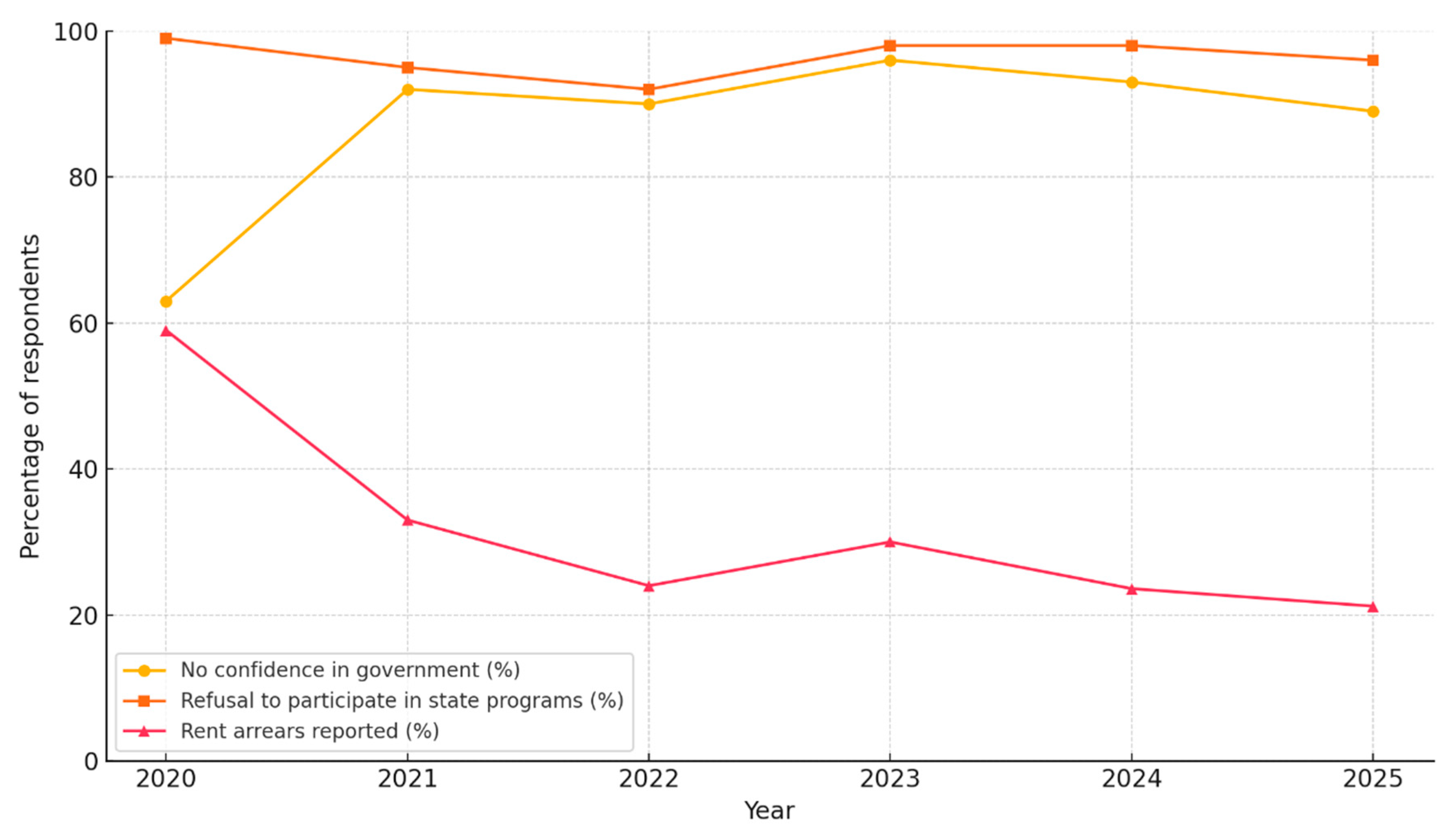
The consequences are striking. In 2024, 96% of landlords stated that they would refuse participation in any state-run rental programme, even with favourable conditions or tax benefits. Furthermore, 92.7% declared they would pursue legal action if their vacant property were requisitioned for public use.
Distrust extends beyond legislation to the broader judicial and fiscal framework. Courts are seen as slow and unpredictable; tax regimes as punitive; rental contracts as biased towards tenants; and eviction processes as prohibitively uncertain. Even when statistically rare, “nightmare scenarios” of non-paying tenants carry enormous symbolic weight, especially among older landlords with limited financial buffers.
This institutional uncertainty transforms vacancy into a political stance as much as a market behaviour, a form of silent resistance to a system perceived as unfair and unreliable. Without restoring trust, predictability, and procedural clarity, public incentives will remain largely ineffective.
The institutional mistrust expressed in the ALP Barometers is echoed in statements obtained from other associations in the sector [
2]. In a written interview, the Setúbal Association of Builders and Owners (ACPS) stresses that ‘an eviction (for serious breach of contract) takes more than 12 months’ and that ‘the law limits the security deposit to two months’ rent,’ which, according to the association, exposes landlords to ‘excessive risk’ [
30]. This perception of contractual imbalance reinforces the idea that the current legal framework creates uncertainty and encourages defensive withdrawal.
ACPS proposes two concrete solutions: (i) to legally guarantee eviction within a period shorter than that of the security deposit (e.g., two months), through summary proceedings in local civil courts; or (ii) the creation of a ‘universal public guarantee’ on rental contracts, managed by the State and compensated via Personal Income Tax (IRS). This proposal reflects an attempt to design ‘risk-sharing’ mechanisms that make renting less vulnerable to judicial delays.
This testimony corroborates the analysis developed here, which emphasises that mistrust is not limited to legislative instability, but extends to the perception that the judicial and tax systems are ineffective, slow and asymmetrical. The systematic refusal to participate in public programmes, as indicated by data from the 2024 Barometer, where 96% of respondents rejected state involvement, seems to be rooted in a broader pattern of institutional delegitimization.
The inclusion of testimony from the Portuguese Association of Real Estate Developers and Investors (APPII) provides a valuable counterpoint to the defensive logic expressed by small-scale landlords’ associations. While both groups identify legal uncertainty, judicial inefficiency, and fiscal instability as the core obstacles to market participation, their positions diverge in rationale and scale. For local landlords, as represented by the Setúbal Association of Builders and Owners (ACPS), distrust leads to protective withdrawal, a form of retreat from a system perceived as hostile and unpredictable [
33,
34]. For institutional investors and developers, however, represented by APPII, disengagement is framed as a strategic suspension of investment pending regulatory reform. Their proposed remedies are structural rather than reactive: long-term contractual flexibility, judicial efficiency, and predictable fiscal frameworks aimed at stimulating build-to-rent schemes and housing rehabilitation. This contrast reveals a layered landscape of mistrust: at one end, small proprietors withdraw to protect family assets; at the other, professional investors delay engagement until governance credibility is restored. Both dynamics reflect the same institutional fatigue but operate through distinct temporal and economic logics.
4.3. Sociocultural Dimensions: Patrimony, Identity, and the Right to Withhold
Beneath the economic calculus and legal hesitations that shape property owner behaviour in the LMA lies a deeper, more intimate layer of motivation, one rooted not in profit or policy, but in cultural norms, affective attachments, and intergenerational logics of patrimony. For many landlords in Portugal, property is not merely an investment or a utility. It is a symbolic asset, woven into family identity, social status, and long-term life planning.
The ALP Barometers consistently reveal that most landlords in the LMA are not corporate entities or large-scale investors, but older individuals managing inherited property. Over 60% of respondents are aged 55 or older, with many owning between one and five units -often buildings passed down through generations, concentrated in the same neighbourhoods where they themselves live or grew up [
2]. These landlords operate not within the rationalist frameworks of institutional investors, but within what might be described as a “familiar moral economy”, where the use of property is embedded in kinship obligations, emotional continuity, and informal inheritance strategies.
Within this worldview, vacancy is not wasteful but often a strategic, value-laden choice. An empty apartment may be reserved for a child or grandchild not yet ready to leave home. It may be kept unrented to avoid disputes, wear-and-tear, or conflicts that could tarnish a family asset. In other cases, it is simply held in stasis, neither sold nor leased, because it represents something more than shelter or income: it represents control, memory, dignity, and future security.
This “withholding” behaviour aligns with a broader Southern European pattern, where homeownership has historically functioned as a substitute for underdeveloped welfare regimes. In Portugal, owning property is often a form of private social insurance. It provides backup housing in times of crisis, serves as a fallback pension, and enables parents to offer their children a foothold in increasingly unaffordable urban markets. As [
9] argues in the Greek context, but equally applicable here, real estate is often the most reliable asset in a context of institutional fragility and market volatility, and its symbolic value can eclipse any potential rental yield [
14].
This patrimonial logic also interacts with affective economies of risk. Older landlords, especially those with few properties, often describe themselves as emotionally unprepared for the strain of dealing with problematic tenants, eviction proceedings, or public bureaucracy. Many express a preference for “peace of mind” over income, and a strong desire to maintain full control over how, when, and to whom their property is leased. In this sense, leasing is not just a financial transaction, it is a relational exposure, one that many would prefer to avoid altogether.
These choices are further reinforced by a moral narrative of responsibility. Contrary to stereotypes of landlord greed, many Lisbon owners describe themselves as careful, even paternalistic stewards of their properties. Some deliberately refrain from raising rents, even in the face of inflation, out of loyalty to long-term tenants. Others refuse to enter public programs because they believe the state would assign tenants they cannot vet personally, thereby compromising the integrity of the housing relationship. For these actors, rental decisions are guided not only by rational interest, but by reputational, familial, and emotional considerations.
Seen from this perspective, vacancy is neither passive nor antisocial. It is an active form of management, one that privileges long-term family strategies, personal autonomy, and asset preservation over short-term profit or public interest. It is, in effect, a cultural practice, shaped by generational memory, neighbourhood identity, and a deep scepticism of formal institutions.
As such, any policy that seeks to mobilize these vacant units must contend not only with legal and financial barriers, but also with these non-economic meanings of property. Designing effective interventions will require more than tax breaks or subsidies; it will demand culturally sensitive engagement with landlords’ values, identities, and lifeworld’s, and an acknowledgment that for many, renting out a home is not a business decision, but a deeply personal one.
This perception is not limited to rhetoric. It is grounded in concrete experience. Successive legislative shifts have altered the terms of leasing with little warning: rent freezes were reinstated after partial liberalization, eviction moratoria were introduced during the COVID-19 pandemic with minimal compensatory mechanisms, and the proposal for coercive rental, forced leasing of vacant properties by municipalities, was interpreted by many as a direct threat to the sanctity of ownership itself. Such policies, even when temporary or largely symbolic, send a clear message to landlords: your property is not entirely yours.
The data from the ALP Barometers is unequivocal [
2]. In 2024, 96% of surveyed property owners stated they would not participate in state-run rental programs, even those offering favourable conditions or tax benefits. Equally striking, 92.7% said they would pursue legal action if their vacant property were requisitioned for public use under new legislation. These are not marginal sentiments. They represent a near-consensus among a critical mass of active landlords in the metropolitan region of Lisbon.
Distrust also extends beyond specific policies to broader institutional arrangements. Courts are seen as slow and unpredictable; tax regimes are viewed as punitive and retroactive; rental contract frameworks are considered biased in favour of tenants. Eviction processes, in particular, are cited repeatedly as a deterrent. While not always statistically common, the perception of “nightmare scenarios”, where non-paying tenants occupy properties for months or even years without resolution, carries extraordinary symbolic weight, especially among older landlords or those with limited financial buffers. In this sense, the fear of legal entrapment often outweighs the financial benefits of occupancy.
Importantly, this climate of mistrust is not only institutional but relational and cultural. Landlords often report feeling politically vilified, portrayed in public discourse as profiteers, speculators, or hoarders, rather than as contributors to urban housing ecosystems. This symbolic delegitimization further entrenches their resistance to state programs. As the ALP barometers reveal [
2], many owners do not merely opt out of government schemes because they are inefficient; they do so because they feel fundamentally misrecognized by them.
What emerges from this data is not just a market failure, but a failure of mutual recognition between the state and a key class of urban stakeholders. While public authorities frame vacancy as a policy problem to be corrected, many owners experience it as a last refuge of autonomy in an environment where other rights, contractual, fiscal, reputational, have been gradually eroded.
Vacancy, in this light, becomes a political stance as much as a market behaviour. It is a way for owners to assert control, to resist participation in systems they no longer trust, and to insulate themselves from what they see as an unstable and ideologically shifting legal terrain. This dynamic fundamentally alters how policymakers must approach the problem: no amount of financial incentive will succeed unless it is accompanied by a restoration of trust, legal predictability, and symbolic legitimacy.
4.4. The Evolution of Landlord Confidence (2020–2025)
The evolution of owners’ attitudes between 2020 and 2025 highlights the procedural nature of withdrawal. Rather than being static or reactive, owners’ behaviour shows evidence of cumulative adaptation, shaped by repeated institutional disappointments, regulatory changes and deteriorating symbolic legitimacy. The ALP Barometers [
2] allow us to trace this trajectory in detail: initial caution induced by the pandemic gives way to chronic scepticism, especially in response to contested policy packages such as Mais Habitação [
35]. What emerges is not a one-off reaction, but a dynamic learning process in which landlords recalibrate expectations and reduce engagement with the rental market over time. This longitudinal evidence challenges purely structural explanations and underscores the importance of the time sequence for understanding how withdrawal becomes entrenched (
Table 3).
The trajectory of landlords’ confidence over the five years covered by the ALP Landlord Confidence Barometer provides us with a longitudinal dimension that supports the conclusions discussed above [
2]. Taken together, these barometers reveal not inconsistent fluctuations, but a persistent and cumulative process of withdrawal and mistrust. What began in 2020 as a reaction to the pandemic and emergency legislation has gradually become established as a structural feature of the rental landscape in Portugal, namely a widespread belief that the institutional environment is unpredictable and that the safest response is disengagement.
Since the first edition, following the COVID-19 moratorium, more than half of landlords reported serious delays in rent payments, and more than sixty per cent said they had lost confidence in the government’s handling of the housing crisis. Five years on, the same scepticism dominates the responses, even though the context has changed. The 2025 Barometer shows that 57.8% of landlords now identify legal and legislative stability as the decisive factor determining their participation in the rental market, far surpassing profitability or taxation as reasons for acting. This is perhaps the most direct statistical confirmation to date of the argument put forward in this research. Concretely, the primary barrier to mobilising private housing is institutional and symbolic, rather than economic. Once eroded, trust does not return with tax incentives, as it requires the rebuilding of predictability and respect.
Over the course of half a decade, this erosion accelerated under the weight of political controversy. The 2023’ Mais Habitação package, designed to expand the supply of rentals, had the opposite effect [
35]. According to ALP data [
2], two in ten landlords sold previously rented properties, while another in ten increased rents or converted them to short-term rentals. More tellingly, 96% of respondents said they would not rent to the state under any circumstances, and over 92% said they would go to court if faced with compulsory leases. The package, designed to engage landlords, ended up reinforcing the perception that government policy was volatile and contradictory. In subsequent editions, this sentiment did not diminish, as in 2024, about a quarter of landlords still reported delays in rent payments and more than half said they expected the situation to worsen.
The profile of landlords remained stable throughout this period. Each barometer confirms that the Portuguese rental market continues to be dominated by elderly, small-scale landlords (around 60% are over 55 years old and half have inherited their properties rather than buying them as an investment). The 2025 Barometer makes this dynamic explicit, noting that 44% of landlords are between 65 and 85 years old and that 58% did not even apply for the state compensation available for frozen rents, largely because they considered the process bureaucratically exhausting or unreliable. These details lend empirical depth to the argument developed earlier in this article, that the apparent “inertia” of landlords is in fact a culturally rooted strategy of protection and continuity.
Over these five years, the data reveal a consistent pattern of mainly defensive rationality. Landlords report similar levels of rent arrears (ranging from 20 to 30 per cent of respondents) and an almost unchanged refusal to participate in public programmes (over 90 per cent in all editions). Even with the change in the political landscape (from the socialist majority of the pandemic era to the new centre-right coalition in 2025), the feeling of mistrust persisted. As the latest Barometer concludes, most respondents do not believe that the current government’s tax reforms or “housing shock” initiatives will change their behaviour. Half say they will not put additional units on the market, and most will limit rent increases to the legal indexation coefficient.
Taken together, these successive surveys over the past five years transform what might appear to be a one-off dissatisfaction into a measurable continuity. The data reveals a class of small property owners who have learned to live defensively, conserving their property, avoiding involvement with state programmes and considering the legal framework as an unpredictable risk. In this sense, the housing crisis is not a temporary distortion of market dynamics, but the external symptom of long-term institutional fatigue. The lack of trust documented in the ALP Barometers for 2020–2025 reveals a housing system mired in mutual suspicion, where private landlords no longer expect the state to be a “person of good faith” and where public policies oscillate between dependence and hostility towards them [
2]. The challenge for the coming years will not only be to legislate differently, but to rebuild a relationship of trust, without which no incentive, however generous, will be able to transform empty houses into homes for families to live in.
The case studied suggests that the mechanisms underpinning vacancy are not isolated acts of resistance or purely cultural reflexes (
Figure 1). They are reproduced by a political environment that alternates between over-regulation and crisis management. Before proposing solutions, it is necessary to recognise that the governance structure itself has become a generator of risk perception.
5. Vacancy as a Rational Withdrawal in a Dysfunctional System
Beyond individual cost–benefit assessments, this article conceptualises incentives in housing governance as being collectively configured and institutionally mediated. In urban policy, incentives do not work solely through isolated economic signals, but through shared expectations, reputational norms, and anticipatory behaviours that emerge in specific governance environments. As the literature on urban incentives suggests, behavioural outcomes are shaped less by the presence of formal rewards or penalties than by how these instruments are collectively perceived, interpreted, and internalised over time.
In the case of Lisbon, political incentives aimed at activating vacant housing fail not because they are insufficiently generous, but because they are embedded in a broader incentive structure that consistently rewards risk avoidance and withdrawal. Legislative volatility, the symbolic delegitimisation of landlords, and procedural uncertainty collectively signal that non-participation is the safest and most legitimate strategy. As a result, individual landlords respond not to isolated incentives, but to a shared institutional climate in which vacancy functions as a collectively rational outcome.
This perspective helps explain why repeated fiscal incentives and regulatory adjustments have produced limited behavioural change. When incentives are misaligned at the collective level, additional measures tend to reinforce defensive expectations rather than counteract them. Vacancy thus reflects not the failure of individual motivation, but rather the cumulative effect of incentive configurations that normalise caution, delay, and disengagement within the housing system.
The conclusions of the Lisbon case are consistent with the theoretical framework discussed above, linked to financial rationality, institutional mistrust, and patrimonial logic. In line with studies on financialization promoted by the state [
3,
7] and on the moral economies of property [
36], the data suggest that the withdrawal of owners from the rental market represents an adaptation to regulatory uncertainty rather than an act of pure speculation.
The findings from the LMA case reveal a picture far more complex than the conventional narrative of “empty homes amidst housing crisis” might suggest. Far from being irrational or speculative, withholding properties from the rental market represents a rational withdrawal—a strategic, often deeply personal response to dysfunctional market signals, institutional frameworks, and sociocultural expectations.
Rather than a sign of market inefficiency, vacancy can be interpreted as part of a broader ecology of heritage withdrawal, that is, a constellation of behaviours in which financial caution, legal distrust, and heritage management coexist. This interpretation is in line with the work of Vrantsis [
14], who refers to similar dynamics of possessive familism in southern European property markets.
The three primary rationales identified, financial caution, institutional distrust, and patrimonial logic, reflect not only different motivations, but different modes of risk perception. For the economically cautious owner, vacancy is a hedge against weak rental yields and rising regulatory costs. For the distrustful owner, it is a shield against perceived state overreach and legal uncertainty. For the patrimonial owner, it is a means of preserving identity, dignity, and intergenerational autonomy. These rationales are not mutually exclusive. In many cases, they reinforce each other, creating a layered ecology of non-participation.
A further insight from the Lisbon Municipal Housing Charter reinforces this interpretation. Vacancy is driven not by a single mechanism but by coexisting structural processes across the housing stock. Newly built units may remain unused while awaiting sale or long-term tenants, whereas older buildings—often in poor condition or subject to inheritance fragmentation, legal disputes or protected tenancy legacies—are kept offline for years. This duality challenges policy narratives that treat vacancy as a homogeneous category. Instead, it reveals a stratified landscape in which different segments of the housing stock respond to different forms of uncertainty and risk.
Equally important is the temporal persistence of vacancy. Municipal data show that around 80% of derelict buildings have been classified as such for at least five years, and around 20% for over a decade, underscoring the difficulty of reactivating units once they fall out of circulation. Long-term vacancy is reinforced by procedural bottlenecks, from slow administrative classification to the numerous legal exceptions that exempt properties from intervention. These conditions contribute to a self-reinforcing cycle in which the longer a dwelling remains vacant, the harder it becomes to return it to productive use. Such persistence cannot be explained by short-term market fluctuations; it reflects structural fatigue.
Taken together, these insights suggest that vacancy in the LMA is not caused by any single market failure or policy gap, but by robust misalignments across several domains. Economic incentives remain too weak when compared to the perceived risks of tenancy and regulation. Institutional frameworks lack credibility, and their instability amplifies owners’ perception that renting exposes them to unpredictable burdens. Cultural and affective dimensions of property use—including deep-seated patrimonial logics—are routinely overlooked by policy instruments designed through economic or regulatory framings.
From a theoretical standpoint, the LMA case underscores the need to conceptualise housing not merely as an economic asset or regulatory object, but as a socially embedded, historically layered, and symbolically charged good. In Southern European contexts, where property ownership is intertwined with familial security, moral economies, and long-term strategies of intergenerational continuity, vacancy often reflects long-standing social norms rather than opportunistic behaviour.
Furthermore, the findings highlight a central paradox of housing governance: policies aimed at increasing supply may, if perceived as coercive or unstable, deepen withdrawal and entrench vacancy. Measures such as rent freezes, forced leasing, sudden tax reforms or abrupt changes in tenancy law can inadvertently validate landlords’ worst fears and reinforce non-participation. In this sense, the governance environment becomes a generator of risk perception rather than a mitigator. The evidence suggests that institutional distrust operates as a relational and symbolic mechanism, not merely a reaction to specific policies. Echoing Ferreira [
18], landlords’ withdrawal reflects a deeper erosion of procedural legitimacy, where policy volatility and administrative opacity translate into moral fatigue and political alienation.
Interpreted through this lens, the Lisbon case illustrates how vacancy emerges within what [
30] describes as an incomplete property regime, where ownership entails not only rights but also exposure to institutional uncertainty. At the same time, consistent with [
31,
32] account of fragmented urban governance, withdrawal reflects adaptation to a policy environment characterised by discontinuity, overlapping reforms and weak temporal coherence. Vacancy thus appears not as a passive residue of dysfunction, but as an active and rational adjustment to the way housing is governed.
This does not mean that regulation is inherently counterproductive. Rather, it underscores the importance of predictability, procedural fairness, and symbolic legitimacy. Landlords will not be compelled into participation through pressure alone. They must also be invited into partnership, with policy frameworks that offer not just incentives, but respect and recognition.
Finally, the case of the LMA points to a broader conceptual shift: rather than seeing vacancy as a purely negative externality, we might understand it as a barometer of institutional health. Persistent vacancy amid high demand signals not only a supply-demand mismatch but a rupture in the housing social contract, a breakdown of trust, reciprocity, and cooperation between private owners and public institutions.
Taken together, these findings point to an interdependent triad of mechanisms (financial, institutional, and cultural) that collectively sustain the persistence of vacancy. This synthesis supports the integrated framework proposed in
Section 2, showing that defensive withdrawal is not a deviation from rational behaviour but a culturally rooted adaptation to systemic uncertainty. Although further empirical research is needed to validate these patterns beyond Lisbon, the interpretative model developed here suggests a coherent explanation of how trust, political volatility, and patrimonial culture interact to shape housing outcomes.
6. Limitations and Reflexivity
This study is subject to several important limitations. First, the analysis is based on publicly available summary data from the ALP Homeowners’ Confidence Barometer [
2]. Although these barometers provide longitudinal consistency and thematic coherence, the authors did not have access to the raw data sets or socio-demographic variables at the respondent level. This limits the granularity of the analysis, particularly in terms of age, income, and housing portfolio.
Second, although the analysis focuses on the LMA, the ALP survey set is not strictly limited to that region [
2]. The barometers include respondents from across the country, which may introduce some heterogeneity in motivations, especially for variables such as urban regulation, market dynamics and exposure to tourism pressures. However, the majority of respondents are based in Lisbon and all the policy measures analysed were first implemented or had a primary impact in the Lisbon context.
Thirdly, this study focuses on small and medium-sized owners, represented by ALP members [
2]. It does not capture the perspectives or behaviours of large institutional investors, real estate funds, or international actors, whose presence in the Lisbon market has grown significantly in recent years. These actors often operate on different grounds, including yield optimisation, tax engineering, and portfolio diversification, which were outside the scope of this research.
Although ALP Landlord Confidence Barometers offer valuable longitudinal information on the dynamics of confidence and behavioural attitudes among landlords, they predominantly represent the perspectives of active landlords who continue to participate in the rental market. This introduces an obvious structural limitation as the study does not directly capture the views of landlords who do not let, i.e., those who own additional properties but choose to keep them vacant or use them informally. Understanding this ‘silent segment’ is crucial, as their absence from the rental market is a key mechanism in the persistence of urban vacancy.
Finally, as in any interpretative study, there is a risk of analytical bias. The thematic categories used (financial, institutional, patrimonial) were developed inductively but inevitably reflect the researcher’s perspective. Reflexivity was maintained throughout the study, triangulating the results with multiple data sources and positioning the analysis within the broader literature.
7. Conclusions and Policy Recommendations
This article has argued that the persistence of vacant housing in the LMA cannot be adequately explained by conventional explanations of market inefficiency, regulatory friction, or owner neglect. Instead, vacancy emerges as the result of a multidimensional ecology, shaped by financial rationality, institutional distrust, and patrimonial values.
By introducing the concept of ‘heritage withdrawal ecology’, the article advances the existing literature in several ways. First, it integrates cultural and affective dimensions into economic decision-making structures, showing that property is not only a financial asset but also a symbolic and intergenerational anchor. Second, it reframes institutional distrust as a processual phenomenon, not merely a perception but a sedimented outcome of erratic governance, bureaucratic opacity, and symbolic delegitimization. Third, it brings to the fore the relational and moral logics behind withdrawal, revealing how legal evasion and empathy often coexist in homeowners’ strategies.
Methodologically, the article draws on five years of sequential barometric data to trace the evolution of landlords’ attitudes, demonstrating that withdrawal is neither irrational nor abrupt, but learned, adaptive, and reinforced by political signals over time.
The case of Lisbon illustrates a paradox that extends beyond the local property market. Over five years, evidence shows that landlords’ withdrawal from the rental sector is not only a response to low returns, but a rational adaptation to legal instability, fiscal volatility and symbolic delegitimization. Financialization and regulation, far from being opposing forces, have interacted to produce an environment in which property is both an investment vehicle and a potential liability. This results in widespread “defensive rationality”, whereby landlords hold on to assets rather than putting them into circulation, making vacancy a structural feature of the urban landscape.
The evidence presented in this study suggests that the persistence of vacant housing in Lisbon cannot be fully explained by conventional accounts of market inefficiency or owner negligence. Instead, the findings indicate that vacancy often emerges as a multidimensional and rational response to a combination of financial caution, institutional distrust, and patrimonial values. Within this interpretive framework, what we describe as a heritage withdrawal ecology reflects the ways in which small property owners navigate uncertainty and preserve autonomy within an unstable regulatory environment.
These interpretations should, however, be read in light of the study’s methodological limitations. Because the ALP Barometer data primarily represent active landlords and are not statistically representative of the total population of property owners, the conclusions drawn here are indicative rather than definitive. The patterns identified reveal plausible mechanisms and relational dynamics rather than measurable proportions. Future research using broader datasets and complementary qualitative methods will be essential to test and refine these hypotheses.
Nevertheless, the overall evidence points consistently toward one critical implication: addressing housing vacancy in Portugal will require not only economic or fiscal instruments but also the gradual rebuilding of institutional trust, procedural stability, and symbolic recognition of small landlords as legitimate partners in housing governance. While the data do not “prove” this claim beyond doubt, they strongly suggest that without such trust-based reforms, the structural disengagement of private owners is likely to persist, leaving a significant share of Portugal’s housing stock underutilized.
7.1. Structural Predictability
The need for predictability and risk sharing is also emphasised by representatives of the private sector. ACPS, for example, proposes the creation of an ‘automatic public guarantee’ in rental contracts, managed by the State and compensated via income tax, in order to guarantee the payment of rent in the event of default. Alternatively, it advocates the implementation of simplified judicial mechanisms for evictions, similar to the former “eviction warrant”, with binding deadlines of less than two months. Both proposals are based on a diagnosis that makes it clear that the perception of legal risk is greater than the expected return, which discourages the placing of properties on the market.
When comparing small landlords and institutional investors, it is clear that mistrust is a common condition, but not a uniform experience. For small landlords, withdrawal from the rental market represents a defensive strategy rooted in asset preservation and emotional risk aversion; for institutional actors such as those represented by APPII, disengagement reflects a rational response to an unstable and inefficient governance environment. Although both groups demand greater predictability and legal protection, their preferred paths differ: micro-owners seek procedural safeguards and relational recognition, while developers and investors advocate structural reforms that increase contractual freedom, fiscal stability, and regulatory continuity. An effective housing policy must therefore adopt a differentiated approach that combines security and simplicity for small owners with credibility and long-term certainty for institutional capital. Only by aligning these parallel forms of rebuilding trust can policy restore confidence across the spectrum of private property and activate the housing stock that remains underutilised.
Including such proposals in the political debate does not imply their direct adoption but rather recognises that the actors in the sector themselves offer pragmatic solutions aimed at restoring confidence and reducing legal vulnerability. Such measures, if designed with balance and institutional safeguards, could represent important steps in rebuilding a stable and cooperative contractual environment.
At the heart of the crisis is the lack of legal and fiscal predictability. Longitudinal ALP Barometers [
2] suggest that legislative instability now surpasses profitability as the main determinant of landlords’ behaviour. Policies should prioritise stability and predictability over novelty. Introducing multi-year stability clauses in rental legislation—ensuring that contractual and fiscal conditions cannot be retroactively altered—would send a strong signal of reliability. Similarly, tax reform should aim for neutrality rather than incentives, as simplifying tax codes and unifying deductions for small landlords would reduce the perception of discretionary intervention that currently drives defensive behaviour.
7.2. Relational Trust
Rebuilding trust requires more than legal initiatives. The analysis suggest that landlords view the state not as a partner, but as an adversary with unpredictable behaviour. To counter this perception, intermediary institutions are essential. Independent agencies or municipal housing funds could act as mediators, ensuring transparent communication, fair dispute resolution, and protection against unilateral policy reversals. These intermediaries would translate abstract policies into credible practices, restoring relational trust where institutional trust has been degraded.
7.3. Socio-Cultural Recognition
The data also suggest that Portuguese landlords are predominantly elderly and often owners ‘by inheritance’. Their relationship with housing is patrimonial and affective, as well as economic. Policies portraying landlords solely as income-seekers ignore this dimension, thereby alienating them. Measures based on recognition, for example, heritage-sensitive rehabilitation programmes or the symbolic recognition of long-standing small property owners as civic contributors, can rebuild legitimacy. Integrating this sociocultural understanding into housing policy is not a mere aspect. It is more the pragmatic recognition of the moral economy that underpins real estate decisions.
7.4. Institutional Coherence
The case of Lisbon further highlights how successive and contradictory policy packages have eroded credibility. Fragmented interventions, oscillating between punitive taxation and subsidy schemes, signal a short-term vision and amplify uncertainty. A coherent national framework for housing, ideally enshrined in a parliamentary agreement between parties, would stabilise expectations across political cycles. The focus must shift from piecemeal and incoherent responses to the crisis to institutional reliability. Only coherence can transform the relationship between private owners and public objectives from transactional to cooperative.
7.5. Beyond Incentives
Finally, data suggest that fiscal incentives alone are not enough to rebuild lost trust. Trust is cumulative and relational and cannot arise spontaneously. The challenge is not so much to create new subsidies, investing money in the problem, but to ensure that existing promises are kept. This requires transparent monitoring, accessible complaint mechanisms, and political discipline to enforce the rules once they are established.
This article has argued that the persistence of vacant housing in the region of Lisbon cannot be adequately explained by conventional explanations of market inefficiency, regulatory friction, or owner neglect. Instead, vacancy emerges as the result of a multidimensional ecology, shaped by financial rationality, institutional distrust, and patrimonial values.
By introducing the concept of ‘patrimonial withdrawal ecology’, the article advances the existing literature in three main ways. First, it integrates cultural and affective dimensions into economic decision-making structures, showing that property is not only a financial asset but also a symbolic and intergenerational anchor. Second, it reframes institutional distrust as a processual phenomenon, not merely a perception but a sedimented outcome of erratic governance, bureaucratic opacity, and symbolic delegitimization. Third, it brings to the fore the relational and moral logics behind withdrawal, revealing how legal evasion and empathy often coexist in homeowners’ strategies.
Policy responses that focus exclusively on economic incentives or coercive measures are unlikely to succeed without restoring legal stability, symbolic recognition, and administrative coherence. Future research should explore how hybrid models of governance, combining fiscal predictability with the building of trust relationships, can promote re-engagement among small landlords.
7.6. Further Research
Future research should therefore aim to complement barometric data with targeted surveys and mixed-method approaches capable of identifying the profile, scale, and motivations of these owners. This would allow for a more accurate quantification of how many housing units are intentionally retained and the reasons (socioeconomic, emotional, or institutional) behind this decision. Combining administrative data (e.g., tax returns, registration information, or water consumption records) with qualitative interviews could provide a richer understanding of the logic behind defensive withdrawal. Such research would not only refine the explanatory model proposed here, but also strengthen the empirical basis for the development of trust-based housing policies capable of re-engaging owners who do not rent out their properties.