

Skip to Content
  • 41 days
    Submission to First Decision
  • 21 days
    Acceptance to Publication

Société Internationale d’Urologie Journal

Société Internationale d’Urologie Journal (SIUJ) is an international, peer-reviewed, open access journal that covers all aspects of urology and related fields, published bimonthly online. It is the official journal of the International Society of Urology (SIU).
  • Open Access— free for readers and authors (diamond open access), with article processing charges (APC) paid by the Société Internationale d’Urologie.
  • Rapid Publication: manuscripts are peer-reviewed and a first decision is provided to authors approximately 41 days after submission; acceptance to publication is undertaken in 20.8 days (median values for papers published in this journal in the first half of 2026).
  • Recognition of Reviewers: Reviewers whose reports are timely and of high quality receive an APC discount voucher for a future publication in an MDPI journal. Become a reviewer.

Get Alerted

Add your email address to receive forthcoming issues of this journal.

All Articles (431)

  • Systematic Review
  • Open Access

Background/Objectives: Repeat transurethral resection of bladder tumor (TURBT) remains important in selected high-risk non-muscle-invasive bladder cancer (NMIBC) because residual tumor may persist after initial resection, yet some patients may undergo an ultimately tumor-negative procedure. Postoperative urinary molecular testing may provide a noninvasive approach to identify residual disease before repeat TURBT. This review evaluated the diagnostic performance and potential triage value of postoperative urinary nucleic-acid assays for detecting histologically confirmed residual tumor before repeat TURBT in patients with high-risk NMIBC. Methods: PubMed, Scopus, Web of Science, and the Cochrane Library were searched. Eligible studies included adults with high-risk NMIBC undergoing initial TURBT, postoperative urinary nucleic-acid testing before repeat TURBT, and histopathological residual-disease assessment. Risk of bias was assessed using Quality Assessment of Diagnostic Accuracy Studies, version 2 (QUADAS-2). Certainty of evidence was assessed using Grading of Recommendations, Assessment, Development, and Evaluation (GRADE) for diagnostic test accuracy. Findings were synthesized narratively. Results: Of 3231 records, four studies met the eligibility criteria. Performance varied across assays. UroAmp Prognosis achieved 97% sensitivity and 89% negative predictive value (NPV); UroAmp minimal residual disease (MRD) achieved 72% sensitivity, 80% specificity, and 57% NPV. utLIFE achieved 80.7% sensitivity, 96.2% specificity, and 90.1% NPV. The H4 Clustered Histone 6 (H4C6)/Twist Family bHLH Transcription Factor 1 (TWIST1) methylation panel achieved 65.2% sensitivity, 87.5% specificity, and a calculated NPV of 77.8%. OncoUrine achieved an NPV of approximately 82% in the high-risk subgroup. Certainty was very low for UroAmp Prognosis, UroAmp MRD, the H4C6/TWIST1 panel, and utLIFE, and low for OncoUrine in the high-risk subgroup. No included study evaluated omission of repeat TURBT based on a negative molecular result. Conclusions: Postoperative urinary molecular assays remain promising investigational tools, but the available evidence is of low to very low certainty and does not establish that repeat TURBT can safely be omitted after a negative result. Prospective external validation and management-impact studies are required before routine clinical use for this purpose.

Soc. Int. Urol. J.

21 October 2026
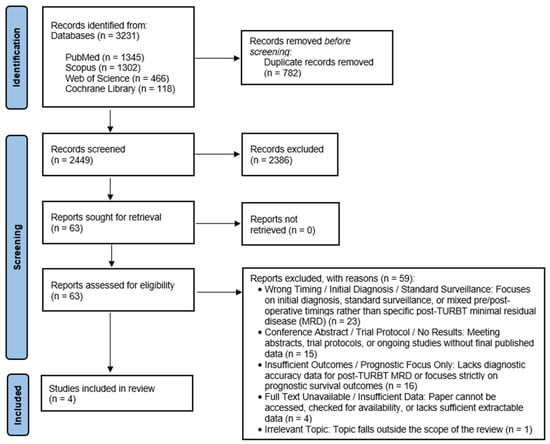
PRISMA flow diagram of study identification, screening, eligibility assessment, and inclusion. The diagram summarizes the identification of records, removal of duplicates, title/abstract and full-text screening, reasons for exclusion, and final inclusion of four studies evaluating postoperative urinary nucleic-acid molecular assays for histologically confirmed residual tumor after initial TURBT in patients with high-risk non-muscle-invasive bladder cancer. PRISMA, Preferred Reporting Items for Systematic Reviews and Meta-Analyses, TURBT, transurethral resection of bladder tumor.
  • Editorial
  • Open Access

One Year On

  • Henry H. Woo

This issue marks my first year as Editor-in-Chief of the Société Internationale d’Urologie Journal (SIUJ) [...]

Soc. Int. Urol. J.

21 October 2026

  • Article
  • Open Access

Accuracy, Completeness, and Clarity of EAU Guidelines Bot for Renal Transplantation

  • Matteo Romagnoli,
  • Manfredi Bruno Sequi and
  • Cosimo De Nunzio
  • + 20 authors

Background/Objectives: Recently, the European Association of Urology (EAU) guidelines presented the EAU guidelines bot to assist urologists in the reading of the guidelines; however, to date, no external validation is available. The aim of our study is to assess the accuracy, completeness, and clarity of the guidelines bot in reading renal transplantation guidelines and clinical cases. Methods: A total of 103 questions derived from the recommendations included in the EAU guidelines on renal transplantation, together with 10 distinct clinical scenarios, were created. Each question and clinical case was submitted to the EAU guidelines bot, and the corresponding responses were independently evaluated by two expert urologists in terms of accuracy, completeness, and clarity. Each domain was scored using a 5-point Likert scale. In cases of disagreement between the two reviewers, a third urologist was consulted. Accuracy, completeness, and clarity were analyzed for the clinical cases and per chapter and grade of recommendation for the questions. Results: Overall, 103 questions were generated. Regarding accuracy, 101/103 responses (98%) were classified as accurate, corresponding to scores of 4–5, whereas 2/103 responses (2%) showed fair accuracy, corresponding to a score of 3. No responses were considered inaccurate, defined as a score of 1–2. In terms of completeness, 101/103 responses (98%) were judged to be complete, with scores of 4–5, while 2/103 responses (2%) were rated as fairly complete, with a score of 3. No responses were classified as incomplete. With regard to clarity, 102/103 responses (99%) were considered clear, corresponding to scores of 4–5, whereas 1/103 response (1%) was rated as fairly clear, with a score of 3. No responses were deemed unclear. No significant differences were observed when comparing responses related to strong versus weak recommendations. For the clinical scenarios, 8/10 responses (80%) were rated as accurate, with scores of 4–5, while 2/10 responses (20%) showed fair accuracy, with a score of 3. Regarding completeness, all 10 responses (100%) were classified as fairly complete, corresponding to a score of 3. Finally, in terms of clarity, 8/10 responses (80%) were judged to be clear, with scores of 4–5, whereas 2/10 responses (20%) were rated as fairly clear, with a score of 3. Conclusions: The EAU guidelines bot represents an accurate tool for renal transplantation. Besides some occasional inaccuracies the bot is an excellent tool for urologists, especially to clarify doubt about the EAU guidelines. At the same time, it can give good support when facing a clinical case.

Soc. Int. Urol. J.

21 October 2026
  • Article
  • Open Access

Background/Objectives: Large language models (LLMs) such as ChatGPT, Gemini and Claude are increasingly used by patients to research new diagnoses, including testicular cancer. The aim of this study was to evaluate and compare the quality of responses generated by these three platforms to patient-facing frequently asked questions on testicular cancer, including a focused evaluation of fertility and sexual health questions. Methods: Fifteen questions were developed from established patient education resources and refined by senior urology consultant review. Each question was posed to ChatGPT, Gemini and Claude using a standardised patient-perspective prompt. The 45 responses were de-identified, randomised and assessed in a single consensus meeting by a urology panel using the Quality Analysis of Medical Artificial Intelligence (QAMAI) tool. Comparative analysis used the Friedman test with Bonferroni-corrected pairwise Wilcoxon signed-rank testing. Results: All three models produced moderate quality responses, with a mean total QAMAI score of 21.8 for ChatGPT, 22.4 for Claude, and 22.1 for Gemini (Friedman p = 0.246). Clarity differed significantly between models (adjusted p = 0.022), with Claude and Gemini outperforming ChatGPT. In the fertility and sexual health domain, Claude (24.0) and Gemini (23.0) outperformed ChatGPT (19.7). No response from any model spontaneously cited references or directed the reader to external resources. Conclusions: ChatGPT, Gemini and Claude deliver broadly equivalent overall quality on patient-facing testicular cancer questions, with inter-model differences in clarity and in the fertility and sexual health domain. The absence of source citation is a clinically relevant limitation. These tools should be regarded as a supplement to, rather than a substitute for, specialist counselling.

Soc. Int. Urol. J.

21 October 2026

Highly Accessed Articles

News & Conferences

Latest Issues

Open for Submission

Journal Sections

XFacebookLinkedIn
Soc. Int. Urol. J. - ISSN 2563-6499