


Abstract
Background/Objectives: Repeat transurethral resection of bladder tumor (TURBT) remains important in selected high-risk non-muscle-invasive bladder cancer (NMIBC) because residual tumor may persist after initial resection, yet some patients may undergo an ultimately tumor-negative procedure. Postoperative urinary molecular testing may provide a noninvasive approach to identify residual disease before repeat TURBT. This review evaluated the diagnostic performance and potential triage value of postoperative urinary nucleic-acid assays for detecting histologically confirmed residual tumor before repeat TURBT in patients with high-risk NMIBC. Methods: PubMed, Scopus, Web of Science, and the Cochrane Library were searched. Eligible studies included adults with high-risk NMIBC undergoing initial TURBT, postoperative urinary nucleic-acid testing before repeat TURBT, and histopathological residual-disease assessment. Risk of bias was assessed using Quality Assessment of Diagnostic Accuracy Studies, version 2 (QUADAS-2). Certainty of evidence was assessed using Grading of Recommendations, Assessment, Development, and Evaluation (GRADE) for diagnostic test accuracy. Findings were synthesized narratively. Results: Of 3231 records, four studies met the eligibility criteria. Performance varied across assays. UroAmp Prognosis achieved 97% sensitivity and 89% negative predictive value (NPV); UroAmp minimal residual disease (MRD) achieved 72% sensitivity, 80% specificity, and 57% NPV. utLIFE achieved 80.7% sensitivity, 96.2% specificity, and 90.1% NPV. The H4 Clustered Histone 6 (H4C6)/Twist Family bHLH Transcription Factor 1 (TWIST1) methylation panel achieved 65.2% sensitivity, 87.5% specificity, and a calculated NPV of 77.8%. OncoUrine achieved an NPV of approximately 82% in the high-risk subgroup. Certainty was very low for UroAmp Prognosis, UroAmp MRD, the H4C6/TWIST1 panel, and utLIFE, and low for OncoUrine in the high-risk subgroup. No included study evaluated omission of repeat TURBT based on a negative molecular result. Conclusions: Postoperative urinary molecular assays remain promising investigational tools, but the available evidence is of low to very low certainty and does not establish that repeat TURBT can safely be omitted after a negative result. Prospective external validation and management-impact studies are required before routine clinical use for this purpose.
1. Introduction
Non-muscle-invasive bladder cancer (NMIBC) accounts for approximately three-quarters of newly diagnosed bladder cancers and comprises a heterogeneous group of Ta, T1, and carcinoma in situ tumors with substantial risks of recurrence and progression [1]. Accurate pathological staging and complete initial resection are therefore central to subsequent management. In selected high-risk settings, repeat transurethral resection of bladder tumor (re-TURBT) remains recommended, particularly after T1 disease, incomplete resection, or absence of detrusor muscle, because residual tumor and occult understaging may persist after the initial procedure [2,3]. Contemporary evidence continues to demonstrate clinically relevant residual disease at repeat resection, despite improvements in resection techniques [4].
The challenge is that re-TURBT is invasive and is not followed by residual tumor in every patient. This creates a clinically important gap between the need to detect occult residual disease and the burden of routinely repeating an invasive procedure [5]. A reliable noninvasive test that identifies patients with a sufficiently low probability of residual tumor could therefore support more individualized postoperative management. Urine is particularly attractive for this purpose because the urinary tract directly reflects bladder tumor biology and permits repeated, noninvasive sampling [6].
Urinary molecular biomarkers have expanded beyond conventional cytology to include genomic alterations, DNA methylation, tumor-derived DNA, and multimarker classifiers [7]. However, most published evidence has focused on initial cancer detection, surveillance, or prediction of future recurrence rather than on the immediate postoperative decision of whether a patient requires re-TURBT [8,9]. Recent studies have begun to address this specific clinical window, including urinary DNA mutation/methylation assays and multidimensional tumor-DNA classifiers evaluated before repeat resection [10,11,12]. These emerging data raise the possibility that postoperative molecular negativity could function as a rule-out signal for residual disease, while molecular positivity could identify patients in whom repeat resection remains particularly warranted. However, the incremental value of postoperative molecular testing relative to cystoscopy or enhanced cystoscopic visualization remains uncertain in this clinical setting. The diagnostic performance of these assays may also differ according to tumor phenotype; papillary disease, papillary disease with concomitant carcinoma in situ (CIS), and CIS-only disease should not be assumed to have equivalent molecular-detection profiles.
Importantly, diagnostic accuracy alone does not establish clinical utility. For a molecular assay to influence the decision to omit re-TURBT, it must reliably exclude clinically meaningful residual disease, minimize false-negative results, and demonstrate reproducible performance in appropriately selected high-risk populations [13]. This requirement is particularly important when false-negative findings involve high-grade residual disease or CIS. Existing urinary-biomarker reviews have largely examined surveillance against cystoscopy and therefore do not directly answer this postoperative pathological question [9]. A focused synthesis of studies evaluating urinary nucleic-acid assays specifically between initial and repeat transurethral resection of bladder tumor (TURBT) is therefore needed. In addition to summarizing assay-specific diagnostic accuracy, distinguishing phenotype-specific findings where reported and clarifying whether direct comparative evidence against enhanced cystoscopy is available are important for defining the potential clinical role of these tests.
The aim of this systematic review was to evaluate the diagnostic performance of postoperative urinary nucleic-acid molecular assays for detecting histologically confirmed residual tumor at repeat TURBT in adults with high-risk NMIBC, with particular emphasis on negative predictive value, false-negative risk, reported findings according to tumor phenotype where available, comparative evidence against other diagnostic approaches, and the potential of molecular testing to support individualized selection for repeat TURBT.
2. Methods
2.1. Protocol and Registration
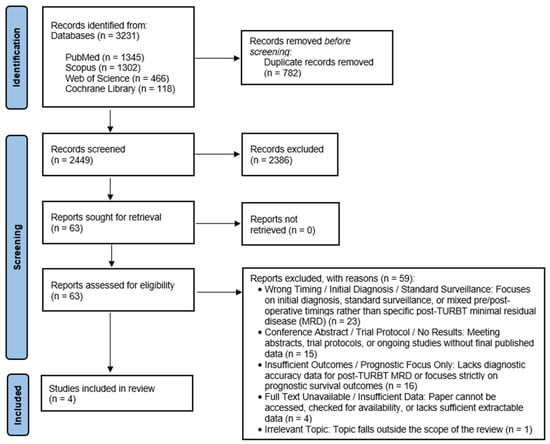
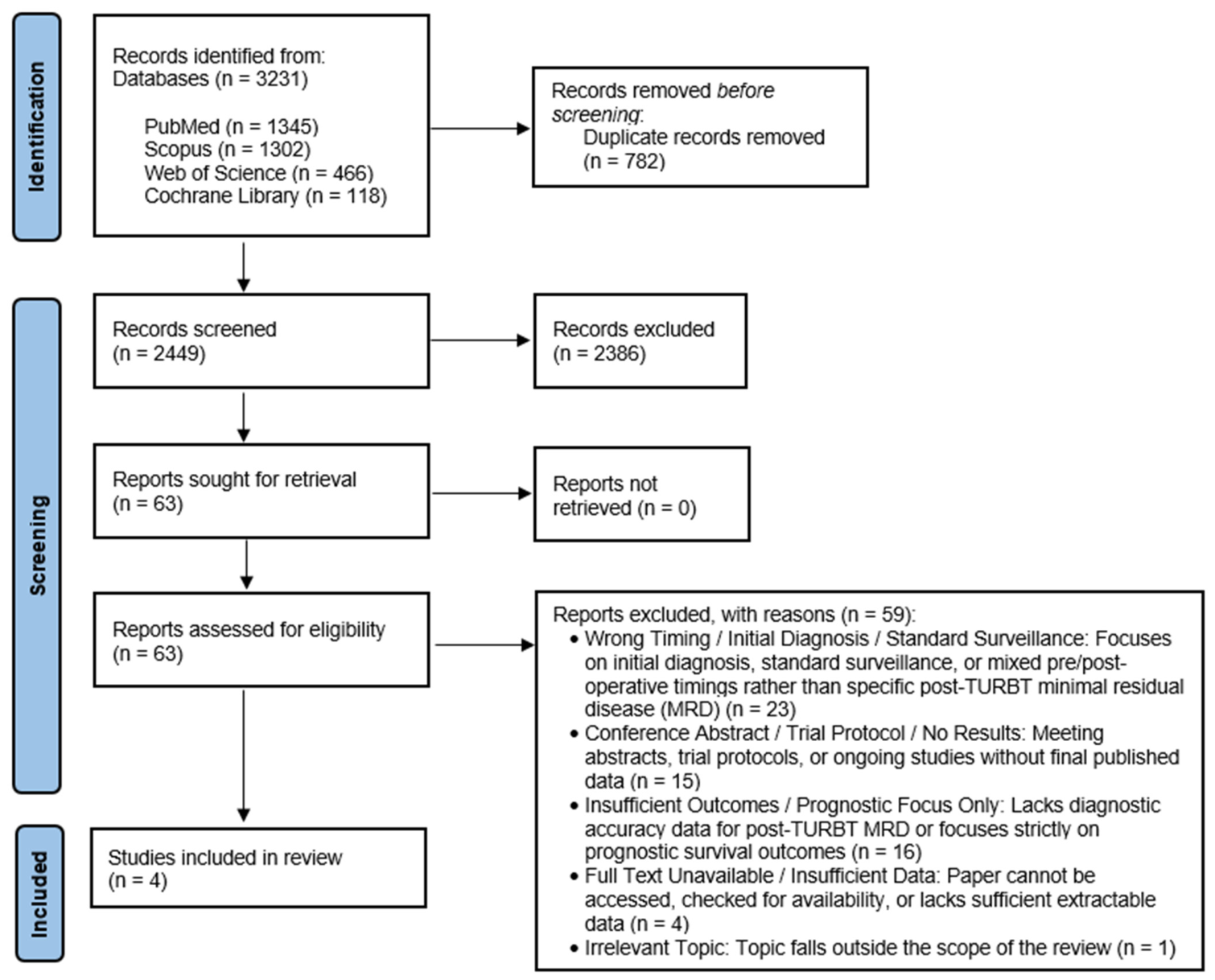
This systematic review was registered in the International Prospective Register of Systematic Reviews (PROSPERO; CRD420261492613). The review was conducted and reported in accordance with the Preferred Reporting Items for Systematic Reviews and Meta-Analyses (PRISMA) 2020 statement and its associated reporting guidance (PRISMA 2020 Checklist). The review question, eligibility criteria, outcomes, risk-of-bias approach, and narrative synthesis strategy were prespecified. The study-selection process is summarized in Figure 1, and the complete database-specific search strategies are provided in Supplementary Table S1.
Figure 1.
PRISMA flow diagram of study identification, screening, eligibility assessment, and inclusion. The diagram summarizes the identification of records, removal of duplicates, title/abstract and full-text screening, reasons for exclusion, and final inclusion of four studies evaluating postoperative urinary nucleic-acid molecular assays for histologically confirmed residual tumor after initial TURBT in patients with high-risk non-muscle-invasive bladder cancer. PRISMA, Preferred Reporting Items for Systematic Reviews and Meta-Analyses, TURBT, transurethral resection of bladder tumor.
2.2. Review Question and Eligibility Criteria
The review question was structured around whether, in adults with high-NMIBC who had undergone initial TURBT, a postoperative urinary nucleic-acid molecular assay performed before repeat TURBT could identify histologically confirmed residual tumor and potentially support individualized repeat-TURBT decision-making.
Studies were eligible when they included adults aged ≥18 years with high-risk NMIBC, including high-grade Ta disease, high-grade T1 disease, or CIS evaluated within a high-risk NMIBC/repeat-TURBT pathway. Mixed-stage, mixed-grade, or mixed-risk populations were eligible only when an analyzable high-risk subgroup undergoing repeat TURBT was reported or when at least 80% of the analyzed population met the predefined high-risk criteria, and the cohort was clearly situated within a repeat-TURBT pathway. Studies in which lower-risk disease predominated and eligible high-risk data could not be separated were excluded. In all eligible studies, the patients had to have undergone an initial TURBT before collection of the urine specimen used for the relevant molecular analysis.
The index test was required to be a urinary nucleic-acid-based molecular assay intended to detect residual tumor, molecular persistence, or tumor-derived molecular abnormalities after TURBT. Eligible technologies included urinary tumor DNA or tumor-derived cell-free DNA assays, mutation or genomic-alteration profiling, DNA methylation assays, copy-number analysis, targeted or whole-genome sequencing, polymerase chain reaction (PCR)-based molecular assays targeting tumor-derived alterations, digital PCR, multiplex molecular panels, tumor-informed or tumor-naïve urinary DNA assays, and molecular classifiers using machine-learning methods applied to urinary nucleic-acid features. Assays based exclusively on urinary proteins, nuclear matrix protein 22 (NMP22) or similar protein markers, conventional cytology, metabolomic or inflammatory biomarkers, nonqualifying microRNA-only approaches, imaging, or blood-based biomarkers were excluded. Cytology and imaging were permitted as comparator modalities but did not qualify as the index test.
A mandatory timing criterion was applied. The qualifying urine specimen had to be obtained after initial TURBT and before repeat TURBT, with a preferred interval of 2–12 weeks after the initial procedure. For synthesis, postoperative timing was categorized as 2–6 weeks or >6–12 weeks when adequately reported. Studies were retained when the exact interval fell slightly outside these ranges only if the specimen was clearly obtained after the initial TURBT and before the planned repeat TURBT and the timing was considered clinically comparable to the repeat-TURBT decision interval. Studies involving urine collected only before initial TURBT, during initial diagnostic evaluation, during routine long-term surveillance, after documented recurrence, or after repeat TURBT were excluded unless an independently eligible pre-repeat-TURBT specimen was available.
The mandatory reference standard was histopathological assessment of tissue obtained at repeat TURBT. Eligible target conditions included any residual tumor, residual Ta or T1 disease, residual CIS, higher-grade residual disease, pathological upstaging, or muscle-invasive disease identified at repeat TURBT. Cystoscopy, cytology, imaging, symptoms, clinical assessment, or molecular status alone could not substitute for histopathological verification of residual disease.
The primary outcome was histologically confirmed residual tumor at repeat TURBT. Eligible diagnostic measures included sensitivity, specificity, positive predictive value (PPV), negative predictive value (NPV), diagnostic accuracy, area under the receiver-operating-characteristic curve (AUC), likelihood ratios, and diagnostic odds ratios when reported. Secondary outcomes included repeat-TURBT triage performance, false-negative rates, residual disease among molecular-negative and molecular-positive patients, estimated repeat-TURBT avoidance, clinically significant residual disease, pathological upstaging, occult muscle-invasive disease, recurrence and progression outcomes, Bacillus Calmette–Guérin (BCG) failure, subsequent repeat TURBT or radical cystectomy, and comparative performance against cytology, cystoscopy, conventional clinicopathological models, or combined clinical models. Comparative findings involving enhanced cystoscopy were considered when directly reported by an eligible study. Secondary longitudinal outcomes were considered only when reported from an otherwise eligible postoperative cohort.
Eligible designs included prospective diagnostic studies, prospective or retrospective cohort studies, biomarker validation studies, longitudinal observational studies, and nested case–control studies when the qualifying urine sample preceded determination of the pathological outcome and an appropriate repeat-TURBT reference standard was available. Case reports, case series without an appropriate pathological reference standard, reviews, systematic reviews, meta-analyses, editorials, commentaries, letters without sufficient original data, conference abstracts without adequate methodological and outcome information, protocols without clinical results, animal studies, in vitro studies, and laboratory-only studies were excluded.
A study was considered eligible only when all mandatory elements were satisfied: an adult high-risk NMIBC population; initial TURBT before molecular testing; qualifying urinary nucleic-acid testing after initial TURBT; urine collection before repeat TURBT; repeat TURBT or equivalent pathological reassessment; histopathological determination of residual disease; original human clinical data; and an evaluable relationship between the molecular result and the pathological outcome.
2.3. Information Sources and Search Strategy
A comprehensive electronic search was conducted in PubMed, Scopus, Web of Science, and the Cochrane Library to identify potentially eligible studies. Search strategies combined controlled vocabulary and free-text terms related to NMIBC, residual or persistent tumor after TURBT, repeat TURBT, urinary molecular biomarkers, urinary tumor DNA, genomic or mutational profiling, DNA methylation, and related nucleic-acid assays. Database-specific syntax and indexing were adapted for each information source. The complete search strategies are provided in Supplementary Table S1.
The search was designed to identify studies evaluating the postoperative molecular decision point between initial TURBT and repeat TURBT rather than urinary biomarkers used solely for diagnosis at presentation or routine surveillance. Reference lists of relevant studies and reviews were also screened to identify potentially eligible reports not retrieved through the electronic database searches. Multiple publications arising from the same underlying cohort were assessed together to avoid double-counting.
2.4. Study Selection
All retrieved records were consolidated and duplicate citations were removed before screening. Two reviewers independently screened titles and abstracts, followed by independent full-text assessment of potentially eligible reports against the prespecified criteria. Disagreements were resolved through discussion and consensus between the reviewers.
At the full-text stage, the principal exclusion reasons were inappropriate timing or focus on initial diagnosis or routine surveillance, conference abstracts or trial protocols without eligible final results, insufficient diagnostic outcomes or a prognostic-only focus, unavailable or insufficiently extractable full-text information, and irrelevance to the review question. The study-selection process is presented in Figure 1.
The search identified 3231 records: 1345 from PubMed, 1302 from Scopus, 466 from Web of Science, and 118 from the Cochrane Library. After removal of 782 duplicates, 2449 records underwent title and abstract screening. Of these, 2386 were excluded, and 63 reports were sought for full-text assessment. All 63 reports underwent eligibility assessment, with 59 subsequently excluded: 23 because of inappropriate timing or focus on initial diagnosis/standard surveillance; 15 because they were conference abstracts, trial protocols, or studies without final results; 16 because they lacked diagnostic accuracy data for post-TURBT residual disease or were prognostic-only studies; 4 because the full text was unavailable or insufficiently informative for data extraction; and 1 because of an irrelevant topic. Four studies met all predefined eligibility criteria and were included in the final review.
2.5. Data Extraction
Data were extracted independently by two reviewers using a prespecified standardized extraction framework. Study-level information included first author, publication year, country, study design, recruitment setting, center number, recruitment period, sample size, and prospective or retrospective status. Patient and tumor characteristics included age, sex, initial pathological stage, tumor grade, CIS, risk classification, primary versus recurrent disease, presence of detrusor muscle, and the indication for repeat TURBT. Tumor phenotype was considered during interpretation by distinguishing, where the available data permitted, papillary Ta/T1 disease without concomitant CIS, papillary disease with concomitant CIS, and CIS-only disease.
For the molecular index test, the reviewers extracted the assay name and platform, molecular modality, nucleic-acid target, genomic or epigenetic features, tumor-informed versus tumor-naïve design, number and type of molecular markers, specimen type and urinary fraction, positivity threshold, classifier characteristics, and development or validation stage. Timing variables included the interval from initial TURBT to urine collection and from urine collection to repeat TURBT, with repeat-TURBT timing categorized according to the prespecified postoperative windows where sufficient information was available.
Reference-standard variables included timing of repeat TURBT, pathological sampling approach, residual-disease definition, pathological upstaging, and methods of pathological assessment and blinding. Diagnostic extraction included true-positive, false-positive, false-negative, and true-negative counts when reported, as well as sensitivity, specificity, PPV, NPV, AUC, accuracy, likelihood ratios, diagnostic odds ratios, and comparator performance. Where reported, information on comparative performance against conventional or enhanced cystoscopy was recorded. Clinical and longitudinal outcomes included residual tumor, pathological upstaging, recurrence, progression, BCG failure, repeat TURBT, radical cystectomy, recurrence-free survival, and reported associations between molecular status and subsequent outcomes. Funding sources, industry involvement, author conflicts of interest, and other relevant disclosures were also recorded.
Where multiple cohorts or analytical populations were reported, extraction was restricted to the population satisfying the predefined eligibility criteria whenever that population could be separated. For mixed-risk studies, separately analyzable high-risk subgroups were extracted in preference to broader mixed-risk estimates when required by the protocol. Multiple molecular classifiers reported within the same study were retained as separate index-test analyses when they represented different thresholds, algorithms, or intended operating characteristics. When several eligible postoperative urine time points were available, the sample closest to repeat TURBT was prioritized for the primary synthesis, while earlier eligible samples were retained as secondary observations.
Values not reported by the source study were recorded as not reported (NR) and were not inferred. Raw 2 × 2 diagnostic data were retained when directly reported or when exact counts permitted an unambiguous calculation; rounded percentages were not used to reconstruct missing diagnostic cells. The detailed eligibility, patient and tumor characteristics, diagnostic data, longitudinal outcomes, Quality Assessment of Diagnostic Accuracy Studies, version 2 (QUADAS-2)assessments, funding/conflict information, and Grading of Recommendations, Assessment, Development, and Evaluation (GRADE) assessment are presented in Supplementary Tables S2–S8.
2.6. Outcome Definitions and Timing
The primary target condition was the presence or absence of histologically confirmed residual tumor at repeat TURBT. Diagnostic outcomes were interpreted against this pathological reference standard rather than against surveillance cystoscopy, cytology, imaging, recurrence, or molecular persistence alone.
For repeat-TURBT triage, particular emphasis was placed on NPV, false-negative results, residual disease among molecular-negative patients, clinically meaningful residual disease, and occult muscle-invasive disease. Estimates of potentially avoidable repeat-TURBT procedures were treated as model-based or theoretical clinical-utility estimates unless the study prospectively evaluated actual omission of repeat TURBT.
Longitudinal outcomes were restricted to studies that had already satisfied the primary postoperative molecular-testing and histopathological eligibility criteria. Recurrence, progression, recurrence-free survival, and subsequent treatment outcomes were interpreted as supporting longitudinal evidence and were not considered alternative reference standards for the primary residual-disease endpoint.
2.7. Risk of Bias Assessment
Because the principal review question concerns diagnostic accuracy for histologically confirmed residual disease, the primary risk-of-bias framework was QUADAS-2. QUADAS-2 evaluates four domains: patient selection, index test, reference standard, and flow and timing. The assessment considered consecutive or appropriately sampled recruitment, inappropriate exclusions, blinding and prespecification of index-test thresholds, adequacy and interpretation of the pathological reference standard, timing between molecular testing and repeat TURBT, consistency of reference-standard application, and completeness of the analyzed population.
For studies containing longitudinal prognostic analyses, prognostic-methodological considerations specified in the protocol included study participation, attrition, prognostic-factor measurement, outcome measurement, confounding, and statistical analysis/reporting, consistent with the domains addressed by the Quality In Prognosis Studies (QUIPS) framework. Because the primary objective of this review was diagnostic residual-disease detection and the longitudinal outcomes were secondary, QUADAS-2 constituted the principal formal risk-of-bias framework. Longitudinal methodological limitations were additionally considered when interpreting recurrence and progression findings.
Risk-of-bias judgments were performed independently by the two reviewers and disagreements were resolved by consensus.
2.8. Data Synthesis
Given the small number of eligible studies and substantial clinical and methodological heterogeneity, no quantitative meta-analysis was undertaken. The studies differed in patient selection, formal risk classification, molecular technology, molecular targets, assay thresholds, sampling protocols, reference-standard methodology, analytic populations, and validation stage. In addition, several studies evaluated internally developed or previously developed classifiers in relatively small cohorts, while one study contained a mixed-risk population requiring restriction to a high-risk subgroup. These differences precluded a clinically meaningful pooled estimate of diagnostic accuracy.
Findings were therefore synthesized narratively according to the prespecified domains of patient and tumor risk profile, timing of postoperative urine sampling, molecular assay type and target, tumor-informed versus tumor-naïve strategy, assay development or validation stage, histological residual disease, diagnostic performance, pathological upstaging, potential repeat-TURBT triage, comparative performance against cytology or clinical/imaging models, and longitudinal recurrence or progression. Where reported, diagnostic findings were also examined according to papillary disease, papillary disease with concomitant CIS, and CIS-only disease. Subgroup-specific accuracy estimates were not inferred from aggregate data when the original studies did not report stratified results. Comparative findings involving enhanced cystoscopy were interpreted only when directly reported; comparisons across separate studies were not treated as evidence of direct comparative superiority or equivalence. The primary interpretation emphasized the capacity of a negative postoperative molecular result to identify patients with a sufficiently low probability of residual tumor to potentially reconsider repeat TURBT.
Diagnostic performance was reported using the estimates provided by the original studies without generating pooled sensitivity, specificity, NPV, PPV, or AUC values. When studies reported multiple assay algorithms, these were presented separately rather than averaged. Combined molecular, imaging, and clinical prediction models were distinguished from molecular-only assays. Theoretical estimates of repeat-TURBT avoidance were not interpreted as evidence of prospectively demonstrated safe omission. Longitudinal recurrence or progression findings were treated as supportive biological or prognostic evidence rather than substitutes for histological verification of residual disease.
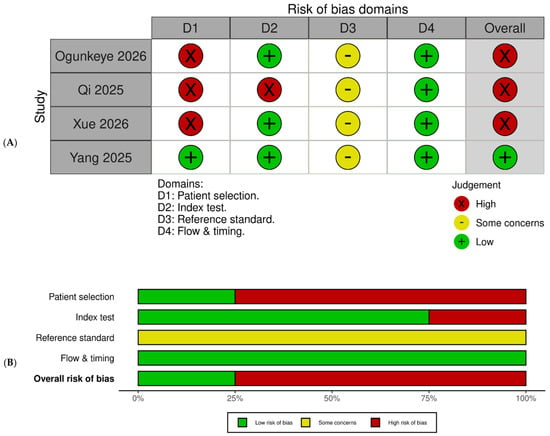
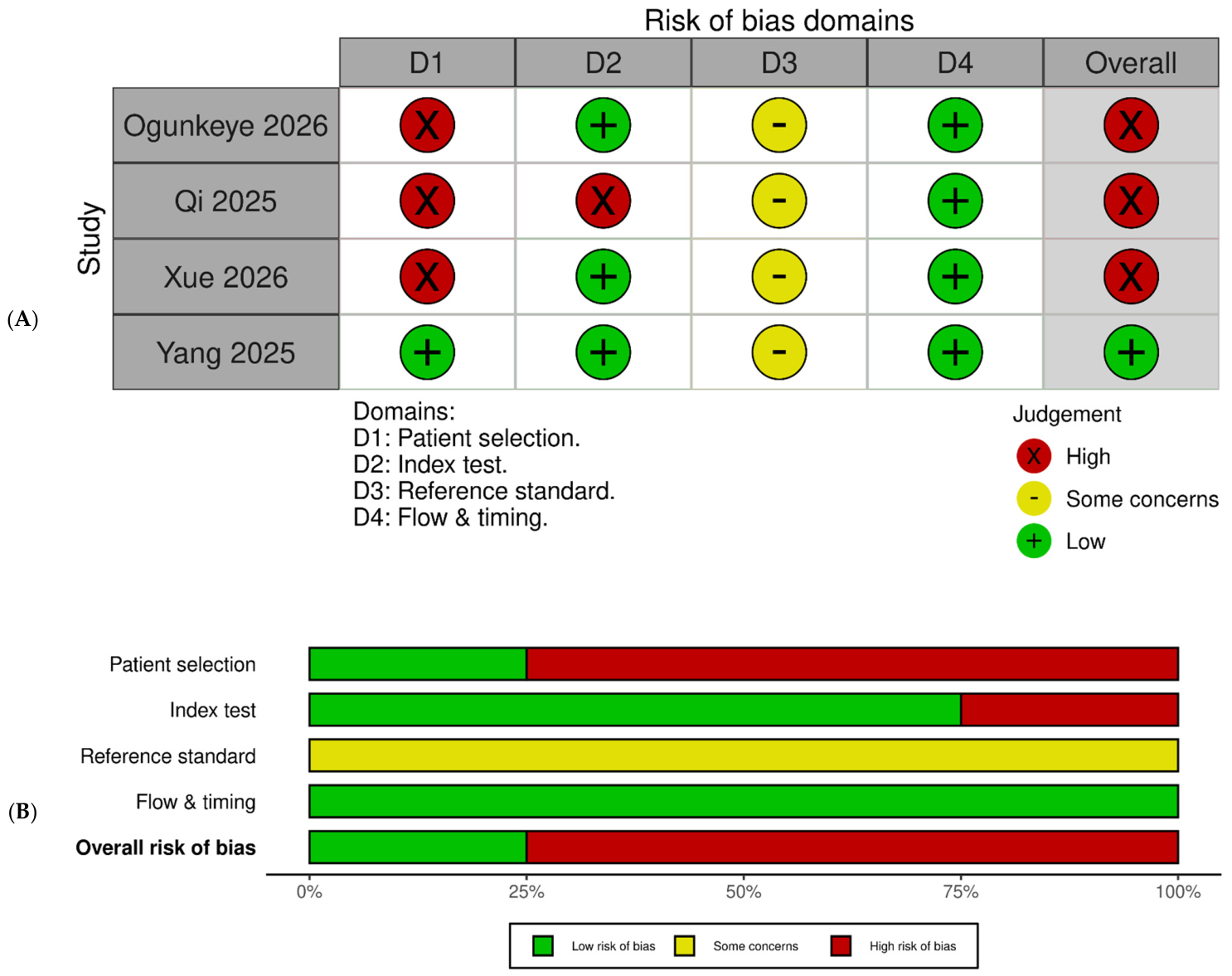
The final evidence synthesis is presented in Table 1, Table 2, Table 3, Table 4 and Table 5, with detailed eligibility, patient/tumor, diagnostic, QUADAS-2, longitudinal, funding/conflict, and certainty-of-evidence information provided in Supplementary Tables S2–S8. Figure 1 presents the study-selection process, and Figure 2 summarizes the QUADAS-2 assessment.
Table 1.
Characteristics of the included studies and postoperative high-risk NMIBC populations.
Table 2.
Characteristics of postoperative urinary molecular assays, sampling strategy, and pathological reference standards.
Table 3.
Diagnostic performance of postoperative urinary molecular assays for histologically confirmed residual tumor at repeat TURBT.
Table 4.
Potential utility of postoperative urinary molecular testing for repeat-TURBT triage and reported longitudinal clinical outcomes.
Table 5.
Risk of bias and applicability assessment using QUADAS-2.
Figure 2.
Risk of bias assessment of the included diagnostic studies using QUADAS−2. (A) Traffic-light plot showing study-level judgments across the four QUADAS−2 domains: patient selection, index test, reference standard, and flow and timing, together with the overall risk-of-bias judgment. (B) Summary plot showing the distribution of risk-of-bias judgments across the included studies for each QUADAS−2 domain and overall assessment. QUADAS−2, Quality Assessment of Diagnostic Accuracy Studies−2.
2.9. Certainty of Evidence Assessment (GRADE)
Certainty of evidence was assessed using the GRADE framework for diagnostic test accuracy evidence [14,15,16]. The assessment was based on the extracted diagnostic data, the original study reports, and the existing QUADAS-2 judgments.
Because the included assays differed in molecular targets, platforms, algorithms, thresholds, and intended operating characteristics, certainty was assessed separately for each index-test strategy rather than for urinary molecular assays as a single test class. The five strategies assessed were UroAmp Prognosis, UroAmp minimal residual disease (MRD), the combined Clustered Histone 6 (H4C6)/Twist Family bHLH Transcription Factor 1 (TWIST1) methylation panel, utLIFE, and OncoUrine in the European Association of Urology (EAU) high-risk subgroup. UroAmp Prognosis and UroAmp MRD were treated as separate algorithms evaluated in the same underlying cohort and were not considered independent studies. The Qi et al. nomogram incorporating urinary methylation, Vesical Imaging-Reporting and Data System (VI-RADS), and hematuria was treated as a combined molecular/imaging/clinical model and was not graded as evidence for a standalone urinary assay.
The target condition was histologically confirmed residual tumor at repeat TURBT. Sensitivity and specificity were assessed as separate outcomes using the available true-positive, false-positive, false-negative, and true-negative counts. NPVs were reported descriptively alongside the prevalence of residual disease in each study but were not assigned separate certainty ratings because they depend on the prevalence of the target condition. Direct evidence on the safety of omitting or deferring repeat TURBT after a negative molecular result was considered separately.
The assessment considered the GRADE domains of risk of bias, inconsistency, indirectness, imprecision, and publication bias. Following GRADE guidance for diagnostic test accuracy, certainty was initially considered at the high level for the included cross-sectional diagnostic-accuracy studies and rated down where warranted by the evidence. QUADAS-2 judgments informed, but did not automatically determine, GRADE risk-of-bias judgments. The risk-of-bias assessment considered whether identified limitations could plausibly affect the relevant accuracy estimate. Indirectness was evaluated in relation to the target population, the postoperative testing interval, the intended clinical application, and the histopathological reference standard.
Because each assay-level evidence unit was informed by a single study, between-study inconsistency could not be meaningfully assessed and was recorded as not assessable rather than as an absence of concern. Imprecision was evaluated using confidence intervals and the numbers of true-positive, false-negative, true-negative, and false-positive observations. Because clinically acceptable accuracy thresholds had not been prespecified, sensitivity boundaries of 80%, 90%, and 95% and specificity boundaries of 50%, 75%, and 90% were used as exploratory interpretation boundaries, not as validated thresholds for safely omitting repeat TURBT. Under this exploratory approach, crossing one boundary was considered a serious concern, and crossing two or more boundaries a very serious concern. Publication bias was considered qualitatively, taking into account the small evidence base, the early stage of assay development, and reported developer or industry involvement; formal statistical testing was not undertaken because the evidence base was insufficient for meaningful assessment.
Diagnostic data were taken from the primary studies or calculated from exact reported counts where possible. Rounded percentages were not used to reconstruct missing diagnostic cells. Where confidence intervals were not reported for estimates derivable from exact counts, Wilson 95% confidence intervals were calculated. The final domain-level judgments, certainty ratings, and their justifications are presented in Supplementary Table S8. No direct evidence concerning the safety of omitting or deferring repeat TURBT after a negative molecular test was identified; this outcome was therefore reported as having no direct evidence rather than assigned a certainty rating.
2.10. Ethics
This systematic review used data derived exclusively from previously published human studies and did not involve collection of new patient-level data or direct interaction with human participants. Accordingly, institutional ethics approval and informed consent were not required for the review.
3. Results
3.1. Study Selection
The database search identified 3231 records, comprising 1345 from PubMed, 1302 from Scopus, 466 from Web of Science, and 118 from the Cochrane Library. After removal of 782 duplicate records, 2449 records underwent title and abstract screening, of which 2386 were excluded. Full texts were sought for 63 reports, and all 63 were assessed for eligibility. Fifty-nine reports were subsequently excluded: 23 for inappropriate timing or focus on initial diagnosis/standard surveillance, 15 because they were conference abstracts, trial protocols, or studies without available results, 16 because of insufficient diagnostic outcomes or a prognostic-only focus, 4 because the full text was unavailable or contained insufficient extractable data, and 1 because of an irrelevant topic. Four studies therefore met all predefined eligibility criteria and were included in the systematic review (Figure 1; Supplementary Table S2).
3.2. Characteristics of Included Studies and Populations
The four included studies were published between 2025 and 2026 and comprised two prospective studies—one prospective multicenter cohort and one prospective single-arm cohort—and two retrospective analyses, one of which used a biobank-based cohort (Table 1). Study sizes ranged from 43 patients contributing 47 urine samples to 161 patients. The included populations were specifically situated within repeat-TURBT pathways, although the operational definition of high-risk NMIBC varied between studies.
Ogunkeye et al. evaluated 43 patients with high-grade NMIBC contributing 47 urine samples; four patients underwent a second re-transurethral resection (TUR) and therefore contributed an additional sample. The cohort was predominantly T1 disease (75%), with 14% Ta disease, 9% Ta/T1 disease with CIS, and 2% CIS alone. Forty-two of 43 patients (98%) met American Urological Association (AUA)/Society of Urologic Oncology (SUO) high-risk criteria, while the remaining patient had high-grade Ta disease. Qi et al. enrolled 86 patients prospectively, of whom 55 were included in the final analysis. Formal EAU/AUA risk-group classification was not reported, but eligibility was defined by a repeat-TURBT pathway based on T1 disease, high-grade disease, or absent detrusor muscle. Xue et al. included 161 patients, of whom 69% had T1, and 31% had Ta disease; 78% had high-grade tumors, and 30% had concomitant CIS. The cohort contained 62% high-risk and 21% very-high-risk disease according to EAU classification, thereby satisfying the predefined ≥80% high/very-high-risk threshold. Yang et al. prospectively screened 161 patients and included 151 in the overall diagnostic cohort. Because the overall cohort contained a substantial intermediate-risk component, the separately analyzable high-risk subgroup of 83 patients was used for the protocol-concordant primary synthesis. Detailed study-level population characteristics are presented in Table 1 and Supplementary Table S3.
All included studies obtained the qualifying urine specimen after initial TURBT and before repeat TURBT. Postoperative sampling was performed approximately 2–6 weeks after initial TURBT in Xue et al.; Yang et al. reported a median interval of 31 days [interquartile range (IQR) 27–39]. Ogunkeye et al. reported a median postoperative sampling interval of 3.4 weeks, although some patients were referred later than the conventional 6-week repeat-TURBT interval. In Qi et al., urine was obtained within 2 weeks before repeat TURBT, which was performed 1–3 months after the initial procedure. Thus, despite variation in exact timing, all four studies evaluated the biomarker during the intended post-resection/pre-repeat-TURBT clinical window (Table 2; Supplementary Table S2).
Tumor phenotype was not characterized uniformly across studies. Ogunkeye et al. included patients with papillary Ta/T1 disease as well as patients with concomitant CIS or CIS alone, and Xue et al. reported concomitant CIS in 30% of the cohort. Yang et al. excluded primary CIS from their cohort definition, although a Tis finding was listed among the reported residual-disease cases. However, the studies did not provide sufficiently consistent, phenotype-stratified diagnostic estimates to compare sensitivity or specificity separately for papillary tumors, concomitant CIS, and CIS-only disease. Consequently, the present evidence cannot establish whether these assays perform differently across papillary and flat urothelial disease phenotypes.
3.3. Characteristics of Urinary Molecular Assays and Reference Standards
Ogunkeye et al. evaluated UroAmp, a tumor-naïve urinary tumor-DNA assay using shallow whole-genome sequencing and targeted next-generation sequencing, with separate Prognosis and MRD algorithms. The Prognosis algorithm was configured toward high sensitivity, whereas the MRD algorithm used a genomic disease-burden threshold of >50 to provide a more specific molecular signal.
Qi et al. evaluated urinary H4C6 and TWIST1 promoter methylation using methylation-specific quantitative PCR. The H4C6 and TWIST1 markers and their combined molecular panel constituted the qualifying index test for this review. The study also evaluated VI-RADS and a combined nomogram incorporating methylation, VI-RADS, and hematuria; these analyses were retained as comparator or combined-model evidence rather than being considered the primary urinary molecular index test.
Xue et al. evaluated utLIFE, a tumor-naïve urinary tumor-DNA platform incorporating shallow whole-genome sequencing, targeted sequencing of 155 genes, and a machine-learning classifier. The classifier had been developed previously and was applied to the study cohort without retraining. Yang et al. evaluated OncoUrine, a fixed 17-gene mutation panel combined with ONECUT2 methylation.
All four studies used histopathological assessment at repeat TURBT as the reference standard for residual disease. The extent of pathological sampling varied, with systematic mapping biopsies described in Xue et al. and fractionated resection with additional sampling in Yang et al. Detailed assay characteristics, sampling methods, positivity thresholds, and reference-standard definitions are provided in Table 2 and Supplementary Tables S2 and S3.
None of the four studies directly compared a standalone postoperative urinary molecular assay with blue-light cystoscopy, photodynamic diagnosis, or narrow-band imaging. Qi et al. evaluated VI-RADS, a magnetic resonance imaging (MRI)-based assessment, and a combined molecular/imaging/clinical nomogram; this does not constitute a direct comparison with enhanced cystoscopy. The relative diagnostic value of urinary molecular assays versus enhanced cystoscopy therefore could not be estimated from the included studies.
3.4. Diagnostic Performance for Histologically Confirmed Residual Tumor
The principal diagnostic findings are summarized in Table 3, and the underlying raw diagnostic data are provided in Supplementary Table S4. Considerable heterogeneity was observed in assay technology, molecular targets, thresholds, analytic populations, and reporting format; consequently, and consistent with the prespecified protocol, no quantitative meta-analysis was performed.
3.5. Urinary Tumor-DNA Assays
UroAmp demonstrated markedly different operating characteristics according to the algorithm used. The Prognosis algorithm showed a sensitivity of 97% (95% confidence interval [CI], 86–100%), specificity of 53% (95% CI, 29–76%), PPV of 82% (95% CI, 67–91%), and NPV of 89% (95% CI, 59–99%). In contrast, the MRD algorithm had lower sensitivity at 72% (95% CI, 55–85%), but higher specificity at 80% (95% CI, 56–94%) and PPV at 88% (95% CI, 72–97%); its NPV was substantially lower at 57% (95% CI, 36–76%). These findings indicate that the two UroAmp algorithms operated at distinctly different points on the diagnostic spectrum, with the Prognosis algorithm more closely aligned with a rule-out strategy and the MRD algorithm more appropriate for molecular rule-in discrimination.
In Xue et al., utLIFE identified residual tumor with a sensitivity of 80.7% (95% CI, 69.0–89.0%) and specificity of 96.2% (95% CI, 91.0–99.0%). The corresponding PPV and NPV were 92.0% (95% CI, 81.0–97.0%) and 90.1% (95% CI, 83.0–94.0%), respectively, with an overall accuracy of 90.7%. The corresponding 2 × 2 table comprised 46 true-positive, 4 false-positive, 11 false-negative, and 100 true-negative results.
For Yang et al., the protocol-eligible high-risk subgroup of 83 patients demonstrated sensitivity of 71%, specificity of 67%, PPV of 53%, and NPV of 82%. These estimates were lower than the corresponding results reported for the broader mixed-risk cohort of 151 patients, for which sensitivity, specificity, PPV, and NPV were 77%, 78%, 62%, and 88%, respectively. The high-risk subgroup was therefore retained as the principal estimate because it most closely matched the prespecified review population. The original report did not provide an extractable 2 × 2 diagnostic table for the 83-patient high-risk subgroup; its reported accuracy estimates were therefore retained without reconstructing unreported diagnostic counts from rounded percentages.
3.6. Urinary Methylation Assays
Qi et al. reported discrimination for H4C6 and TWIST1 individually and in combination. The AUC was 0.698 (95% CI, 0.551–0.845) for H4C6 and 0.758 (95% CI, 0.619–0.896) for TWIST1. The combined H4C6 + TWIST1 urinary methylation panel achieved a sensitivity of 65.22% (95% CI, 44.89–81.19%), specificity of 87.50% (95% CI, 71.93–95.03%), and AUC of 0.764 (95% CI, 0.628–0.900). Although PPV and NPV were not reported directly by the study authors, they can be calculated from the exact panel counts reported in the study: 15 positive results among 23 patients with residual tumor and 4 positive results among 32 patients without residual tumor. These counts yield a review-calculated PPV of 78.9% (15/19) and NPV of 77.8% (28/36); the calculated NPV should be interpreted in the context of the study’s observed residual-disease prevalence and small sample size. The study’s full nomogram, which combined urinary methylation with VI-RADS and hematuria, achieved an AUC of 0.972 (95% CI, 0.937–1.000); however, this represented a combined, internally derived model rather than a urinary molecular assay alone and was therefore not interpreted as the primary molecular diagnostic estimate.
Overall, the diagnostic evidence demonstrated potentially useful rule-out characteristics for selected urinary tumor-DNA approaches, particularly UroAmp Prognosis and utLIFE, but performance varied substantially between platforms and algorithms. These point estimates should not be interpreted as proof that the assays are interchangeable or that a negative result has the same meaning across different clinical populations. Direct numerical comparison across studies was therefore considered inappropriate.
3.7. Potential Role in Repeat-TURBT Triage
The principal clinical question of the review concerned whether a negative postoperative molecular test could identify a group with a sufficiently low probability of residual disease to potentially support omission of repeat TURBT. The available evidence was encouraging but preliminary (Table 4).
Ogunkeye et al. reported an NPV of 89% for the UroAmp Prognosis algorithm, although the wide confidence interval reflected the small number of pathology-negative cases. The article presented clinical examples involving high-volume T1 disease, multifocal disease, and occult CIS; these examples should not be counted as three independently verified false-negative results against the repeat-TURBT histopathological reference standard. The assay-specific diagnostic material instead indicated one false-negative result for UroAmp Prognosis and nine for UroAmp MRD, the latter involving six high-grade Ta cases, one T1 case, and two T2 cases. These figure-derived case counts are described cautiously because the main publication did not present them as one complete, unified 2 × 2 table. The MRD algorithm had an NPV of only 57%, indicating that it was not suited to ruling out residual disease.
Xue et al. reported an NPV of 90.1% for utLIFE. Eleven false-negative cases were identified, involving low-grade Ta, T1, or CIS, and two subsequently developed recurrence. The investigators estimated that a utLIFE-guided strategy could theoretically reduce unnecessary repeat-TURBT procedures by 33% with utLIFE alone and by 24% with a combined strategy at a 10% decision-curve threshold. These estimates were model-based rather than prospectively demonstrated reductions in performed procedures.
Yang et al. reported an NPV of 82% in the high-risk subgroup, while the study’s broader mixed-risk cohort yielded an NPV of 88%. The authors estimated that 53% of repeat-TURBT procedures might potentially be avoided in the overall cohort, with higher proportions in selected subgroups. Because this estimate was derived from the mixed-risk population, it was not considered a definitive estimate for the high-risk target population of the present review. Similarly, the high-risk subgroup did not have sufficient raw data to independently quantify a corresponding avoidance proportion. The 11 false-negative results described in the overall diagnostic cohort should not be assumed to represent the false-negative count in the 83-patient high-risk subgroup.
Qi et al. did not report NPV directly for the combined urinary methylation panel. The review-calculated NPV of 77.8%, based on the exact reported cell counts, provides a descriptive estimate but does not establish the safety of omitting re-TURBT. The full methylation/VI-RADS/hematuria nomogram demonstrated favorable decision-curve characteristics and calibration, but these findings represented theoretical model performance within the development cohort rather than prospective evidence that repeat TURBT could safely be omitted.
Taken together, the available evidence suggests that postoperative urinary molecular testing may have triage potential, particularly when optimized for high sensitivity, but none of the included studies prospectively demonstrated that molecular-negative patients could safely forgo guideline-indicated repeat TURBT. No included study reported a direct cost-effectiveness analysis comparing a postoperative molecular-testing strategy with the conventional repeat-TURBT pathway. Reported procedure-avoidance percentages were theoretical or model-based and cannot be interpreted as demonstrated cost savings.
3.8. Longitudinal Recurrence and Other Clinical Outcomes
Three studies reported longitudinal clinical outcomes, although the depth of follow-up varied (Table 4; Supplementary Table S5). Ogunkeye et al. reported recurrence-free survival only within a small pathology-negative T0 subgroup. Within this subgroup, patients classified as molecularly high-risk had a 24-month RFS of 36% compared with 100% among molecularly low-risk patients (p = 0.006). These findings were exploratory because of the small subgroup size.
Xue et al. reported a median follow-up of 32.5 months and a recurrence rate of 20.5% (33/161). Positive utLIFE status was independently associated with recurrence on multivariable analysis (hazards ratio [HR], 16.4; 95% CI, 2.7–101.8; p = 0.003). The study also reported that, among 47 patients undergoing longitudinal molecular testing, urinary tumor-DNA positivity preceded cystoscopic recurrence by a median of 5.4 months (range, 3.1–20.0 months). This lead-time finding was derived from a subset and should therefore be considered exploratory.
Yang et al. reported a median follow-up of 18.0 months among 131 patients included in the recurrence analysis, with recurrence occurring in 20 patients (15.3%). OncoUrine positivity was associated with recurrence both in univariate analysis (HR, 3.67; 95% CI, 1.50–9.00; p = 0.002) and after multivariable adjustment (HR, 3.64; 95% CI, 1.44–9.22; p = 0.006). The study also identified OncoUrine positivity as an independent predictor of residual disease at repeat TURBT (OR, 10.04; 95% CI, 4.32–23.35; p < 0.001). A reporting inconsistency was noted in the description of pathological upstaging in Yang et al.: the narrative did not report upstaging, whereas the case-level material included a T2 residual-disease finding. This discrepancy limits a definitive interpretation of the study’s upstaging findings and should be clarified against the original report before making a categorical statement about missed muscle-invasive disease.
No included study provided sufficiently consistent evidence regarding progression, metastatic progression, BCG failure, or radical cystectomy to permit meaningful cross-study synthesis. Longitudinal findings were therefore interpreted as supportive evidence of biological and prognostic relevance rather than as substitutes for the primary histopathological residual-disease endpoint.
3.9. Risk of Bias and Applicability
Risk-of-bias assessments using QUADAS-2 are summarized in Table 5 and Figure 2, with detailed signaling responses provided in Supplementary Table S6. Three of the four studies were judged to have an overall high risk of bias, whereas Yang et al. was judged to have a low overall risk of bias.
Patient selection represented the principal recurrent concern. Ogunkeye et al. and Xue et al. were both retrospective studies using selected cohorts, including biobank availability or availability of both molecular testing and cytology. Qi et al. was also judged to have a high risk of bias in patient selection because 86 patients were enrolled but only 55 were included, with incomplete reporting of exclusions and potential spectrum bias. In contrast, Yang et al. used consecutive prospective screening across four centers and were judged low risk in this domain.
For the index-test domain, Ogunkeye, Xue, and Yang were judged low risk, whereas Qi was judged high risk because molecular-assay blinding was incompletely reported and the full nomogram threshold appeared to have been derived within the study dataset. For the reference-standard domain, all four studies received an unclear judgment, primarily because blinding of pathological assessors to molecular test results was not consistently documented. Flow and timing were judged low risk across all four studies because the qualifying urine testing and repeat-TURBT procedures occurred within clinically relevant intervals, and the reference standard was generally applied consistently within each study.
Separate applicability judgments were not available in the extracted QUADAS-2 dataset and were therefore recorded as not reported rather than inferred. The principal methodological concerns were consequently the retrospective or selectively assembled populations, small sample sizes in some cohorts, incomplete blinding documentation, internally derived models, and limited independent validation.
3.10. Certainty of Evidence (GRADE)
The GRADE assessment found very-low-certainty evidence for the diagnostic accuracy of UroAmp Prognosis, UroAmp MRD, the combined H4C6/TWIST1 methylation panel, and utLIFE, and low-certainty evidence for OncoUrine in the protocol-eligible high-risk subgroup (Supplementary Table S8). These ratings apply to the available study-specific diagnostic evidence and should not be interpreted as a single certainty rating for urinary molecular assays as a class.
Risk-of-bias concerns, limited sample sizes, imprecise estimates, and the restricted evidence base reduced confidence in the accuracy estimates. Imprecision was especially important where confidence intervals were wide or where false-negative results could include clinically consequential residual disease. The prospective multicenter design of the OncoUrine study supported a higher rating than the other assay-specific evidence, but uncertainty remained because the high-risk subgroup had no extractable 2 × 2 table and its estimates could not be independently reproduced from the subgroup data available to the review.
Inconsistency could not be meaningfully assessed for assays represented by a single study; this was treated as an unassessable domain, not as evidence that results were consistent. Likewise, formal assessment of publication bias was not feasible for the separate assay strategies because the evidence base was too small. These limitations do not establish that publication bias is absent. The evidence profile and its footnotes provide the assay-specific judgments and the rationale for each final certainty rating.
No included study directly demonstrated that patients with a negative molecular result could safely omit guideline-indicated repeat TURBT. Therefore, the diagnostic-accuracy ratings should not be transferred to the safety or clinical utility of omitting the procedure. Direct evidence for that management decision remains absent.
3.11. Overall Synthesis of the Evidence
Across the four included studies, postoperative urinary molecular assays demonstrated heterogeneous but potentially clinically useful diagnostic performance for detecting histologically confirmed residual tumor after initial TURBT. The strongest rule-out signals were observed with the high-sensitivity UroAmp Prognosis algorithm and utLIFE, whereas the UroAmp MRD algorithm displayed a more rule-in-oriented profile because of its higher specificity and lower NPV. The urinary methylation approach showed more modest discrimination when evaluated as a molecular-only test, while the highest AUC reported in the evidence base arose from a combined molecular, imaging, and clinical nomogram that had not undergone external validation.
These apparently favorable results require cautious interpretation in light of the GRADE findings: certainty was very low for UroAmp Prognosis, UroAmp MRD, the H4C6/TWIST1 panel, and utLIFE, and low for OncoUrine in the high-risk subgroup. The evidence supporting direct replacement or omission of repeat TURBT remained insufficient. Although several studies reported NPVs around or above 80–90% and modeled potentially substantial reductions in repeat procedures, these estimates were predominantly derived from small, selected, or internally evaluated cohorts and were not validated in prospective clinical-utility studies. No direct cost-effectiveness evidence was identified, and no study demonstrated that the theoretical reduction in repeat procedures would translate into lower overall costs without compromising oncological safety. Accordingly, the current evidence supports the concept of molecularly informed repeat-TURBT triage as a promising investigational strategy rather than an established substitute for histopathological repeat resection.
4. Discussion
This systematic review identified only four studies that met the prespecified, highly specific eligibility criteria for postoperative urinary nucleic-acid testing between initial TURBT and repeat TURBT with histopathological verification of residual disease. Across these studies, molecular assays showed promising but heterogeneous diagnostic performance, with the strongest rule-out signals observed for the UroAmp Prognosis algorithm and utLIFE, which achieved NPVs of 89% and 90.1%, respectively [5,12]. However, these point estimates should not be interpreted as establishing clinical readiness: the GRADE assessment rated the diagnostic evidence as very low certainty for UroAmp Prognosis, UroAmp MRD, the H4C6/TWIST1 panel, and utLIFE, and low certainty for OncoUrine in the protocol-eligible high-risk subgroup (Supplementary Table S8). The evidence does not establish that a negative molecular result can safely replace or support routine omission of repeat TURBT. The evidence remains preliminary because the studies were few, several were small or retrospective, and independent external validation was limited.
For repeat-TURBT triage, sensitivity and NPV are particularly important because a false-negative result may leave clinically relevant residual tumor untreated. The UroAmp Prognosis algorithm was deliberately oriented toward high sensitivity and achieved 97% sensitivity with an NPV of 89%, whereas the UroAmp MRD classifier traded sensitivity for specificity, achieving 80% specificity but an NPV of only 57%; these profiles suggest different potential roles rather than a single uniform assay effect [12]. utLIFE provided a favorable combination of sensitivity, specificity, PPV, and NPV among the included studies, although its retrospective single-center design limits certainty [5]. By comparison, urinary H4C6/TWIST1 methylation showed more modest discrimination as a molecular-only strategy, while the lower performance observed in the high-risk subgroup of the OncoUrine study compared with its broader mixed-risk cohort illustrates the influence of population composition on apparent diagnostic performance [10,11]. Thus, “urinary molecular assay” should not be regarded as a homogeneous diagnostic class; its clinical value depends on the molecular signal, classifier threshold, target population, and intended rule-in or rule-out function.
The methylation-panel results also warrant a distinction between reported and review-calculated metrics. Although the Qi study did not directly report PPV or NPV for the combined H4C6/TWIST1 panel, the exact reported diagnostic counts permit calculation of a PPV of 78.9% and an NPV of 77.8%. These values are descriptive, not independently validated outcomes, and the NPV is dependent on the residual-disease prevalence in the small analyzed cohort. The AUC of 0.972 reported for the full nomogram should be interpreted separately because it arose from a model combining urinary methylation with VI-RADS and hematuria, rather than from the molecular panel alone. The apparent performance of a combined model therefore cannot establish the standalone accuracy of the molecular assay or its ability to identify patients who can safely avoid re-resection.
The findings do not establish whether assay performance differs between papillary tumors and CIS. The included populations differed in their representation of Ta/T1 tumors, concomitant CIS, and CIS-only disease, but no study provided sufficiently comparable accuracy estimates across these phenotypes. This limitation matters clinically because a pooled estimate from populations with different tumor phenotypes may obscure differences in how well a urinary assay detects residual disease in individual subgroups. The false-negative findings—including reported residual Ta/T1 disease, CIS, and, in the available case-level material, a T2 finding—also caution against assuming that a negative molecular result excludes all clinically consequential residual disease. Future studies should prespecify and report accuracy by initial tumor stage, grade, papillary versus flat phenotype, concomitant or CIS-only disease, and detrusor-muscle status. Until such results are available, no phenotype-specific recommendation about using a negative result to omit repeat TURBT is justified.
The central clinical implication is that diagnostic accuracy is not equivalent to safe procedure omission. Several studies reported substantial theoretical reductions in repeat-TURBT use, but these estimates were derived from decision-curve or model-based analyses rather than prospective management strategies in which molecular-negative patients actually avoided repeat TURBT [5,10,11]. Translation into practice would require a prespecified threshold linked to a sufficiently low residual-disease probability, consistently high sensitivity, reliable detection of clinically consequential residual disease, prospective external validation, and standardized pathological verification. The acceptable residual-disease risk cannot be inferred from an NPV threshold alone; it must be defined in relation to the consequences of missed high-grade disease, occult muscle-invasive disease, delayed staging, and the clinical characteristics of the intended population. Importantly, performance should be established within the highest-risk clinical subgroups, including high-grade T1 disease, very-high-risk disease, CIS, and patients with or without detrusor muscle in the initial specimen. Ultimately, a management-impact trial in which molecular-negative patients undergo structured omission or deferral of repeat TURBT, with oncological and safety outcomes compared with standard care, would provide the most direct evidence of clinical utility.
Urinary molecular assays should also be considered in relation to, rather than assumed to replace, enhanced cystoscopy. Blue-light cystoscopy and other enhanced visualization techniques are intended to improve endoscopic lesion detection and resection; the AUA/SUO guideline recommends offering blue-light cystoscopy at TURBT when available [17]. A health technology assessment has separately evaluated the clinical and economic evidence for enhanced visualization as an adjunct to the initial TURBT pathway [18]. However, these technologies address a different decision point from a urine assay collected after initial resection and before repeat TURBT. None of the four included studies directly compared a molecular assay with blue-light cystoscopy, photodynamic diagnosis, or narrow-band imaging. Qi et al.’s VI-RADS assessment was MRI-based, and the favorable performance of its combined nomogram cannot be interpreted as a comparison with enhanced cystoscopy. Consequently, this review cannot determine whether molecular testing adds diagnostic value to enhanced cystoscopy, whether the approaches are complementary, or whether one strategy would reduce repeat-TURBT use more safely than another. Direct comparative studies should evaluate molecular testing alone, enhanced cystoscopy where clinically applicable, and combined strategies using the same target population and pathological reference standard.
The economic implications also remain unresolved. None of the included studies provided a direct cost-effectiveness comparison between postoperative urinary molecular testing and the conventional repeat-TURBT pathway, and no included study established the assay cost, downstream resource use, incremental cost-effectiveness, or actual costs avoided through prospectively documented omission of procedures. The modeled reductions in repeat-TURBT procedures therefore should not be described as cost savings. A molecular strategy would introduce assay, sample-processing, implementation, and follow-up costs; false-positive results could prompt additional evaluation, while false-negative results could delay diagnosis or treatment of residual disease. Conversely, a genuinely safe reduction in procedures could reduce anesthesia exposure, procedural morbidity, time away from usual activities, and demand on surgical services. The net effect depends on assay price and performance, the baseline probability and clinical significance of residual disease, and what procedures can appropriately be avoided. Cost-effectiveness findings for enhanced visualization during initial TURBT cannot be transferred directly to postoperative molecular triage because the technologies act at different points in the clinical pathway [18]. A future economic evaluation should therefore be linked to prospective clinical-utility data and should compare total pathway costs and clinical outcomes, not merely the price of a molecular assay against the cost of one repeat procedure.
The small evidence base reflects the specificity of the clinical question rather than an absence of urinary molecular research. Most urinary biomarker studies in NMIBC address initial diagnosis, standard surveillance, or prediction of future recurrence, rather than the narrow postoperative interval in which residual tumor remains the immediate clinical concern [9]. In contrast, this review required a clearly defined sequence of initial TURBT → postoperative urinary molecular testing → repeat TURBT → histopathological determination of residual disease, while excluding surveillance-only studies and studies using nonpathological reference standards. This focused eligibility framework isolates the evidence most directly relevant to the unresolved question of whether repeat TURBT can eventually be individualized using a postoperative molecular test.
4.1. Strengths and Limitations
A key strength of this review is its decision-point specificity: rather than evaluating urinary biomarkers broadly, it isolates a single actionable clinical window and requires histopathological confirmation of the target condition. The review also prespecified postoperative timing, prioritized analyzable high-risk populations, separated molecular-only assays from combined imaging/clinical models, and distinguished diagnostic residual-disease evidence from longitudinal prognostic findings. Adding an explicit GRADE assessment in response to the editor’s request further clarifies the uncertainty around each study-specific assay estimate; however, this assessment was added during revision and was not part of the original protocol. The main limitation is the small, heterogeneous evidence base, which precluded meaningful quantitative synthesis and limits certainty around generalizability and clinical thresholds. Three studies had an overall high risk of bias, and independent prospective validation remains limited; in addition, the evidence for each assay strategy was largely confined to a single study, preventing meaningful assessment of between-study consistency. Accordingly, the findings should be interpreted as evidence of clinical promise rather than readiness for routine omission of repeat TURBT.
Other limitations include the nonuniform reporting of tumor phenotype and the lack of reliable phenotype-stratified estimates, the absence of direct comparisons with enhanced cystoscopy, and the absence of a direct economic evaluation of molecularly guided repeat-TURBT decisions. The available false-negative counts and subgroup data were also incompletely reported for some assays, which restricted independent reproduction of the diagnostic estimates. The NPV estimates should be interpreted in their respective study populations rather than generalized to all patients with high-risk NMIBC, because predictive values depend on the prevalence of residual disease as well as assay performance. Finally, the data do not establish whether a strategy that reduces repeat TURBT would maintain oncological safety, because none of the included studies prospectively tested omission of guideline-indicated re-resection after a negative molecular test.
4.2. Future Directions
The next phase of research should proceed from diagnostic validation to clinical utility. First, existing assays require independent external validation in well-characterized high-risk NMIBC cohorts, followed by prospective multicenter studies using standardized repeat-TURBT pathology and prespecified molecular thresholds. Studies should report performance separately in high-grade T1, very-high-risk, CIS, and detrusor-muscle-defined subgroups rather than relying primarily on pooled mixed-risk estimates. The distinction between papillary tumors, papillary tumors with concomitant CIS, and CIS-only disease should be prespecified and consistently reported. Studies should also directly compare molecular assays with enhanced cystoscopy or evaluate whether the combination improves detection beyond either strategy alone.
The definitive step would be a prospective management-impact or randomized study testing whether molecular-negative patients can safely omit repeat TURBT, while monitoring residual and missed muscle-invasive disease, recurrence, progression, procedure-related morbidity, quality of life, and cost-effectiveness. Economic evaluations should be embedded in or linked to these prospective studies and should compare complete care pathways, including assay and processing costs, repeat-resection costs, further workup after positive or indeterminate results, and the clinical and economic consequences of false-negative findings.
5. Conclusions
Postoperative urinary nucleic-acid assays show promising potential for detecting residual tumor and individualizing repeat-TURBT decisions in high-risk NMIBC, particularly when optimized for high sensitivity and negative predictive value. However, the GRADE assessment indicates very low certainty for the available diagnostic evidence for UroAmp Prognosis, UroAmp MRD, the H4C6/TWIST1 methylation panel, and utLIFE, and low certainty for OncoUrine in the protocol-eligible high-risk subgroup. These ratings, together with the small and heterogeneous evidence base, preclude confident conclusions about the generalizability of the reported accuracy estimates. No included study prospectively demonstrated that molecular-negative patients could safely forgo guideline-indicated repeat TURBT, and no direct cost-effectiveness comparison with the conventional repeat-TURBT pathway was available. The current evidence therefore supports further investigation of molecularly informed triage as a potentially useful adjunct—not a validated replacement for histopathological repeat resection. Prospective external validation, phenotype-specific accuracy estimates, direct comparisons with enhanced cystoscopy, and management-impact studies incorporating oncological safety and cost-effectiveness are required before molecular testing can support routine omission of repeat TURBT.
Supplementary Materials
The following supporting information can be downloaded at: https://www.mdpi.com/article/10.3390/siuj7050075/s1, Table S1: Database Search Strategies; Table S2: Eligibility and protocol-adherence characteristics of the included studies; Table S3: Detailed patient, tumor, and initial TURBT characteristics of the included studies; Table S4: Raw diagnostic data for postoperative urinary molecular assays versus histopathological residual disease at repeat TURBT; Table S5: Longitudinal recurrence, progression, and subsequent treatment outcomes among included postoperative cohorts; Table S6: Detailed QUADAS-2 signaling questions and risk-of-bias/applicability judgments (Panels A–E); Table S7: Funding sources, industry involvement, and conflicts of interest of included studies; Table S8: GRADE certainty-of-evidence assessment for postoperative urinary nucleic-acid assays detecting residual tumor at repeat TURBT; PRISMA 2020 Checklist.
Author Contributions
Conceptualization, K.E.; methodology, K.E.; software, K.E.; validation, K.E.; formal analysis, K.E.; investigation, A.M. and K.S.; resources, K.E.; data curation, K.E., A.M. and K.S.; writing—original draft preparation, K.E.; writing—review and editing, K.E., A.M. and K.S.; visualization, K.E.; supervision, K.E.; project administration, K.E. All authors have read and agreed to the published version of the manuscript.
Funding
This research received no external funding.
Institutional Review Board Statement
Not Applicable.
Informed Consent Statement
Not Applicable.
Data Availability Statement
Data sharing is not applicable to this article as no datasets were generated or analyzed during the current study.
Conflicts of Interest
The authors declare no conflict of interest.
References
- Olislagers, M.; de Jong, F.C.; Rutten, V.C.; Boormans, J.L.; Mahmoudi, T.; Zuiverloon, T.C.M. Molecular biomarkers of progression in non-muscle-invasive bladder cancer—Beyond conventional risk stratification. Nat. Rev. Urol. 2025, 22, 75–91. [Google Scholar] [CrossRef] [Scilit] [PubMed]
- Kim, L.H.C.; Patel, M.I. Transurethral resection of bladder tumour (TURBT). Transl. Androl. Urol. 2020, 9, 3056–3072. [Google Scholar] [CrossRef] [Scilit] [PubMed]
- Cumberbatch, M.G.K.; Foerster, B.; Catto, J.W.F.; Kamat, A.M.; Kassouf, W.; Jubber, I.; Shariat, S.F.; Sylvester, R.J.; Gontero, P. Repeat Transurethral Resection in Non-muscle-invasive Bladder Cancer: A Systematic Review. Eur. Urol. 2018, 73, 925–933. [Google Scholar] [CrossRef] [Scilit] [PubMed]
- Yanagisawa, T.; Kawada, T.; Von Deimling, M.; Bekku, K.; Laukhtina, E.; Rajwa, P.; Chlosta, M.; Pradere, B.; D’Andrea, D.; Moschini, M.; et al. Repeat transurethral resection for non–muscle-invasive bladder Cancer: An Updated Systematic Review and Meta-analysis in the Contemporary Era. Eur. Urol. Focus 2023, 10, 41–56. [Google Scholar] [CrossRef] [Scilit] [PubMed]
- Xue, Z.; Qie, Y.; Shen, C.; Wu, Z.; Chen, H.; Lin, Y.; Li, R.; Huang, S.; Hu, H. Urinary Tumor DNA to Identify Candidates for Repeat Transurethral Resection in Non-Muscle-Invasive Bladder Cancer. Cancer Sci. 2026, 117, 787–796. [Google Scholar] [CrossRef] [Scilit] [PubMed]
- Lee, H.H.; Kim, S.H. Review of non-invasive urinary biomarkers in bladder cancer. Transl. Cancer Res. 2020, 9, 6554–6564. [Google Scholar] [CrossRef] [Scilit] [PubMed]
- Yang, Z.; Song, F.; Zhong, J. Urinary Biomarkers in Bladder Cancer: FDA-Approved Tests and Emerging Tools for Diagnosis and Surveillance. Cancers 2025, 17, 3425. [Google Scholar] [CrossRef] [Scilit] [PubMed]
- Liedberg, F.; Mariappan, P.; Gontero, P.; EAU NMIBC Guideline Panel. Clinical Implementation of Urinary Biomarkers for Surveillance of Non-muscle-invasive Bladder Cancer (NMIBC): Considerations from the European Association of Urology NMIBC Guideline Panel. Eur. Urol. Oncol. 2025, 8, 234–236. [Google Scholar] [CrossRef] [Scilit] [PubMed]
- Ramasamy, R.P.; Chai, C.A.; Cormio, A.; Rajandram, R.; Castellani, D.; Tan, W.S.; Gauhar, V.; Pang, S.T.; Mariappan, P.; Teoh, J.Y.C.; et al. Evaluating diagnostic performance of urinary biomarkers in the surveillance of non-muscle invasive bladder carcinoma: A systematic review. Investig. Clin. Urol. 2025, 66, 482–490. [Google Scholar] [CrossRef] [Scilit] [PubMed]
- Qi, W.; Qisheng, L.; Weiyang, W.; Yuan, L.; Linfeng, L.; Bin, C.; Yaqiang, H. Integrating urinary dual-gene methylation and VI-RADS score to predict residual tumors after TURBT in NMIBC: A nomogram-based model. BMC Urol. 2025, 25, 255. [Google Scholar] [CrossRef] [Scilit] [PubMed]
- Yang, X.; Cai, L.; Xin, Y.; Chen, X.; Zheng, B.; Han, J.; Yuan, L.; Yang, X.; Li, P.; Zhuang, J.; et al. Potential of Urinary Mutation and Methylation Biomarkers in Selecting Candidates for Repeat Transurethral Resection of Bladder Tumor in Non-muscle-invasive Bladder Cancer: A Prospective Multicenter Study. Eur. Urol. Open Sci. 2025, 77, 49–57. [Google Scholar] [CrossRef] [Scilit] [PubMed]
- Ogunkeye, J.; Shkolyar, E.; Mach, K.E.; Prendiville, S.; Prado, K.; Shah, J.B.; Skinner, E.C.; Fischer, D.S.; Phillips, K.G.; Bicocca, V.T.; et al. Performance of Urine Tumor DNA Detection in Patients with High-grade Non-muscle-invasive Bladder Cancer Undergoing Repeat Transurethral Resection. Eur. Urol. Focus 2026, S2405-4569(26)00097-0, Advance online publication. [Google Scholar] [CrossRef] [Scilit] [PubMed]
- Sim, K.C.; Kim, M.J.; Sung, D.J.; Park, B.J.; Han, N.Y.; Han, Y.E.; Cha, S.H. Diagnostic and Prognostic Non-Invasive Markers in Bladder Cancer. Diagnostics 2026, 16, 1948. [Google Scholar] [CrossRef] [Scilit] [PubMed]
- Schünemann, H.J.; Mustafa, R.A.; Brozek, J.; Steingart, K.R.; Leeflang, M.; Murad, M.H.; Bossuyt, P.; Glasziou, P.; Jaeschke, R.; Lange, S.; et al. GRADE guidelines: 21 part 1. Study design, risk of bias, and indirectness in rating the certainty across a body of evidence for test accuracy. J. Clin. Epidemiol. 2020, 122, 129–141. [Google Scholar] [CrossRef] [Scilit] [PubMed]
- Schünemann, H.J.; Mustafa, R.A.; Brozek, J.; Steingart, K.R.; Leeflang, M.; Murad, M.H.; Bossuyt, P.; Glasziou, P.; Jaeschke, R.; Lange, S.; et al. GRADE guidelines: 21 part 2. Test accuracy: Inconsistency, imprecision, publication bias, and other domains for rating the certainty of evidence and presenting it in evidence profiles and summary of findings tables. J. Clin. Epidemiol. 2020, 122, 142–152. [Google Scholar] [CrossRef] [Scilit] [PubMed]
- Mustafa, R.A.; El Mikati, I.K.; Murad, M.H.; Hultcrantz, M.; Steingart, K.R.; Yang, B.; Leeflang, M.M.; Akl, E.A.; Dahm, P.; Schünemann, H.J. GRADE guidance 37: Rating imprecision in a body of evidence on test accuracy. J. Clin. Epidemiol. 2024, 165, 111189. [Google Scholar] [CrossRef] [Scilit] [PubMed]
- Holzbeierlein, J.M.; Bixler, B.R.; Buckley, D.I.; Chang, S.S.; Holmes, R.; James, A.C.; Kirkby, E.; McKiernan, J.M.; Schuckman, A.K. Diagnosis and treatment of non-muscle invasive bladder cancer: AUA/SUO guideline: 2024 amendment. J. Urol. 2024, 211, 533–538. [Google Scholar] [CrossRef] [Scilit] [PubMed]
- Ontario Health (Quality). Enhanced visualization methods for first transurethral resection of bladder tumour in suspected non-muscle-invasive bladder cancer: A health technology assessment. Ont. Health Technol. Assess. Ser. 2021, 21, 1–123. [Google Scholar] [PubMed]

Disclaimer/Publisher’s Note: The statements, opinions and data contained in all publications are solely those of the individual author(s) and contributor(s) and not of MDPI and/or the editor(s). MDPI and/or the editor(s) disclaim responsibility for any injury to people or property resulting from any ideas, methods, instructions or products referred to in the content. |
© 2026 by the authors. Published by MDPI on behalf of the Société Internationale d’Urologie. Licensee MDPI, Basel, Switzerland. This article is an open access article distributed under the terms and conditions of the Creative Commons Attribution (CC BY) license.