


Abstract
Background/Objectives: Benign prostatic hyperplasia (BPH) with lower urinary tract symptoms (LUTS) affects up to 60% of men by age 90. With Singapore’s aging population, minimally invasive surgical therapies (MIST) have emerged as effective alternatives for patients unsuitable for traditional surgery. We sought to evaluate real-world outcomes of MIST procedures: Water Vapor Thermal Therapy (WVTT) and Prostatic Urethral Lift (PUL) in treating BPH-related LUTS. Methods: This is a retrospective analysis of 62 MIST patients treated at a tertiary hospital in Singapore between August 2021 and February 2025, with a minimum of three-month follow-up. Primary outcomes included improvements in maximum urinary flow rate (Qmax), International Prostate Symptom Score (IPSS), and Quality of Life (QoL) scores. Secondary outcomes included complications, re-treatment rates, and healthcare utilization metrics. Results: Thirty-six patients underwent WVTT, and 26 underwent PUL. Median age was 67 years, with a mean prostate volume of 61 cm3. At three months, both procedures showed improvements: Qmax increased by 4.28 mL/s (WVTT, p < 0.001) and 3.46 mL/s (PUL, p = 0.06); IPSS decreased by 12.8 (WVTT, p < 0.001) and 12.5 (PUL, p < 0.001); QoL scores improved by 2.53 (WVTT, p < 0.001) and 3.31 (PUL, p < 0.001). The complication rate was 32.3%, with complications being predominantly Clavien–Dindo grades 1–2. Day surgery was achieved in 83.9% of cases, with only 4.8% requiring readmission within 30 days. At three months, 98.4% were catheter-free, and excluding prior catheter-dependent patients, 82.4% were medication-free. At a median follow-up of 5.9 months, the re-treatment rate was 3.2%. Conclusions: MIST procedures are safe and effective for BPH-LUTS, showing comparable outcomes between WVTT and PUL while optimizing healthcare resource utilization.
1. Introduction
Benign prostatic hyperplasia (BPH) represents one of the most common urological conditions affecting aging men, with lower urinary tract symptoms (LUTS) impacting up to 60% of men by the age of 90 years [1]. The demographic transition toward an aging population in developed nations, including Singapore, has resulted in an increasing prevalence of BPH-related LUTS. Local epidemiological studies have demonstrated a concerning rise in prevalence from 14% to 16.5%, reflecting Singapore’s rapidly aging demographic and the associated escalating healthcare burden [2].
Traditional management approaches for BPH-LUTS have historically ranged from conservative medical therapy to more invasive surgical interventions such as transurethral resection of the prostate (TURP). However, the growing population of elderly patients with increasing comorbidities has created a significant clinical challenge, as many are unsuitable candidates for conventional surgical procedures due to increased perioperative risks. Moreover, a significant proportion of BPH patients wish to avoid medical therapy in general or to avoid sexual side effects associated with medical therapy or standard BPH surgery [3]. Specifically, medications such as alpha-1 blockers are associated with postural hypotension and retrograde ejaculation, while 5α-reductase inhibitors are associated with loss of libido and erectile dysfunction [4].
In response to this clinical need, minimally invasive surgical therapies (MIST) have emerged as a paradigm-shifting alternative, offering a middle ground between medical management and traditional surgery. These procedures aim to provide symptomatic relief while minimizing anesthetic risks. Among the most promising MIST options are Water Vapor Thermal Therapy (WVTT) and Prostatic Urethral Lift (PUL), both of which have gained recognition from regulatory bodies such as the National Institute for Health and Care Excellence (NICE) [5,6]. Notably, there are more recent reports of MIST such as WVTT and PUL being performed under local anesthesia (LA) alone [7,8]. This offers a potential solution for patients who decline or are unable to tolerate general anesthesia (GA).
The WVTT system utilizes convective radiofrequency water vapor energy to achieve targeted thermal therapy of prostatic tissue, resulting in controlled coagulative necrosis and subsequent tissue remodeling [9]. Conversely, the PUL system employs permanent implants to mechanically lift and hold the enlarged prostatic lobes away from the urethra, thereby relieving obstruction without tissue ablation [10].
While clinical trial data have established the efficacy and safety of these procedures, real-world evidence from diverse healthcare settings remains limited, particularly in Asian populations. Furthermore, the comparative effectiveness of these two distinct MIST approaches in routine clinical practice requires further elucidation. Understanding the practical outcomes, resource utilization, and patient selection criteria for these procedures is crucial for informed clinical decision-making and healthcare policy development.
This study aims to evaluate the real-world outcomes of MIST procedures at a regional hospital in Singapore, providing insights into their effectiveness, safety profile, and impact on healthcare resource utilization in a contemporary Asian healthcare setting.
2. Materials and Methods
2.1. Study Design
A retrospective observational study was conducted at the Department of Urology, Khoo Teck Puat Hospital, Singapore, a 795-bed regional hospital serving the northern region of Singapore.
The study was conducted in accordance with the Declaration of Helsinki and approved by the Ethics Committee of National Healthcare Group Domain Specific Review Board (NHG DSRB Ref: 2025-0313) on 2 July 2025 for studies involving humans. The study involved anonymised data and did not require formal NHG DSRB review.
2.2. Study Population
All consecutive patients who underwent MIST procedures (WVTT or PUL) between 30 August 2021 and 11 February 2025 were included in the analysis. Inclusion criteria comprised (1) diagnosis of BPH with LUTS, (2) completion of MIST procedure (WVTT or PUL), (3) a minimum of 3 months of post-operative follow-up, and (4) availability of complete clinical records. Patients without a minimum of 3 months of clinical follow-up were excluded. For each outcome measure, analyses were restricted to patients with both baseline and follow-up measurements for that specific outcome.
2.3. Procedures
WVTT (RezūmTM): Water Vapor Thermal Therapy was performed using the WVTT System (Boston Scientific, Marlborough, MA, USA). Radiofrequency-generated water vapor was delivered transurethrally to targeted prostatic tissue under cystoscopic visualization. Treatment was individualized based on prostate anatomy, with treatment sessions lasting 15–30 min. PUL (UroLiftTM): Prostatic Urethral Lift was performed using the PUL System (Teleflex, Wayne, PA, USA). Under cystoscopic guidance, permanent nitinol implants were placed to lift obstructing prostatic tissue away from the urethra. The number of implants varied based on prostate size and configuration. Selection between WVTT and PUL was non-randomized and based on shared decision-making between the surgeon and patient, taking into account patient-specific factors such as prostate size, prostate anatomy (presence of a median lobe or presence of high bladder neck), patient preference, and physician expertise.
2.4. Anesthesia and Perioperative Management
The anesthetic approach was individualized based on patient comorbidities, procedure complexity, and preference. Options included general anesthesia, regional anesthesia, local anesthesia with sedation, or local anesthesia only. Perioperative antibiotics were administered per institutional protocols.
Outcome Measures
Primary Outcomes:
- Change in maximum urinary flow rate (Qmax) measured by uroflowmetry at a minimum follow-up of 3 months,
- Change in International Prostate Symptom Score (IPSS),
- Change in Quality of Life (QoL) score related to urinary symptoms.
Secondary Outcomes:
- Complication rates classified according to the Clavien–Dindo system,
- Hospital length of stay and day surgery rates,
- 30-day readmission rates,
- BPH medication (alpha blockers and 5-alpha-reductase inhibitors) independence rates at 3 months,
- Catheter-free rates at 3 months,
- Re-treatment rates during the follow-up period.
2.5. Data Collection and Follow-Up
Baseline demographic data, clinical characteristics, procedural details, and outcome measures were extracted from electronic medical records. Patients were routinely followed at 1 month and 3 months post-procedure, with additional visits as clinically indicated. Uroflowmetry and validated symptom questionnaires (IPSS and QoL) were completed at baseline and follow-up visits.
2.6. Statistical Analysis
Descriptive statistics were used to characterize the study population. Continuous variables were expressed as means and standard deviations. Categorical variables were presented as frequencies and percentages. Changes in outcome measures from baseline to the 3-month follow-up were calculated. Analysis for each outcome was performed only for patients with both baseline and follow-up measurements for that specific outcome, using paired-samples t-tests. Statistical significance was defined as a two-sided p < 0.05. Statistical analyses were performed using jamovi (the jamovi project, 2025) [11].
3. Results
3.1. Patient Characteristics (Table 1)
A total of 62 patients met the inclusion criteria and were included in the final analysis. Thirty-six patients (58.1%) underwent WVTT therapy, while 26 patients (41.9%) received PUL treatment. The mean age of the cohort was 67 years (range: 52–85 years), reflecting the typical demographic affected by symptomatic BPH. The mean prostate volume was 61 cm3 (range: 32–120 cm3), indicating moderate to severe prostatic enlargement.
Table 1.
Patient characteristics, indications for surgery, and peri-operative management.
3.1.1. Indications for Treatment (Table 1)
The most common indication for MIST was “failed medical therapy”—defined in this study as persistent or worsened symptoms despite medication, accounting for 43.5% (n = 27) of cases. This was followed by “patient-declined medical therapy” in 38.7% (n = 24) of cases; among this group were patients who preferred procedural intervention over long-term pharmacological management and those who were unable to tolerate medication side effects. Eleven (n = 11) patients, representing 17.7% of the cohort, underwent MIST due to “catheter dependence” following prior recurrent urinary retention.
3.1.2. Perioperative Management (Table 1)
General anesthesia was utilized in 74.2% (n = 46) of cases, while the remaining 25.8% (n = 16) were managed with alternative approaches including local anesthesia only (n = 7, 11.3%), local anesthesia with sedation (n = 3, 4.8%), sedation only (n = 5, 8.1%) and regional anesthesia only (n = 1, 1.6%). This flexibility in anesthetic approach demonstrates the adaptability of MIST procedures to patients with varying risk profiles and comorbidities, including the possibility of performing them with local anesthesia only, without sedation.
3.2. Primary Outcomes (Table 2)
Both MIST procedures demonstrated notable functional improvements at the three-month follow-up. Objective urodynamic parameters showed a statistically significant enhancement in the WVTT group, with Qmax increasing by 4.28 mL/s (+/−5.03 standard deviation [S.D.], p < 0.001). The PUL group also saw an increase in Qmax of 3.46 mL/s (+/−7.73 S.D., p = 0.06), and while this did not reach statistical significance, this showed a trend toward improved Qmax.
Despite the difference in objective flow rates, subjective symptom assessments revealed comparable and significant benefits between the two procedures. Both groups experienced substantial improvements in IPSS scores, decreasing by 12.8 points (+/−7.37 S.D., p < 0.001) in the WVTT group and 12.5 points (+/−7.74 S.D., p < 0.001) in the PUL group. QOL scores followed a similar pattern, with significant reductions of 2.53 points (+/−1.77 S.D., p < 0.001) and 3.31 points (+/−1.54 S.D., p < 0.001), respectively, indicating a meaningful enhancement in patient-reported well-being for both treatments.
Table 2.
Primary outcomes.
3.3. Complications and Safety Profile (Table 3)
The overall complication rate was 33.9% (n = 21), with the vast majority representing minor complications. The complication spectrum included urinary tract infection, hematuria, temporary urinary retention, and persistence or temporary worsening of LUTS. Notably, all complications were classified as Clavien–Dindo grades 1–2, indicating minor complications not requiring surgical intervention.
No major complications (Clavien–Dindo grades 3–5) were observed in the series, underscoring the excellent safety profile of MIST procedures. The absence of significant bleeding, major infectious complications, complications requiring intervention, or mortality demonstrates the low-risk nature of these interventions.
Table 3.
Complications.
3.4. Healthcare Utilization Outcomes (Table 4)
The impact on healthcare resource utilization was notably favorable. Day surgery was successfully achieved in 83.9% (n = 52) of patients, including 94.4% (n = 34) of WVTT and 69.2% (n = 18) of PUL patients, highlighting the outpatient feasibility of these procedures. All WVTT patients were discharged with a urethral catheter as per protocol, while 28% (n = 10) of PUL patients required a catheter for more than 24 h either due to gross hematuria requiring monitoring (n = 3) or an unsuccessful same-day trial without a catheter (n = 7).
Only 4.8% (n = 3) of patients required readmission within 30 days of the procedure. Two were admitted for urinary tract infection, and one was admitted for hematuria. The median follow-up period was 5.9 months (range: 3–40 months), providing adequate time for the assessment of durability and identification of treatment failures.
At the three-month follow-up, 67.7% (n = 42) of patients were completely medication-free, representing successful liberation from chronic pharmacological therapy. This outcome has significant implications for medication costs, side effect burden, and patient quality of life. Additionally, 96.8% (n = 60) of patients were catheter-free at three months, indicating resolution of urinary retention and restoration of normal voiding function. One catheter-dependent patient was unable to undergo a successful trial without a catheter despite WVTT, necessitating a re-treatment with a suprapubic catheter (SPC); the other patient successfully underwent a trial without a catheter at four months.
The re-treatment rate was low at 3.2% (n = 2) over the median follow-up of 5.9 months, suggesting durable therapeutic benefit. Other than the patient who was re-treated with a SPC, another patient underwent TURP at around three years post-WVTT due to recurrence of symptoms. This finding is particularly important given the follow-up duration, as it indicates sustained efficacy beyond the immediate post-operative period.
Table 4.
Healthcare utilizations outcomes.
4. Discussion
This real-world study demonstrated the effective and safe implementation of MIST, specifically WVTT and PUL, for patients with BPH-LUTS at a regional Southeast Asian hospital. The results provide valuable insights into the practical application of these technologies in a contemporary Asian healthcare setting.
4.1. Patient Selection and Clinical Application
In recent years, there has been a trend toward early management of BPH to prevent the onset of bladder dysfunction and consequential obstructive uropathy [12]. While medical therapy for BPH is effective and in many cases considered first-line, side effects can be debilitating, and MIST should be considered in men who have failed medical therapy, or who want to avoid conventional surgery such as TURP, or who are poor candidates for conventional surgery [13]. The diverse indications for treatment in this cohort reflect the broad applicability of MIST procedures. The high proportion of patients who failed or declined medical therapy (82.2% combined) illustrates the important role of MIST as a bridge between conservative management and conventional surgery. We also established that a high proportion of patients who elected to undergo MIST (38.7%) declined medical therapy, either refusing to initiate BPH treatment or being unable to tolerate the side effects of medication.
Furthermore, there is growing evidence supporting the use of MIST (WVTT and PUL) in the management of catheter-dependent men. Recent studies showed that WVTT could lead to a successful trial without a catheter in 70.3% of catheter-dependent men [14], and PUL could be similarly successful in 73% to 80% of cases [15]; these outcomes were similar to the success rate of conventional surgery (70.8%) for catheter dependence [16]. In our study, 17.7% of patients who underwent MIST were catheter-dependent, reflecting a clinical need for a suitably low-risk procedure for catheter-dependent men who were poor candidates for conventional surgery. While this represented a small proportion, 10 out of 11 (90.9%) catheter-dependent patients in our study were successfully weaned from their urinary catheters.
Six out of 11 (54.5%) catheter-dependent men underwent MIST under LA alone, indicating that these patients were poor candidates for both surgery and general anesthesia. Following best practices for LA MIST, our technique included the transrectal ultrasound-guided transrectal periprostatic nerve block “white mountain” or “Mt Everest” and pelvic plexus block “clouds above the white mountain” [17]. The combination of LA and MIST provides a highly viable option for individuals at high anesthetic risk needing treatment for BPH.
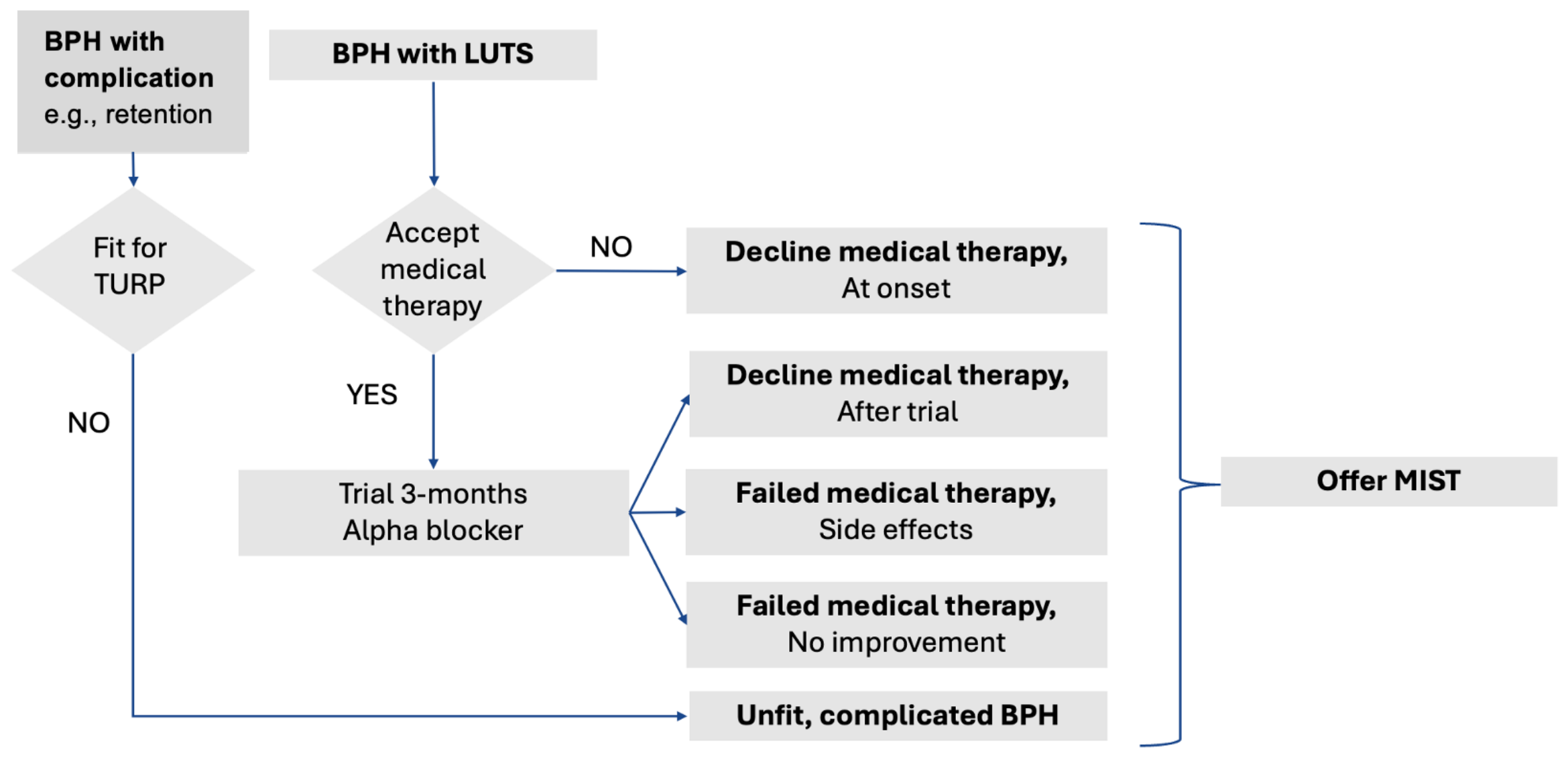
Applying our understanding of best practices and our experience in the utility of MIST for BPH, we have now implemented a management pathway to help guide decision-making in selecting treatment options for our patients (Figure 1).
Figure 1.
Management pathway for BPH. BPH: benign prostatic hyperplasia; LUTS: lower urinary tract symptoms; MIST: minimally invasive surgical therapies; TURP: transurethral resection of the prostate.
4.2. Efficacy Outcomes
The functional improvements observed in this study align closely with published literature. Both WVTT and PUL demonstrated clinically meaningful improvements in objective (Qmax) and subjective (IPSS, QoL) outcome measures. The combined overall improvement in IPSS (−12.6), QoL (−2.91), and Qmax (+5.00 mL/s) at three-month follow-up was consistent with the findings of randomized controlled trials involving WVTT and PUL [10,16].
Overall, both MIST options yielded improvements in urinary flow, though the degree of statistical certainty and clinical impact varied between the two. The WVTT group demonstrated superior efficacy with a mean Qmax increase of 4.28 mL/s (+/−5.03 S.D.), reaching high statistical significance (p < 0.001).
The PUL procedure showed a trend toward improvement in our study. This group showed a smaller mean improvement of 3.46 mL/s (+/−7.73 S.D.), which did not meet the threshold for statistical significance (p = 0.06).
The outcomes of WVTT and PUL suggest that both procedures remain viable options, with treatment selection ultimately guided by patient-specific factors such as prostate size, prostate anatomy, including the presence of a median lobe or a high bladder neck, patient preference, and physician expertise. The efficacy profiles support a personalized approach to MIST selection rather than a one-size-fits-all strategy. Key considerations for WVTT include the need for urethral catheterization and prolonged irritation of the urethra for up to a few weeks. PUL considerations include the presence of a protruding middle lobe, prostate size, and the introduction of permanent implants with risks of steel struts degrading the image quality of magnetic resonance imaging (MRI) [18].
4.3. Safety and Complications
The safety profile demonstrated in this study reinforces the minimally invasive nature of these procedures. The 32.3% complication rate consisted predominantly of minor, self-limiting complications that did not require surgical intervention. In our study, the most common complication was persistent urgency beyond three months (14.5%), followed by urinary retention after an initially successful trial without a catheter (8.1%), and significant gross hematuria (4.8%). This complication rate closely resembles the real-world outcomes of high-volume centers that perform WVTT and PUL [19,20]. Even though our institution had previously reported an excellent safety profile following bipolar TURP [21], there remain significant concerns with traditional surgical approaches such as TURP, which carry higher risks of bleeding, infection, and sexual dysfunction [22]. This risk-benefit profile supports the use of MIST in patients who might otherwise be considered unsuitable for surgical intervention.
4.4. Healthcare Resource Utilization
In a recent local cost-effectiveness study, WVTT was shown to be superior to medical management as a first-line treatment for patients with moderate or severe BPH [23]. The present study now provides further insights into the practically achievable healthcare resource utilization outcomes related to the use of MIST. One of the most significant findings of our study relates to healthcare efficiency. MIST was performed as day surgery 83.9% of the time, with a low readmission rate of 4.8%. Interestingly, PUL patients who required catheterization for >24 h due to an unsuccessful initial trial without a catheter (10/26, 28.5%) or had significant hematuria (3/26, 11.5%) were likely to be admitted overnight for a repeat trial without a catheter or bladder irrigation, respectively. These findings were consistent with the understanding that 75% of patients who need catheterization would be successful in a trial without a catheter the following day [24], and that 12% of PUL patients practically required a one-night stay [25]. These situations accounted for the day surgery rate of 69.2% (18/26) for PUL. On the other hand, WVTT cases were routinely counseled regarding the need for a urethral catheter post-operatively and were able to be discharged the same day without issues (34/36, 94.4%). Overall, the combination of LA MIST and day-surgery MIST may allow these procedures to be performed as outpatient office interventions that reduce hospital bed utilization and associated costs while improving patient convenience.
Patients who were originally catheter-dependent prior to MIST were routinely kept on long-term BPH medications post-operatively. The rationale for this regimen was the lack of long-term data on the effect of MIST on reducing progression of BPH. Despite this, the overall high medication independence rate (67.7%) represents both a clinical success and an economic benefit, as it reduces the ongoing costs and potential side effects of chronic BPH medications. In particular, 5α-reductase inhibitors are associated with reduced libido, erectile dysfunction, and mood disturbances, while α-blockers are associated with orthostatic hypotension and ejaculatory dysfunction. Excluding catheter-dependent patients, the medication-free rate at three months was 82.4%. This result compares favorably with a prior healthcare utilization study, which showed that the rate of medication therapy post-TURP was 6.2% at one year and 10.6% at five years of follow-up [26]. Also, if we use the medication-free rate as a surrogate measure for the ability to discharge such patients from the specialist outpatient clinic setting, MIST represents an effective procedure to reduce healthcare utilization of specialist services.
4.5. Limitations
Several limitations should be acknowledged. The retrospective design inherently limits the strength of the conclusions. During the pre-operative phase and follow-up, it was noted that some patients did not complete all patient-reported outcome measures or uroflowmetry. Therefore, complete case analyses were performed for each outcome separately, and the number of paired observations differed between outcome measures. These limitations of the retrospective design, relatively short follow-up, incomplete paired outcome data, and non-random treatment allocation limited the utility of formal between-group comparisons in this study. The absence of a control group prevents direct comparison with standard-of-care treatment modalities. The relatively short follow-up period, while adequate for the assessment of immediate outcomes, may not capture longer-term durability or late complications. The medication-free rate in this study was limited to alpha blocker and 5-alpha-reductase inhibitor use and did not include anticholinergics with which some patients with prolonged urgency were treated. The single-center design may limit generalizability, although the diverse patient population and real-world setting enhance external validity.
4.6. Future Directions
Longer-term follow-up studies are needed to establish the durability of MIST procedures and identify predictors of treatment success or failure. Comparative effectiveness research directly comparing MIST procedures with traditional surgical approaches would provide valuable guidance for treatment selection. Economic analyses incorporating both direct and indirect costs would further inform healthcare policy decisions.
5. Conclusions
This real-world study demonstrates that minimally invasive surgical therapies, specifically WVTT and PUL, represent safe and effective treatment options for patients with BPH-LUTS. While both procedures achieved high statistical significance in all subjective symptom assessments (p < 0.001), the objective efficacy profile was more pronounced in the WVTT group, which demonstrated a significant increase in Qmax (p < 0.001). In contrast, the PUL group showed a notable trend toward flow improvement (p = 0.06), though it did not meet the threshold for objective statistical significance. Despite these variations in flow dynamics, the excellent safety profile and overall symptom relief support the use of these procedures as viable alternatives for patients, including those considered high-risk for traditional surgery.
The favorable healthcare utilization metrics, including high day surgery rates, low readmission rates, and high medication independence rates, demonstrate the potential for MIST to optimize resource utilization while maintaining excellent clinical outcomes. The low re-treatment rate suggests durable therapeutic benefit, although longer-term studies are needed to confirm sustained efficacy. Additionally, the limitations of this study restrict direct comparative analyses between WVTT and PUL, and future studies would be beneficial for determining their relative effectiveness.
These findings support the integration of MIST procedures into standard urological practice as effective alternatives to both medical therapy and traditional surgical approaches. The choice between WVTT and PUL can be individualized, as both showed comparable outcomes in this real-world setting.
Author Contributions
Conceptualization, M.C.C. and W.L.; methodology, M.C.C. and W.L.; formal analysis, M.C.C. and W.L.; investigation, S.Y., M.M.O. and W.L.; resources, S.Y., M.M.O. and W.L.; data curation, M.C.C. and A.S.; writing—original draft preparation, M.C.C. and W.L.; writing—review and editing, M.C.C., S.Y., M.M.O. and W.L.; visualization, W.L.; supervision, S.Y., M.M.O. and W.L.; project administration, W.L. All authors have read and agreed to the published version of the manuscript.
Funding
This research received no external funding.
Institutional Review Board Statement
The study was conducted in accordance with the Declaration of Helsinki and approved by the Ethics Committee of National Healthcare Group Domain Specific Review Board (NHG DSRB Ref: 2025-0313) on 2 July 2025 for studies involving humans. The study involved anonymized data and did not require formal NHG DSRB review.
Informed Consent Statement
The study was conducted in accordance with, and approved by, the Ethics Committee of the National Healthcare Group Domain Specific Review Board (NHG DSRB Ref: 2025-0313) on 2 July 2025 for studies involving humans. The study involved anonymized data that do not meet the definition of human subject research, and as such, consent was not necessary.
Data Availability Statement
The original contributions presented in this study are included in the article. Further inquiries can be directed to the corresponding author.
Conflicts of Interest
The authors declare no conflicts of interest.
References
- Lim, K.B. Epidemiology of clinical benign prostatic hyperplasia. Asian J. Urol. 2017, 4, 148–151. [Google Scholar] [CrossRef] [Scilit] [PubMed]
- Chong, C.; Fong, L.; Lai, R.; Lau, W.K.O.; Hartman, M.; Chia, S.E. The prevalence of lower urinary tract symptoms and treatment-seeking behaviour in males over 40 years in Singapore: A community-based study. Prostate Cancer Prostatic Dis. 2012, 15, 273–277. [Google Scholar] [CrossRef] [Scilit] [PubMed]
- Madersbacher, S.; Roehrborn, C.G.; Oelke, M. The role of novel minimally invasive treatments for lower urinary tract symptoms associated with benign prostatic hyperplasia. BJU Int. 2020, 126, 317–326. [Google Scholar] [CrossRef] [Scilit] [PubMed]
- Shum, C.F.; Lau, W.; Teo, C.P.C. Medical therapy for clinical benign prostatic hyperplasia: α1 Antagonists, 5α reductase inhibitors and their combination. Asian J. Urol. 2017, 4, 185–190. [Google Scholar] [CrossRef] [Scilit] [PubMed]
- National Institute for Health and Care Excellence. Rezum for Treating Lower Urinary Tract Symptoms Secondary to Benign Prostatic Hyperplasia (Medical Technologies Guidance [MTG49]). 2020. Available online: https://www.nice.org.uk/guidance/mtg49 (accessed on 6 April 2026).
- National Institute for Health and Care Excellence. UroLift for Treating Lower Urinary Tract Symptoms of Benign Prostatic Hyperplasia (Medical Technologies Guidance [MTG58]). 2021. Available online: https://www.nice.org.uk/guidance/mtg58 (accessed on 6 April 2026).
- Wirtzfeld, N.; Moretto, S.; Doizi, S. Local anesthesia for Rezūm™: A narrative review of the literature. World J. Urol. 2025, 43, 252. [Google Scholar] [CrossRef] [Scilit] [PubMed]
- Secco, S.; Mirabella, G.; Savoldi, A.; Tagliabue, D.; Zamboni, S.; Suardi, N.R.; Olivero, A.; Dell’Oglio, P.; Simeone, C.; Massimo Bocciardi, A.; et al. Italian experience with Prostatic Urethral Lift using pure local anaesthesia. Ambul. Surg. 2022, 28, 69–72. [Google Scholar]
- McVary, K.T.; Gittelman, M.C.; Goldberg, K.A.; Patel, K.; Shore, N.D.; Levin, R.M.; Pliskin, M.; Beahrs, J.R.; Prall, D.; Kaminetsky, J.; et al. Final 5-year outcomes of the multicenter randomized sham-controlled trial of a water vapour thermal therapy for treatment of moderate to severe lower urinary tract symptoms secondary to benign prostatic hyperplasia. J. Urol. 2021, 206, 715–724. [Google Scholar] [CrossRef] [Scilit] [PubMed]
- Roehrborn, C.G.; Gange, S.N.; Shore, N.D.; Giddens, J.L.; Bolton, D.M.; Cowan, B.E.; Brown, B.T.; McVary, K.T.; Te, A.E.; Gholami, S.S.; et al. The prostatic urethral lift for the treatment of lower urinary tract symptoms associated with prostate enlargement due to benign prostatic hyperplasia: The L.I.F.T. Study. J. Urol. 2013, 190, 2161–2167. [Google Scholar] [CrossRef] [Scilit] [PubMed]
- The Jamovi Project. Jamovi, version 2.7; The Jamovi Project: Sydney, Australia, 2025. Available online: https://www.jamovi.org (accessed on 6 April 2026).
- Mirone, V.; Imbimbo, C.; Longo, N.; Fusco, F. The detrusor muscle: An innocent victim of bladder outlet obstruction. Eur. Urol. 2007, 51, 57–66. [Google Scholar] [CrossRef] [Scilit] [PubMed]
- Bortnick, E.; Brown, C.; Simma-Chiang, V.; Kaplan, S.A. Modern best practice in the management of benign prostatic hyperplasia in the elderly. Ther. Adv. Urol. 2020, 12, 1756287220929486. [Google Scholar] [CrossRef] [Scilit] [PubMed]
- McVary, K.T.; Holland, B.; Beahrs, J.R. Water vapour thermal therapy to alleviate catheter-dependent urinary retention secondary to benign prostatic hyperplasia. Prostate Cancer Prostatic Dis. 2020, 23, 303–308. [Google Scholar] [CrossRef] [Scilit] [PubMed]
- Rochester, M.; Doherty, R.; Page, T.; Barber, N.; Kavia, R.; Thiruchelvam, N.; Gange, S.; Mueller, T.; Eure, G.; Chin, P.; et al. Prostatic urethral lift for subjects in urinary retention (PULSAR): 12-Month results of a prospective controlled trial compared with real-world outcomes. BJUI Compass 2024, 5, 60–69. [Google Scholar] [CrossRef] [Scilit] [PubMed]
- Gondran-Tellier, B.; McManus, R.; Sichez, P.C.; Akiki, A.; Gaillet, S.; Toledano, H.; Andre, M.; Delaporte, V.; Vidal, V.; Karsenty, G.; et al. Efficacy and safety of surgery for benign prostatic obstruction in patients with preoperative urinary catheter. J. Endourol. 2021, 35, 102–108. [Google Scholar] [CrossRef] [Scilit] [PubMed]
- McVary, K.T.; Chughtai, B.; Miller, L.E.; Bhattacharyya, S.K.; Dornbier, R.A.; Elterman, D.S. Putting patients ahead by leaving nothing behind: An emerging treatment paradigm in minimally invasive surgical therapy for benign prostatic hyperplasia. Med. Devices 2021, 14, 59–64. [Google Scholar] [CrossRef] [Scilit] [PubMed]
- Cantrill, C.H.; Zorn, K.C.; Elterman, D.S.; Gonzalez, R.R. The Rezūm system—A minimally invasive water vapour thermal therapy for obstructive benign prostatic hyperplasia. Can. J. Urol. 2019, 26, 9787–9793. [Google Scholar] [PubMed]
- Chin, C.P.; Garden, E.B.; Ravivarapu, K.T.; Shukla, D.; Omidele, O.; Levy, M.; Qian, D.; Araya, J.S.; Valenzuela, R.; Reddy, A.; et al. Medium-term real-world outcomes of minimally invasive surgical therapies for benign prostatic hyperplasia: Water vapour thermal therapy (Rezum) vs prostatic urethral lift (UroLift) in a high-volume urban academic center. J. Endourol. 2022, 36, 1559–1566. [Google Scholar] [CrossRef] [Scilit] [PubMed]
- Kaplan, S.; Kaufman, R.P., Jr.; Mueller, T.; Elterman, D.; Chughtai, B.; Rukstalis, D.; Woo, H.; Roehrborn, C. Retreatment rates and postprocedural complications are higher than expected after BPH surgeries: A US healthcare claims and utilization study. Prostate Cancer Prostatic Dis. 2024, 27, 485–491. [Google Scholar] [CrossRef] [Scilit] [PubMed]
- Shum, C.F.; Mukherjee, A.; Teo, C.P.C. Catheter-free discharge on first postoperative day after bipolar transurethral resection of prostate: Clinical outcomes of 100 cases. Int. J. Urol. 2014, 21, 313–318. [Google Scholar] [CrossRef] [Scilit] [PubMed]
- Mayer, E.K.; Kroeze, S.G.C.; Chopra, S.; Bottle, A.; Patel, A. Examining the ’gold standard’: A comparative critical analysis of three consecutive decades of monopolar transurethral resection of the prostate (TURP) outcomes. BJU Int. 2012, 110, 1595–1601. [Google Scholar] [CrossRef] [Scilit] [PubMed]
- Sánchez-Gómez, L.M.; Polo-deSantos, M.; Gómez-Sancha, F.; Luengo-Matos, S. Efficacy and safety of the urolift® system for the treatment of benign prostate hyperplasia symptoms: Systematic review. Actas Urol. Esp. 2015, 39, 311–319. [Google Scholar] [CrossRef] [Scilit]
- Page, T.; Veeratterapillay, R.; Keltie, K.; Burn, J.; Sims, A. Prostatic urethral lift (UroLift): A real-world analysis of outcomes using hospital episodes statistics. BMC Urol. 2021, 21, 55. [Google Scholar] [CrossRef] [Scilit] [PubMed]
- Chay, J.; Tung, J.Y.M.; Su, R.J.; Aslim, E.J.; Wong, C.; Swan, G.; Chua, W.J.; Ho, H.S.S.; Finkelstein, E.A. Cost-effectiveness of alternative first- and second-line treatments for benign prostatic hyperplasia in Singapore. J. Med. Econ. 2023, 26, 1269–1277. [Google Scholar] [CrossRef] [Scilit] [PubMed]
- Kaplan, S.; Kaufman, R.P.; Elterman, D.; Chughtai, B.; Roehrborn, C. Extended LUTS medication use following BPH surgical treatment: A US healthcare claims analysis. Prostate Cancer Prostatic Dis. 2025, 28, 913–917. [Google Scholar] [CrossRef] [Scilit] [PubMed]
Disclaimer/Publisher’s Note: The statements, opinions and data contained in all publications are solely those of the individual author(s) and contributor(s) and not of MDPI and/or the editor(s). MDPI and/or the editor(s) disclaim responsibility for any injury to people or property resulting from any ideas, methods, instructions or products referred to in the content. |
© 2026 by the authors. Published by MDPI on behalf of the Société Internationale d’Urologie. Licensee MDPI, Basel, Switzerland. This article is an open access article distributed under the terms and conditions of the Creative Commons Attribution (CC BY) license.