


A 79-year-old man presented with progressively worsening abdominal pain and distension 12 days after undergoing routine intradetrusor injection of 100 units of onabotulinumtoxinA for refractory overactive bladder. He had previously undergone the same treatment multiple times at the same dose without complications. The procedure was performed using a flexible cystoscope under local anaesthesia. A total volume of 10 mL was administered as ten 1-mL injections using a 27 G, 4 mm needle: one into each lateral wall, one into the trigone, and seven into the posterior bladder wall in two rows.
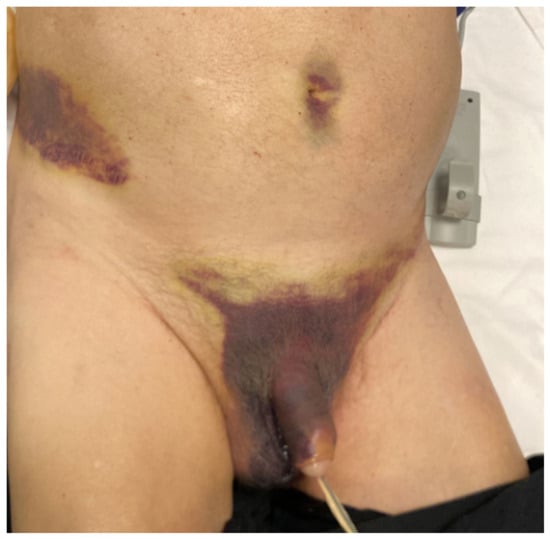
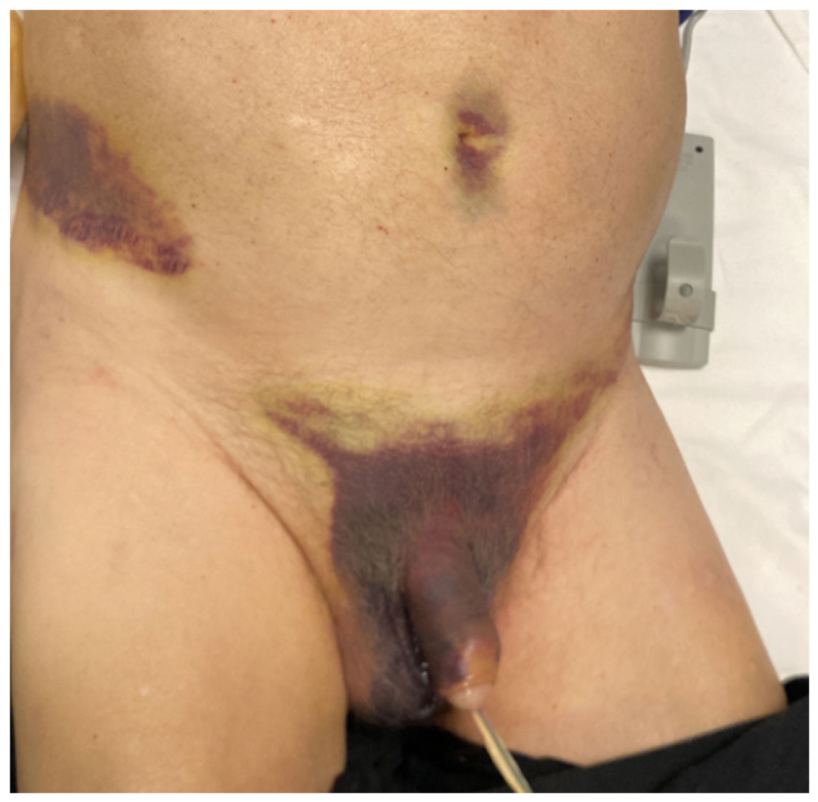
Clinical examination revealed extensive ecchymosis involving the flanks, periumbilical region and external genitalia (Figure 1). The periumbilical ecchymosis represented Cullen’s sign, reflecting tracking of extravasated blood into the periumbilical subcutaneous tissues. Laboratory investigations demonstrated an approximately 4 g/dL fall in haemoglobin.
Figure 1.
Clinical photograph demonstrating extensive flank, periumbilical, and external genital ecchymosis.
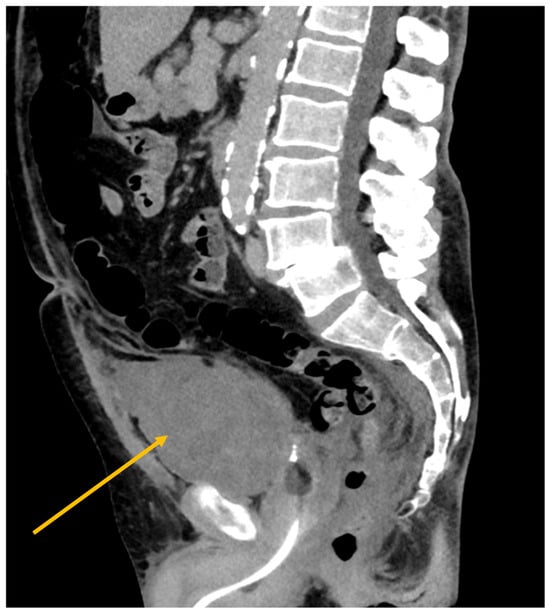
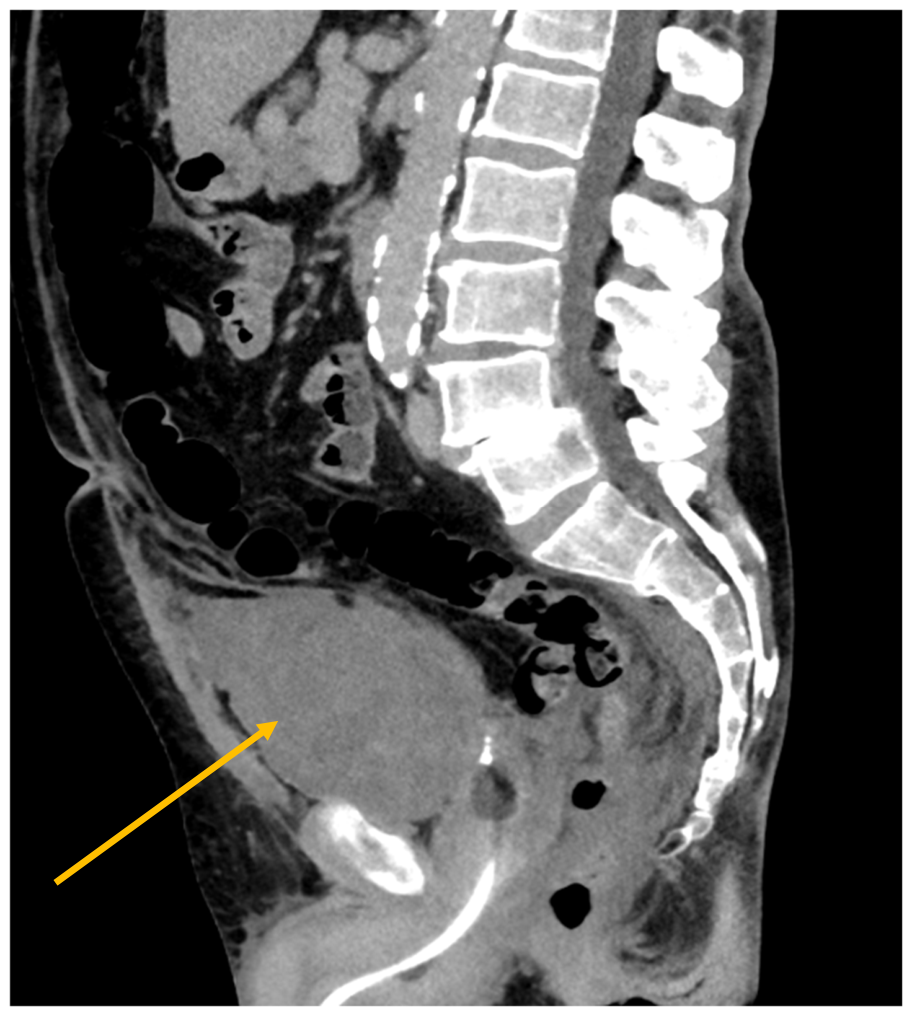
Emergency computed tomography demonstrated an 8 × 8.5 × 11.5 cm extraperitoneal haematoma located anterior to the bladder, extending towards the pubic symphysis and superiorly to the level of the umbilicus (Figure 2). No ongoing bleeding was identified, and the patient remained haemodynamically and haematologically stable during a 2-day admission. No transfusion, antibiotics, or invasive intervention were required, and his condition improved with observation alone.
Figure 2.
Sagittal contrast-enhanced computed tomography (CT) image demonstrating a large extraperitoneal haematoma (marked with arrow).
His medical history included polycythaemia vera. He was also taking aspirin 75 mg daily, which was continued. Pelvic and retroperitoneal haematomas following intradetrusor botulinum toxin A have previously been reported by Atayi et al. and Eineluoto and Jokinen [1,2]. In this case, the temporal and anatomical relationship suggests needle-related vascular injury, although the specific vessel could not be identified. Alternative causes include trauma, coagulopathy, vascular lesions, and other pelvic pathology.
This case illustrates the striking clinical and radiological manifestations of significant extravesical haemorrhage and highlights that delayed presentation may occur after an apparently uncomplicated intradetrusor onabotulinumtoxinA injection, even following previous uneventful treatments.
Author Contributions
Conceptualization, P.J.-J.; methodology, I.R. and P.J.-J.; writing—original draft preparation, P.J.-J.; writing—review and editing, I.R., C.B. and I.R.; supervision, P.J.-J. All authors have read and agreed to the published version of the manuscript.
Funding
This research received no external funding.
Institutional Review Board Statement
Ethical review and approval were not required for this clinical image. Under applicable research ethics guidance in Norway, a single-patient case report/image without a systematic research methodology does not constitute medical and health research requiring prior approval by an ethics committee. Written and signed informed consent was obtained from the patient for publication of this clinical image.
Informed Consent Statement
Written informed consent has been obtained from the patient to publish this paper.
Data Availability Statement
The raw data supporting the conclusions of this article will be made available by the authors on request.
Conflicts of Interest
The authors declare no conflicts of interest.
References
- Atayi, A.; Al-Gburi, S.; Hamdoon, M.; Patrick, N. A Large Pelvic Haematoma Caused by a Local Anaesthetic Flexible Cystoscopy Injection of Intradetrusor Botulinum Toxin A: A Case Report. Cureus 2024, 16, e74754. [Google Scholar] [CrossRef] [Scilit] [PubMed]
- Eineluoto, J.T.; Jokinen, J. Silent but Severe: A Case Report of a Large Retroperitoneal Hematoma Following Routine Intradetrusor Botulinum Toxin A Injections. Cureus 2025, 17, e90013. [Google Scholar] [CrossRef] [Scilit] [PubMed]
Disclaimer/Publisher’s Note: The statements, opinions and data contained in all publications are solely those of the individual author(s) and contributor(s) and not of MDPI and/or the editor(s). MDPI and/or the editor(s) disclaim responsibility for any injury to people or property resulting from any ideas, methods, instructions or products referred to in the content. |
© 2026 by the authors. Published by MDPI on behalf of the Société Internationale d’Urologie. Licensee MDPI, Basel, Switzerland. This article is an open access article distributed under the terms and conditions of the Creative Commons Attribution (CC BY) license.