


Research on Interventions for Improving Outcomes of Patients with Multimorbidity in Primary Care and Community Settings
Special Issue Information
Dear Colleagues,
Multimorbidity is defined as the coexistence of two or more chronic health conditions in thesame individual, often requiring long-term care. Patterns of multimorbidity are shaped by several factors including age (e.g., noncommunicable diseases, visual and hearing impairment), higher prevalence of conditions (e.g., noncommunicable diseases and HIV), shared risk factors (e.g., cardiovascular disease, diabetes and chronic respiratory disease), and associations between disease conditions (e.g., anxiety and depression, chronic respiratory disease and tuberculosis). In addition, social and behavioral determinants may affect the emergence and subsequent evolution of multimorbidity.
Evidence from studies indicates that multimorbidity leads to impaired physical and mental health, reduced quality of life, and higher hospitalization, mortality rates and healthcare costs. Most of these negative impacts of multimorbidity are even worse in resource-constrained settings where healthcare systems are fragmented, underfunded and often designed to address single disease conditions or risk factors. The prevalence of people with multimorbidity in primary care increases from 20% before the age of 40 to 75% at 70. Primary health care offers a sustainable, pragmatic and cost-effective approach to address the challenges of multimorbidity, since it encompasses primary care service delivery, public health services, and intersectoral actions on social determinants of health and equity.
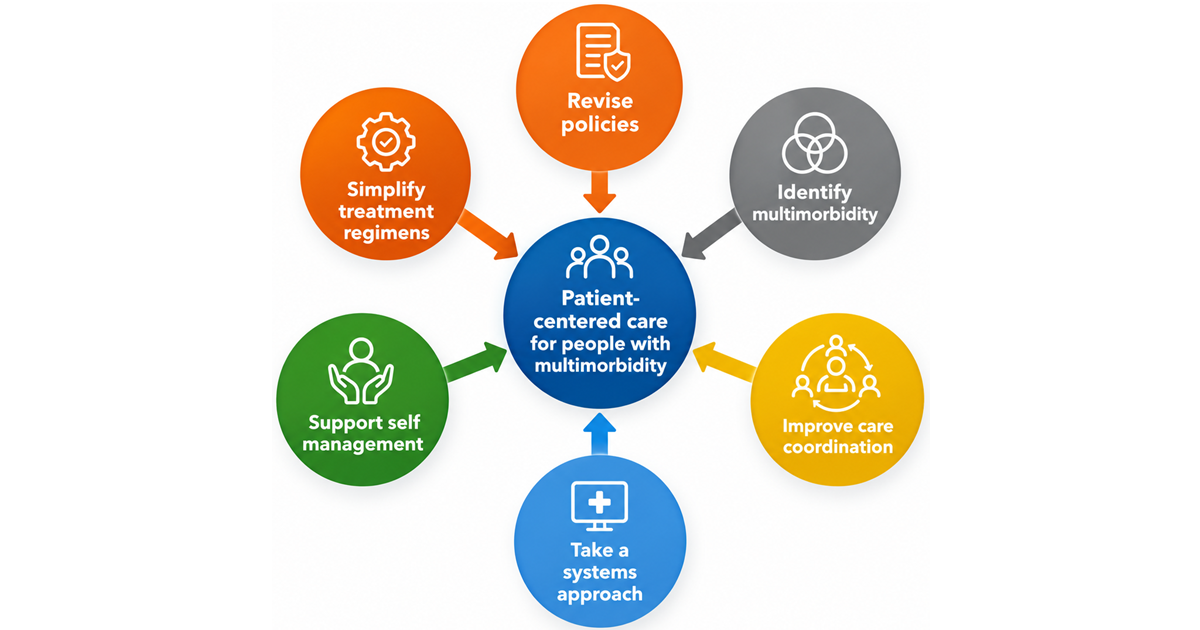
Interventions that have the potential to address the varied needs of people with multimorbidity and improve outcomes are complex and multifaceted. Such interventions may be organizational, patient-oriented, professional-oriented, financial or regulatory. However, there has been limited research on the effectiveness of these interventions.
The aim of this Special Issue is to gather evidence on key strategies that have the potential to deliver patient-centered care for people with multimorbidity in primary and community care settings. Decision-makers, health professionals, researchers, scholars, and advocates are invited to enrich this Special Issue by submitting papers on evaluated interventions for multimorbidity, especially pragmatic trials, implementation studies, health-services research, mixed-methods studies, economic evaluations, and high-quality systematic reviews.
We look forward to receiving your contributions.
Dr. Shanthi Mendis MBBS, MD FRCP FACC
Guest Editor
Manuscript Submission Information
Manuscripts should be submitted online at www.mdpi.com by registering and logging in to this website. Once you are registered, click here to go to the submission form. Manuscripts can be submitted until the deadline. All submissions that pass pre-check are peer-reviewed. Accepted papers will be published continuously in the journal (as soon as accepted) and will be listed together on the Special Issue website. Research articles, review articles as well as short communications are invited. For planned papers, a title and short abstract (about 250 words) can be sent to the Editorial Office for assessment.
Submitted manuscripts should not have been published previously, nor be under consideration for publication elsewhere (except conference proceedings papers). All manuscripts are thoroughly refereed through a single-anonymized peer-review process. A guide for authors and other relevant information for submission of manuscripts is available on the Instructions for Authors page. Primary and Hospital Care is an international peer-reviewed open access quarterly journal published by MDPI.
Please visit the Instructions for Authors page before submitting a manuscript. The Article Processing Charge (APC) for publication in this open access journal is 1000 CHF (Swiss Francs). Submitted papers should be well formatted and use good English. Authors may use MDPI's English editing service prior to publication or during author revisions.
Keywords
- multimorbidity
- primary health care
- health outcomes
- people-centered care
Benefits of Publishing in a Special Issue
- Ease of navigation: Grouping papers by topic helps scholars navigate broad scope journals more efficiently.
- Greater discoverability: Special Issues support the reach and impact of scientific research. Articles in Special Issues are more discoverable and cited more frequently.
- Expansion of research network: Special Issues facilitate connections among authors, fostering scientific collaborations.
- External promotion: Articles in Special Issues are often promoted through the journal's social media, increasing their visibility.
- Reprint: MDPI Books provides the opportunity to republish successful Special Issues in book format, both online and in print.
Published Papers


Prim. Hosp. Care - ISSN 3042-9897