Prim. Hosp. Care 2026, 25(2), 10; https://doi.org/10.3390/phc25020010 - 10 Jul 2026
Abstract
►
Show Figures
Antimicrobial resistance—partly driven by inappropriate antibiotic consumption—is a major public health threat. Point-of-care (POC) procalcitonin testing can reduce antibiotic prescribing safely. Within an implementation-effectiveness trial, we conducted a two-phase participatory context analysis to identify and prioritise determinants of POC procalcitonin adoption, implementation and
[...] Read more.
Antimicrobial resistance—partly driven by inappropriate antibiotic consumption—is a major public health threat. Point-of-care (POC) procalcitonin testing can reduce antibiotic prescribing safely. Within an implementation-effectiveness trial, we conducted a two-phase participatory context analysis to identify and prioritise determinants of POC procalcitonin adoption, implementation and continued use in Swiss primary care. First, we conducted 32 semi-structured interviews with 34 participants, including physicians, representatives of medical organisations, patient representatives and other stakeholders. By coding transcripts deductively using the Consolidated Framework for Implementation Research and inductively, we identified 86 potential determinants. Second, in a focus group with ten ImpPro research team members, 15 determinants were identified as ‘not requiring change’, and ten were considered ‘unchangeable’. Among the remaining 61 determinants, 41 were prioritised through dot-voting and group discussion. These key implementation determinants were inductively grouped into eight themes. The themes with the highest priority were: (1) physicians’ awareness, knowledge, and access to education regarding POC procalcitonin, (2) scientific evidence supporting POC procalcitonin-guided antibiotic prescribing, (3) physician motivation and (4) endorsement of POC procalcitonin by credible organisations and experts. Addressing these determinants will likely require a tailored, multifaceted (combining several unique strategies), and multilevel (targeting different levels of the system) implementation strategy.
Full article
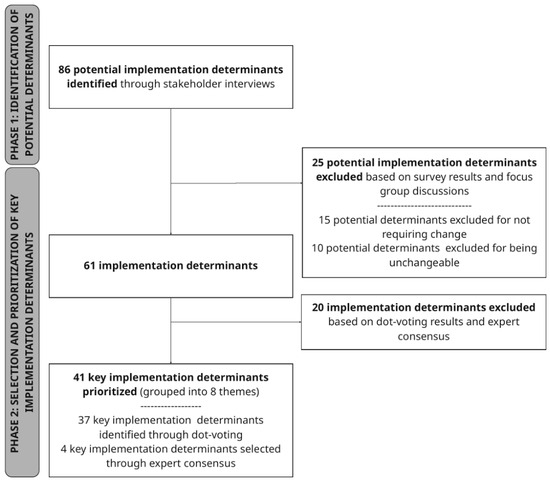
Figure 1