Skip to Content
  • 34 days
    Submission to First Decision
  • 8 days
    Acceptance to Publication

Pandemics

Pandemics is an international, peer-reviewed, open access journal on infectious disease pandemics that is published quarterly online by MDPI.
  • Open Access— free for readers, with article processing charges (APC) paid by authors or their institutions.
  • Rapid Publication: first decisions in 18 days; acceptance to publication in 7 days (median values for MDPI journals in the first half of 2026).
  • Recognition of Reviewers: Reviewers whose reports are timely and of high quality receive an APC discount voucher for a future publication in an MDPI journal. Become a reviewer.

Get Alerted

Add your email address to receive forthcoming issues of this journal.

All Articles (15)

  • Review
  • Open Access

Antimicrobial-resistant Pseudomonas aeruginosa and Acinetobacter baumannii are major One Health threats, yet the environmental distribution of their epidemic lineages in Brazil remains poorly characterized. This systematic review aimed to synthesize evidence on the clonal diversity, antimicrobial resistance, and geographic distribution of molecularly typed P. aeruginosa and A. baumannii recovered from Brazilian aquatic environments. Searches were conducted in PubMed/MEDLINE, Scopus, Web of Science, SciELO, and LILACS/BVS, following PRISMA 2020. Eleven studies published between 2015 and 2026 were included, comprising 66 unique molecularly typed environmental isolates: 59 P. aeruginosa and seven A. baumannii. Among P. aeruginosa, 24 sequence types (STs) were identified, including the recognized high-risk clones ST244, ST277, and ST235. Four A. baumannii isolates belonged to ST79/International Clone 5, while ST1278, ST3355, and ST744 represented additional lineages. Clinically relevant resistance determinants included blaSPM-1, blaVIM-2, blaKPC-2, and blaOXA-23. Evidence was geographically concentrated and frequently based on selective molecular characterization. Brazilian aquatic environments therefore harbor both established high-risk clones and diverse additional resistant lineages within a One Health framework.

Pandemics

28 October 2026
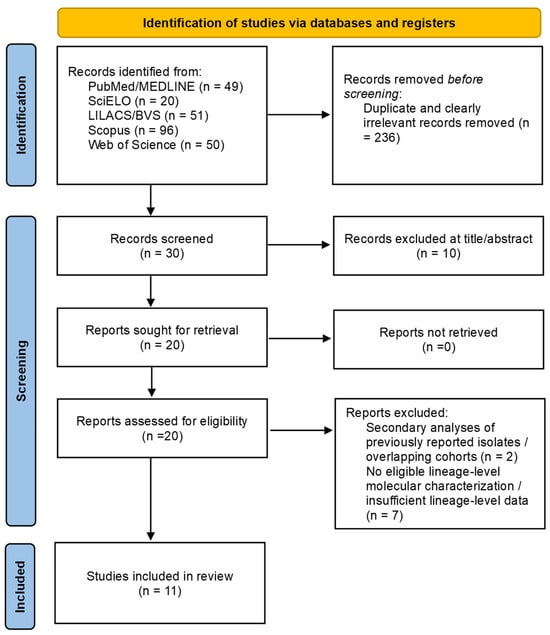
PRISMA 2020 flow diagram of study identification, screening, eligibility, and inclusion.
  • Review
  • Open Access

Feline calicivirus (FCV) is a genetically diverse and rapidly evolving positive-sense RNA virus that remains a major cause of infectious disease in domestic cats worldwide. FCV is classically associated with upper respiratory tract disease and oral ulceration; however, the emergence of highly virulent systemic FCV (VS-FCV) strains has expanded its clinical significance owing to severe multisystemic disease, increased mortality, and frequent outbreaks in shelters, breeding colonies, and veterinary healthcare facilities. Continuous viral evolution driven by mutation, recombination, and immune selection promotes antigenic diversity, prolonged asymptomatic shedding, vaccine escape, and the emergence of novel variants, thereby complicating diagnosis, prevention, and disease control. This review summarizes recent advances in FCV molecular biology, viral evolution, host–virus interactions, pathogenesis, epidemiology, clinical manifestations, diagnostics, vaccination, and emerging antiviral and immunomodulatory therapies. The review also examines the available epidemiological evidence on FCV in India, highlighting reported regional findings, limitations in geographic and genomic coverage, and the need for coordinated surveillance. Within a One Health framework, FCV is considered primarily as an important companion-animal pathogen and a model for strengthening veterinary surveillance, biosecurity, genomic monitoring, and outbreak preparedness, rather than as a confirmed zoonotic threat. By integrating current scientific evidence with identified surveillance and research gaps, this review outlines priorities for improving FCV surveillance, prevention, and control and for strengthening preparedness for emerging companion-animal viral diseases.

Pandemics

26 October 2026

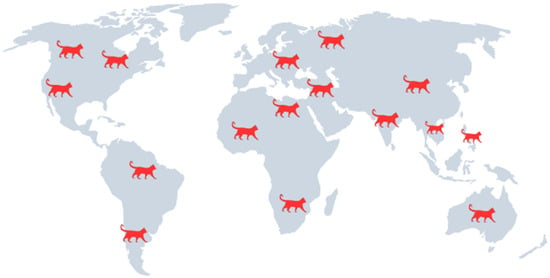
Worldwide distribution of feline calicivirus (FCV) infection. The map illustrates the reported geographical occurrence of FCV in domestic cats across different continents, highlighting the widespread distribution of the virus globally. Created in BioRender. Publication License Details: https://BioRender.com/r9vygl1.
  • Article
  • Open Access

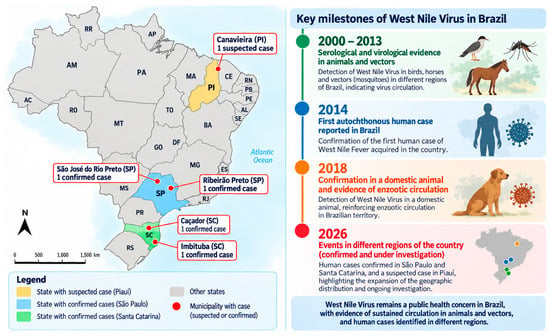
West Nile fever (WNF) is a zoonotic arboviral disease caused by West Nile virus (WNV), maintained primarily in an enzootic cycle involving birds and mosquitoes, particularly species of the genus Culex. Although evidence of viral circulation has previously been documented in Brazil, human disease remains infrequently recognized. This study aimed to describe the human cases of WNF identified in Brazil in 2026 and to interpret their epidemiological significance within an integrated One Health surveillance framework. A descriptive retrospective study was conducted using secondary information from the Ministry of Health, state and municipal health authorities, scientific literature, and official technical documents, incorporating information available through 28 August 2026. Four human cases were confirmed—two in Santa Catarina and two in São Paulo—and one probable/under-investigation case was identified in Piauí. The confirmed cases showed heterogeneous clinical presentations, including neuroinvasive manifestations, hospitalization, and one death; the latter was recorded as associated with stroke, with its relationship to WNV infection remaining under investigation. One confirmed case had recent travel to the Amazon region, while other probable sites of infection remained under investigation. The available public sources did not provide concurrent entomological or animal surveillance results sufficient to establish a local transmission chain. The 2026 events therefore constitute a sentinel epidemiological signal that supports intensification of integrated human, laboratory, entomological, animal, and environmental surveillance rather than inference of sustained autochthonous transmission.

Pandemics

30 September 2026

Geographic distribution and timeline of West Nile fever cases in Brazil in 2026 (data cutoff: 28 August 2026).
  • Article
  • Open Access

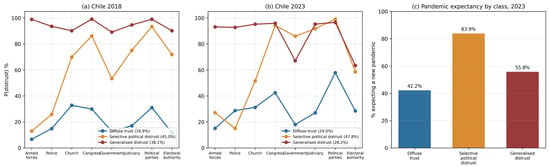
Background: Three years after the acute phase of COVID-19, it remains unclear whether pandemic experience left a durable imprint on civic attitudes in Latin America, and which citizens continue to anticipate a recurrence. This study examines how latent configurations of institutional trust relate to the expectation of a future pandemic in Chile. Methods: We analysed the Chilean subsamples of two independent Latinobarómetro cross-sections (2018, n = 1200; 2023, n = 1200). Latent class analysis was applied to eight harmonised, dichotomised institutional trust indicators in each wave, with class enumeration based on the Bayesian information criterion, entropy, interpretability, and a parametric bootstrap likelihood ratio test. Weighted logistic regression modelled pandemic expectancy on class membership, with bootstrap standard errors. Results: A three-class solution was retained in both waves: diffuse trust, selective political distrust, and generalised distrust. Distrust declined for the electoral authority (−16.2 pp, p < 0.001), the church (−13.0 pp, p = 0.001), and the police (−10.7 pp, p = 0.011), while remaining stable or rising for representative institutions. No respondent named the pandemic as the country’s main problem in 2023, yet 69.2% expected another pandemic. Expectancy was non-monotonic across classes, peaking in the selective political distrust class (78.8%) rather than the generalised distrust class (61.8%). Conclusions: At the population level, pandemic memory and pandemic expectancy appear to have come apart. The non-monotonic gradient is inconsistent with the pattern predicted by a fatalism account of risk anticipation. Because the inter-wave interval spans both the 2019 social uprising and the COVID-19 pandemic, the repeated cross-sectional design cannot attribute attitudinal change to the pandemic specifically, and the findings are best read as descriptive of the post-pandemic period rather than as pandemic effects.

Pandemics

23 September 2026

Latent class profiles of institutional distrust and pandemic expectancy in Chile. (a) Conditional probabilities of distrust by class, 2018. (b) Conditional probabilities of distrust by class, 2023. (c) Weighted percentage expecting a new pandemic by class, 2023. Class prevalences in parentheses.

Highly Accessed Articles

News & Conferences

Latest Issues

Open for Submission

Journal Sections

XFacebookLinkedIn
Pandemics - ISSN 3042-9323