


Abstract
Antimicrobial-resistant Pseudomonas aeruginosa and Acinetobacter baumannii are major One Health threats, yet the environmental distribution of their epidemic lineages in Brazil remains poorly characterized. This systematic review aimed to synthesize evidence on the clonal diversity, antimicrobial resistance, and geographic distribution of molecularly typed P. aeruginosa and A. baumannii recovered from Brazilian aquatic environments. Searches were conducted in PubMed/MEDLINE, Scopus, Web of Science, SciELO, and LILACS/BVS, following PRISMA 2020. Eleven studies published between 2015 and 2026 were included, comprising 66 unique molecularly typed environmental isolates: 59 P. aeruginosa and seven A. baumannii. Among P. aeruginosa, 24 sequence types (STs) were identified, including the recognized high-risk clones ST244, ST277, and ST235. Four A. baumannii isolates belonged to ST79/International Clone 5, while ST1278, ST3355, and ST744 represented additional lineages. Clinically relevant resistance determinants included blaSPM-1, blaVIM-2, blaKPC-2, and blaOXA-23. Evidence was geographically concentrated and frequently based on selective molecular characterization. Brazilian aquatic environments therefore harbor both established high-risk clones and diverse additional resistant lineages within a One Health framework.
1. Introduction
Among the Gram-negative pathogens driving the global antimicrobial resistance (AMR) crisis, Pseudomonas aeruginosa and Acinetobacter baumannii are of particular concern because of their ability to persist in adverse environments, accumulate resistance mechanisms, and disseminate successful epidemic lineages. Carbapenem-resistant strains of both species are associated with limited therapeutic options and difficult-to-treat (DTR) healthcare-associated infections. Reflecting this clinical importance, the 2024 WHO Bacterial Priority Pathogens List places carbapenem-resistant A. baumannii (CRAB) in the critical-priority group and carbapenem-resistant P. aeruginosa (CRPA) in the high-priority group. Their relevance is further underscored by the wider burden of bacterial AMR, which was estimated to have directly caused 1.27 million deaths globally in 2019 [1,2].
The global success of AMR on P. aeruginosa is disproportionately associated with a limited number of epidemic lineages commonly referred to as high-risk clones (HRCs). These lineages combine broad geographic dissemination with epidemic success and, frequently, multidrug-resistant (MDR) or extensively drug-resistant (XDR) phenotypes and horizontally acquired β-lactamases [3,4]. Among the most recognized P. aeruginosa HRCs are ST235, ST111, ST233, ST244, ST357, ST308, ST175, ST277, ST654, and ST298 [3,4,5]. In A. baumannii, successful epidemic populations are more commonly described within the framework of international clones (ICs). In Latin America, carbapenem resistance has been strongly associated with OXA-type carbapenemases, particularly OXA-23, and with successful lineages including CC79/ST79, corresponding to International Clone 5 (IC5), which has achieved substantial regional dissemination [6].
Although molecular surveillance of these lineages has traditionally focused on clinical settings, increasing evidence shows that their epidemiology extends into aquatic environments. Wastewater and wastewater-impacted surface waters can receive resistant bacteria, AMR genes, antimicrobial residues, and other selective agents, making them important compartments for One Health AMR surveillance. The detection of clinically relevant clones in these environments suggests circulation beyond hospitals, while methodological heterogeneity among environmental studies still limits direct comparisons and highlights the need for structured evidence synthesis [7,8]. In Brazil, clinically relevant P. aeruginosa and A. baumannii lineages have been increasingly reported outside healthcare settings, including hospital wastewater, urban rivers, streams, and other aquatic environments [9,10,11,12,13,14,15,16,17,18,19]. Molecular and genomic investigations have identified internationally recognized HRCs carrying important resistance determinants, indicating that aquatic systems may represent relevant compartments for the environmental dissemination of healthcare-associated lineages.
Despite increasing interest in environmental AMR, reports on the occurrence and molecular characteristics of high-risk P. aeruginosa and A. baumannii lineages in Brazilian aquatic environments remain fragmented across different regions, environmental matrices, and molecular approaches, and their overall distribution has not yet been systematically mapped. Consequently, the extent to which specific epidemic lineages occur across distinct aquatic compartments, and the resistance determinants associated with their environmental detection, remains incompletely characterized.
From a pandemic preparedness perspective, the environmental occurrence of HRCs is particularly relevant because these lineages combine AMR, successful dissemination across geographic regions, and the capacity to persist in multiple ecological niches. Aquatic environments may therefore represent reservoirs or interfaces facilitating the maintenance and dissemination of clinically important lineages beyond healthcare settings. Although their detection in environmental samples does not itself demonstrate pandemic potential, monitoring their circulation across human, animal, and environmental compartments is relevant to One Health surveillance and preparedness for the emergence and international spread of antimicrobial-resistant pathogens. Therefore, this systematic review aimed to characterize the molecular epidemiology, clonal diversity, and AMR of P. aeruginosa and A. baumannii recovered from Brazilian aquatic environments, with particular emphasis on recognized high-risk and international clones, while also describing other genotyped lineages with potential epidemiological relevance.
2. Materials and Methods
2.1. Review Design, Question, and PECO-S Framework
This systematic review was conducted to characterize the molecular epidemiology, clonal diversity, and AMR of P. aeruginosa and A. baumannii recovered from Brazilian aquatic environments. The review included both HRCs and ICs, as well as other lineages, to capture the broader environmental clonal diversity and to identify lineages that may have emerging epidemiological relevance. This systematic review was conducted and reported in accordance with the PRISMA 2020 statement (Supplementary File S1) and was retrospectively registered with the Open Science Framework (OSF; registration DOI: 10.17605/OSF.IO/D3QGF). No formal review protocol was prepared prior to conducting the review.
The main review question was “Which molecularly typed lineages of P. aeruginosa and A. baumannii have been reported in Brazilian aquatic environments, and what are their molecular epidemiological and antimicrobial-resistance characteristics, particularly regarding recognized HRCs-ICs and other potentially epidemiologically relevant lineages?” Eligibility criteria were structured according to the PECO-S framework (Population, Exposure, Comparator, Outcome, and Study design), adapted for environmental molecular epidemiology (Table 1) [20].
Table 1.
PECO-S framework used to define the review question and eligibility criteria.
2.2. Eligibility Criteria
Studies were considered eligible when they reported P. aeruginosa and/or A. baumannii recovered from aquatic environments in Brazil and provided sufficient molecular characterization to assign isolates to a sequence type (ST), IC, or equivalent lineage. Aquatic environments included natural and anthropogenically impacted water systems, such as rivers, streams, bays, coastal waters, reservoirs, wastewater, hospital wastewater, hospital effluents, sewage, wastewater-treatment systems and similars. Studies were included when they met the following criteria: (a) investigated P. aeruginosa and/or A. baumannii; (b) included isolates recovered from Brazilian aquatic environments; (c) provided lineage-level molecular typing, particularly multilocus sequence typing (MLST), whole-genome sequencing (WGS), or another approach allowing robust assignment to a defined clonal lineage; (d) provided sufficient information to distinguish environmental isolates from isolates originating from clinical or other sources.
When the same environmental isolates were analyzed in more than one publication, the primary study reporting their original environmental recovery and molecular typing was retained for the systematic dataset. Subsequent studies that exclusively performed additional genomic or molecular characterization of isolates already reported in an included primary study, without contributing new environmental isolates, were treated as secondary analyses and excluded from the study-level and isolate-level counts. This approach was used to prevent duplicate counting of isolates and environmental sampling events. Secondary genomic publications could nevertheless be considered as supporting literature in the interpretation of the findings when relevant.
Studies based exclusively on phenotypic antimicrobial susceptibility testing or molecular methods that did not permit lineage assignment, such as PFGE or ERIC-PCR without accompanying MLST or equivalent lineage determination, were excluded from the clone-level synthesis. Studies conducted outside Brazil, studies involving exclusively clinical isolates, reviews, editorials, conference abstracts without sufficient primary data, and studies from which the relevant aquatic isolates could not be distinguished were also excluded.
2.3. Classification of Clonal Lineages
STs were categorized according to their epidemiological status based on previously established molecular epidemiology literature. For P. aeruginosa, STs widely recognized as globally disseminated and/or epidemic were classified as recognized HRCs [3,4,5,21,22]. For A. baumannii, internationally disseminated clonal lineages were classified according to the established IC nomenclature. Assignment was based on reported relationships between MLST STs and clonal complexes (CCs) and recognized ICs, including IC1–IC9 [23]. Other lineages genotyped by MLST were retained because the absence of an established HRC designation does not necessarily indicate limited epidemiological relevance.
2.4. Information Sources and Search Strategy
A systematic literature search was conducted in PubMed/MEDLINE, Scopus, Web of Science (Core Collection), SciELO and LILACS/BVS. Searches covered publications from 2006 onward and included studies published in English, Portuguese, or Spanish. The year 2006 was selected to define a 20-year review period extending through 2026.
The search strategy combined four main concepts: (a) P. aeruginosa and A. baumannii; (b) aquatic environments; (c) Brazil; and (d) molecular typing and clonal characterization. Search terms included combinations related to water and wastewater environments, MLST, sequence types, clonal lineages, whole-genome sequencing, genomics, phylogeny, and phylogenomics. The strategy was adapted to the syntax and indexing characteristics of each database. The complete database-specific search strategies are provided in Supplementary File S2. To increase search coverage and identify potentially relevant studies not retrieved through the indexed databases, the reference lists of included studies and relevant articles were manually examined to identify further potentially eligible publications.
2.5. Study Selection and Data Extraction
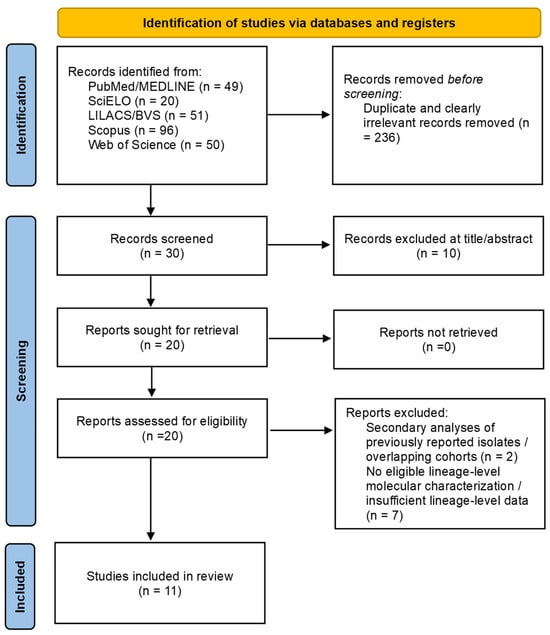
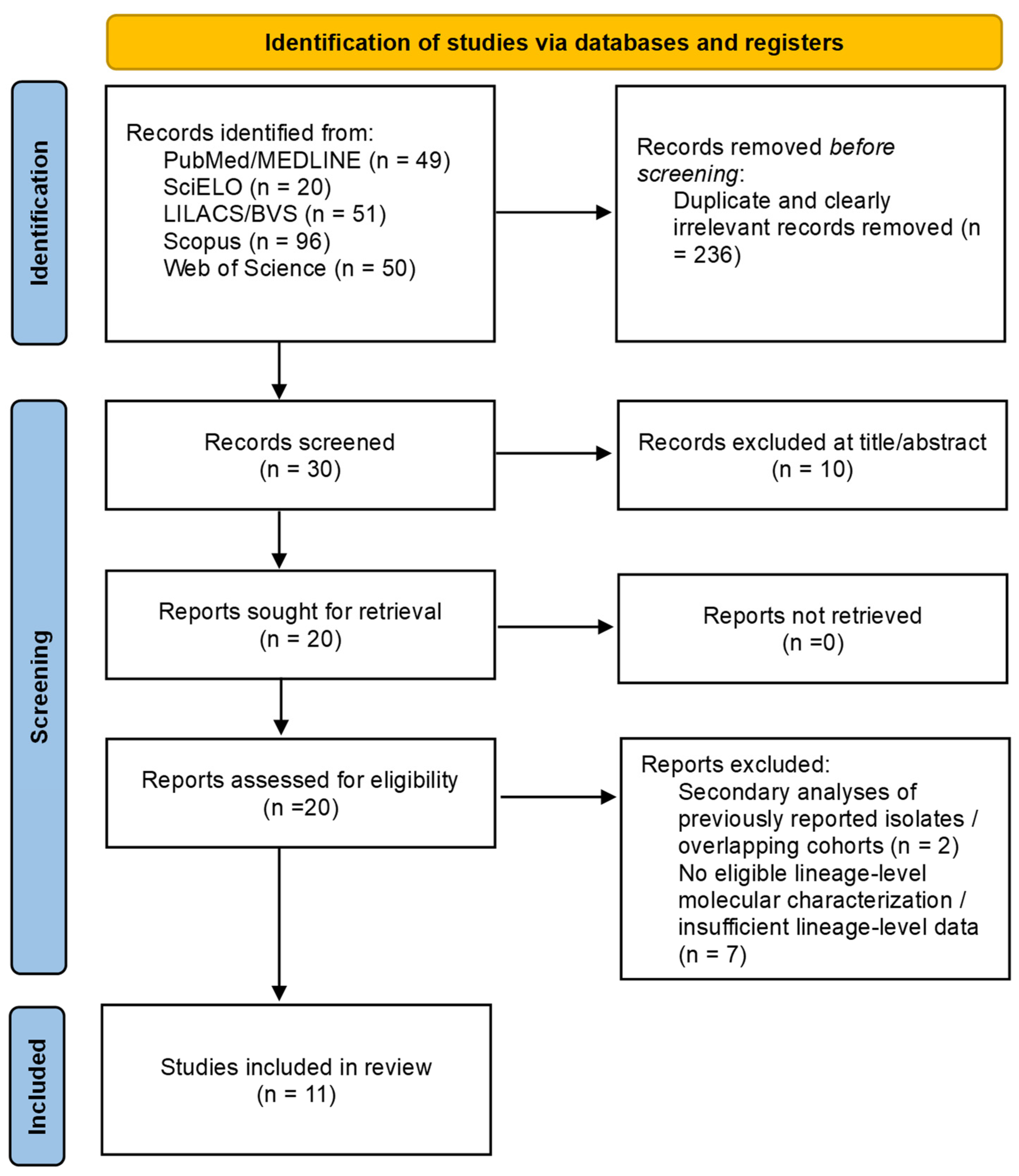
All retrieved records were compiled, and duplicates were removed before screening. Study selection and data extraction were conducted independently by three reviewers (Y.C.R., P.A.S.d.S and C.S.d.S.). Titles and abstracts were assessed against the predefined eligibility criteria, and potentially relevant studies were subsequently evaluated in full text. During full-text assessment, particular attention was given to confirming the Brazilian aquatic origin of the isolates, the availability of lineage-level molecular characterization, and the absence of duplicate reporting of isolates already included from an earlier primary study. Reasons for full-text exclusion were recorded and summarized in the PRISMA flow diagram.
Data from eligible studies were independently extracted using a standardized form developed for this review. Extracted information included study characteristics, sampling location and period, aquatic matrix, bacterial species, number and identity of genotyped isolates, sequence types and clonal classifications, AMR phenotypes and determinants, and genomic characteristics. When studies included multiple species or environmental matrices, only data corresponding to eligible aquatic P. aeruginosa and A. baumannii isolates were extracted. The complete data-extraction framework is provided in Supplementary File S3.
2.6. Methodological Quality Assessment
Methodological quality was assessed using an adapted JBI Critical Appraisal Checklist for Studies Reporting Prevalence Data and were conducted independently by three reviewers (Y.C.R., P.A.S.d.S and C.S.d.S.) [24]. The nine checklist items were interpreted in the context of environmental molecular epidemiology and rated as Yes, No, Unclear, or Not applicable. No aggregate numerical quality score was calculated. All studies meeting the eligibility criteria were retained, and appraisal findings were considered when interpreting the evidence. Detailed study-level assessments are provided in Supplementary File S4.
2.7. Data Synthesis and Visualization
Given the heterogeneity of environmental matrices, sampling designs, isolate-selection strategies, and molecular characterization across studies, findings were synthesized descriptively and no quantitative meta-analysis was performed. Study and lineage characteristics were summarized in tables, while relationships among P. aeruginosa sequence types were visualized using a minimum-spanning tree based on seven-locus MLST profiles, and geographic distributions were represented descriptively in maps. No formal subgroup, sensitivity, reporting-bias, or certainty-of-evidence analyses were conducted.
3. Results
3.1. Study Selection and Characteristics
The study-selection process is summarized in the PRISMA flow diagram (Figure 1). Following screening and full-text assessment, 11 independent studies met the eligibility criteria and were included in the systematic review. The studies were published between 2015 and 2026, whereas the underlying environmental sampling spanned from 2006 to 2023. Seven studies investigated only P. aeruginosa, two focused exclusively on A. baumannii, and two included both species. All studies were published in English.
Figure 1.
PRISMA 2020 flow diagram of study identification, screening, eligibility, and inclusion.
Most studies originated from Southeastern Brazil, particularly Rio de Janeiro and São Paulo, with additional evidence from Minas Gerais, Paraná, Pará, and southern Brazil. The aquatic matrices were heterogeneous. Hospital wastewater or effluent accounted for five of the 11 studies, while the remaining investigations examined urban rivers and streams, residual water, coastal surface water, freshwater lake water, and groundwater. Sampling designs ranged from repeated monitoring of wastewater-treatment stages and seasonal effluent collections to multisite river, coastal-water, lake, and groundwater surveys.
Across the 11 studies, 66 unique molecularly typed environmental isolates were included in the synthesis, comprising 59 P. aeruginosa and seven A. baumannii isolates. Among these, 21 isolates belonged to recognized HRCs or ICs, whereas 45 represented other lineages. Considerable clonal diversity was observed for P. aeruginosa, with 24 sequence types identified across the included studies. Among A. baumannii, four isolates belonged to the ST79/International Clone 5 (IC5) lineage, while three additional isolates represented ST1278, ST3355, and ST744.
Molecular characterization varied considerably among studies. Earlier investigations primarily relied on conventional MLST, sometimes combined with ERIC-PCR, whereas more recent studies increasingly incorporated WGS and in silico lineage assignment. Eight of the eleven studies used WGS for at least a subset of eligible isolates. The extent of lineage-level characterization also differed substantially: some studies examined broad environmental isolate collections, whereas others selectively characterized isolates exhibiting resistance phenotypes or other epidemiologically relevant features (Table 2 and Supplementary File S3).
Table 2.
Characteristics of studies reporting P. aeruginosa and A. baumannii genotyped by MLST from Brazilian aquatic environments.
3.2. Results of the Methodological Quality Assessment
Overall, the included studies showed generally adequate methodological quality, particularly regarding microbiological identification, antimicrobial susceptibility testing, and molecular characterization. Most studies provided sufficient descriptions of the environmental setting and applied standardized methods for species identification and lineage assignment. The complete study-level appraisal is presented in Supplementary File S4.
The main methodological limitations were related to sampling representativeness and the extent of molecular characterization. In some studies, only selected isolates, typically those exhibiting specific resistance phenotypes or other epidemiologically relevant characteristics, were subjected to MLST or WGS, limiting the ability to characterize the complete clonal diversity of the original environmental isolated population. In addition, a small number of genomic studies provided limited information on the broader environmental sampling frame or isolate-selection process.
3.3. P. aeruginosa Clonal Landscape
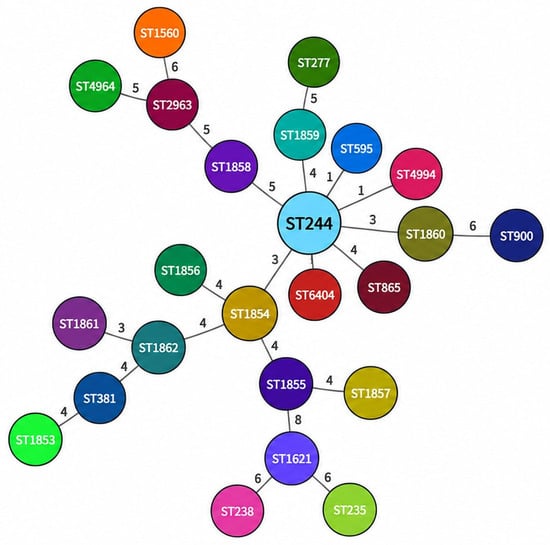
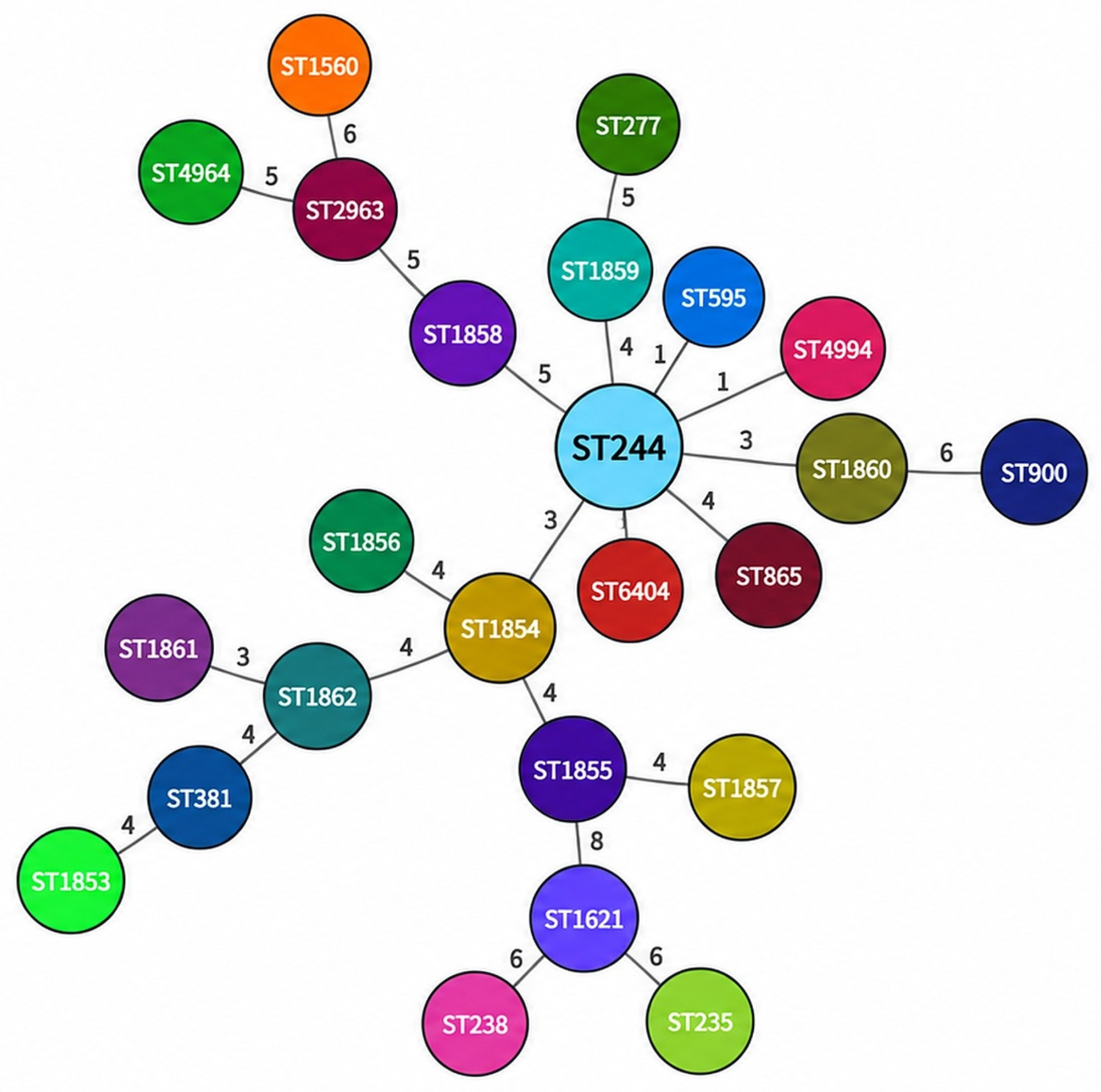
Among the 59 environmental P. aeruginosa isolates genotyped by MLST, 17 belonged to recognized high-risk clones (HRCs), represented by ST244, ST277, and ST235, whereas the remaining 42 isolates comprised other lineages (Figure 2, Table 3). Overall, 24 distinct STs were identified across hospital wastewater, groundwater, treated effluents, residual water, urban rivers, and coastal surface waters.
Figure 2.
Minimum-spanning tree of P. aeruginosa sequence types identified in Brazilian aquatic environments. Legend: Minimum-spanning tree based on seven-locus MLST profiles of the 24 P. aeruginosa STs identified among the genotyped environmental isolates included in the review. Each node represents a ST, and numbers along connecting edges indicate the number of allelic differences between STs. Colors were assigned randomly. Recognized high-risk clones identified in the review were ST235, ST244, and ST277.
Table 3.
Molecular lineages and antimicrobial resistance characteristics of Pseudomonas aeruginosa and Acinetobacter baumannii recovered from Brazilian aquatic environments.
3.3.1. Recognized P. aeruginosa HRCs
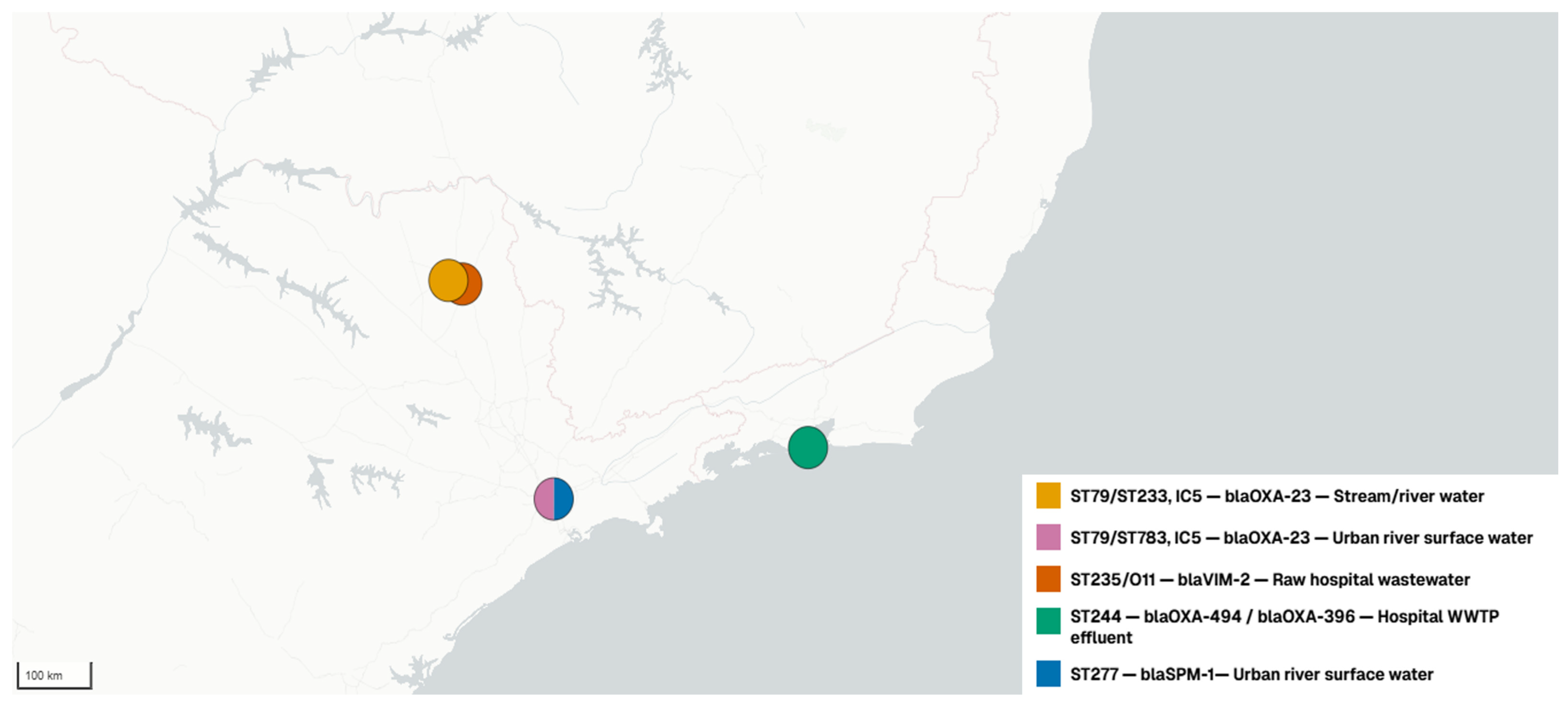
ST244 was the most frequently identified HRC (n = 13) and was reported in two hospital wastewater studies from metropolitan Rio de Janeiro. Miranda et al. identified eight ST244 isolates within a collection sampled from different stages of a hospital wastewater treatment plant in 2008 and 2010. The overall collection showed extensive antimicrobial resistance, with 28 isolates classified as MDR and six as XDR; however, resistance genes and phenotypes could not be reliably assigned to individual ST244 isolates because complete isolate-to-ST linkage was not provided. In a later genomic study, five environmental ST244 isolates recovered between 2018 and 2022 were resolved into rST20964/O5 and rST79892/O12 sublineages. Their resistomes included blaPAO, blaOXA-494, blaOXA-396, aph(3′)-IIb, fosA, and catB7, with aac(6′)-Ib3, crpP, sul1, and qacE additionally detected in two isolates.
ST277 was represented by three MDR isolates recovered from surface waters of the Tietê and Pinheiros Rivers in São Paulo. All three were resistant to multiple antipseudomonal agents, including ceftazidime, cefepime, imipenem, meropenem, ciprofloxacin, and aminoglycosides, and all carried the metallo-β-lactamase gene blaSPM-1.
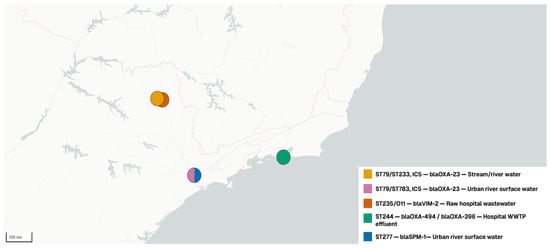
The globally disseminated ST235 was represented by a single O11 isolate recovered from raw hospital wastewater in southeastern Brazil. The isolate showed resistance to multiple β-lactams, including carbapenems, as well as fluoroquinolones and tobramycin. Whole-genome analysis identified blaVIM-2 together with blaOXA-4, blaOXA-488, blaPDC-35, and additional resistance determinants (Table 3; Figure 3).
Figure 3.
Geographic distribution and AMR features of high-risk/international clones of P. aeruginosa and A. baumannii reported in Brazilian aquatic environments. Legend: ST244, ST277, ST235, and ST79/IC5, with major acquired carbapenemase or β-lactamase determinants and corresponding aquatic matrices indicated in the legend.
3.3.2. Other Genotyped P. aeruginosa Lineages
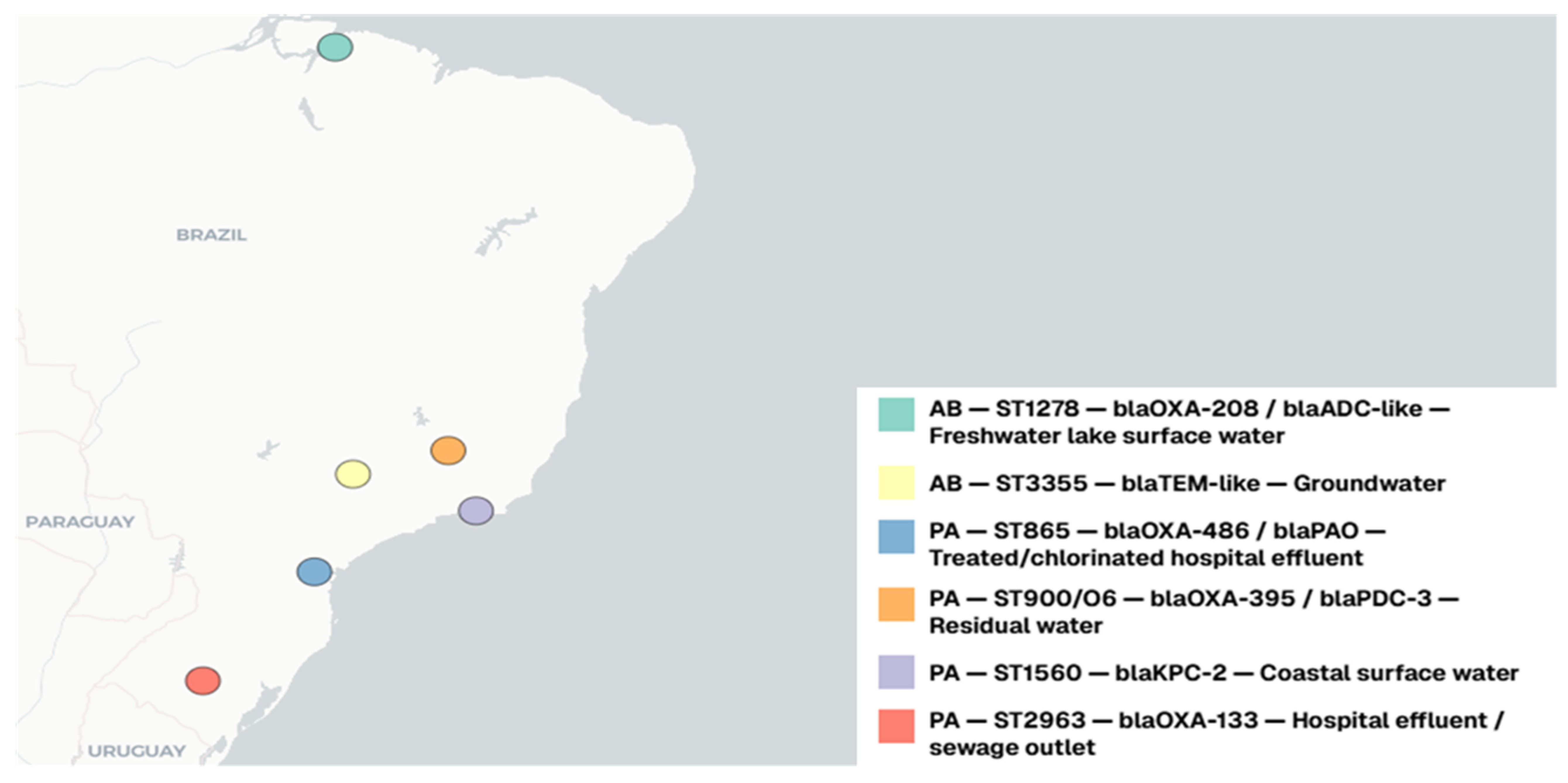
Beyond the recognized HRCs, 42 isolates belonged to STs not currently established as HRCs. Most of this diversity originated from the hospital wastewater collection of Miranda et al., which, in addition to ST244, contained ST238, ST381, ST595, ST1621, and ST1853–ST1862. These isolates occurred within a population characterized by frequent multidrug resistance, although the available data did not permit resistance phenotypes or determinants to be consistently attributed to individual STs. ST595, despite its relationship with ST244 in the original analysis, was classified as a non-HRC lineage in the present review (Table 3; Figure 4).
Figure 4.
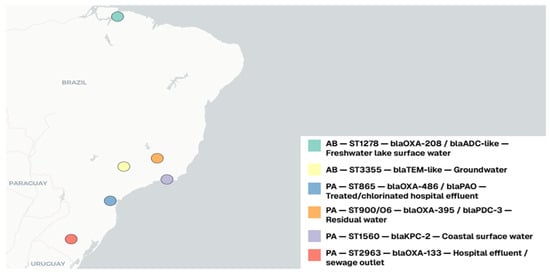
Geographic distribution and antimicrobial resistance features of other molecularly typed P. aeruginosa and A. baumannii lineages identified in Brazilian aquatic environments. Legend: Geographic distribution of selected non-HRC P. aeruginosa and non-IC A. baumannii lineages for which antimicrobial resistance determinants could be attributed at the sequence-type level. The figure includes P. aeruginosa ST865, ST900/O6, ST1560, and ST2963, and A. baumannii ST1278 and ST3355. Colors correspond to individual STs, with major resistance determinants and the respective aquatic matrices indicated in the figure legend. PA, P. aeruginosa; AB, A. baumannii; ST, sequence type; HRC, high-risk clone; IC, international clone.
Other studies identified several less frequently reported lineages with clinically relevant resistance profiles. Two ST2963 isolates recovered from hospital effluent were resistant to carbapenems and multiple additional antimicrobial classes and both carried blaOXA-133; additional tetracycline, phenicol, and efflux-associated determinants were also detected. The ST900/O6 isolate BR164, recovered from residual water in Brumadinho, exhibited an MDR phenotype that included resistance to imipenem, fluoroquinolones, gentamicin, and colistin. Genomic analysis revealed intrinsic resistance genes and multiple alterations in chromosomal determinants, including OprD.
A carbapenem-resistant ST865 isolate was subsequently identified in treated hospital effluent in Curitiba. Its genome contained the intrinsic β-lactamase genes blaOXA-486 and blaPAO. More recently, two MDR P. aeruginosa isolates recovered from groundwater in São Paulo State were assigned to the novel ST6404. Although they shared the same allelic profile, the isolates originated from geographically distinct aquifers and cities. EW2179 was resistant to ceftazidime, cefepime, aztreonam, piperacillin/tazobactam, tobramycin, and colistin and carried aac(6′)-Ib, whereas EW2181 was resistant to ceftazidime, cefepime, ciprofloxacin, and colistin and carried qnrS.
Finally, three additional lineages (ST1560, ST4994, and ST4964) were identified among colistin-resistant isolates recovered from Guanabara Bay. ST1560 exhibited an XDR phenotype, high-level meropenem resistance, and carried blaKPC-2 together with blaOXA-395, blaPDC-68, aph(3′)-IIb, and fosA. In contrast, ST4994 and ST4964 were classified as MDR and colistin resistant, but no acquired carbapenemase was reported for either lineage.
3.4. Acinetobacter baumannii Clonal Landscape
3.4.1. Recognized International Clone
Four of the seven genotyped environmental A. baumannii isolates belonged to the internationally disseminated ST79/IC5 lineage. to the internationally disseminated ST79/IC5 lineage. Three isolates recovered from surface waters of the Tietê and Pinheiros Rivers in São Paulo were assigned to ST79/CC79 by the Pasteur MLST scheme. All were MDR, including resistance to carbapenems, and carried blaOXA-23 together with the intrinsic blaOXA-51-like gene (Table 3; Figure 3).
A fourth ST79/IC5 isolate, EW779, was recovered from river water in Sertãozinho, São Paulo, in 2020. WGS assigned the isolate to ST79 by the Pasteur scheme and ST233 by the Oxford scheme, with the KL9-OCL10 profile. EW779 was classified as XDR and carried blaOXA-23, blaOXA-65, blaTEM-1A, and blaADC-182, together with genes conferring resistance to aminoglycosides, sulfonamides, trimethoprim, and streptothricin. Fluoroquinolone resistance-associated substitutions GyrA S81L and ParC E88K were also detected. The blaOXA-23 gene was located within a Tn2008-associated structure.
3.4.2. Other A. baumannii Lineages
Three additional molecularly typed A. baumannii isolates belonged to lineages not assigned to a recognized international clone in the present review. In 2019, Freitas et al. described isolate APC25 from Lake Água Preta in Pará. WGS assigned the isolate to the novel ST1278. APC25 displayed a MDR phenotype and was resistant to most β-lactams, while remaining susceptible to imipenem and cefepime. Its genome contained the intrinsic β-lactamase genes blaOXA-208 and blaADC-like, and no plasmids were detected.
Two further lineages were subsequently identified among groundwater isolates from São Paulo State. Isolate EW2209 was assigned to ST744 and exhibited resistance to ceftazidime, meropenem, gentamicin, and amikacin. Isolate EW2192 represented the novel ST3355 and was resistant to ceftazidime, meropenem, and amikacin and carried a blaTEM-like gene. Both isolates were classified as MDR (Table 3; Figure 4).
4. Discussion
This systematic review provides an integrated overview of the clonal diversity and AMR characteristics of molecularly typed P. aeruginosa and A. baumannii recovered from Brazilian aquatic environments. Although only eleven independent studies met the eligibility criteria, the available evidence demonstrated the occurrence of clinically important lineages, including P. aeruginosa ST244, ST277, and ST235 and A. baumannii ST79/IC5. These clones are well established in the molecular epidemiology of antimicrobial-resistant infections and are frequently associated with MDR/XDR phenotypes and acquired β-lactamases [3,4,5,6,21,22,23]. Their detection across hospital wastewater, treated effluents, urban rivers, streams, and other surface waters, together with the identification of additional lineages in freshwater lake water and groundwater, reinforces that the environmental distribution of these species extends beyond conventional healthcare settings [9,10,11,12,13,14,15,16,17,18,19,25].
Among P. aeruginosa, ST244 was the most frequently represented HRC in the evidence included. Its recovery from hospital wastewater in metropolitan Rio de Janeiro during temporally separated sampling periods indicates repeated environmental detection of this lineage rather than a single isolated finding [9,16]. Bianco et al. [16] further revealed genomic heterogeneity among environmental ST244 isolates and close relationships between wastewater and clinical isolates recovered within the same healthcare complex. Although these findings cannot establish the direction of transmission, they support connectivity between clinical and wastewater bacterial populations. This interpretation is biologically plausible because wastewater systems receive resistant bacteria and resistance determinants from human-associated sources, while treatment processes may incompletely remove these components before discharge into receiving environments [25,26].
The environmental detection of ST277 and ST235 provides additional evidence that clinically important P. aeruginosa HRCs occur beyond conventional healthcare surveillance. ST277 isolates recovered from the Tietê and Pinheiros Rivers carried blaSPM-1, a resistance determinant historically associated with this Brazilian epidemic lineage [10]. A subsequent genomic analysis of the same environmental isolates, which was therefore not considered an independent study in the present review, demonstrated a broad resistome and further positioned these river isolates within the genomic context of the Brazilian ST277 population [27]. Similarly, the recovery of VIM-2-producing ST235/O11 from raw hospital wastewater is notable because ST235 is among the most globally disseminated P. aeruginosa HRCs and is frequently associated with acquired metallo-β-lactamases [3,4,13,21,22]. Together, these observations illustrate the interface between healthcare-associated wastewater and receiving aquatic environments in the environmental occurrence of successful resistant clones. Recent evidence from wastewater–river continua further shows that treated effluents can influence the abundance and diversity of resistance determinants in downstream freshwater compartments [28].
Importantly, the environmental P. aeruginosa population represented in the Brazilian literature extended well beyond established HRCs. Forty-two typed isolates belonged to other molecular lineages, including ST2963, ST900, ST865, ST1560, ST4994, ST4964, and ST6404, in addition to the diverse ST background identified in hospital wastewater [9,11,12,15,17,19]. Although these additional STs are not currently established as epidemic HRCs, their occurrence in diverse aquatic matrices and, in several cases, association with clinically relevant resistance profiles supports their inclusion in molecular surveillance as epidemiologically relevant lineages. This is particularly evident for ST1560, which combined an XDR phenotype, colistin resistance, and blaKPC-2 [17], and ST900, in which multidrug resistance was associated predominantly with chromosomal mechanisms rather than an acquired carbapenemase [12]. The detection of the novel ST6404 in two MDR groundwater isolates further expands the environmental compartments in which molecularly characterized P. aeruginosa lineages have been reported; although both isolates shared the same ST, they carried distinct resistance determinants, aac(6′)-Ib and qnrS [19]. Environmental molecular surveillance restricted exclusively to established HRCs could therefore overlook less-characterized lineages carrying important resistance determinants or showing features that warrant continued epidemiological monitoring.
The A. baumannii evidence remained limited but showed greater clonal diversity than suggested by the recognized international-clone component alone. Four of the seven genotyped isolates belonged to ST79/IC5, a lineage of established epidemiological relevance in Brazil and Latin America and strongly associated with carbapenem resistance mediated by OXA-type enzymes, particularly OXA-23 [6,23]. ST79/IC5 was recovered from distinct freshwater systems in São Paulo, including the Tietê and Pinheiros Rivers and river water from the Ribeirão Preto macroregion [10,14]. The EW779 genome additionally displayed an XDR phenotype and carried blaOXA-23 within a Tn2008-associated structure together with a broader resistance repertoire [14]. A later phylogenomic analysis comparing aquatic and clinical OXA-23-positive ST79 isolates also supported genomic relatedness between environmental and healthcare-associated IC5 populations [29]. Because this study reanalyzed environmental isolates previously reported in the primary literature, it was used as supporting evidence rather than counted as an additional independent cohort. Three other isolates represented ST1278, ST744, and ST3355. ST1278 was recovered from freshwater lake water in Pará and displayed an MDR phenotype associated with intrinsic/chromosomal resistance determinants, including blaOXA-208 and blaADC-like [18]. More recently, MDR ST744 and the novel ST3355 were identified in groundwater from São Paulo State; ST3355 carried a blaTEM-like gene, whereas no ARG was detected in ST744 using the tested panel [19]. These findings indicate that the currently characterized environmental A. baumannii population in Brazil is not restricted to IC5, although the small number of molecularly typed isolates precludes broader conclusions regarding clonal distribution.
From a One Health perspective, these findings support the inclusion of aquatic compartments in molecular AMR surveillance [7,8,25,26]. Wastewater treatment can substantially reduce bacterial and resistance-gene loads, but removal is variable and does not necessarily eliminate resistant bacteria or AMR genes from final effluents [26]. Moreover, evidence from wastewater–river systems indicate that wastewater-associated AMR signatures can persist beyond treatment facilities and influence downstream aquatic environments [28]. Previous reviews provide a broader context for these findings. An earlier systematic review of antimicrobial resistance in Brazilian aquatic environments documented resistant bacteria across diverse water matrices but did not address clone-level molecular epidemiology [30]. More recently, a systematic review of treated effluents in Latin America, in which Brazilian studies constituted a substantial component of the available evidence, reported frequent antimicrobial-resistant bacteria, particularly Gram-negative bacilli, in wastewater-treatment effluents [31]. However, comparisons across studies and aquatic settings should be interpreted cautiously because the environmental matrices represented are highly heterogeneous. Although wastewater effluents, rivers, lakes, reservoirs, and coastal waters may all represent aquatic environments affected by anthropogenic inputs, they differ substantially in pollutant loads, antimicrobial and biocide exposure, selective pressures, physicochemical conditions, and microbial community dynamics. These differences may influence both the occurrence and persistence of antimicrobial-resistant organisms and therefore limit direct comparisons of prevalence among environmental matrices [31].
Biofilm formation may further contribute to the persistence and antimicrobial recalcitrance of both species in aquatic and wastewater environments. In P. aeruginosa, biofilm growth involves altered expression of resistance- and stress-response genes, physiological heterogeneity, and conditions that can favor antimicrobial tolerance and the selection of resistance. In A. baumannii, biofilm regulatory networks similarly promote persistence on biotic and abiotic surfaces and reduce antimicrobial susceptibility. These characteristics may facilitate the maintenance of resistant populations outside clinical settings [32,33].
In Brazil, however, the available molecular evidence remains markedly uneven. Most studies originated from Rio de Janeiro and São Paulo, with additional evidence from Minas Gerais, Paraná, southern Brazil, and Pará in the North region [18]. The North was represented by only one eligible study, while no eligible lineage-level studies were identified from the Northeast or Center-West regions. Hospital wastewater and effluents were also disproportionately represented, although the inclusion of freshwater lake water and groundwater broadened the range of aquatic compartments represented in the current evidence [18,19]. Longitudinal surveillance integrating standardized environmental sampling, WGS, and contemporaneous clinical isolates would therefore be particularly valuable for distinguishing transient introduction from persistence, local diversification, and broader environmental dissemination.
Beyond the geographic imbalance, the overall volume of clone-level environmental evidence remains limited. Across nearly two decades of environmental sampling, only 66 isolates from 11 independent studies were genotyped by MLST and were available for inclusion, comprising 59 P. aeruginosa and seven A. baumannii. This contrasts with the broader Brazilian molecular epidemiology literature on P. aeruginosa: a previous systematic review and meta-analysis identified 298 MLST-typed isolates representing 78 unique STs across clinical and non-clinical settings [5]. Although the different scopes of the two reviews preclude direct quantitative comparison, the substantially smaller environmental dataset highlights the relative scarcity of clone-level surveillance in Brazilian aquatic systems. Moreover, several environmental studies performed MLST or WGS only on selected resistant or otherwise epidemiologically notable isolates rather than on the complete isolate population. Consequently, the 24 P. aeruginosa STs and four A. baumannii clonal lineages currently documented are likely to represent only a fraction of the clonal diversity present in Brazilian aquatic environments. This limited molecular characterization constitutes an important surveillance gap and underscores the need for additional studies incorporating systematic isolate selection, broader geographic coverage, diverse aquatic matrices, and genome-based typing.
Future studies could further integrate WGS with transcriptomic approaches such as RNA sequencing and advanced computational methods, including machine learning and artificial intelligence, to identify regulatory pathways associated with resistance and persistence, improve resistance-phenotype prediction, and support the discovery of potential therapeutic targets. These approaches should complement phenotypic and experimental validation [34,35,36].
In addition, the detection of recognized high-risk lineages in Brazilian aquatic environments has implications beyond their immediate environmental occurrence. Although their presence in water does not itself demonstrate pandemic potential, the recovery of internationally disseminated clones such as ST235, ST244, and ST277 of P. aeruginosa, as well as high-risk A. baumannii lineages, indicates that clinically relevant clones may persist beyond healthcare settings. These findings reinforce the importance of integrated environmental and clinical genomic surveillance to monitor antimicrobial-resistant lineages with epidemic or potentially pandemic relevance [3,4].
This review has several strengths, including a systematic PRISMA-based approach, explicit identification and exclusion of secondary analyses to prevent duplicate counting of environmental isolates, standardized study- and lineage-level data extraction, and consideration of both recognized HRCs/ICs and other lineages. Methodological quality was also assessed using an adapted JBI framework, and resistance determinants were attributed to specific lineages only when supported by the original studies. Nevertheless, interpretation remains constrained by the small evidence base, pronounced geographic concentration, heterogeneous environmental sampling strategies, and selective molecular characterization of resistant or otherwise notable isolates in several investigations. In some studies, resistance determinants could not be reliably linked to individual STs, while the limited number of molecularly characterized A. baumannii isolates restricts conclusions regarding its environmental clonal diversity. Accordingly, collection-level resistance findings from these studies should not be interpreted as resistance characteristics of every isolate assigned to a given ST, particularly ST244. Furthermore, heterogeneous sampling frames and isolate-selection strategies precluded estimates of environmental prevalence or formal temporal trends. The frequencies reported here should therefore be interpreted as the distribution of the currently characterized molecular evidence, rather than as representative estimates of the prevalence of high-risk clones in Brazilian aquatic environments.
5. Conclusions
This systematic review demonstrates that Brazilian aquatic environments contain both recognized high-risk lineages and a broader diversity of molecularly typed P. aeruginosa and A. baumannii, including P. aeruginosa ST244, ST277, and ST235 and A. baumannii ST79/IC5, frequently associated with clinically relevant AMR determinants. The detection of these clones in hospital wastewater, treated effluents, urban rivers, and other surface waters reinforces the importance of aquatic environments within One Health AMR surveillance. At the same time, the identification of multiple non-HRC lineages carrying important resistance traits highlights the need to monitor clonal diversity beyond established epidemic clones.
Current evidence remains geographically concentrated, particularly in the Southeast and South regions of Brazil, and methodologically heterogeneous, limiting inferences regarding prevalence and temporal trends. Expanded, standardized, genome-based surveillance across underrepresented Brazilian regions and aquatic matrices will be essential to better define the environmental dissemination, persistence, and epidemiological relevance of these lineages. Also, incorporating environmental genomic surveillance into One Health strategies may therefore improve early recognition of the emergence and dissemination of antimicrobial-resistant high-risk lineages with epidemic or potentially pandemic relevance.
Supplementary Materials
The following supporting information can be downloaded at https://www.mdpi.com/article/10.3390/pandemics1030015/s1. Supplementary File S1. PRISMA 2020 Checklist [37]. Supplementary File S2. Search Strategies Used to Identify Genotyped Pseudomonas aeruginosa and Acinetobacter baumannii from Brazilian Aquatic Environments. Supplementary File S3. Data Extraction Framework for the Included Studies. Supplementary File S4. Adapted JBI Critical Appraisal of the Included Studies.
Author Contributions
Conceptualization, Y.C.R., P.A.S.d.S. and A.L.d.S.; Methodology, Y.C.R., P.A.S.d.S. and D.M.S.; Formal Analysis, Y.C.R., P.A.S.d.S., D.M.S., C.S.d.S., A.F.D., B.N.d.S. and J.V.d.S.S.; Investigation, Y.C.R., P.A.S.d.S., A.F.D., B.N.d.S., J.V.d.S.S., D.M.S. and C.S.d.S.; Data Curation, Y.C.R., P.A.S.d.S., A.F.D., B.N.d.S., J.V.d.S.S., D.M.S. and C.S.d.S.; Writing—Original Draft Preparation, Y.C.R., P.A.S.d.S., A.F.D., B.N.d.S., J.V.d.S.S., D.M.S., C.S.d.S. and C.A.M.A.; Writing—Review and Editing, Y.C.R., P.A.S.d.S., A.F.D., B.N.d.S., J.V.d.S.S., D.M.S., C.S.d.S., C.A.M.A., A.L.d.S., D.M.B., K.V.B.L. and C.d.O.S.; Visualization, Y.C.R. and P.A.S.d.S.; Resources: Y.C.R., C.A.M.A., A.L.d.S., D.M.B., K.V.B.L. and C.d.O.S. Supervision, Y.C.R., A.L.d.S., D.M.B., K.V.B.L. and C.d.O.S.; Project Administration, Y.C.R., A.L.d.S. and C.d.O.S. All authors have read and agreed to the published version of the manuscript.
Funding
This study also received support from the CNPq Research Productivity Grant (Grant No. 309979/2026-9 to K.V.B.L.) and from the REVIGEN Consortium, funded under CNPq/SECTICS/CAPES/FAPs Call No. 46/2024—Programa Institutos Nacionais de Ciência e Tecnologia (INCT), Process No. 408842/2024-5.
Institutional Review Board Statement
Not applicable. This study is a systematic review of previously published data and did not involve the direct participation of humans or animals.
Informed Consent Statement
Not applicable.
Data Availability Statement
All data analyzed in this systematic review were obtained from published studies and are presented within the article and its Supplementary Materials. No new primary datasets were generated.
Acknowledgments
The authors acknowledge the REVIGEN Consortium (Rede de Vigilância Genômica de Microrganismos de Importância à Saúde Única) for its institutional and scientific support. The authors also thank their respective institutions for the academic, technical, and institutional support provided during the development of this study.
Conflicts of Interest
The authors declare no conflicts of interest.
References
- World Health Organization. WHO Bacterial Priority Pathogens List, 2024: Bacterial Pathogens of Public Health Importance to Guide Research, Development and Strategies to Prevent and Control Antimicrobial Resistance; World Health Organization: Geneva, Switzerland, 2024. [Google Scholar]
- Antimicrobial Resistance Collaborators. Global burden of bacterial antimicrobial resistance in 2019: A systematic analysis. Lancet 2022, 399, 629–655. [Google Scholar] [CrossRef] [Scilit] [PubMed]
- Del Barrio-Tofiño, E.; López-Causapé, C.; Oliver, A. Pseudomonas aeruginosa epidemic high-risk clones and their association with horizontally acquired β-lactamases: 2020 update. Int. J. Antimicrob. Agents 2020, 56, 106196. [Google Scholar] [CrossRef] [Scilit] [PubMed]
- Kocsis, B.; Gulyás, D.; Szabó, D. Diversity and distribution of resistance markers in Pseudomonas aeruginosa international high-risk clones. Microorganisms 2021, 9, 359. [Google Scholar] [CrossRef] [Scilit] [PubMed]
- Rodrigues, Y.C.; Silva, M.J.A.; Reis, H.S.; dos Santos, P.A.S.; Sardinha, D.M.; Gouveia, M.I.M.; dos Santos, C.S.; Marcon, D.J.; Aires, C.A.M.; Souza, C.d.O.; et al. Molecular epidemiology of Pseudomonas aeruginosa in Brazil: A systematic review and meta-analysis. Antibiotics 2024, 13, 983. [Google Scholar] [CrossRef] [Scilit] [PubMed]
- Rodríguez, C.H.; Nastro, M.; Famiglietti, A. Carbapenemases in Acinetobacter baumannii: Review of their dissemination in Latin America. Rev. Argent. Microbiol. 2018, 50, 327–333. [Google Scholar] [CrossRef] [Scilit] [PubMed]
- Punch, R.; Azani, R.; Ellison, C.; Majury, A.; Hynds, P.D.; Payne, S.J.; Brown, R.S. The surveillance of antimicrobial resistance in wastewater from a One Health perspective: A global scoping and temporal review (2014–2024). One Health 2025, 21, 101139. [Google Scholar] [CrossRef] [Scilit] [PubMed]
- Hassoun-Kheir, N.; Stabholz, Y.; Kreft, J.-U.; de la Cruz, R.; Dechesne, A.; Smets, B.F.; Romalde, J.L.; Lema, A.; Balboa, S.; García-Riestra, C.; et al. EMBRACE-WATERS statement: Recommendations for reporting of studies on antimicrobial resistance in wastewater and related aquatic environments. One Health 2021, 13, 100339. [Google Scholar] [CrossRef] [Scilit] [PubMed]
- Miranda, C.C.; de Filippis, I.; Pinto, L.H.; Coelho-Souza, T.; Bianco, K.; Cacci, L.; Picão, R.; Clementino, M. Genotypic characteristics of multidrug-resistant Pseudomonas aeruginosa from hospital wastewater treatment plant in Rio de Janeiro, Brazil. J. Appl. Microbiol. 2015, 118, 1276–1286. [Google Scholar] [CrossRef] [Scilit] [PubMed]
- Turano, H.; Gomes, F.; Medeiros, M.; Oliveira, S.; Fontes, L.C.; Sato, M.I.; Lincopan, N. Presence of high-risk clones of OXA-23-producing Acinetobacter baumannii (ST79) and SPM-1-producing Pseudomonas aeruginosa (ST277) in environmental water samples in Brazil. Diagn. Microbiol. Infect. Dis. 2016, 86, 80–82. [Google Scholar] [CrossRef] [Scilit] [PubMed]
- Martins, A.F.; de Lima-Morales, D.; Mayer, F.Q.; Fuentefria, D.; Corção, G. First detection of Pseudomonas aeruginosa ST2963 from hospital effluent: A draft genome analysis. J. Glob. Antimicrob. Resist. 2018, 14, 275–276. [Google Scholar] [CrossRef] [Scilit] [PubMed]
- Ramos, M.S.; Furlan, J.P.R.; Santos, L.D.R.; Rosa, R.S.; Savazzi, E.A.; Stehling, E.G. Patterns of antimicrobial resistance and metal tolerance in environmental Pseudomonas aeruginosa isolates and the genomic characterization of the rare O6/ST900 clone. Environ. Monit. Assess. 2023, 195, 713. [Google Scholar] [CrossRef] [Scilit] [PubMed]
- Zagui, G.S.; de Almeida, O.G.G.; Moreira, N.C.; Silva, N.G.A.; Meschede, M.S.C.; Darini, A.L.C.; Andrade, L.N.; Segura-Muñoz, S.I. Hospital wastewater as source of human pathogenic bacteria: A phenotypic and genomic analysis of international high-risk clone VIM-2-producing Pseudomonas aeruginosa ST235/O11. Environ. Res. 2024, 255, 119166. [Google Scholar] [CrossRef] [Scilit] [PubMed]
- Furlan, J.P.R.; Ramos, M.S.; Rosa, R.S.; Santos, L.D.R.; Savazzi, E.A.; Stehling, E.G. Unveiling transposon-mediated multidrug resistance in OXA-23-producing Acinetobacter baumannii ST79/ST233 subclone KL9-OCL10 in Brazil. Gene 2025, 958, 149489. [Google Scholar] [CrossRef] [Scilit] [PubMed]
- Krul, D.; Negoseki, B.R.S.; Siqueira, A.C.; Tomaz, A.P.O.; Santos, E.M.; Sousa, I.; Vasconcelos, T.M.; Marinho, I.C.R.; Arend, L.N.V.S.; Mesa, D.; et al. Spread of antimicrobial-resistant clones of the ESKAPEE group: From the clinical setting to hospital effluent. Sci. Total Environ. 2025, 973, 179124. [Google Scholar] [CrossRef] [Scilit] [PubMed]
- Bianco, K.; Vianna, T.C.C.; Oliveira, S.S.; Montenegro, K.; Flores, C.; Nascimento, A.P.A.; Cardoso, A.M.; Clementino, M.M. Genomic relationship between high-risk Pseudomonas aeruginosa clone ST244 serotypes O5 and O12 from Southeastern Brazil. Microbiol. Res. 2026, 17, 27. [Google Scholar] [CrossRef] [Scilit]
- Assunção, V.C.; Magaldi, M.; Lopes-Carvalho, M.; Santos, H.S.O.; Gonçalves-Brito, A.; Vianna, T.C.C.; Souza, H.D.F.; Montenegro, K.; Paranhos, R.; Cardoso, A.M.; et al. Genomic characterization of colistin- and carbapenem-resistant Pseudomonas aeruginosa ST1560 from Guanabara Bay, Brazil. J. Appl. Microbiol. 2026, 137, lxag035. [Google Scholar] [CrossRef] [Scilit] [PubMed]
- Freitas, D.Y.; Araújo, S.; Folador, A.R.C.; Ramos, R.T.J.; Azevedo, J.S.N.; Tacão, M.; Silva, A.; Henriques, I.; Baraúna, R.A. Extended Spectrum Beta-Lactamase-Producing Gram-Negative Bacteria Recovered From an Amazonian Lake Near the City of Belém, Brazil. Front. Microbiol. 2019, 10, 364. [Google Scholar] [CrossRef] [Scilit] [PubMed]
- Rosa, R.d.S.; Ramos, M.S.; Gervasoni, L.F.; dos Santos, L.D.R.; Savazzi, E.A.; Furlan, J.P.R.; Stehling, E.G. Antimicrobial Resistance, Metal Tolerance, and Virulence Determinants in Gram-Negative Opportunistic Pathogens Isolated from Brazilian Groundwater. Water Air Soil Pollut. 2026, 237, 1210. [Google Scholar] [CrossRef] [Scilit]
- Morgan, R.L.; Whaley, P.; Thayer, K.A.; Schünemann, H.J. Identifying the PECO: A framework for formulating good questions to explore the association of environmental and other exposures with health outcomes. Environ. Int. 2018, 121, 1027–1031. [Google Scholar] [CrossRef] [Scilit] [PubMed]
- Oliver, A.; Mulet, X.; López-Causapé, C.; Juan, C. The increasing threat of Pseudomonas aeruginosa high-risk clones. Drug Resist. Updat. 2015, 21–22, 41–59. [Google Scholar] [CrossRef] [Scilit] [PubMed]
- Sawa, T.; Momiyama, K.; Mihara, T.; Kainuma, A.; Kinoshita, M.; Moriyama, K. Molecular epidemiology of clinically high-risk Pseudomonas aeruginosa strains: Practical overview. Microbiol. Immunol. 2020, 64, 331–344. [Google Scholar] [CrossRef] [Scilit] [PubMed]
- Shelenkov, A.; Akimkin, V.; Mikhaylova, Y. International clones of high risk of Acinetobacter baumannii—Definitions, history, properties and perspectives. Microorganisms 2023, 11, 2115. [Google Scholar] [CrossRef] [Scilit] [PubMed]
- Munn, Z.; Moola, S.; Lisy, K.; Riitano, D.; Tufanaru, C. Methodological guidance for systematic reviews of observational epidemiological studies reporting prevalence and incidence data. Int. J. Evid. Based Healthc. 2015, 13, 147–153. [Google Scholar] [CrossRef] [Scilit] [PubMed]
- Męcik, M.; Stefaniak, K.; Harnisz, M.; Korzeniewska, E. Hospital and municipal wastewater as a source of carbapenem-resistant Acinetobacter baumannii and Pseudomonas aeruginosa in the environment: A review. Environ. Sci. Pollut. Res. 2024, 31, 48813–48838. [Google Scholar] [CrossRef] [Scilit] [PubMed]
- Drane, K.; Sheehan, M.; Whelan, A.; Ariel, E.; Kinobe, R. The role of wastewater treatment plants in dissemination of antibiotic resistance: Source, measurement, removal and risk assessment. Antibiotics 2024, 13, 668. [Google Scholar] [CrossRef] [Scilit] [PubMed]
- Esposito, F.; Cardoso, B.; Fontana, H.; Fuga, B.; Cardenas-Arias, A.; Moura, Q.; Fuentes-Castillo, D.; Lincopan, N. Genomic analysis of carbapenem-resistant Pseudomonas aeruginosa isolated from urban rivers confirms spread of clone sequence type 277 carrying broad resistome and virulome beyond the hospital. Front. Microbiol. 2021, 12, 701921. [Google Scholar] [CrossRef] [Scilit] [PubMed]
- Read, D.S.; Gweon, H.S.; Bowes, M.J.; Anjum, M.F.; Crook, D.W.; Chau, K.K.; Shaw, L.P.; Hubbard, A.; AbuOun, M.; Tipper, H.J.; et al. Dissemination and persistence of antimicrobial resistance (AMR) along the wastewater-river continuum. Water Res. 2024, 264, 122204. [Google Scholar] [CrossRef] [Scilit] [PubMed]
- Martins-Gonçalves, T.; Sano, E.; Melocco, G.; Dantas, K.; Esposito, F.; Becerra, J.; Fontana, H.; Queiroga, G.; Pariona, J.G.; Cayô, R.; et al. Phylogenomic analysis of aquatic and clinical OXA-23-positive Acinetobacter baumannii belonging to the international clone 5 (ST79) from Southeast Brazil. One Health 2025, 21, 101140. [Google Scholar] [CrossRef] [Scilit] [PubMed]
- Nascimento, E.D.; Araújo, M.F.F. Antimicrobial resistance in bacteria isolated from aquatic environments in Brazil: A systematic review. Rev. Ambient. Água 2014, 9, 239–249. [Google Scholar] [CrossRef] [Scilit][Green Version]
- Costa, G.L.M.; Gois, L.L.; Santos, A.B.A.; Aquino, R.C.A.; Brandão, J.S.; Almeida, P.F.; Matos, J.B.T.L.; Azevedo, J. Bacterial resistance in Latin American treated effluents: A systematic review. Ciênc. Saúde Colet. 2026, 31, e16762024. [Google Scholar]
- Fernández-Billón, M.; Llambías-Cabot, A.E.; Jordana-Lluch, E.; Oliver, A.; Macià, M.D. Mechanisms of antibiotic resistance in Pseudomonas aeruginosa biofilms. Biofilm 2023, 5, 100129. [Google Scholar] [CrossRef] [Scilit] [PubMed]
- Upmanyu, K.; Haq, Q.M.R.; Singh, R. Factors mediating Acinetobacter baumannii biofilm formation: Opportunities for developing therapeutics. Curr. Res. Microb. Sci. 2022, 3, 100131. [Google Scholar] [CrossRef] [Scilit] [PubMed]
- Djordjevic, S.P.; Jarocki, V.M.; Seemann, T.; Cummins, M.L.; Watt, A.E.; Drigo, B.; Wyrsch, E.R.; Reid, C.J.; Donner, E.; Howden, B.P. Genomic surveillance for antimicrobial resistance—A One Health perspective. Nat. Rev. Genet. 2024, 25, 142–157. [Google Scholar] [CrossRef] [Scilit] [PubMed]
- Kröger, C.; MacKenzie, K.D.; Alshabib, E.Y.; Kirzinger, M.W.B.; Suchan, D.M.; Chao, T.-C.; Akulova, V.; A Miranda-CasoLuengo, A.; A Monzon, V.; Conway, T.; et al. The primary transcriptome, small RNAs and regulation of antimicrobial resistance in Acinetobacter baumannii ATCC 17978. Nucleic Acids Res. 2018, 46, 9684–9698. [Google Scholar] [CrossRef] [Scilit] [PubMed]
- Liu, G.; Catacutan, D.B.; Rathod, K.; Swanson, K.; Jin, W.; Mohammed, J.C.; Chiappino-Pepe, A.; Syed, S.A.; Fragis, M.; Rachwalski, K.; et al. Deep learning-guided discovery of an antibiotic targeting Acinetobacter baumannii. Nat. Chem. Biol. 2023, 19, 1342–1350. [Google Scholar] [CrossRef] [Scilit] [PubMed]
- Page, M.J.; McKenzie, J.E.; Bossuyt, P.M.; Boutron, I.; Hoffmann, T.C.; Mulrow, C.D.; Shamseer, L.; Tetzlaff, J.M.; Akl, E.A.; Brennan, S.E.; et al. The PRISMA 2020 statement: An updated guideline for reporting systematic reviews. BMJ 2021, 372, n71. [Google Scholar] [CrossRef] [Scilit] [PubMed]

Disclaimer/Publisher’s Note: The statements, opinions and data contained in all publications are solely those of the individual author(s) and contributor(s) and not of MDPI and/or the editor(s). MDPI and/or the editor(s) disclaim responsibility for any injury to people or property resulting from any ideas, methods, instructions or products referred to in the content. |
© 2026 by the authors. Licensee MDPI, Basel, Switzerland. This article is an open access article distributed under the terms and conditions of the Creative Commons Attribution (CC BY) license.