


Abstract
West Nile fever (WNF) is a zoonotic arboviral disease caused by West Nile virus (WNV), maintained primarily in an enzootic cycle involving birds and mosquitoes, particularly species of the genus Culex. Although evidence of viral circulation has previously been documented in Brazil, human disease remains infrequently recognized. This study aimed to describe the human cases of WNF identified in Brazil in 2026 and to interpret their epidemiological significance within an integrated One Health surveillance framework. A descriptive retrospective study was conducted using secondary information from the Ministry of Health, state and municipal health authorities, scientific literature, and official technical documents, incorporating information available through 28 August 2026. Four human cases were confirmed—two in Santa Catarina and two in São Paulo—and one probable/under-investigation case was identified in Piauí. The confirmed cases showed heterogeneous clinical presentations, including neuroinvasive manifestations, hospitalization, and one death; the latter was recorded as associated with stroke, with its relationship to WNV infection remaining under investigation. One confirmed case had recent travel to the Amazon region, while other probable sites of infection remained under investigation. The available public sources did not provide concurrent entomological or animal surveillance results sufficient to establish a local transmission chain. The 2026 events therefore constitute a sentinel epidemiological signal that supports intensification of integrated human, laboratory, entomological, animal, and environmental surveillance rather than inference of sustained autochthonous transmission.
1. Introduction
West Nile fever (WNF) is a disease caused by the West Nile virus (WNV), a flavivirus widely distributed across Africa, Europe, the Middle East, Asia, and the Americas [1]. Its natural cycle primarily involves wild birds and mosquitoes, particularly those of the Culex genus [2]. Humans and equines are incidental hosts and, under typical conditions, do not exhibit sufficient viremia to sustain transmission to new mosquitoes [3].
Most human infections are asymptomatic; approximately 20% of infected individuals develop febrile illness, and a small proportion progress to neuroinvasive disease, including meningitis, encephalitis, or poliomyelitis-like manifestations [4]. The risk of severe forms increases with age and in individuals with certain immunosuppressive conditions [5]. Currently, there is no licensed vaccine or specific antiviral treatment for human use, making the prevention of mosquito exposure and epidemiological surveillance central components of control efforts [6].
In Brazil, evidence of WNV circulation has been documented in birds, equines, and mosquitoes in different regions [7,8,9]. The first confirmed human case was reported in Piauí in 2014, in a rural worker with encephalitis and flaccid paralysis [8,10]. Subsequent investigations and molecular studies have provided evidence of viral circulation in animals and of a lineage related to the NY99 strain in Brazil [11]. More recently, the Ministry of Health reported that, between 2014 and 2025, 13 human cases had been recorded in five states and that, in 2026, four additional confirmed cases and one probable case were identified; 12 equine detections had also been confirmed during 2014–2026 [11]. This broader context indicates that human cases should be interpreted as components of a transmission system involving humans, vectors, animal hosts, and environmental conditions. Accordingly, the present report describes the human cases identified in 2026 and examines what can and cannot be inferred from the publicly available human, laboratory, entomological, animal, and environmental evidence.
2. Methods
2.1. Study Design and Objective
A descriptive, retrospective study based on secondary data was conducted to characterize human cases of West Nile fever (WNF) identified in Brazil in 2026 and to discuss their implications for integrated epidemiological surveillance and preparedness for zoonotic events. The unit of analysis was the individual human case, complemented by a description of the epidemiological and geographic context of occurrence.
2.2. Period and Cutoff Date
Epidemiological events identified between 1 January and 28 August 2026, were included, with 28 August 2026, established as the analysis cutoff date. Information released or updated after this date was not incorporated into this report.
2.3. Data Sources
Information was obtained from public secondary sources, including communications and epidemiological data released by the Ministry of Health, State Health Departments, and official municipal surveillance authorities. The analysis incorporated the Ministry of Health Technical Note No. 79/2026-CGARB/DEDT/SVSA/MS, which updated the national epidemiological scenario and surveillance guidance for WNF [11], as well as scientific literature and official technical documents concerning human, animal, entomological, and environmental surveillance. The information was organized according to the principal components of integrated surveillance: clinical and epidemiological surveillance in humans; laboratory diagnosis; entomological surveillance; animal and wildlife surveillance; and environmental and territorial investigation.
Information selection prioritized institutional and scientific sources that allowed confirmation of case occurrence, epidemiological classification, laboratory evidence, clinical characteristics, exposure history, and information on viral circulation. Particular attention was given to whether the sources documented mosquito captures or species identification, vector abundance or infection testing, investigations of birds or equines, environmental or territorial assessments, and actions taken after human-case detection. When these components were not reported in publicly accessible sources, they were treated as unavailable rather than inferred. The Ministry of Health recommends that detection of WNV in humans, animals, or mosquitoes trigger retrospective and prospective investigation of unexplained neurological disease, investigation of neurologically affected birds and equines, and entomological investigation in affected areas [11].
2.4. Case Identification and Classification Criteria
The report included individuals residing in Brazil whose WNF cases were officially classified as confirmed by competent health authorities during the study period. Classification as a confirmed case was based on official recognition by state health authorities and/or the Ministry of Health and, where publicly reported, supported by the laboratory criteria in force at the time of the investigation. The case definitions were interpreted in accordance with the updated Ministry of Health guidance, under which confirmation may be established by detection of WNV RNA in clinical specimens, among other specified laboratory criteria [11].
An additional case, involving a resident of Canavieira, Piauí, was presented separately as a probable/under-investigation case, because definitive classification depended on complementary laboratory investigation. The Ministry of Health reported reactive or indeterminate IgM findings in paired serum samples, with non-reactive results for other arboviruses and the possibility of further confirmation by plaque-reduction neutralization testing [11].
Cases classified merely as suspected, or information not corroborated by reliable health or scientific sources, were excluded.
2.5. Variables Analyzed
The following variables were extracted, when available: state and municipality of residence; age; sex; clinical manifestations; specific neurological manifestations; hospitalization and, when publicly reported, duration or level of care; treatment or supportive measures; clinical outcome; cause of death when applicable; recent travel and other exposure histories; probable location of infection acquisition; laboratory evidence; epidemiological case classification; and available information regarding human, entomological, animal/wildlife, environmental, and territorial surveillance.
When specific information was unavailable in the consulted sources, it was classified as “not available” or “under investigation,” and no data imputation was performed. The absence of publicly reported entomological, animal, or environmental findings was therefore treated as a data gap and not as evidence that such investigations had not occurred.
2.6. Data Analysis
A descriptive analysis was conducted by organizing cases according to demographic, clinical, laboratory, epidemiological, exposure, and geographic characteristics. Cases were presented individually and grouped by federal unit of occurrence. The surveillance context was then examined across human, laboratory, entomological, animal/wildlife, and environmental/territorial domains to distinguish observed evidence from information that remained unavailable.
The spatial distribution of cases was used to describe the geographic occurrence of events, without inferring—in the absence of sufficient epidemiological evidence—sustained autochthonous transmission or the establishment of transmission chains. Particular attention was given to municipalities with confirmed or probable cases and to reported travel or exposure locations.
Epidemiological interpretation took into account travel history, the probable location of infection acquisition, and available information from the epidemiological investigation. Due to the small number of cases and the descriptive nature of the study, no inferential statistical tests were performed.
2.7. Temporal Scope of Information
Given that the epidemiological investigation was ongoing during the analyzed period, the results should be interpreted as an epidemiological snapshot of the situation in Brazil through 28 August 2026, rather than a definitive estimate of the magnitude of WNV circulation in the country.
2.8. Ethical Considerations
The study relied exclusively on secondary data from public sources and epidemiological information released by health authorities; there was no access to personal identifiers, medical records, interviews, questionnaires, biological samples, or any patient interventions. Data were used solely for descriptive and epidemiological purposes, with no possibility of individual case identification beyond the information already made public by health authorities. Consequently, there was no direct contact with participants or generation of primary data.
The analysis was conducted for epidemiological surveillance and public health purposes, adhering to principles of confidentiality, minimization of identifiable information, and responsible use of secondary data. In accordance with Resolution No. 510/2016 of the National Health Council, research utilizing publicly accessible or public-domain information—without the possibility of individual identification—led the Institutional Ethics Committees to waive the requirement for registration and review by the CEP/CONEP system. Consequently, the requirement to obtain informed consent did not apply to this secondary analysis.
3. Results
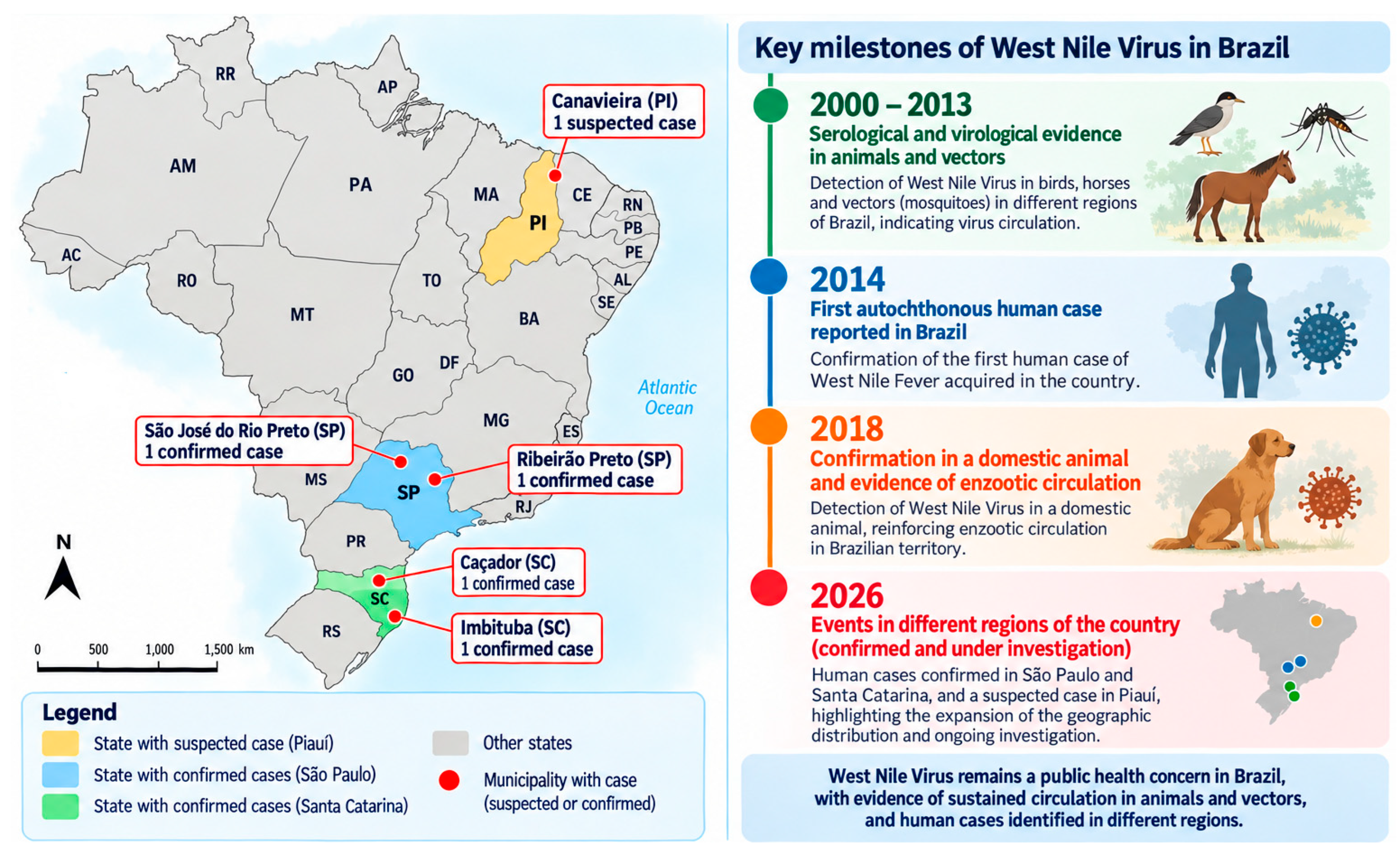
As of 28 August 2026, four human cases of WNV infection had been confirmed in Brazil, distributed across the states of São Paulo and Santa Catarina, in addition to one probable/under-investigation case in Piauí (Figure 1). The Ministry of Health reported that these detections brought the national total to 17 confirmed human cases and one probable case for 2014–2026, alongside 12 confirmed equine detections [11]. The 2026 cases should therefore be interpreted within an established but incompletely characterized national pattern of viral circulation (Table 1).
Figure 1.
Geographic distribution and timeline of West Nile fever cases in Brazil in 2026 (data cutoff: 28 August 2026).
Table 1.
Human cases of West Nile fever identified in Brazil up to 28 August 2026, including clinical, laboratory, exposure, and outcome information available from official sources.
3.1. Confirmed Cases in Santa Catarina
The first confirmed case in Santa Catarina occurred in a 77-year-old woman residing in Imbituba. Symptoms began on 25 June 2026, with weakness, dizziness, and headache, followed by neurological deterioration, encephalitis, reduced strength in the lower limbs, and confusion. WNV RNA was detected by RT-PCR in cerebrospinal fluid collected on 3 August. She died on 8 August. The recorded cause of death was stroke; the association between the cerebrovascular event and WNV infection remained under investigation, and the available public information did not establish a specific proximate mechanism of death. No recent travel considered epidemiologically relevant was reported.
The second confirmed case in Santa Catarina involved a 56-year-old man residing in Caçador, with symptom onset on 21 July 2026. He presented disorientation, vertigo, weakness, and difficulty remaining upright without assistance. During the investigation, Susac syndrome was considered as a differential diagnosis. WNV RNA was detected by RT-PCR in cerebrospinal fluid collected on 29 July. The patient had no reported travel in the preceding months and subsequently recovered. Publicly available sources did not provide detailed information on intensive care, respiratory support, or specific treatment.
3.2. Confirmed Cases in São Paulo
The first confirmed case in São Paulo involved a 34-year-old woman residing in Ribeirão Preto, with symptom onset on 4 June 2026. She presented with headache, marked ocular edema, retro-orbital pain, fatigue, and myalgia, without reported fever, followed by papilledema and intracranial hypertension. She was hospitalized from 21 July to 31 July and recovered clinically. WNV RNA was detected by RT-PCR in blood and cerebrospinal fluid collected on 24 July. She had traveled to Parintins, Amazonas, from 30 May to 6 June, and later traveled to Cristina, Minas Gerais, on 20 June and 17 July, with short stays in a rural area. She denied visits to forest or riparian environments and contact with rivers, lakes, waterfalls, or caves. The probable site of infection remained under investigation.
The second confirmed case in São Paulo involved an 18-year-old woman residing in São José do Rio Preto, with a reported onset of symptoms on 29 July 2026, although records also documented headache, altered consciousness, and photophobia on 8 July, indicating a chronology that remained subject to review. The clinical picture included fever, headache, myalgia, arthralgia, retro-orbital pain, vomiting, weakness, anorexia, somnolence, tremors, seizures, flaccidity/paralysis, upper-limb rigidity, and petechiae. She was hospitalized on 8 August and remained under clinical monitoring at the cutoff date. WNV RNA was detected by RT-PCR in cerebrospinal fluid collected on 10 August. She reported mosquito exposure and a stay at a rural property in Miracatu, São Paulo, from 30 April to 6 May.
3.3. Probable Case in Piauí
The probable/under-investigation case in Piauí involved a 35-year-old woman residing in the rural area of Canavieira, with symptom onset on 12 April 2026. She developed paresthesia and bilateral lower-limb paralysis with an insidious, ascending pattern compatible with Guillain–Barré syndrome (acute inflammatory demyelinating polyradiculoneuropathy). She was hospitalized in Teresina and discharged after partial clinical improvement. Serum samples collected on 28 April and 8 May showed indeterminate IgM in the first sample and reactive IgM against WNV in the second, with non-reactive results for other arboviruses. Final classification remained dependent on the feasibility and result of plaque-reduction neutralization testing (PRNT).
This episode is particularly relevant because Piauí was the site of the first confirmed human WNV case in Brazil in 2014. That patient was a rural worker from Aroeiras do Itaim who developed acute encephalitis and flaccid paralysis and was subsequently discharged [8]. The recurrence of a compatible neuroinvasive syndrome more than a decade later does not, by itself, establish sustained circulation; however, comparison of the two events supports renewed investigation of human, animal, vector, and environmental evidence in the affected region. Molecular evidence subsequently obtained from Brazilian animal isolates has also supported circulation of a lineage related to the NY99 strain, reinforcing the value of genomic and ecological investigations when assessing recurrent events [12].
3.4. Integrated Surveillance Context and Evidence Gaps
The public information reviewed did not contain contemporaneous results of mosquito captures, species composition, vector abundance, WNV testing in mosquitoes, or coordinated serological/molecular surveillance of birds and equines specifically linked to the 2026 human cases. It also did not provide a standardized environmental assessment for the affected municipalities. These findings were therefore not interpreted as evidence that surveillance activities were absent. Rather, they identify an important evidence gap between human case detection and characterization of the local transmission system. In accordance with Ministry of Health guidance, detection of WNV in humans should trigger investigation of unexplained neurological disease, neurologically affected birds and equines, and potential mosquito vectors in the affected areas [11].
4. Discussion
The identification of four confirmed cases of WNF in 2026, distributed between São Paulo and Santa Catarina, represents a relevant signal for arbovirus surveillance in Brazil, but the available evidence does not justify interpreting the event as sustained autochthonous transmission or as a national epidemic. The predominance of neurological disease among the detected cases may reflect the fact that neuroinvasive presentations are more likely to prompt diagnostic investigation, whereas a substantial proportion of infections are asymptomatic or paucisymptomatic [13,14]. Accordingly, the five cases described here should be understood as detected clinical events rather than as an estimate of the extent of viral circulation. The death of the 77-year-old patient also requires cautious interpretation: although severe neurological disease occurred, the recorded cause of death was stroke and its causal relationship with WNV remained under investigation [11].
The geographical distribution of the cases adds complexity to the interpretation. The municipalities involved in São Paulo and Santa Catarina are geographically distant, and the probable locations of infection acquisition remain incompletely defined. The 34-year-old woman from Ribeirão Preto had recent travel to Parintins, Amazonas, as well as later travel to rural Cristina, Minas Gerais, making imported or geographically acquired infection a relevant alternative explanation. In contrast, the Santa Catarina cases had no reported travel compatible with acquisition elsewhere, which increases the epidemiological relevance of local exposure but does not establish local transmission. The available public sources reviewed for this report did not provide concurrent mosquito-density estimates, WNV infection rates in mosquitoes, or contemporaneous serological or molecular findings in birds or equines for the municipalities involved. Thus, the absence of vector animal evidence prevents establishment of a sustained local transmission chain and highlights the need for the investigations recommended by the Ministry of Health [11].
The probable/under-investigation case in Canavieira warrants additional attention. Piauí was the site of the first confirmed human WNV case in Brazil [8,12], and the 2026 episode presents a neuroinvasive phenotype with ascending paralysis that is clinically compatible with Guillain–Barré syndrome. The laboratory profile—reactive WNV IgM in the second serum sample, non-reactive results for other arboviruses, and pending PRNT—supports the classification used by the Ministry of Health but does not provide the same level of evidence as direct viral RNA detection [11]. The recurrence of a case in the same state should therefore prompt comparison with the 2014 investigation and targeted assessment of local vectors, birds, equines, and environmental conditions. The molecular evidence of a NY99-related strain in Brazil [12] provides a biologically relevant context for such investigation, but it should not be interpreted as evidence that the 2026 case belongs to that lineage in the absence of sequence data from the patient or local reservoirs.
The concept of integrated surveillance in WNV requires more than the parallel identification of human cases. In the present context, it encompasses coordinated clinical and epidemiological surveillance of neuroinvasive syndromes; laboratory confirmation; entomological investigation of potential vectors; surveillance of birds, equines, and other relevant animal hosts; and environmental and territorial assessment of areas where human or animal infections are detected. The Ministry of Health recommends retrospective testing of unexplained neurological cases, prospective investigation of suspected neuroinvasive disease, investigation of neurologically affected birds and equines, and entomological surveys in affected areas [11,12]. These components are particularly important because the WNV cycle is maintained primarily between birds and mosquitoes, while humans and equines are incidental hosts [2,15]. The present study did not conduct these investigations directly; rather, it assessed the extent to which their results were publicly available and identified important gaps in the evidence surrounding the 2026 cases.
From a practical public-health perspective, four priorities emerge from the 2026 events. First, surveillance for neuroinvasive arboviral syndromes should be intensified in and around Imbituba, Caçador, Ribeirão Preto, São José do Rio Preto, and Canavieira, with retrospective review of unexplained encephalitis, meningitis, myelitis, encephalomyelitis, and Guillain–Barré syndrome in epidemiologically compatible periods and locations [11]. Second, diagnostic capacity should be strengthened. The Ministry of Health initiated decentralization of molecular diagnosis for WNV and Saint Louis encephalitis to state public-health laboratories (Lacen) in 2026, using a duplex molecular protocol developed by the Evandro Chagas Institute [11]. This expansion should be linked to routine arbovirus surveillance and supported by complementary serological and neutralization testing when indicated, given potential flavivirus cross-reactivity [16,17]. Third, entomological investigations should be initiated in affected areas to identify Culex and other potentially competent mosquitoes, characterize abundance and spatial distribution, and, when feasible, test mosquitoes for WNV [11]. Fourth, animal and wildlife surveillance should prioritize neurologically affected equines and birds, with coordinated notification and investigation through health, agriculture, and environmental sectors [11].
These priorities are consistent with a One Health approach in which human, animal, vector, and environmental information is interpreted jointly [18]. They also make the surveillance recommendations more operational: the areas immediately requiring attention are not an abstract national territory but the municipalities with confirmed or probable cases and their epidemiologically connected locations, including reported exposure sites such as Miracatu and travel-associated locations. The Ministry of Health further recommends environmental management and mechanical measures to reduce vector proliferation when WNV is detected in urban settings in sufficient time for containment [11]. Personal protection against mosquito exposure—repellents, long clothing, screens, and avoidance of peak Culex activity during dusk, night, and dawn—remains appropriate in areas with recent occurrence or documented circulation [11]. The objective is not to infer transmission from human cases alone, but to generate timely evidence capable of distinguishing imported infection, focal local transmission, and broader enzootic circulation.
This report has important limitations. The principal limitation is the dynamic nature of the epidemiological investigations and the reliance on publicly available secondary information. Detailed individual clinical records, complete treatment information, intensive-care requirements, comorbidities, full exposure histories, vector abundance, mosquito infection rates, animal surveillance results, environmental assessments, and genomic data for the 2026 human cases were not available in the sources consulted. The absence of publicly reported entomological or animal findings cannot be interpreted as proof that such investigations were not performed; it indicates that their results were not accessible for this analysis. In addition, ascertainment bias is likely because neuroinvasive manifestations are more likely to trigger laboratory investigation than mild or asymptomatic infections [19]. No population-based serological survey or systematic screening of asymptomatic contacts was available to estimate the proportion of inapparent infections. The findings should therefore be interpreted as a time-limited description of detected cases and available surveillance evidence through 28 August 2026, rather than as an estimate of the magnitude or geographic extent of WNV circulation in Brazil.
5. Conclusions
The four confirmed human cases of West Nile fever identified in Brazil in 2026, together with one probable/under-investigation case in Piauí, constitute an important epidemiological alert but do not, on the evidence currently available, establish sustained local transmission or a national epidemic. The clinical spectrum included neuroinvasive manifestations, hospitalization, and one death in an elderly patient, whose recorded cause of death was stroke and whose relationship with WNV remained under investigation. The principal contribution of these events to surveillance is therefore not the number of cases itself, but the opportunity to identify gaps in the chain linking human detection to vector, animal, laboratory, and environmental investigation.
A robust response requires a genuinely integrated One Health surveillance strategy, combining human clinical and epidemiological surveillance with decentralized laboratory diagnosis, entomological investigation, animal and wildlife surveillance, and environmental and territorial assessment. In practical terms, the municipalities affected in 2026 and their epidemiologically connected areas should receive intensified investigation, including retrospective and prospective surveillance of neuroinvasive syndromes, vector surveys, investigation of neurologically affected birds and equines, and rapid laboratory confirmation. The 2026 experience therefore provides an opportunity to strengthen Brazil’s capacity to distinguish imported infections from focal local transmission and to detect viral circulation before additional human disease occurs.
Author Contributions
Conceptualization: D.S.T.J.; methodology: D.S.T.J. and E.M.d.A.; investigation: D.S.T.J.; data curation: D.S.T.J.; writing—original draft preparation: D.S.T.J. and E.M.d.A.; writing—review and editing: D.S.T.J. and E.M.d.A.; supervision: E.M.d.A. All authors have read and agreed to the published version of the manuscript.
Funding
This research received no external funding.
Institutional Review Board Statement
Not applicable. The study was based exclusively on publicly available secondary information and did not involve direct interaction with human participants or access by the research team to individual identifiable or re-identifiable health records. Under the applicable Brazilian framework for research using publicly accessible information, CEP/CONEP review was not required.
Informed Consent Statement
Not applicable.
Data Availability Statement
No new datasets were generated. The case-level information analyzed in this report was derived exclusively from publicly available official communications, technical documents, epidemiological materials, and institutional statements. The authors did not access confidential clinical records, laboratory information systems, or restricted surveillance databases. The specific public sources used are cited in the manuscript.
Acknowledgments
We acknowledge the Brazilian public-health institutions whose official communications and technical materials made this secondary analysis possible, including the Ministry of Health, state health authorities, reference services, and public-health laboratories involved in the original investigations. No institutional representative is presented as an author solely based on institutional affiliation; authorship is limited to those who made substantial contributions to the conception, analysis, and writing of this report. The authors do not claim access to unpublished institutional records.
Conflicts of Interest
The authors declare no conflicts of interest.
References
- Irekeola, A.A.; Alshehri, A.A. Human West Nile virus infection: A meta-analysis of recent global data (2019–24). J. Glob. Health 2025, 15, 04278. [Google Scholar] [CrossRef] [Scilit] [PubMed]
- Bruno, L.; Nappo, M.A.; Frontoso, R.; Perrotta, M.G.; Di Lecce, R.; Guarnieri, C.; Ferrari, L.; Corradi, A. West Nile virus (WNV): One Health and EcoHealth global risks. Vet. Sci. 2025, 12, 288. [Google Scholar] [CrossRef] [Scilit] [PubMed]
- Carrasco, L.; Utrilla, M.J.; Fuentes-Romero, B.; Fernández-Novo, A.; Martin-Maldonado, B. West Nile virus: An update focusing on Southern Europe. Microorganisms 2024, 12, 2623. [Google Scholar] [CrossRef] [Scilit] [PubMed]
- Marino, A.; Vitale, E.; Maniaci, A.; La Via, L.; Moscatt, V.; Spampinato, S.; Senia, P.; Venanzi Rullo, E.; Restivo, V.; Cacopardo, B.; et al. West Nile virus: Insights into microbiology, epidemiology, and clinical burden. Acta Microbiol. Hell. 2025, 70, 44. [Google Scholar] [CrossRef] [Scilit]
- Judson, S.D.; Dowdy, D. Risk factors for West Nile neuroinvasive disease and mortality in the United States, 2013–2024. JAMA Netw. Open 2025, 8, e2548229. [Google Scholar] [CrossRef] [Scilit] [PubMed]
- Gupta, A.; Tripathi, A.; Jha, K.; Rawat, Y.; Bhardwaj, U.; Khasa, R.; Chauhan, S. Advances and challenges in vaccine development for West Nile virus (WNV) infection. Vaccines 2026, 14, 499. [Google Scholar] [CrossRef] [Scilit] [PubMed]
- Pauvolid-Corrêa, A.; Morales, M.A.; Levis, S.; Figueiredo, L.T.; Couto-Lima, D.; Campos, Z.; Nogueira, M.F.; da Silva, E.E.; Nogueira, R.M.; Schatzmayr, H.G. Neutralising antibodies for West Nile virus in horses from Brazilian Pantanal. Mem. Inst. Oswaldo Cruz 2011, 106, 467–474. [Google Scholar] [CrossRef] [Scilit] [PubMed]
- Vieira, M.A.; Romano, A.P.; Borba, A.S.; Silva, E.V.; Chiang, J.O.; Eulálio, K.D.; Azevedo, R.S.; Rodrigues, S.G.; Almeida-Neto, W.S.; Vasconcelos, P.F. West Nile virus encephalitis: The first human case recorded in Brazil. Am. J. Trop. Med. Hyg. 2015, 93, 377–379. [Google Scholar] [CrossRef] [Scilit] [PubMed]
- Siconelli, M.J.L.; de Melo Jorge, D.M.; de Castro-Jorge, L.A.; Fonseca-Júnior, A.A.; Nascimento, M.L.; Floriano, V.G.; de Souza, F.R.; Queiroz-Júnior, E.M.; Camargos, M.F.; Costa, E.D.L.; et al. Evidence of the current circulation of an old West Nile virus strain (NY99) in Brazil. Rev. Soc. Bras. Med. Trop. 2021, 54, e0687-2020. [Google Scholar] [CrossRef] [Scilit] [PubMed]
- Vieira, M.A.C.e.S.; de Almeida Xavier Aguiar, A.; de Souza Borba, A.; Guimarães, H.C.L.; Eulálio, K.D.; de Albuquerque-Neto, L.L.; Salmito, M.A.; Lima, O.B. West Nile fever in Brazil: Sporadic case, silent endemic disease or epidemic in its initial stages? Rev. Inst. Med. Trop. São Paulo 2015, 57, 276. [Google Scholar] [CrossRef] [Scilit] [PubMed]
- Ministry of Health; Secretariat of Health and Environmental Surveillance; Department of Communicable Diseases; General Coordination of Arbovirus Surveillance. Technical Note No. 79/2026-CGARB/DEDT/SVSA/MS: Update on the Epidemiological Scenario of West Nile Fever and Surveillance Guidelines; Ministry of Health: Brasília, DF, Brazil, 2026. Available online: https://www.gov.br/saude/pt-br/centrais-de-conteudo/publicacoes/notas-tecnicas/2026/nota-tecnica-no-79-2026.pdf/view (accessed on 8 September 2026). (In Brazilian)
- World Health Organization. West Nile Virus—Brazil. Disease Outbreak News, 15 December 2014. Available online: https://www.who.int/emergencies/disease-outbreak-news/item/15-december-2014-wnv-en (accessed on 8 September 2026).
- Zerbato, V.; Rossi, B.; Di Bella, S.; Bartalucci, C.; Cerchiaro, M.; Da Re, D.; Dentone, C.; Sepulcri, C.; Marini, G.; Delfino, E.; et al. West Nile virus: Epidemiology, prevention, clinical features, diagnosis, treatment, and open research questions. Ann. Med. 2026, 58, 2615482. [Google Scholar] [CrossRef] [Scilit] [PubMed]
- Curtolo, A.; Kontogiannis, D.; Ascoli Bartoli, T.; Maffongelli, G.; Tomassi, M.V.; Bevilacqua, N.; De Marco, P.; Del Borgo, C.; Lichtner, M.; Vita, S. West Nile neuroinvasive disease: Current management, emerging therapies and future clinical trial priorities. Rev. Med. Virol. 2026, 36, e70182. [Google Scholar] [CrossRef] [Scilit] [PubMed]
- Marini, G.; Pugliese, A.; Wint, W.; Alexander, N.S.; Rizzoli, A.; Rosà, R. Modelling the West Nile virus force of infection in the European human population. One Health 2022, 15, 100462. [Google Scholar] [CrossRef] [Scilit] [PubMed]
- Girl, P.; Euringer, K.; Coroian, M.; Mihalca, A.D.; Borde, J.P.; Dobler, G. Comparison of five serological methods for the detection of West Nile virus antibodies. Viruses 2024, 16, 788. [Google Scholar] [CrossRef] [Scilit] [PubMed]
- Ministry of Health; Health Surveillance Secretariat; Department of Epidemiological Surveillance. Culex quinquefasciatus Surveillance Guide, 3rd ed.; Ministry of Health: Brasília, Brazil, 2011; 76p. (In Brazilian)
- Kolodziejek, J.; Jungbauer, C.; Aberle, S.W.; Allerberger, F.; Bagó, Z.; Camp, J.V.; Dimmel, K.; de Heus, P.; Kolodziejek, M.; Schiefer, P.; et al. Integrated analysis of human-animal-vector surveillance: West Nile virus infections in Austria, 2015–2016. Emerg. Microbes Infect. 2018, 7, 25. [Google Scholar] [CrossRef] [Scilit] [PubMed]
- Madere, F.S.; Andrade da Silva, A.V.; Okeze, E.; Tilley, E.; Grinev, A.; Konduru, K.; García, M.; Rios, M. Flavivirus infections and diagnostic challenges for dengue, West Nile and Zika viruses. npj Viruses 2025, 3, 36. [Google Scholar] [CrossRef] [Scilit]

Disclaimer/Publisher’s Note: The statements, opinions and data contained in all publications are solely those of the individual author(s) and contributor(s) and not of MDPI and/or the editor(s). MDPI and/or the editor(s) disclaim responsibility for any injury to people or property resulting from any ideas, methods, instructions or products referred to in the content. |
© 2026 by the authors. Licensee MDPI, Basel, Switzerland. This article is an open access article distributed under the terms and conditions of the Creative Commons Attribution (CC BY) license.