


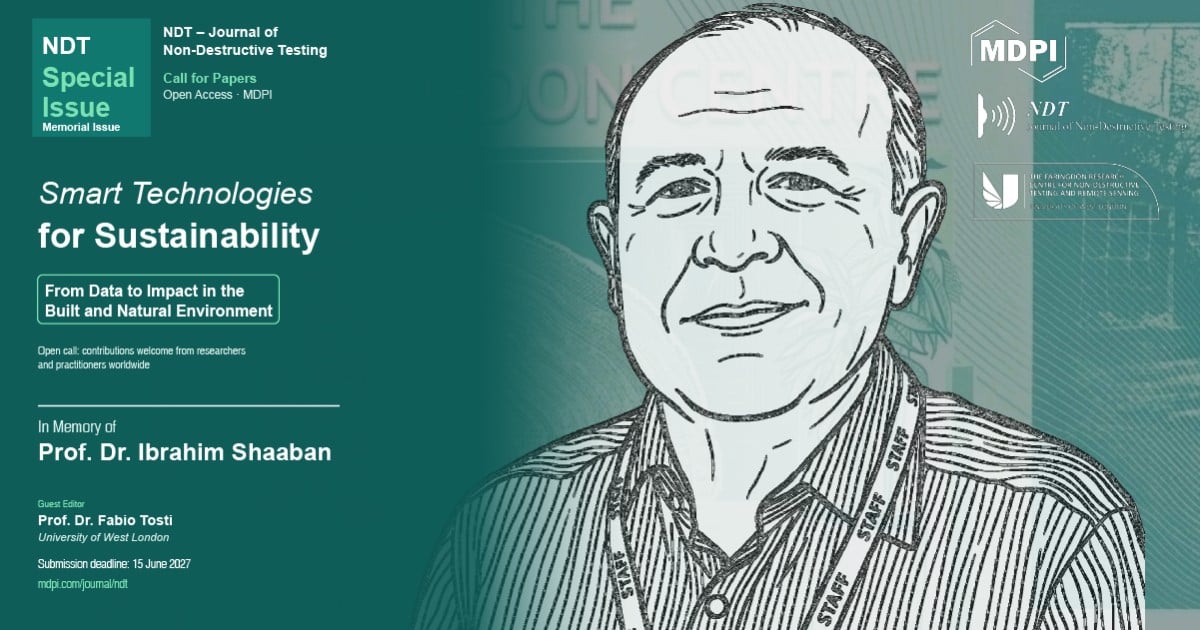
Smart Technologies for Sustainability: From Data to Impact in the Built and Natural Environment—in Memory of Prof. Ibrahim Shaaban
Special Issue Information
Dear Colleagues,
Smart technologies, from non-destructive testing (NDT) and remote sensing to sensor networks, robotics, artificial intelligence and the digital tools that bring data to people, are now mature enough to be judged by what they change. The open question is no longer only whether we can detect a defect, map a subsurface or monitor a landscape, but how that evidence makes structures safer and longer-lived, infrastructure more resilient to a changing climate, cultural and natural heritage better protected, and decisions more transparent to the communities that depend on them. This Special Issue invites work that moves sensing towards this impact, from early-stage research on new methods, materials and data fusion with a clear path to application, to field deployments, decision support and public engagement.
This Special Issue is dedicated to the memory of Prof. Dr. Ibrahim Shaaban, Professor of Structural Engineering and Head of Civil Engineering at the University of West London (UWL). Over four decades in Egypt and the UK, he contributed to the strengthening, repair and durability of concrete structures, advanced composites and sustainable construction materials, as well as to engineering education as a dean, programme founder and research group leader. As an active member of The Faringdon Research Centre for Non-Destructive Testing and Remote Sensing, he always asked what a measurement meant for the safety and service life of a structure, and he was a generous mentor to young researchers.
This Special Issue, titled “Smart Technologies for Sustainability: From Data to Impact in the Built and Natural Environment—in Memory of Prof. Ibrahim Shaaban”, is open to researchers and practitioners worldwide and welcomes contributions on, but not limited to, the following topics:
- NDT, structural health monitoring and remote sensing of buildings, bridges, tunnels, pavements, railways and airfields;
- Assessment of concrete, masonry, steel and composite structures: durability, deterioration, strengthening, retrofitting and repair;
- Monitoring of sustainable and low-carbon construction materials and nature-based solutions;
- Earth observation and in situ sensing for climate-adaptive infrastructure and environmental resilience;
- Sensing for cultural and natural heritage, and for environmental and geohazard risk;
- Multi-sensor, multi-platform and multi-scale data fusion (e.g., GPR, ultrasonics, thermography, LiDAR, photogrammetry, InSAR, multispectral imaging);
- Smart and emerging technologies: IoT and wireless sensor networks, robotics and drones, self-sensing materials, artificial intelligence and digital twins;
- Immersive and interactive technologies (XR, web GIS) for communicating sensing data to stakeholders and communities;
- Evidence of impact: decision support, asset management, policy, cost and carbon benefits of sensing;
- Education, training and capacity building in NDT and remote sensing.
Original research articles, reviews, case studies and data descriptors are welcome from the whole international community; presentation at the Faringdon Symposium is not required. Authors who presented at FARSY 2026 are also welcome to submit substantially extended versions of their work. In addition to regular submissions, some review papers will be invited, and the Guest Editors will write an Editorial that presents the collected articles in light of the Special Issue focus and reflects on how they connect with, and carry forward, Prof. Dr. Ibrahim Shaaban's legacy and career contributions.
Thank you for your consideration.
Prof. Dr. Fabio Tosti
Dr. Saeed Parnow
Dr. Parisa Saadati
Dr. Francesco Soldovieri
Guest Editors
Manuscript Submission Information
Manuscripts should be submitted online at www.mdpi.com by registering and logging in to this website. Once you are registered, click here to go to the submission form. Manuscripts can be submitted until the deadline. All submissions that pass pre-check are peer-reviewed. Accepted papers will be published continuously in the journal (as soon as accepted) and will be listed together on the Special Issue website. Research articles, review articles as well as short communications are invited. For planned papers, a title and short abstract (about 250 words) can be sent to the Editorial Office for assessment.
Submitted manuscripts should not have been published previously, nor be under consideration for publication elsewhere (except conference proceedings papers). All manuscripts are thoroughly refereed through a single-anonymized peer-review process. A guide for authors and other relevant information for submission of manuscripts is available on the Instructions for Authors page. NDT is an international peer-reviewed open access quarterly journal published by MDPI.
Please visit the Instructions for Authors page before submitting a manuscript. The Article Processing Charge (APC) for publication in this open access journal is 1000 CHF (Swiss Francs). Submitted papers should be well formatted and use good English. Authors may use MDPI's English editing service prior to publication or during author revisions.
Keywords
- smart technologies
- non-destructive testing (NDT)
- remote sensing
- structural health monitoring
- sustainable infrastructure
- climate resilience
- cultural heritage
- data fusion
- artificial intelligence
- digital twins
- immersive technologies
- societal impact
Benefits of Publishing in a Special Issue
- Ease of navigation: Grouping papers by topic helps scholars navigate broad scope journals more efficiently.
- Greater discoverability: Special Issues support the reach and impact of scientific research. Articles in Special Issues are more discoverable and cited more frequently.
- Expansion of research network: Special Issues facilitate connections among authors, fostering scientific collaborations.
- External promotion: Articles in Special Issues are often promoted through the journal's social media, increasing their visibility.
- Reprint: MDPI Books provides the opportunity to republish successful Special Issues in book format, both online and in print.
Published Papers


NDT - ISSN 2813-477X