


You are currently viewing a new version of our website. To view the old version click .

Nanomaterials

Nanomaterials is an international, interdisciplinary, peer-reviewed, open access journal published semimonthly online by MDPI, and that publishes reviews, regular research papers, communications, and short notes that are relevant to any field of study that involves nanomaterials with respect to their science and applications.
The Spanish Carbon Group (GEC) and The Chinese Society of Micro-Nano Technology (CSMNT) are affiliated with Nanomaterials and their members receive discounts on the article processing charges.
Indexed in PubMed | Quartile Ranking JCR - Q2 (Physics, Applied | Chemistry, Multidisciplinary | Materials Science, Multidisciplinary | Nanoscience and Nanotechnology)

All Articles (21,513)

(1) Background: Intra-articular injection is a fundamental technique in preclinical research for evaluating therapeutics and inducing joint disease models in rodents. However, the absence of standardized and validated protocols compromises reproducibility and translational validity. (2) Methods: This study establishes and experimentally validates a refined protocol for precise intra-articular injection in the knee of adult male Wistar rats. The comprehensive procedure specifies anatomical landmarks (medial border of the patellar tendon), instrumentation (27 G needle, 100 µL Hamilton syringe), a maximum volume of 35 µL, and operative verification criteria based on tactile feedback. Experimental validation was performed by administering a suspension of wear particles (2.35 mg/mL) generated from tribocorrosion tests of CoCr surfaces biofunctionalized with graphene oxide-hyaluronic acid (GO-HA) into the left knee of five rats. (3) Results: Histological analysis using the cutting–grinding technique and Toluidine Blue staining confirmed the exclusive intra-articular localization of particles in all injected animals (5/5 success rate). Qualitative assessment revealed abundant particulate distribution within the synovial space, with numerous individual particles and multiple aggregates observed per high-power field, without evidence of extravasation in any case. (4) Conclusions: The protocol demonstrated high intra-operator repeatability and provides a reliable, ethically refined tool for precise intra-articular administration of nanomaterials and for generating robust joint disease models, thereby enhancing reproducibility and animal welfare in preclinical research.

20 December 2025
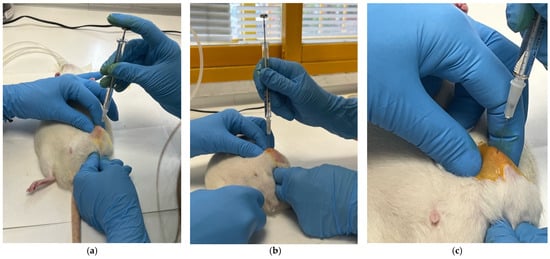
Sequence of the intra-articular approach. (a) Medial entry point to the patellar tendon. (b) Needle insertion directed towards the synovial space. (c) Needle insertion was performed at 90° to the sagittal plane with 10–15° cranial inclination, advancing 3–4 mm to reach the synovial space in rats weighing 250–300 g.

High-flexibility copper foils are critical for reliable flexible interconnects and displays. In this work, commercial-purity copper belts were processed by triple-layer stacked cold rolling to ultrathin foils, producing distinct surface- and layer-dependent deformation structures in the bright, matte, and central-interface layers; subsequent annealing at 600 °C then promoted orientation-selective recrystallization. Under the present conditions, the center-interface layer of the triple-rolled foil achieved the highest flexural-fatigue life (≈8.0 × 10⁴ cycles) within a window of cube ≈ 30–45% and grain size ≈ 40–60 μm. In this regime, grain-size control stabilizes intergranular slip compatibility, reduces elastic–plastic mismatch, and mitigates strain localization during cyclic bending. Even without aggressive cube enrichment, high flexural fatigue resistance can likewise be achieved through deliberate control of grain size. These findings establish a clear processing–microstructure–property linkage and indicate that layer-dependent control of texture and grain size can enhance flexural-fatigue performance in triple-layer stacked-rolled copper foils for flexible electronics.

20 December 2025

In this study, nanocrystalline dysprosium oxide (Dy2O3) thin films were deposited on sapphire and quartz glass substrates by an electron beam evaporation technique to comparatively evaluate the influence of substrate type on their structural and optical properties. X-ray diffraction (XRD) confirms that all films exhibit a polycrystalline nature and possess a cubic-type structure. The Debye–Scherrer equation was used to determine the average crystallite size and it was found that the film deposited on quartz glass substrate is slightly larger than the film deposited on the sapphire substrate. Scanning electron microscopy (SEM) revealed a granular morphology for the sapphire film and a more compact, pore-free surface for the quartz film. Spectroscopic ellipsometry (SE) and UV-Vis spectrophotometry were employed to extract the optical constants and reflectance behavior, respectively. The film on sapphire exhibited a lower refractive index, higher extinction coefficient, and reduced reflectance, confirming its enhanced anti-reflective performance. The study provides new insights into how the substrate affects the optical properties of Dy2O3 thin films. This study demonstrates that sapphire is a more suitable substrate for enhanced anti-reflective and optoelectronic applications.

20 December 2025

Developing sustainable, high-performance biomass composites is crucial for replacing non-renewable structural materials. In this study, a “bamboo steel” composite was fabricated using a multilevel modification strategy involving alkali pretreatment, toughened resin impregnation, and surface functionalization. Bamboo fibers were treated to remove hemicellulose and lignin, enhancing porosity and interfacial bonding. The bamboo scaffold was subsequently impregnated with a thermo-plastic polyurethane-modified epoxy resin to create a robust, interpenetrating network. The optimized composite (treated at 80 °C) exhibited a flexural strength of 443.97 MPa and a tensile strength of 324.14 MPa, demonstrating exceptional stiffness and toughness. Furthermore, a superhydrophobic coating incorporating silica nanoparticles was applied, achieving a water contact angle exceeding 150° and excellent self-cleaning properties. This work presents a scalable strategy for producing bio-based structural materials that balance mechanical strength with environmental durability.

19 December 2025

News & Conferences

Issues

Open for Submission

Editor's Choice

Reprints of Collections

Design and Applications of Heterogeneous Nanostructured Materials
Reprint

Design and Applications of Heterogeneous Nanostructured Materials

Editors: Hongbo Ju, Bingyang Ma, Manuel António Peralta Evaristo, Jicheng Ding, Filipe Daniel Fernandes
Synthesis and Application of Nanoparticles in Novel Composites
Reprint

Synthesis and Application of Nanoparticles in Novel Composites

Editors: Edgar O'Rear, Fernando Esteban Florez

Get Alerted

Add your email address to receive forthcoming issues of this journal.

XFacebookLinkedIn
Nanomaterials - ISSN 2079-4991