Skip to Content
  • 40 days
    Submission to First Decision
  • 24 days
    Acceptance to Publication

Nanomanufacturing

Nanomanufacturing is an international, peer-reviewed, open access journal on the fabrication of miniaturized devices or objects, their scalability, and their eventual industrial production, published quarterly online by MDPI.
  • Open Access— free for readers, with article processing charges (APC) paid by authors or their institutions.
  • Rapid Publication: manuscripts are peer-reviewed and a first decision is provided to authors approximately 39.3 days after submission; acceptance to publication is undertaken in 23.8 days (median values for papers published in this journal in the first half of 2026).
  • Recognition of Reviewers: Reviewers whose reports are timely and of high quality receive an APC discount voucher for a future publication in an MDPI journal. Become a reviewer.
  • Nanomanufacturing is a companion journal of Nanomaterials.

Get Alerted

Add your email address to receive forthcoming issues of this journal.

All Articles (120)

  • Review
  • Open Access

Healthcare-associated infections and rising antimicrobial resistance have driven sustained interest in antibacterial surface engineering as a complement to systemic treatment and terminal disinfection. Nanomaterials, including metal/metal-oxide nanoparticles, iodine/iodophor systems, chitosan composites, and core–shell architectures, offer distinct antibacterial mechanisms and emerging routes to scalable manufacturing. This review synthesizes the literature, deliberately weighting coverage toward manufacturing scalability, mechanical durability, and regulatory translation rather than materials chemistry alone. Using a structured critical-appraisal approach, methodologically pivotal studies are evaluated narratively, while the broader literature is categorized in comprehensive appraisal tables mapping designs, key results, and limitations. Targeted case studies on orthopedic implants and catheters are also examined in depth to expose localized translational bottlenecks. The overall assessment of this work is that while antibacterial nanomaterial chemistry is mature and well characterized across several platforms, scalable deposition methods, standardized durability/retention-of-efficacy testing, and nanomaterial-specific regulatory guidance remain the primary rate-limiting factors in wider clinical and industrial adoption.

Nanomanufacturing

12 October 2026
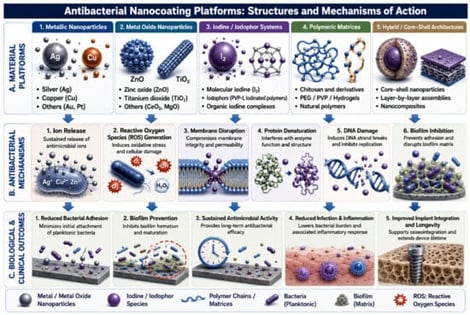
Antibacterial nanocoating platforms surveyed in Section 2 (A), their principal mechanisms of bacterial inactivation (B), and the resulting biological and clinical outcomes (C).
  • Article
  • Open Access

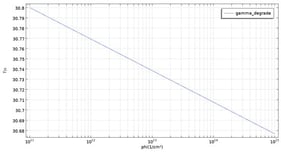
This paper focuses on the X-cut Y-propagating lithium niobate Mach–Zehnder modulator and studies how its performance degrades under atmospheric neutron irradiation. Since SRIM cannot directly simulate neutron-induced nuclear reactions, 1 MeV H+ ions are adopted as surrogate particles to compute displacement damage. SRIM is used to simulate the interaction between equivalent particles and lithium niobate lattices, constructing a material damage model that links neutron fluence to defect density, electro-optic coefficient degradation, and increased transmission loss. These material degradation relations are imported into COMSOL Multiphysics to build a multiphysics-coupled model integrating radiation damage, optical-field transmission, and electric-field modulation. Material-level simulation outputs are mapped onto three-dimensional real devices via structural equivalence principles. The simulation results show that lattice defect density rises with increasing neutron fluence, which further induces half-wave voltage drift, elevated insertion loss, and continuous extinction-ratio reduction. This work reveals the neutron displacement-damage-driven performance degradation mechanism and establishes a complete simulation workflow: neutron fluence → lattice defects → material property deterioration → device performance degradation. The established framework supports radiation-hardened design and on-orbit lifetime assessment for lithium-niobate-based space photonic devices. Limitations of the surrogate-particle approximation and model boundaries are also discussed, as all quantitative trends are simulation-derived rather than fully validated by experimental measurement.

Nanomanufacturing

1 October 2026

Degradation curve of electro-optic coefficient.
  • Feature Paper
  • Article
  • Open Access

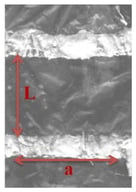
Polypyrrole (PPy) nanofilms were deposited by in situ chemical oxidative polymerization on polyethylene or polypropylene. The thickness is determined by SEM of the cross-section. Thin thickness nanofilms (180 ± 5 nm) are deposited. The nanofilms are then modified by nucleophilic addition to attach functional groups to the nanofilms. Strong nucleophiles (e.g., thiols) react by conventional heating. Weak nucleophiles (e.g., nitroanilines) only react when applying microwaves. The spectroscopic (UV–visible, FTIR, XPS and XANES) characterization shows the attachment of functional groups and the change in electronic properties upon the reaction. The conductivity of the functionalized PPy nanofilms are lower than unmodified PPy nanofilms, likely due to steric effects on the extended conjugation and disturbance of the electron hopping between chains. While reaction with some nucleophiles (e.g., bisulfite ion) makes nanofilms more hydrophilic, modification with long alkyl chains or fluorinated long chains produces highly hydrophobic nanofilms. No noticeable effect of the reaction on the film thickness is observed, suggesting little or no loss of polymer due to dissolution.

Nanomanufacturing

9 September 2026

Photograph of PPy film on PE, with silver ink bands as electrical contacts.
  • Article
  • Open Access

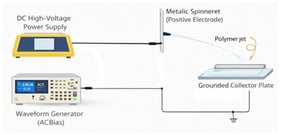
A low-voltage alternating current (AC) field (20 V peak-to-peak, 1 kHz) was superimposed on a conventional direct current (DC) electrospinning configuration in order to test whether the shape of that perturbation measurably alters fiber formation. A function generator delivered sinusoidal, pulsed (square), ramp and arbitrary (noise) waveforms to a foil-covered flat collector, while a standard DC high-voltage source (20 kV) drove the jet from the spinneret. Polyvinylpyrrolidone (PVP) nanofibers were characterized by scanning electron microscopy (SEM), fiber-diameter distribution analysis (FIJI/ImageJ), quantitative orientation analysis and contact profilometry. One-way analysis of variance across the six conditions was significant (F(5.594) = 5.56, p = 5.1 × 10⁻⁵) but the associated effect size was small (η2 = 0.045). Relative to the connected control (237 ± 52 nm), the ramp (205.5 ± 43.9 nm), noise (201.3 ± 48.6 nm) and pulse (212.6 ± 70.0 nm) waveforms yielded significantly finer fibers (Tukey HSD, p = 0.0008, 0.0001 and 0.022, respectively); relative to the grounded control (215 ± 47 nm), no waveform reached significance. The ramp waveform produced the narrowest diameter distribution but, unexpectedly, the roughest mat of the four AC conditions (Ra = 1.95 µm against 0.74 µm for the grounded control), while the noise waveform gave both the smallest mean diameter and the smoothest mat (Ra = 0.61 µm); with a single profile per scan direction, these roughness values are descriptive rather than statistically compared. Quantitative orientation analysis using two independent estimators (structure tensor and fast Fourier transform) returned Herman orientation factors of S ≤ 0.13 for every condition, against S = 0.81 for a partially aligned reference population: no condition exceeded the isotropic noise floor of the FFT estimator (S95 = 0.141), and the three conditions that marginally exceeded the structure-tensor floor (S95 = 0.104) included the connected control, which received no oscillating signal. No waveform, including the pulsed waveform, produced fiber alignment attributable to the AC field. The applied AC amplitude corresponds to approximately 0.05% of the DC voltage, and the associated oscillating field (±50 V m−1) is approximately three orders of magnitude smaller than the mean DC field (~1 × 10⁵ V m−1); the electrohydrodynamic mechanisms discussed here are therefore presented as hypotheses requiring direct measurement rather than as established explanations. Within these limits, low-voltage waveform modulation is a simple, safe and retrofittable route to modest control of nanofiber diameter and mat uniformity in a single-polymer system, but it does not induce fiber alignment.

Nanomanufacturing

2 September 2026

A combined experimental setup including the electrospinning under primary DC with a waveform generator as a secondary AC bias.

Highly Accessed Articles

News & Conferences

Latest Issues

Open for Submission

Journal Sections

XFacebookLinkedIn
Nanomanufacturing - ISSN 2673-687X