




- Article

Characterization of Borrelia-Derived Extracellular Vesicles: Implications for Pathogenesis and Diagnostics
- Barbara Birkaya,
- Ahana Byne and
- Alessandra Luchini
- + 12 authors
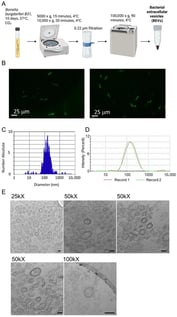
The cause of chronic neurological effects associated with Lyme disease (LD) remains unclear. We propose that bacterial extracellular vesicles (BEVs) released by Borrelia burgdorferi, the causative agent of LD, exacerbate spirochete-induced damage and serve as a persistent source of antigenic stimulation. We showed that, over a 10-day period, in vitro cultures of B. burgdorferi B31 produced 38,000 BEVs per spirochete with a distinctive double-membrane structure and median diameter of 143.3 nm. BEVs contained known immunogenic and immunomodulatory molecules such as peptidoglycan, p66, flagellar filament protein (FlaB), basic membrane proteins A/B/D, BdrV, GroEL, CRASP-1, ErpA8, glycerophosphodiester phosphodiesterase, p37, OMS28, p13, OspA/B/C, VlsE, and outer membrane glycolipids (e.g., cholesteryl 6-O acyl beta D galactopyranoside). Chromosome-encoded 16S ribosomal RNA and cp32 plasmid-encoded OspE and terminase genes were also detected in the BEVs. Of the 45 Borrelia proteins identified in the urine of a C3H/HeJ murine model of Lyme disease, 14 were associated with BEVs. In human urine samples, 31 of 289 spirochete proteins detected in patients with either acute Lyme disease or persistent borreliosis post-treatment symptoms, including p66 and FlaB, were also BEV-associated. BEV treatment of HMC3 human microglial cells reduced phagocytic activity and triggered aberrant activation of inflammatory and immunometabolic pathways, including upregulation of interferon-alpha (IFN-α), aconitate decarboxylase 1 (Acod1), and Toll-like receptor 2 (TLR2) gene expression. BEVs also induced NRF2 nuclear translocation. In conclusion, these findings support that BEVs can amplify spirochete-induced damage and act as antigenic debris, driving dampened phagocytic activity and dysregulated inflammation, with implications for diagnostics and therapeutics targeting vesicle-mediated pathology.
7 March 2026