Skip to Content
  • 2.9
    Impact Factor
  • 4.6
    CiteScore
  • 18 days
    Submission to First Decision
  • 3 days
    Acceptance to Publication

Medicina

Medicina is an international, peer-reviewed, open access journal covering all problems related to medicine, published monthly online. It is the official journal of the Lithuanian University of Health Sciences (LUHS). The Lithuanian Medical Association (LMA), Vilnius University, Rīga Stradiņš University, University of Latvia, and University of Tartu are affiliated with Medicina, serving as their official journal. Members of these organizations receive discounts on the article processing charges.
  • Open Access— free for readers, with article processing charges (APC) paid by authors or their institutions.
  • High Visibility: indexed within Scopus, SCIE (Web of Science), PubMed, MEDLINE, PMC, and other databases.
  • Journal Rank: JCR - Q1 (Medicine, General and Internal) / CiteScore - Q1 (General Medicine)
  • Rapid Publication: manuscripts are peer-reviewed and a first decision is provided to authors approximately 17.4 days after submission; acceptance to publication is undertaken in 2.8 days (median values for papers published in this journal in the first half of 2026).
  • Recognition of Reviewers: Reviewers whose reports are timely and of high quality receive an APC discount voucher for a future publication in an MDPI journal. Become a reviewer.

Get Alerted

Add your email address to receive forthcoming issues of this journal.

All Articles (14,380)

  • Systematic Review
  • Open Access

Background and Objectives: Experimental studies suggest that melatonin can influence antioxidant, inflammatory, mitochondrial, and chronobiological pathways relevant to musculoskeletal degeneration, repair, and selected spine-related conditions, but clinical translation remains uncertain. This systematic review evaluated primary in vitro, animal, and human evidence concerning exogenous parent melatonin in these conditions. Materials and Methods: PubMed/MEDLINE and Europe PMC were searched from inception to 6 August 2026; ClinicalTrials.gov was mapped separately. Eligible reports were peer-reviewed comparative primary investigations. One reviewer performed screening, extraction, and a screen-level methodological limitation assessment, followed by a complete consistency pass; no automation tools were used. Complete articles were consulted where accessible, but access status was not logged prospectively and the exact number accessed cannot be reconstructed reliably. Because quantitative pooling was not appropriate, evidence was synthesized by stream and clinical domain according to PRISMA 2020 and SWiM. The review was not registered, and no standalone protocol was prepared. Results: The searches yielded 3201 records and 1646 unique records after deduplication. Of 437 reports taken forward for retrieval and report-level assessment using available information, 208 were included (23 in vitro, 142 animal, and 43 human reports). Preclinical studies generally reported osteogenic, chondroprotective, antioxidant, anti-inflammatory, mitochondrial, and tissue-repair effects, but findings were not uniformly favorable: high-dose fracture-remodeling impairment and MT2-dependent heterotopic ossification were reported. Human evidence was limited, heterogeneous, and showed frequent screen-level methodological limitations. Formulations, routes, and exposures were non-equivalent. Conclusions: Melatonin is biologically plausible but clinically unproven in the reviewed conditions. No formulation, dose, or route can presently be recommended for disease modification, neurological recovery, or tissue regeneration.

Medicina

9 October 2026

PRISMA 2020 study-selection flow diagram for the bibliographic search completed on 6 August 2026. The report was the unit of synthesis. The 437 reports retained after initial screening were taken forward for retrieval and report-level assessment using complete articles where accessible and indexed information otherwise. Complete-article access status was not logged prospectively; the exact numbers retrieved and not retrieved cannot be reconstructed reliably, and indexed-only assessment is not equivalent to full-text assessment. ClinicalTrials.gov records were mapped in parallel and were not treated as efficacy evidence unless a peer-reviewed report independently met the review criteria. Reporting framework: PRISMA 2020 [37].
  • Article
  • Open Access

Beyond Cardiorenal Risk Factors: The Prognostic Role of Frailty in Acute Heart Failure

  • Georgios Aletras,
  • Maria Marketou and
  • Konstantinos Stylianou
  • + 6 authors

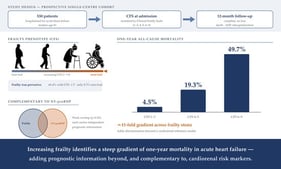
Background: Frailty is highly prevalent in acute heart failure (AHF), yet whether it is more strongly associated with all-cause mortality or with non-fatal heart-failure events, and whether it adds information beyond cardiac severity, is seldom examined. Methods: In a prospective single-center registry of 530 consecutive patients hospitalized for AHF (February 2023–June 2025), frailty was graded at admission by the Clinical Frailty Scale (CFS; strata 1–3, 4–5, 6–9, and CFS ≥ 5) from patient and collateral history. The primary outcome was 12-month all-cause mortality; first AHF rehospitalization was analyzed with death and renal replacement therapy (RRT) as competing events, using Aalen–Johansen cumulative incidence and cause-specific and Fine–Gray models. Incremental value was tested against a cardiorenal model (age, log NT-proBNP, admission estimated glomerular filtration rate and left ventricular ejection fraction [LVEF]). Results: Frailty was highly prevalent (CFS ≥ 5, 66.4%) and was associated with older age, female sex, renal impairment, right heart failure, multivalvular disease and higher, rather than lower, LVEF. Mortality rose steeply across strata (4.5%, 19.3%, 49.7%; hazard ratio 3.29 per stratum, 95% CI 2.43–4.45), whereas the cumulative incidence of first AHF rehospitalization rose less steeply (4.5%, 29.2%, 33.0%; cause-specific hazard ratio 1.86, 95% CI 1.42–2.45; subdistribution hazard ratio 1.51, 95% CI 1.19–1.92). Frail patients with below-median NT-proBNP had mortality comparable to that of patients with CFS < 5 and above-median NT-proBNP (24.3% vs. 22.0%). Adding CFS to the cardiorenal model improved discrimination (C-index 0.701 → 0.734; optimism-corrected 0.694 → 0.726; apparent ΔC-index 0.033, 95% CI 0.007–0.063) and fit (likelihood-ratio χ2 = 27.7, p < 0.001). Discharge prescription of disease-modifying therapy declined with increasing frailty. Conclusions: In elderly patients with AHF, frailty was more strongly associated with all-cause mortality than with documented non-fatal AHF rehospitalization, carried prognostic information complementary to natriuretic peptides, and added discrimination beyond cardiorenal variables, supporting structured frailty assessment alongside heart-failure-directed therapy.

Medicina

8 October 2026

Study flow and analysis populations. AHF, acute heart failure; ACS, acute coronary syndrome; HFrEF, heart failure with reduced ejection fraction; LVEF, left ventricular ejection fraction; RRT, renal replacement therapy; STEMI, ST-elevation myocardial infarction. The competing-risks analysis of first AHF rehospitalization used the full cohort (n = 530); n = 366 denotes only the survivor subset used for the descriptive post-discharge rehospitalization and emergency-department analyses.
  • Article
  • Open Access

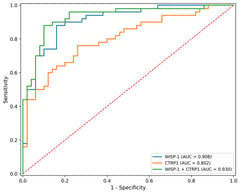
Background and Objectives: Gestational diabetes mellitus (GDM) is characterized by insulin resistance and metabolic dysregulation, in which adipokines may be involved. We evaluated serum Wnt1-inducible signaling pathway protein-1 (WISP-1/CCN4) and C1q/TNF-related protein-1 (CTRP1) in women with GDM and normal glucose tolerance and assessed their relationships with glucose–insulin homeostasis and cross-sectional discriminatory ability. Materials and Methods: This exploratory cross-sectional biomarker study with prospective obstetric follow-up included 100 pregnant women at 24–28 weeks of gestation (50 GDM and 50 controls). WISP-1, CTRP1, HOMA-IR, and GDM status were assessed during the same gestational period; therefore, the principal biomarker analyses were cross-sectional. GDM was diagnosed using the one-step 75-g oral glucose tolerance test criteria recommended by the American Diabetes Association Standards of Care 2026. WISP-1 and CTRP1 were measured by ELISA. Group comparisons, correlation analyses, ROC analyses, nested logistic regression, and bootstrap internal validation were performed. Results: WISP-1 was higher in GDM than in controls (422.80 [387.10–471.85] vs. 315.00 [288.30–351.55] pg/mL; p < 0.001), as was CTRP1 (34.13 ± 6.74 vs. 26.50 ± 5.65 ng/mL; p < 0.001). WISP-1 showed a higher apparent AUC than CTRP1 in the present cohort (0.908 vs. 0.802; DeLong p = 0.034). In the final model adjusted for maternal age and BMI, both WISP-1 (adjusted OR per 1-SD increase 7.53, 95% CI 2.95–19.21; p < 0.001) and CTRP1 (3.61, 95% CI 1.45–8.99; p = 0.006) remained associated with GDM status after adjustment for these covariates. Within GDM, the age- and BMI-adjusted association between WISP-1 and HOMA-IR remained significant (partial ρ = 0.574; p < 0.001), whereas CTRP1 was not associated with HOMA-IR. Conclusions: WISP-1 and CTRP1 were elevated in GDM, with WISP-1 showing a stronger association with HOMA-IR and a higher internally derived AUC in this cohort. These findings support further investigation of WISP-1 and CTRP1 as exploratory metabolic biomarkers associated with GDM but do not establish diagnostic or predictive utility. Independent external validation is required before any potential clinical application.

Medicina

8 October 2026

ROC curves of WISP-1, CTRP1, and the combined WISP-1 + CTRP1 model for discrimination of GDM. ROC curves of WISP-1, CTRP1, and the combined WISP-1 + CTRP1 model for discrimination of GDM. The red dotted diagonal line represents the reference line for no discriminatory ability (AUC = 0.50).
  • Article
  • Open Access

Diagnostic Yield of Internal Medicine Referrals to Rheumatology: A Retrospective Single-Center Study

  • Pınar Akyüz Dağlı,
  • Berkan Armağan and
  • Hakan Babaoğlu
  • + 16 authors

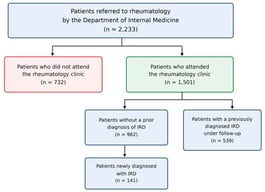
Background and Objectives: In Turkey, access to adult rheumatology outpatient clinics requires referral from another specialty, mostly internal medicine, and no standardized referral algorithms are in use. We estimated the diagnostic yield of new inflammatory rheumatic disease (IRD) diagnoses among internal medicine referrals who completed rheumatology evaluation and identified referral-stage characteristics associated with a new IRD diagnosis. Materials and Methods: In this retrospective cohort study, 2233 patients referred from internal medicine clinics to rheumatology outpatient clinics between 1 September and 30 November 2022 were screened. Patients with a prior diagnosis of IRD (n = 539) and those who did not attend their scheduled appointment (n = 732) were excluded, leaving 962 patients who completed rheumatology evaluation for analysis. Findings documented at referral were compared between patients with and without a new IRD diagnosis, and associations were examined with a clinically selected multivariable logistic regression model without laboratory variables, because laboratory tests had been ordered selectively. Results: Among the 962 patients who completed rheumatology evaluation, 141 (14.6%) received a new IRD diagnosis, corresponding to 6.3% of all 2233 referrals; the diagnostic status of the 732 patients who did not attend is unknown. In the multivariable model, swollen and tender joints were associated with a new IRD diagnosis (odds ratio [OR] 5.24, 95% confidence interval [CI] 3.17–8.68), whereas sicca symptoms (OR 1.45, 95% CI 0.83–2.55) and constitutional symptoms (OR 1.66, 95% CI 0.76–3.64) were not independently associated. Conclusions: Among patients referred from internal medicine to a tertiary rheumatology clinic who completed evaluation, approximately one in seven received a new IRD diagnosis. Referral appropriateness was not assessed, and the high non-attendance rate limits generalization to all referrals. Swollen and tender joints were the only referral characteristic independently associated with a new diagnosis. Whether structured referral criteria, medical education, or triage strategies improve the yield of referrals is a hypothesis for prospective evaluation.

Medicina

8 October 2026

Flowchart of patients included in the study.  IRD: Inflammatory rheumatic disease.

Highly Accessed Articles

News & Conferences

Latest Issues

Open for Submission

Journal Sections

Chronic Respiratory Diseases
Reprint

Chronic Respiratory Diseases

Updates on Pathophysiology, Symptoms, Diagnosis and Treatment
Editors: Marcin Kurowski, Laura Malinauskienė, Corrado Pelaia
XFacebookLinkedIn
Medicina - ISSN 1648-9144