




You are currently viewing a new version of our website. To view the old version click .

Materials

Materials is an international peer-reviewed, open access journal on materials science and engineering published semimonthly online by MDPI.
The Spanish Materials Society (SOCIEMAT), Manufacturing Engineering Society (MES) and Chinese Society of Micro-Nano Technology (CSMNT) are affiliated with Materials and their members receive discounts on the article processing charges.
Indexed in PubMed | Quartile Ranking JCR - Q2 (Metallurgy and Metallurgical Engineering | Physics, Applied | Physics, Condensed Matter)

All Articles (54,122)

The widespread application of Rhodamine B (RhB) poses a serious threat to the aquatic environment. ZnFe2O4, as a catalyst material, can effectively activate persulfate (PMS) and respond to visible light, thus effectively degrading RhB with the joint assistance of sunlight and PMS. This study recovered Fe2O3 from high-iron coal gangue through an activating–acid leaching–extracting–back-extracting process and synthesized ZnFe2O4 catalysts (CG-ZFO) using coal gangue back-extraction liquid as the Fe source by a hydrothermal method and cetyltrimethylammonium bromide (CTAB)-assisted hydrothermal method. The characterization results of X-ray diffraction (XRD), scanning electron microscopy (SEM), and diffuse reflectance spectroscopy (DRS) showed that the CG-ZFO has a pure crystal phase, and the addition of CTAB can effectively improve the photoelectric performance of the catalyst. The synthesized CG-ZFO can produce a significant synergistic effect with simulated sunlight (SS) and PMS, and the constructed SS/CG-ZFO/PMS system had a good degradation effect on RhB. Based on the conclusions of free radical-quenching experiments, electron paramagnetic resonance (EPR) spectroscopy, and X-ray photoelectron spectroscopy (XPS), the main active species in the SS/CG-ZFO/PMS system was identified as 1O2, and the degradation mechanism of RhB was elucidated. CG-ZFO prepared from coal gangue holds promising potential for application in the remediation of organic dye wastewater, and this study also provides a new approach for the resource regeneration of high-iron coal gangue.

2 January 2026

Flowchart of coal gangue resource utilization.

This study evaluates an integrated approach for recovering lead and silver from lead cake through chlorination roasting followed by acid leaching. The lead cake originates from sulfuric acid leaching of zinc ferrite residues obtained during the hydrometallurgical processing of zinc calcine. The effects of roasting temperature, lead cake-to-NaCl mass ratio, and roasting duration on metal recovery were systematically examined to determine optimal process conditions. Based on the experimental results, roasting at 550 °C for 1.5 h with a lead cake-to-NaCl mass ratio of 1:3, followed by leaching in 1 M HCl, was selected as a representative and sufficiently effective condition for the combined process. Under these conditions, nearly complete dissolution of Pb and Ag was achieved, reducing their contents in the final solid residue to 0.90% and 0.0027%, respectively. Compared to direct chloride leaching, the combined process provided higher extraction efficiencies (Pb 98.67%, Ag 98.09%) and a lower final residue mass (34% vs. 45%). The roasting step enables the solid-state conversion of PbSO4 into highly soluble chloride phases (PbCl2 and Pb(OH)Cl), while ZnFe2O4, Fe2O3 and SiO2 remain stable and form the inert matrix of the residue. Acid leaching at a lower solid-to-liquid ratio (1:10) ensures near-complete dissolution of Pb and Ag, whereas aqueous leaching at a high ratio (1:100) results in incomplete Pb removal. The compliance leaching test (EN 12457-2) confirmed that the residue produced after the optimized two-step treatment meets the EU criteria for inert waste. Overall, the proposed combined process enhances Pb and Ag recovery, minimizes environmental risk, and offers a technically robust and sustainable route for treating lead-containing industrial residues.
2 January 2026

The structure and properties of coke are of significant importance in the metallurgical industry. Coke samples were prepared from different bituminous coals at varying temperatures using a one-sided heating furnace. The evolution of carbon structure during the coking process was investigated by X-ray diffraction (XRD) and Raman spectroscopy. The correlations between carbon structure parameters and the properties of the coal and coke were investigated during coke formation. The results indicated that with increasing temperature, the values of La, Lc, N, n, and fa were increased, while the d002 values decreased. The La/Lc ratio was expanded twice more than raw coal due to condensation and cross-linking reactions, indicating compaction of the carbon structure and the formation of larger aromatic units. A negative correlation was observed between Lc and the Coke Reactivity Index (CRI), whereas a positive correlation was found between La and Coke Strength after Reaction (CSR), which mean that coke properties improve with increasing Lc. Specifically, when Lc exceeds 2.4 nm, and La lies between 5 and 5.5 nm, the coke exhibits higher quality. The quality of coke is strongly affected by the structural evolution of carbon during the coal coking process.

2 January 2026

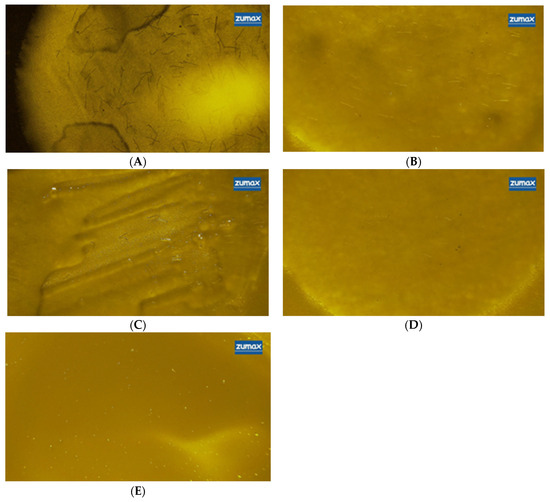
Polyurethane (PU) is widely recognized for its efficient oil sorption properties. However, this capacity is highly dependent on its intrinsic chemical composition and morphological structure, which can be altered by mechanical or chemical treatments commonly applied before using it as a sorbent. In this study, we present a comprehensive investigation of the oil sorption behavior of both soft and rigid PU foams, and their blade-milled ground (BMG) counterparts obtained by mechanical treatment of several recycled PU-based products, including seats, mattresses, side panels of cars, packaging components, and insulating panels of refrigerators and freezers. We found that blade milling the soft PU foams leads to a significant reduction in oil sorption capacity proportional to the extent of grinding. Pristine soft PU foams and BMG-PUs with intermediate particle size (−250 μm–1 mm) exhibited the highest oil uptake (20–30 g/g), whereas the finest fraction (5 μm–250 μm) showed a lower capacity (3–7 g/g). In contrast, rigid PU foams showed consistently low oil sorption (~5 g/g), with negligible differences between the original and ground materials. At the macroscopic level, optical and morphological analyses revealed the collapse of the 3D porous network and a reduction in surface area. On the microscopic scale, spectroscopic, structural, and thermal analyses confirmed phase separation and rearrangement of hard and soft segmented domains within the polymer matrix, suggesting a different mechanism for oil sorption in BMG-PU. Despite reduced performance compared to pristine foams, BMG-PU powders, especially those with intermediate dimensions and originating from soft PU foams, present a viable, low-cost, and sustainable alternative for oil sorption applications, including oil spill remediation, while offering an effective strategy for effective recycling of PU foam wastes.
2 January 2026

News & Conferences

Issues

Open for Submission

Editor's Choice

Reprints of Collections

Advances in Computation and Modeling of Materials Mechanics
Reprint

Advances in Computation and Modeling of Materials Mechanics

Editors: Hai Huang, Abduljabar Alsayoud, Yucheng Lan
Recent Researches in Polymer and Plastic Processing
Reprint

Recent Researches in Polymer and Plastic Processing

Editors: Joanna Izdebska-Podsiadły

Get Alerted

Add your email address to receive forthcoming issues of this journal.

XFacebookLinkedIn
Materials - ISSN 1996-1944