
Skip to Content
  • 3.7
    Impact Factor
  • 7.0
    CiteScore
  • 15 days
    Submission to First Decision
  • 4 days
    Acceptance to Publication

Materials

Materials is an international peer-reviewed, open access journal on materials science and engineering published semimonthly online by MDPI. The Spanish Materials Society (SOCIEMAT), Manufacturing Engineering Society (MES) and Chinese Society of Micro-Nano Technology (CSMNT) are affiliated with Materials and their members receive discounts on the article processing charges.

Get Alerted

Add your email address to receive forthcoming issues of this journal.

All Articles (58,698)

  • Article
  • Open Access

Rheological Properties of Selected Copper Alloys in Liquid and Semi-Solid State

  • Arkadiusz Madetko,
  • Platon Kapranos and
  • Krzysztof Sołek

The analysis of rheological properties provides information that allows the potential for the practical application of metal alloys to be determined and to effectively design their shaping with the use of advanced engineering modelling. The paper presents an analysis of the basic rheological properties of selected copper alloys, CuSn10 and CuAl10Fe3Mn2, in the liquid and semi-solid states. The analysis was based on viscosity measurements and rheological modelling. The measurements were carried out using a high-temperature rheometer with the Searle method. The research described in this article was undertaken to provide data for assessing the potential of using thixoforming technologies to shape copper matrix alloys; research data in this field are insufficient and information in the literature is also limited. The analysis carried out includes the complex characterisation of viscosity in terms of the influence of temperature, strain rate and time. The results were enriched with rheological models that can be used in simulation studies.

Materials

8 November 2026
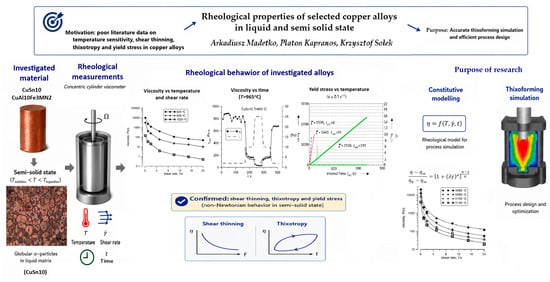
Comparison of viscosity as a function of temperature obtained by calculations using ProCAST software (a,c) and from experimental measurements (b,d) for CuSn10 and CuAl10Fe3Mn2 alloys.
  • Article
  • Open Access

Collagen Coatings on Titanium: Comparative Study of Electrochemical and Chemical Formation

  • Marin Hodalj,
  • Ines Despotović and
  • Željka Petrović
  • + 4 authors

This study investigates the influence of two collagen coating formation approaches, self-assembly and electrochemical formation by cyclic voltammetry, on the surface properties and electrochemical behavior of titanium (Ti). Collagen-modified Ti surfaces were characterized before and after 7 days of immersion in Fusayama artificial saliva using attenuated total reflectance Fourier-transform infrared spectroscopy, field emission scanning electron microscopy coupled with energy-dispersive X-ray spectroscopy, X-ray diffraction, and electrochemical impedance spectroscopy. Self-assembly produced a continuous collagen layer, whereas cyclic voltammetry generated a fibrillar coating. During immersion, calcium phosphate (CaP) deposits formed on both collagen-modified surfaces, but with distinctly different spatial organization. The self-assembled coating underwent reorganization, whereas the electrochemically formed coating retained its fibrillar framework closely associated with the CaP deposits. This organic–inorganic architecture was accompanied by enhanced electrochemical barrier properties after 7 days compared with the self-assembled coating. Density functional theory calculations further showed that one-electron oxidation of an adsorbed collagen-model tripeptide induces pronounced structural rearrangement, providing molecular-level insight into the redox response of collagen-derived species at the TiO2 interface. In addition, prolonged exposure of Ti surfaces to cell culture media resulted in negligible Ti release, while the resulting conditioned media did not reduce the metabolic viability of HGF-1 or MG-63 cells under the investigated conditions, supporting favorable indirect in vitro cytocompatibility.

Materials

8 November 2026

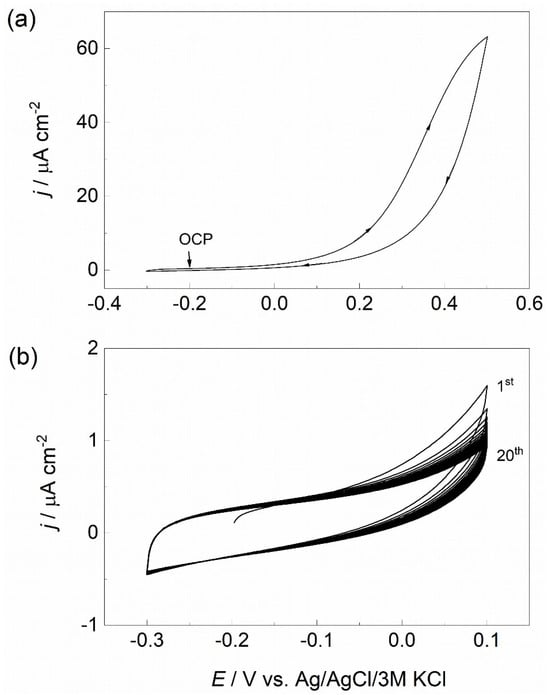
Cyclic voltammetric responses of Ti in the HC solution: (a) cyclic voltammogram recorded over a wider potential range at a scan rate of 50 mV s−1; (b) evolution of the cyclic voltammetric response during 20 cycles within the selected coating-formation potential range at a scan rate of 10 mV s−1.
  • Article
  • Open Access

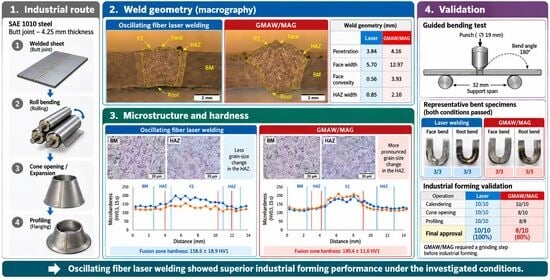
This study evaluates oscillating fiber laser welding as an alternative to gas metal arc welding with an active shielding gas (GMAW/MAG) for manufacturing 4.25 mm thick SAE 1010 agricultural wheel rims. A systematic product development approach guided technology selection. The comparison included process energy, weld geometry, microstructure, grain size, Vickers microhardness, guided-bend testing, and industrial forming. Estimated GMAW/MAG heat input was 0.64 kJ/mm, whereas nominal incident laser energy was 0.019 kJ/mm; these quantities do not represent equivalent measurements of absorbed heat. Measurements from one transverse cross-section per welding condition showed a smaller weld-face width (5.70 vs. 12.97 mm), lower convexity (0.56 versus 3.93 mm), and a narrower heat-affected zone (0.85 versus 2.10 mm) for laser welding compared with GMAW/MAG. Less grain coarsening was observed in the laser-welded heat-affected zone. Mean fusion-zone hardness was 158.6 ± 18.9 HV1 for laser welding and 190.4 ± 11.0 HV1 for GMAW/MAG. Both conditions passed the guided-bend tests. All ten laser-welded specimens completed industrial forming, whereas two of ten GMAW/MAG specimens fractured during cone opening. The examined laser-welded cross-section exhibited a narrower weld profile than the examined GMAW/MAG cross-section. The laser-welding manufacturing route also eliminated the post-weld grinding operation under the investigated conditions.

Materials

8 November 2026

Schematic representation of the oscillating fiber laser welding process adopted in this study.
  • Article
  • Open Access

A parametric finite element (FE) framework incorporating a finite-thickness equivalent bonding layer is developed for cold roll-beating of explosively bonded Fe/Al layered composites. The equivalent layer thickness is identified from interfacial characterization and the through-thickness microhardness gradient, while its quasi-static and strain-rate-dependent response is determined from nanoindentation, compression, split Hopkinson pressure bar tests, and inverse FE identification. The resulting properties are assigned to a three-layer FE model comprising the steel clad, equivalent bonding layer, and aluminum substrate. Experimental validation gives mean absolute relative errors of 8.35% and 6.20% for forming-force prediction in the spindle-speed and feed-speed series, respectively, and a mean profile normalized root-mean-square error (NRMSE) of 3.27% across six validation conditions. These errors are consistently lower than those of the simplified bilayer model. With increasing spindle speed, the peak forming force first increases slightly and then decreases, while the tooth root deepens and material pile-up increases. Increasing feed speed from 100 to 225 mm/min raises the predicted peak forming force from 13.62 to 14.98 kN but produces a shallower profile. These different trends indicate that peak force reflects local deformation resistance, whereas the final profile is governed mainly by plastic deformation accumulated over successive engagements.

Materials

8 November 2026

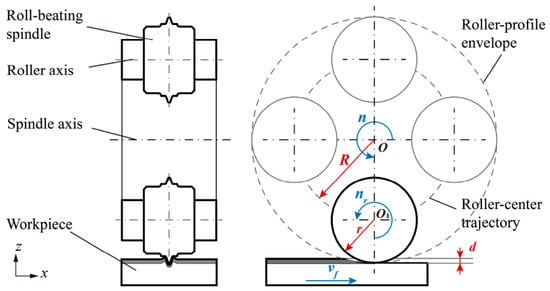
Kinematic relationships and control parameters for cold roll-beating of explosively bonded layered composites.

Highly Accessed Articles

News & Conferences

Latest Issues

Open for Submission

Journal Sections

XFacebookLinkedIn
Materials - ISSN 1996-1944