Luminescent Materials
Share This Topical Collection
Editor
 Prof. Dr. Hubertus Hintzen
Prof. Dr. Hubertus Hintzen
E-Mail
Website
Collection Editor
Group Luminescent Materials, Section Fundamental Aspects of Materials and Energy, Faculty of Applied Sciences, Delft University of Technology, Delft, The Netherlands
Interests: nitride; phosphor; luminescence; optical properties
Special Issues, Collections and Topics in MDPI journals
Topical Collection Information
Dear Colleagues,
After publishing several successful Special Issues on Luminescent Materials, we would like to announce the start of the publication of a collection on Luminescent Materials. The objective is to highlight the progress and prospects of curiosity-driven academic research on novel phosphor materials with new or improved properties, as well as of innovative developments of industrial applications, in particular in emerging fields of energy, mobility, health, food and security. By discussing the new results in the context of known information, the publication is not only helpful as a tutorial introduction for novices in the field, but also serves as an updated overview for those who are more experienced. Therefore, review publications on experimental or theoretical studies of different types of luminescent materials (powders, nano-particles, ceramics, thin films, single crystals, glasses) are of special interest. Because of the multidisciplinary nature of the discussed topics, the publications will be of interest to solid state chemists and spectroscopic physicists, as well as to materials scientists and engineers.
Other editions of “Luminescent Materials”
Techniques and Methods for Advanced Characterization of Luminescent Materials Luminescent Materials 2013
Luminescent Materials
Prof. Hubertus Hintzen
Guest Editor
Manuscript Submission Information
Manuscripts should be submitted online at www.mdpi.com by registering and logging in to this website. Once you are registered, click here to go to the submission form. All submissions that pass pre-check are peer-reviewed. Accepted papers will be published continuously in the journal (as soon as accepted) and will be listed together on the collection website. Research articles, review articles as well as short communications are invited. For planned papers, a title and short abstract (about 250 words) can be sent to the Editorial Office for assessment.
Submitted manuscripts should not have been published previously, nor be under consideration for publication elsewhere (except conference proceedings papers). All manuscripts are thoroughly refereed through a single-blind peer-review process. A guide for authors and other relevant information for submission of manuscripts is available on the Instructions for Authors page. Materials is an international peer-reviewed open access semimonthly journal published by MDPI.
Please visit the Instructions for Authors page before submitting a manuscript.
The Article Processing Charge (APC) for publication in this open access journal is 2600 CHF (Swiss Francs).
Submitted papers should be well formatted and use good English. Authors may use MDPI's
English editing service prior to publication or during author revisions.
Keywords
- luminescent material, phosphor
- luminescence, fluorescence, phosphorescence
- photoluminescence, cathodoluminescence, electroluminescence, X-ray luminescence, mechanoluminescence, triboluminescence, persistent luminescence
- spectroscopy
Published Papers (6 papers)
Open AccessFeature PaperEditor’s ChoiceArticle
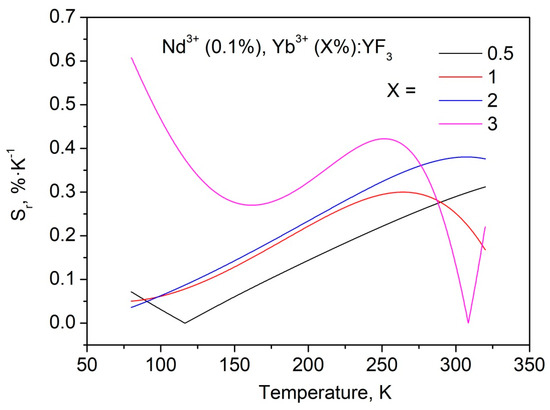
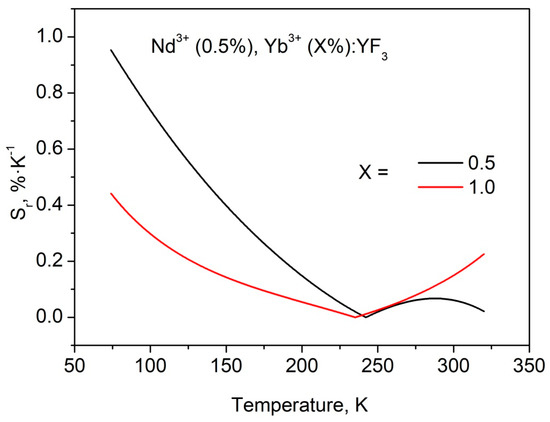
Nd3+, Yb3+:YF3 Optical Temperature Nanosensors Operating in the Biological Windows
by
Maksim Pudovkin, Ekaterina Oleynikova, Airat Kiiamov, Mikhail Cherosov and Marat Gafurov
Cited by 14 | Viewed by 2773
Abstract
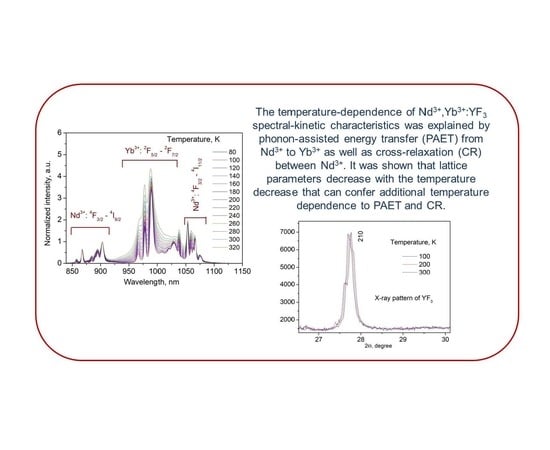
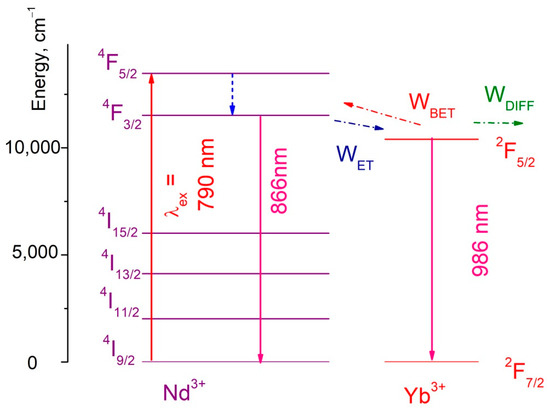
This work is devoted to the study of thermometric performances of Nd
3+ (0.1 or 0.5 mol.%), Yb
3+ (X%):YF
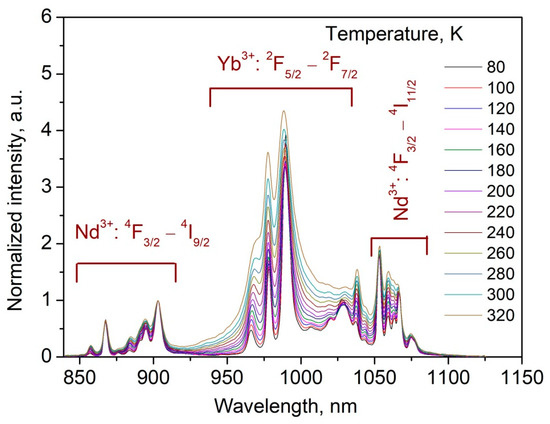
3 nanoparticles. Temperature sensitivity of spectral shape is related to the phonon-assisted nature of energy transfer (PAET) between Nd
3+ and Yb
3+
[...] Read more.
This work is devoted to the study of thermometric performances of Nd
3+ (0.1 or 0.5 mol.%), Yb
3+ (X%):YF
3 nanoparticles. Temperature sensitivity of spectral shape is related to the phonon-assisted nature of energy transfer (PAET) between Nd
3+ and Yb
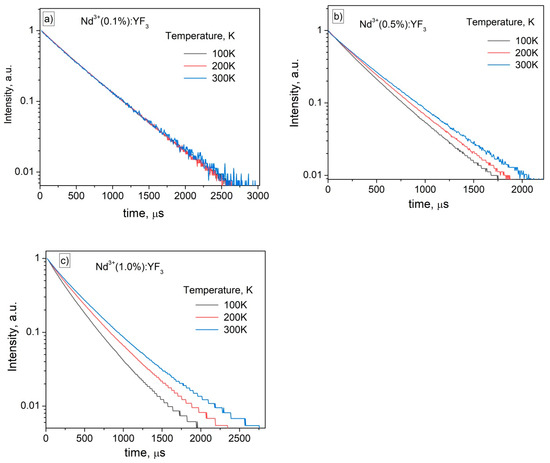
3+). However, in the case of single-doped Nd
3+ (0.1 or 0.5 mol.%):YF
3 nanoparticles, luminescence decay time (LDT) of
4F
3/2 level of Nd
3+ in Nd
3+ (0.5 mol.%):YF
3 decreases with the temperature decrease. In turn, luminescence decay time in Nd
3+ (0.1 mol.%):YF
3 sample remains constant. It was proposed, that at 0.5 mol.% the cross-relaxation (CR) between Nd
3+ ions takes place in contradistinction from 0.1 mol.% Nd
3+ concentration. The decrease of LDT with temperature is explained by the decrease of distances between Nd
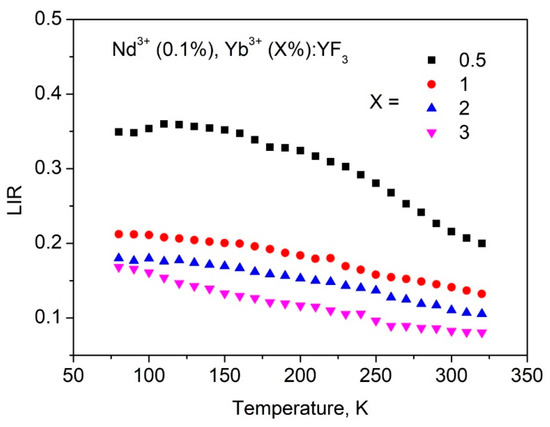
3+ with temperature that leads to the increase of cross-relaxation efficiency. It was suggested, that the presence of both CR and PAET processes in the studied system (Nd
3+ (0.5 mol.%), Yb
3+ (X%):YF
3) nanoparticles provides higher temperature sensitivity compared to the systems having one process (Nd
3+ (0.1 mol.%), Yb
3+ (X%):YF
3). The experimental results confirmed this suggestion. The maximum relative temperature sensitivity was 0.9%·K
−1 at 80 K.
Full article
►▼
Show Figures
Open AccessArticle
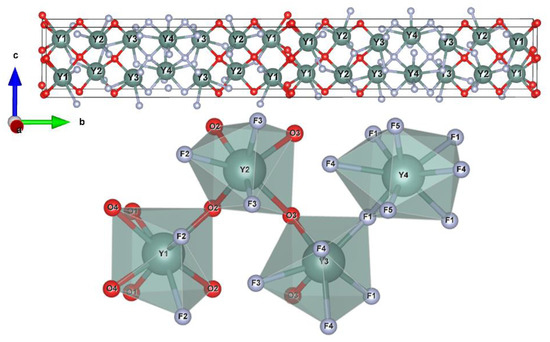
Energy Transfer from Pr3+ to Gd3+ and Upconversion Photoluminescence Properties of Y7O6F9:Pr3+, Gd3+
by
Yang Sun, Yangbo Wang, Chengchao Hu, Xufeng Zhou, Jigong Hao, Wei Li and Huaiyong Li
Cited by 18 | Viewed by 3570
Abstract
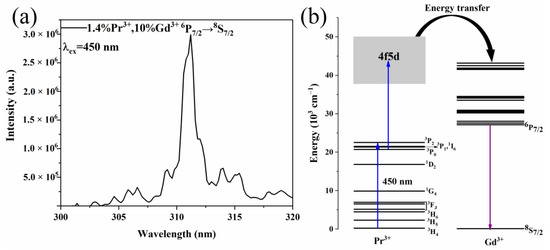
Upconversion materials have numerous potential applications in light energy utilization due to their unique optical properties. The use of visible light excitation to obtain ultraviolet emission is a promising technology with broad application prospects, while relevant research is absent. A series of Pr
[...] Read more.
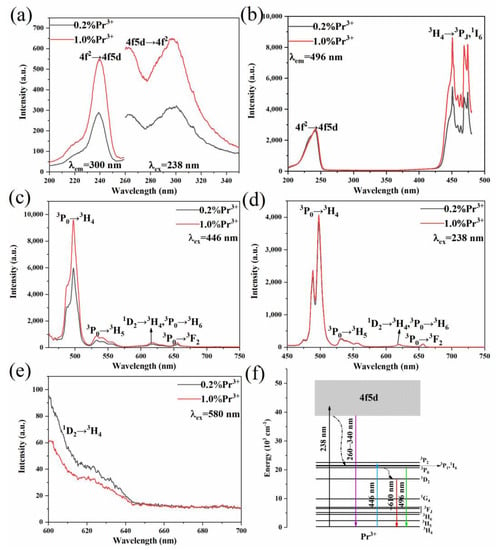
Upconversion materials have numerous potential applications in light energy utilization due to their unique optical properties. The use of visible light excitation to obtain ultraviolet emission is a promising technology with broad application prospects, while relevant research is absent. A series of Pr
3+, Gd
3+ doped Y
7O
6F
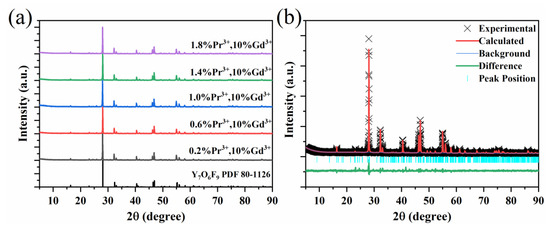
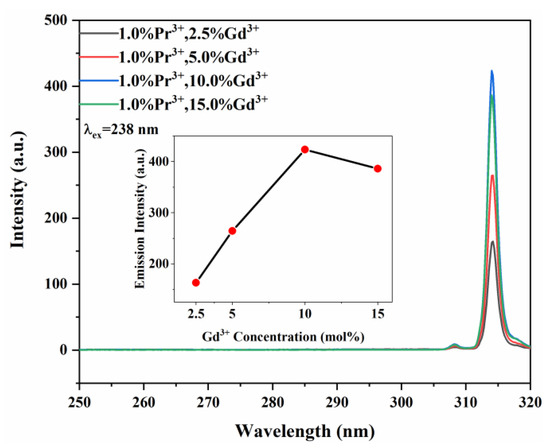
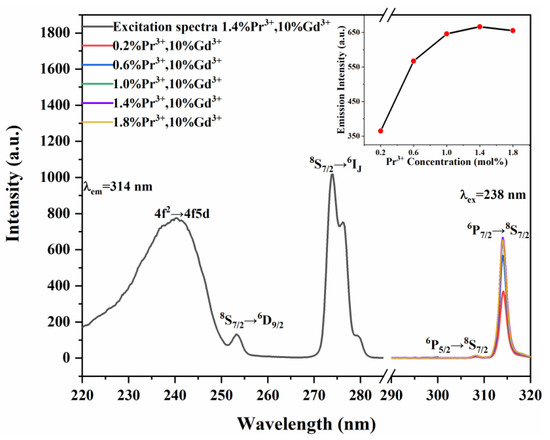
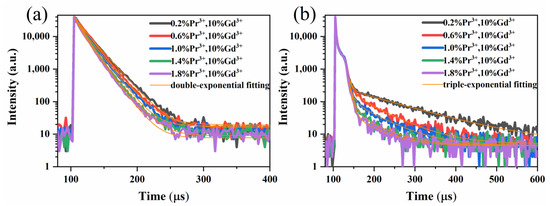
9 phosphors were synthesized by traditional solid–state reaction. X-ray diffraction, scanning electronic microscopy, steady-state photoluminescence spectra, a decay dynamic, and upconversion emission spectra of the samples were studied. Under the excitation of 238 nm, the energy transfer from Pr
3+ to Gd
3+ was realized and a strong ultraviolet B emission due to the
6P
7/2→
8S
7/2 transition of the Gd
3+ ions was achieved. Under the excitation of a 450 nm blue laser, Pr
3+ absorbed two blue photons to realize the upconversion process and then transferred the energy to Gd
3+ to obtain the ultraviolet B emission.
Full article
►▼
Show Figures
Open AccessFeature PaperEditor’s ChoiceArticle
Bright UV-C Phosphors with Excellent Thermal Stability—Y1−xScxPO4 Solid Solutions
by
Dmitry Spassky, Andrey Vasil’ev, Vitali Nagirnyi, Irina Kudryavtseva, Dina Deyneko, Ivan Nikiforov, Ildar Kondratyev and Boris Zadneprovski
Cited by 16 | Viewed by 2564
Abstract
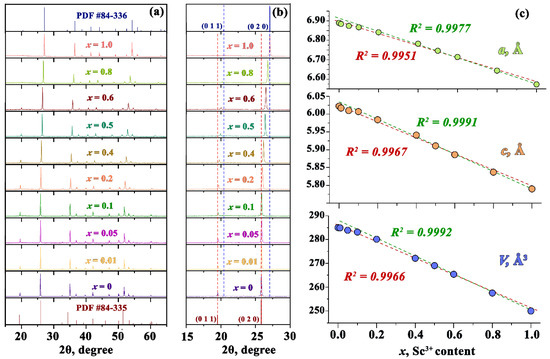
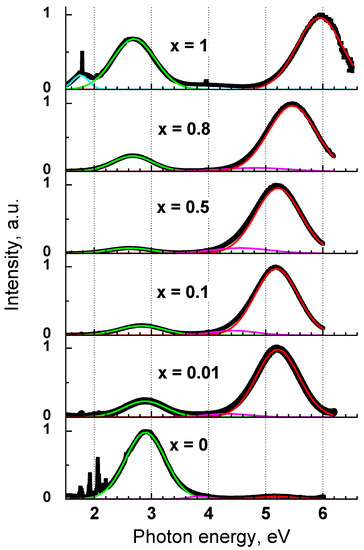
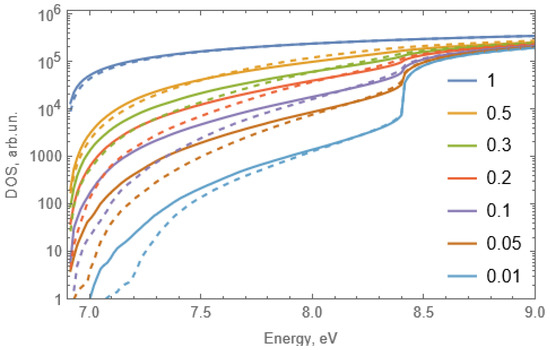
The structural and luminescence properties of undoped Y
1−xSc
xPO
4 solid solutions have been studied. An intense thermally stable emission with fast decay (τ
1/e ~ 10
−7 s) and a band position varying from 5.21 to 5.94 eV
[...] Read more.
The structural and luminescence properties of undoped Y
1−xSc
xPO
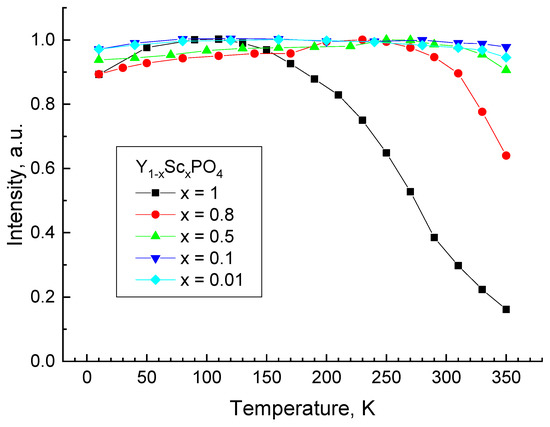
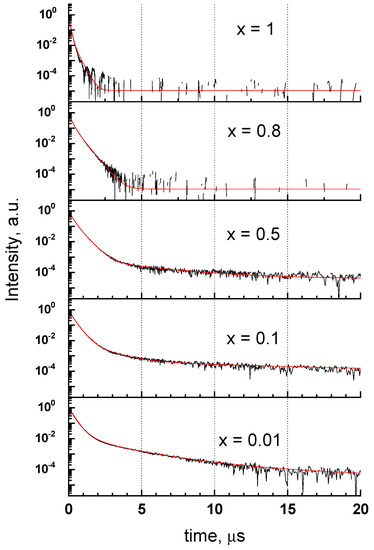
4 solid solutions have been studied. An intense thermally stable emission with fast decay (τ
1/e ~ 10
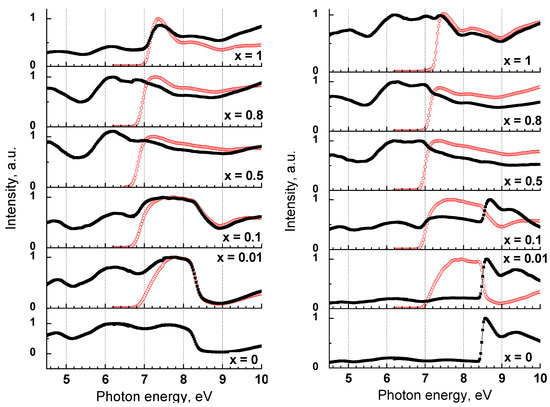
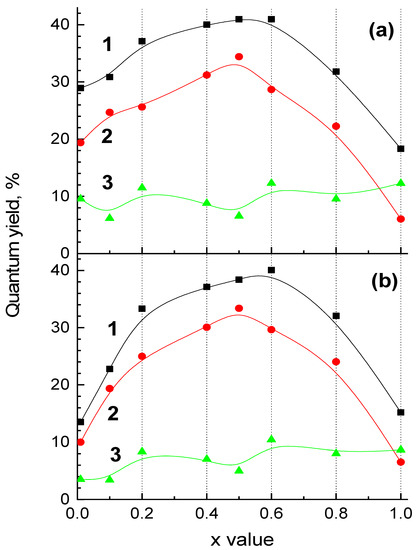
−7 s) and a band position varying from 5.21 to 5.94 eV depending on the Sc/Y ratio is detected and ascribed to the 2p O-3d Sc self-trapped excitons. The quantum yield of the UV-C emission, also depending on the Sc/Y ratio, reaches 34% for the solid solution with
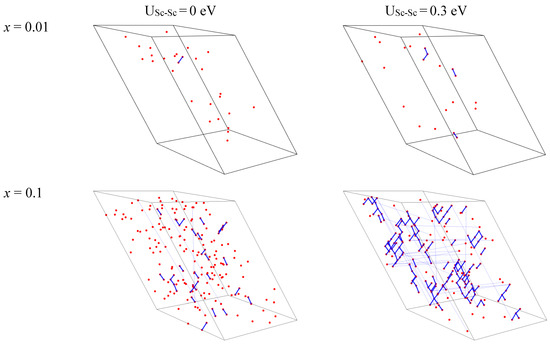
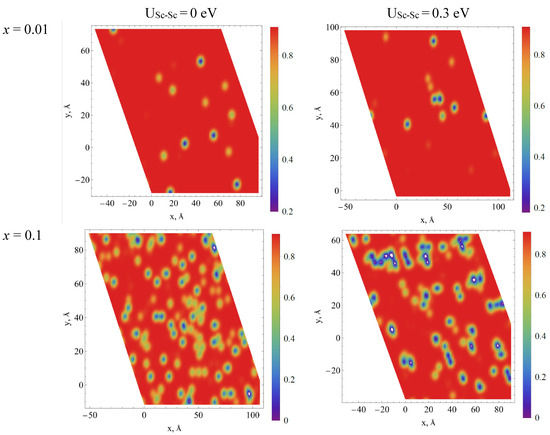
x = 0.5 at 300 K. It is shown by a combined analysis of theoretical and experimental data that the formation of Sc clusters occurs in the solid solutions studied. The clusters facilitate the creation of energy wells at the conduction band bottom, which enables deep localization of electronic excitations and the creation of luminescence centers characterized by high quantum yield and thermal stability of the UV-C emission.
Full article
►▼
Show Figures
Open AccessArticle
Structure and Photoluminescence Properties of Thermally Synthesized V2O5 and Al-Doped V2O5 Nanostructures
by
Chih-Chiang Wang, Chia-Lun Lu, Fuh-Sheng Shieu and Han C. Shih
Cited by 53 | Viewed by 5938
Abstract
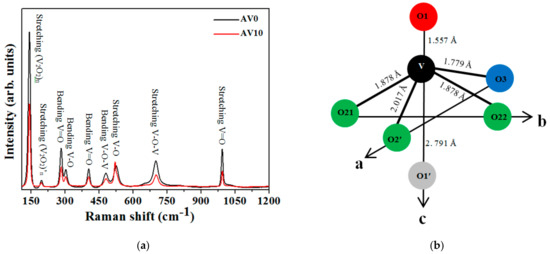
Al-free and Al-doped V
2O
5 nanostructures were synthesized by a thermal-chemical vapor deposition (CVD) process on Si(100) at 850 °C under 1.2 × 10
−1 Torr via a vapor-solid (V-S) mechanism. X-ray diffraction (XRD), Raman, and high-resolution transmission electron microscopy (HRTEM)
[...] Read more.
Al-free and Al-doped V
2O
5 nanostructures were synthesized by a thermal-chemical vapor deposition (CVD) process on Si(100) at 850 °C under 1.2 × 10
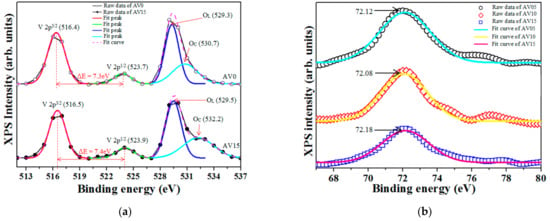
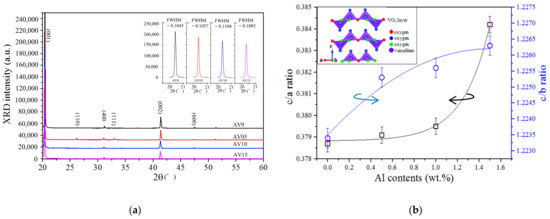
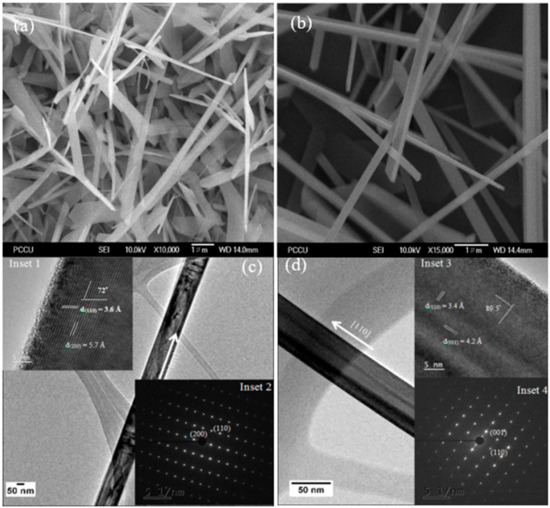
−1 Torr via a vapor-solid (V-S) mechanism. X-ray diffraction (XRD), Raman, and high-resolution transmission electron microscopy (HRTEM) confirmed a typical orthorhombic V
2O
5 with the growth direction along [110]-direction of both nanostructures. Metallic Al, rather than Al
3+-ion, was detected by X-ray photoelectron spectroscopy (XPS), affected the V
2O
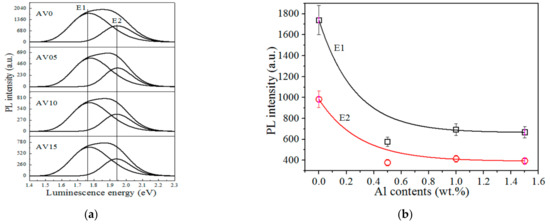
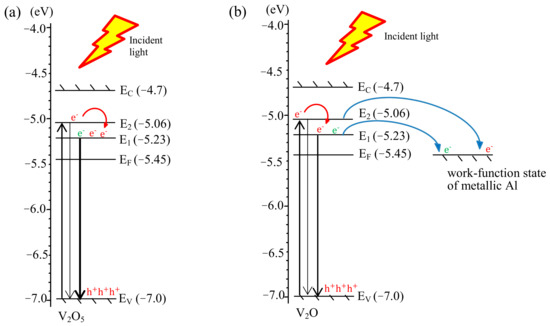
5 crystallinity. The photoluminescence intensity of V
2O
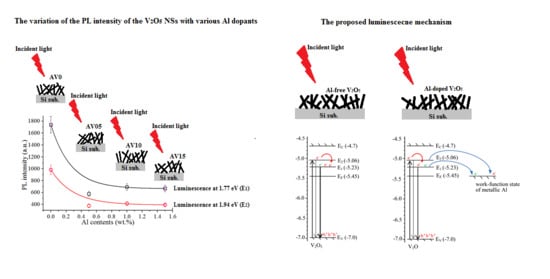
5 nanostructure at 1.77 and 1.94 eV decreased with the increasing Al-dopant by about 61.6% and 59.9%, attributing to the metallic Al intercalated between the V
2O
5-layers and/or filled in the oxygen vacancies, which behaved as electron sinks. Thus the Al-doped V
2O
5 nanostructure shows the potential applications in smart windows and the electrodic material in a Li-ion battery.
Full article
►▼
Show Figures
Open AccessArticle
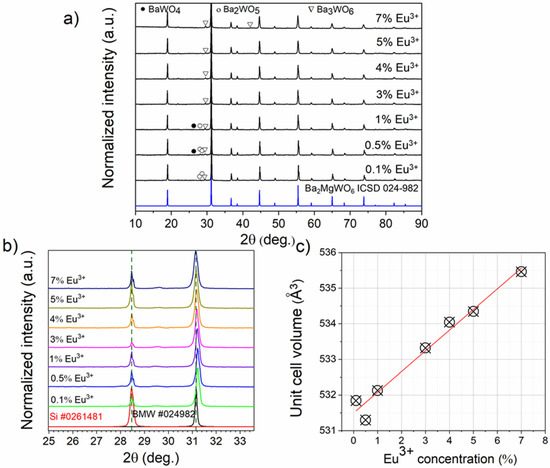
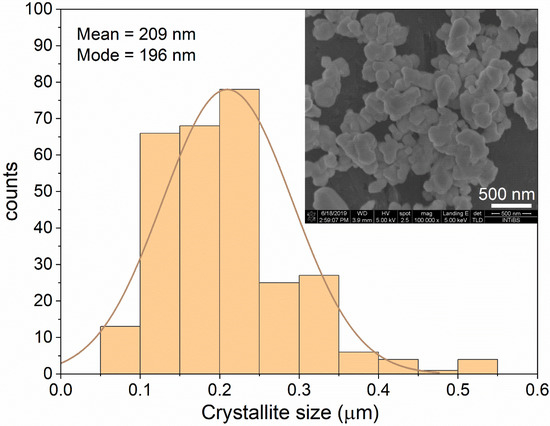
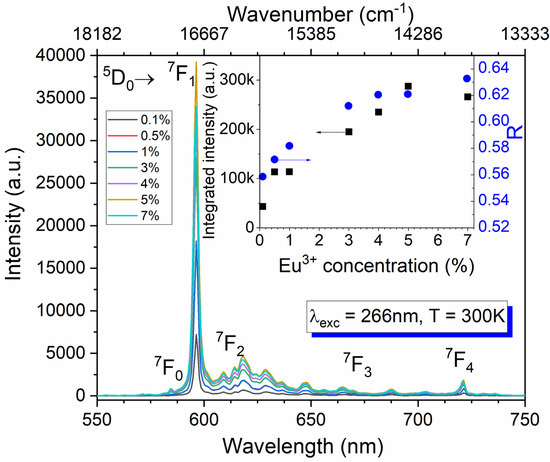
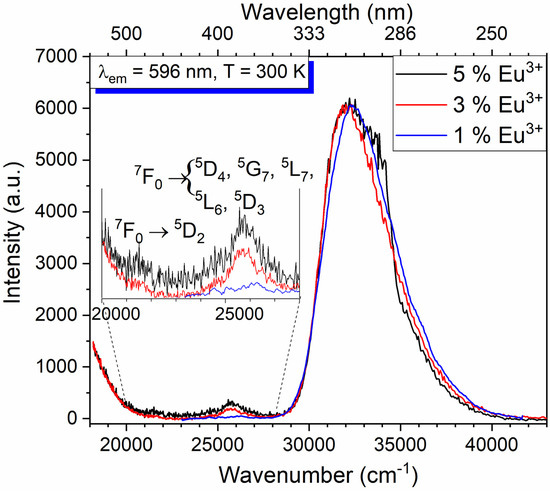
Synthesis, Structure, Morphology, and Luminescent Properties of Ba2MgWO6: Eu3+ Double Perovskite Obtained by a Novel Co-Precipitation Method
by
Thi Hong Quan Vu, Bartosz Bondzior, Dagmara Stefańska, Natalia Miniajluk and Przemysław J. Dereń
Cited by 39 | Viewed by 4961
Abstract
Eu
3+ doped Ba
2MgWO
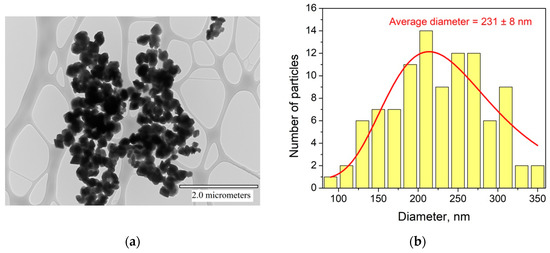
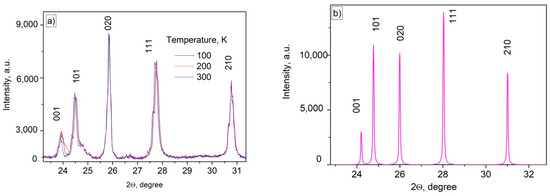
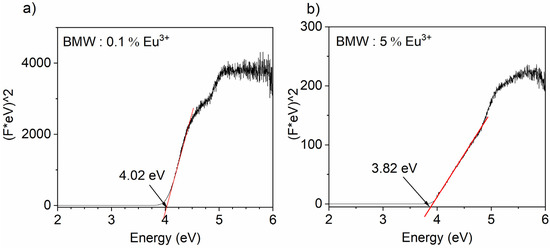
6 (BMW) double-perovskite was successfully synthesized for the first time by the co-precipitation method. The synthesis procedure, crystal structure, as well as morphology of obtained samples are presented. Domination of the
5D
0–
7F
[...] Read more.
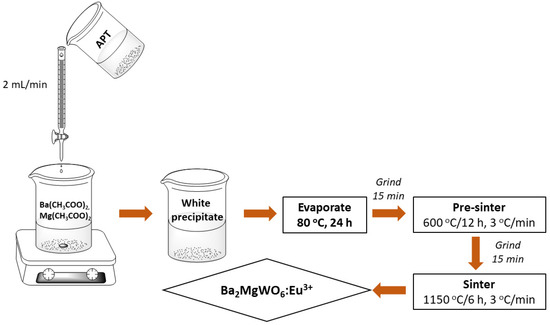
Eu
3+ doped Ba
2MgWO
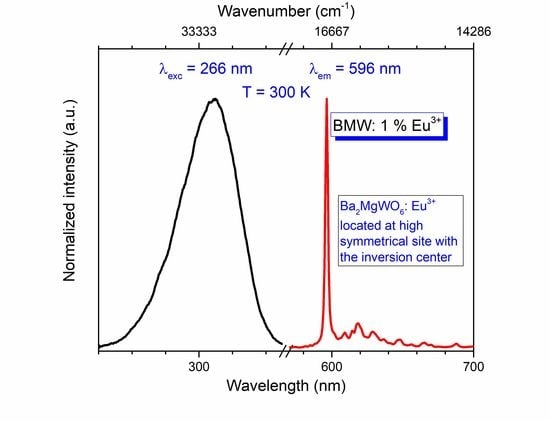
6 (BMW) double-perovskite was successfully synthesized for the first time by the co-precipitation method. The synthesis procedure, crystal structure, as well as morphology of obtained samples are presented. Domination of the
5D
0–
7F
1 magnetic–dipole over forced electric–dipole transitions in the emission spectra indicates that Eu
3+ ions are located in the high symmetry site with inversion center. Only one emission line assigned to the
5D
0–
7F
0 transition was observed, confirming that europium substituted for only one host cation site. The photoluminescence excitation (PLE) spectrum is dominated by a strong and broad band related to the O
2− → Eu
3+ and O
2− → W
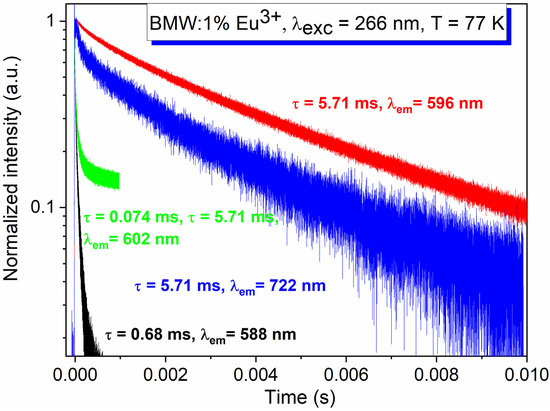
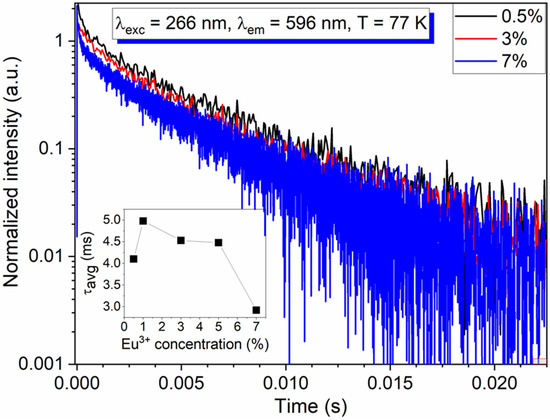
6+ charge transfer. The decay of the emission from the
5D
0 and
5D
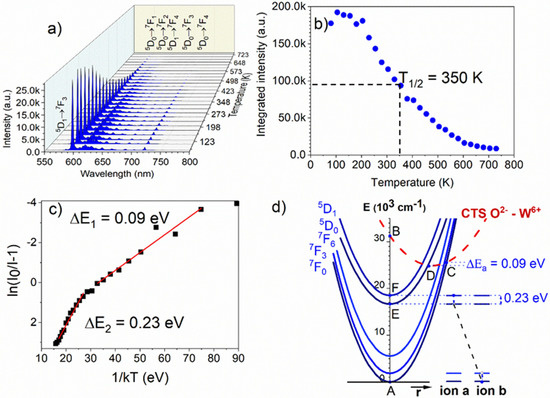
1 levels was investigated. The temperature-dependent emission spectra showed that the T
0.5 is equal to 350 K. Extinguishing mechanisms of the Eu
3+ luminescence in the studied host are discussed.
Full article
►▼
Show Figures
Open AccessArticle
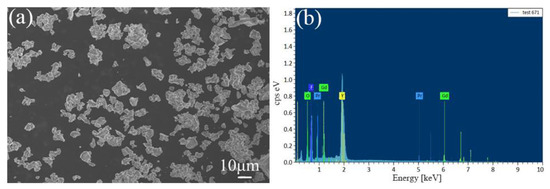
Chromaticity-Tunable and Thermal Stable Phosphor-in-Glass Inorganic Color Converter for High Power Warm w-LEDs
by
Zikun Chen, Bo Wang, Xiaoshuang Li, Dayu Huang, Hongyang Sun and Qingguang Zeng
Cited by 15 | Viewed by 4782
Abstract
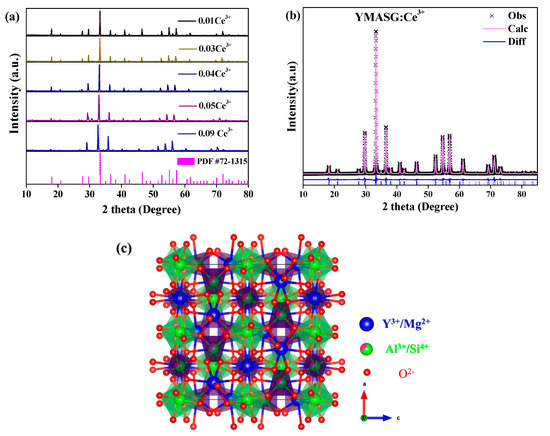
In this work, an aluminate silicate garnet phosphor, Y
2Mg
2Al
2Si
2O
12:Ce
3+ (YMASG:Ce
3+), exhibiting strong and broad yellow-orange emission, was successfully synthesized. Attributed to the double cation substitution of YAG:Ce
3+, which
[...] Read more.
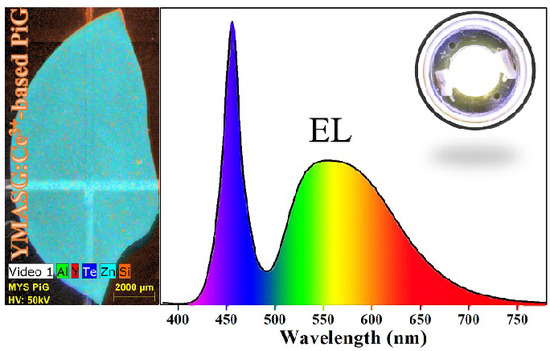
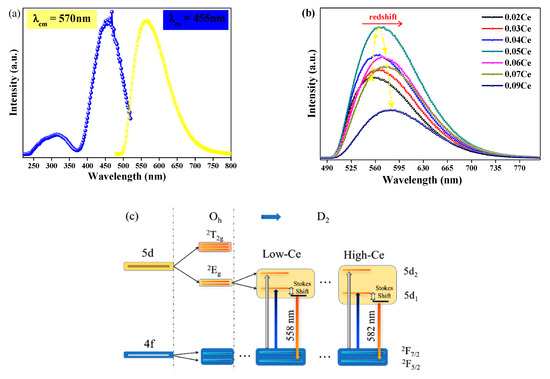
In this work, an aluminate silicate garnet phosphor, Y
2Mg
2Al
2Si
2O
12:Ce
3+ (YMASG:Ce
3+), exhibiting strong and broad yellow-orange emission, was successfully synthesized. Attributed to the double cation substitution of YAG:Ce
3+, which led to a compression effect, a redshift was observed with respect to YAG:Ce
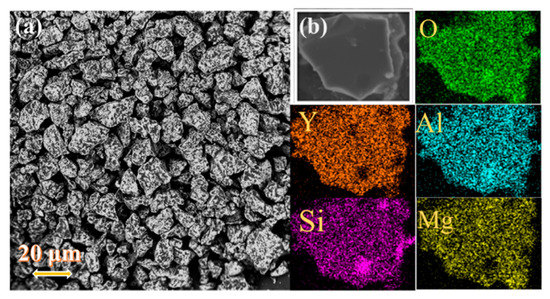
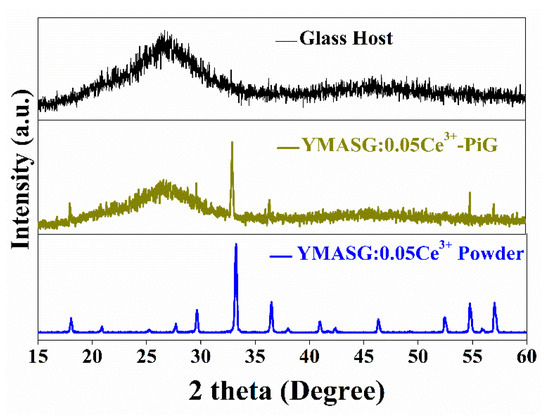
3+. More importantly, a transparent phosphor-in-glass (PiG) sample was obtained by incorporating the phosphor YMASG:Ce
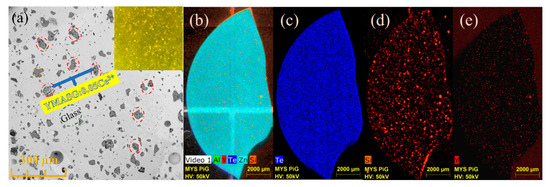
3+ into a special low-melting precursor glass. The energy dispersive spectrometer (EDS) mapping analysis of the as-prepared PiG sample indicates that YMASG:Ce
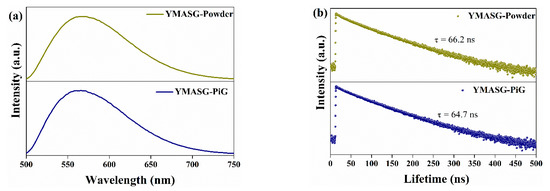
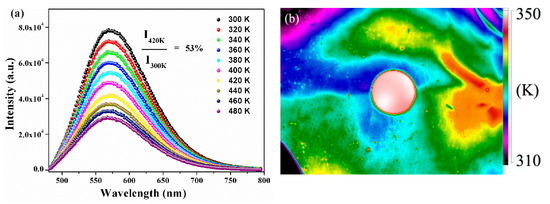
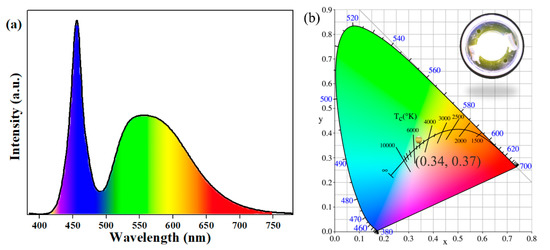
3+ was successfully incorporated into the glass host, and its powders were uniformly distributed in glass. The photoluminescence intensity of the PiG sample was higher than that of the powder due to its relatively high thermal conductivity. Additionally, the combination of the PiG sample and a blue high-power chip generated a modular white LED with a luminous efficacy of 54.5 lm/W, a correlated color temperature (CCT) of 5274 K, and a color rendering index (CRI) of 79.5 at 350 mA.
Full article
►▼
Show Figures