

- Article

Superhydrophilic Hierarchical Anatase Coating on Sandblasted, Acid-Etched Titanium: In Vitro Apatite Formation and Osteoblast Responses and the Role of Polar Surface Free Energy
- Leila Mohammadnejad,
- Wafa Zafira and
- Stefanie Krajewski
- + 10 authors
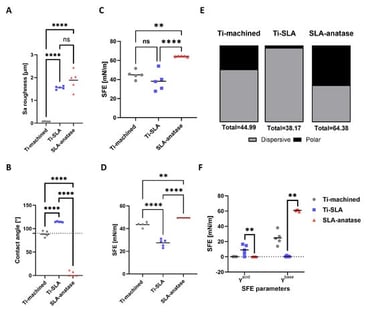
Physicochemical modification of titanium implants aims to enhance early osseointegration by improving bioactivity. This study deposited and evaluated an anatase TiO2 film on clinically relevant sandblasted, acid-etched titanium (Ti-SLA) to enhance in vitro bioactivity and osteogenic responses. An ~8 µm TiO2-anatase coating was deposited on Ti-SLA by reactive pulsed DC magnetron sputtering. Surface characterization included FE-SEM, helium ion microscopy, and XRD. Wettability and surface free energy (SFE) were evaluated by contact angle analysis. In vitro bioactivity was assessed by hydroxyapatite (HA) formation in twofold-concentrated simulated body fluid (2× SBF). Osteoblast responses were evaluated through cell adhesion, viability, alkaline phosphatase activity, gene expression, and mineralization. The coating produced hierarchical multi-globular microstructures decorated with faceted anatase nanocrystals. Ti-SLA’s initial hydrophobicity converted to a superhydrophilic, high-energy surface with increased polar SFE. Homogeneous HA crystallites deposited exclusively on SLA-anatase in 2× SBF. SAOS-2 cells showed enhanced metabolic activity, ALP activity, osteogenic gene upregulation, and improved mineralized matrix, while primary human osteoblasts exhibited increased metabolic activity and calcium deposition. The anatase coating produced a superhydrophilic, high-energy micro-nano surface that accelerates HA formation and enhances osteoblast function in vitro, warranting in vivo validation for early osseointegration.
6 February 2026